I’ve walked through hundreds of kitchens over the years — some breathtaking, some forgettable — but nothing has stayed with me quite like the moment green stopped being a “bold choice” and became the defining palette of modern kitchen design. I still remember the first time I saw a deep forest-green island anchored against raw plaster walls in a Brooklyn townhouse remodel; the room felt alive, grounded, and effortlessly sophisticated all at once. Since then, I’ve watched green evolve from a fleeting trend into a full-blown design language — one that speaks to our growing desire for spaces that feel connected to nature without sacrificing edge or elegance.
What’s arriving in 2026, though, is on a different level entirely. Green kitchens are no longer about painting a single cabinet and calling it done. They’re becoming layered ecosystems of texture, material, and tone — where sage meets slate, where bottle green collides with warm brass, where matte finishes and terrazzo floors coexist in perfect tension. Whether you’re planning a full renovation or a weekend refresh, the ideas I’m sharing here are drawn from real projects, emerging material trends, and the spatial instincts that only come from years of standing inside these rooms and feeling what works.
1. Aged Brass & Bottle Green — The Moody Maximalist Kitchen
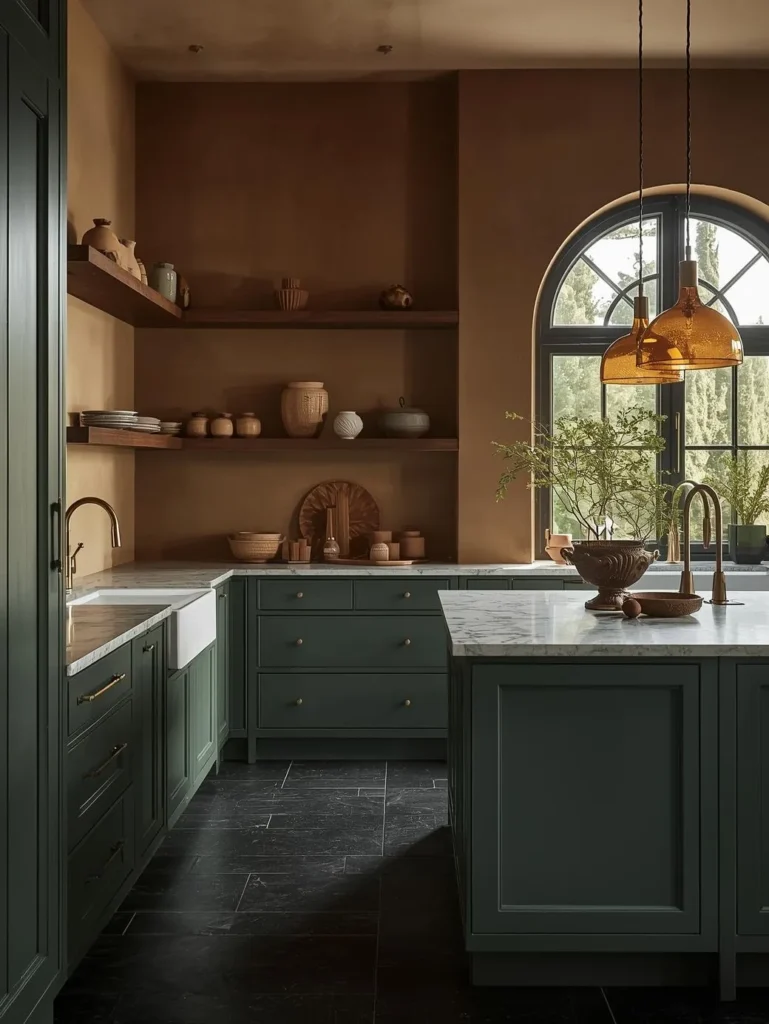
There’s a richness to the pairing of aged brass hardware and deep bottle-green cabinetry that feels almost architectural — like walking into a room that has stories to tell. This combination works because both elements carry a sense of history and weight. The green grounds the space with organic depth while the brass introduces warm metallic tension without veering into cold or sterile territory.
In 2026, this pairing is being pushed further with limewash plaster walls, raw walnut open shelving, and pendant lights with amber glass. The result is a kitchen that feels layered, intentional, and arrestingly beautiful — the kind of space you linger in long after the cooking is done.
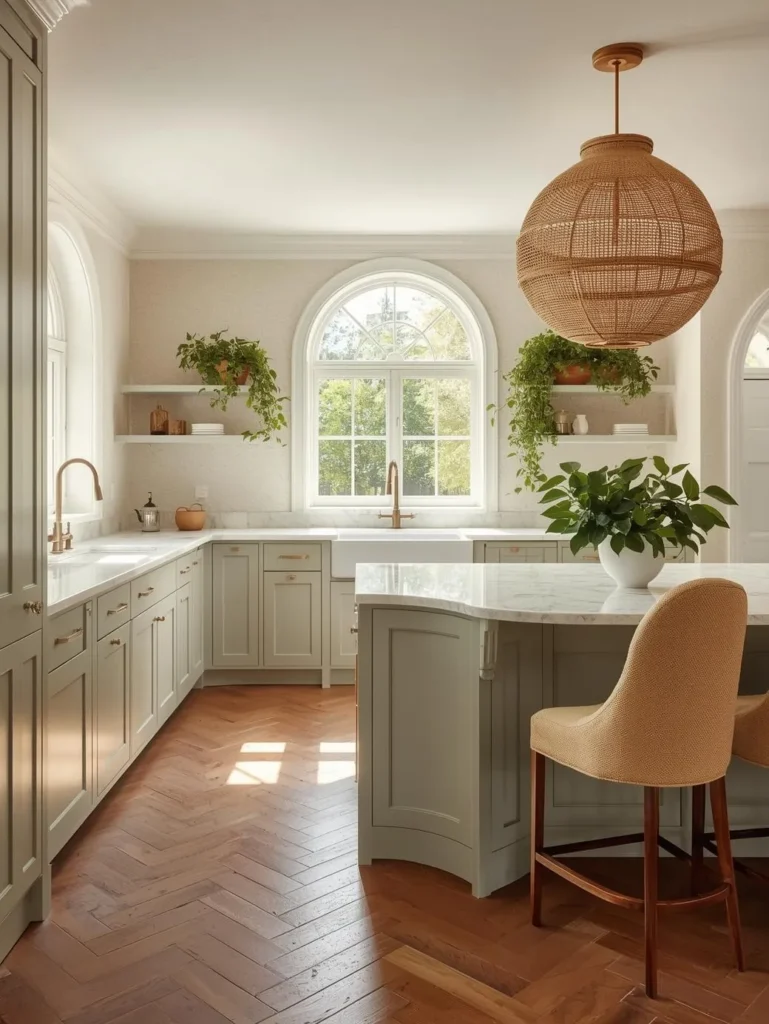
2. Sage Green & Curved Cabinetry — The Soft Organic Kitchen
Curves are having a serious moment, and nowhere do they feel more right than in a sage-green kitchen where hard edges are the enemy. The softness of sage — that muted, grey-green that sits somewhere between olive and mint — pairs naturally with arched cabinet doors, rounded islands, and organic-form pendant lights.
This design direction is rooted in biophilic principles: the human brain processes curved forms as safe and welcoming, which is exactly the energy you want in a kitchen. In 2026, sage-green curved kitchens are being paired with fluted glass inserts, boucle bar stools, and honed marble countertops to create spaces that feel as restorative as they do refined.
3. Forest Green Lacquer & Black Steel — The Industrial Luxe Kitchen
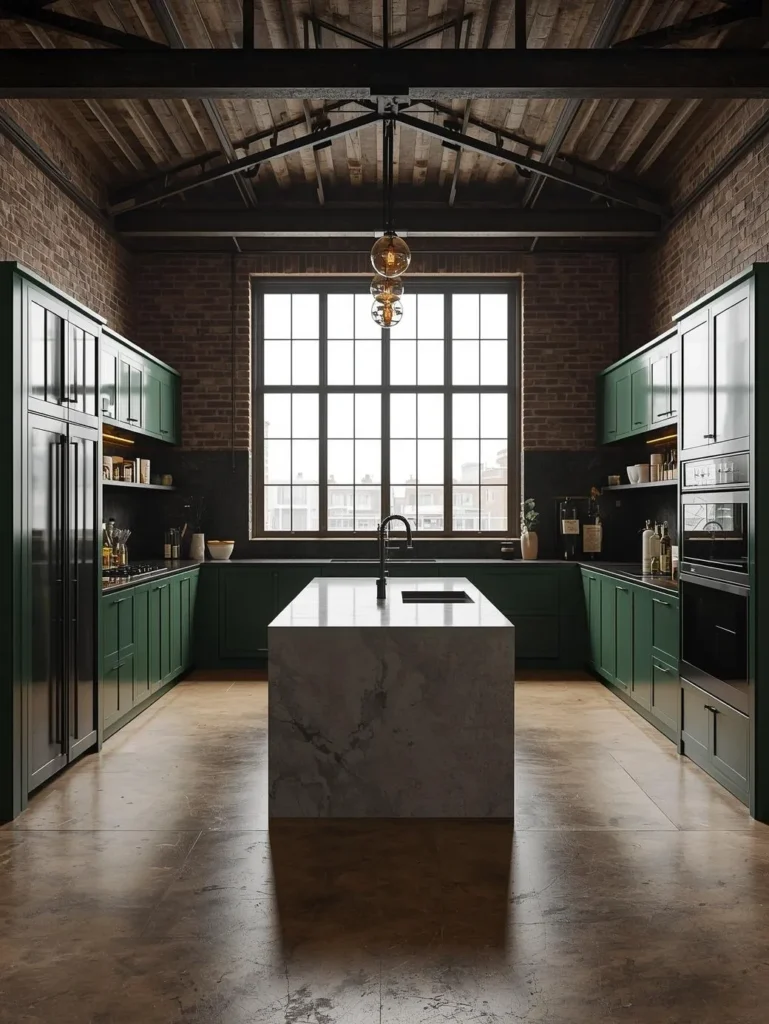
When forest green meets black powder-coated steel, something extraordinary happens — the kitchen becomes a space with genuine architectural conviction. This is a combination I’ve used in high-end urban loft conversions where clients want luxury without ornamentation.
The lacquered green cabinetry introduces high-gloss depth and sophistication, while steel-framed windows, black grid cabinet inserts, and matte black tapware pull the design into industrial territory. What makes this work in 2026 is the counterbalance: warm concrete floors, aged timber accents, and oversized pendant bulbs soften what could otherwise feel too austere. It’s a kitchen for people who don’t compromise.
4. Terrazzo Floors & Mint Green Cabinets — The Retro-Modern Playful Kitchen
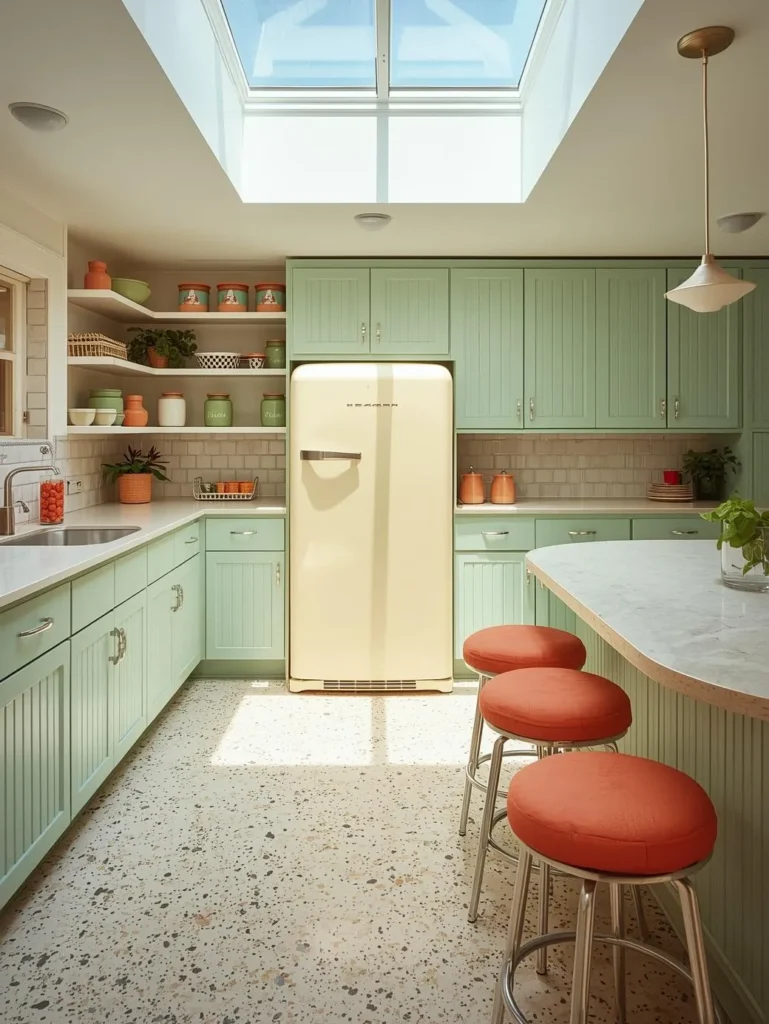
Not every green kitchen needs to be serious. The combination of speckled terrazzo flooring and minty green cabinetry is one of the most joyful directions emerging in 2026 — a nostalgic nod to mid-century optimism wrapped in thoroughly contemporary execution. Mint green sits at the lighter, fresher end of the green spectrum: energizing without being aggressive, cheerful without being naive.
Paired with a terrazzo floor in cream with green and coral flecks, brushed nickel hardware, and a retro-style fridge in a complementary tone, this kitchen concept brings a sense of personality and play that most design directions can’t achieve. It’s particularly powerful in smaller city apartments where the space needs to feel expansive and uplifting.
5. Olive Green & Raw Travertine — The Mediterranean Earthy Kitchen
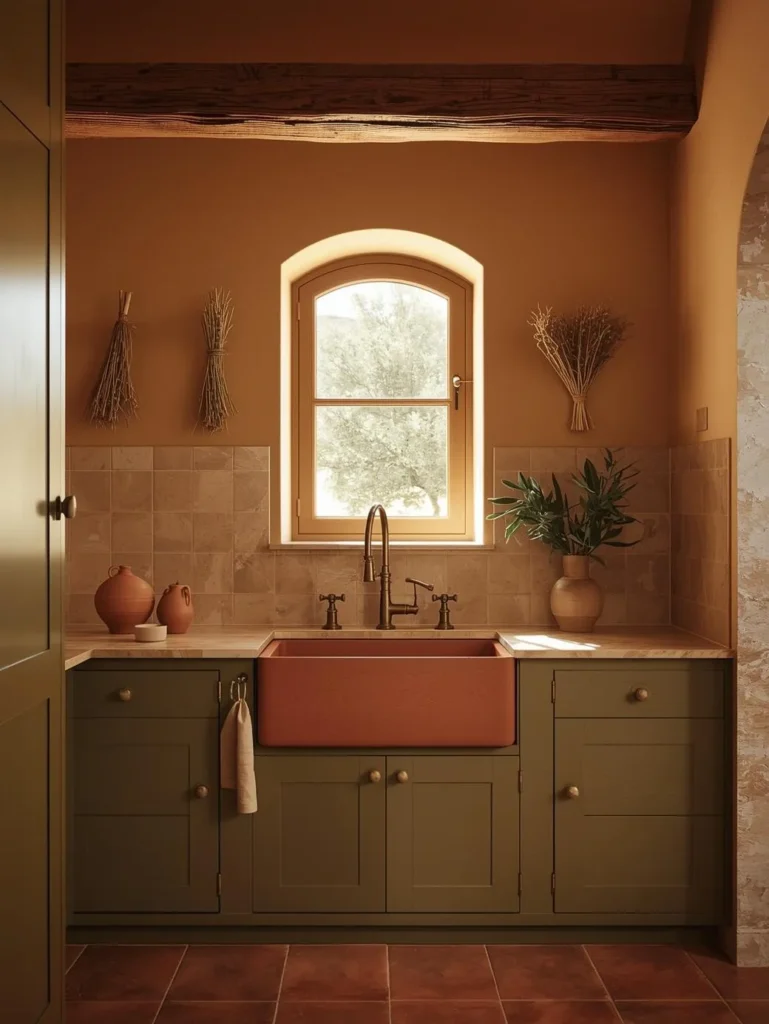
Few combinations feel as immediately grounding as olive green cabinetry set against raw travertine stone. This pairing draws from Mediterranean and North African design traditions — spaces built close to the earth, where materials are harvested nearby and aged gracefully. Olive green is a mature, complex tone: it reads as green in certain lights, almost brown or khaki in others, giving it extraordinary versatility across different times of day.
In 2026, the approach is to keep everything tactile and imperfect — honed travertine countertops with visible fossils, hand-thrown ceramic knobs, unlacquered brass taps that will patina naturally, and limewashed walls that feel almost geological. This kitchen doesn’t shout. It whispers, deeply.
6. Two-Tone Green Kitchen — Dark Base, Light Upper Cabinets
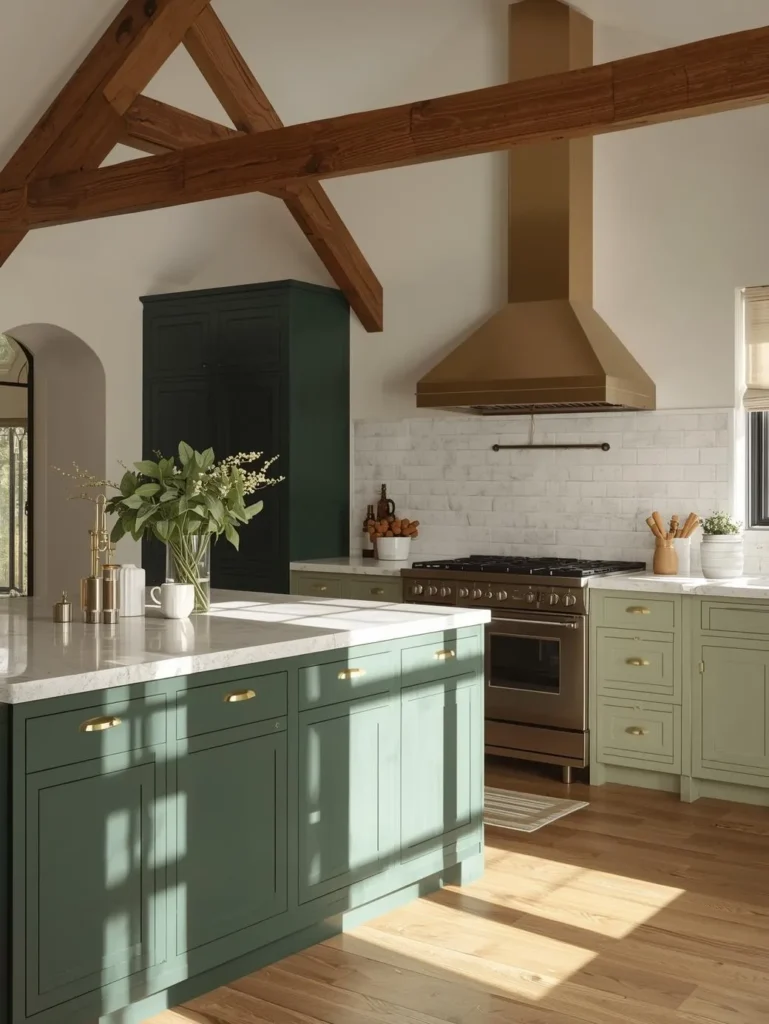
The two-tone kitchen has been growing in confidence for several years, and in 2026 it reaches its most sophisticated expression: pairing a dark emerald or hunter green on lower cabinets with a much lighter sage or pale pistachio on the uppers. This approach solves one of the most common anxieties around committing to a green kitchen — the fear that it will feel too heavy or too much.
By anchoring the dark tone low and keeping the upper zone light and airy, the kitchen achieves visual balance while still delivering the full drama of a bold green palette. The transition between tones is best handled with a complementary island in a neutral stone or timber finish, letting both greens breathe without competing.
7. Green Kitchen With Living Wall — The Biophilic Statement
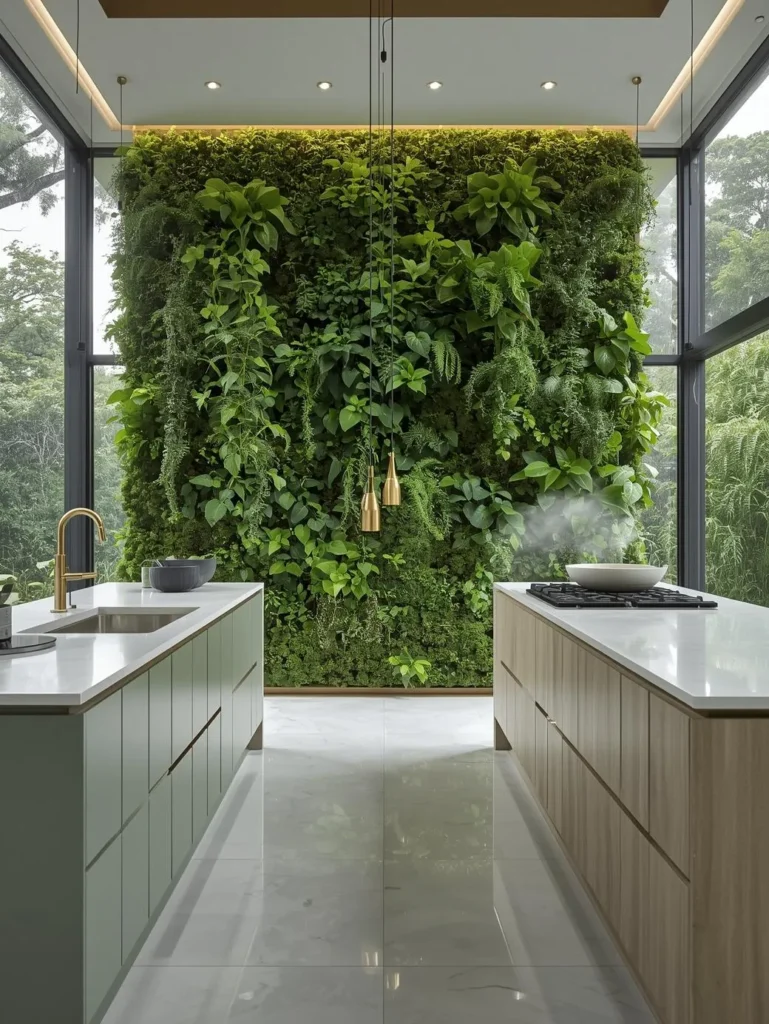
The most forward-thinking green kitchens of 2026 don’t just use green as a color — they incorporate living green as a material. A built-in living wall panel integrated into a kitchen design is no longer a novelty; it’s a considered design choice that improves air quality, reduces noise reverberation, and creates an irreplaceable sense of aliveness in the space.
The most resolved versions I’ve seen incorporate an automated irrigation system hidden behind the planting frame, with a mix of culinary herbs, trailing ferns, and low-light mosses. Paired with matte sage green cabinetry to blur the boundary between built and natural, this design direction is genuinely the future of kitchen interiors.
8. Painted Green Brick Kitchen — The Textured Urban Approach
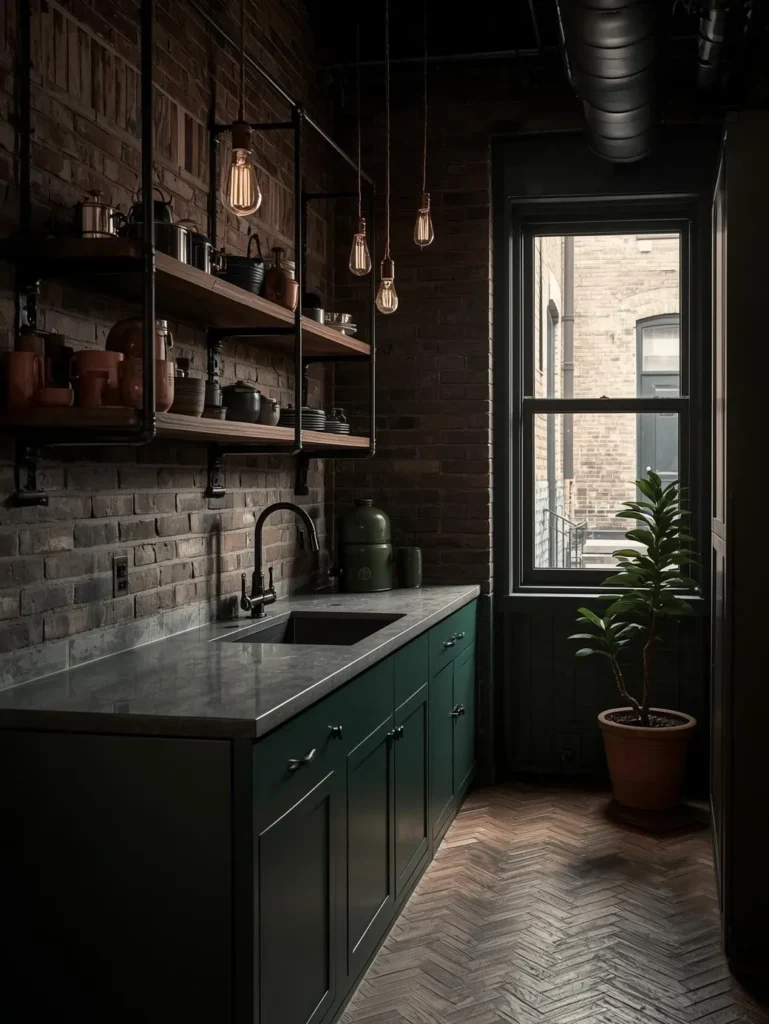
Sometimes the most powerful green kitchen isn’t about cabinetry at all — it’s about the walls. Painting exposed brick in a deep racing green or dark sage transforms an urban kitchen into something that feels both raw and refined simultaneously. The texture of the brick gives the paint enormous visual depth that flat drywall simply cannot replicate: the mortar lines create shadow and dimensionality, the irregular surface absorbs and reflects light differently at every angle.
In 2026, this approach is being paired with open pipe shelving in raw black steel, pendant lights on long braided cables, and concrete worktops for a kitchen that feels like it belongs in a converted Shoreditch warehouse — rugged, beautiful, and completely itself.
9. Green & White Japandi Kitchen — Minimalist Calm
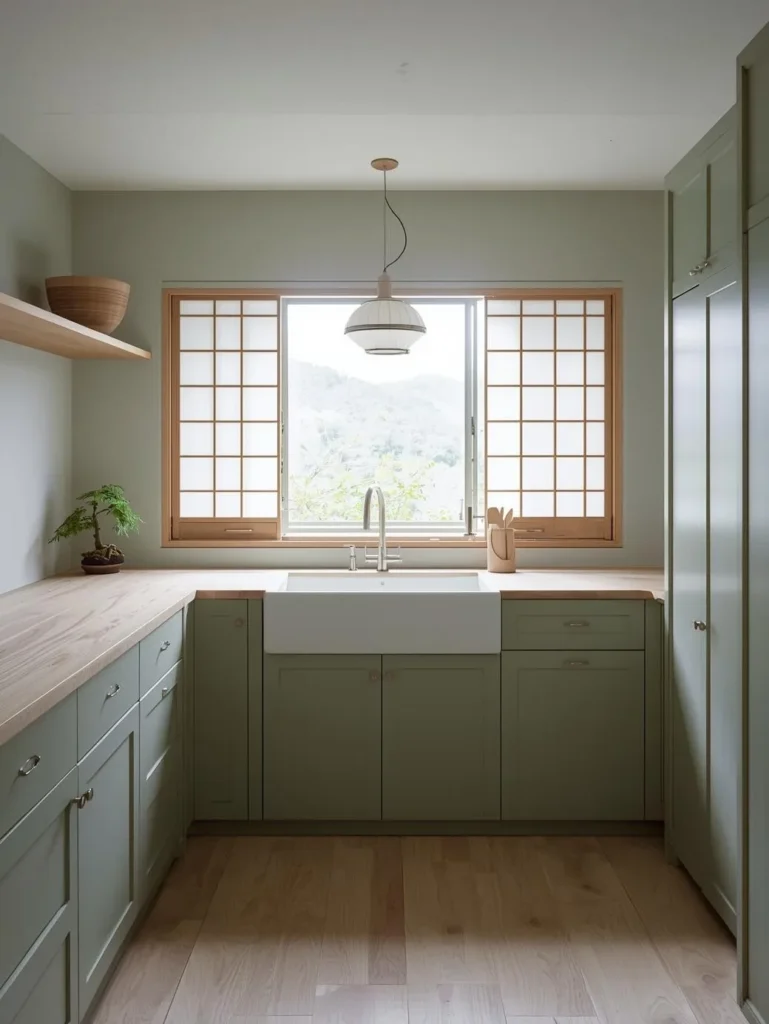
Japandi — the design philosophy that fuses Japanese minimalism with Scandinavian warmth — reaches a particularly beautiful expression when green is introduced into its restrained palette. Soft muted greens, the color of celadon pottery or aged bamboo, integrate seamlessly into the Japandi language of clean lines, natural materials, and purposeful negative space.
In 2026, the Japandi green kitchen is defined by handleless flat-front cabinetry in a muted celadon or grey-green, white oak worktops with visible grain, a simple ceramic undermount sink, and a complete absence of visual noise. Every object earns its place. The kitchen becomes less a place for cooking and more a space for presence — quiet, considered, deeply calm.
10. Dark Emerald & Velvet Finish — The Opulent Evening Kitchen
Not all kitchens are designed for daylight. The dark emerald velvet-finish kitchen is conceived as an evening space — a room that comes alive under artificial light, where the depth of the cabinetry seems to shift and breathe with the flicker of candles and the warm wash of pendant lamps.
Velvet-effect lacquer finishes, now available from premium cabinet manufacturers, absorb light rather than reflect it, creating a softness and richness that matte paint cannot achieve. Paired with unlacquered brass, dark veined marble, and smoked mirror splashback panels, this is a kitchen for entertaining — operatic, sensuous, and entirely unapologetic about its ambition.
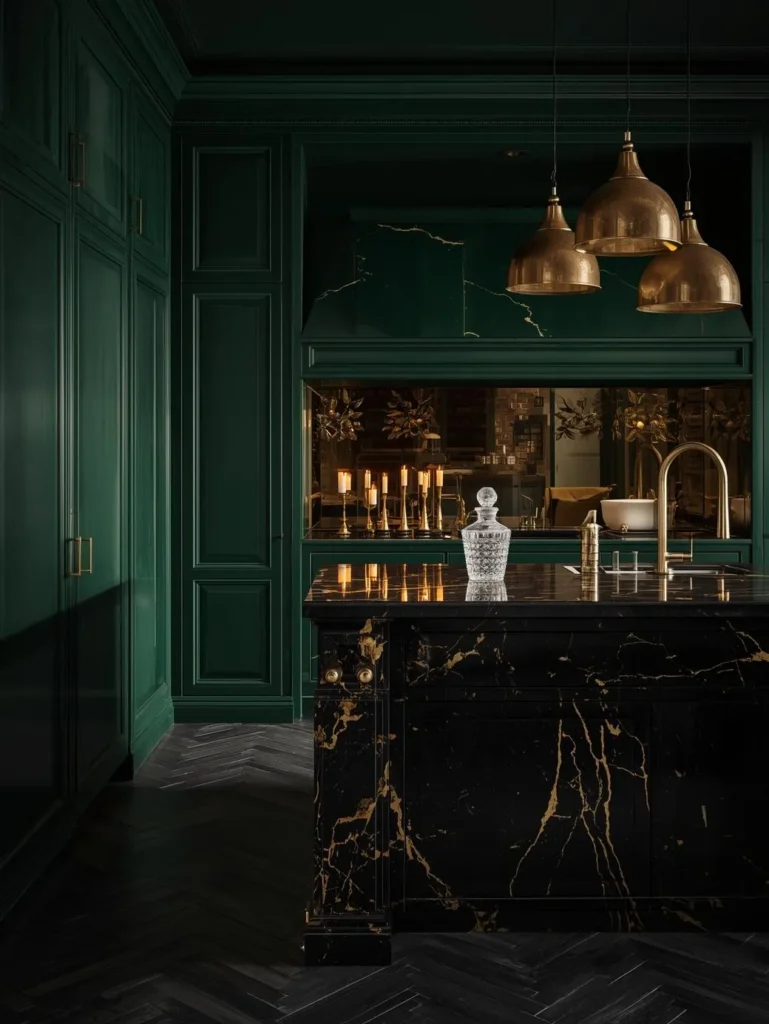
11. Green Zellige Tile Kitchen — Handcrafted Artisan Surfaces
Zellige tile — the hand-cut, glazed terracotta tile originating from Morocco — brings an irreplaceable handmade quality to any kitchen it inhabits. In green, it becomes transformative. Each individual tile is slightly different in tone, thickness, and glaze coverage, meaning that a green Zellige splashback is essentially a living artwork: no two installations look alike, and the way light catches the irregular surface throughout the day creates a mesmerizing visual experience.
In 2026, full-height Zellige splashbacks in forest green, teal-green, or celadon are being used as the singular statement in otherwise simple kitchen schemes — letting the tile do all the talking while cabinetry stays quiet in white, off-white, or natural timber.
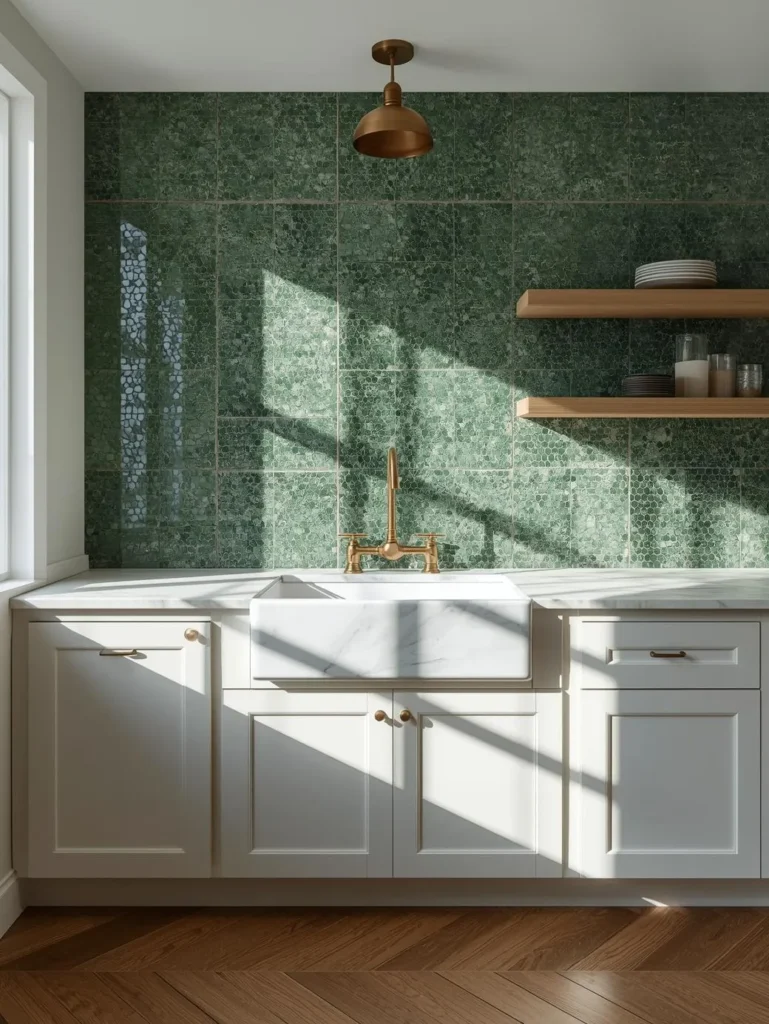
12. Green Island, White Perimeter — The Focal Point Approach
For anyone not ready to commit to an all-green kitchen but unwilling to settle for the predictable all-white scheme, the green island approach offers the most elegant compromise available. The perimeter cabinetry stays crisp and white — clean, bright, spatially generous — while the island becomes a bold, confident statement in deep green.
The island, being a freestanding object within the room, can carry color in a way that the surrounding cabinetry cannot: it reads more like a piece of furniture than a fixed architectural element. In 2026, the most refined versions of this approach feature an island in a contrasting material finish — a velvet green against satin white, or matte green against high-gloss white — to amplify the intentional contrast.
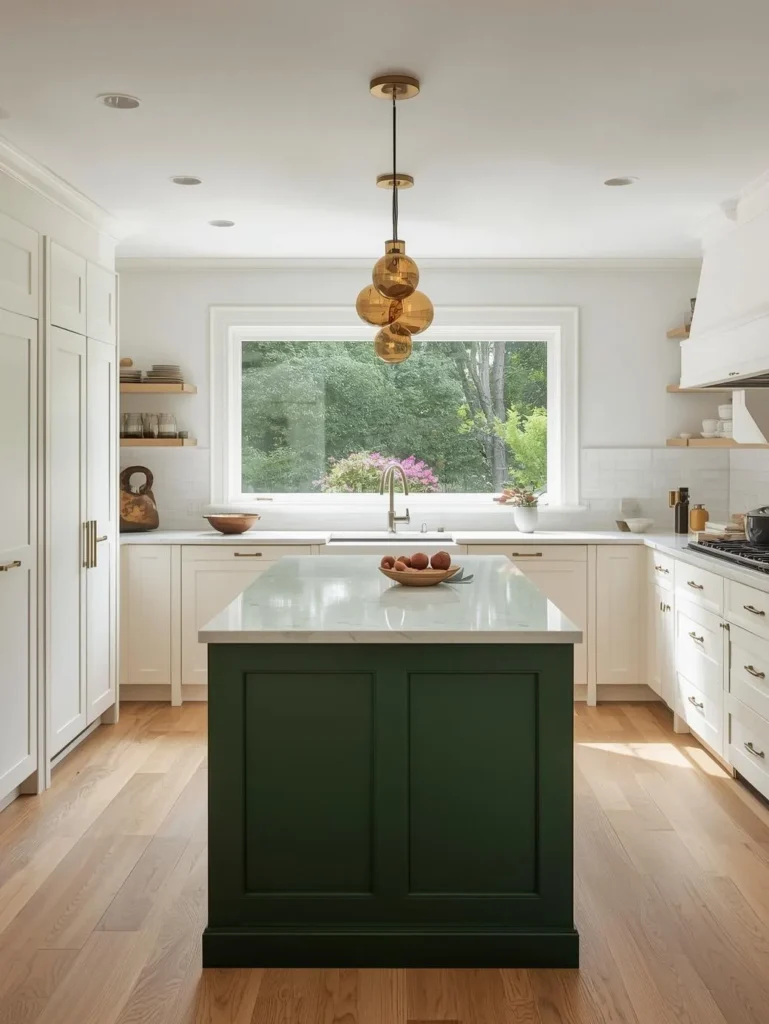
13. Green Scallop Tile & Rattan — The Coastal Artisan Kitchen
The scallop tile — with its fish-scale silhouette and handmade ceramic quality — is one of the most characterful splashback choices available, and in a soft seafoam or pale ocean green, it anchors a coastal-artisan kitchen aesthetic that is both deeply relaxed and highly considered.
This design direction draws from the overlap between Portuguese azulejo tradition and contemporary Californian coastal interiors: natural rattan barstools, whitewashed timber cabinetry with a lightly distressed finish, linen window treatments, and woven pendant lights. The green scallop tile acts as the rhythmic, textural centrepiece — bringing movement, pattern, and a sense of the handmade that mass-produced kitchens almost never achieve.
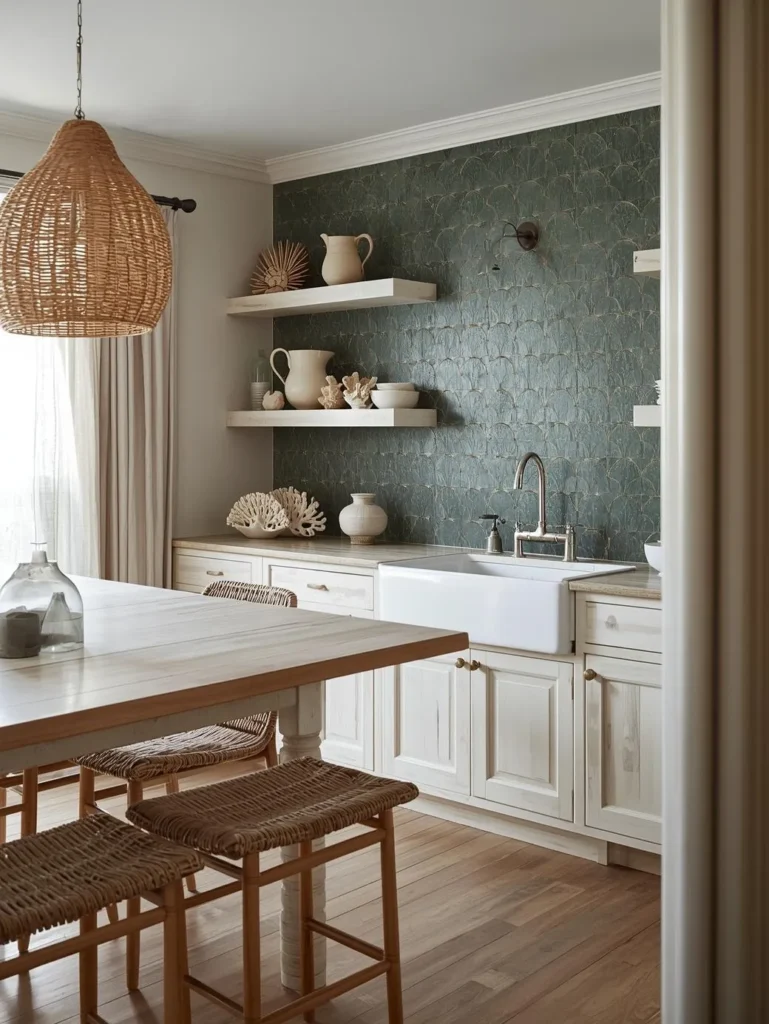
14. Green & Copper — The Oxidized Material Kitchen
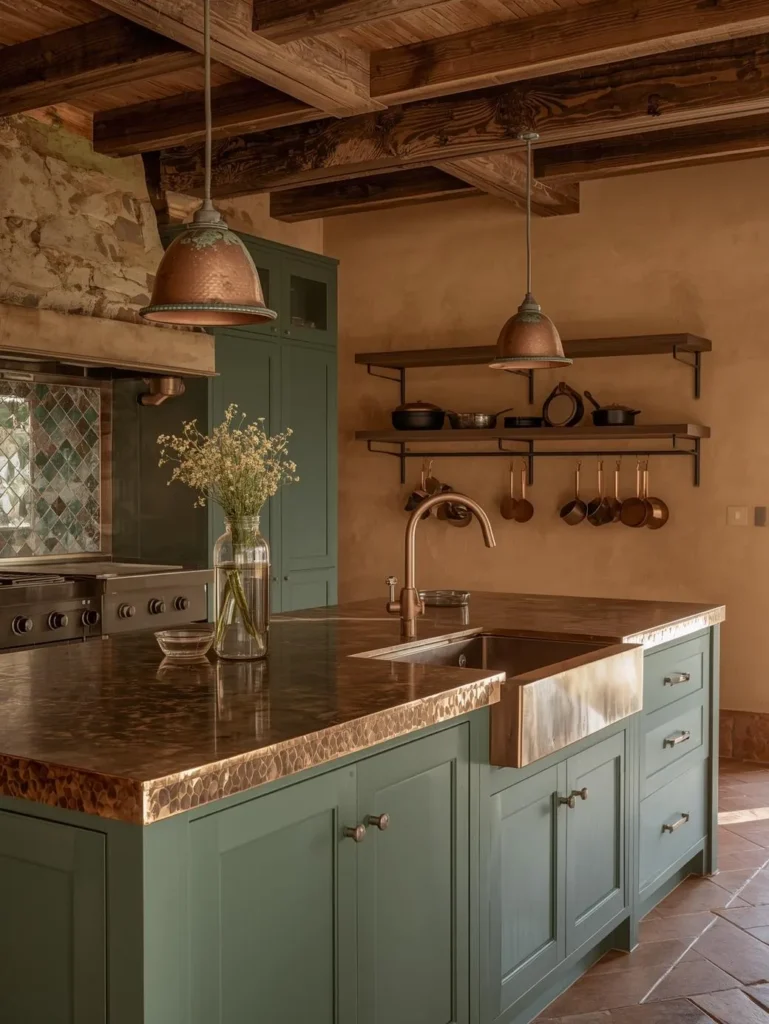
Copper and green have one of the most naturally occurring relationships in the material world — verdigris, the blue-green patina that forms on aged copper, is proof that these two elements belong together. In a kitchen context, this natural chemistry translates into an extraordinarily rich material palette: green cabinetry paired with aged copper pendant lights, a copper-topped island, hand-hammered copper sink, and copper pipe shelving.
The key in 2026 is to resist the urge to use polished, mirror-bright copper — the aged, oxidized version is far more interesting, far more alive, and it builds a story with the space over time as it continues to evolve.
15. Full Green Ceiling Kitchen — The Enveloping Canopy Effect
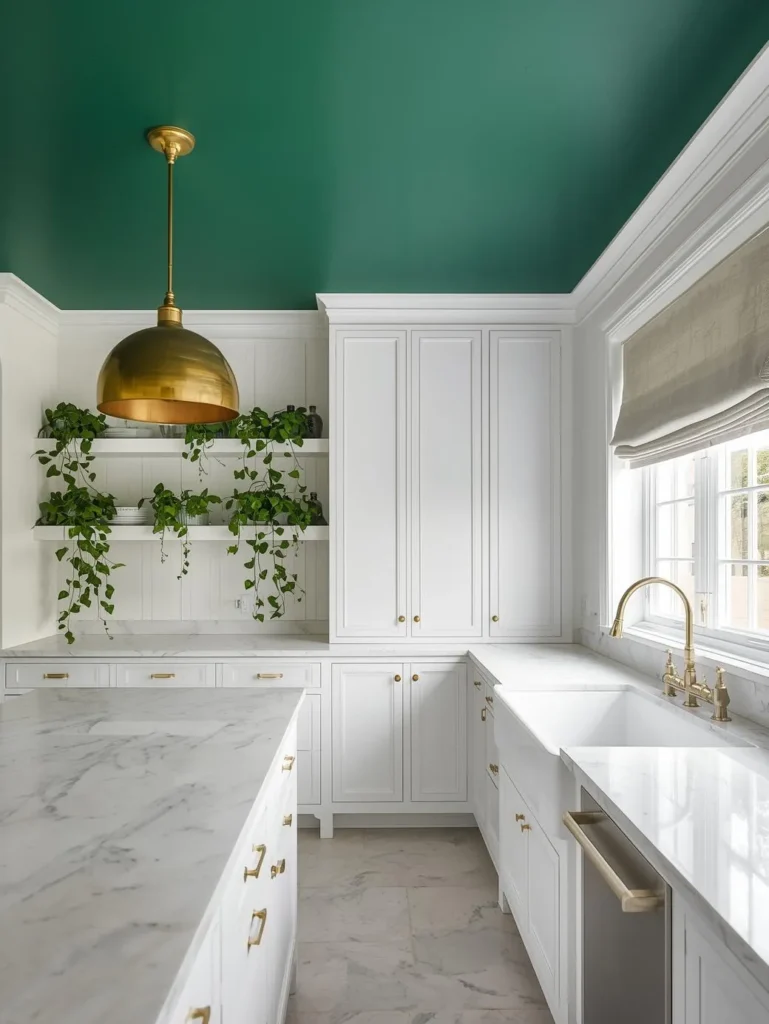
The most avant-garde green kitchen direction arriving in 2026 isn’t about the cabinets or the walls — it’s the ceiling. Painting the kitchen ceiling in a saturated, confident green — forest, hunter, or deep sage — while keeping the walls and cabinetry in clean white or very pale neutrals creates a phenomenon that I can only describe as standing inside a forest canopy.
The color descends from above rather than closing in from the sides, which paradoxically makes the room feel more expansive, not less. When paired with pendant lights in white or brass that pool soft light onto work surfaces below, and plants that reach upward toward the colored ceiling, the effect is genuinely unlike anything else in residential kitchen design right now.