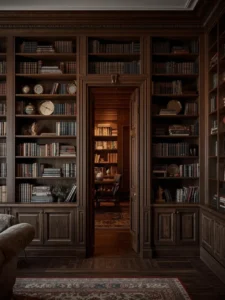
I’ve seen hundreds of living rooms over the years, and the single most common regret I hear from homeowners is this: “I wish we had done something with the walls and ceiling.” People invest in sofas, rugs, and lighting — then leave the largest surfaces in the room completely blank. In 2026, that oversight is becoming impossible to ignore.
What I’ve seen transform ordinary living rooms into extraordinary ones isn’t always the furniture — it’s the surfaces above and around it. Walls and ceilings are the architecture of a room’s personality. When treated with intention, they do something no piece of furniture ever can: they make the entire room feel designed from the inside out. These 15 wall and ceiling ideas for living rooms will show you exactly how.
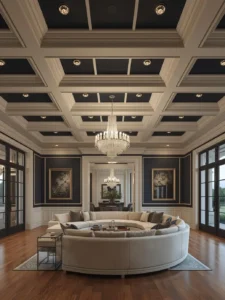
1. Coffered Ceiling With Painted Interior Panels
The coffered ceiling is one of the oldest architectural details in residential design — and in its 2026 form, it’s more relevant and beautiful than ever. I’ve installed coffered ceilings in living rooms that previously felt like unfinished boxes, and the transformation is always the same: guests walk in and immediately look up, speechless.
What makes the modern coffered ceiling exceptional is painting the recessed interior panels in a contrasting tone — deep navy, warm terracotta, or forest green — while keeping the beams white or natural wood. That color depth within the grid creates visual drama that shifts the entire character of the room below.

2. Curved Plaster Ceiling With Cove Lighting
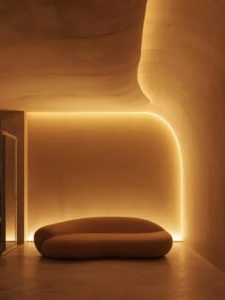
Flat ceilings are architecturally neutral — they neither add nor subtract from a room. In 2026, curved plaster ceilings with integrated cove lighting are replacing them in living rooms where atmosphere and emotion are the priority. I’ve shaped plaster into soft barrel curves, dome centers, and flowing organic transitions that make a ceiling feel like a piece of sculpture overhead.
The cove lighting hidden within the curve does something magical: it washes the ceiling in warm, indirect light that has no visible source, making the room glow rather than simply illuminate. It’s the ceiling treatment that makes guests ask, “What is that light doing?” — which is exactly the right question.
3. Full-Wall Limewash Textured Finish
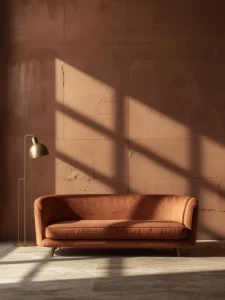
A limewash wall in a living room is not a painted wall — it’s a crafted surface, and there’s a meaningful difference. I’ve applied limewash in living rooms ranging from modern lofts to traditional family homes, and in every case, the wall becomes the first thing every visitor responds to — usually by walking up and touching it.
The layered, translucent application creates a depth and movement that changes with every shift in natural light throughout the day. In warm whites, clay tones, or even dramatic sage and charcoal, a full limewash feature wall gives a living room the one thing that furniture alone never can: genuine soul.
4. Wood Slat Wall and Ceiling Continuation
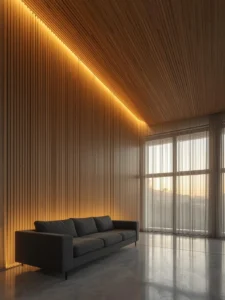
One of the most visually powerful moves available in living room design is running a wood slat treatment from wall directly onto the ceiling in one uninterrupted flow. I’ve designed this continuation in natural oak, walnut, and painted MDF — and the effect is always the same: the room feels like it’s been wrapped in a single, considered gesture of design.
The slats create rhythm, warmth, and acoustic softness simultaneously. Hidden LED strips between slat rows add a layer of ambient lighting that makes the wall-ceiling junction disappear entirely. For living rooms that lack architectural interest, this single treatment solves the problem completely.
5. Grasscloth Wallpaper on Double-Height Walls
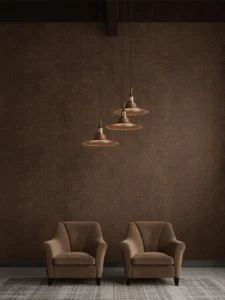
Grasscloth wallpaper applied to a double-height or tall living room wall introduces a texture and organic warmth that painted surfaces can never replicate. I’ve used it on walls ranging from 9 to 18 feet tall, and the natural woven fiber — seagrass, jute, or abaca — creates a backdrop that makes every piece of furniture in front of it look more expensive and intentional.
The key in 2026 is pairing bold grasscloth in deep tones — ink blue, warm tobacco, or aged olive — with architectural elements like exposed beams or picture rail systems. The contrast between the raw woven surface and refined structural detail is a combination I’ve come to consider nearly foolproof.
6. Geometric 3D Wall Panels
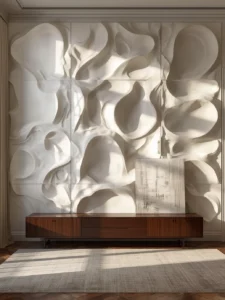
Three-dimensional wall panels have evolved far beyond the foam diamonds of the early 2010s. In 2026, geometric 3D panels in plaster, concrete-look resin, or sustainably sourced wood pulp composites are delivering living room wall features that look genuinely architectural — as if the wall itself has been sculpted. I’ve installed hexagonal, chevron, and ripple-form panels that completely changed the energy of rooms that previously had nothing to offer visually.
The beauty of 3D panels lies in their relationship with light: as natural and artificial light shifts across the raised surface, the wall casts its own moving shadows, creating a living artwork that costs a fraction of a commissioned piece but delivers equal visual impact day after day.
7. Shiplap Ceiling in a Bold Painted Tone
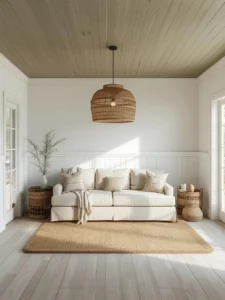
Shiplap on ceilings isn’t new — but shiplap ceilings painted in a bold, unexpected color is one of the most underused living room ideas I see overlooked in 2026. I’ve painted shiplap ceilings in dusty sage, warm blush, deep terracotta, and even moody charcoal — and the result is a room that feels completely custom-built with surprisingly modest material costs.
The horizontal planks add texture and rhythm overhead without the formality of coffering or the labor of plaster work. When the ceiling color pulls from an accent tone already present in the room, the effect is one of complete compositional cohesion — a room that feels like it was designed all at once, by someone who knew exactly what they were doing.
8. Mirrored Wall Panel Installations
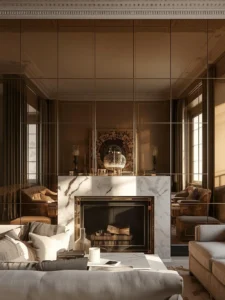
A mirrored wall in a living room, done incorrectly, looks like a 1980s dance studio. Done correctly — as I’ve executed it across dozens of projects — it looks like a design decision made by someone who understands light, space, and proportion at a deep level. The difference is entirely in the framing and format.
In 2026, mirrored wall panels are being installed in antique, smoked, or bronze-tinted glass, divided by thin brass or plaster frames into grid or arch compositions. The result is a wall that doubles the perceived depth of any living room, reflects natural light dramatically, and creates a sense of spatial luxury that no paint color or wallpaper can match.
9. Exposed Brick With Limewash Wash Finish
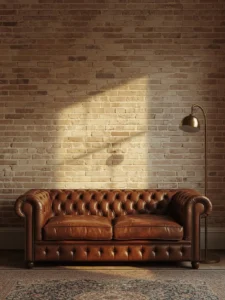
Raw exposed brick in a living room walks a fine line between industrial character and unfinished renovation. In 2026, the limewash wash finish over exposed brick is the technique that tips that balance decisively toward breathtaking. I’ve applied diluted limewash over red and grey brick in living rooms and created walls that look like they belong in a centuries-old Italian farmhouse — in homes built in 2019.
The semi-transparent wash softens the brick’s rawness while preserving every texture, mortar line, and imperfection that makes it beautiful. The result is a wall with history, softness, and depth — one that works equally well behind a contemporary sofa or a traditional Chesterfield.
10. Tray Ceiling With Metallic or Wallpapered Interior
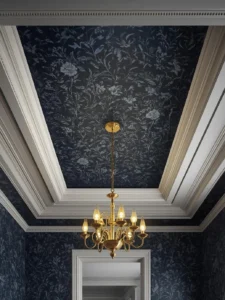
The tray ceiling — a recessed central section raised above the surrounding perimeter — is one of the most elegant ceiling architectures available in residential design. What I’m doing with it in 2026 is treating the recessed interior as a design canvas: metallic leaf, bold wallpaper, limewash color, or even micro-mosaic tile applied within the tray creates a ceiling feature that is genuinely unexpected.
Looking up at a tray ceiling wallpapered in a deep botanical print or finished in aged gold metallic leaf is an experience that photographs impossibly well and impresses every single person who enters the room. It’s the design detail that proves someone truly cared about every surface — including the one overhead.
11. Vertical Stripe Wall Painting Technique
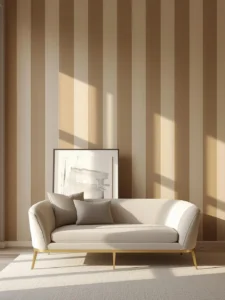
Before any material or texture is applied, paint alone — used with architectural intention — can transform a living room wall into something that reads as genuinely designed. The vertical stripe technique I’m recommending in 2026 isn’t the bold graphic stripes of the past: it’s a tonal, tone-on-tone approach using the same color in matte and satin finishes alternating in wide columns.
The result is a wall with subtle, sophisticated movement that you almost have to look twice to understand. In warm whites, clay tones, or deep earthy neutrals, tonal stripe walls add height, rhythm, and quiet complexity to living rooms that previously had nothing happening on their largest surfaces.
12. Statement Wallpaper on Ceiling Only
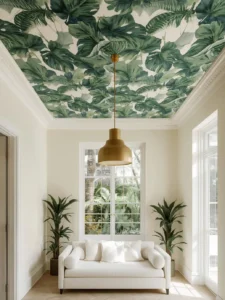
In 2026, the most surprising thing I’m doing with wallpaper is putting it where no one expects it: on the ceiling. The “fifth wall” — as designers have long called it — is finally having its moment as a genuine feature surface. I’ve papered living room ceilings in oversized botanical prints, celestial star maps, abstract watercolour washes, and deep geometric patterns that change everything about how the room feels from the moment you enter.
Keeping all four walls neutral while delivering the pattern entirely overhead creates a sense of discovery — guests look up and find something extraordinary waiting. It also makes furniture arrangement effortless because the room’s focal point is settled before a single piece is placed.
13. Stone Cladding Feature Wall
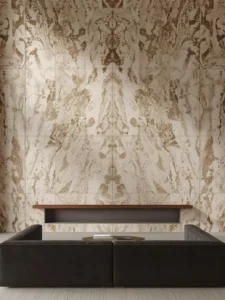
Natural stone on a living room wall is one of those design decisions that ages like fine wine — it only gets better, more interesting, and more beautiful with time. I’ve used stacked ledger stone, large-format travertine slabs, and tumbled limestone on living room feature walls, and in every case the material brings a weight and permanence that manufactured finishes simply cannot replicate.
In 2026, the approach I’m advocating is large-format book-matched stone — where two consecutive slabs are opened like a book and mounted to mirror each other’s veining. The result is a symmetrical, almost painting-like wall surface that has never been and will never be exactly replicated anywhere else on earth.
14. Painted Ceiling Medallion With Decorative Detail
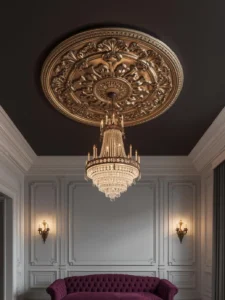
Ceiling medallions — circular ornamental plaster details centered around a light fixture — are being reborn in 2026 as deliberate, painted design statements rather than forgotten architectural leftovers. I’ve taken standard plaster medallions and painted them in deep contrasting tones or metallic leaf finishes that transform them into intentional focal points, commanding attention from across the room.
In homes without existing medallions, lightweight polyurethane versions install in an afternoon and deliver the same visual impact. The painted medallion anchors the ceiling, gives the chandelier or pendant a composed frame, and introduces the kind of detail that says a room was designed rather than decorated.
15. Integrated Bookshelf Wall With Hidden Room Access
The pinnacle of living room wall design in 2026 isn’t a texture, a paint finish, or a material — it’s an experience. A full-wall integrated bookshelf system with a hidden door built seamlessly into the shelving is the most dramatic, most memorable, and most talked-about living room wall feature I have ever designed. It turns a wall into a story.
The hidden door — disguised as a section of shelving complete with books, objects, and matching hardware — opens to a home office, reading nook, media room, or even a bar. It is architecture as theatre, function as magic, and design as pure delight. Every guest who discovers it becomes a storyteller on your behalf.