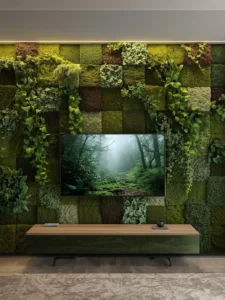
I’ve seen more living rooms than I can count — and the TV wall is always the conversation that matters most. It’s the wall everyone faces, the wall that sets the entire room’s tone, and somehow the wall that gets the least design attention. What I’ve seen shift dramatically heading into 2026 is a refusal to treat the television as a necessary evil. The best living rooms I’ve walked into recently don’t hide the TV or apologize for it — they build entire design narratives around it.
What separates a forgettable TV wall from one that stops you mid-step is intention. Every idea I’m sharing here starts with the question: what should this wall feel like when the screen is off? That’s the test. When your TV wall is beautiful, purposeful, and considered even in silence — that’s when you know it’s been done right. These 15 ideas are the ones I genuinely stand behind for 2026 and beyond.
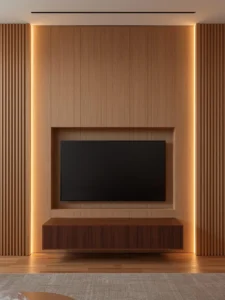
1. Full-Height Fluted Wood Paneling with Recessed TV Niche
Fluted wood panels — vertical grooves running floor to ceiling in solid oak, walnut, or painted MDF — are the single most transformative TV wall treatment of 2026. The TV sits recessed into a niche cut directly into the paneling, flush with the surface, so it reads as part of the wall architecture rather than a device mounted on it.
The fluted texture does extraordinary things with light: morning sun rakes across the grooves casting rhythmic shadows, and evening lamp light creates depth that a flat wall could never achieve. This works in both modern and transitional living rooms and ages beautifully — the wood only gets richer over time while flat painted walls chip and yellow.

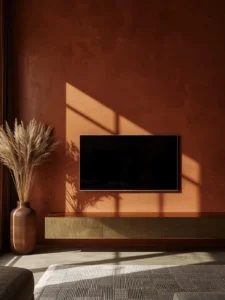
2. Limewash Plaster TV Wall with Organic Textural Depth
A limewash plaster feature wall behind the television turns what was once a flat painted surface into something with genuine material depth. The natural variation in limewash application — darker in the recesses, lighter where the trowel catches — creates a wall that shifts character throughout the day as light moves across it.
In 2026, the most compelling color directions for limewash TV walls are warm terracotta, aged sage, deep charcoal, and warm greige — all muted enough to recede when the screen is on but rich enough to anchor the room when it’s off. The TV mounts directly onto the textured surface with a slim-profile bracket, and the organic wall becomes the frame.
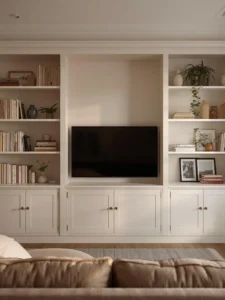
3. Built-In Bookcase Wall Framing the TV as a Central Panel
The built-in bookcase TV wall is a classic direction — but the 2026 version is significantly more refined. The television is treated as one panel in a symmetric floor-to-ceiling shelving composition: centered, framed by identical shelf towers on each side, with the shelf depth slightly shallower than the TV recess so the screen sits slightly proud and reads as the intentional focal point.
The shelving is styled with restraint — books spine-out in a limited color palette, ceramic vessels, trailing plants, and strategic empty space. The base of the unit incorporates closed cabinet doors for media equipment and storage. When done correctly, this is the TV wall that looks like it was always part of the house.
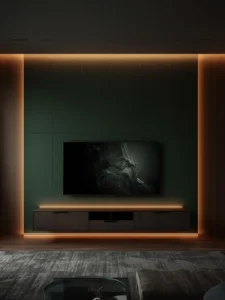
4. Dark Dramatic TV Wall with Integrated Indirect Lighting Trough
In a room with light walls and furniture, a single deeply saturated TV wall — painted in near-black forest green, navy, charcoal, or oxblood — creates an instant cinema effect that frames the screen brilliantly. The 2026 upgrade is a concealed indirect lighting trough running along the top and bottom edges of the wall, casting warm light toward the ceiling and floor rather than at the viewer.
This bias lighting effect isn’t just aesthetic — it reduces eye strain during viewing by softening the contrast between the bright screen and dark surroundings. The result is a wall that functions as both a design statement and a viewing optimization, two things that rarely come from the same decision.
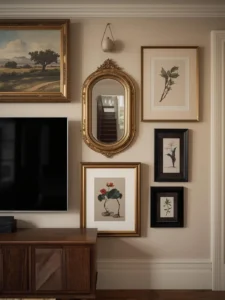
5. Gallery Wall TV Integration with Salon-Style Art Arrangement
The TV-disguised-as-art direction reaches full sophistication in 2026. Rather than using a frame TV (which tries too hard to look like a painting), this approach embraces the TV honestly — mounting it within a genuine salon-style gallery wall where it becomes one element among many rather than the singular focus of the composition.
Oversized frames around actual art prints, mirrors, and objects surround the television at varying scales. The key is sizing: the TV should not be the largest element in the arrangement. When a 36-inch framed landscape sits beside a 65-inch screen, the hierarchy shifts and the wall reads as a curated collection rather than a device on a wall.
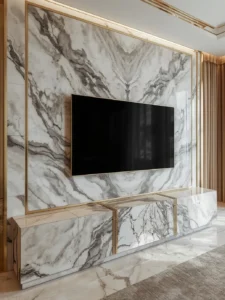
6. Marble or Stone Slab TV Wall with Waterfall Media Console
A full stone slab TV wall — in book-matched marble, quartzite, or sintered stone — is the ultimate luxury direction for 2026 living rooms. The television mounts directly onto the polished or honed stone surface, and a matching stone media console with a waterfall edge (the stone wrapping from the top surface down the sides continuously) grounds the composition below.
The stone’s natural veining creates a one-of-a-kind background that no painted or paneled wall can replicate. Sintered stone (engineered to look like natural stone) makes this idea accessible beyond the ultra-luxury budget — it’s scratch-resistant, heat-tolerant, and comes in slabs large enough to cover an entire wall without seaming.
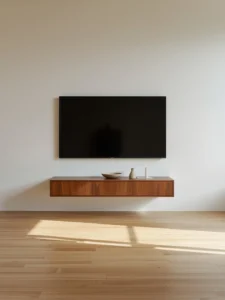
7. Japandi Minimalist TV Wall with Floating Teak Console and Negative Space
The Japandi TV wall is defined entirely by what’s not there. A single wall in warm white or soft warm gray, a floating teak or white oak media console positioned low (12 to 16 inches from the floor), the TV mounted at precise eye level above it, and nothing else on the wall — not a single shelf, object, or decoration competing for attention.
The negative space is the design. The relationship between the horizontal console, the mounted screen, and the empty wall above is a composition in proportion. In 2026, with maximalist TV walls everywhere, this restrained approach feels radical, confident, and deeply calming — the room equivalent of a deep breath.
8. Curved Plaster Arch Framing the TV as an Architectural Focal Point
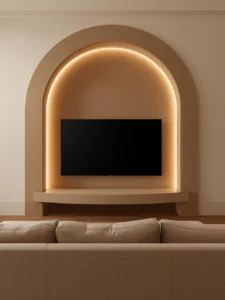
An arched plaster surround — built directly from the wall — frames the television the way a proscenium arch frames a stage: it announces the screen as the intentional center of the room’s attention without requiring a single piece of furniture or decoration to do the work. The arch is plastered smooth, painted in a tone slightly contrasting the surrounding wall, and the TV sits within the arch recess.
This is a structural decision — it requires a builder or skilled plasterer — but the result is entirely permanent and entirely original. No other living room will have your arch. The curved form softens the rectangle of the screen and brings architectural romance to a wall that otherwise has none.
9. Acoustic Panel TV Wall with Sound-Absorbing Fabric Inserts
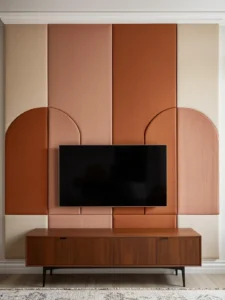
In 2026, the TV wall does more than look good — the best ones improve how the room sounds. Acoustic fabric panel systems — modular soft panels in stretched upholstery-grade fabric mounted in geometric arrangements around the television — absorb echo and mid-frequency room noise dramatically, improving both music listening and TV audio clarity.
The panels function as wall art. Available in hundreds of fabric colors and in shapes ranging from simple rectangles to hexagons, arches, and custom die-cut silhouettes, they bring texture, color, and acoustic performance to a wall that previously had none. This is especially relevant in open-plan living spaces with hard floors and high ceilings where echo is a persistent problem.
10. Industrial Pipe and Reclaimed Wood Shelving TV Wall
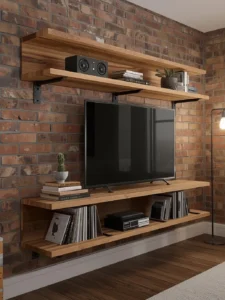
Exposed black steel pipe hardware combined with reclaimed solid wood shelves creates a TV wall that feels genuinely handbuilt and irreplaceable. The pipes mount to the wall as shelf brackets — adjustable, repositionable, honest about their structural role — and the shelves themselves are thick slabs of reclaimed wood with natural edge variations, saw marks, and aged grain.
The television mounts between shelf levels on a flush bracket, integrated into the open shelving composition. This direction works exceptionally well in loft apartments, converted industrial spaces, and modern homes that want one raw element to ground all the refinement elsewhere. It’s deliberately imperfect and entirely confident.
11. Vertical Slat Wood Screen Partially Concealing the TV
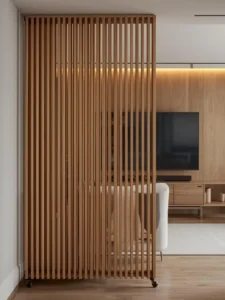
A vertical slat wood screen — freestanding or wall-mounted, with evenly spaced thin timber slats — creates a semi-permeable visual layer in front of or around the television. When viewed from directly in front, the TV is clearly visible through the slats. From any angle, the slats create a layered, filtered visual that makes the entire wall feel more architectural.
This is the idea for renters who can’t alter walls permanently. A freestanding slat screen on casters can be positioned, repositioned, or stored — and costs a fraction of built-in joinery. In natural rattan, painted timber, or powder-coated steel, the slat screen brings privacy-screen aesthetics to the TV wall with zero commitment.
12. Tiled TV Wall with Zellige or Handmade Ceramic Tile
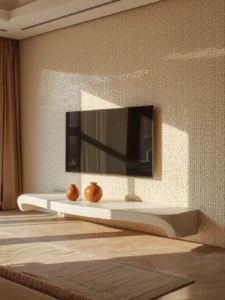
Bringing tile into the living room — specifically onto the TV wall — is one of the most unexpected and rewarding design choices of 2026. Zellige tile (the hand-cut Moroccan ceramic with irregular surfaces that catch light differently across every single piece) or large-format handmade ceramic tile in soft matte glazes creates a wall of genuine artisanal character.
The TV mounts onto the tiled surface on a slim bracket, and the tile becomes the frame — no additional decoration needed. Colors that work best: warm ivory, dusty sage, aged terracotta, and deep teal. The slight imperfection of handmade tile means the wall is alive with light variation at every hour, making it endlessly interesting even when the screen is dark.
13. Double-Sided Bookcase Room Divider with TV on One Face
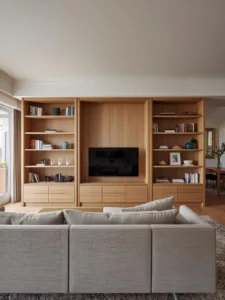
In open-plan homes, the TV wall doesn’t have to be against a perimeter wall at all. A freestanding double-sided bookcase — positioned as a room divider between the living area and dining zone — carries the television on its living room face and open shelving on its dining room face, creating two distinct zones from a single furniture installation.
This is one of the most spatially intelligent TV wall solutions of 2026, particularly for open-plan apartments and new builds where the living-dining-kitchen runs in one long rectangle. The divider creates visual separation without physical walls, and the TV face anchors the lounge zone while the shelf face adds storage and display to the dining area.
14. Backlit Onyx or Resin Panel TV Surround
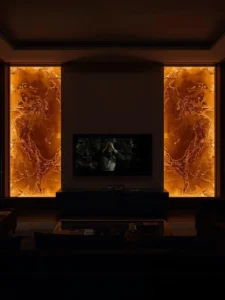
Translucent onyx stone or poured pigmented resin panels — backlit with concealed LED panels — create a TV surround that glows from within like something between geology and science fiction. When the lights dim for evening viewing, the backlit panel flanking the television emits a soft, amber or warm white internal glow that makes the wall look as though it’s lit from inside the material itself.
Natural onyx is a significant investment, but large-format backlit resin panels engineered to mimic onyx veining are now available at accessible price points and are indistinguishable at living room viewing distances. This is the TV wall for people who want their living room to feel like nowhere else on earth.
15. Living Wall with Preserved Moss and Plants Framing the TV
The most biophilic TV wall direction of 2026 uses preserved moss panels, air plants, and trailing live greenery to frame the television in a living wall composition. Preserved moss (which requires no watering, no light, and no maintenance while retaining its color and texture for years) forms the background, with strategic air plants and a few trailing pothos vines adding dimensionality.
The television sits at the center of this green composition on a flush bracket, surrounded entirely by living texture. This wall works particularly well in urban apartments where access to nature is limited — it introduces an entire ecosystem into the most-viewed wall of the home, improving air quality, reducing stress, and making the room feel genuinely alive.