
Black kitchens done wrong look heavy and cold — black kitchens done right look like the most confident room in the house. This post breaks down the best black kitchen ideas 2026 has to offer, from cabinet finishes and countertop pairings to lighting strategies and the one contrast move that keeps a dark kitchen from feeling like a cave. If you’ve been drawn to the look but unsure how to pull it off, this is exactly where to start.
1. How to Use Matte Black Cabinets Without Making the Kitchen Feel Dark
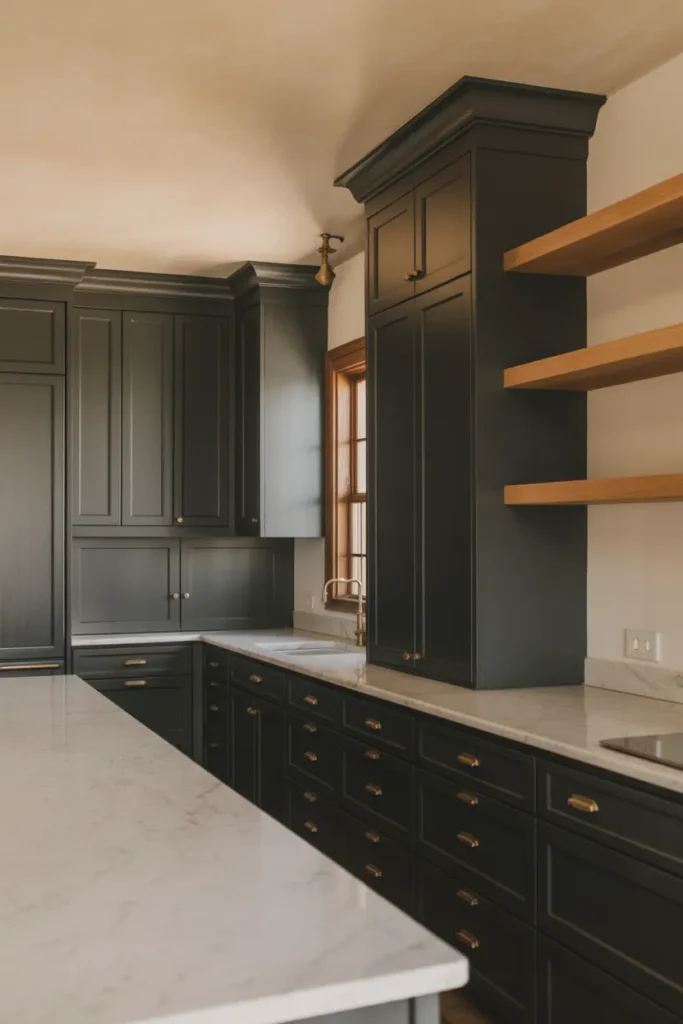
Picture floor-to-ceiling matte black cabinets paired with a warm white plaster ceiling and natural oak open shelving on one wall. The matte finish absorbs light rather than reflecting it — which sounds counterintuitive, but the result is a kitchen that feels grounded and intentional rather than dark and heavy.
Matte black works because it reads as a neutral, not a statement color. It recedes visually the same way a deep navy or charcoal does, letting the countertop material, hardware, and lighting carry the design weight. The kitchen doesn’t feel black — it feels sophisticated.
The tip most people miss: warm the matte black with one natural material. A butcher block island top, a woven rattan pendant, or a terracotta tile floor breaks the coolness of an all-black cabinet run without undermining the drama.

Pair matte black cabinets with warm white walls — not cool white. The undertone difference is the entire ballgame.
2. The Black and Wood Kitchen Combination That Dominates 2026 Boards
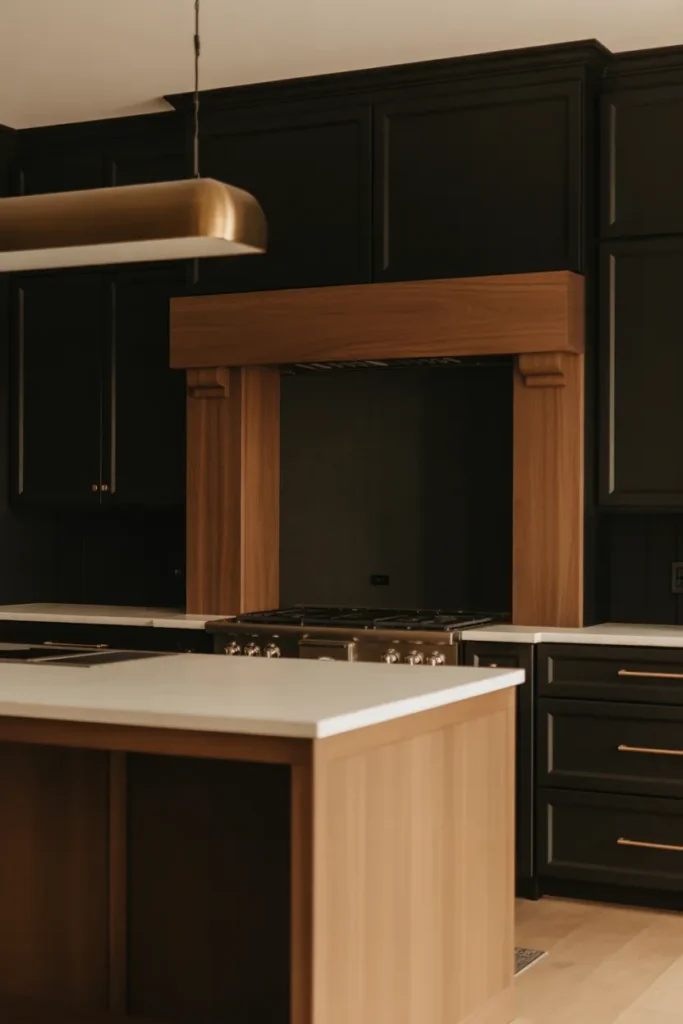
Black cabinets paired with warm wood — an oak island, walnut open shelves, or a wood-panel range hood — is the most-saved kitchen combination heading into 2026. The contrast is immediate and compelling: the black grounds the space, the wood warms it, and neither element has to work as hard on its own.
The ratio matters more than the specific materials. A good starting point: 70% black cabinets, 20% wood accents, 10% metal hardware. Tip that balance too far toward wood and the kitchen loses its edge. Too little wood and the room stays cold.
The wood element that works hardest for the least cost: a wood-paneled range hood surround. It draws the eye upward, creates an architectural focal point, and introduces the warm tone in the most visible zone of the kitchen.
For flooring, wide-plank light oak or warm-toned engineered wood runs parallel to the cabinet line, visually widening the space and reinforcing the black-and-wood palette without introducing a third color.
3. Black Kitchen Countertops — Which Material Actually Works
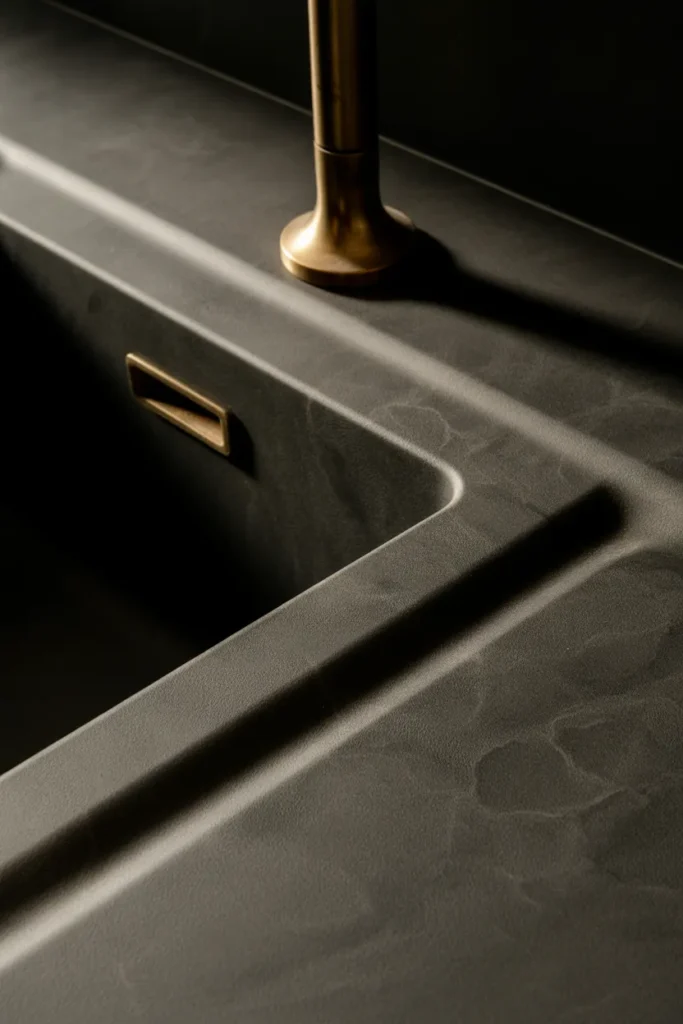
- Black leathered granite — matte textured surface, hides fingerprints and scratches remarkably well, warm undertones, pairs beautifully with both black and light cabinets
- Black soapstone — softest look of the black stones, develops a natural patina over time, slightly greenish undertone, best for kitchens with warm wood accents
- Black quartz — most consistent color, engineered for durability, the widest range of finishes from polished to honed, best for families who want low maintenance
- Black porcelain slab — ultra-modern, zero absorption, works for countertop and backsplash in one continuous material for a sleek seamless look
- Black absolute granite — the deepest, most dramatic option, high polish reflects light dramatically — use only if the rest of the kitchen has sufficient contrast to balance it
The countertop finish matters as much as the color. Polished black shows every watermark and fingerprint. Honed or leathered black hides daily use and ages gracefully. In an active kitchen, leathered is almost always the right call.
4. How a Black Kitchen Backsplash Creates a Focal Wall Without Renovation
A black backsplash — even in a kitchen with light or neutral cabinets — creates an instant focal wall behind the range that anchors the cooking zone and gives the kitchen a designed-from-scratch quality.
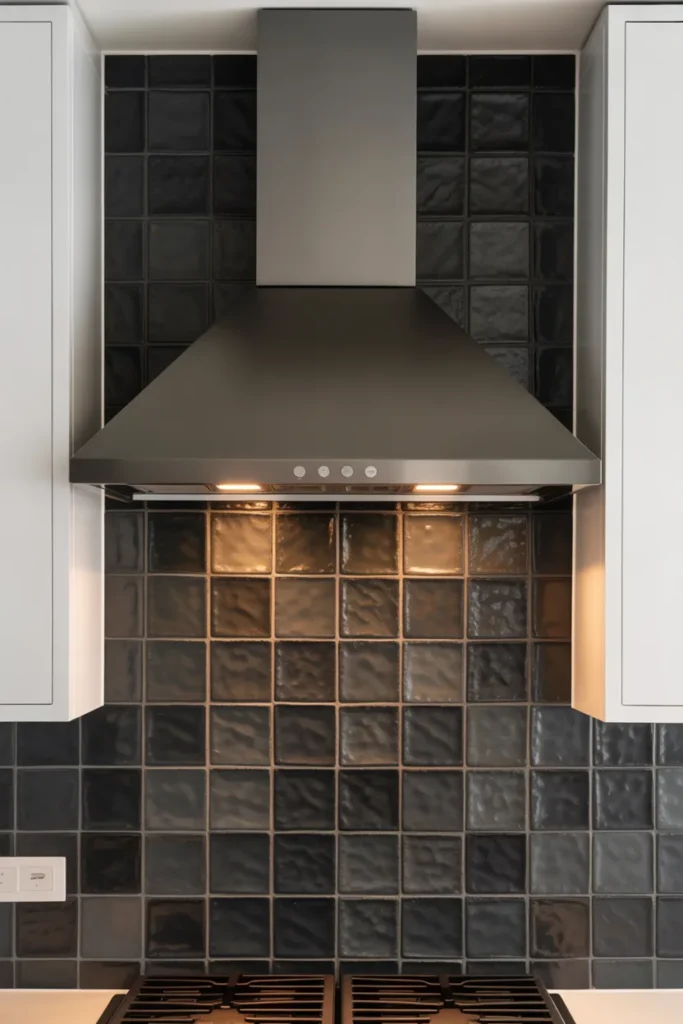
The most compelling black backsplash materials in 2026: Full-height black zellige tile behind the range creates a jewel-like wall that catches light differently at every hour of the day. Black fluted ceramic tile adds dimensional texture that reads as architectural. A black porcelain slab backsplash — no grout lines, one seamless surface — delivers the most dramatic and modern result.
The unexpected move: use a black backsplash in a white kitchen. White cabinets, white countertops, black backsplash behind the range. The contrast is bold, graphic, and completely intentional — and it keeps the kitchen light without being predictable.
Grout color is non-negotiable in a black tile backsplash. Tone-on-tone black grout keeps the surface seamless. White grout on black tile creates a graphic grid pattern — which can be beautiful, but it’s a permanent commitment to that energy.
5. Black Kitchen Hardware — Do This, Not That
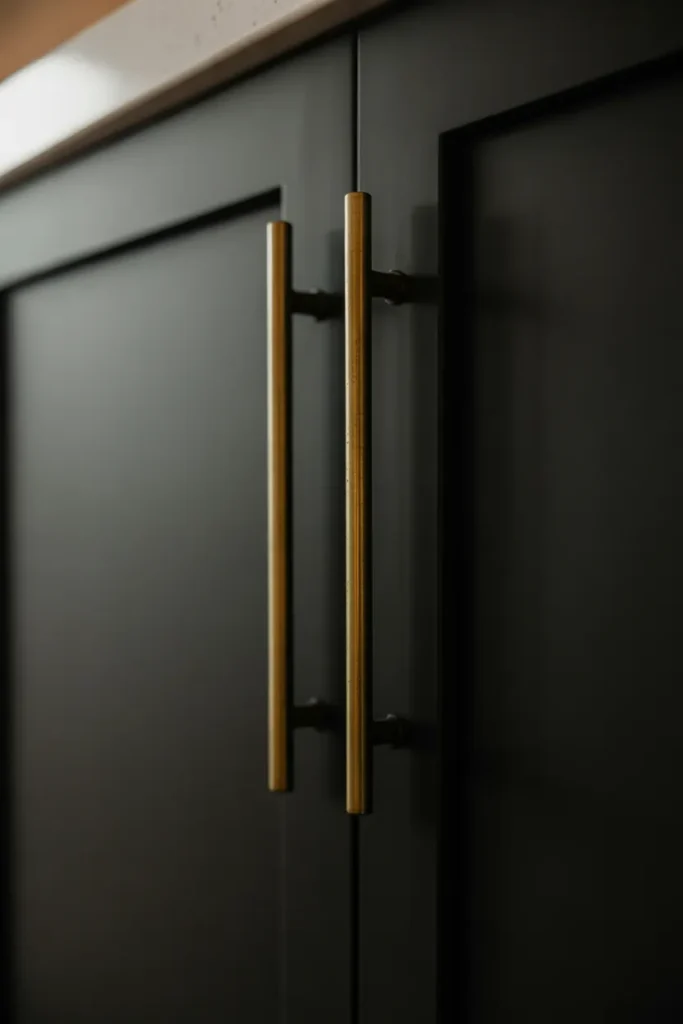
DO: Choose matte black hardware on matte black cabinets for a tone-on-tone effect that reads as custom and intentional — the hardware almost disappears, letting the cabinet silhouette lead.
DON’T: Use polished chrome or brushed nickel hardware on black cabinets. The cool silver against black reads as unresolved — like a decision that wasn’t finished.
DO: Mix matte black cabinet hardware with a contrasting faucet finish — unlacquered brass, antique bronze, or brushed gold. The faucet is the kitchen’s jewelry, and contrast at the sink creates a deliberate, designed moment.
DON’T: Over-mix hardware finishes. Two finishes maximum — one for cabinet hardware, one for plumbing fixtures. Three or more reads as unplanned.
DO: Scale hardware to cabinet size. Long bar pulls (5–8 inches) on tall pantry cabinets. Shorter pulls or knobs on standard upper cabinet doors. Mis-scaled hardware on black cabinets reads immediately because the dark surface draws attention to every detail.
DON’T: Choose hardware as the last decision. In a black kitchen, hardware is a structural design choice — finalize it before ordering cabinets, not after installation.
6. How to Light a Black Kitchen So It Feels Dramatic — Not Dingy
Lighting is the single most critical decision in a black kitchen. A black kitchen with poor lighting feels like a basement. A black kitchen with layered, warm lighting feels like a high-end restaurant.
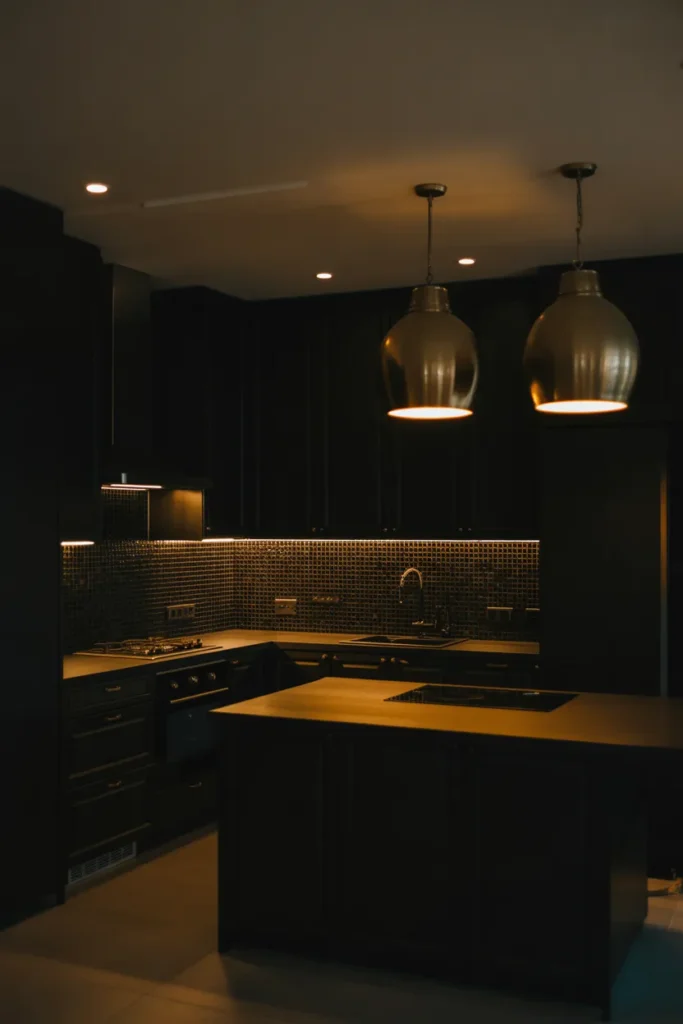
The non-negotiable layer: under-cabinet task lighting. In a dark kitchen, the countertop is where work happens and where light disappears fastest. LED strip lighting under every upper cabinet run brings the work surface to life and illuminates the backsplash material in a way that overhead lighting alone never achieves.
The mood layer: pendants above the island in a warm metal — aged brass, antique bronze, or warm gold. The metal finish reflects light into the darkest zones of the kitchen. Choose pendants with open bottoms that direct light downward onto the countertop rather than decorative pendants that diffuse light in all directions.
The dimmer is non-negotiable in a black kitchen. Full-brightness recessed lighting in a black kitchen feels harsh and clinical. At 40–60% dimmer level, the same fixtures create something entirely different — warm, intentional, and distinctly luxurious.
7. The Black and White Kitchen Formula That Never Goes Wrong
Black and white kitchens are the most graphically confident design decision in residential interiors — and the 2026 version moves away from stark contrast toward something more nuanced and warm.
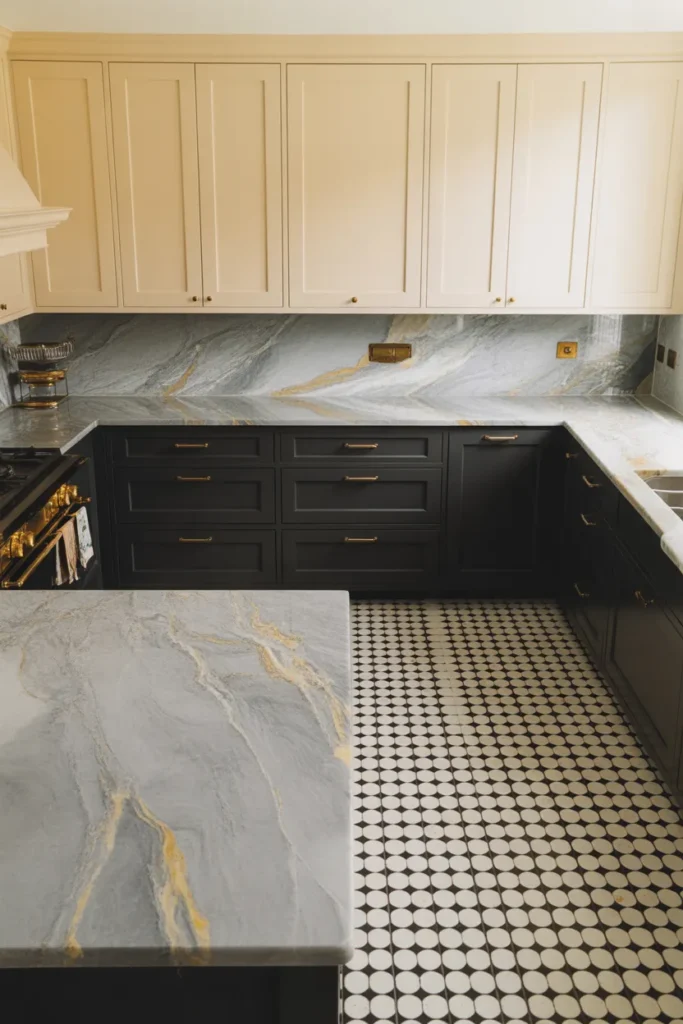
Picture black lower cabinets, warm white upper cabinets, a white marble or quartz countertop, and a black-and-white encaustic or geometric tile floor. The palette is binary but the materials introduce enough texture and variation to keep it from feeling clinical.
The key to making black and white feel warm rather than cold is the white you choose. Pure white — cool, blue-toned white — reads as stark and modern. Warm white, aged white, or off-white cream reads as timeless and livable. In a black and white kitchen, that single undertone decision changes the room’s entire emotional register.
The variation most designers recommend for 2026: introduce one material that blurs the line between black and white — warm gray marble veining, a concrete countertop, or a greige grout. It keeps the palette disciplined without making it rigid.
8. Black Kitchens in Small Spaces — Why It Actually Works
The conventional wisdom says small kitchens need light colors. The reality is that a well-lit small kitchen in black can feel more curated and intentional than the same space in white — because dark tones minimize visual clutter and make imperfect elements less visible.
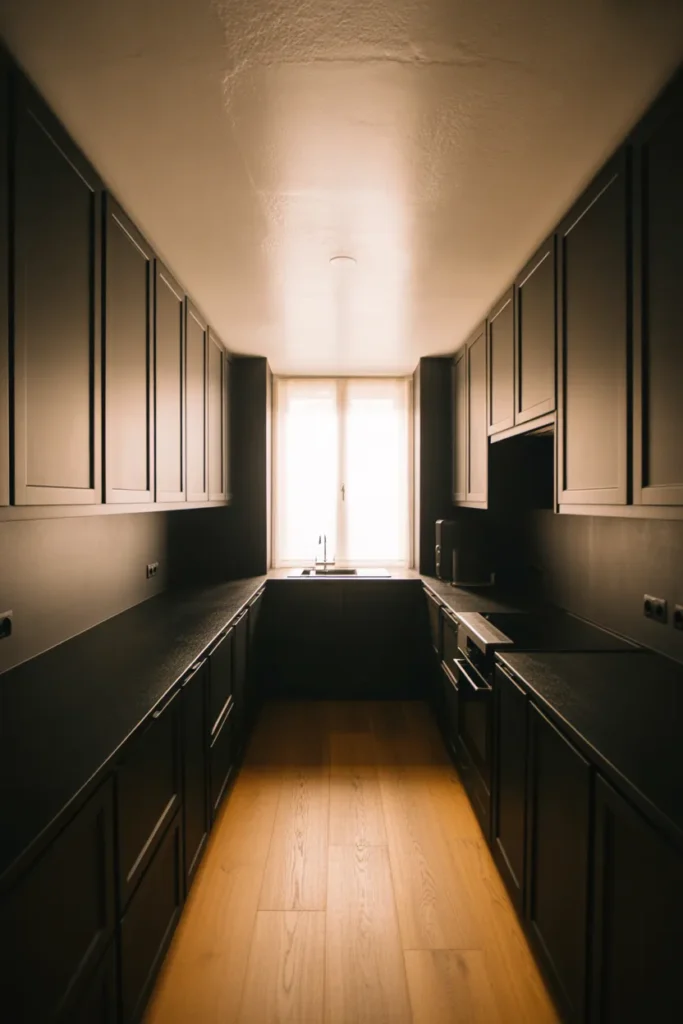
In a small black kitchen, the strategy is simple: keep every surface the same tone family, use continuous hardware, and rely on lighting to define the space rather than color contrast. A small galley kitchen with matte black cabinets, black countertops, and black tile backsplash reads as a deliberate design choice — not a mistake.
The contrast element in a small black kitchen should be at the ceiling and floor — a white or warm plaster ceiling and a light wood or warm stone floor. This frames the dark kitchen between two light planes and prevents the space from reading as a tunnel.
One window with good natural light exposure does more for a small black kitchen than any design decision. If the window situation is limited, a mirrored backsplash section or a glass-front cabinet insert reflects light back into the room without disrupting the palette.
9. The Black Island That Transforms a Light Kitchen Instantly
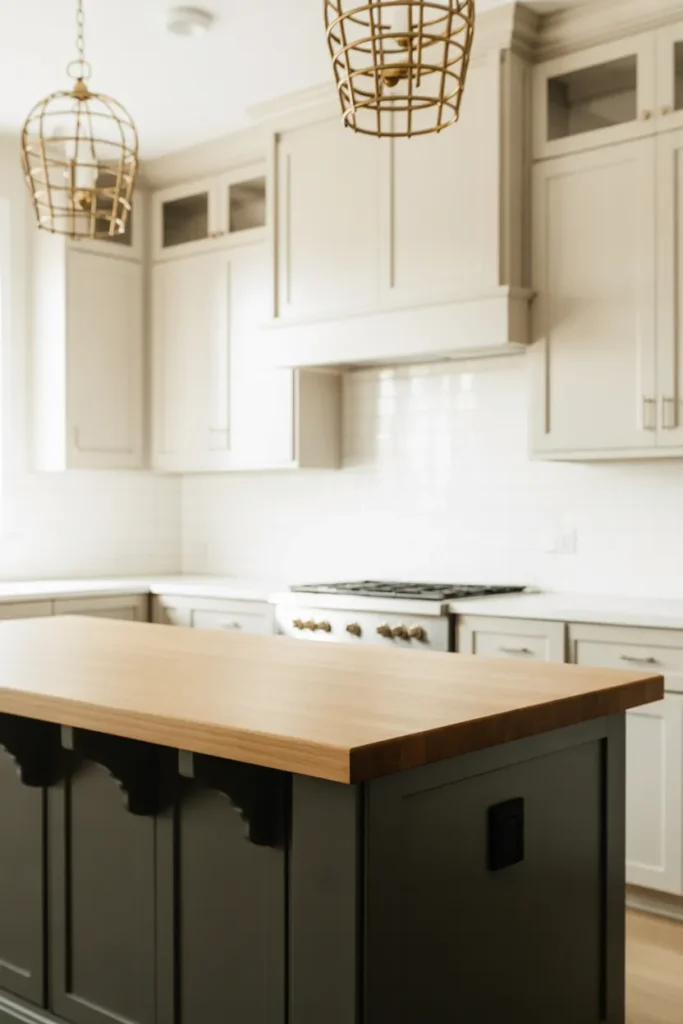
A black island in an otherwise light kitchen is the most impactful single-piece upgrade in kitchen design — and the one move that photographs better than almost anything else in residential interiors.
Picture white or warm cream perimeter cabinets, a light marble countertop, and then a matte black island sitting in the center with a contrasting countertop — warm butcher block, warm white quartz, or even a natural stone with visible movement. The island becomes the room’s anchor immediately.
The black island works because it gives the kitchen a visual center of gravity. Without it, an all-light kitchen can feel soft and undefined. With it, the whole room snaps into focus. Everything relates back to that one grounded element.
Don’t match the island countertop to the perimeter countertop when the island is black. Contrast is the point. A warm wood top on a black base, or a light stone on a black base, is more interesting and more functional than a matchy-matchy approach.
10. The Finish That Makes Black Cabinets Look Most Expensive
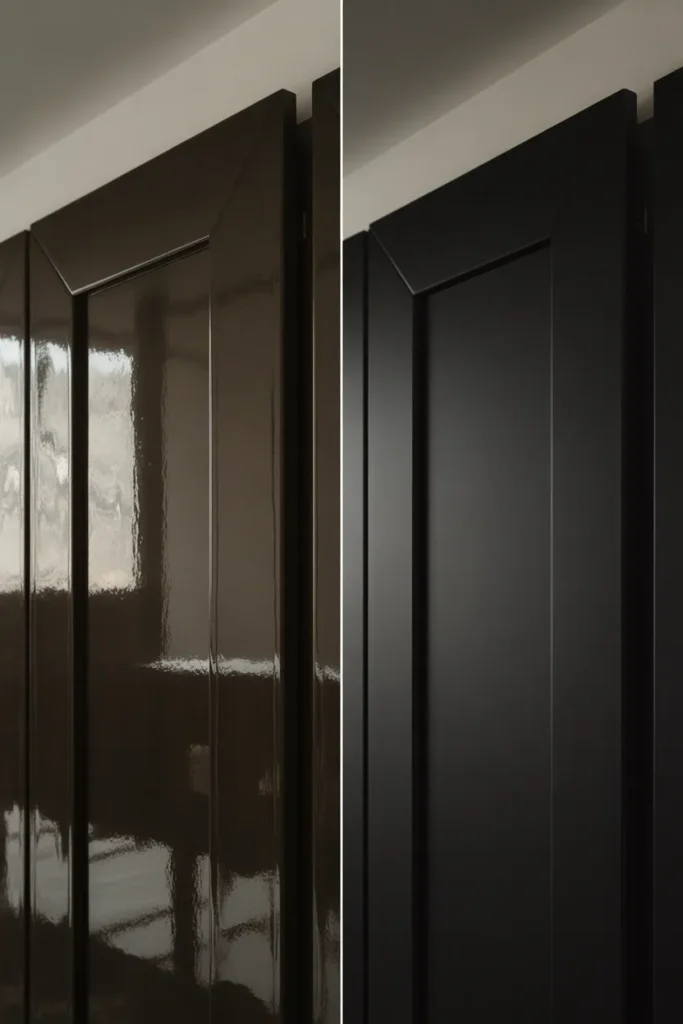
There are four finish options for black cabinets — and they communicate completely different things about the kitchen’s design intent:
- Matte — absorbs light, hides imperfections in the cabinet surface, feels modern and grounded, the most forgiving for everyday use, the most popular for black kitchen ideas in 2026
- Satin — slight sheen, easier to wipe clean than matte, warmer in feel, sits between matte and semi-gloss in formality
- Semi-gloss — noticeable reflection, more traditional cabinet finish, shows brush marks and surface variation more readily, best in kitchens with strong natural light
- High-gloss — mirror-like reflection, ultra-modern European kitchen aesthetic, shows every fingerprint and every imperfection in the cabinet construction — demands flawless installation
Matte black is the finish that reads as most expensive in photography and in person — because it requires better craftsmanship to look right, and it photographs with a depth that glossy finishes can’t replicate. It’s also the most forgiving in daily use, which is a rare combination.
11. How to Warm Up a Black Kitchen With Texture Alone
A black kitchen that feels cold is almost always a texture problem, not a color problem. When every surface in a black kitchen is smooth — flat cabinet doors, polished stone, glossy tile — the room reads as sterile regardless of how thoughtful the palette is.
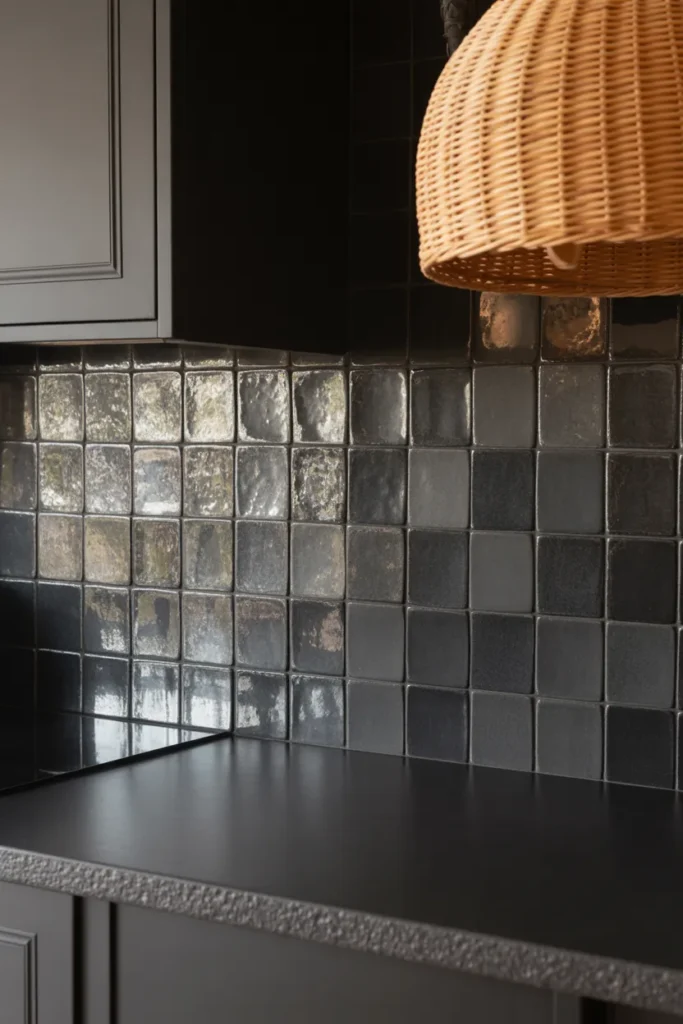
The solution is deliberate texture layering. Introduce a minimum of three different tactile surfaces: a leathered or honed stone countertop, a handmade or dimensional tile backsplash, and a natural material — wood, rattan, linen, or ceramic — somewhere visible in the room.
Texture in a black kitchen does something light-colored kitchens don’t need: it creates visual warmth through surface variation rather than through color. A black zellige tile backsplash, for example, isn’t warm in color — but the irregular handmade surface catches light in a way that makes the whole room feel alive and inviting.
Bold insight: A woven pendant light above a black island is the single fastest texture addition in a dark kitchen. It introduces warmth, softness, and natural material contrast in one object — and it costs a fraction of a countertop or backsplash change.
12. Black Kitchens and Resale Value — What USA Buyers Actually Think
This is one of the most searched questions around black kitchen design — and the answer is more nuanced than most real estate blogs acknowledge.
Black kitchens do not hurt resale value when they are well-executed. What hurts resale value is poor-quality finishes, bad lighting, and a kitchen that feels unlivable regardless of color. A beautifully designed black kitchen with quality materials, strong lighting, and warm contrast elements attracts buyers who would have paid more for a lesser white kitchen.
The real risk with black kitchens and resale is DIY execution. A spray-painted black cabinet with poor prep, inconsistent sheen, and cheap hardware reads as a project house — and that does affect buyer perception. The color isn’t the problem. The execution quality is.
If resale is a concern, the safest black kitchen approach is a black island with light perimeter cabinets. It captures the drama and design confidence of a black kitchen while maintaining the light, open feeling that the broadest buyer pool responds to.
13. The One Element That Prevents a Black Kitchen From Feeling Oppressive
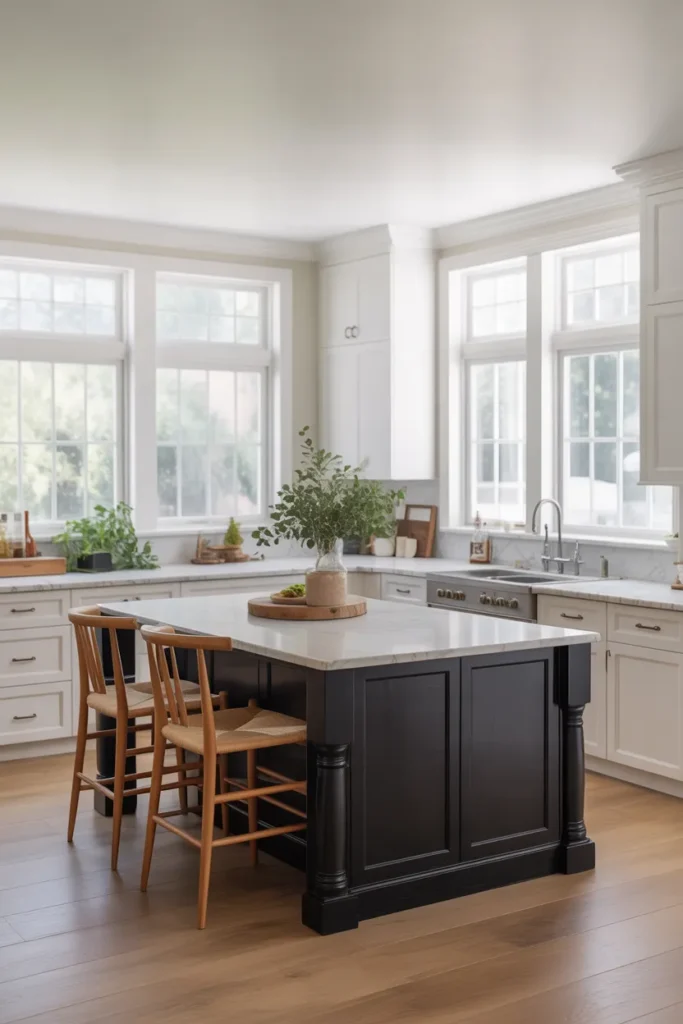
Every well-designed black kitchen has one thing in common: a deliberate relief element that gives the eye somewhere to rest. Without it, even the most beautiful dark kitchen starts to feel relentless.
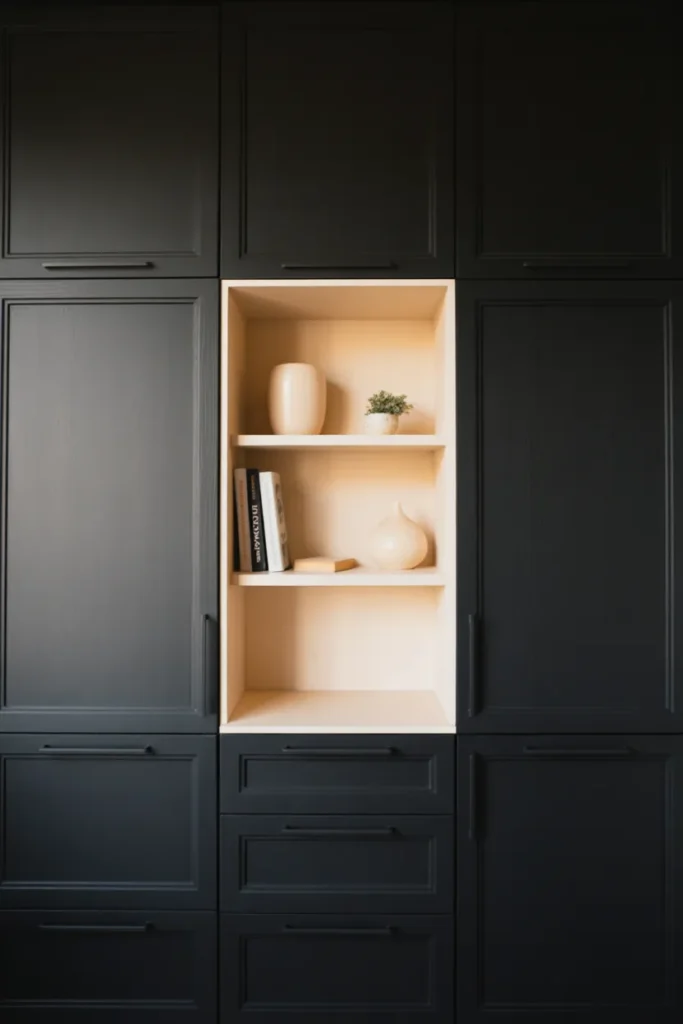
The relief element can take many forms. An open section of wall in a warm white or plaster tone. A glass-front upper cabinet that shows an interior in a lighter color. A window with a direct view of greenery that brings organic contrast into the frame. A floating shelf in natural wood that breaks the continuous dark cabinet run.
The mistake is thinking the relief element needs to be large to work. It doesn’t. Even 15–20% of the kitchen’s visible surface in a lighter or contrasting material is enough to let the black read as a choice rather than an inevitability.
The placement of the relief element matters too. Position it at eye level, in the center of the visual field, where it anchors the composition — not tucked in a corner where it can’t do its job.
14. How to Style a Black Kitchen for Photography That Actually Gets Saved
A black kitchen that looks stunning in person can photograph flat if the styling decisions aren’t intentional. The materials and objects you place in a black kitchen for photography should earn their presence by providing contrast, warmth, or height.
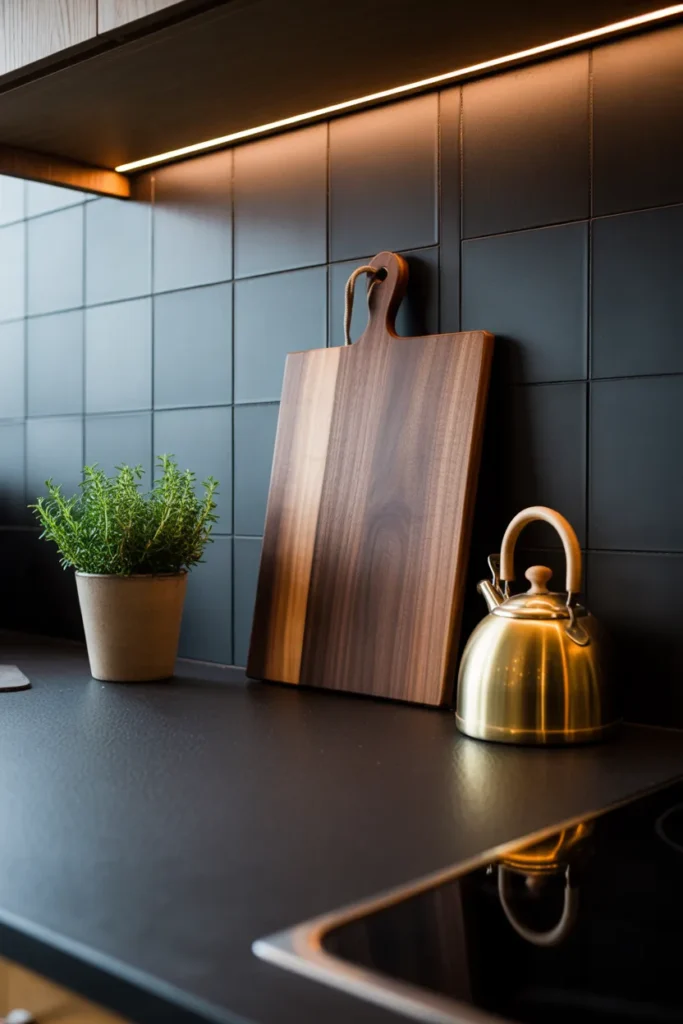
The styling formula for a black kitchen that photographs well: one warm organic element (a wooden cutting board, a terracotta bowl, fresh herbs in a ceramic pot), one metallic element (a brass kettle, copper measuring cups, an antique bronze oil bottle), and one textile element (a linen dish towel, a woven trivet, a rattan tray). Three categories. One object each. Nothing more.
Clear every counter except for these three intentional objects before photographing. In a black kitchen, a cluttered counter reads twice as chaotic as in a light kitchen because the dark background makes every object pop with higher contrast.
The best black kitchen photos are taken in morning light, from a corner angle, with every light layer on at 60–70% dimmer level. Natural light from the side plus warm artificial layers from above creates the dimensional, editorial quality that makes black kitchen images stop the scroll.
These black kitchen ideas for 2026 are worth keeping close — because confident design decisions made slowly, with the right reference in front of you, are always the ones you end up loving most. Pin this post to your kitchen board so it’s there when you need it, and explore more design guides whenever you’re ready to go deeper.