
The entryway staircase is the most architecturally significant feature in any two-story home, yet most renovation plans treat it as a background element rather than a designed focal point. If you are searching for ideas for grand entryway staircase design, this post gives you 10 specific, decision-ready directions covering materials, railing systems, lighting strategies, wall treatments, and layout configurations so you can evaluate each option against your actual space before committing to anything.
1. Switch to an Open-Riser Staircase to Instantly Modernize a Traditional Foyer
An open-riser staircase, where the vertical face between each tread is removed entirely, is one of the most effective single changes available in a grand entryway staircase renovation. The absence of risers allows light to pass through the staircase structure, which opens the foyer visually, makes the ceiling feel taller, and transforms a heavy traditional staircase into a contemporary architectural element.
This configuration works best in homes where the foyer has a sightline to a window or light source behind or beside the staircase. Without that light source, the open riser effect is diminished because the transparency of the structure has nothing to reveal. In homes where the staircase backs against a solid wall with no glazing, a closed-riser design with strong surface material choices will deliver more visual impact.
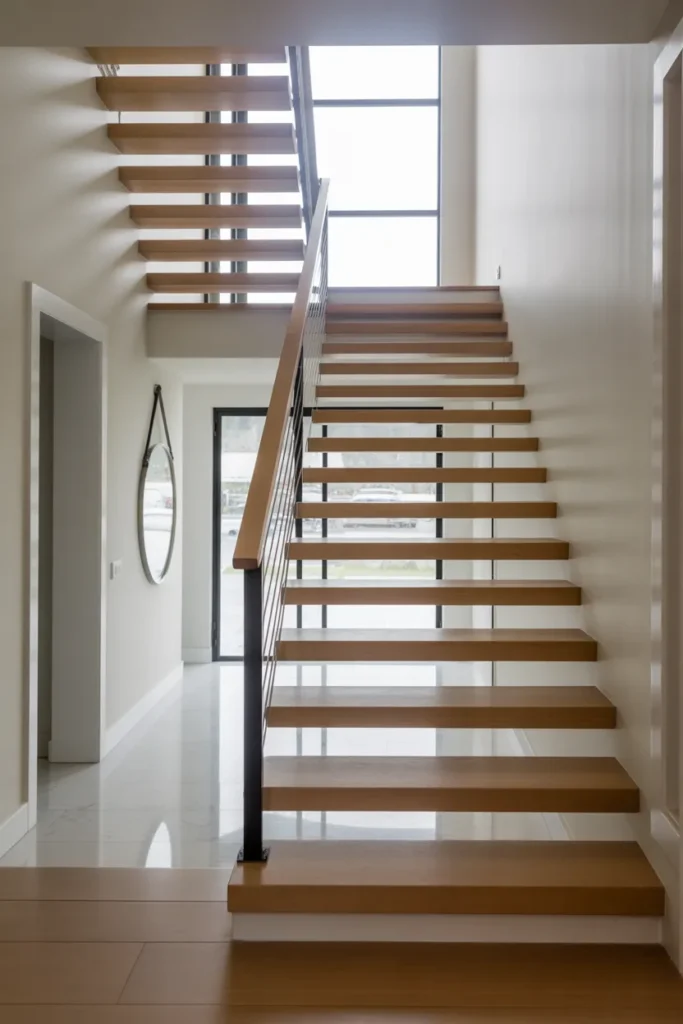

Tread material selection is critical in an open-riser design because each individual tread is fully exposed from multiple angles. Thick solid oak in a natural or white-washed tone, honed marble, or polished concrete are the strongest material choices. Avoid thin engineered wood treads in an open-riser application because the edge profile is always visible and thin materials read as inexpensive regardless of finish quality.
The structural requirement for open-riser stairs is that each tread must be adequately supported without the riser panel providing secondary support. This typically requires thicker tread stock, usually two inches minimum, and may require a structural assessment if you are converting an existing closed-riser staircase rather than building new.
2. Install a Dramatic Oversized Chandelier That Scales to the Full Foyer Height
Scale is the single most important principle in grand entryway staircase lighting, and it is the principle most consistently violated in residential design. A standard-size chandelier hung in a double-height foyer looks like a piece of jewelry on a basketball court. A fixture scaled to occupy at least one-third of the visual height of the foyer space reads as a genuine architectural element rather than an afterthought.
The strongest chandelier choices for a grand staircase foyer in current design are: a linear multi-tier crystal fixture for traditional or transitional homes, a clustered bulb or globe array for contemporary or organic-modern homes, a large-scale drum pendant in a textured material such as rattan, linen, or plaster for relaxed luxury directions, and a sculptural branching fixture for editorial or high-design spaces.
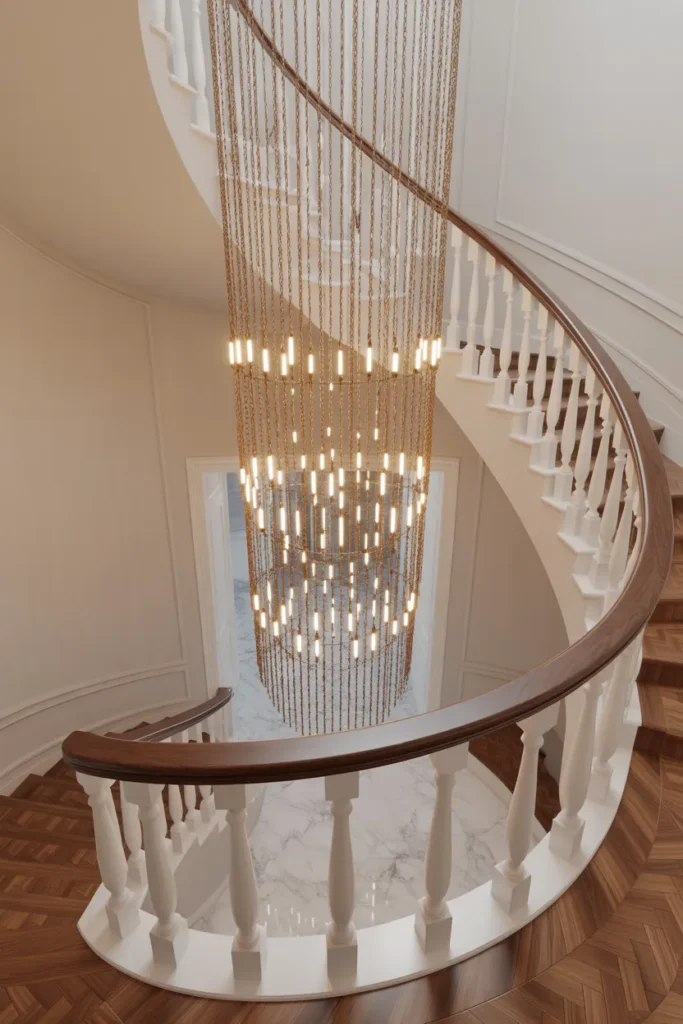
Hanging height is the technical decision most often miscalculated. In a double-height foyer, the bottom of the chandelier should clear the first-floor sight line by at least seven feet to avoid a visual obstruction when entering the space. The top of the fixture should sit close enough to the ceiling to feel connected to the architectural envelope rather than floating in the middle of the void.
The practical consideration that renovation plans frequently miss is maintenance access. A chandelier installed in a sixteen-foot foyer requires either a ladder system, a pulley mechanism, or a scaffolding setup for bulb replacement and cleaning. Plan the access method before finalizing the fixture selection.
3. Add a Curved Staircase With a Sculptural Wrought Iron Railing for Maximum Impact
A curved or spiral staircase configuration is the layout decision that most definitively signals architectural ambition in a grand entryway. Where a straight or L-shaped staircase reads as functional, a curved staircase reads as designed, and its visual arc creates a natural focal point that draws the eye upward from the moment of entry regardless of what else is in the space.
For a curved staircase to read as grand rather than simply curved, the railing system must contribute equal visual weight. A sculptural wrought iron railing with hand-forged scroll or geometric panel detailing between a solid wood handrail at the top and a solid wood base rail at the bottom is the classic execution. It works in traditional, transitional, and certain contemporary homes where the curved form and the iron material share a common character.
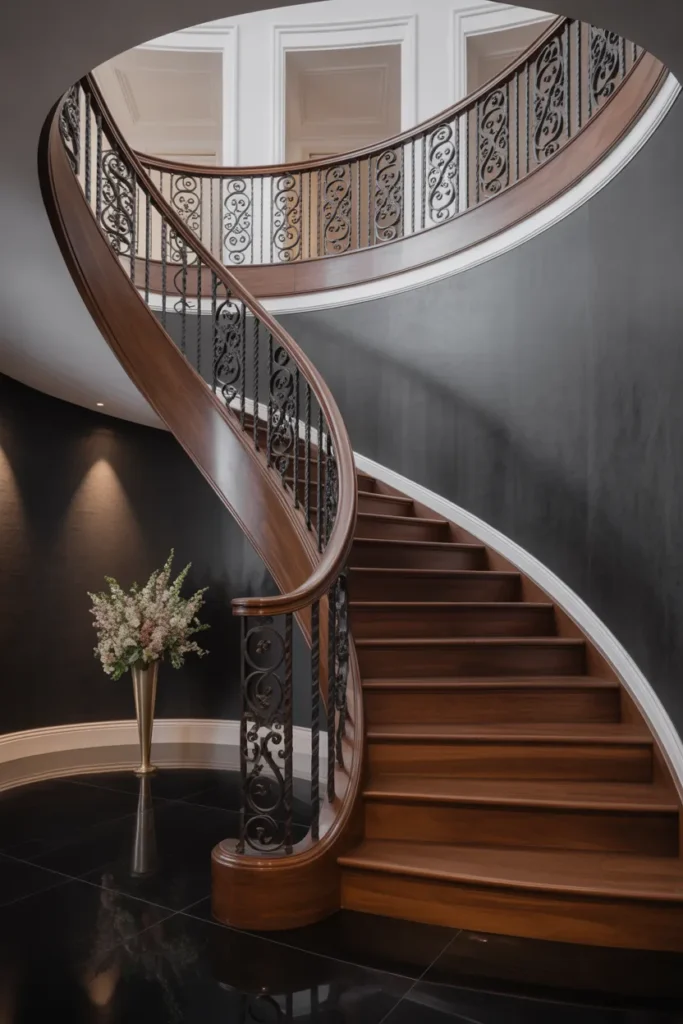
The mistake made most often with curved staircase design is installing a railing system that is too light and thin for the scale of the curve. A delicate baluster pattern on a wide sweeping staircase creates a visual disconnect between the boldness of the form and the delicacy of the railing. The railing must be scaled to match the ambition of the curve.
This design suits homes with foyer footprints of at least twelve by twelve feet to allow the curve to develop fully. In tighter foyers, a quarter-turn or half-turn staircase with a curved outer stringer is the more proportionally appropriate version of the same idea.
4. Clad the Staircase Wall in Full-Height Stone or Marble for a Luxury Hotel Effect
The wall that runs alongside a grand entryway staircase is one of the largest continuous surfaces in a home and one of the most underutilized in residential design. Cladding this wall in full-height natural stone, large-format marble-look porcelain tile, or a honed travertine panel transforms the staircase from a circulation route into an architectural gallery of material quality.
The visual logic behind this approach is borrowed directly from luxury hotel and high-end commercial design, where material investment is concentrated on the surfaces visible from the longest sight lines. In a residential foyer, the staircase wall is almost always the surface visible from the greatest distance, which makes it the highest-return surface for material investment.
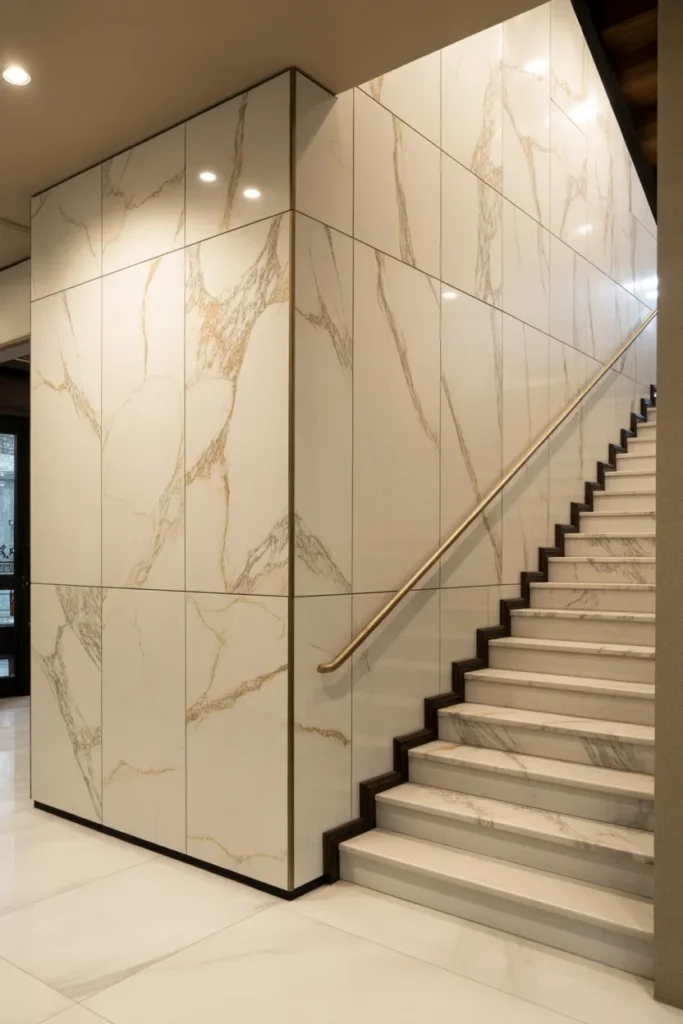
For residential budgets where full natural stone is not viable, large-format marble-look porcelain at slab scale, specifically panels of 48 by 96 inches or larger with minimal grout lines, produces a result that is visually indistinguishable from natural stone in most viewing conditions and far more durable in a high-traffic staircase environment.
The most important installation detail is grout line width. Natural stone and high-quality porcelain panels should be installed with the thinnest grout line the installer can achieve, typically two millimeters or less. Wide grout lines immediately break the illusion of continuous stone and undermine the luxury material effect entirely.
5. Paint the Staircase Risers in a Deep Accent Color to Create a Bold Design Moment
Painting staircase risers in a contrasting deep accent color while keeping the treads in natural wood or white is one of the most cost-effective ways to introduce a grand design moment into an entryway staircase without structural changes or material investment. The vertical face of each riser becomes a repeating color band that draws the eye up the staircase and creates visual rhythm.
This technique works in both traditional and contemporary staircase configurations. In a traditional staircase with closed risers and classic balusters, deep navy, forest green, or terracotta on the risers against white balusters and natural wood treads creates a preppy, high-contrast look that photographs with strong visual impact. In a more contemporary staircase with a cleaner railing profile, the same approach reads as bold and architectural.
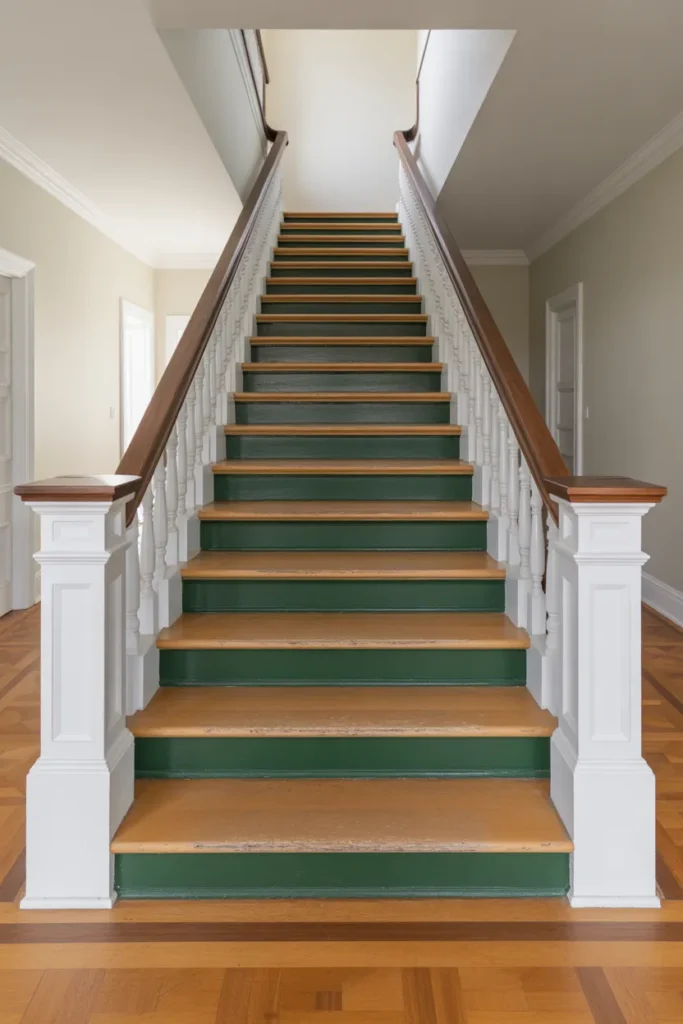
The color selection rule is to choose a tone that already exists in the adjacent spaces rather than introducing an entirely new color. A deep navy riser works in a foyer where the living room visible from the entry carries navy in a textile or art piece. This creates a deliberate color thread through the home rather than a staircase that feels isolated from its surroundings.
Execution requires a careful masking process between the riser and the tread nose to achieve a clean edge. A sloppy paint line at the tread-riser junction is immediately visible from the bottom of the stairs and undermines the intentionality of the design. Take the time to mask precisely or have a professional painter execute this step.
6. Introduce a Sculptural Feature Wall With Dimensional Wall Panels Behind the Staircase
The wall directly behind or visible through a grand entryway staircase is a design opportunity that most renovation plans leave entirely blank. Installing dimensional wall panels, fluted wood cladding, or a plaster relief pattern on this surface creates a background layer that elevates the staircase from a functional element to a framed architectural composition.
Fluted wood panels in a vertical orientation are the most current and versatile choice for this application. Vertical fluting adds visual height to the wall surface, creates strong shadow lines that change with the direction of light, and works equally well in warm natural wood tones, painted white, or in a deep accent color. The material is also achievable at a moderate cost compared to custom plasterwork or stone cladding.
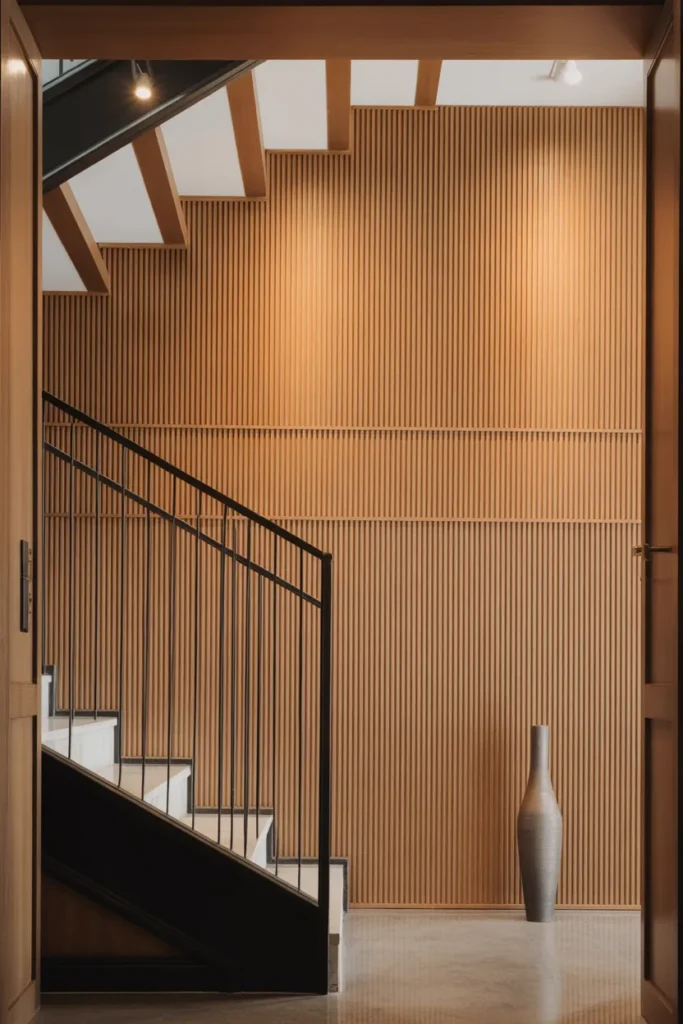
The key spatial requirement is that the feature wall must be visible from the front entry door. A dimensional wall treatment installed on a wall that is only visible from the upper landing defeats the purpose of creating an arrival moment. Identify the sight line from the point of entry first, then identify which wall sits on that axis.
Lighting for a dimensional wall treatment should come from an oblique angle rather than directly in front of the surface. Oblique light, whether from a recessed spotlight angled from above or from a wall-grazing fixture mounted close to the surface, creates shadow play within the flutes or relief panels that flat frontal light completely eliminates.
7. Install Stair Runners in a Bold Pattern to Ground the Staircase and Add Warmth
A stair runner is one of the most underestimated tools in a grand entryway staircase design. Beyond the practical benefits of noise reduction and grip, a runner introduces texture, color, and pattern to a space that is otherwise dominated by hard surfaces. A well-chosen runner brings the staircase into the interior design language of the home rather than leaving it as a purely architectural element.
For a grand staircase context, the runner pattern and color selection should follow one of two directions. The first is bold contrast: a deep geometric pattern in two tones against a natural wood or white painted tread creates a graphic, high-impact result that reads as intentional design. The second is refined texture: a solid or subtly textured runner in a warm neutral that adds softness without competing with the staircase architecture.
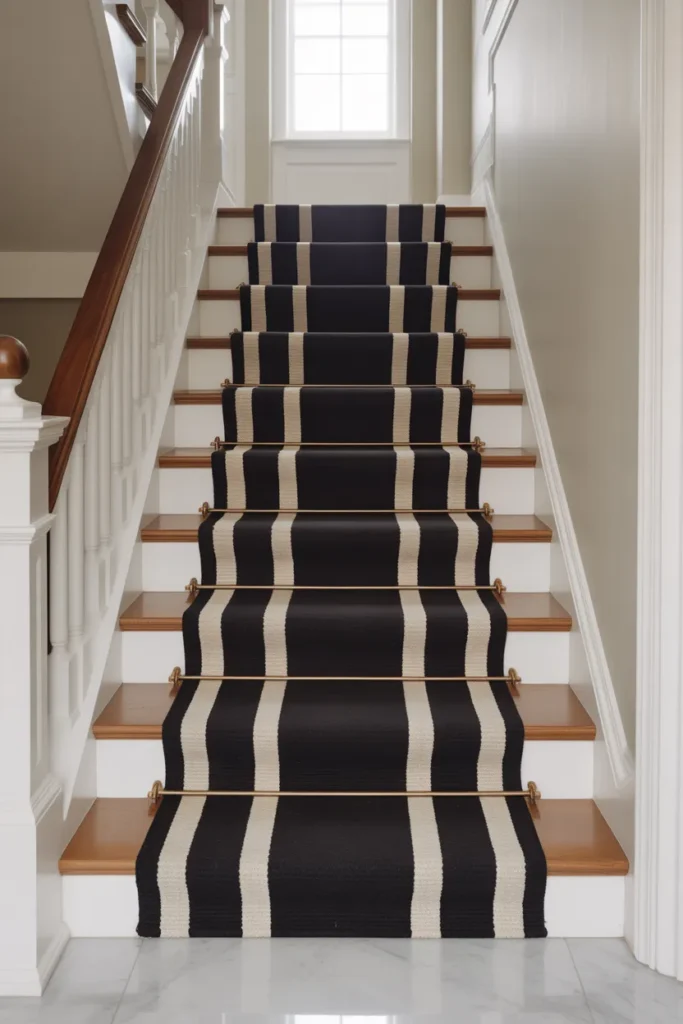
The runner width is the most consequential technical decision. A runner that leaves too little wood tread exposed on each side looks narrow and makes the staircase feel smaller. A runner that covers nearly the full tread width misses the visual opportunity the exposed wood border creates. The standard proportion is to leave four to five inches of tread exposed on each side of the runner.
Avoid runners in bright primary colors or highly novelty-specific patterns in a grand staircase context. The entryway staircase is visible for the life of the home and novelty patterns read as dated within a few years. A classic geometric, a traditional stripe, or a subtle abrash wool in a neutral ground are choices that hold their quality over time.
8. Frame the Staircase With a Double-Height Wainscoting and Picture Rail Detail
Wainscoting applied to the double-height staircase wall at a scale proportional to the architecture transforms a flat painted surface into a paneled composition with the character of a formal Georgian or Federal-style interior. In a grand entryway staircase, this treatment works across a wider range of architectural styles than it is typically given credit for, including transitional and soft contemporary homes where the paneling is painted out in a warm white or tonal color.
The proportion rule for staircase wainscoting is different from standard room wainscoting. In a regular room, wainscoting typically sits at chair rail height, roughly 36 inches from the floor. In a staircase, the panel height should be calculated as a proportion of the double-height wall, typically two-thirds of the total wall height, to maintain visual balance across the full vertical surface.
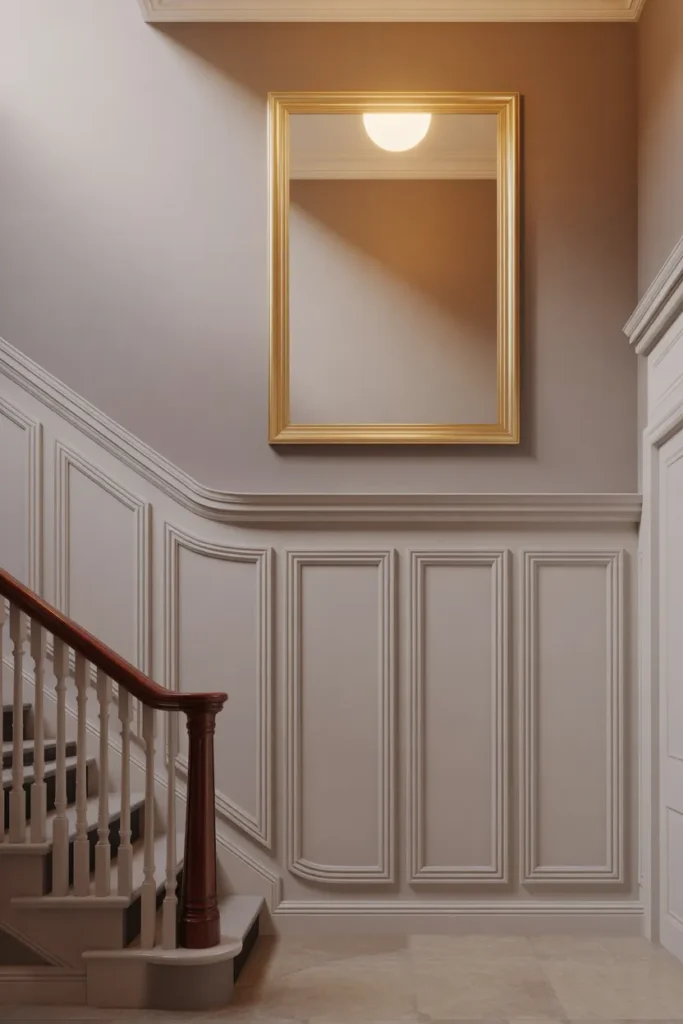
Above the wainscoting, a picture rail molding creates a defined boundary between the paneled lower zone and the painted upper wall. This rail also provides a practical hanging system for oversized artwork, large mirrors, or framed maps without requiring wall anchors drilled directly into the plaster or drywall.
The installation challenge unique to staircase wainscoting is that the panel heights must follow the pitch of the staircase while the top cap molding remains level, or must be raked to follow the stair pitch, depending on which approach the architectural style of the home demands. A professional trim carpenter is worth consulting before attempting this project independently.
9. Design a Built-In Bench and Storage System at the Staircase Base
The area at the base of a grand entryway staircase is one of the highest-traffic functional zones in a home and one of the most frequently left without a design solution. A built-in bench with under-seat storage and integrated coat hooks or a slim wardrobe cabinet flanking the stair newel post converts this transitional zone into a hardworking and visually grounded entry system.
In a grand staircase context, the built-in must match the architectural character of the staircase itself. A casual mudroom-style bench in painted MDF reads as mismatched against formal staircase architecture. A built-in in solid wood with panel detailing that references the staircase baluster style, painted in the same color as the staircase millwork, reads as part of the original architecture rather than an addition.
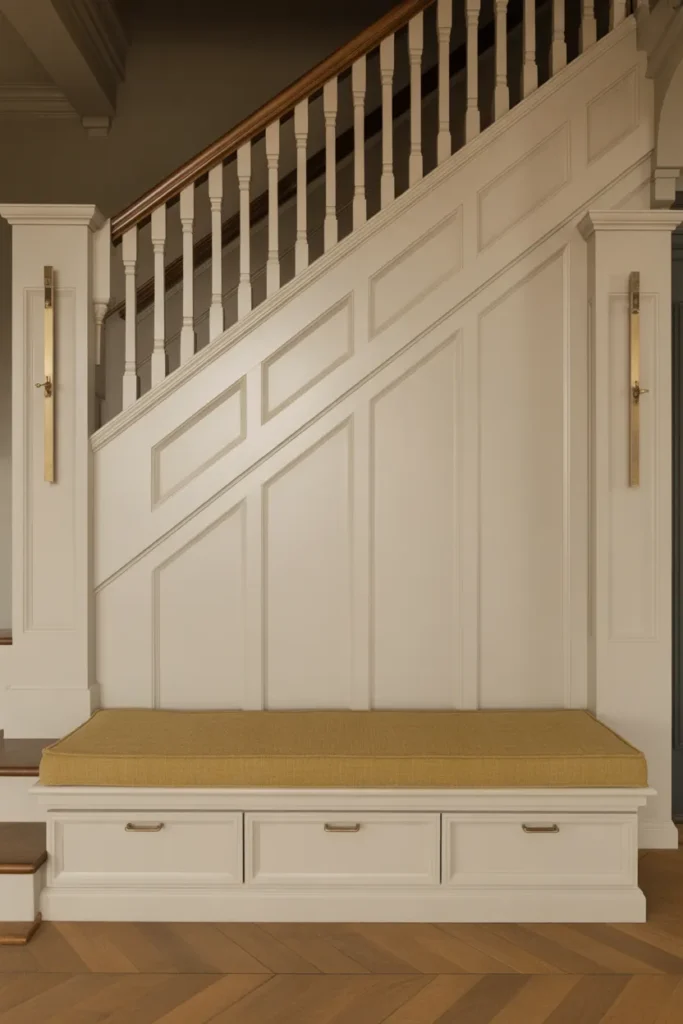
The depth of the built-in must be planned carefully. A bench that projects too far into the foyer interrupts the sight line and the circulation path. A depth of fourteen to sixteen inches is sufficient for seating and provides meaningful under-seat storage without encroaching on the foyer floor area.
This addition is particularly valuable in homes where the front entry connects directly to the living areas without a separate mudroom. It provides the drop-zone function that these homes lack without the informality that a freestanding hall tree or a collection of hooks on the wall would introduce.
10. Use a Double Staircase Layout to Create a True Grand Foyer Statement
The double staircase or bifurcated staircase configuration, where two staircases rise symmetrically from the foyer and meet at a shared upper landing, is the definitive architectural solution for ideas for grand entryway staircase design in large-scale residential projects. Its symmetry creates an immediate sense of formality and scale that no single staircase can replicate, regardless of how well it is designed.
This layout requires a foyer footprint of significant size, typically a minimum of eighteen feet wide and twenty feet deep to allow both staircases to develop fully and to preserve adequate floor area between them at the base. In foyers smaller than this, the double staircase configuration becomes physically crowded and loses the grandeur that is its primary purpose.
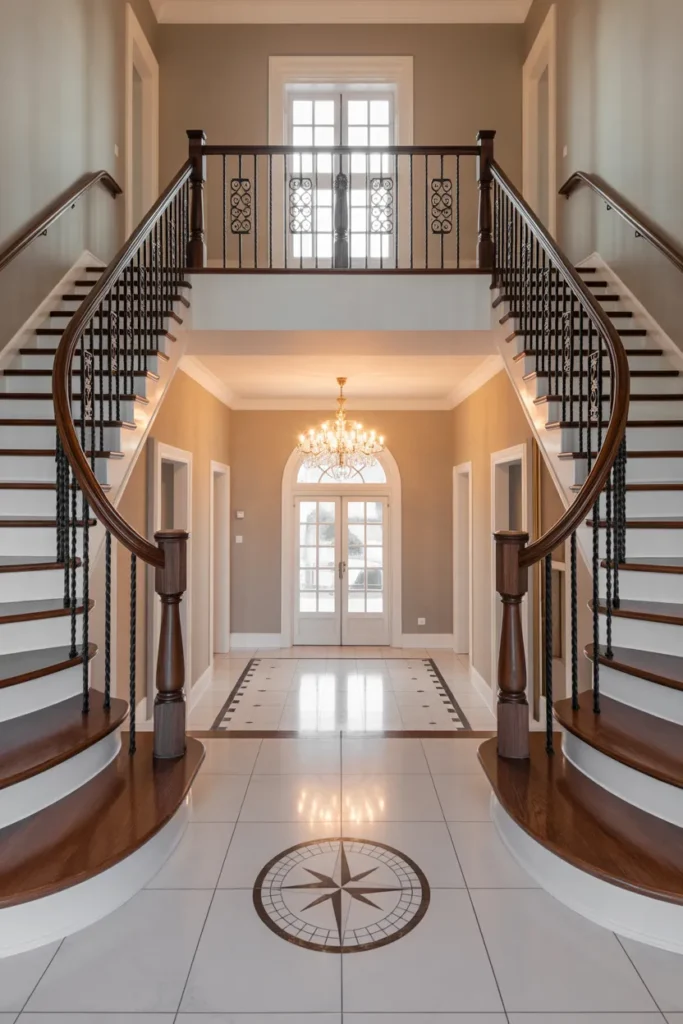
The material consistency rule is especially important in a double staircase because both flights are visible simultaneously. Every material choice must be identical across both runs, including tread material, riser treatment, railing style, baluster profile, handrail tone, and newel post design. Any variation between the two flights reads as an error rather than an intentional contrast.
The space between the two staircases at the lower level is a design zone that must be resolved deliberately. A large-format console table centered between the two newel posts with an oversized mirror or artwork above it anchors the symmetrical composition. Leaving this zone empty makes the layout feel unfinished regardless of how well the staircases themselves are designed.
Conclusion
The ideas for grand entryway staircase design that produce the most lasting results are those that treat the staircase as architecture first and decoration second. Material quality, lighting scale, proportion, and railing detail are the decisions that define a grand staircase. Paint color, runners, and built-in additions are the decisions that refine it. The strongest renovation plans address both layers in the correct sequence.
Save this post to your Pinterest boards before your renovation planning begins so you can return to each section as your project develops. For more detailed guidance on specific staircase configurations, foyer layouts for smaller homes, or entryway lighting design, explore the related posts in this series covering foyer design ideas and entryway renovation planning for 2026.