
Most bathrooms do not get dirty all at once — they decline gradually through small, repeated moments of neglect that compound over time. These tiny habits to keep your bathroom flawless are designed around exactly that reality: short, specific actions you build into routines you already have, so the bathroom stays clean, organized, and visually calm without ever requiring a full deep-clean session to rescue it.
1. Squeegee Your Shower Walls for 30 Seconds After Every Use to Prevent Soap Scum Buildup
Soap scum and hard water deposits do not appear overnight. They build up layer by layer, shower by shower, until they require significant scrubbing effort to remove. A squeegee used immediately after every shower removes the water film before mineral deposits have any opportunity to bond to the tile or glass surface. Thirty seconds of effort after each shower eliminates what would otherwise become a 30-minute cleaning task every two weeks.
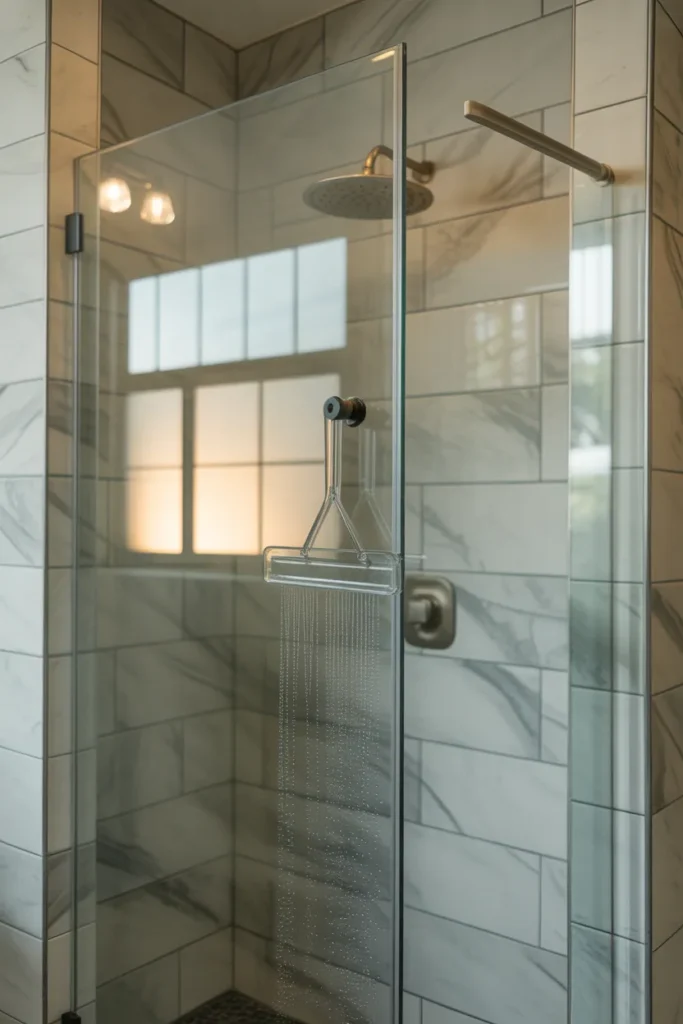
This habit works because it addresses the problem at the only moment it can be prevented — while the water is still liquid and the surface is still warm. Once water dries on glass or tile, the minerals it carries are left behind and begin bonding to the surface. No spray cleaner applied days later works as efficiently as removing the water before it ever dries.

Keep the squeegee hanging on a hook inside the shower within arm’s reach. If it requires opening a cabinet or reaching past other items to access, the habit will not stick. Friction is the enemy of small daily routines. The easier the tool is to grab and return, the more consistently the habit will hold.
2. Wipe Down the Sink and Faucet Every Morning to Stop Toothpaste and Soap From Setting
Toothpaste residue and soap film are significantly easier to remove when they are fresh than when they have dried and hardened on a porcelain or stone sink surface. A single pass with a damp cloth or a pre-moistened wipe across the sink basin, faucet, and surrounding counter immediately after the morning routine takes under 60 seconds and keeps these surfaces looking clean between full cleaning sessions.
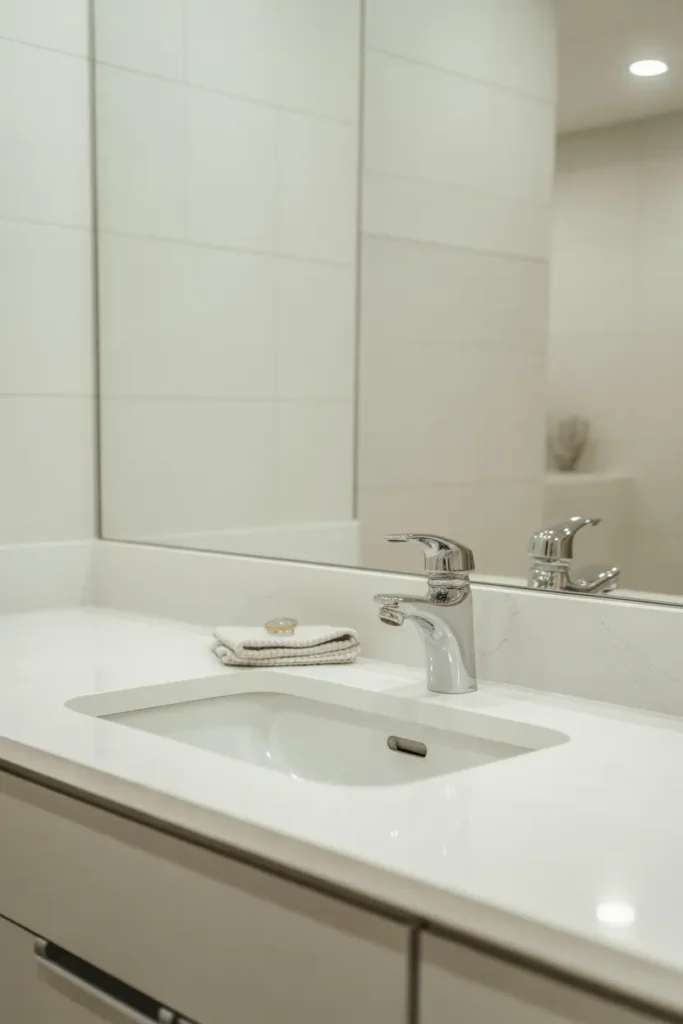
The faucet base is the area most people miss. Water splashes collect around the base of every faucet and, if left daily, create a mineral buildup ring that requires a dedicated descaling effort to remove. Including the faucet base in the daily wipe-down costs no additional time and prevents one of the most stubborn bathroom cleaning problems from developing.
Hang a small folded cloth or keep a roll of paper towels in an accessible counter location — not under the sink. The habit has to happen in the moment, immediately after brushing teeth or washing hands. A tool stored out of sight during the window when the habit should occur is a tool that will not be used.
3. Keep a Toilet Brush Accessible and Do a 60-Second Bowl Scrub Every Other Day
Toilet bowl stains form from mineral deposits, hard water, and organic buildup that accumulates in the water line and under the rim. Scrubbing the bowl every other day — before visible staining has any chance to set — takes under 60 seconds and requires no cleaning product beyond what is already in the bowl. This frequency prevents the buildup cycle entirely rather than responding to it after it has already progressed.
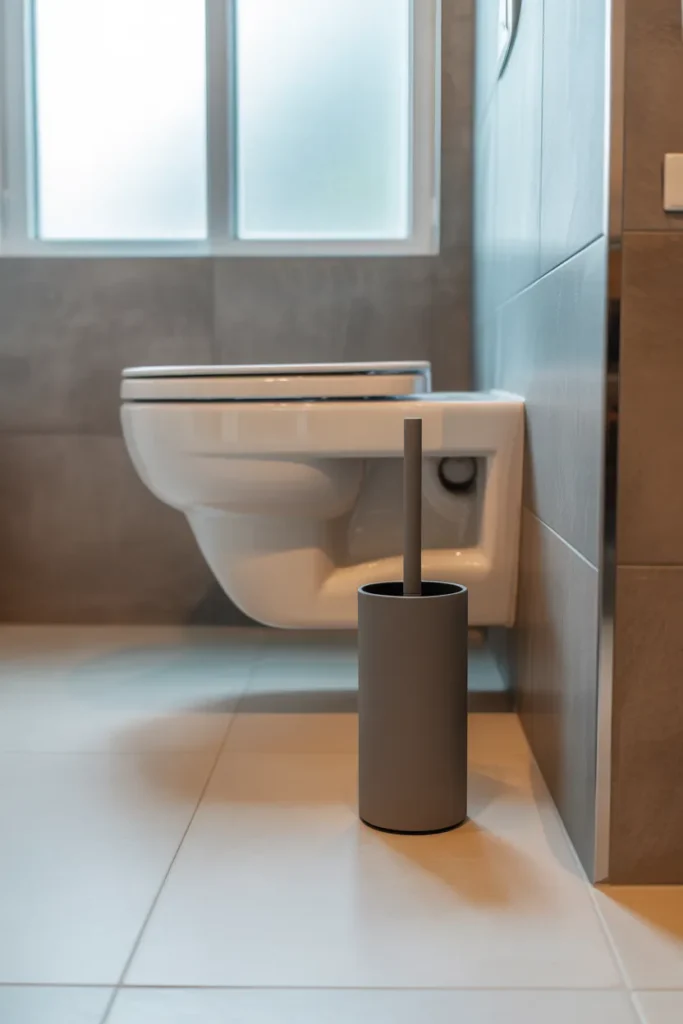
The brush holder placement matters as much as the habit itself. A brush stored behind the toilet or inside a cabinet creates a retrieval step that interrupts the routine. Position the brush holder beside the toilet at a naturally reachable point from a seated or standing position. Modern brush holders in matte black, brushed brass, or ceramic are designed to be visible without being visually disruptive — there is no longer a reason to hide this tool.
The every-other-day schedule works better than a weekly schedule for one specific reason: two days is within the window where no real buildup has occurred yet, so the scrub is genuinely quick. By day seven, light staining has already begun in most water conditions, and what should take 60 seconds starts taking three to four minutes. The shorter interval is actually less total work over the course of a month.
4. Hang Towels Flat After Every Use So They Dry Fully and Never Develop Mildew Odor
A damp towel folded in half and draped over a hook retains moisture in the folded layers for hours longer than a towel spread flat across a bar. That extended moisture is precisely the condition mildew requires to develop. A towel that smells musty after two uses is not a laundry problem — it is a drying problem. The fix is not more frequent washing. It is hanging the towel correctly every single time it is used.
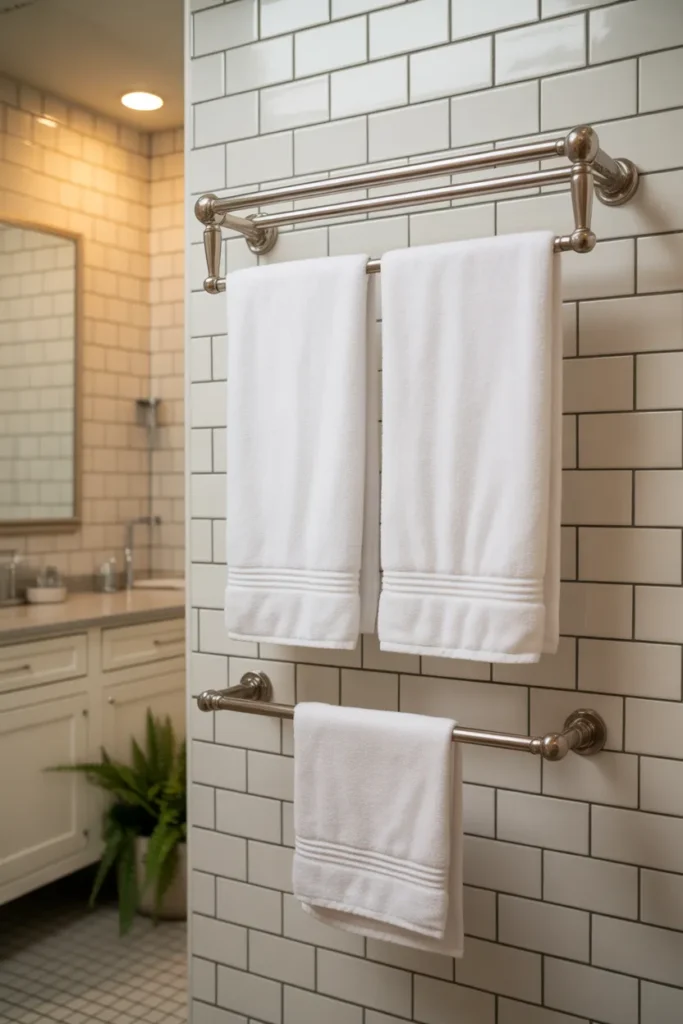
A heated towel bar or a standard towel bar positioned away from walls where air can circulate on both sides of the fabric gives a towel the best chance of drying completely between uses. A hook behind the door or on a wall where towels bunch together is the least effective drying option and the most common setup in small bathrooms — which is exactly why so many small bathroom towels develop odor quickly.
If your bathroom has only hook space and no bar, fold the towel once lengthwise and drape it over the hook so both halves hang open and parallel to the wall. This is less effective than a bar but far better than a bunched hook hang. In bathroom organization for small apartments, this single adjustment consistently extends the fresh life of a towel from two uses to four or five.
5. Empty the Bathroom Trash Can Every Three Days to Prevent Overflow and Odor
A bathroom trash can that reaches capacity and overflows becomes both a visual problem and an odor problem within hours. The fix is not a larger trash can — it is a more consistent emptying schedule. A small to medium bathroom bin emptied every three days stays consistently below capacity, never develops the compressed odor that builds in full bins, and takes under 30 seconds to empty and reline.
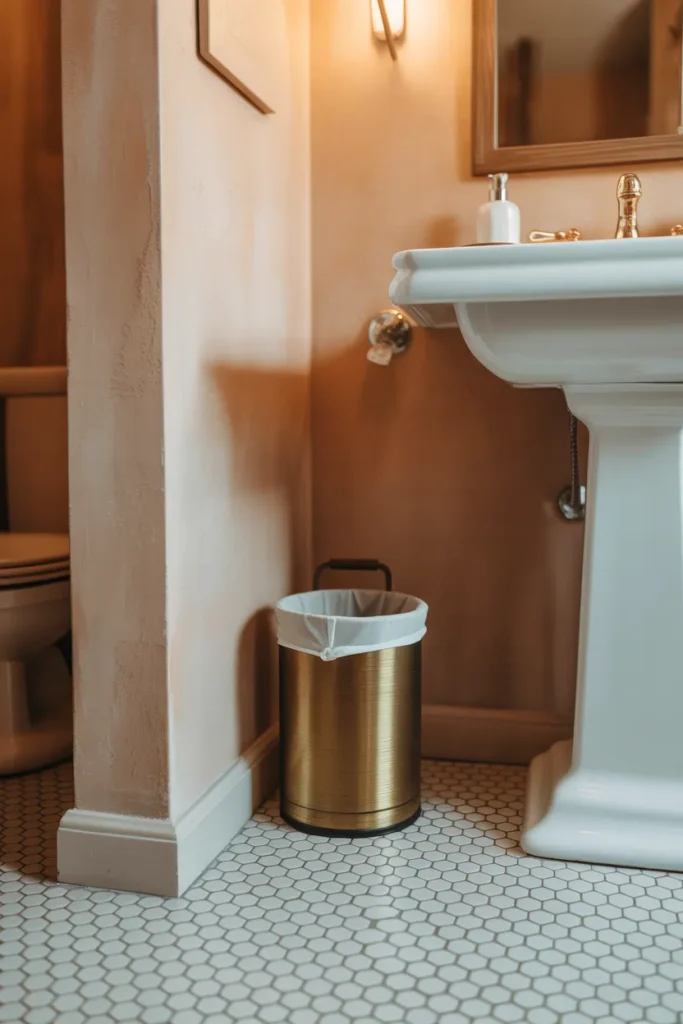
Small bathroom trash cans — under five liters — are actually the better choice for maintaining this habit because they enforce the three-day rhythm naturally. They fill at a rate that makes three-day emptying feel necessary rather than optional. A large bin encourages procrastination until overflow forces the issue.
Place the bin in a position visible from the toilet rather than tucked entirely out of sight. Visibility creates a passive reminder system — you notice the bin is getting full before it is actually full, which means you empty it one cycle earlier than you would otherwise. A bin hidden under the vanity is a bin that gets forgotten until it is a problem.
6. Decant All Products Into Matching Containers to Make Counter Organization Effortless to Maintain
Mismatched product bottles in different shapes, colors, and sizes create visual clutter even when the counter is technically clean and organized. Decanting everyday products — hand soap, cotton rounds, cotton swabs, and skincare basics — into matching containers removes the visual noise that makes a bathroom feel disorganized regardless of how clean it actually is.
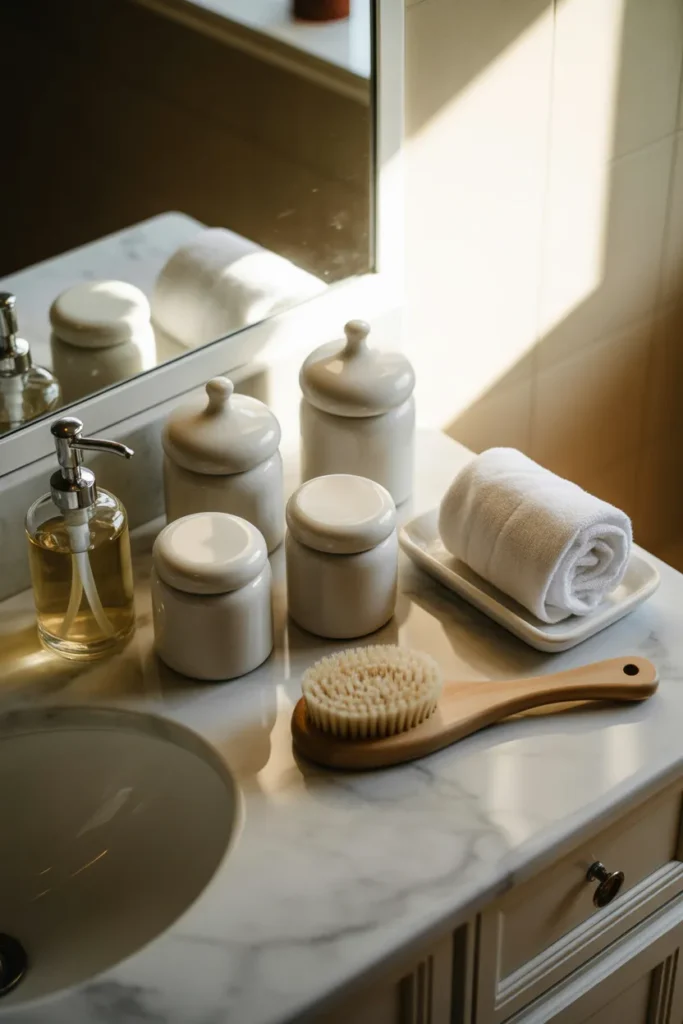
This is one of the tiny habits to keep your bathroom flawless that has the largest visual return per minute of effort invested. A counter with five matching white ceramic or clear glass containers reads as a curated, intentional space. The same counter with five different branded product bottles reads as cluttered even if the total number of items is identical.
The practical benefit beyond aesthetics is that uniform containers are easier to wipe around during the daily sink routine. Round, smooth containers with no label ridges or pump mechanisms take seconds to move and replace. Irregularly shaped retail packaging takes longer to navigate and creates gaps where soap residue and water collect unnoticed.
7. Run the Exhaust Fan During Every Shower and for 15 Minutes After to Control Moisture at the Source
Bathroom moisture is the root cause of mildew on grout, peeling paint on ceilings, swollen wood on cabinets, and the persistent musty smell that no amount of air freshener fully resolves. An exhaust fan running during the shower and for 15 minutes afterward removes the majority of airborne moisture before it has an opportunity to settle on surfaces and penetrate materials.
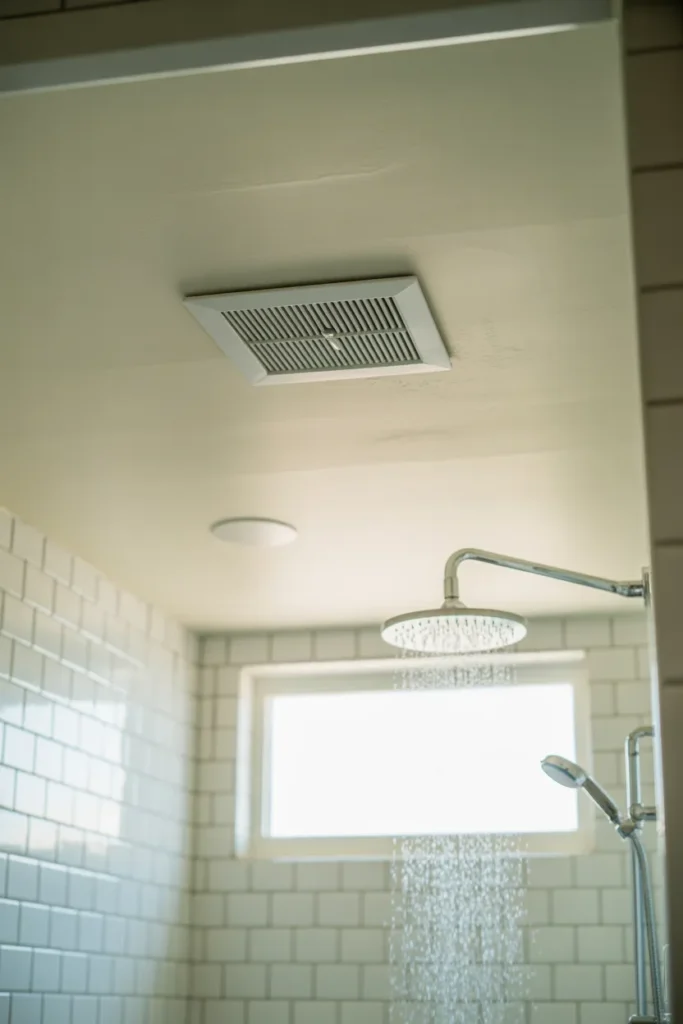
Most people turn the fan off when they leave the bathroom — which is exactly the wrong moment to stop running it. The highest concentration of airborne moisture lingers in the room for 10 to 20 minutes after the shower ends. Running the fan only during the shower removes perhaps 40 percent of the moisture load. Keeping it running for 15 minutes after addresses the remainder.
If remembering to turn the fan off is the concern, install a timer switch — a simple, inexpensive replacement for the standard switch that cuts power automatically after a set interval. Set it to 20 minutes. You will never again need to remember, and the bathroom moisture problem will resolve itself within two to three weeks of consistent fan use as residual moisture in walls and grout slowly dries out.
8. Store Only What You Use Daily on the Counter and Move Everything Else Into a Cabinet
Counter clutter in a bathroom accumulates through a pattern that is easy to recognize once you see it: items that were used once or twice get set on the counter and never moved back to their storage location. Over weeks, the counter fills with products that are used irregularly, backups of things you already have open, and items that have no clear storage home. The counter stops being a workspace and becomes a storage surface by default.
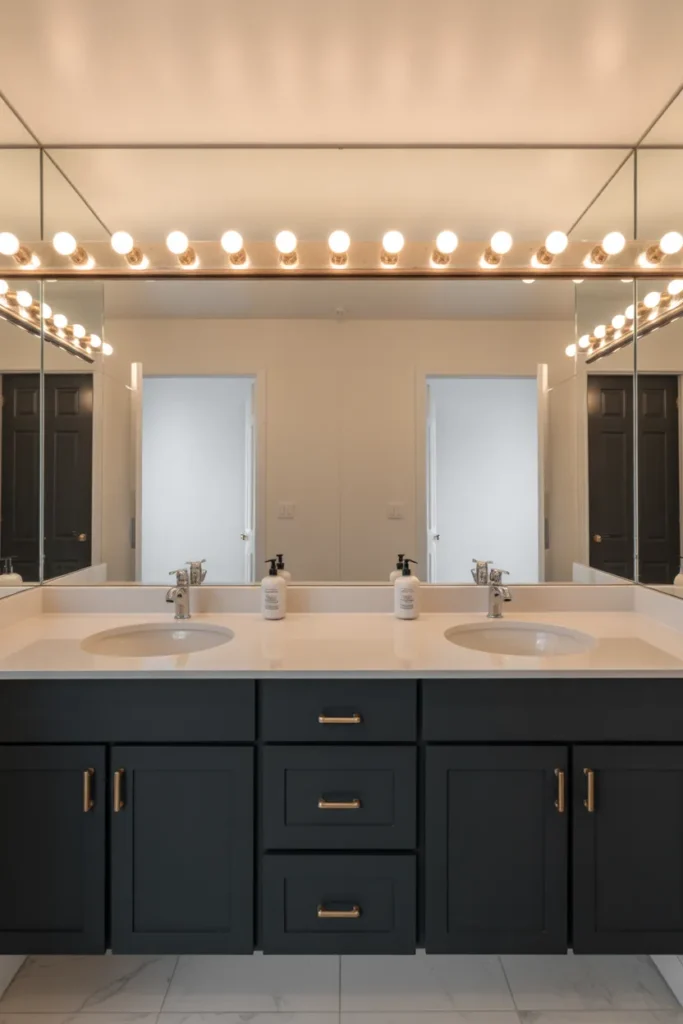
The daily-use-only rule is simple: if you did not reach for it this morning, it does not belong on the counter. Everything else goes into a drawer, a cabinet, or under-sink storage. This is not about minimalism as a design preference — it is about functionality. A clear counter is faster to wipe, easier to use, and visually calmer in a way that makes the entire bathroom feel cleaner than it may actually be.
Apply this rule once during an initial reset, then maintain it as a daily habit by returning every item to its storage location immediately after use rather than setting it back on the counter. The return habit is where most people break down. The fix is creating a specific, accessible storage location for every item that lives off the counter — a home it can reliably go back to without any decision required.
9. Wipe Mirror Surfaces Weekly With a Dry Microfiber Cloth to Eliminate Toothpaste Splatter Instantly
Bathroom mirrors attract toothpaste splatter, hairspray residue, and water spots that accumulate invisibly until one angled light source suddenly reveals weeks of buildup at once. A dry microfiber cloth — not a wet one, not a paper towel — removes all three types of residue in a single pass without streaking, which is the result most people are trying to achieve but failing to get with the wrong tool.
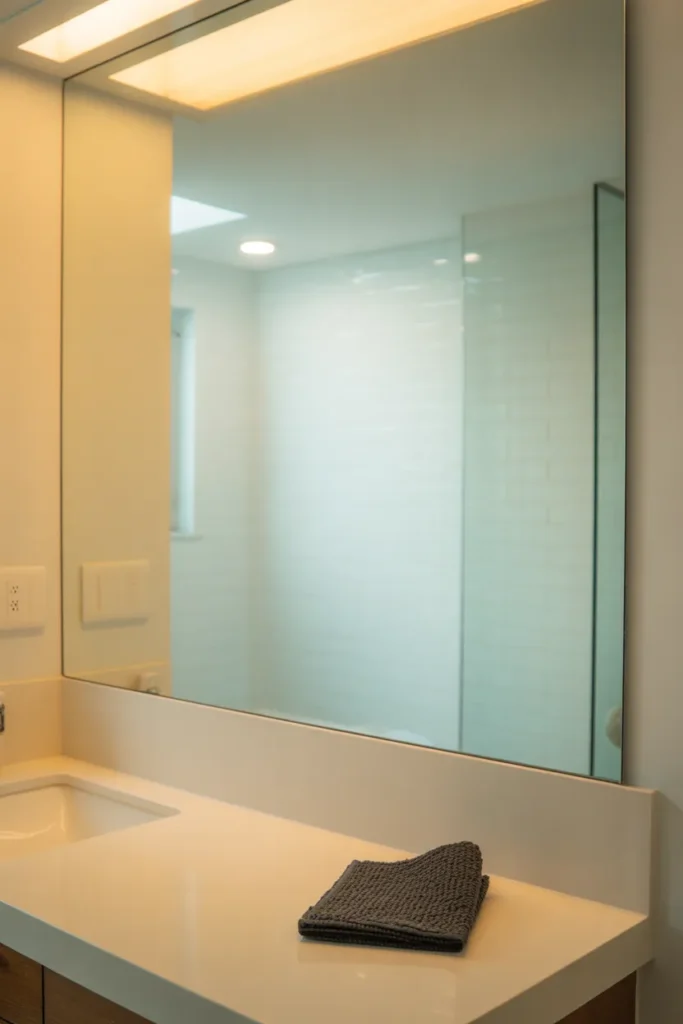
Paper towels leave lint and streaks on glass. Wet cloths spread water-based residue rather than lifting it. A dry microfiber cloth lifts particulate residue through electrostatic attraction and buffs the glass surface clean in one motion. Keep one dedicated microfiber cloth folded on the vanity or on a hook near the mirror. Its sole job is the mirror. Do not use it for anything else.
Weekly is the right frequency for most households. Daily is unnecessary unless the mirror is directly above the sink and heavily used by multiple people. Monthly is too infrequent — by four weeks, the residue has often become visible enough to require a liquid cleaner rather than a dry buff. Weekly keeps it in the maintenance zone where a dry cloth is all you ever need.
10. Do a Weekly Grout Check and Spot-Treat Any Discoloration Before It Becomes Permanent
Grout discoloration progresses through stages. In the first stage — the first few weeks of staining — it can be removed with a basic brush and a mild cleaner in under two minutes per tile section. By the third or fourth stage, it has become permanent discoloration that requires either a commercial bleaching treatment or professional re-grouting. The entire difference between a two-minute fix and a major project is catching it at stage one.
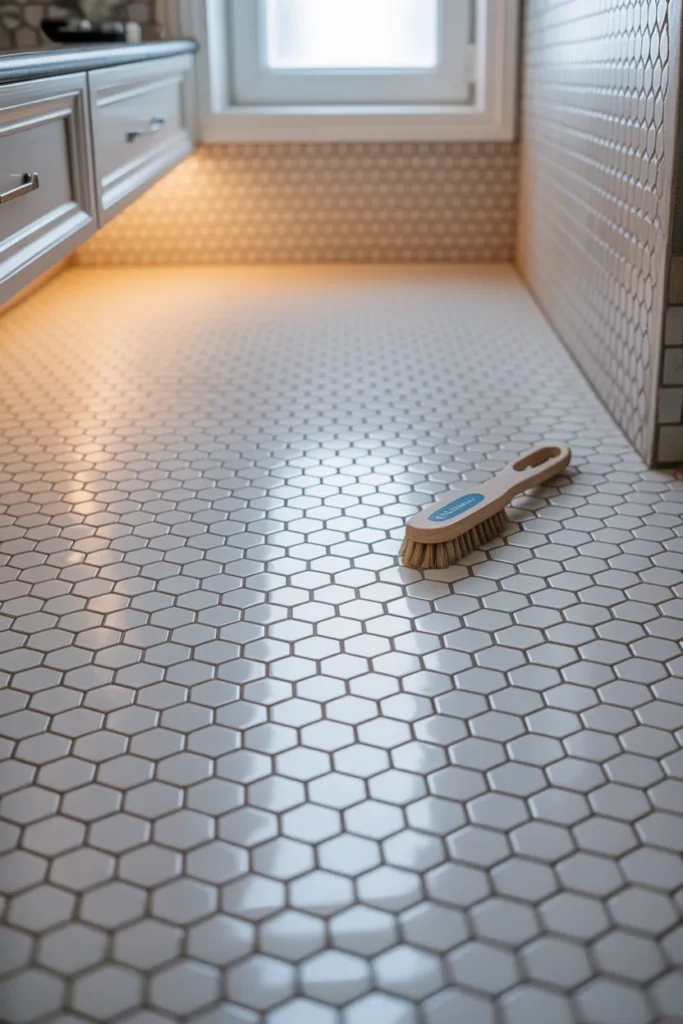
A weekly visual check of the shower and floor grout lines takes under 60 seconds. You are looking for any line that has shifted from its original color toward grey, pink, or brown. Pink discoloration specifically — which appears in warm, humid bathrooms — is a biological growth that spreads rapidly and must be addressed immediately when spotted.
Spot-treating means applying a small amount of grout cleaner to the affected line only, scrubbing with a narrow grout brush, and rinsing. The tools and product stay under the sink, ready to use. This is one of those bathroom cleaning routines that seems unnecessarily frequent until the first time you catch a problem at stage one and resolve it in 90 seconds rather than discovering it at stage four.
11. Organize Under-Sink Storage With Bins So Every Item Has a Permanent, Findable Home
The cabinet under the bathroom sink is the space most likely to become a disorganized pile of loosely stored products, half-empty bottles, and items that have no logical storage category. When nothing has a fixed location, restocking and retrieval require searching through the entire cabinet every time, which means items get pushed to the back, expiration dates go unnoticed, and duplicates accumulate because you could not find the original.
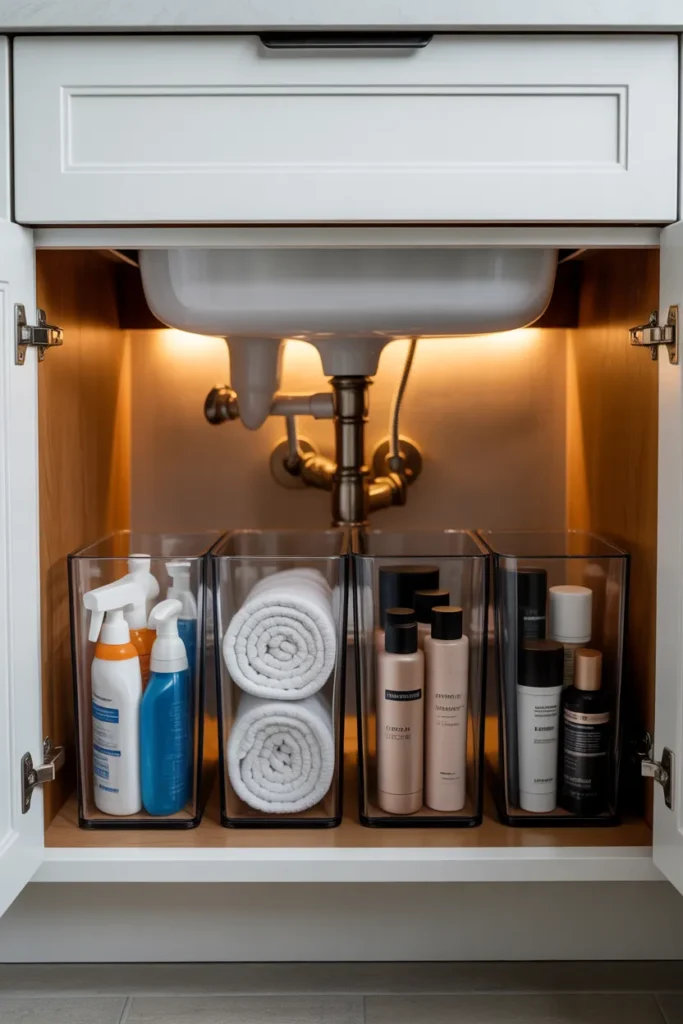
Dividing the under-sink cabinet into three to four clear or labeled bins — one for cleaning supplies, one for skincare and body care backups, one for hair tools, and one for first aid or medication — takes one organizational session and maintains itself indefinitely as long as every item is returned to the correct bin after use.
Clear bins are more functional than opaque ones in this context because they allow visual inventory without removing items. You can see at a glance that the cleaning bin is running low on supplies without emptying it onto the floor. In bathroom organization for small apartments and compact bathrooms where under-sink space is the primary storage zone, this system is what separates a bathroom that stays organized from one that requires a monthly reset.
12. Replace Bar Soap With a Pump Dispenser to Eliminate Soap Dish Residue Permanently
A bar of soap sitting in a soap dish leaves a permanent wet residue problem. Water collects under the bar, the soap softens and disintegrates faster than it should, and the dish itself requires cleaning every few days to remove the gelatinous film that forms beneath a wet bar. This is a small but persistent bathroom maintenance problem that is entirely eliminated by switching to a pump dispenser filled with liquid hand soap.
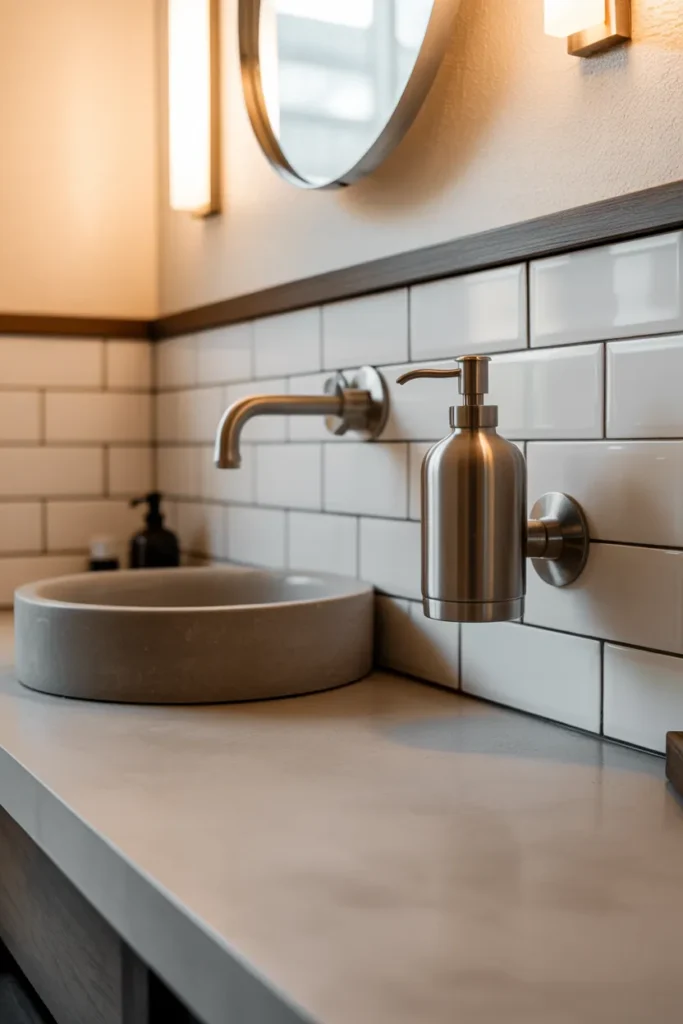
A pump dispenser on the counter or mounted to the wall beside the sink produces no residue, no dish to clean, and no soap that dissolves faster than you can use it. The dispenser itself wipes clean in one pass during the daily vanity wipe-down. The switch is permanent — once made, it eliminates the soap dish problem from your maintenance list entirely.
Wall-mounted pump dispensers are the superior option in small bathrooms because they free counter space and cannot be knocked over. A single recessed or surface-mounted dispenser beside the sink delivers the same function as a counter pump with zero footprint. In bathroom organization for small spaces, eliminating the soap dish is one of the fastest single decisions with the highest immediate impact on countertop cleanliness.
13. Fold Towels in a Consistent Style and Stack Them the Same Way Every Time for Instant Visual Order
Towels that are folded inconsistently — some in thirds, some in half, some rolled, some flat — create visual disorder on a shelf or in a cabinet even when the towels themselves are clean. A single folding method applied consistently every time produces a bathroom linen storage area that looks organized at all times without any additional effort beyond the folding itself.
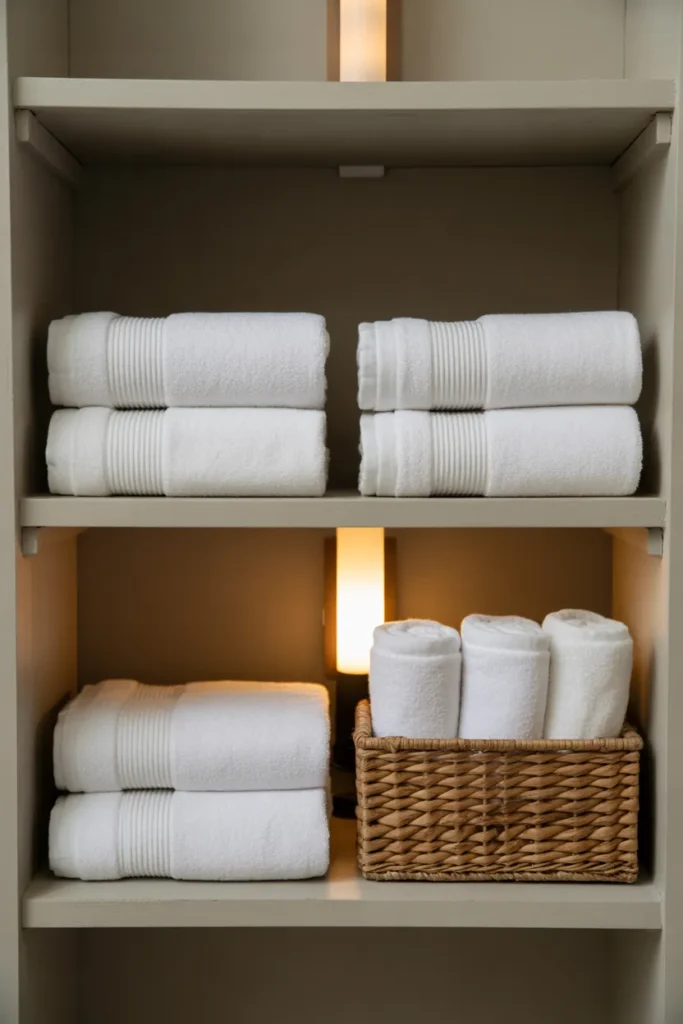
The spa fold — folded in thirds lengthwise, then in half, then in thirds again — is the most compact and visually consistent option for shelf display. The rolled format works well for baskets and open shelving where you want a casual, layered look. Choose one method per storage location and use it every single time without exception.
This is one of those tiny habits to keep your bathroom flawless that requires no products, no tools, and no time investment beyond what laundry folding already demands. The only change is standardizing the method. The visual return is immediate and requires zero maintenance once the habit is established. Guests consistently notice well-folded towel stacks — they are one of the fastest signals of a well-maintained bathroom.
14. Use a Caddy Inside the Shower to Keep Products Off the Floor and Out of Grout Corners
Products stored directly on the shower floor or in the corners of the shower create two separate problems. First, they prevent that area of the floor from drying completely between uses, which accelerates mildew growth in the grout surrounding them. Second, the rings and residue left by product bottles sitting on tile are among the most stubborn bathroom stains to remove once they have set.
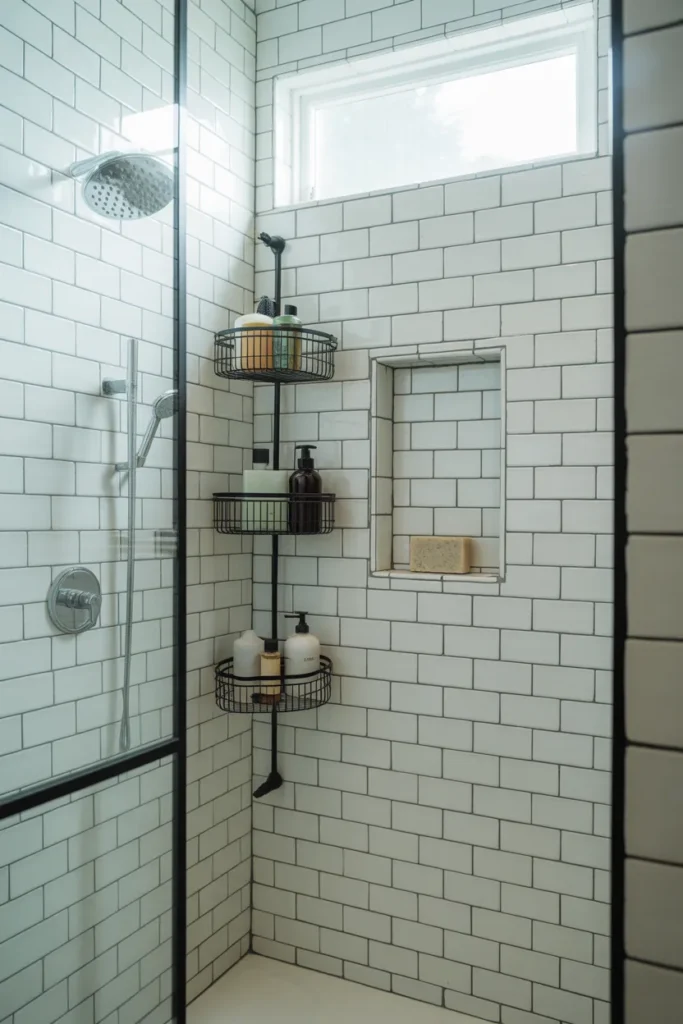
A shower caddy — either tension-pole mounted, corner-mounted, or hanging from the showerhead bar — lifts every product off the floor and positions it at a height where it can drain freely and dry between uses. The shower floor stays fully exposed, fully draining, and fully dry, which is the condition it needs to be in to resist mildew development.
Choose a caddy with open wire or mesh shelves rather than solid shelves. Solid shelves trap water under the products and create the same problem you were trying to eliminate. Open shelves allow air and water to pass through freely so both the caddy and the products stored on it dry completely after each shower. In bathroom cleaning routines for small showers, this single addition consistently reduces floor and corner grout maintenance by more than half.
15. Deep-Clean One Small Zone Per Week Instead of Attempting a Full Bathroom Overhaul Monthly
A full bathroom deep-clean attempted monthly is a 45-to-90-minute task that most people avoid, delay, and eventually rush through incompletely. Dividing the bathroom into five zones — toilet, shower, tub, vanity and sink, and floor — and deep-cleaning one zone per week turns the same total effort into five sessions of under 15 minutes each, spread across the month with no single session long enough to feel burdensome.
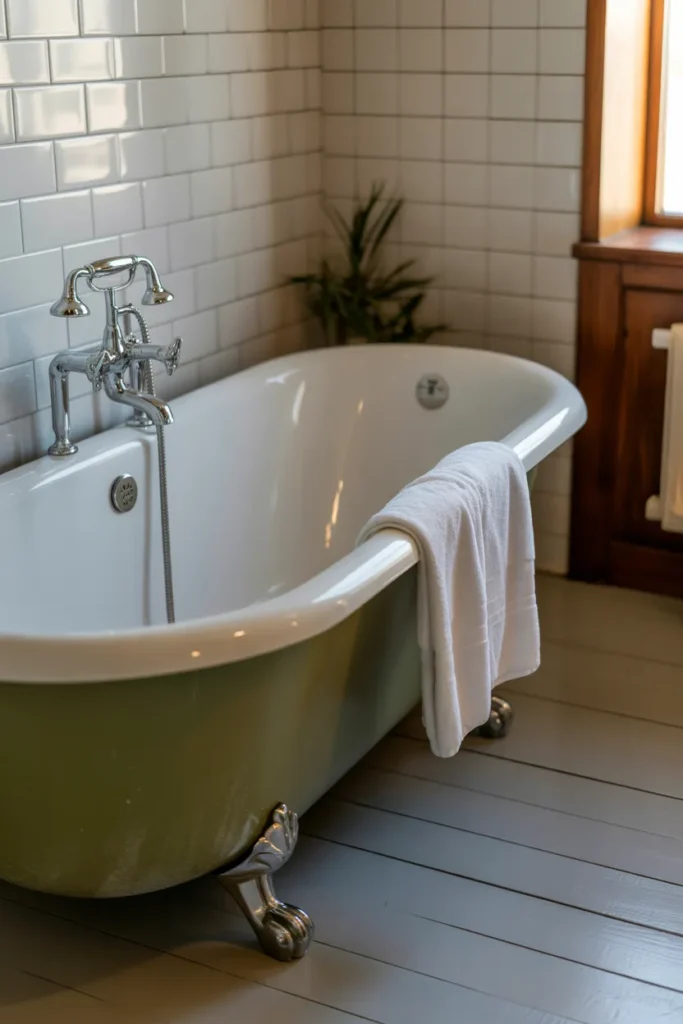
Week one covers the toilet inside and out, including the base and the area behind it. Week two is the shower walls, door, and fixtures. Week three is the sink, faucet, and vanity cabinet fronts. Week four is the floor, baseboards, and any remaining surfaces. The fifth session, in months that have it, is used for the medicine cabinet or linen storage reset.
This is one of the most structurally sound bathroom cleaning routines for households that struggle to maintain consistency. The sessions are short enough to complete in a genuinely spare 10 minutes, which means they happen on schedule rather than being pushed to the weekend, then the following weekend, then the one after that. Regularity at a lower intensity produces a cleaner bathroom than intensity applied rarely.
16. Lay a Non-Slip Mat Outside the Shower That Dries Quickly and Gets Washed Weekly
A bath mat that stays permanently damp on the floor becomes a mildew source within days — not weeks. Most fabric bath mats hold moisture for four to six hours after a shower, and in bathrooms with limited ventilation, they never fully dry between uses. A mat that never fully dries is not doing its job as a hygiene surface. It is adding to the moisture problem it was intended to manage.
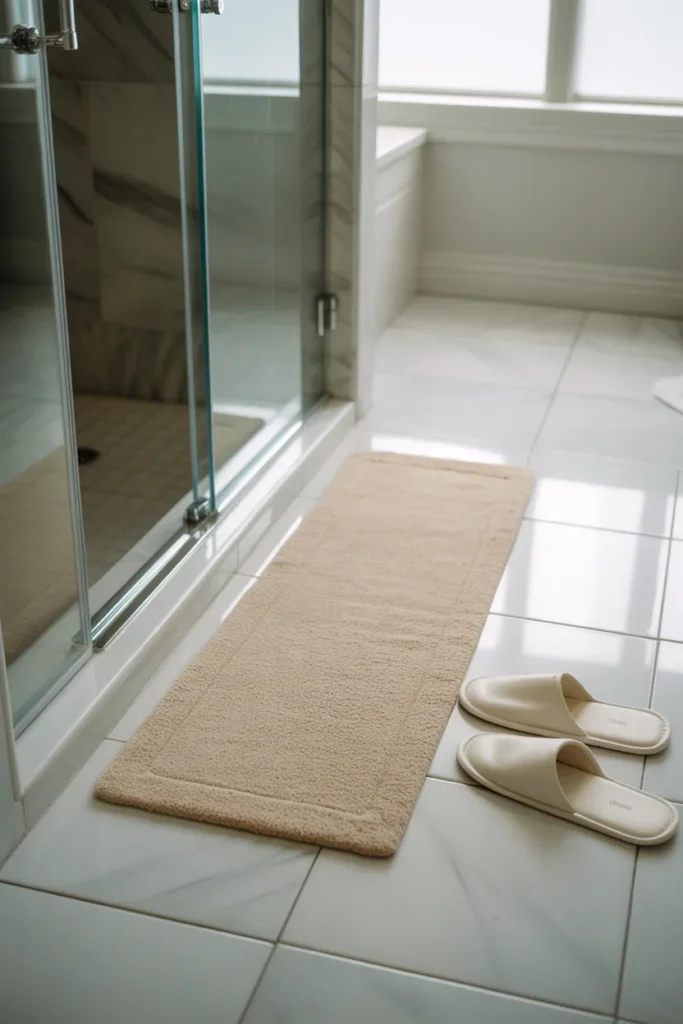
Choose a mat made from fast-drying materials — diatomaceous earth stone mats, open-weave cotton, or microfiber — rather than a thick looped terry mat that holds moisture in its pile for hours. These materials dry in 20 to 40 minutes after use, which is fast enough to be genuinely dry between shower sessions in most households.
Wash the mat weekly regardless of how clean it appears. Bathroom floors host more bacteria per square inch than most surfaces in the home, and a mat that contacts both wet feet and the bathroom floor accumulates that load quickly. A weekly wash cycle is the difference between a mat that is clean and one that only looks clean from a distance.
17. Label Storage Containers So Every Household Member Returns Items to the Correct Location
A bathroom that one person keeps organized often falls apart when multiple people use the same space. The reason is almost never intentional disorganization — it is that other household members do not know where things belong. A label on every container, bin, and basket removes the ambiguity that leads to items being set down in the wrong location, which is where bathroom counter clutter originates in shared spaces.
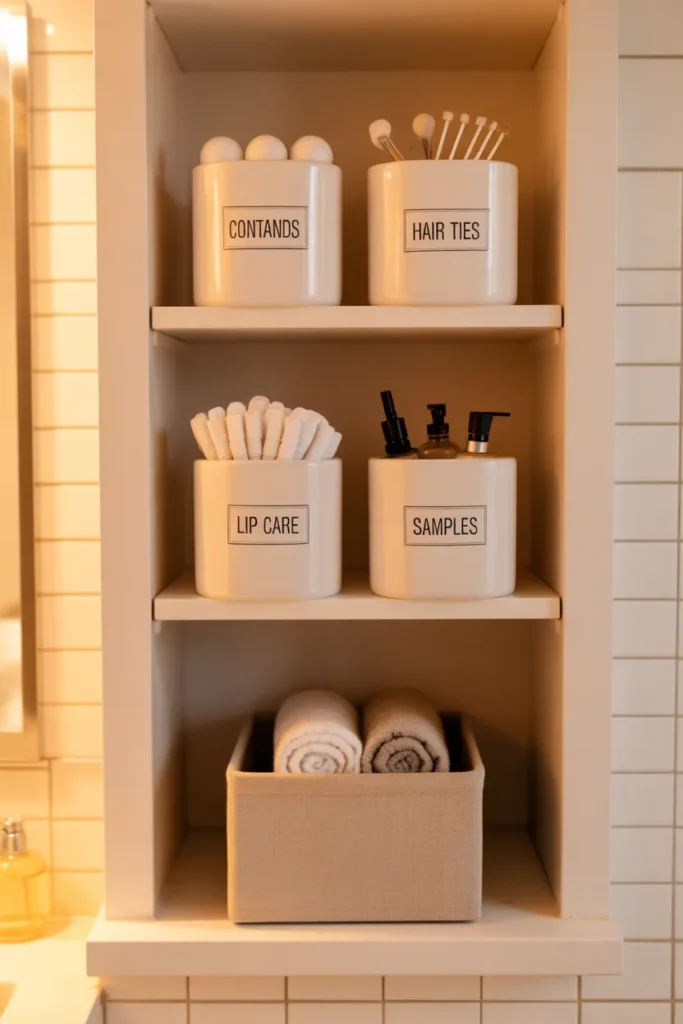
Labels do not need to be elaborate. A simple printed or hand-lettered adhesive label on the front face of each storage container is enough to create a shared understanding of the organizational system. Once every household member knows where each category of items belongs, the system maintains itself without ongoing instruction or correction.
This approach is particularly effective in bathroom organization for families with children. Children who can read will use a label system reliably once the habit is established — they do not need to remember where things go because the label tells them. In households where multiple adults share a bathroom, labels shift the organizational responsibility from a single person managing everything to a shared system everyone participates in.
18. Spot-Clean the Toilet Exterior Three Times Per Week to Prevent Germ Accumulation
The toilet exterior — the seat, lid, tank, and base — is touched multiple times daily and cleaned, in most households, only during the weekly or biweekly full bathroom clean. The gap between cleaning sessions is long enough for bacteria to accumulate to levels that create both a hygiene concern and an odor issue that no amount of air freshener addresses at the source.
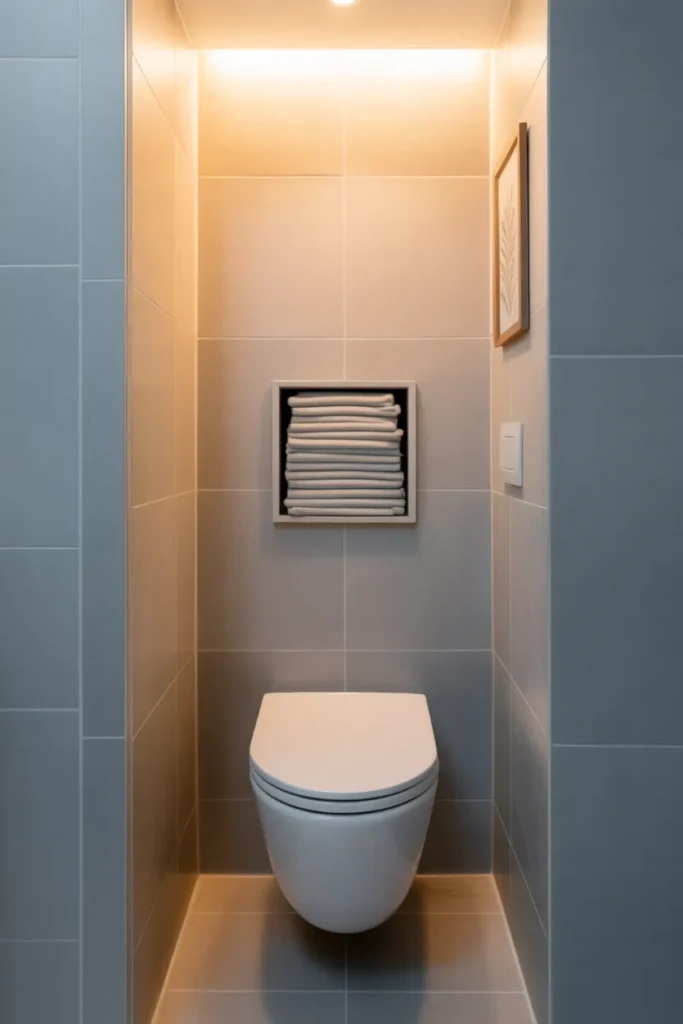
A disinfecting wipe kept in a dispenser visible beside the toilet makes a 45-second exterior wipe-down genuinely effortless three times per week. The wipe covers the seat top, seat underside, lid, and the immediate floor area at the base — the four surfaces that accumulate the most between full cleaning sessions. Three sessions per week keeps the surfaces below the threshold where visible soil or odor develops.
The placement of the wipe dispenser is the deciding factor in whether this habit holds. Mounted on the wall beside the toilet or sitting on a small shelf within arm’s reach, the wipes require no movement to access. Stored under the sink, they require a specific retrieval action that will be skipped 80 percent of the time. Accessibility determines consistency in all bathroom cleaning habits, and this one is no exception.
19. Air Out the Bathroom for 10 Minutes After Every Shower by Opening a Window or Door
Exhaust fans handle airborne moisture efficiently, but natural air movement through an open window or door adds a second layer of moisture and odor management that mechanical ventilation alone does not fully replicate. Ten minutes of open-door or open-window airflow after a shower accelerates surface drying on walls, floors, and fixtures, which directly reduces the conditions that allow mildew to develop between cleaning sessions.

In bathrooms with a window, open it fully during and after the shower whenever outdoor temperature allows. A five-degree temperature differential between indoor and outdoor air creates enough convective airflow to move moisture out of the room passively. In colder months where opening a window is impractical, leaving the bathroom door fully open after showering achieves a slower but still meaningful ventilation effect through the connected living space.
This habit pairs directly with the exhaust fan habit covered earlier in this guide. Used together — fan running for 15 minutes after the shower, door or window open simultaneously — they reduce bathroom moisture levels more effectively than either measure alone. In bathrooms that struggle with persistent mildew despite regular cleaning, this combination often resolves the problem without any additional chemical treatment.
20. Do a Two-Minute Visual Reset Every Night Before Bed to Wake Up to a Flawless Bathroom
The state of a bathroom first thing in the morning is almost entirely determined by what happened in it the night before. A two-minute visual reset before bed — returning products to their locations, hanging towels flat, wiping the sink, straightening the mat — means the bathroom is in its best state when you start the next day rather than carrying the previous day’s disorder forward into the morning routine.
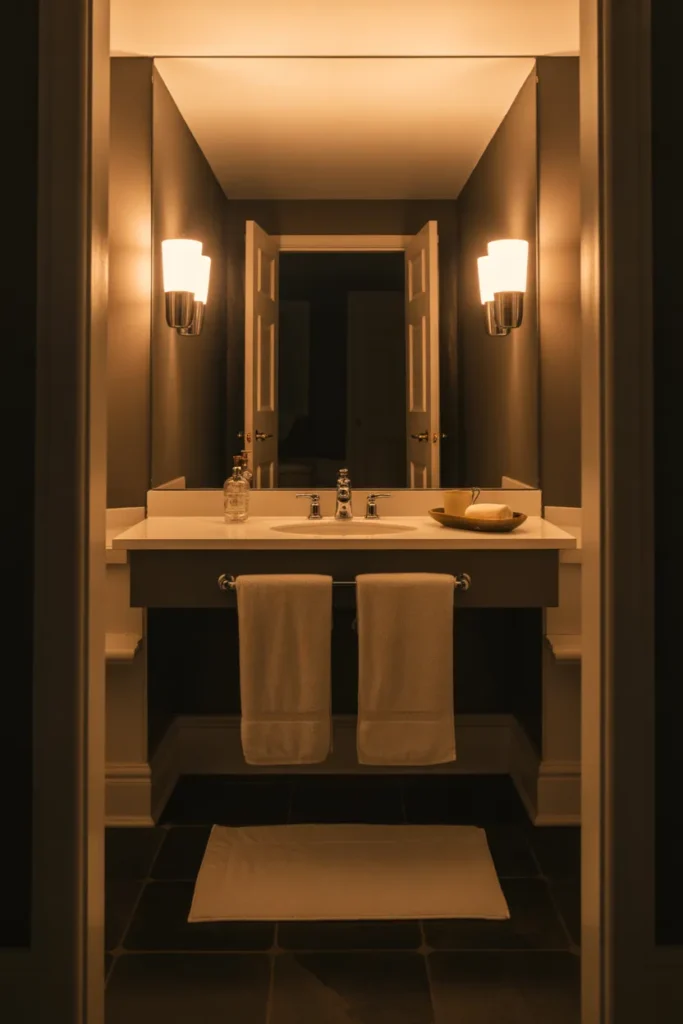
This habit is the capstone of all the tiny habits to keep your bathroom flawless covered in this guide. The individual daily and weekly routines handle specific maintenance tasks. The nightly reset is the habit that keeps all those systems from drifting. It takes two minutes precisely because the other habits have prevented any single problem from becoming significant enough to require more.
Start the reset habit at a consistent trigger point — immediately after brushing teeth, or when the bedroom lights go off. Attaching it to an existing nightly routine eliminates the need to remember it as a separate task. Within two weeks it becomes invisible, requiring no conscious decision to initiate. That is the definition of a habit that holds — and a bathroom that stays flawless without ever feeling like work.
Final Thoughts
A flawless bathroom is not the result of long cleaning sessions — it is the result of short, consistent habits that address problems before they grow into ones that demand your time and energy. Every routine in this guide is designed to take under two minutes when applied regularly, and together they create a bathroom that stays clean, organized, and visually calm every single day.
Save this post before you start building your routine. Returning to a specific habit when you need a reminder is far easier than trying to recall every detail from memory. If you want to go further, explore small bathroom organization ideas and daily home cleaning routines to build a system that keeps every room in your home as well-maintained as your bathroom will be.