
If you are searching for dark kitchen ideas 2026 that go beyond mood boards and actually help you make smarter design decisions, this post is built for you. Dark kitchens are no longer a bold risk — they are one of the most practical and timeless directions in American home design right now. Below you will find 18 distinct ideas, each with layout guidance, material advice, and honest notes on what works and what does not.
1. Matte Black Flat-Front Cabinets in a Single-Wall Galley Layout
Flat-front matte black cabinets work exceptionally well in a single-wall galley kitchen because they eliminate visual clutter in a narrow space. The absence of hardware and raised paneling keeps the eye moving horizontally, which makes the room feel longer rather than cramped.
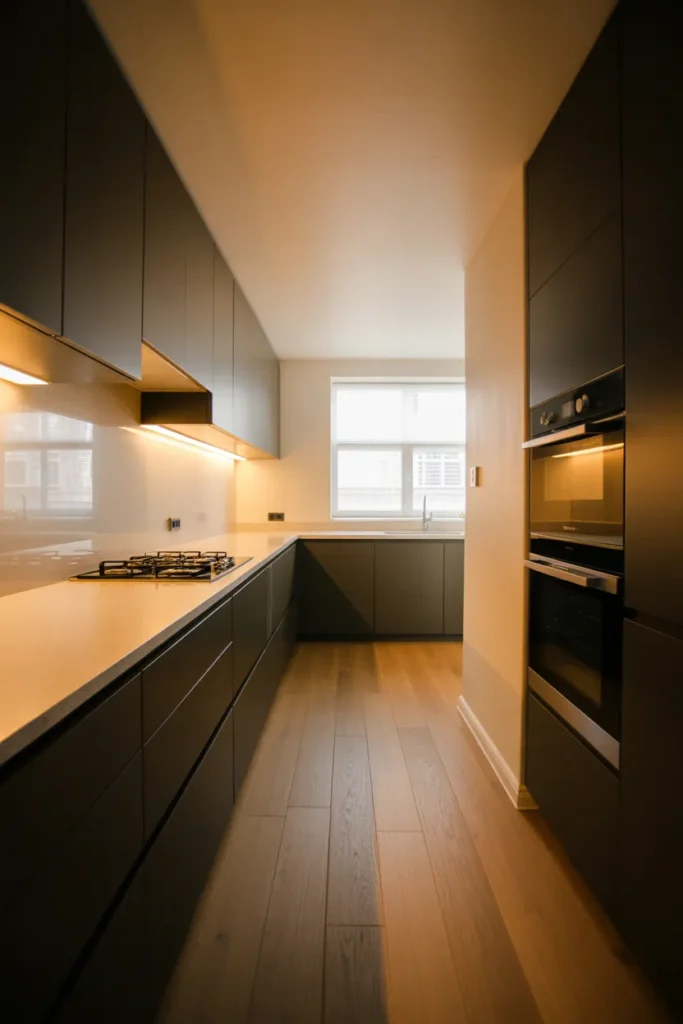
This layout is best suited for apartments, condos, or homes where the kitchen runs along one wall and opens into a living or dining area. If your kitchen already feels tight, a single-wall galley with dark flat-fronts avoids the boxed-in feeling that raised-panel dark cabinetry can create.

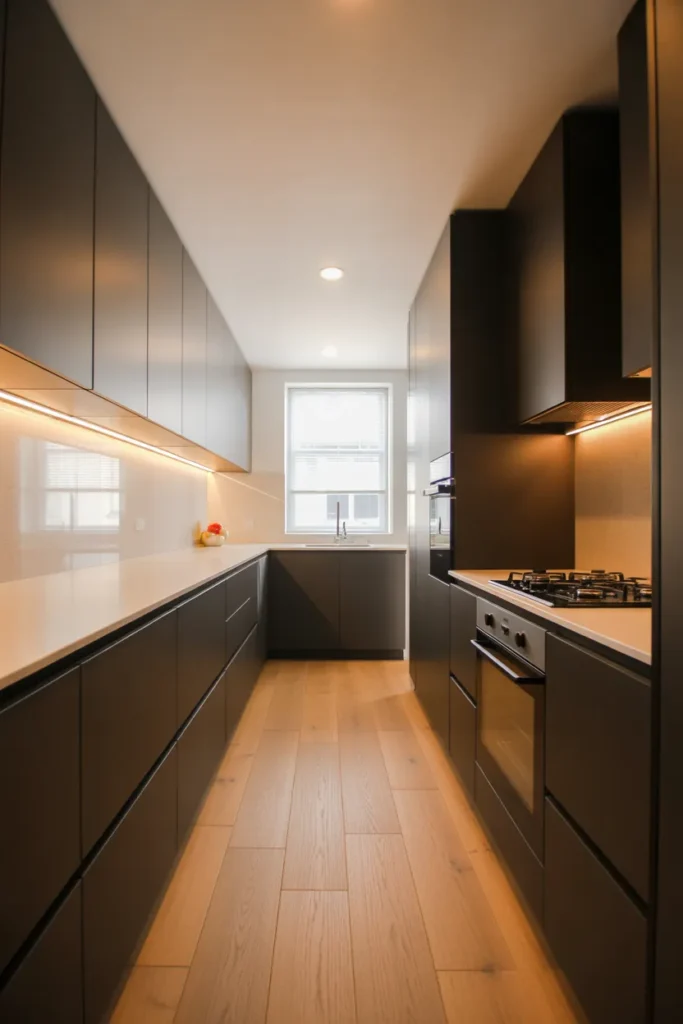
The most common mistake here is pairing matte black with low ceilings and no under-cabinet lighting. Without a light source at counter level, the workspace becomes functionally dark, not just aesthetically dark. Add a continuous LED strip under the upper cabinets before anything else.
2. Deep Navy Blue Shaker Cabinets in an L-Shape Layout With Open Shelving
Navy blue sits in a unique space between dark and approachable. In an L-shape layout, deep navy shaker cabinets bring structure to the corner configuration while keeping the room from feeling entirely closed off. The raised shaker detail adds dimension that flat-fronts cannot deliver in a larger space.
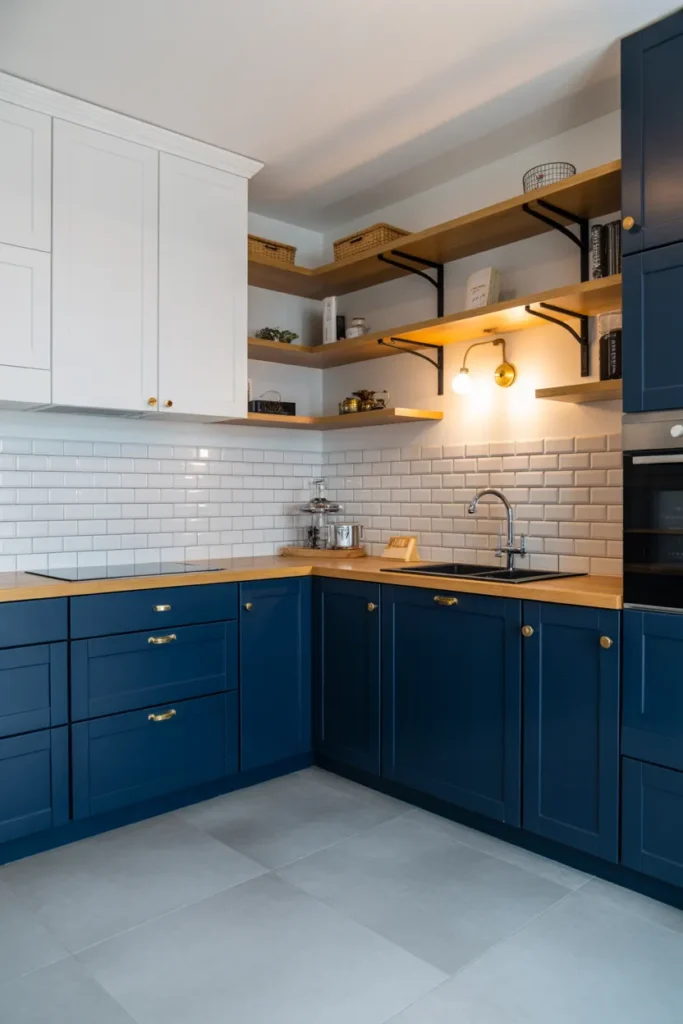
This combination works particularly well in homes with natural wood floors and white or cream walls. The navy anchors the kitchen without competing with the rest of the room. Open shelving on the shorter leg of the L adds visual breathing room and a practical display zone for ceramics or glassware.
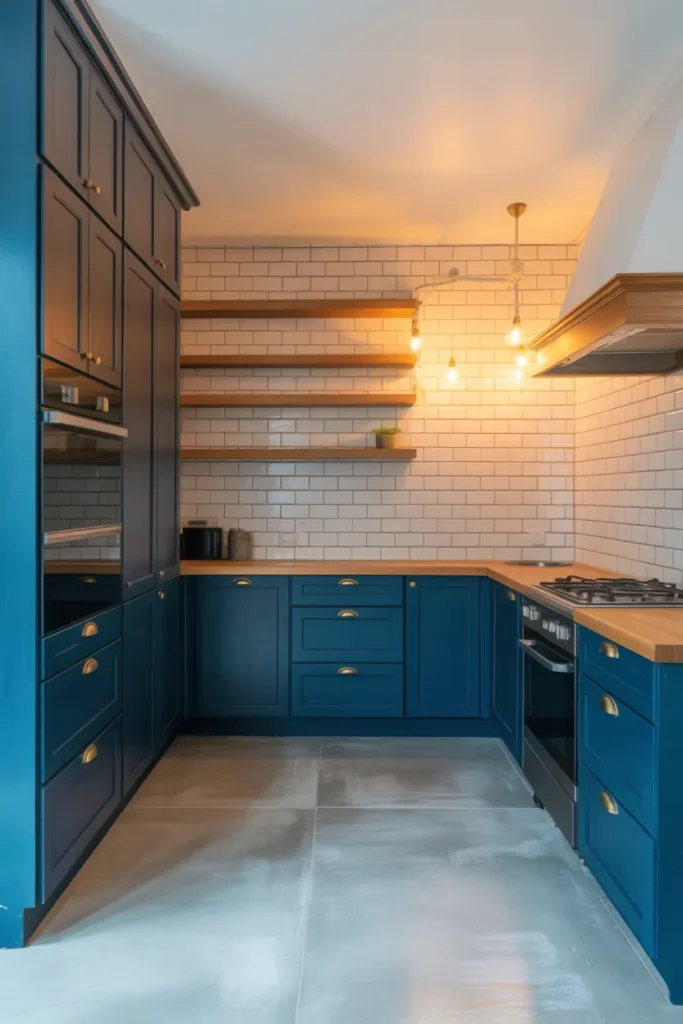
Avoid using navy on all upper and lower cabinets if your kitchen receives limited natural light. In that situation, keep upper cabinets open-shelf or paint them a warm white. The contrast between the dark lower cabinets and lighter upper zone is one of the most functional kitchen space planning ideas for darker rooms.
3. Charcoal Gray Kitchen With a Waterfall Island in an Open-Plan Layout
A charcoal gray kitchen is one of the most versatile dark kitchen directions for open-plan layouts because it bridges the gap between the kitchen and adjacent living spaces without feeling disconnected. Charcoal reads as neutral in most lighting conditions, which means it does not fight with sofas, rugs, or furniture in the connected room.
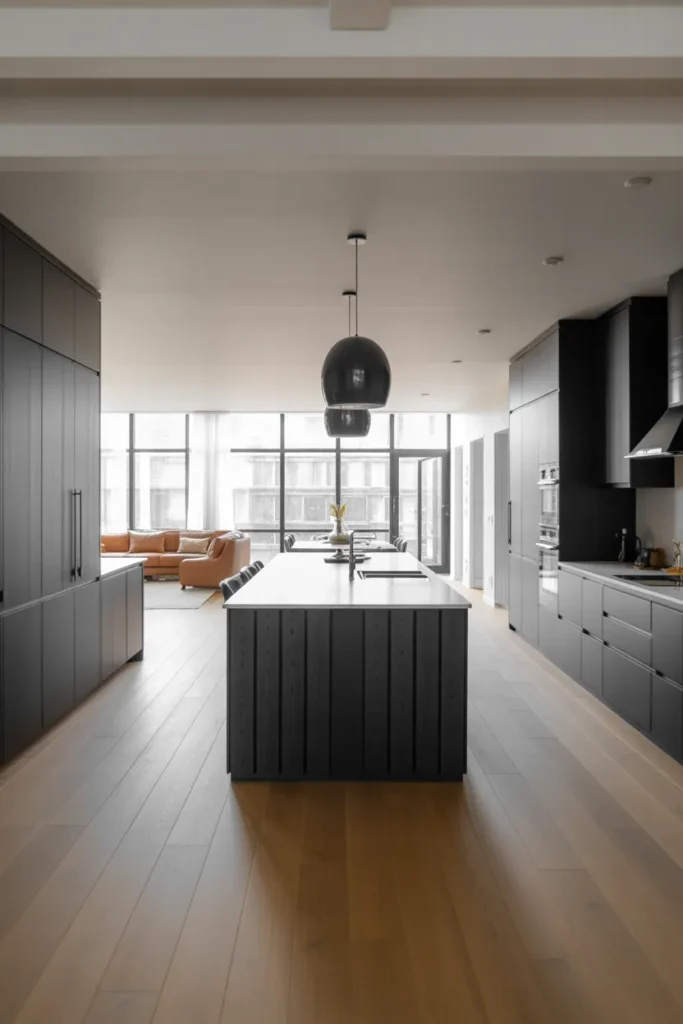
A waterfall island in the same charcoal tone creates a sculptural centerpiece that anchors the open layout. The continuous surface from countertop to floor on both ends gives the island a finished, architectural quality that a standard island cannot replicate. This detail elevates the space without adding structural complexity.
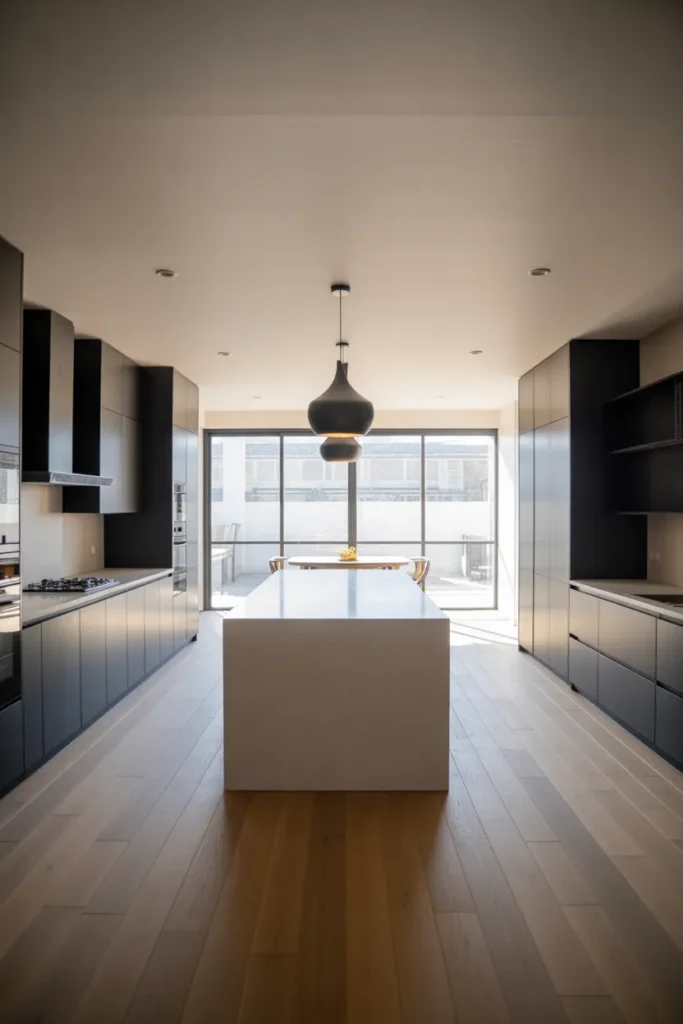
In an open kitchen layout, one of the most common planning errors is using the same dark tone on the island and all perimeter cabinets. This can make the kitchen zone feel like a dark block floating in the room. Consider keeping the island in charcoal and the perimeter cabinets in a slightly lighter complementary tone, such as warm taupe or greige.
4. Forest Green Lower Cabinets With Black Countertops in a U-Shape Kitchen
Forest green is one of the most talked-about directions in modern kitchen layout ideas 2026, and the U-shape configuration gives it room to breathe. The three-wall wraparound layout means the green is distributed evenly rather than concentrated on one wall, which prevents it from feeling heavy or overpowering.
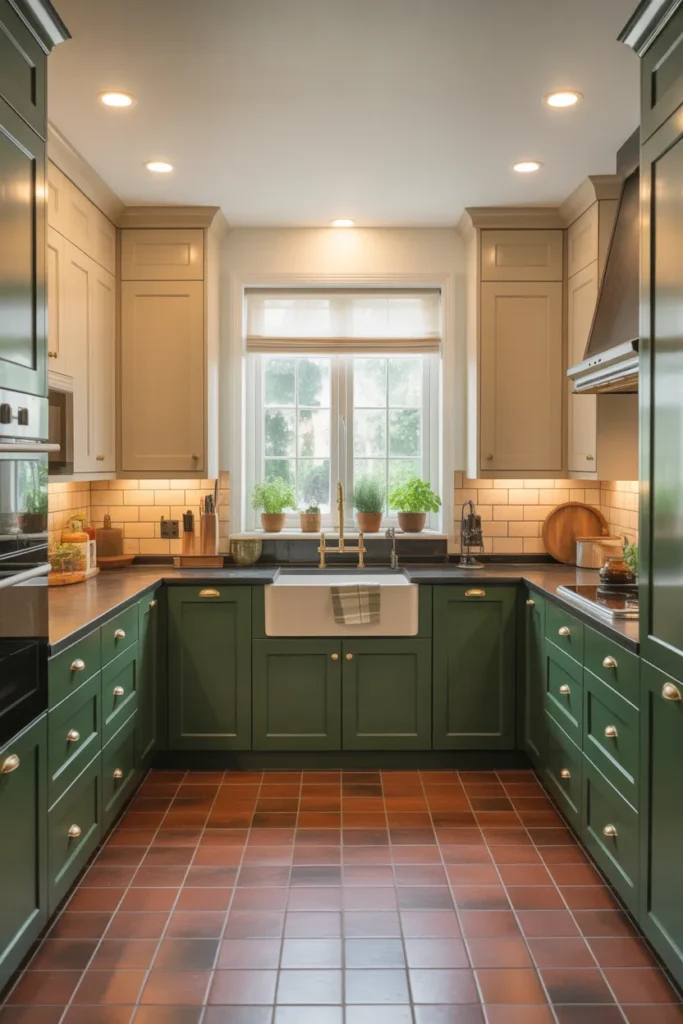
Pairing forest green lower cabinets with a honed black granite or matte black quartz countertop grounds the entire look. The tonal similarity between green and black creates a cohesive depth, while the green still reads clearly as the dominant color. White or off-white upper cabinets complete the balance.
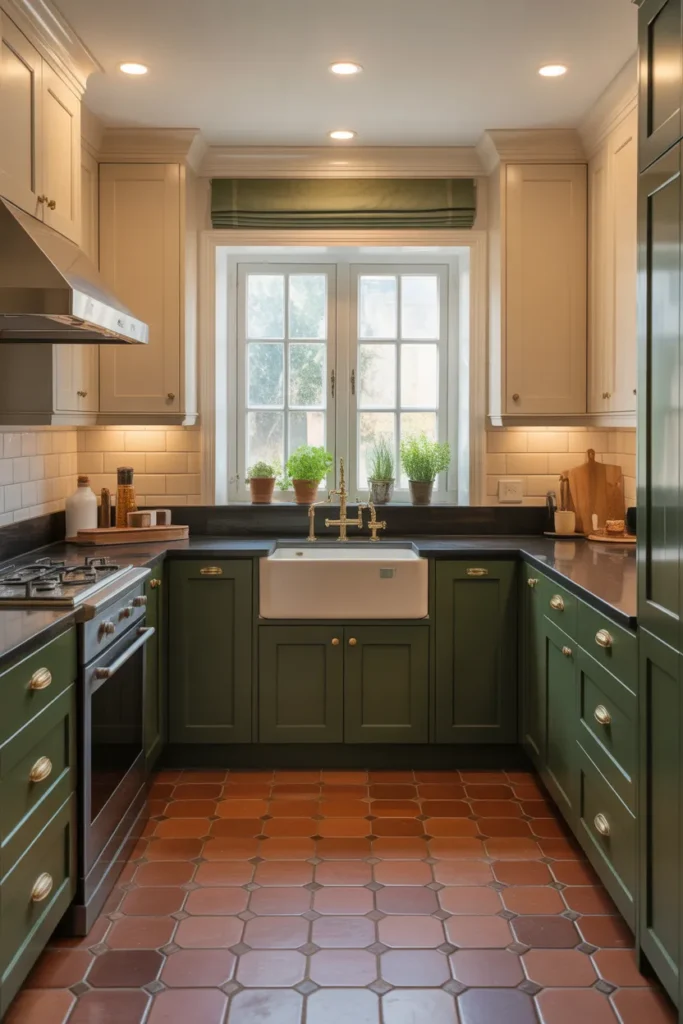
The U-shape is one of the most functional kitchen floor plans available because it maximizes counter space and creates a natural work triangle between the sink, stove, and refrigerator. If you are working with a larger kitchen and want dark color without sacrificing workflow, this layout delivers both.
5. Black Stained Wood Cabinets With Warm Brass Accents in a Two-Wall Layout
Black stained wood is one of the most underused materials in dark kitchen design. Unlike painted black cabinets, stained wood retains the grain texture, which adds warmth and prevents the kitchen from feeling cold or industrial. In a two-wall kitchen layout, where cabinets face each other across a corridor, this warmth is essential.
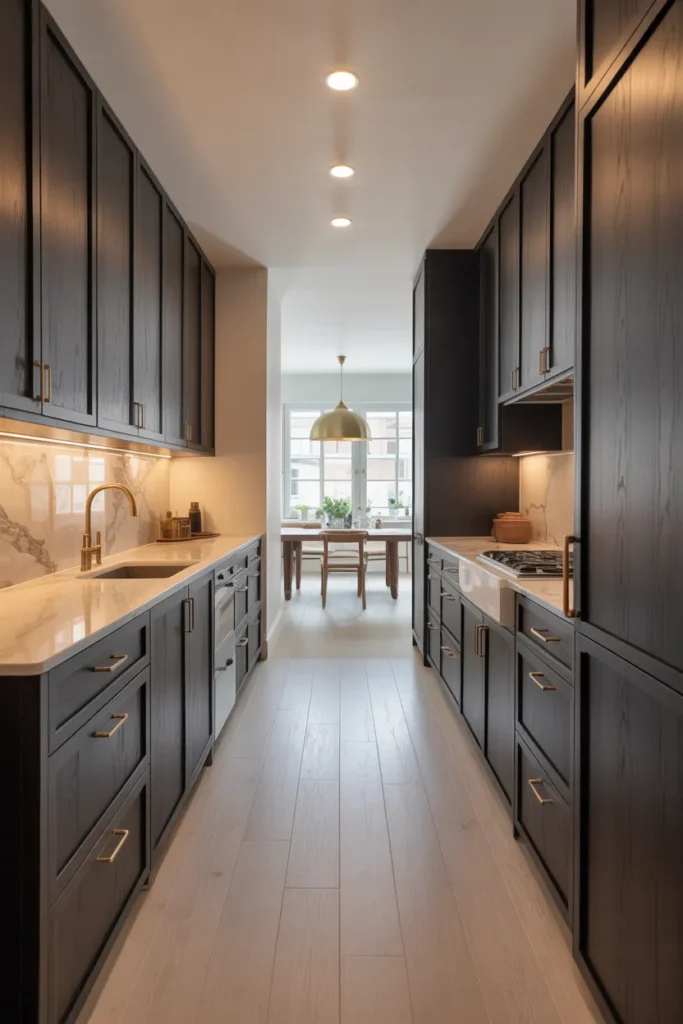
Warm brass hardware and fixtures are the natural pairing for black stained wood. The yellow-gold undertone in brass pulls out the warm brown tones hidden in the stained grain, creating a layered look that feels more like furniture than cabinetry. This is one of the small kitchen layout design approaches that punches significantly above its square footage.
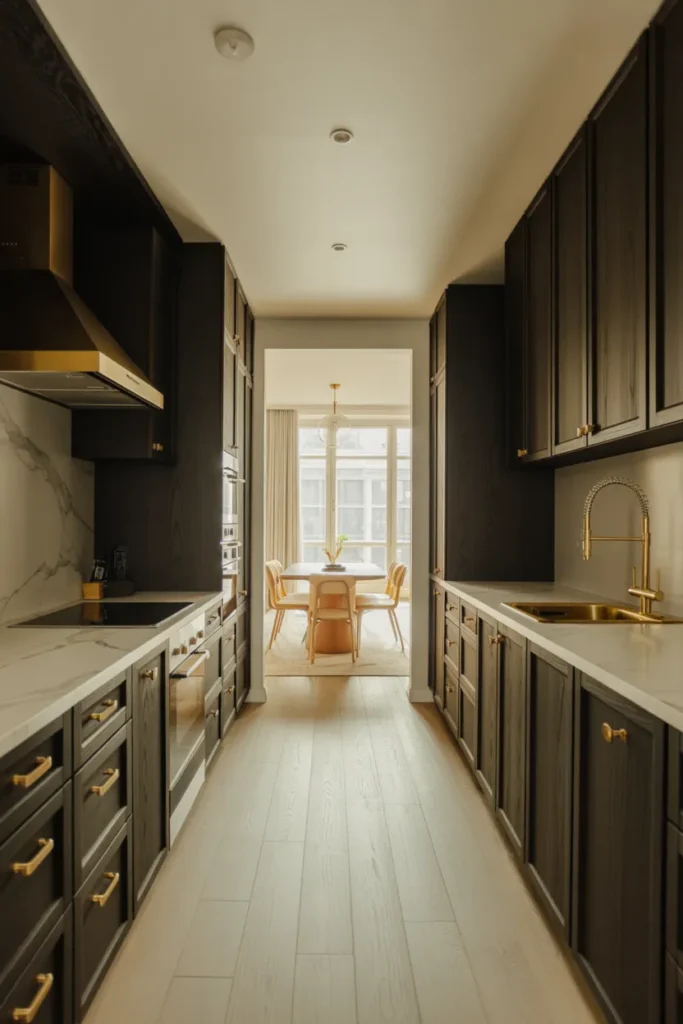
This combination suits homes with warm-toned interiors — think aged wood floors, cream walls, or linen textiles. It is not the right fit for a very cool or modern-industrial space, where the warm wood grain may feel inconsistent with the surrounding aesthetic.
6. Slate Blue-Gray Cabinets in a Small Galley Kitchen With Mirrored Backsplash
Slate blue-gray is a smart choice for small kitchen layout design because it reads as a dark color without absorbing as much light as true black or charcoal. In a compact galley, this distinction matters enormously. The slight blue undertone also keeps the room from feeling cave-like on overcast days.
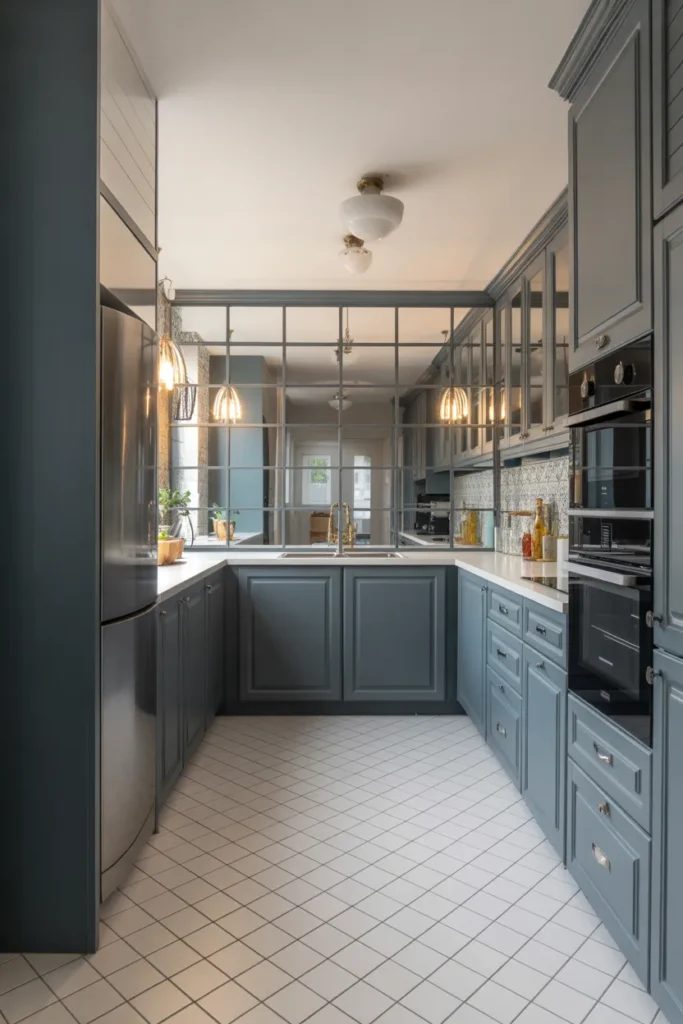
A mirrored or metallic glass backsplash in a small galley multiplies the available light and makes the space appear wider. This is not a design trick — it is practical light management. Combine it with under-cabinet lighting and a single large overhead fixture, and the kitchen feels significantly more functional despite its size.
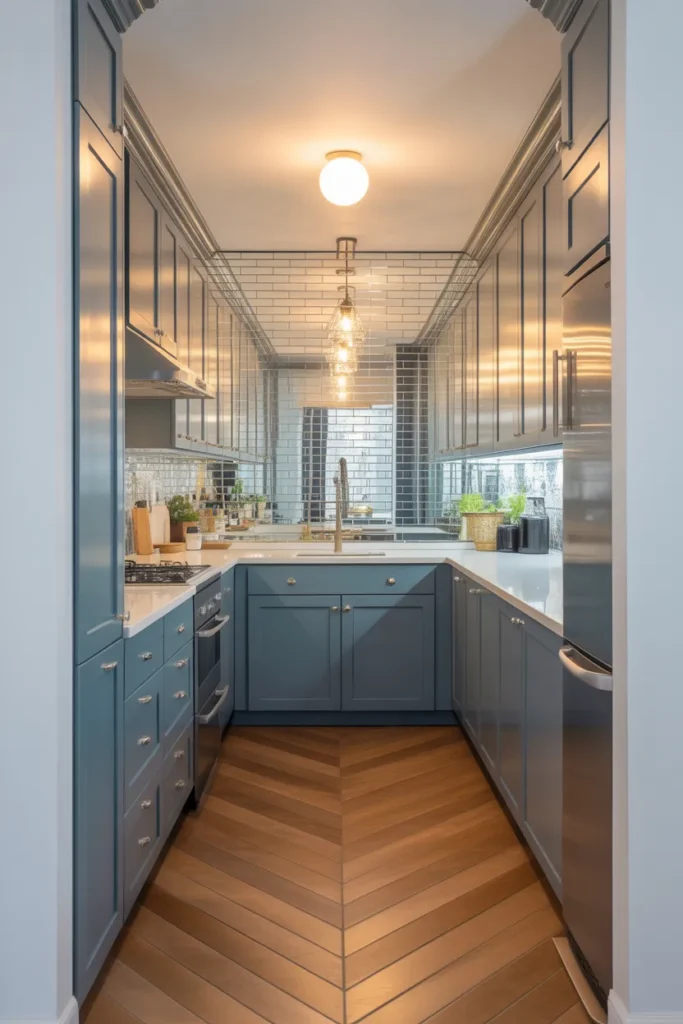
Avoid patterned or busy backsplash tiles in this configuration. In a narrow space with dark cabinets, visual complexity on the backsplash creates tension rather than interest. A clean, reflective surface keeps the focus on the cabinet color and the quality of the materials.
7. All-Black Kitchen With Integrated Appliances and Invisible Handles
A fully integrated all-black kitchen is one of the most intentional dark kitchen ideas 2026 can offer. When appliances are panel-fronted to match the cabinetry and handles are eliminated or recessed, the kitchen becomes a single continuous surface. This approach works best in modern or minimalist homes where simplicity is a design priority.
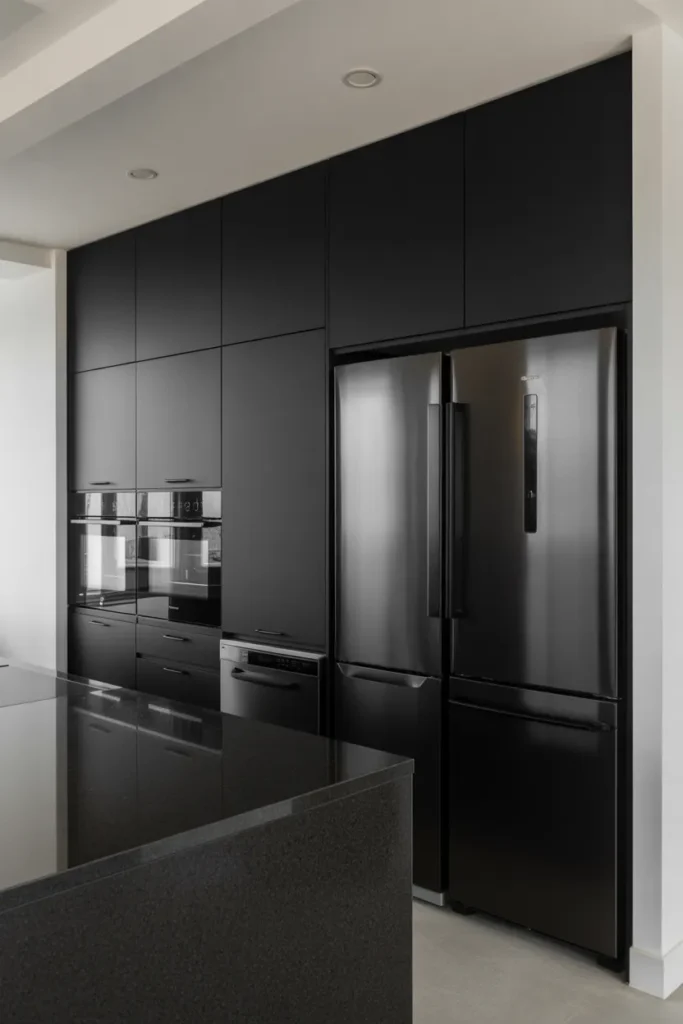
The functional key to this layout is organization. Without visible hardware or appliance breaks to signal where things are, the kitchen relies entirely on quality of finish and precision of installation. Gaps, inconsistent grain, or misaligned panels are immediately obvious. This design rewards careful planning and penalizes shortcuts.
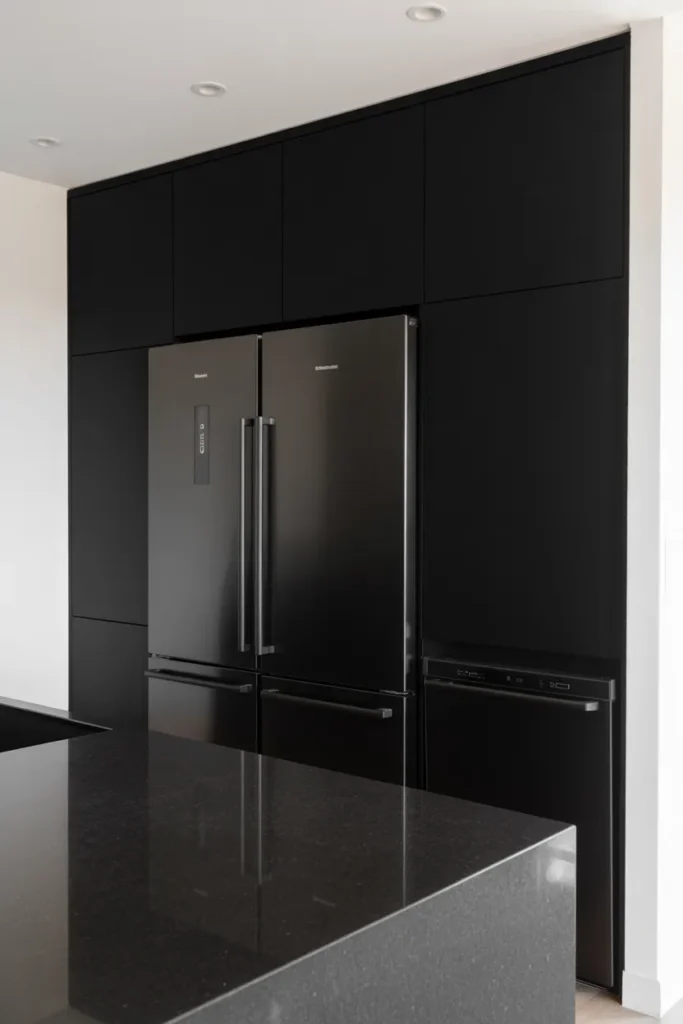
This style suits open kitchen layouts in modern homes, particularly where the kitchen is visible from the main living area. The seamless surface reads as a design statement rather than a room divider. However, it is not ideal for households with young children or heavy daily cooking, where fingerprints and steam residue on matte black surfaces require consistent maintenance.
8. Dark Walnut Cabinets With a Concrete Countertop in an Island Kitchen Layout
Dark walnut is a natural material, not a painted finish, and that distinction changes how the kitchen feels entirely. The rich brown-black tones of walnut cabinetry bring organic warmth to an island kitchen layout while still reading as definitively dark. This is one of the few dark kitchen approaches that feels equally appropriate in a farmhouse, mid-century modern, or contemporary home.
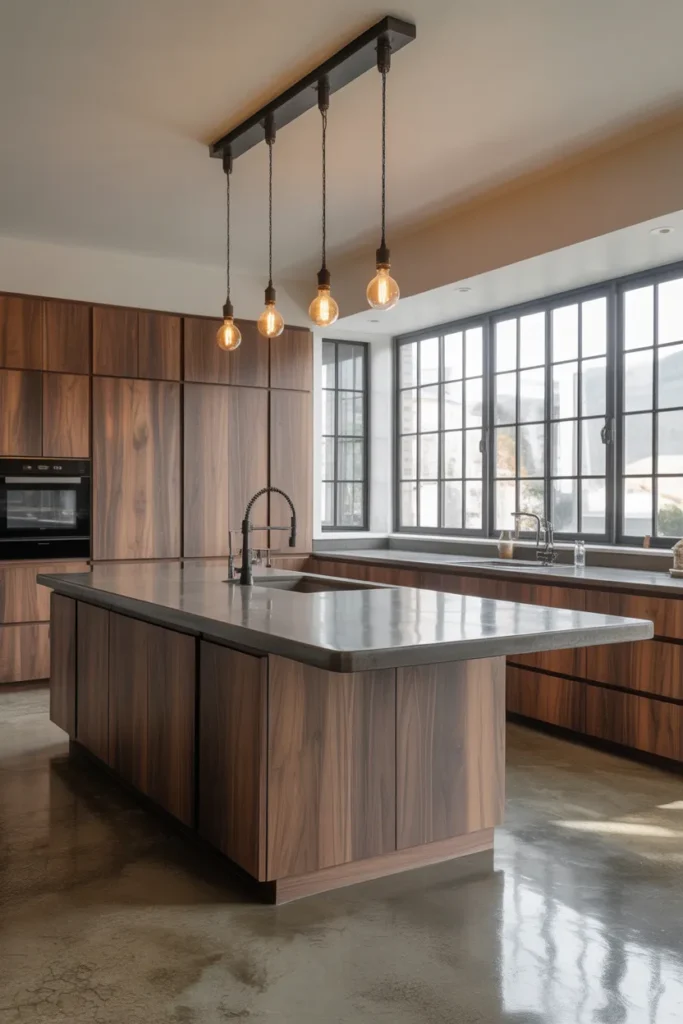
A poured concrete countertop on the island is the ideal functional pairing. Concrete has a raw, matte quality that complements walnut without competing with it. The texture difference between the smooth wood grain and the slightly porous concrete surface creates a tactile contrast that elevates the kitchen beyond purely visual design.
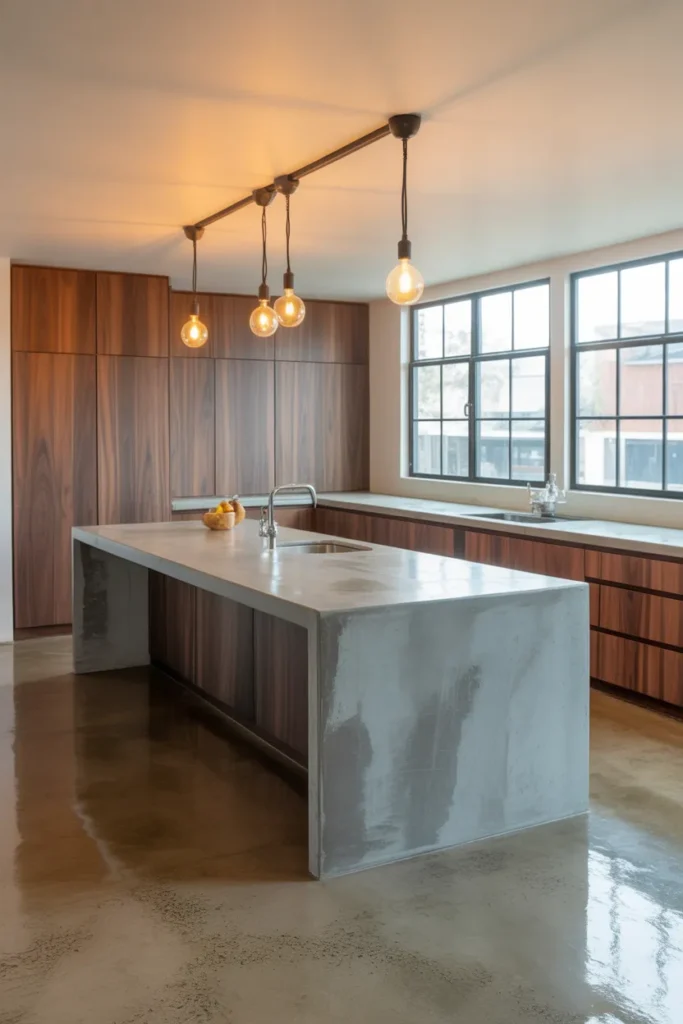
This combination works best in larger kitchen layouts with an island as the central element. The walnut and concrete together can feel heavy in a small space. If you are working with a medium-sized kitchen, consider walnut on the island only, with lighter cabinetry on the perimeter walls.
9. Midnight Green Lacquered Cabinets in a Peninsula Kitchen With Pendant Lighting
Midnight green lacquered cabinets occupy a different design territory than matte finishes. The reflective quality of lacquer catches light and shifts the perception of the color throughout the day — appearing almost black in low light and revealing its deep green tone in direct sunlight. This is ideal for a peninsula kitchen layout where the space is open on one side.
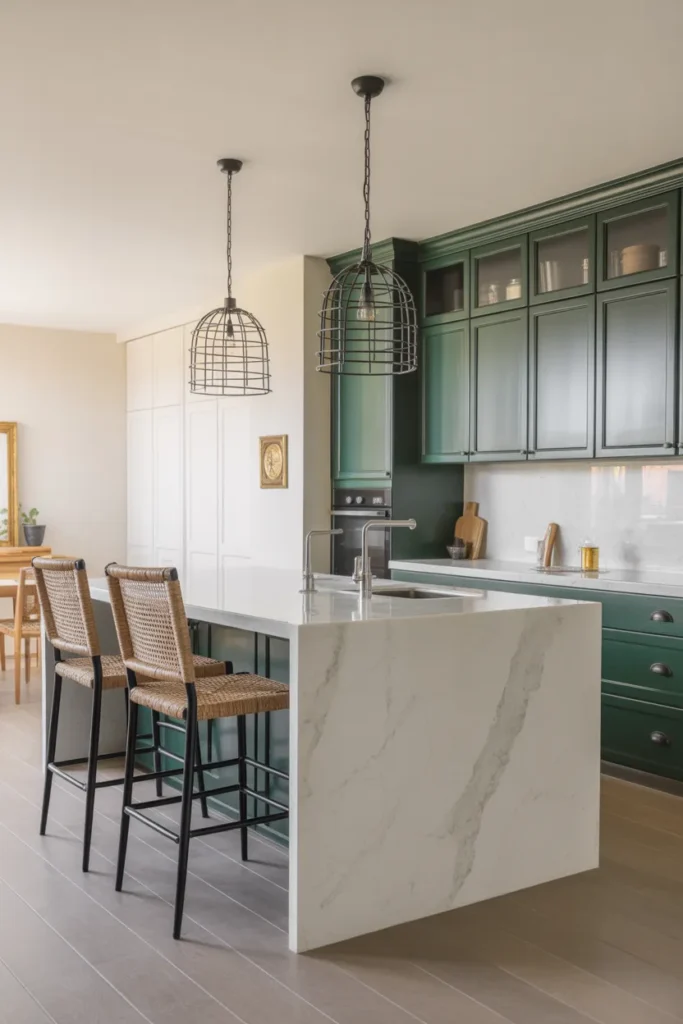
A peninsula is a practical alternative to an island in medium-sized kitchens. It provides the same counter extension and seating opportunity as an island but connects to the perimeter on one end, which reduces traffic flow challenges in tighter spaces. Pendant lighting above the peninsula creates a natural visual anchor for the dark lacquered surface below.
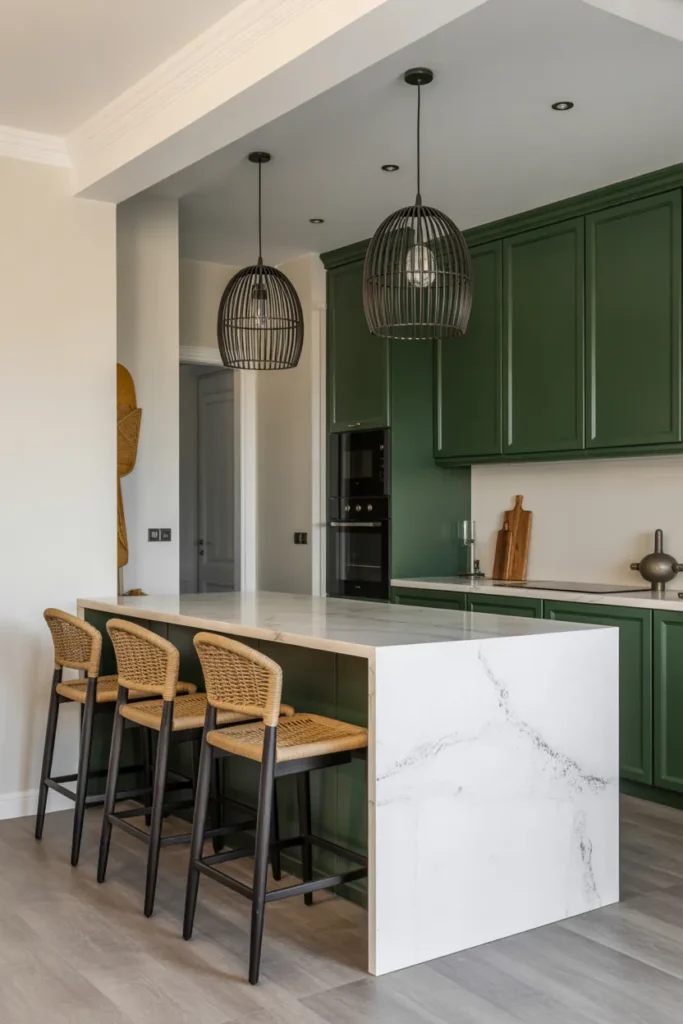
The lacquered finish requires more maintenance than matte. Fingerprints, water splashes, and grease marks are more visible. This is not a reason to avoid the finish, but it is a factor to consider if the kitchen sees heavy daily use. A satin lacquer is a practical middle ground — it has some sheen without the full mirror quality.
10. Espresso Brown Two-Tone Cabinets in a Large Open-Plan Family Kitchen
Two-tone cabinetry in espresso brown allows you to introduce dark kitchen design without committing fully to a single dark color across the entire space. In a large open-plan family kitchen, this is a practical decision. The darker lower cabinets ground the space while lighter upper cabinets maintain the visual height of the room.
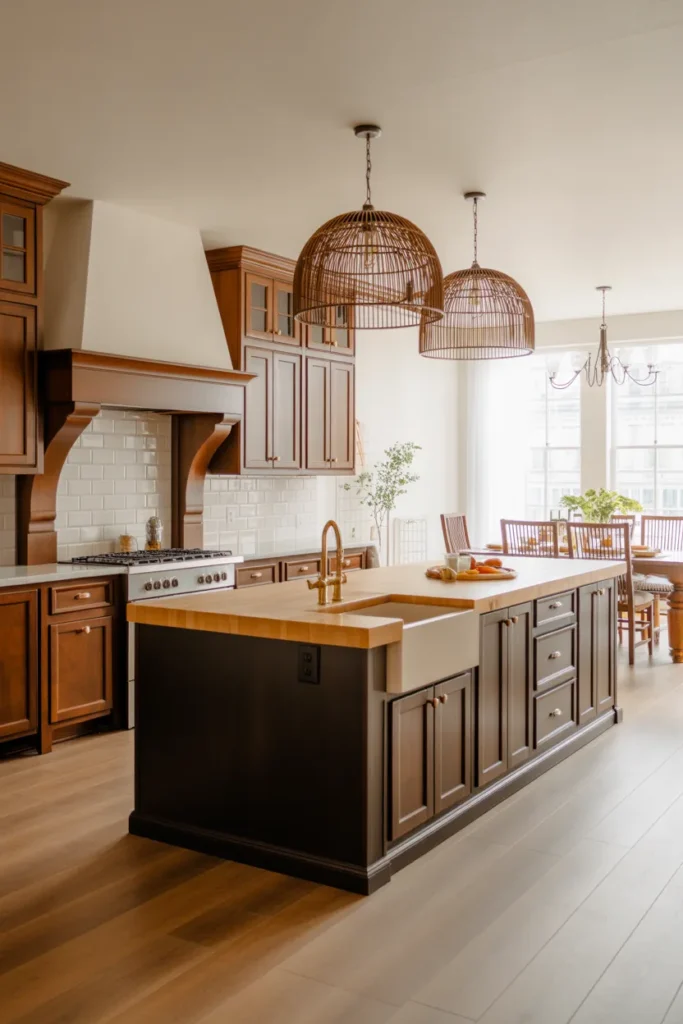
Espresso brown as the lower cabinet color is one of the most enduring directions in functional kitchen floor plans because it hides scuffs, wear marks, and everyday contact points far better than black or navy. Lower cabinets take far more physical abuse than upper cabinets, and a brown-toned dark finish is more forgiving over time.
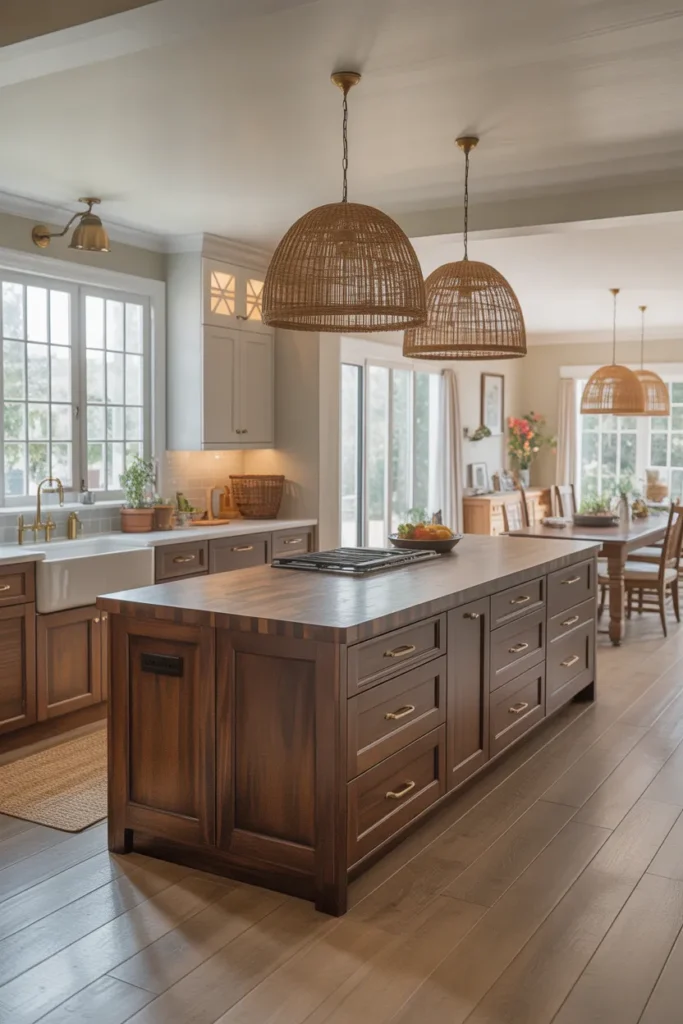
In a large kitchen, two-tone design also helps zone the space visually. The transition between dark lower and lighter upper cabinetry creates a natural horizon line that makes a large kitchen feel more human in scale. Avoid using drastically different colors — the pairing should feel intentional, not like two separate kitchens installed in the same room.
11. Black Painted Brick Wall Kitchen With Exposed Steel Shelving
Not all dark kitchen ideas 2026 require dark cabinetry. A black-painted exposed brick wall with open steel shelving delivers the same visual impact while keeping the kitchen structurally light and airy. This approach works in loft apartments, converted industrial spaces, or any kitchen where the architecture has natural texture worth highlighting.
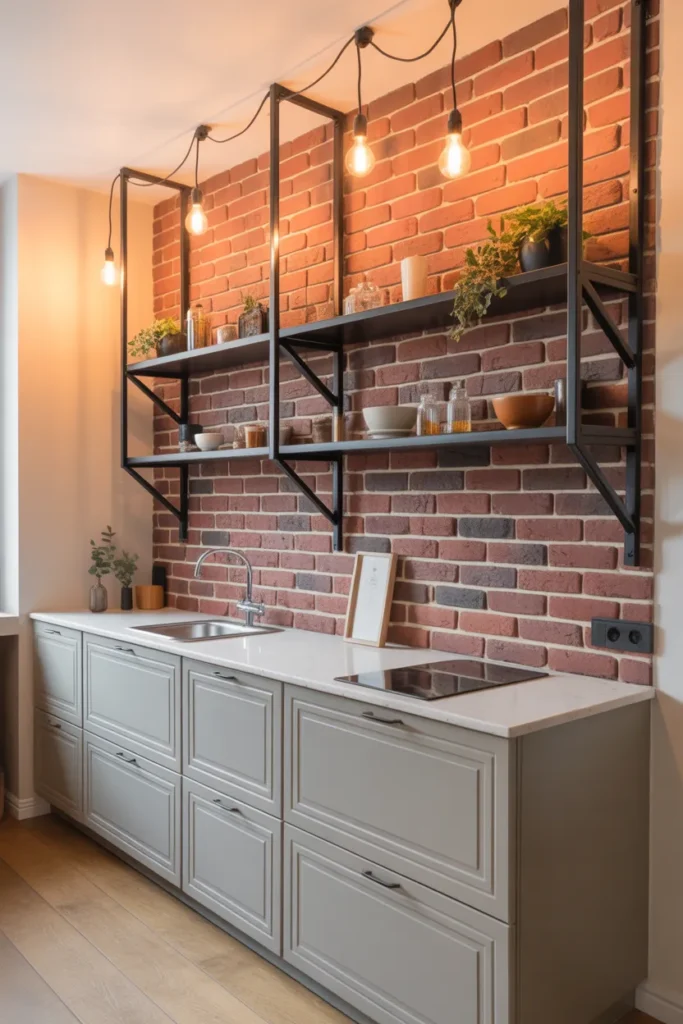
The exposed brick provides a rough, tactile surface that black paint intensifies rather than conceals. The mortar lines and irregular brick face read clearly through the paint, adding depth that no smooth cabinet surface can replicate. Steel open shelving mounted directly to the brick continues the industrial register while keeping the functional storage requirements of the kitchen met.
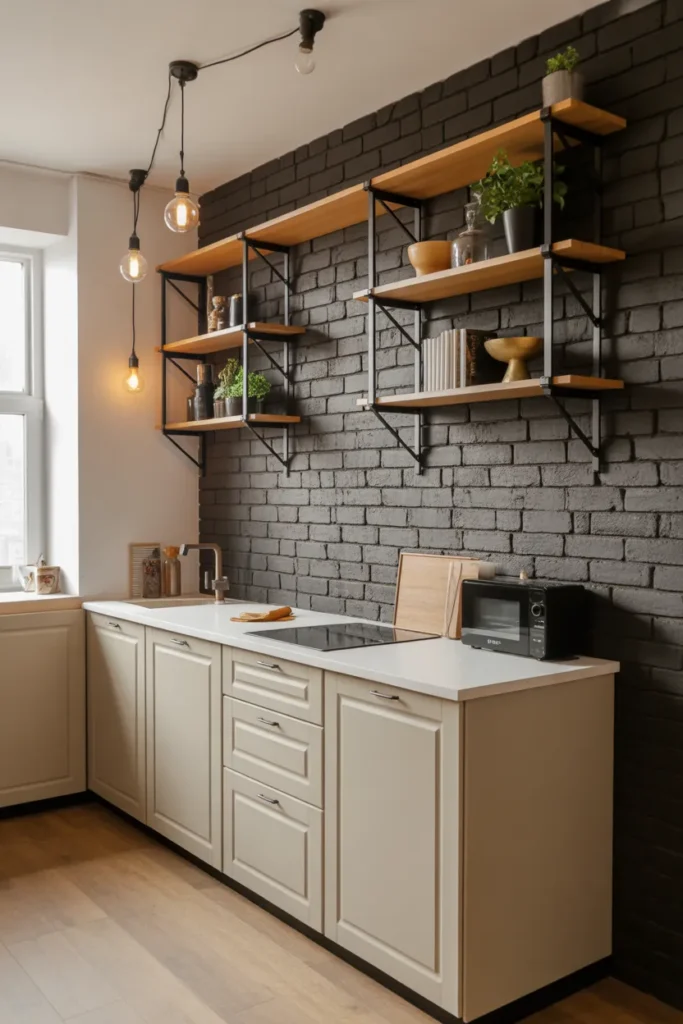
This design direction suits smaller kitchens that cannot accommodate a full cabinet run. The open shelving keeps the room feeling spacious while the black wall creates drama. The key mistake to avoid is overcrowding the shelves. In this aesthetic, edited, minimal shelf arrangements work far better than packed shelves of mismatched items.
12. Dark Olive Green Cabinets With Natural Stone Countertops in a Country-Style Layout
Dark olive green sits between forest green and khaki, and its earthy undertone makes it one of the most natural-looking dark kitchen colors available. In a country-style or transitional kitchen layout, olive green cabinetry connects the kitchen to the organic palette of the surrounding interior without feeling out of place.
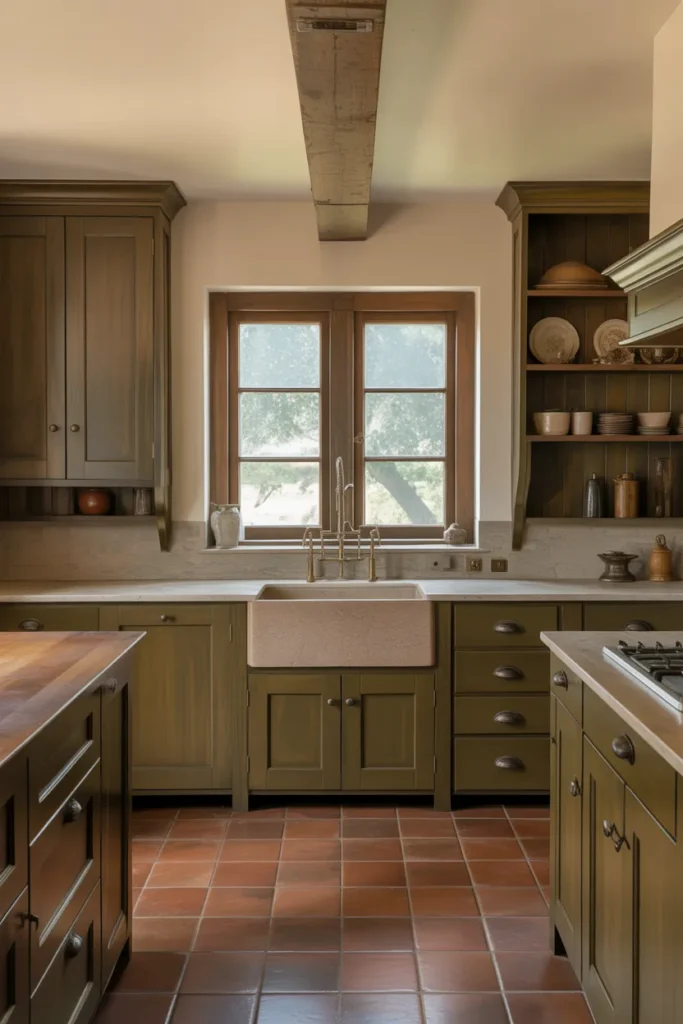
Natural stone countertops — particularly leathered quartzite or honed limestone — are the most harmonious pairing. The organic variation in stone veining echoes the earthy quality of olive green without requiring a precise color match. The leathered or honed finish, rather than polished, keeps the surface in the same matte register as the cabinetry.
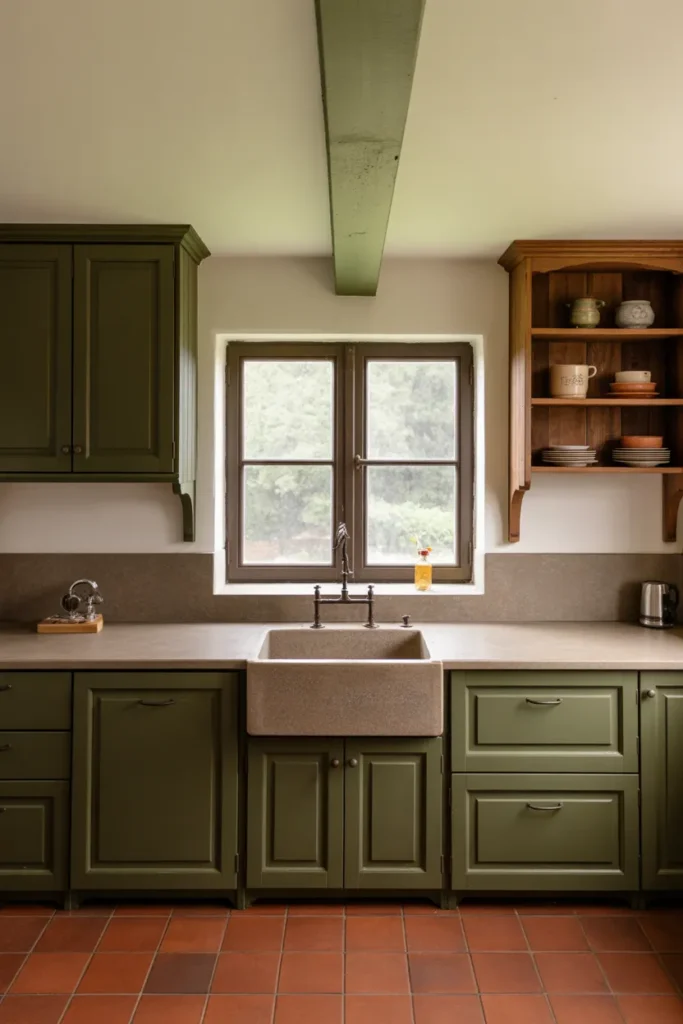
This layout suits homes with natural materials throughout — wood beams, stone floors, linen textiles. It is not the right fit for a very modern or minimalist home, where the country-style sensibility of olive green will feel inconsistent. When used correctly, this is one of the most grounded and livable dark kitchen directions available.
13. Glossy Black Upper Cabinets With White Lower Cabinets in a Compact Square Layout
Reversing the standard two-tone formula — placing the dark cabinets on top rather than the bottom — creates an unexpected visual result in a compact square kitchen layout. Glossy black upper cabinets draw the eye upward and make the room feel taller, while white lower cabinets keep the lower half of the room grounded and light.
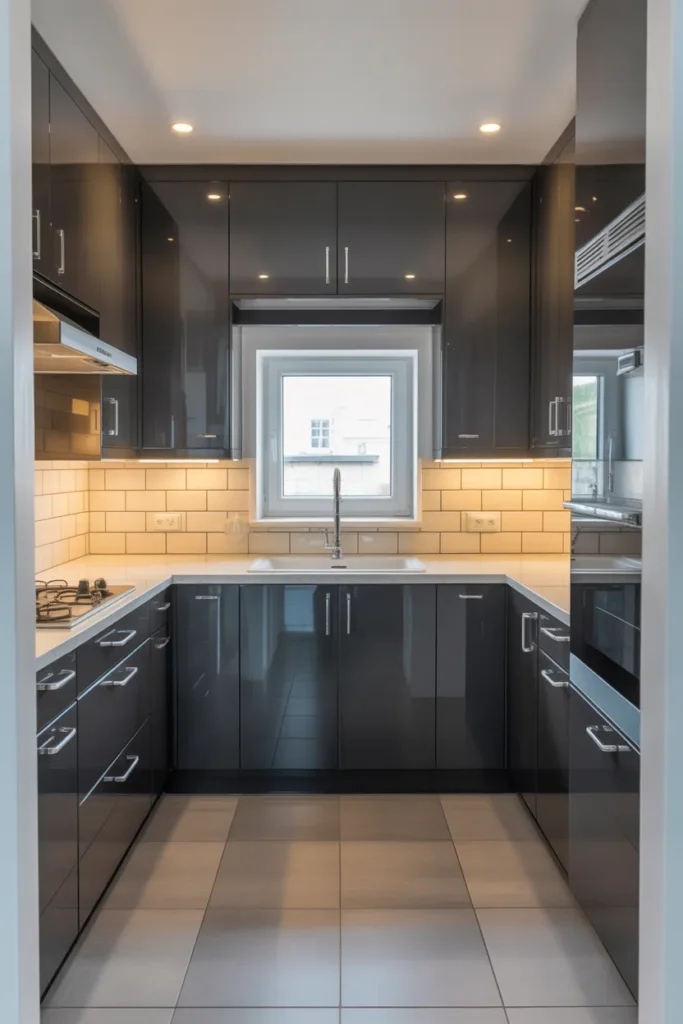
This inversion works because of the reflective quality of the glossy finish. Unlike matte black upper cabinets, which can absorb light and make the ceiling feel lower, a glossy surface bounces ceiling and pendant light across the room. The effect is counterintuitive but functional.
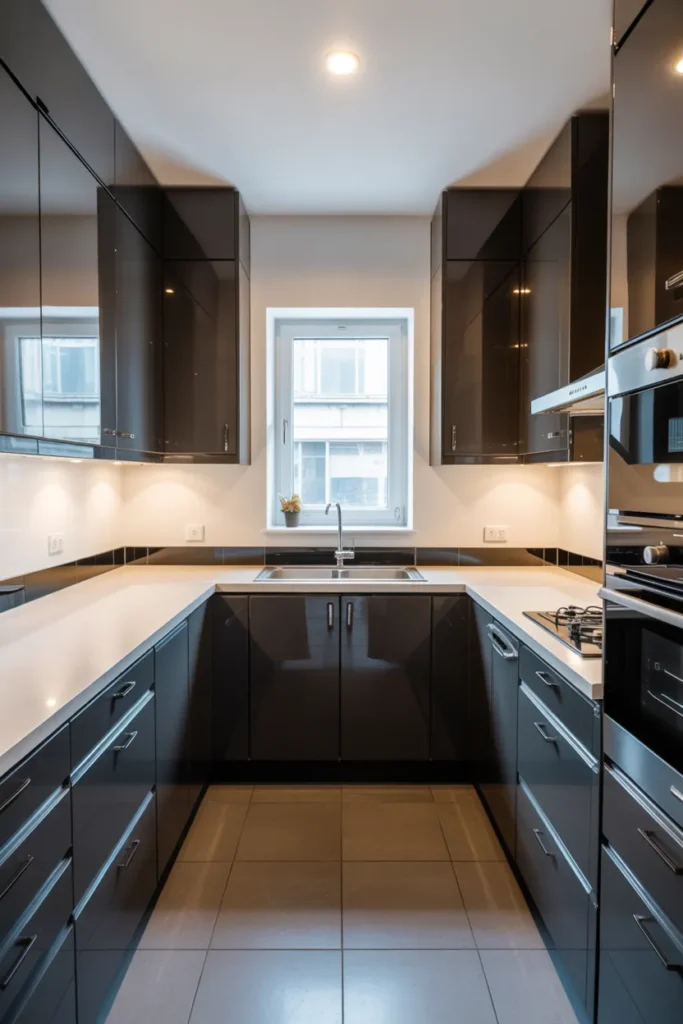
This configuration suits homeowners who want a dark kitchen aesthetic without the commitment of dark lower cabinets throughout. It is also a practical approach for kitchens where the lower cabinets are near a back door or high-traffic area, where lighter surfaces are easier to maintain. Avoid combining glossy black uppers with a dark countertop — the contrast between the white lower cabinets and the countertop is what makes this layout work.
14. Smoked Navy and Brass in a Narrow High-Rise Apartment Kitchen
Small kitchen layout design in urban apartments often requires working with a single narrow wall of cabinetry and very limited natural light. Smoked navy — a navy blue with a gray or green undertone — performs better than pure navy in these conditions because it does not shift toward purple in artificial lighting the way brighter navies can.
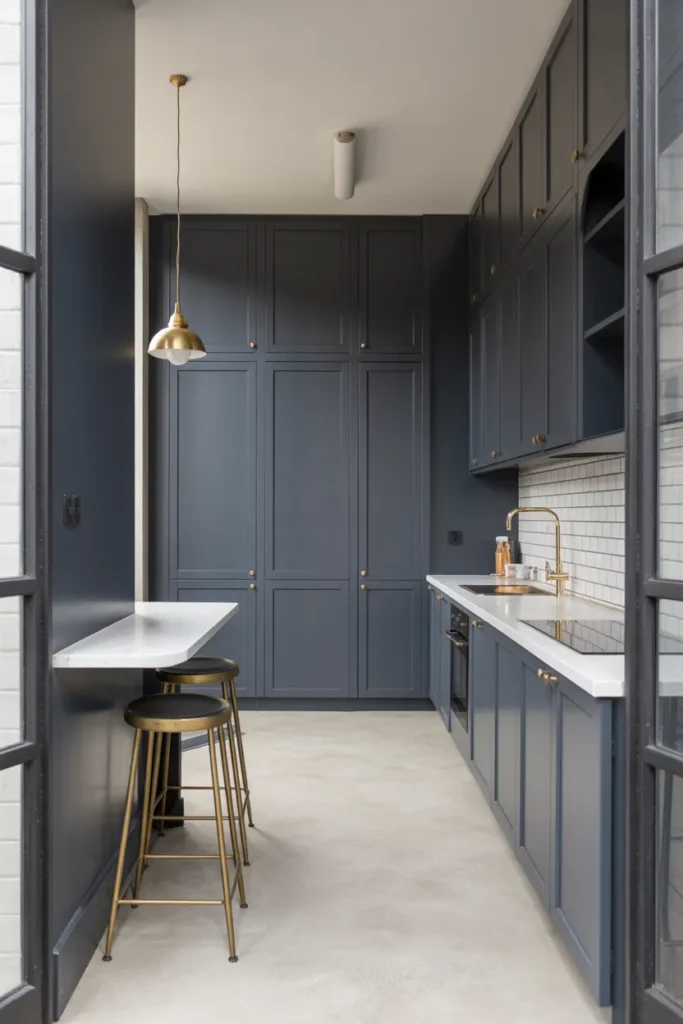
Brass fixtures, faucets, and hardware are the correct accent choice in this configuration because they introduce warmth in a setting that might otherwise feel cold and compressed. A single brass pendant over a small breakfast bar or counter overhang reinforces the material story without overcrowding the narrow space.
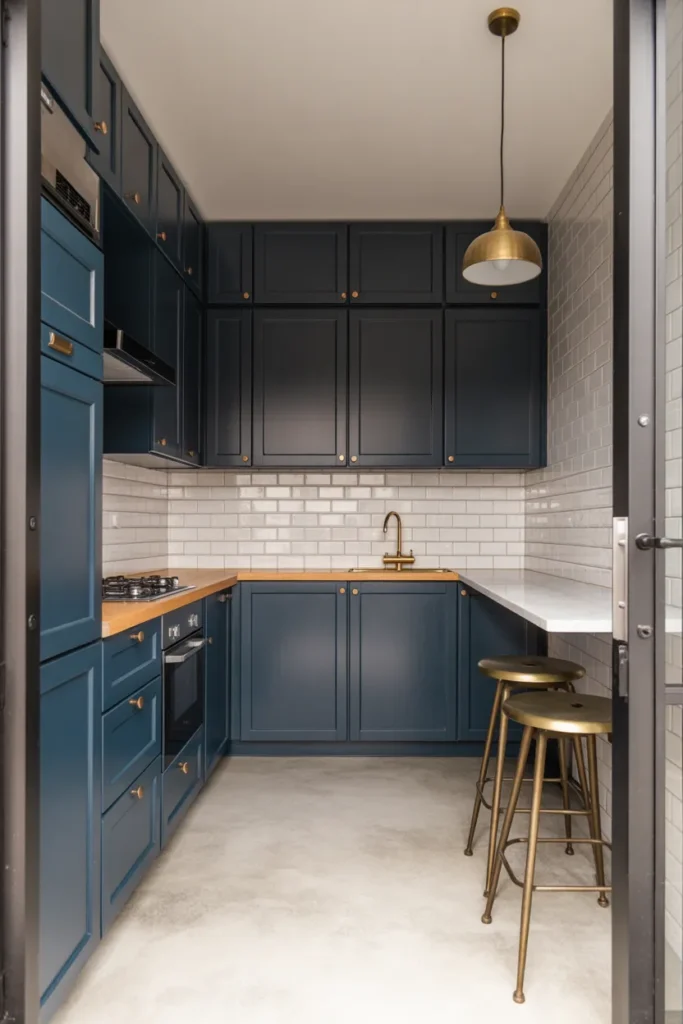
The single most important functional decision in a narrow apartment kitchen is the countertop overhang. Even a 12-inch overhang at counter height creates a casual dining or working surface without requiring a separate table. This is one of the most effective kitchen space planning ideas for small urban homes.
15. Textured Dark Gray Cabinets With Fluted Glass Inserts in a Transitional Layout
Textured cabinetry is one of the most significant directions in modern kitchen layout ideas 2026. Ribbed or slightly embossed cabinet fronts in a dark gray finish add a layer of visual complexity that plain flat-fronts or standard shaker profiles cannot deliver. In a transitional kitchen — one that bridges traditional and contemporary — textured dark gray hits exactly the right register.
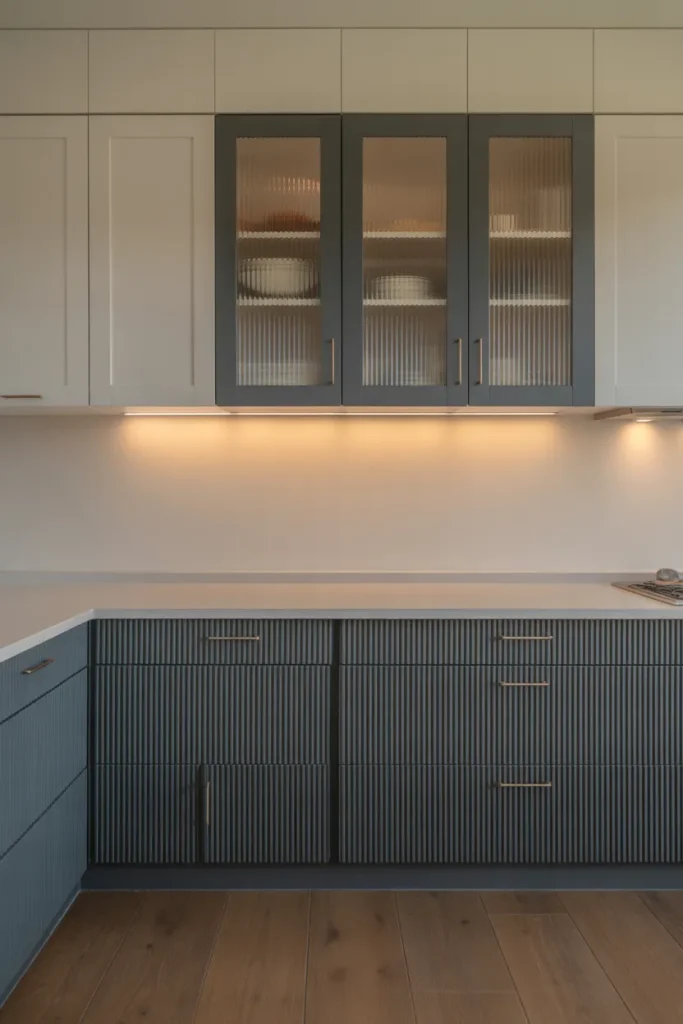
Fluted or reeded glass inserts in a portion of the upper cabinets allow light to pass through while still concealing the contents. This is practical for homeowners who want the visual relief of glass inserts without the pressure of perfectly organized shelves visible behind clear glass. The ribbed pattern in the glass echoes the texture of the cabinet fronts.
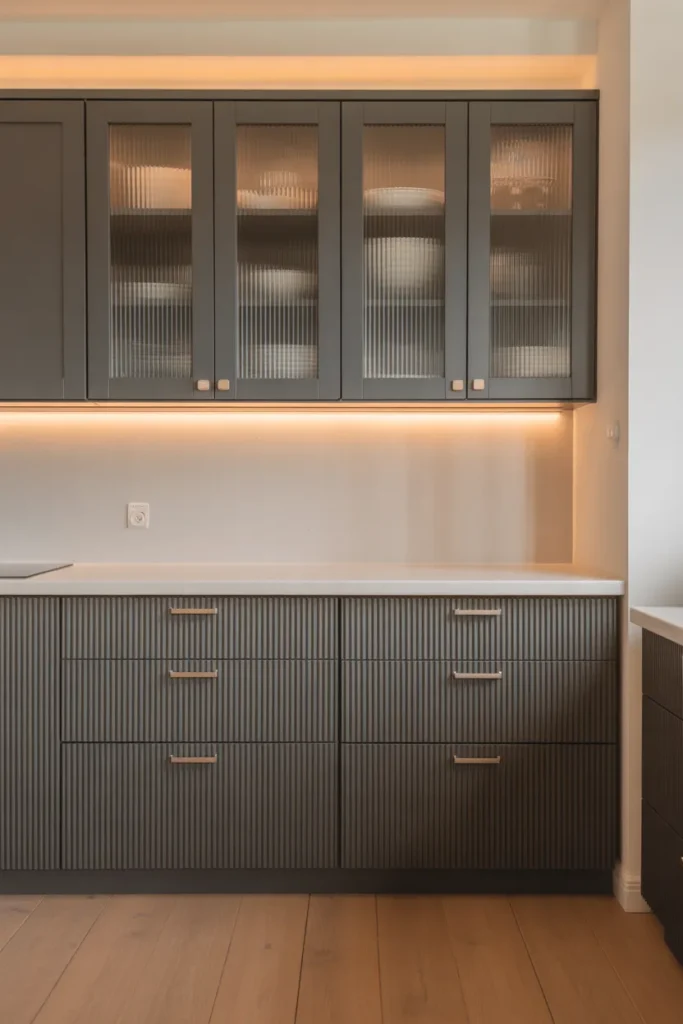
This layout suits medium to large kitchens with high ceilings, where the textured detail has room to read at a distance. In a very small kitchen, the texture may add visual noise rather than interest. Pair this cabinet direction with simple, solid-surface countertops — a busy stone pattern and a textured cabinet front compete for attention rather than complementing each other.
16. Matte Black and Raw Oak Two-Material Kitchen in a Modern Farmhouse Layout
Combining matte black cabinetry with raw or lightly oiled oak on the island or open shelving creates one of the most photographed looks in current residential kitchen design. The contrast between the dense, light-absorbing matte black and the pale, grain-rich oak is both visually arresting and materially honest. Neither material is pretending to be something it is not.
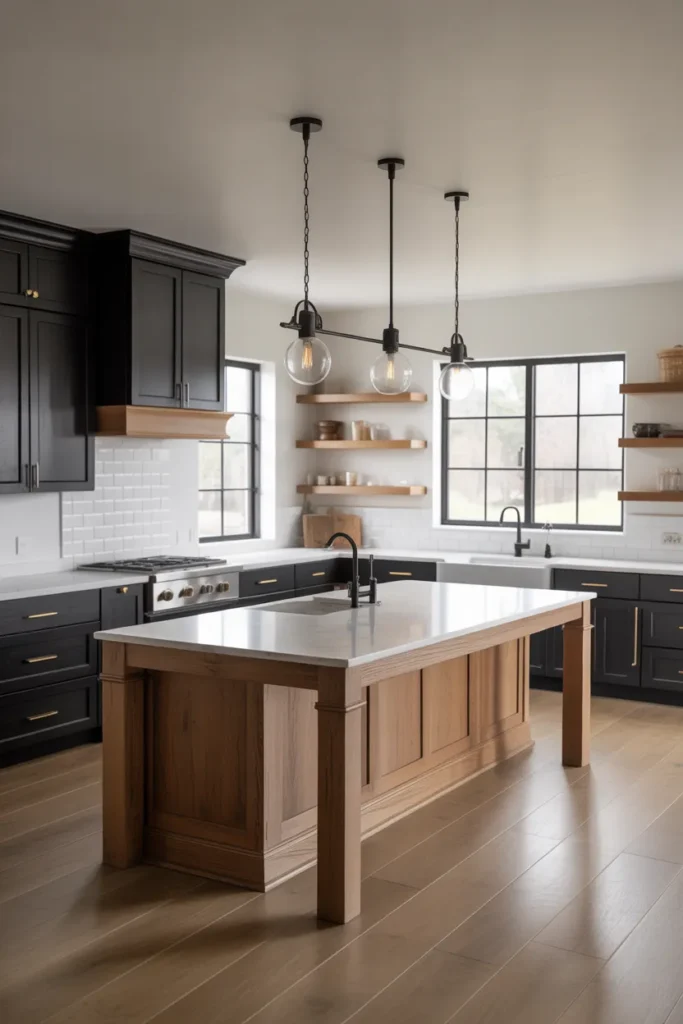
In a modern farmhouse kitchen layout, this pairing bridges the gap between the traditional farmhouse aesthetic and the clean lines of contemporary design. The matte black delivers the modern component. The raw oak delivers the warmth and the handcrafted quality associated with farmhouse style. Together, they avoid the clichés of both aesthetics.
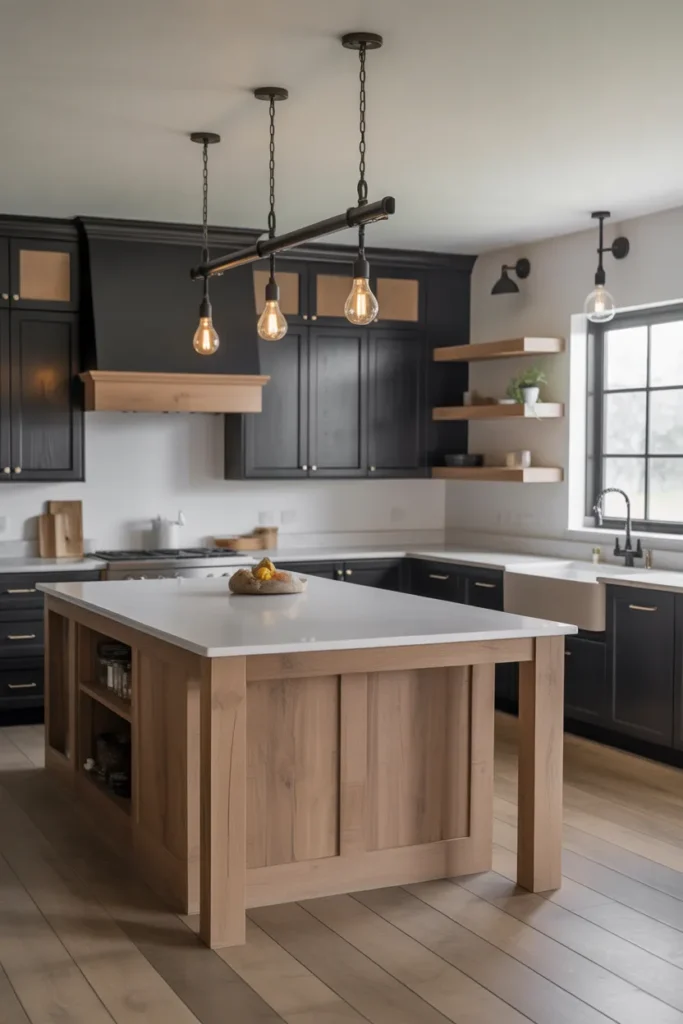
The most effective version of this pairing places matte black on the full perimeter cabinet run and uses raw oak exclusively on the island. Reversing this — oak perimeter, black island — also works but tends to feel heavier because the island is the most physically prominent element in most open kitchen layouts.
17. Dark Teal Cabinets in a Coastal-Inspired Open Kitchen With Rattan Accents
Dark teal sits at the intersection of blue and green in a way that references coastal and organic environments without requiring a literal beach house setting. In an open kitchen layout with access to natural light, dark teal cabinetry shifts in tone throughout the day, appearing closer to navy in the morning and revealing its green quality in afternoon sun.
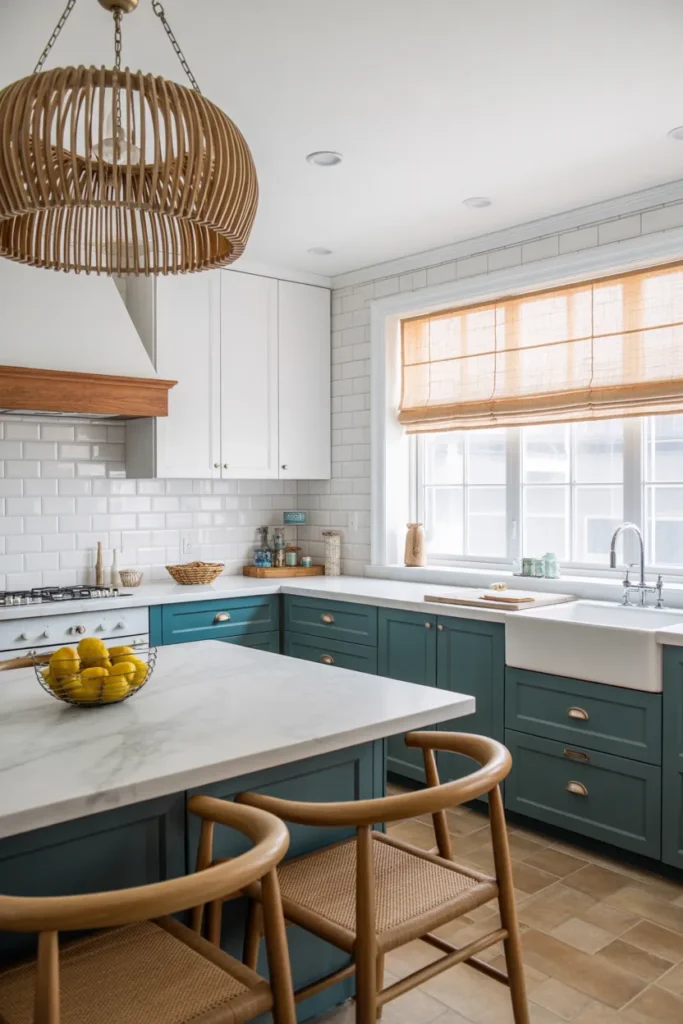
Rattan pendant lights, woven bar stools, and natural linen window treatments complete the coastal connection without making it cartoonish. The key is restraint — one or two natural material accents are sufficient. The teal cabinetry carries the visual story without needing excessive supporting detail.
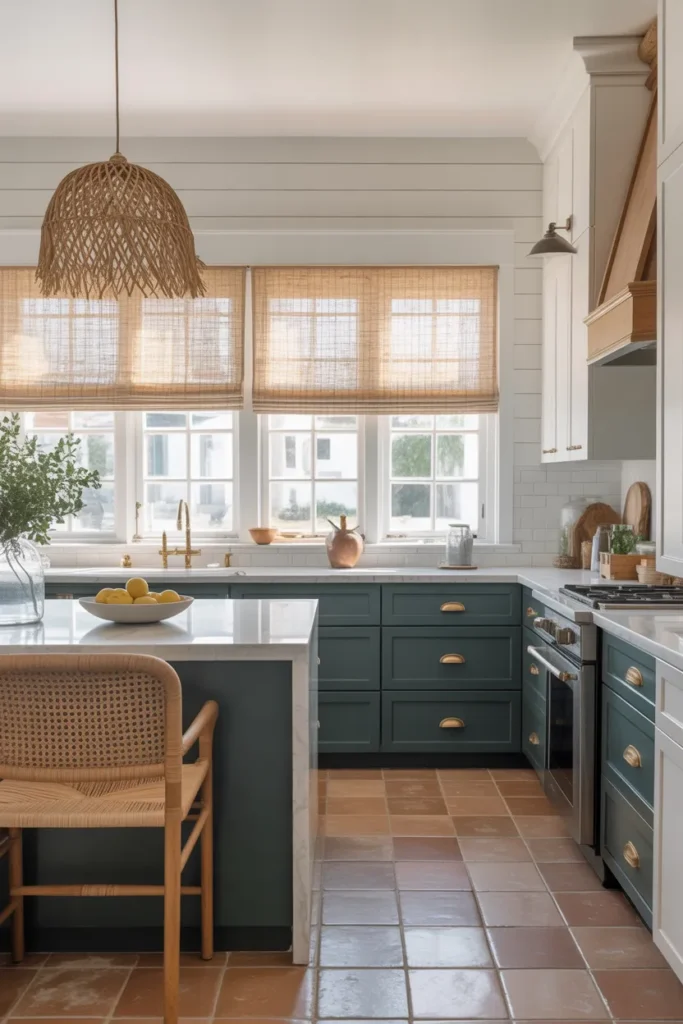
This direction is specifically well-suited to homes in the Southeast, Southwest, and Pacific Coast of the United States, where indoor-outdoor connection is a design priority. In landlocked regions with very different ambient light conditions, dark teal can read as significantly darker than expected. Test a large paint or door sample in your specific kitchen light before committing.
18. Full Slab Dark Backsplash With Black Hardware Throughout in a Luxury Galley
A full slab backsplash — one continuous piece of stone or large-format porcelain running from countertop to upper cabinet — is one of the clearest signals of a high-specification kitchen. In a dark kitchen, a slab in dramatic black veined marble or book-matched black quartzite creates a surface that is simultaneously functional and architectural.
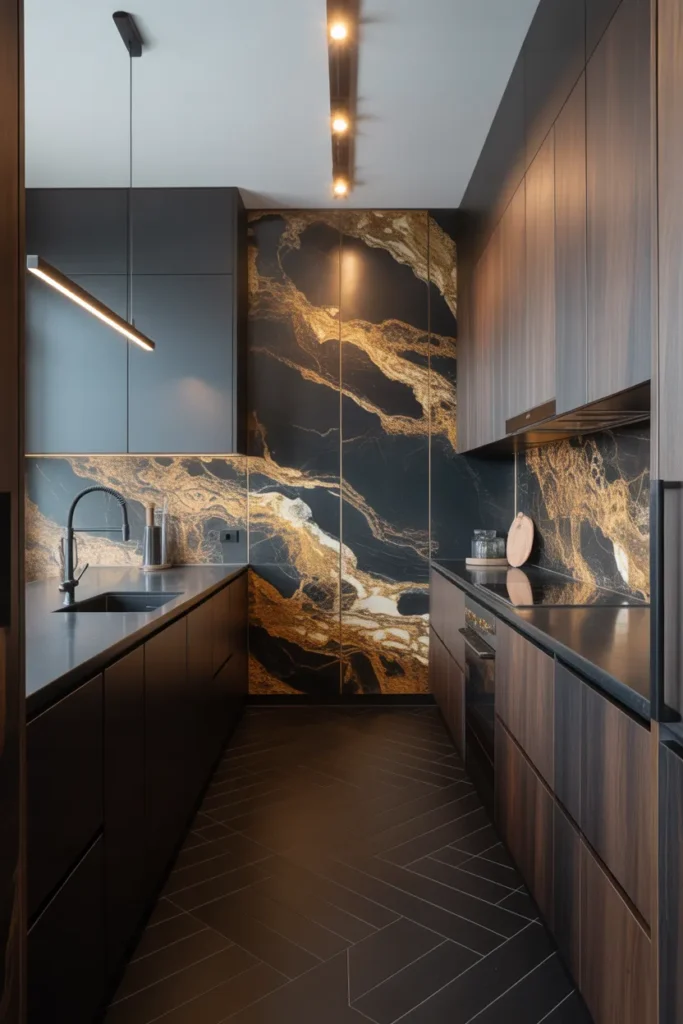
In a galley layout, the full slab backsplash runs the entire length of the kitchen on one or both walls, which maximizes its visual impact. The absence of grout lines gives the wall a seamless, gallery-like quality. Black hardware throughout — pulls, faucet, range hood, and light fixtures — ties the design together without introducing any competing metal tones.
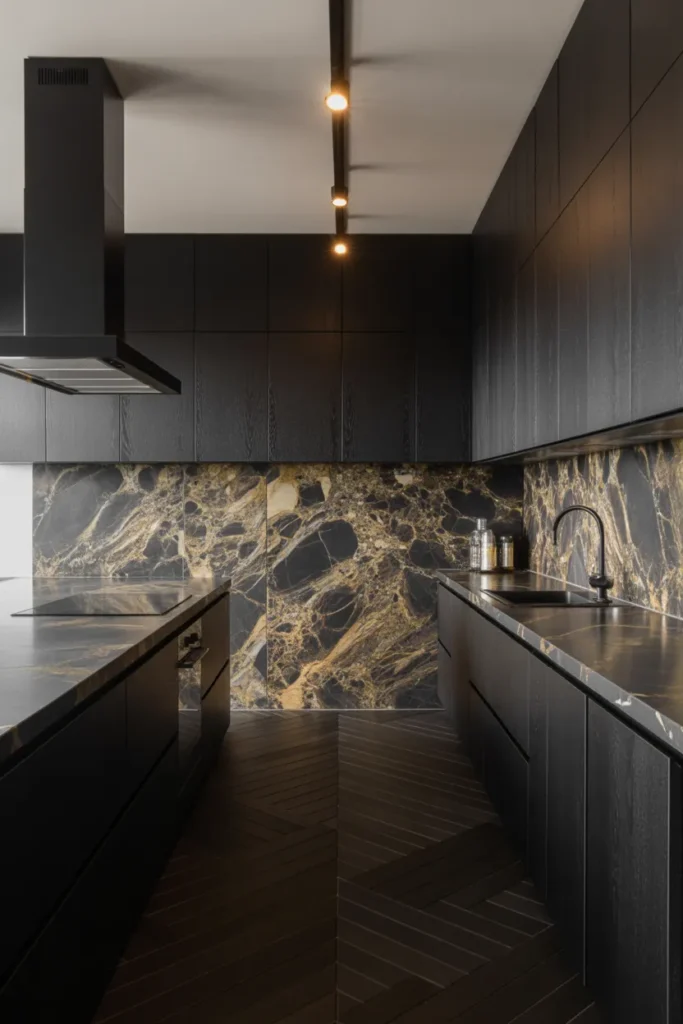
This is not a budget-neutral decision. Full slab stone installation is among the most expensive elements in a kitchen renovation. However, it is also one of the most durable and timeless. In a luxury kitchen, it eliminates the need for a decorative tile pattern, which can date a kitchen significantly faster than quality stone material.
Final Thoughts
Dark kitchen ideas in 2026 are defined by specificity — the right layout, the right finish, and the right material combination for your actual space and lifestyle. There is no single formula that works across every home. The 18 ideas above cover a wide range of layouts, sizes, and aesthetics precisely because dark kitchens are not one-size-fits-all.
Save this post before you close it. Whether you are working with a contractor next month or planning ahead, having a saved reference of distinct, well-considered directions will make your design conversations sharper and your decisions faster. If you are still exploring layouts beyond the dark aesthetic, look into functional kitchen floor plans and open kitchen layout guides to understand how your space can work before you commit to a color direction.