
If you are planning a living room update and want farmhouse living room ideas 2026 that go beyond shiplap and mason jars, this guide delivers ten distinct directions with honest guidance on what works in real homes. Farmhouse style in 2026 has matured significantly — it is warmer, more layered, and far more livable than the stark white versions that dominated earlier in the decade. Every idea below includes practical layout advice and clear decision points so you can move forward with confidence.
1. Exposed Beam Ceiling With Linen Sofas and a Stone Fireplace Wall for Maximum Farmhouse Impact
The combination of exposed ceiling beams, a stone fireplace wall, and linen upholstery is the structural foundation of modern farmhouse living room design. Each element carries its own weight: beams provide vertical depth and historical reference, stone delivers natural texture at the room’s focal point, and linen introduces softness that prevents the space from feeling like a museum recreation of a barn.
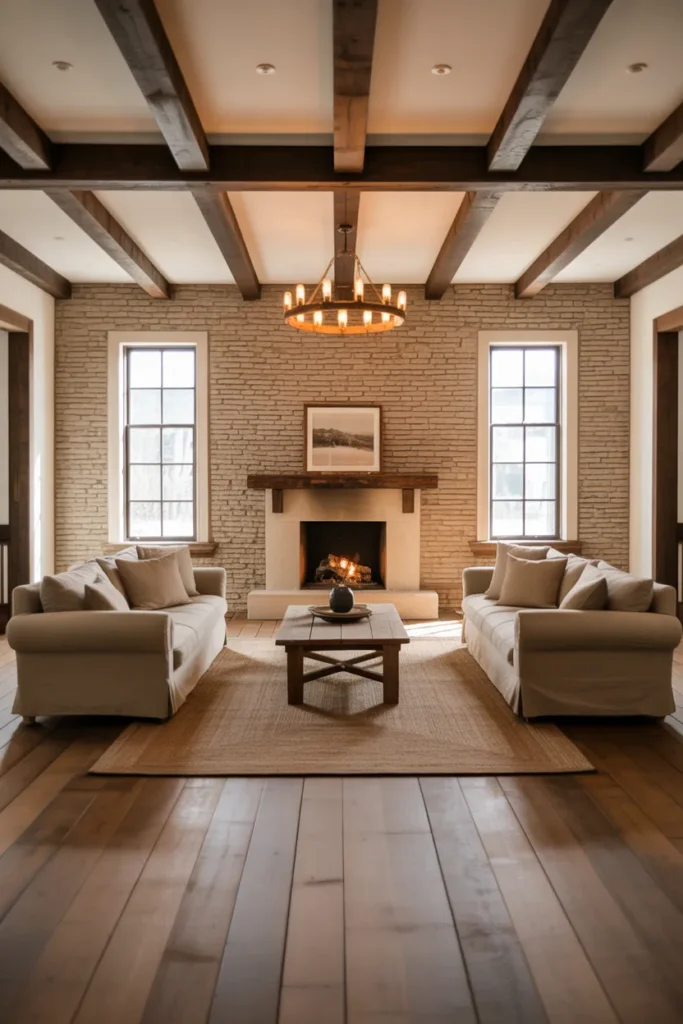
This arrangement works best in living rooms with ceiling heights of nine feet or above. Exposed beams on a low ceiling compress the room and eliminate the sense of openness that makes this design direction breathe. If your ceilings are standard height, consider a single decorative beam running the width of the room rather than a full exposed structure — it delivers the farmhouse signal without the spatial cost.

The stone fireplace wall should extend floor to ceiling in this configuration. A half-height stone surround with drywall above it looks incomplete and undersized. Floor-to-ceiling stone — whether natural fieldstone, stacked limestone, or a dry-stack ledger panel — commands the wall with the authority the design requires.
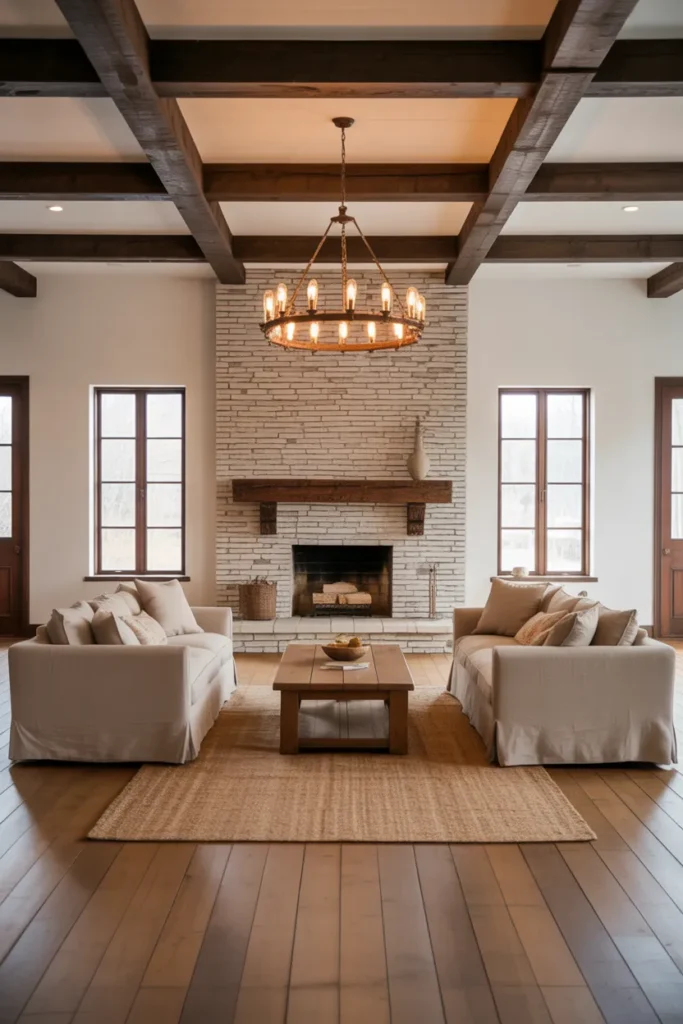
Linen sofas in warm white, oatmeal, or flax are the correct upholstery choice because they are washable, age gracefully, and do not compete with the natural texture of the stone and wood overhead. Velvet, leather, or synthetic fabrics feel tonally inconsistent with this direction and undercut the organic material story the room is built on.
2. Modern Farmhouse Living Room With Shiplap Accent Wall and Minimalist Furniture
Shiplap remains one of the most recognizable elements in farmhouse living room ideas 2026, but how it is used has changed. The wall-to-wall, floor-to-ceiling shiplap rooms of a decade ago have given way to a more considered application: a single accent wall, typically behind the sofa or fireplace, in a painted or natural wood finish. This restraint is what makes modern farmhouse design feel current rather than dated.
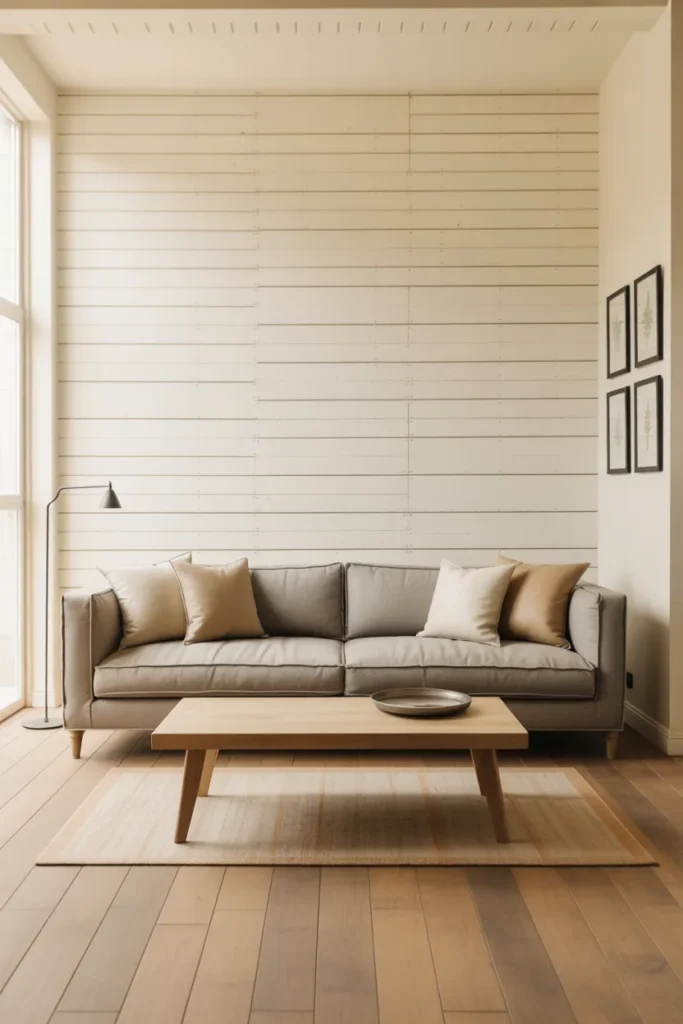
A shiplap accent wall behind the sofa performs a specific spatial function — it creates a defined backdrop for the seating arrangement in rooms that lack architectural features. In open-plan homes where the living room flows into the dining or kitchen area, the shiplap wall establishes the living room as its own zone without a physical divider. This is one of the most effective living room layout ideas for open-plan homes.
Minimalist furniture is the correct pairing for a shiplap accent wall in 2026. Clean-lined sofas with visible legs, a simple rectangular coffee table, and a pared-back media console allow the wall texture to do its work without competing elements. The shiplap is the texture — everything in front of it should be simpler.
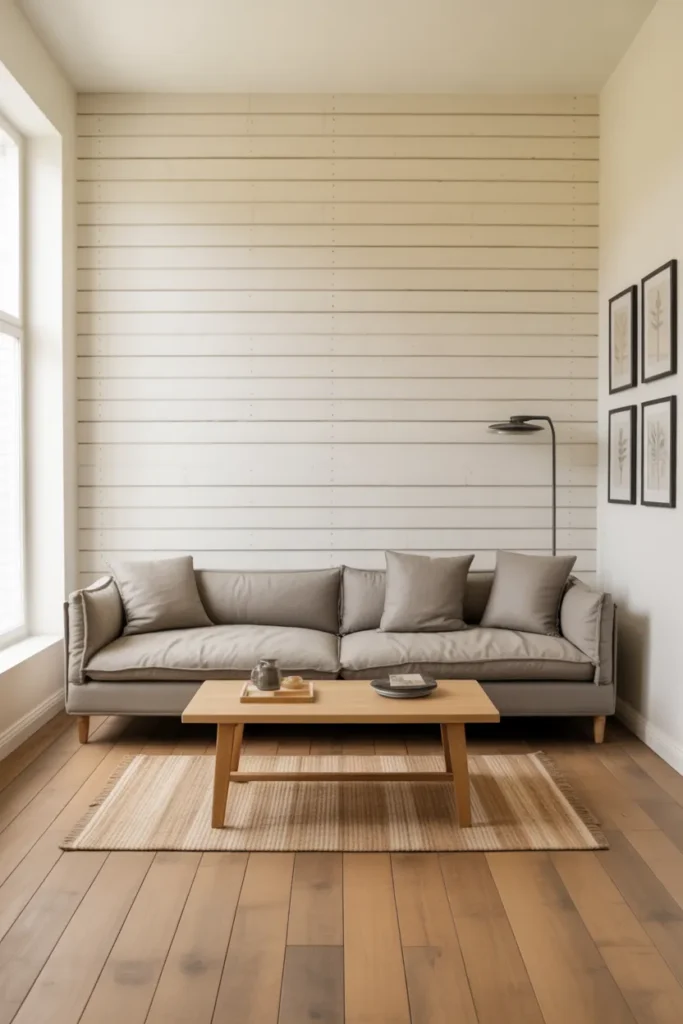
The most common mistake with shiplap accent walls is painting them bright white in a room with otherwise warm tones. A warm white — one with a cream or linen undertone — reads as a considered choice. Bright, cool white against warm wood floors and warm upholstery creates a jarring visual temperature contrast that undermines the cohesion of the room.
3. Dark Moody Farmhouse Living Room With Navy Walls and Warm Wood Accents
The dark farmhouse living room is one of the most significant evolutions in farmhouse living room ideas 2026. Where traditional farmhouse design relied on white, cream, and neutral palettes, the modern interpretation embraces deep wall colors — navy, forest green, charcoal, and warm black — to create a room that feels rich and cozy rather than bright and airy. Navy is the most accessible entry point because it reads as sophisticated rather than heavy in most lighting conditions.
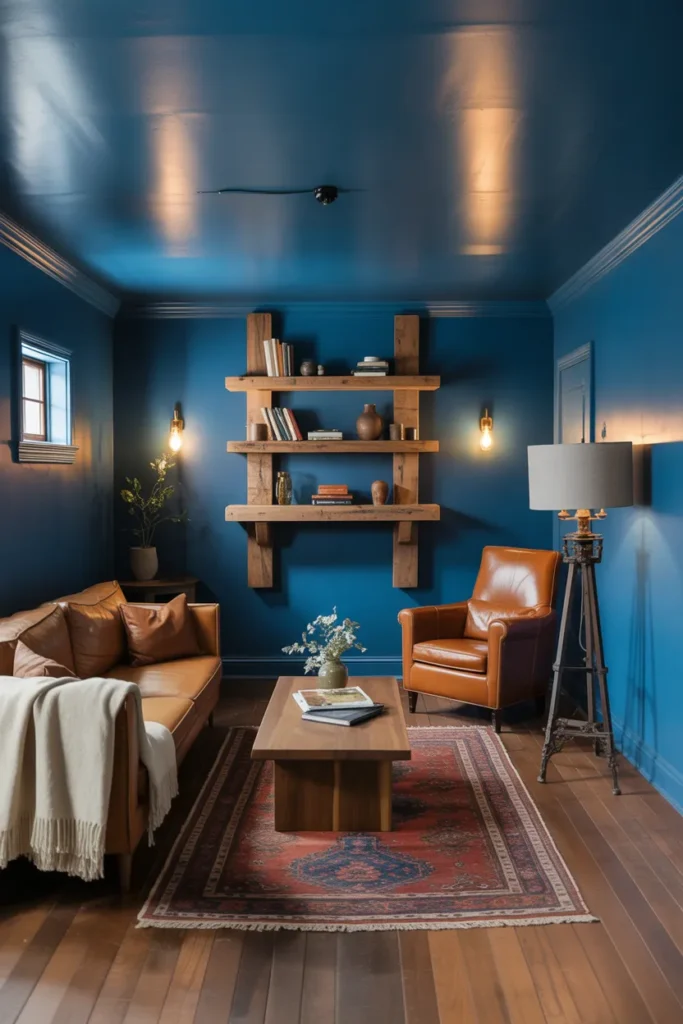
Navy walls in a farmhouse living room work because the deep blue-black tone recedes visually, making the room feel enveloping and intimate. This is ideal for living rooms that are used primarily in the evenings — media rooms, libraries, or multi-purpose family rooms where ambient lighting sets the mood rather than natural daylight driving the design.
Warm wood accents are the essential counterbalance to navy walls. Reclaimed wood shelving, a light oak or walnut coffee table, and wood-framed mirrors or artwork introduce warmth that prevents the navy from feeling cold or corporate. The contrast between the deep blue-black wall and the warm amber of natural wood is one of the most visually satisfying combinations in current residential design.
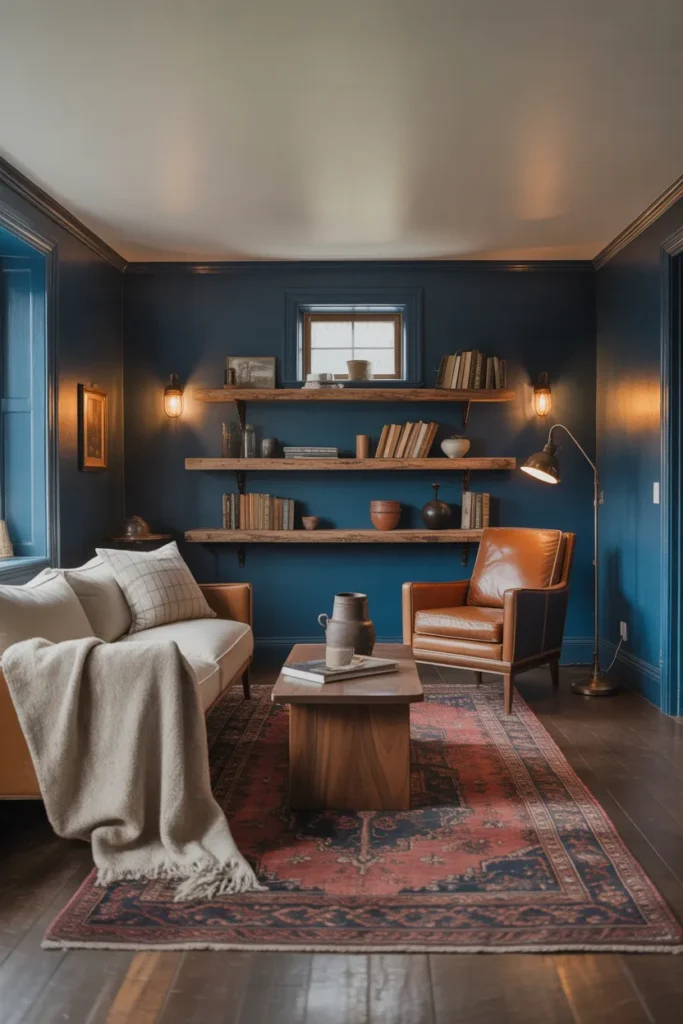
This direction is not appropriate for small, low-ceiling living rooms where limited natural light already makes the room feel confined. Dark walls in already compressed spaces amplify the sense of enclosure. In a small room, apply the navy to one accent wall only rather than all four. In a generous, well-lit room with architectural character, full navy walls are the more impactful and appropriate choice.
4. Vaulted Ceiling Farmhouse Living Room With Whitewashed Wood and Woven Textures
A vaulted ceiling is one of the most valuable architectural assets a farmhouse living room can have, and the design decisions made in the room should respond to that height rather than ignore it. Whitewashed wood applied to the vaulted ceiling — whether as tongue-and-groove paneling, ship-lapped boards, or exposed rafters with whitewash — creates a luminous overhead surface that amplifies the sense of space without losing the warmth of natural wood.
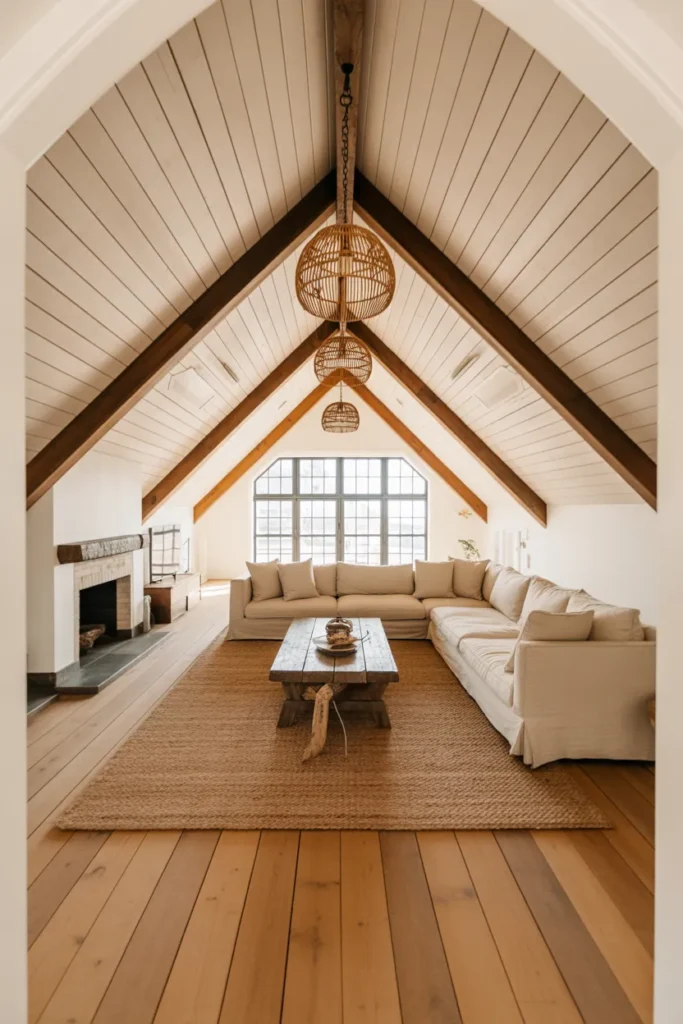
Whitewashing wood is a technique, not just a paint color. True whitewashing — where a diluted white paint or lime wash is applied and partially wiped away — allows the wood grain to show through the white layer. The result is a surface that reads as white from a distance but reveals natural wood character up close. This is tonally correct for a farmhouse interior and far more interesting than painted drywall or solid white-painted wood.
Woven textures at floor level and in soft furnishings — a large jute or sisal rug, woven basket pendants, rattan side chairs, and chunky knit throws — ground the room’s vertical energy. A vaulted ceiling space can feel unresolved without enough material weight and texture at ground and mid-level to counterbalance the height. Woven natural materials add that weight without adding visual complexity.
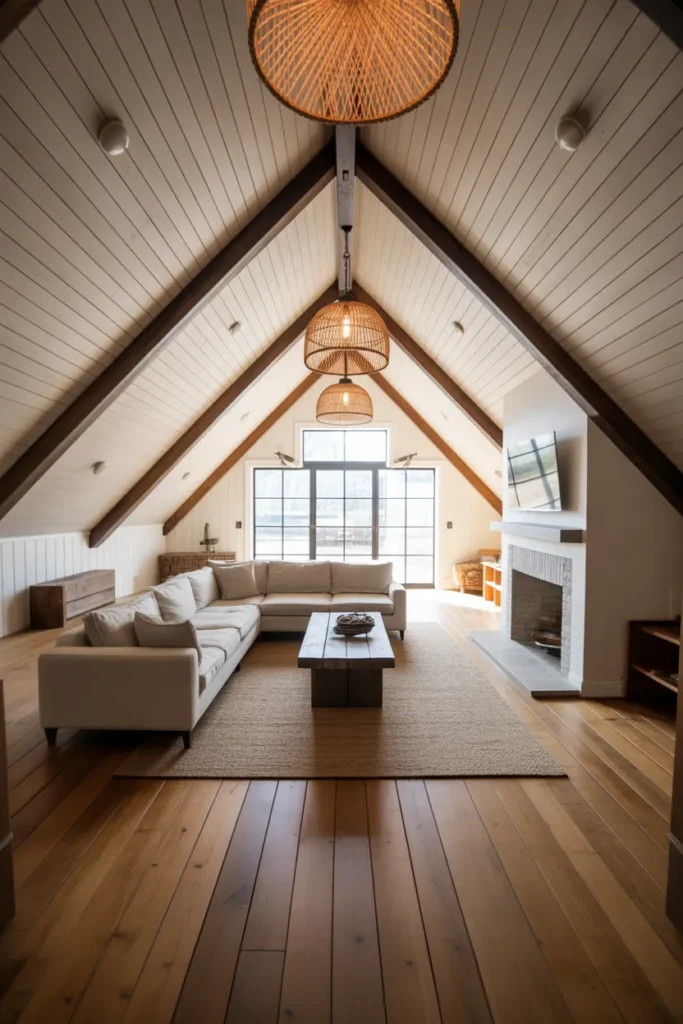
The living room layout in a vaulted-ceiling farmhouse room should always place the sofa perpendicular to the longest ridge line, facing the room’s main focal point — fireplace, view, or media wall. This orientation invites the eye to travel upward along the vault from the seating position, which is the experiential payoff the ceiling deserves.
5. Small Farmhouse Living Room With Built-In Bench Seating and Smart Storage
Small living rooms are one of the most common design challenges in American homes, particularly in older farmhouses, cottages, and bungalows where room sizes reflect a different era of residential design. The solution for a small farmhouse living room is not to minimize the farmhouse aesthetic — it is to integrate the storage and seating into the architecture so the floor area reads as open and intentional.
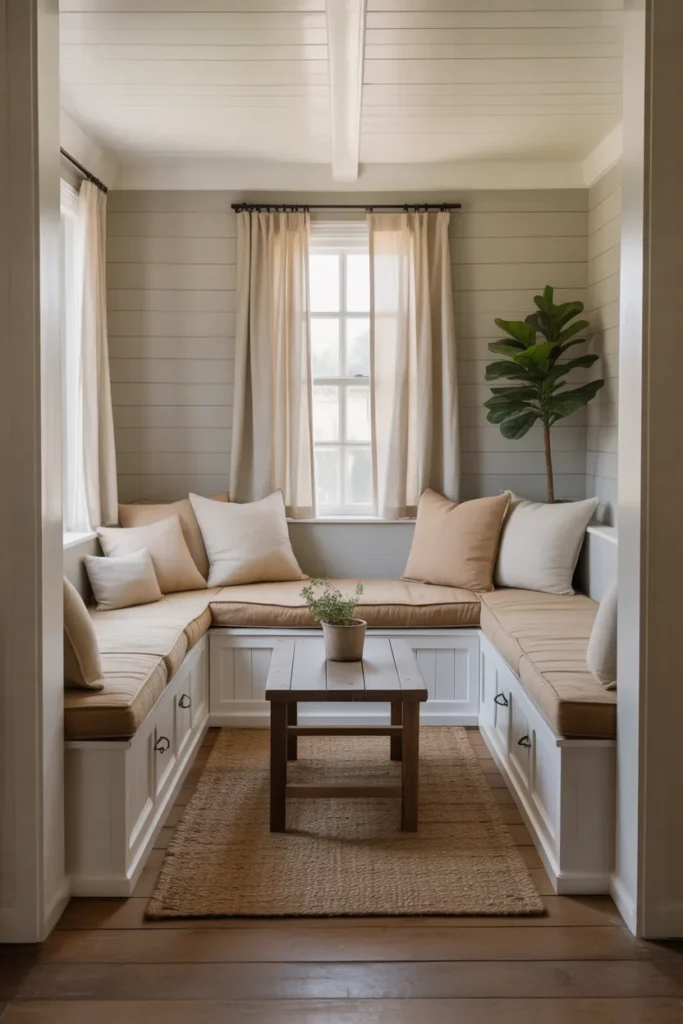
Built-in bench seating along one or two walls — with storage drawers or hinged compartments below the seat — is one of the most efficient small living room layout ideas available. A built-in bench can replace a sofa in a very small room, freeing up the central floor area for a coffee table and creating a perimeter seating arrangement that maximizes usable space. Topped with a thick cushion in natural linen or cotton canvas, the bench reads as comfortable and considered rather than utilitarian.
The farmhouse character of the room comes through in the materials: a shiplap or beadboard back wall behind the bench, simple painted wood framing for the built-in structure, and plain iron hardware on the storage doors. These details do not require significant budget — they require consistency of material choice.
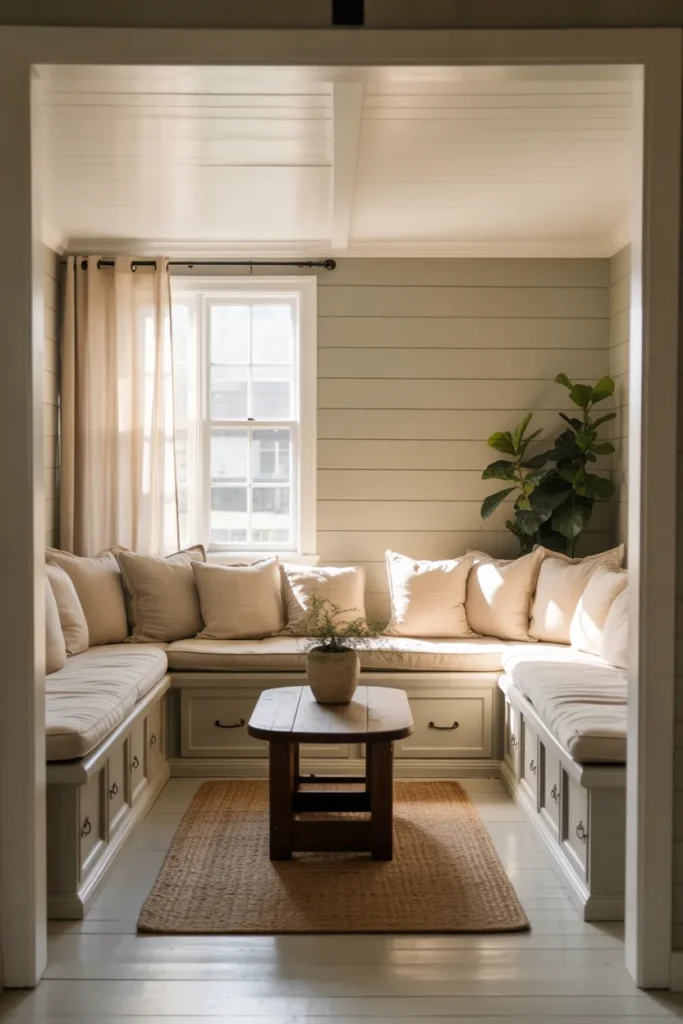
The most important planning decision in a small farmhouse living room is ceiling treatment. A white tongue-and-groove ceiling in a small room amplifies the perception of height and light. A dark or heavy ceiling treatment in the same room would compress what little vertical space is available. Keep the ceiling light and the walls calm, and let the built-in furniture carry the design’s character.
6. Rustic Farmhouse Living Room With Reclaimed Wood Focal Wall and Leather Seating
A reclaimed wood focal wall — using genuine salvaged barn wood or hand-hewn timber planks — is one of the most materially authentic choices available in modern farmhouse living room design. Unlike shiplap, which is a uniform board profile, reclaimed wood brings irregular widths, saw marks, weathering, nail holes, and natural color variation that cannot be replicated with new materials. This authenticity is its primary design value.
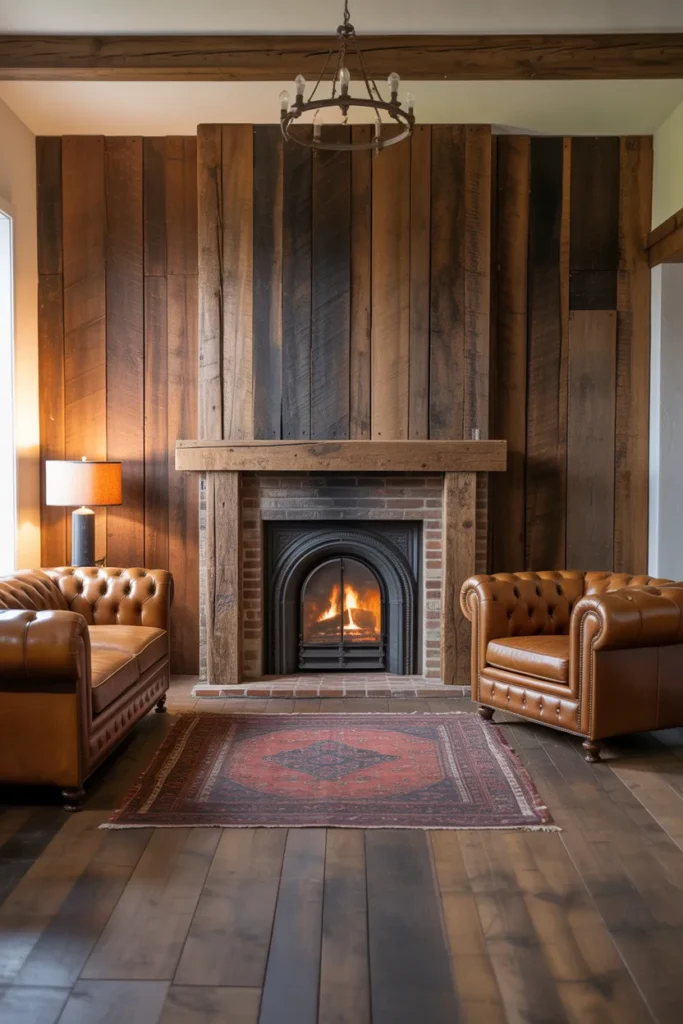
In a living room, the reclaimed wood wall works best as the fireplace surround wall or the wall the television is mounted on — both focal points that benefit from a strong material anchor. The irregular texture and warm gray-brown tones of aged barn wood create a surface that holds the eye naturally without requiring decorative additions. A simple mantel or floating media shelf in a compatible material is all the wall needs.
Leather seating — in cognac, saddle tan, or warm chestnut — is the most historically consistent upholstery choice for a reclaimed wood farmhouse room. Both materials age with dignity: leather develops a patina over years of use, and reclaimed wood already carries decades of character. Together, they create a room that feels as though it has been accumulated over time rather than assembled from a single shopping trip.
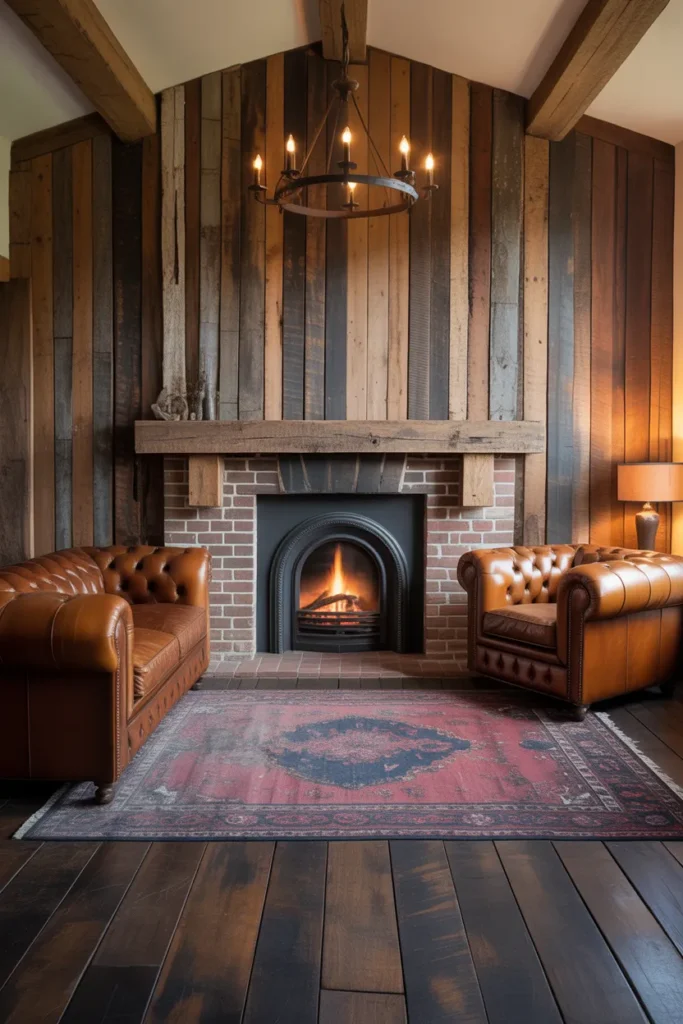
This combination is not suited to a light, airy, or feminine farmhouse aesthetic. Reclaimed wood and leather create a room with weight and gravitas. If your preference leans toward a softer, more delicate farmhouse register, this direction is not the correct fit. Apply it where the room and home’s architecture support a more rugged, grounded character.
7. Farmhouse Living Room With Arched Doorway and Warm Plaster Walls for a European Touch
Arched doorways and warm plaster walls bring a European farmhouse quality to American residential interiors that is distinct from the traditional American barn-reference aesthetic. This direction — sometimes called French country farmhouse or Italian rustic — is one of the fastest-growing living room design ideas for 2026 because it delivers the warmth and naturalness of farmhouse design with a level of refinement and sophistication that the classic American version does not always achieve.
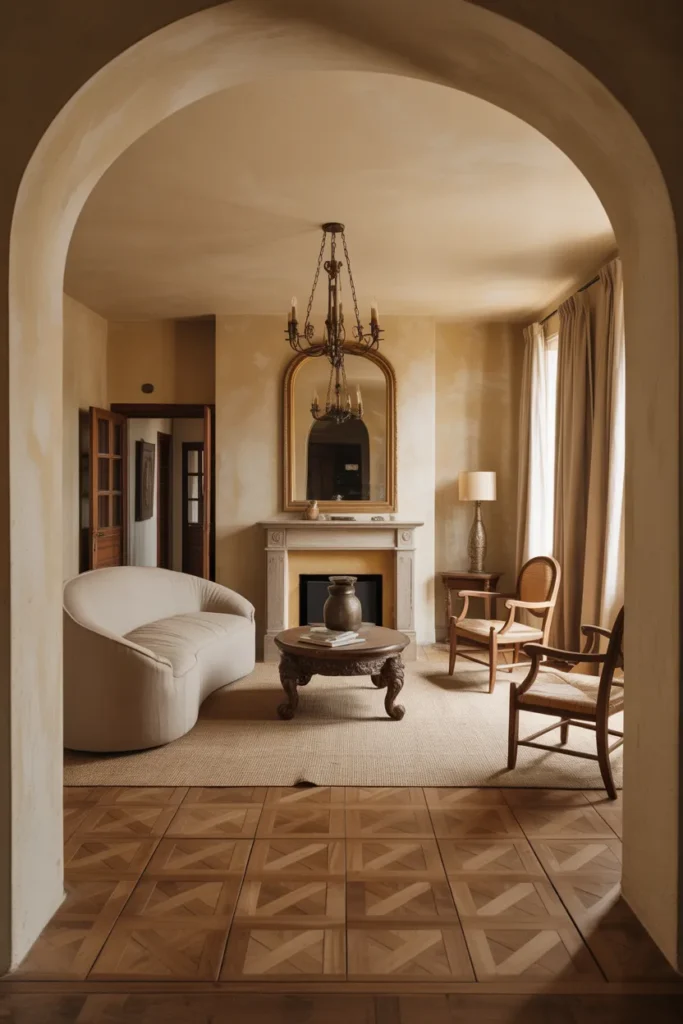
Venetian plaster or limewash paint on the living room walls creates the tactile, slightly matte surface that defines this aesthetic. Both finishes absorb and reflect light differently than standard eggshell or flat paint — they have depth, variation, and a handmade quality that reads immediately as a premium finish. In a warm ivory, sand, or aged ochre tone, these walls set the entire room’s atmosphere.
Arched doorways — whether structural or added as decorative casings — reinforce the European farmhouse reference at the architectural level. An arched opening between the living room and hallway, or between the living room and dining area in an open-plan home, carries more design weight than any decorative accessory and gives the room a sense of permanence and history.
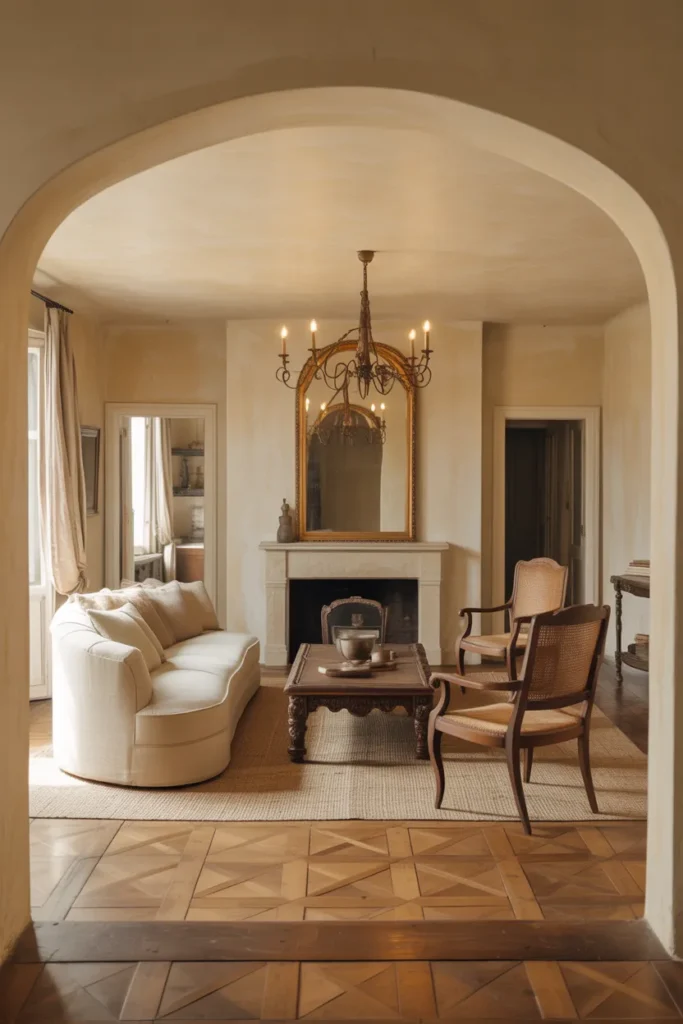
Furniture in this direction should lean toward antique or antique-inspired pieces in natural wood, rush seating, and linen or cotton upholstery. The European farmhouse aesthetic is undermined by overly contemporary furniture. A carved wood coffee table, rush-seated side chairs, and a linen sofa with curved lines are far more appropriate than clean-lined minimalist pieces.
8. Open-Plan Farmhouse Living Room With Sliding Barn Door and Defined Seating Zone
The sliding barn door is one of the most functionally and aesthetically specific elements in farmhouse living room ideas 2026. In an open-plan home, a barn door on a visible wall track creates a physical and visual transition between spaces — living room to office, living room to hallway, or living room to a more private area — without requiring a swinging door that would interrupt traffic flow.
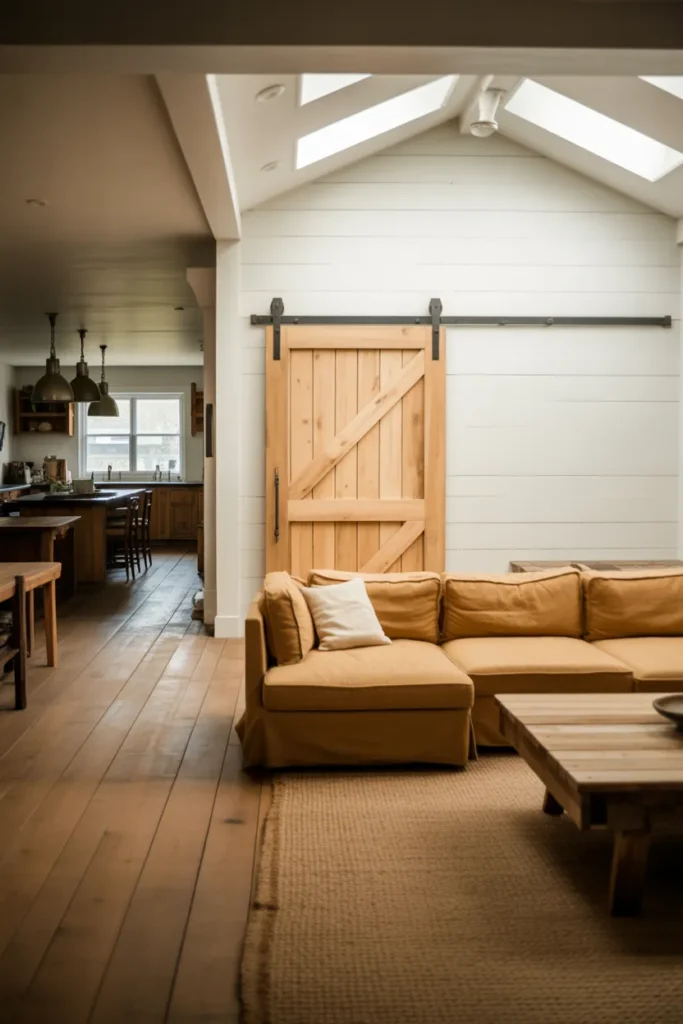
The barn door’s design value in an open-plan living room layout is twofold. First, it is a statement piece that immediately identifies the room as farmhouse in character. Second, it solves the common problem of open-plan homes that feel too exposed or lack any sense of room definition. A barn door can close off a space when needed and slide open to restore the open layout — giving the home flexibility that a fixed wall cannot provide.
Defining the seating zone in an open-plan farmhouse living room is essential. Without walls to create natural room boundaries, a large area rug under the sofa and coffee table does the defining work. The rug should be large enough that all four legs of the sofa sit on it — a rug that is too small makes the seating arrangement look unmoored and reduces the perceived size of the living zone.
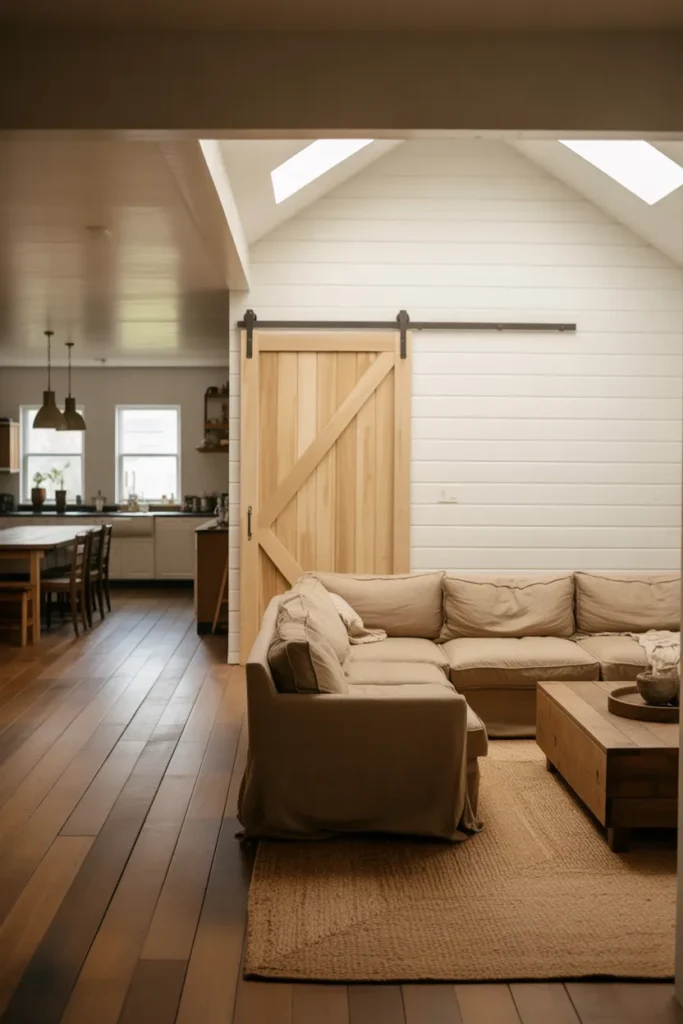
The barn door material should be consistent with the broader farmhouse material palette. Reclaimed wood, natural stained pine, or a whitewashed panel door are all appropriate. A barn door in a high-gloss finish or an industrial metal with glass panels will look technically correct as a barn door style but will feel tonally inconsistent with the farmhouse living room it adjoins.
9. Farmhouse Living Room With Antique and Vintage Pieces for a Collected, Lived-In Look
The most authentically farmhouse living rooms in 2026 are not the ones that were professionally decorated in a single session — they are the ones that look as though they have been thoughtfully accumulated over years. Incorporating genuine antique or high-quality vintage pieces into an otherwise updated farmhouse living room is the single most effective way to achieve this quality.
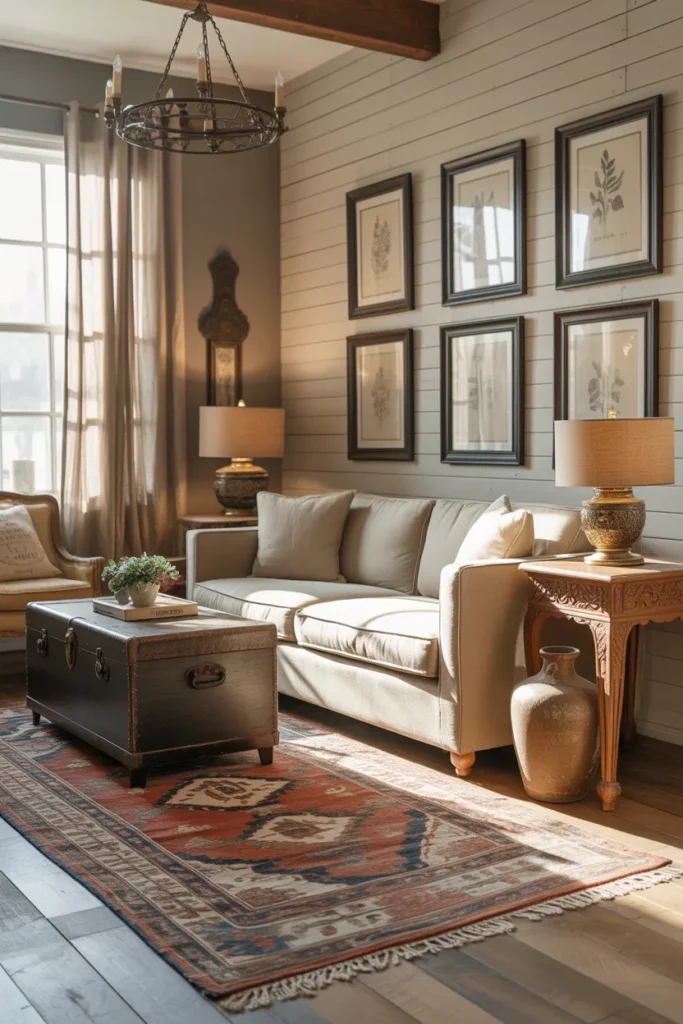
The key antique categories that anchor a farmhouse living room effectively are: a vintage wool or Turkish rug, an antique wood side table or chest used as a coffee table, old framed botanical or architectural prints, and an aged ceramic or pottery piece used as a vase or decorative object. Each of these can be sourced from estate sales, antique markets, or specialist dealers and does not require significant investment relative to the visual impact delivered.
The practical layout consideration in a room built around vintage and antique pieces is proportion. Antique furniture tends to be scaled differently from contemporary pieces — often slightly smaller or lower. Mixing antique side tables with a contemporary sofa requires attention to height relationships. A side table that sits well below the sofa arm looks incorrect and reduces functional usability.
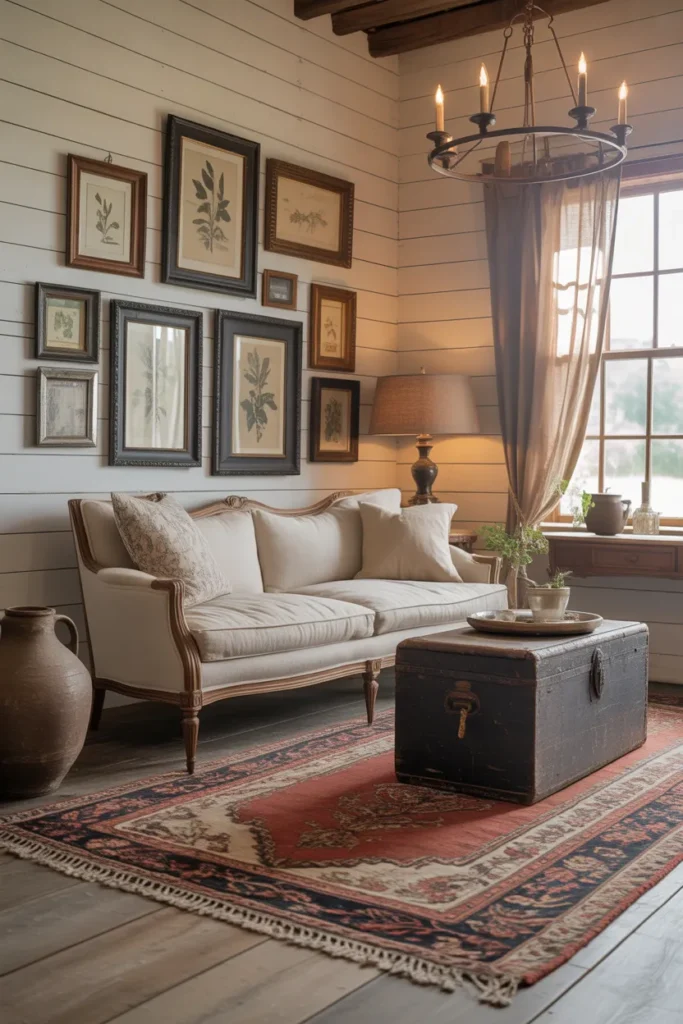
Lighting is where modern comfort and farmhouse character intersect most naturally in this direction. A new overhead fixture in an antique style — a candle-style chandelier, a lantern pendant, or a wrought iron fixture — allows you to have the quality, warmth, and brightness of contemporary lighting while maintaining the visual register of a room built around older materials and objects.
10. Modern Organic Farmhouse Living Room With Curved Furniture and Natural Clay Tones
The modern organic farmhouse is the most refined and forward-looking direction within farmhouse living room ideas 2026. It retains the natural material philosophy and warmth of farmhouse design but replaces the angular, rectilinear furniture of traditional farmhouse interiors with curved, sculptural pieces that reference organic form. This is farmhouse design that has absorbed the influence of contemporary interior design without abandoning its material roots.
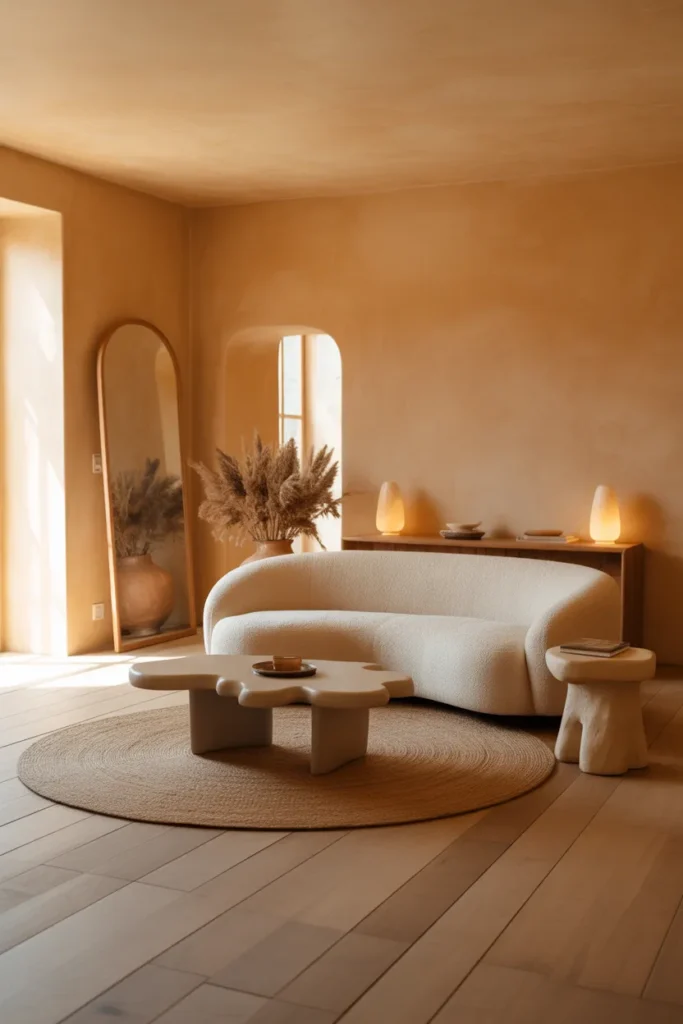
Curved sofas — particularly boucle or textured linen in warm white, cream, or sand — are the defining furniture piece in this direction. The curved form softens the room’s geometry and creates an inviting quality that straight-edged farmhouse furniture, however well-made, does not deliver. The curve also reads as contemporary, which is precisely what distinguishes this direction from a more traditional farmhouse aesthetic.
Natural clay tones — warm terracotta, dusty rose-brown, sand, and raw umber — applied to the walls through limewash or clay paint create an earthy, warm atmosphere that serves as the perfect backdrop for organic curved furniture. These colors are neither strictly warm nor cool — they occupy an earthy middle ground that reads as grounded, natural, and considered.
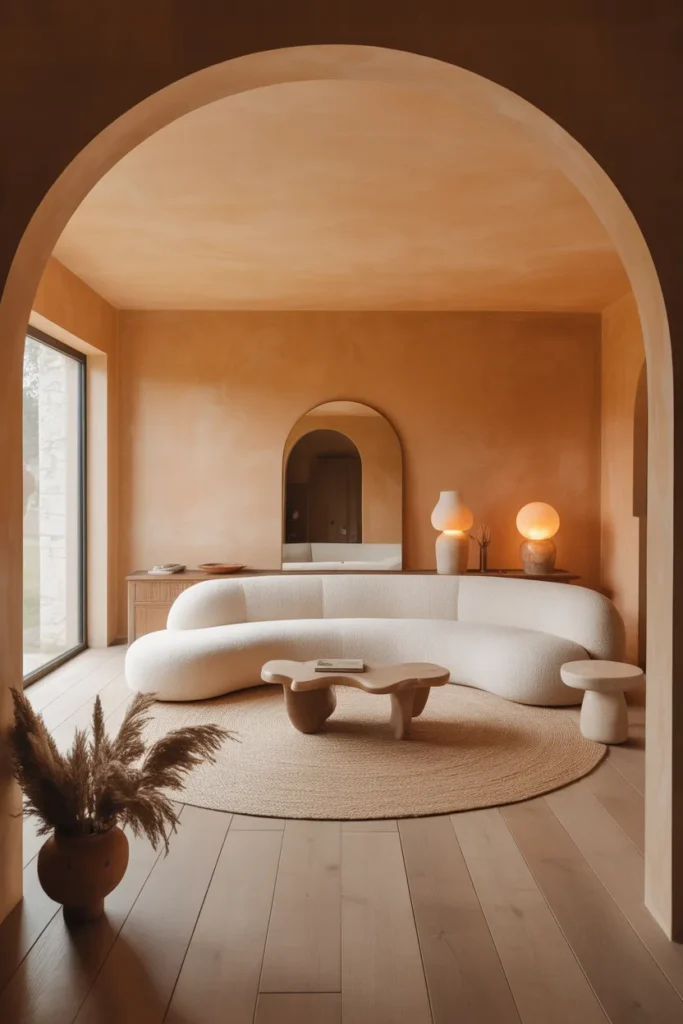
This direction is one of the most versatile farmhouse living room approaches for urban homes, apartments, and modern houses where a full rustic farmhouse aesthetic would feel inconsistent with the architecture. The organic farmhouse sensibility is light enough in its historical reference to work in a variety of building contexts while still delivering the warmth and natural material quality that defines farmhouse design at its best.
Final Thoughts
Farmhouse living room design in 2026 is defined by material honesty, practical warmth, and a clear point of view — not by a checklist of recognizable elements applied without context. The ten directions above cover the full range of the modern farmhouse spectrum, from the dark and moody to the light and organic, from small built-in solutions to open-plan statement rooms. The right choice depends on your specific space, your ceiling height, your natural light, and how you actually use the room.
Save this post before you close it. Whether you are starting a full renovation or updating a single wall, having a clear reference of well-considered farmhouse directions will make your decisions faster and more confident. If you are still working through furniture arrangement and room proportion questions alongside your style decisions, explore open-plan living room layout guides and small living room planning resources to make sure your space functions as well as it looks.