
If you are planning a laundry room renovation and want laundry room designer ideas 2026 that deliver both genuine functionality and a space you actually want to spend time in, this guide gives you nine distinct directions with practical guidance on layouts, materials, and decisions that matter. The laundry room is one of the most under-invested spaces in American homes despite being one of the highest-use rooms in the house. Every idea below addresses a real design problem with a real solution.
1. Full-Height Cabinet Wall With Integrated Appliances for a Laundry Room That Looks Like a Proper Room
The single most transformative upgrade available in laundry room design is a full-height cabinet wall that integrates the washer, dryer, sink, and storage into one continuous built-in system. When appliances are tucked behind cabinet-front panels or framed within a consistent cabinetry run, the laundry room stops reading as a utility closet with machines shoved in it and starts reading as a designed space with a clear organizational logic.
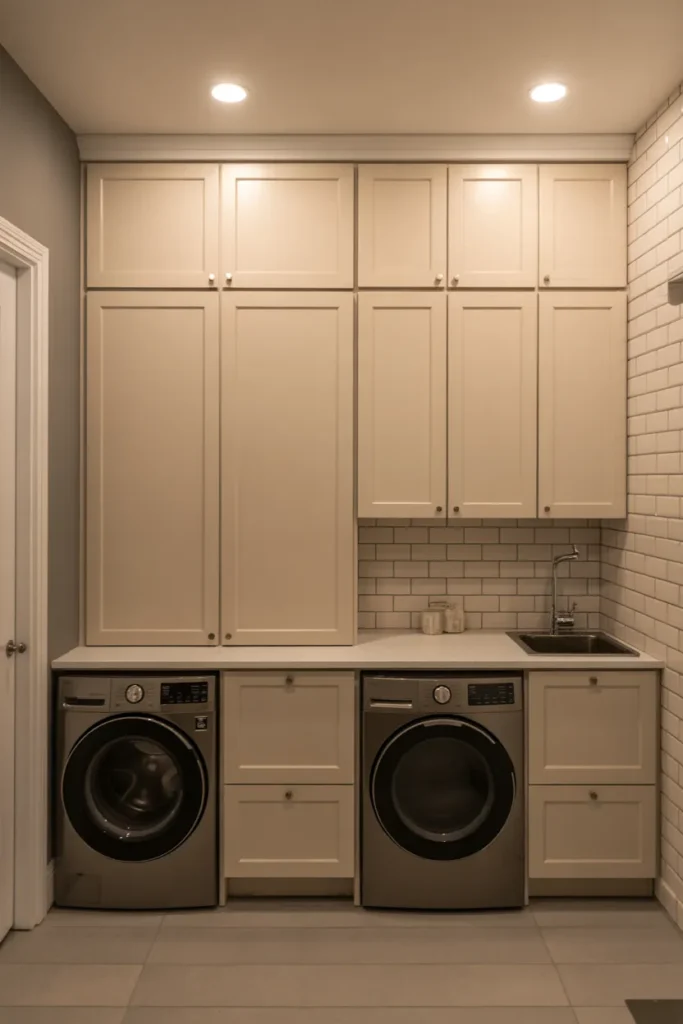
This approach works in any laundry room with at least one full wall of eight feet or more. The washer and dryer sit side by side at floor level — or stacked in a tower configuration if the wall is narrower — with upper cabinets above the machines running the full width and height of the wall. A countertop over the appliances creates a folding and sorting surface that a free-standing machine setup never provides.

The cabinet front panels for the washer and dryer opening are the detail that makes or breaks this look. A cabinet door that swings open to reveal the machine controls — rather than a panel glued to the appliance itself — gives the installation an architectural quality. The doors align with all adjacent cabinet doors, creating the seamless visual line that makes the whole wall read as intentional rather than improvised.
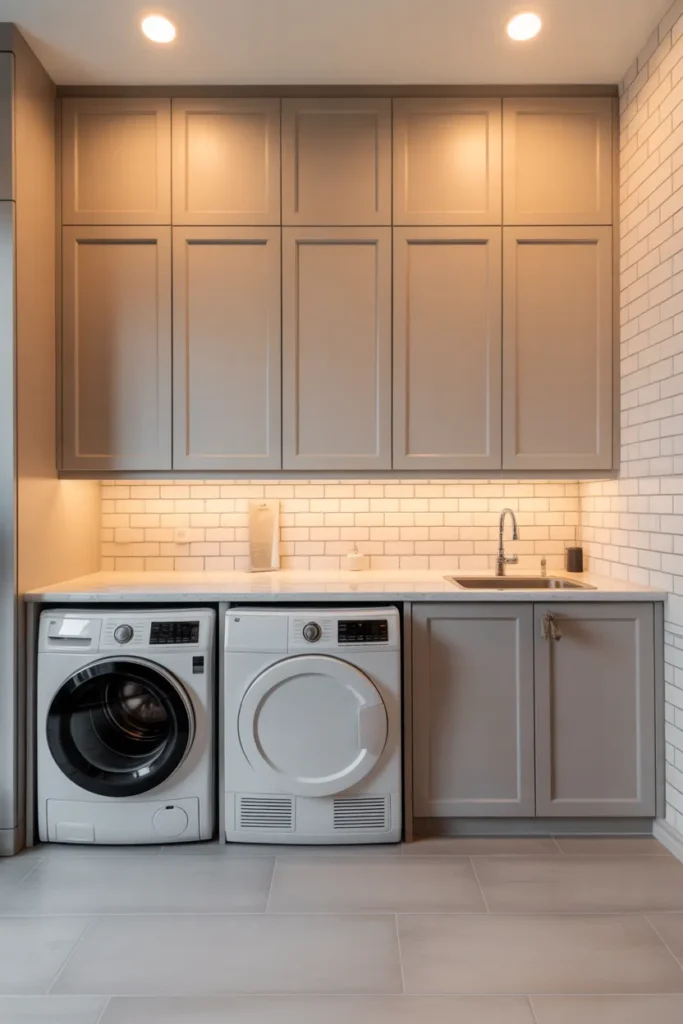
The most important planning decision in this configuration is ventilation. The dryer requires an unobstructed exhaust duct run regardless of how it is cabinetted. Confirm the duct path before finalizing cabinet dimensions, and build a service access panel into the cabinet back or side for future maintenance. Overlooking ventilation in the planning phase is the most common and most costly mistake in this type of installation.
2. Navy Blue Shaker Laundry Room With Open Brass Shelving for a High-Design Utility Space
A laundry room designed in deep navy blue shaker cabinetry with aged brass open shelving is one of the most photographed and saved laundry room designer ideas 2026 has produced — and for good reason. The combination delivers a room that reads as a deliberate interior design decision rather than a functional afterthought. More importantly, it demonstrates that a high-use utility room can carry a strong color and material identity without any sacrifice to function.
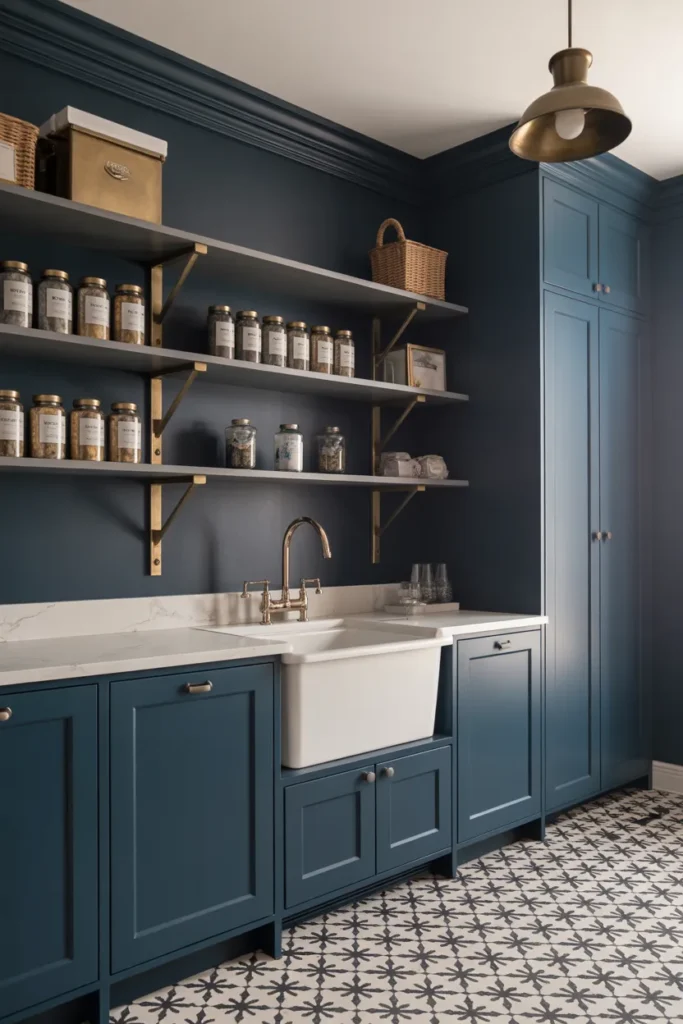
Navy shaker cabinets work in a laundry room for the same reason they work in a kitchen: the shaker profile adds dimension to a painted dark color, and navy’s blue-dark quality reads as sophisticated and calm in a room where the visual noise of laundry, cleaning products, and mechanical equipment is always present. The strong cabinet color anchors and organizes the room visually, even when the countertop is covered with unsorted laundry.
Open brass shelving above the countertop or alongside the cabinets provides accessible storage for items used daily — detergent, fabric softener, dryer sheets — without requiring a cabinet door to be opened every use. This is a genuine workflow improvement, not just a design choice. In a small laundry room where every movement counts, the difference between open and closed storage at the primary work zone is meaningful.
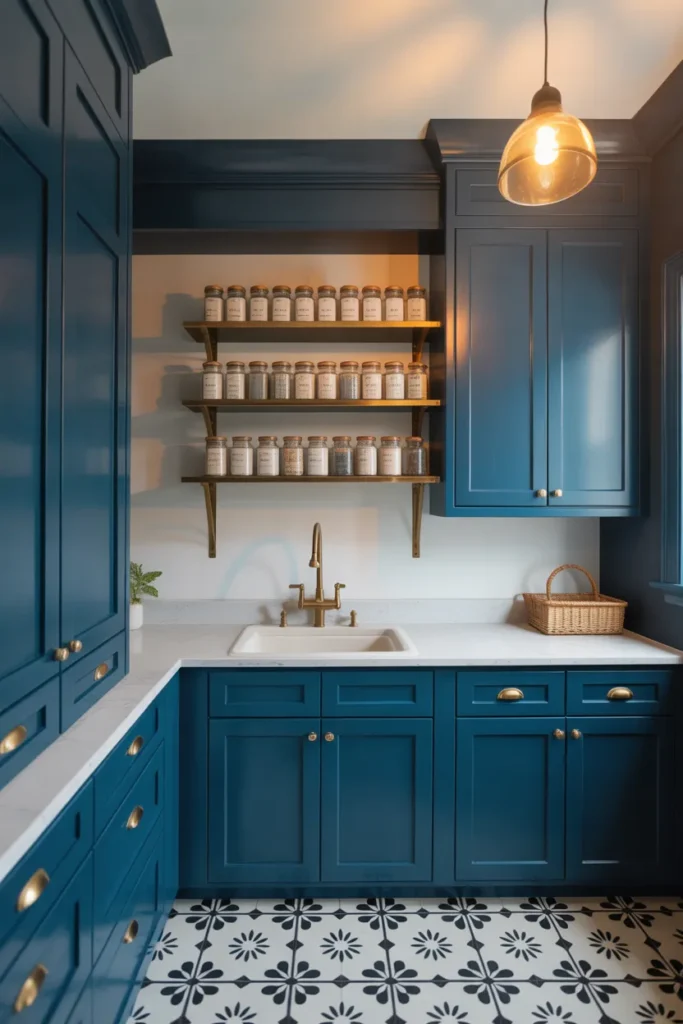
The mistake to avoid with bold cabinet colors in a laundry room is neglecting the floor. A navy cabinet room with a plain white vinyl floor looks unresolved. A large-format tile in a warm gray, a black and white pattern, or even a simple terracotta tone anchors the room and confirms that the design decision was made for the whole space, not just one wall.
3. Stacked Washer and Dryer Alcove With Floor-to-Ceiling Storage on Both Sides for Small Laundry Rooms
The stacked washer-dryer configuration is the most space-efficient appliance arrangement available and the correct choice for any laundry room under sixty square feet. Stacking reduces the appliance footprint from approximately five linear feet to approximately two and a half, which frees the remaining wall space for storage, a utility sink, or a folding counter — elements that a side-by-side arrangement in a small room cannot accommodate.
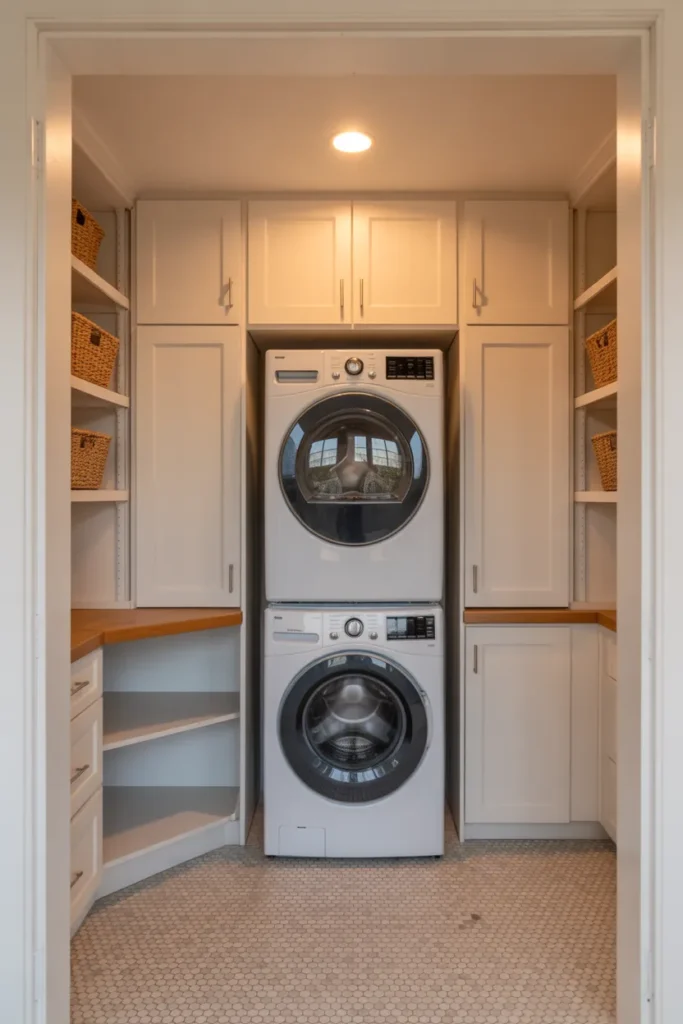
Building floor-to-ceiling storage columns on both sides of the stacked appliance alcove is the design move that transforms a utilitarian stack from a compromise into a layout strength. The tall storage towers visually frame the appliances as a deliberate centerpiece rather than a space-saving necessity. The towers provide significantly more storage volume than low cabinets would, and their height draws the eye upward, which makes the room feel taller.
The alcove depth for a stacked unit must be planned precisely. Most stacked washer-dryer combinations require approximately 27 to 29 inches of depth plus clearance for hoses and electrical connections at the rear. The alcove surround cabinets must be built to exactly match this depth — cabinets that are shallower than the appliances create a protruding machine effect that looks unfinished.
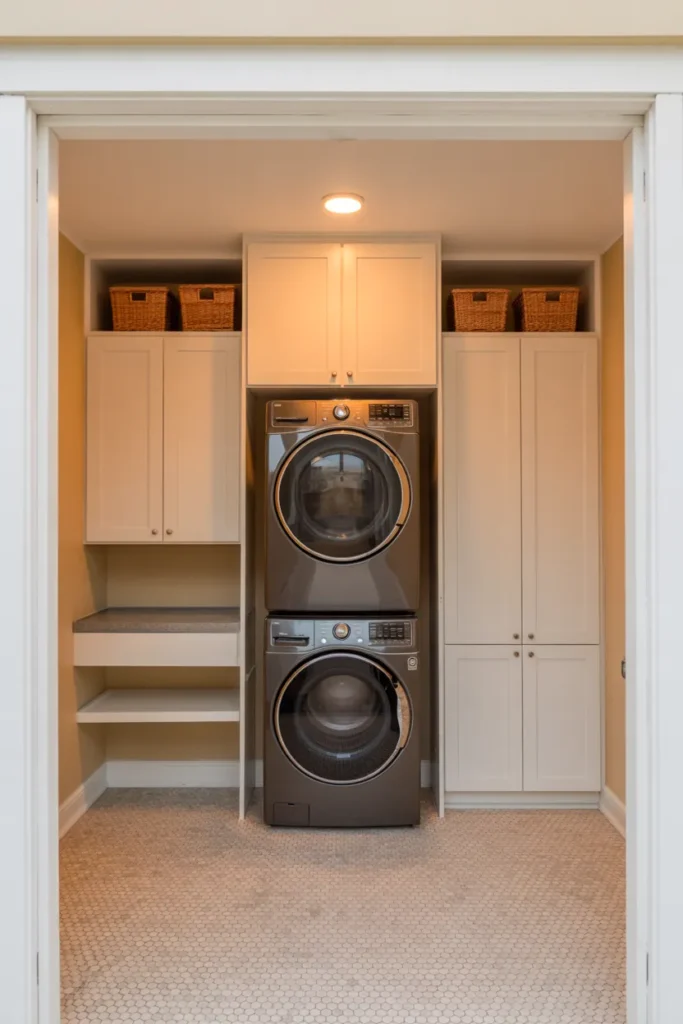
This layout is one of the most effective small laundry room space planning ideas for homes where the laundry is housed in a hallway closet, a narrow utility room, or a bathroom-adjacent space. The key planning note is door access: a stacked unit in a deep alcove may require a door that opens fully flat against the wall to avoid blocking access to the machine controls. Pocket doors or bifold doors are often the correct hardware choice in these configurations.
4. Sage Green Laundry Room With Shiplap Walls and a Farmhouse Utility Sink for an Organic Modern Look
Sage green cabinetry in a laundry room is one of the most durable and broadly appealing color decisions available for 2026 because it occupies the same earthy, organic palette that is driving design decisions across the American home right now. Unlike trend-driven colors that date quickly, sage green connects to a natural reference — garden herbs, aged patina, mossy stone — that holds relevance across interior design cycles.
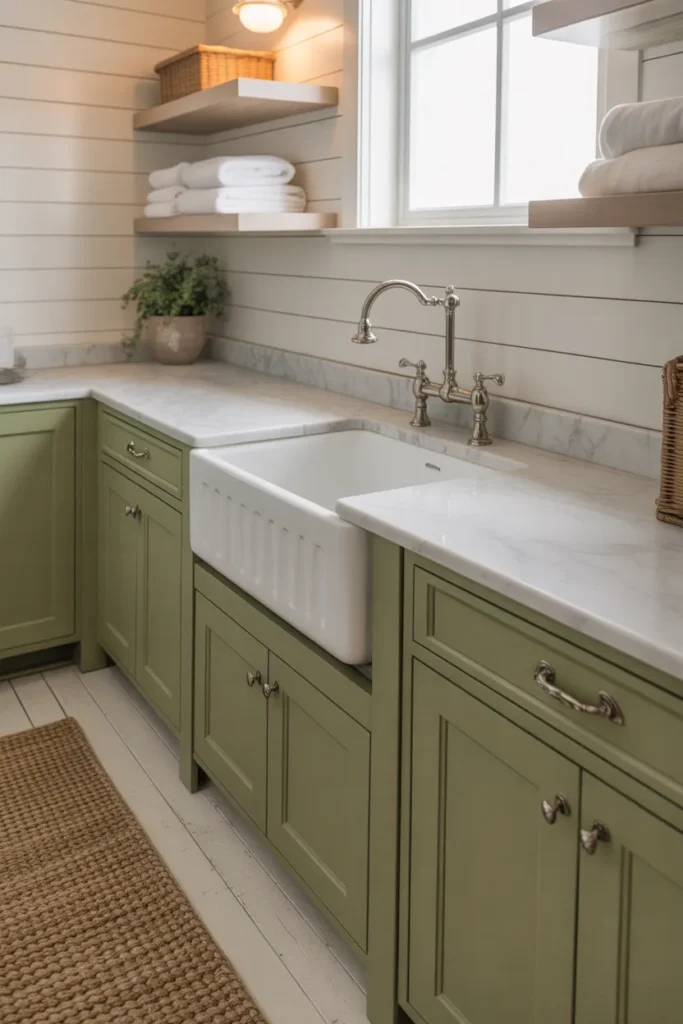
Shiplap on the walls above the cabinets reinforces the organic modern register without pushing into full farmhouse territory. In a laundry room, shiplap painted in a warm white or soft cream creates a backdrop that is easy to clean, visually interesting without being busy, and tonally consistent with the sage green cabinetry below. The horizontal lines of the shiplap also create a visual horizon that makes narrow laundry rooms feel wider.
A farmhouse-style apron utility sink — deeper and wider than a standard laundry tub — is the functional anchor of this design direction. The apron front in white porcelain or glazed cast iron reinforces the farmhouse reference while delivering a genuinely practical work basin large enough for hand-washing delicates, soaking items, or cleaning muddy gear. This is a sink that earns its space.
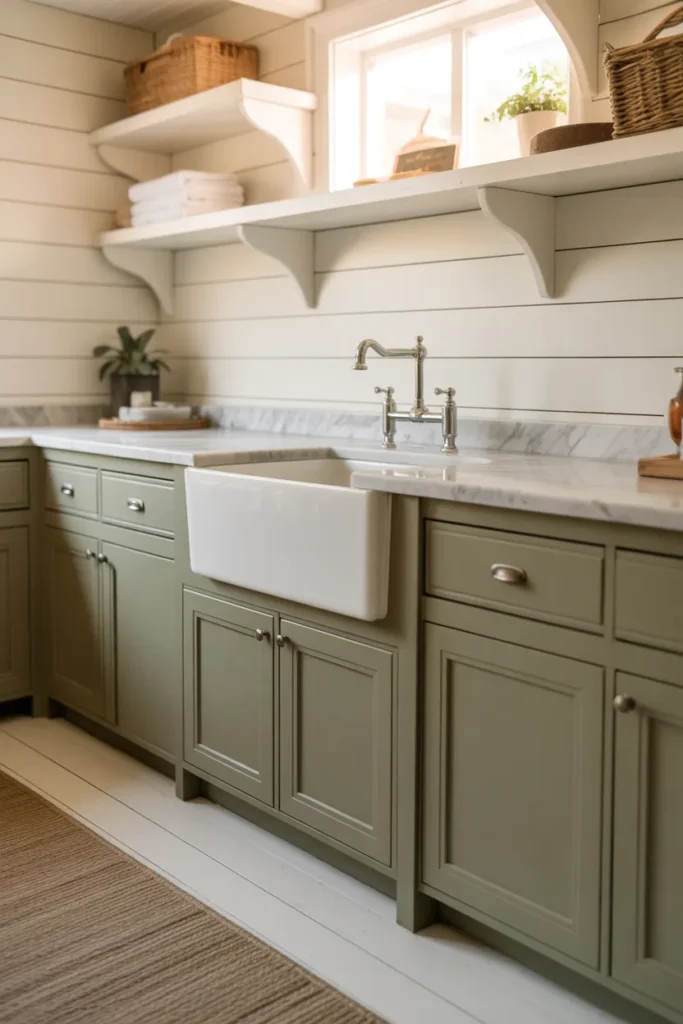
This combination is particularly well-suited to laundry rooms in older American homes, craftsman houses, and suburban family homes where the broader interior already leans toward natural materials and warm tones. In a very modern or minimalist home, the farmhouse utility sink and shiplap may feel architecturally inconsistent with the surrounding spaces. The design should connect to the home, not operate as a separate themed room.
5. All-White Laundry Room With Integrated Drying Rack System and Hidden Storage for Maximum Cleanliness
An all-white laundry room — white cabinets, white walls, white countertop, white tile floor — is the most practical color decision for a room where the primary visual challenge is managing the constant presence of laundry, stains, and cleaning products. White reflects maximum light, making even a windowless laundry room feel open and clean. More importantly, white provides a neutral backdrop that allows the room’s organizational systems to be the design story rather than the color scheme.
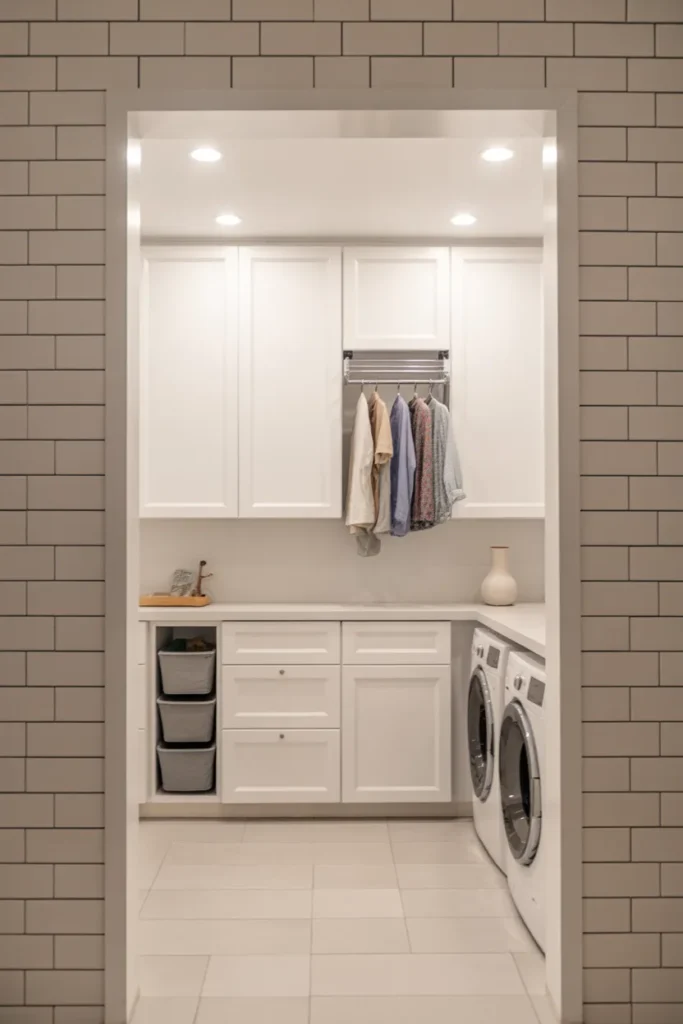
An integrated wall-mounted drying rack system is the most useful functional addition in a modern laundry room designer layout for 2026. A retractable or folding drying rack mounted between upper cabinets — at a height that allows full-length garments to hang without touching the countertop — eliminates the need for a freestanding drying rack that takes up floor space when in use and storage space when not. When folded, the rack reads as a cabinet element rather than a piece of equipment.
Hidden storage in a white laundry room means building in pull-out laundry hamper drawers below the countertop, a tall broom-and-mop closet beside the appliances, and a dedicated cleaning supply cabinet with interior shelving scaled to bottle heights. These are the specific storage categories that, when they do not have dedicated homes, result in the visual clutter that makes most laundry rooms feel disorganized regardless of their size.
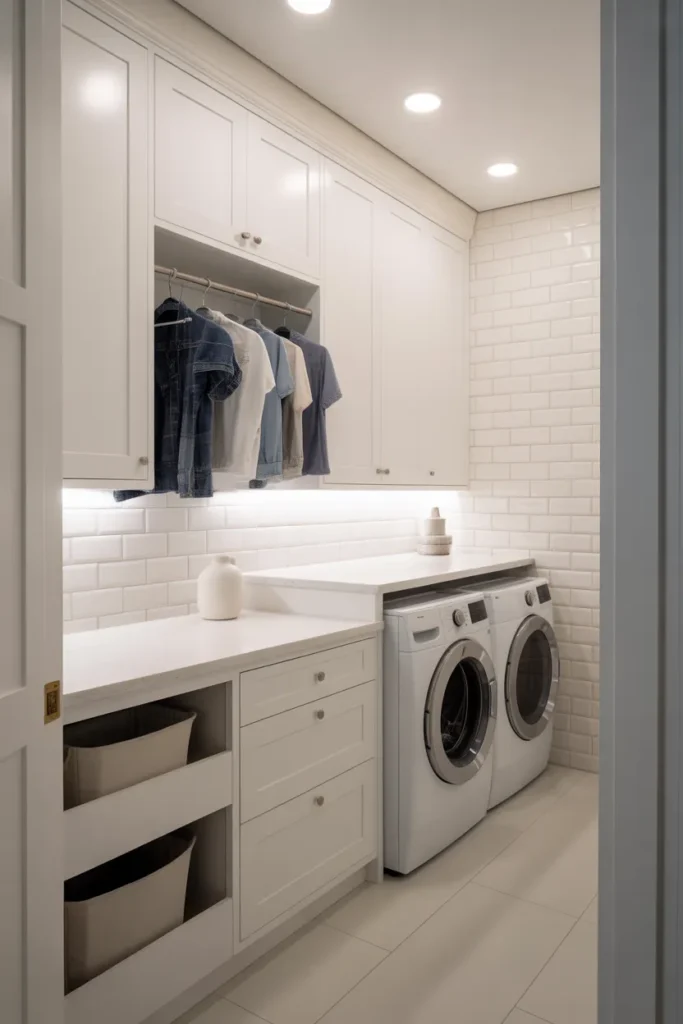
The single weakness of an all-white laundry room is that it requires consistent cleaning to look as intended. White grout on tile floors will gray over time without regular maintenance. A warm light gray grout on white tile floors is a more practical alternative that maintains the clean, light quality of an all-white room while being significantly more forgiving in a high-use utility space.
6. Moody Black Laundry Room With Matte Tile and Warm Lighting for a Spa-Like Utility Experience
A fully matte black laundry room — black cabinets, black walls, black tile — is one of the most visually bold laundry room designer ideas 2026 offers, and it is also one of the most practically sound in a room without natural light. Counter-intuitively, dark surfaces in a windowless laundry room can feel more resolved and intentional than light surfaces that emphasize the room’s lack of windows by attempting to compensate for them. A dark room that commits to its darkness and uses warm artificial lighting to create atmosphere is more successful than a bright room that fails because it has insufficient natural light to back it up.
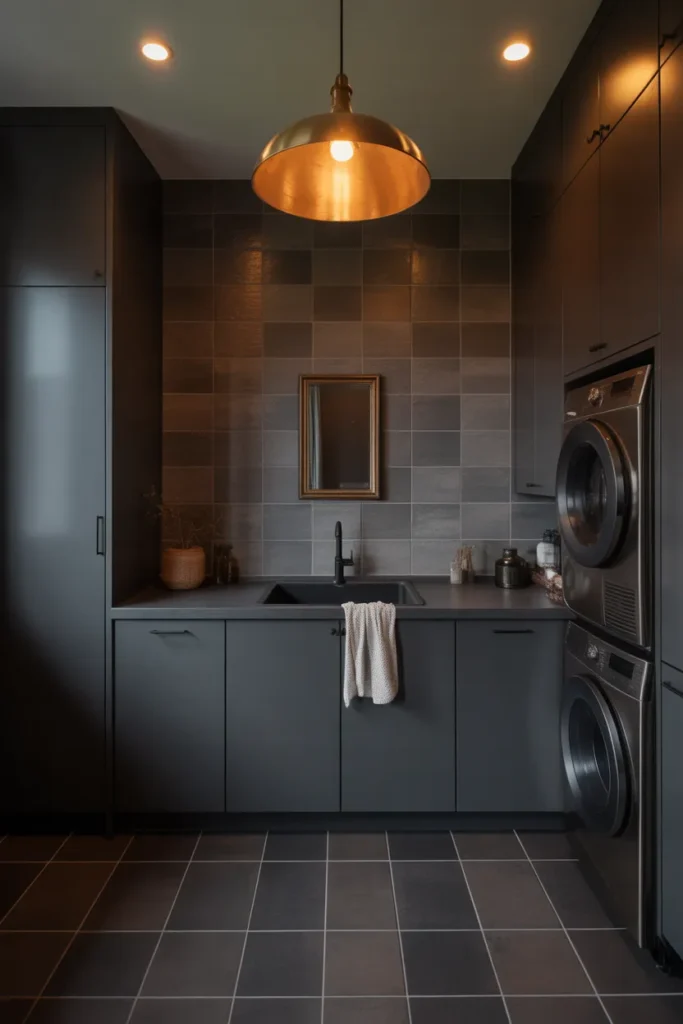
Matte tile — in a large format charcoal or matte black — is the correct tile choice in this direction because gloss black surfaces in a utility room show every water splash, fingerprint, and dust particle. Matte surfaces absorb rather than reflect these marks, which keeps the room looking clean through daily use. On the walls, a matte black paint or a textured matte black tile on one feature wall creates depth without the maintenance burden of gloss.
Warm lighting is the essential counterbalance to the dark surfaces. A warm white LED — in the 2700K to 3000K color temperature range — combined with a statement light fixture creates a spa-like warmth that the room’s dark palette makes possible. A single large pendant in a brushed brass or antique brass finish, centered above the countertop, delivers the light quality and the visual warmth needed to prevent the room from feeling oppressive.
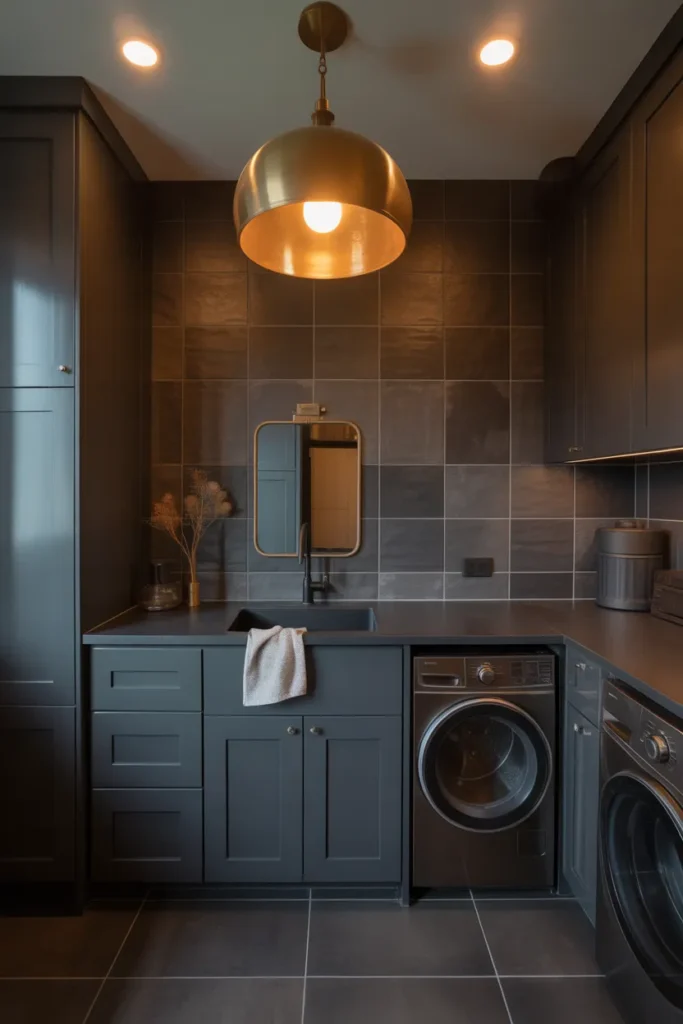
This direction is specifically suited to interior laundry rooms with no windows and good ventilation. It is not the correct choice for a laundry room with a window and natural light, where the dark palette would fight the daylight rather than work with it. In the right context — a hallway laundry, a basement utility room, or an interior closet conversion — this is one of the most dramatic and effective small laundry room design ideas available.
7. Laundry Room With Mudroom Integration and Bench Seating for Entry-Adjacent Utility Spaces
Combining a laundry room with mudroom functions — boot storage, coat hooks, bench seating, and bag drop — is one of the most practical functional laundry room layout ideas for American homes where the laundry room is positioned near the garage entry, back door, or side entry. The integration solves two organizational problems simultaneously: where to manage dirty clothes coming in from outside activities, and where to manage the transition from outdoor gear to indoor living.
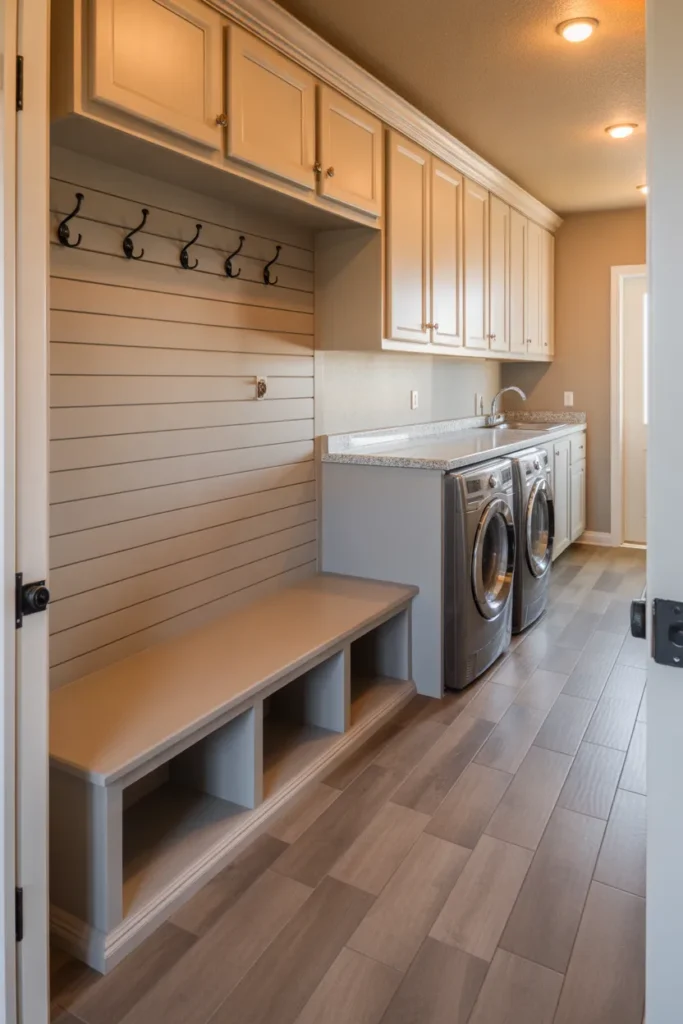
The layout of a combined laundry-mudroom requires clear zone separation within the same space. The mudroom zone — bench, hooks, boot storage — should be positioned at the entry point, closest to the door. The laundry zone — appliances, sink, folding counter — should be positioned deeper in the room, away from the high-traffic entry point. This prevents the two functions from colliding during peak use times, particularly in family homes with multiple children.
A built-in bench with under-seat storage cubby compartments is the defining functional element of the mudroom zone. The bench height — typically 17 to 19 inches from the floor — should be consistent with comfortable seating for boot removal. Above the bench, a combination of open hooks and closed upper cabinet storage keeps coats, bags, and outdoor gear accessible but contained.
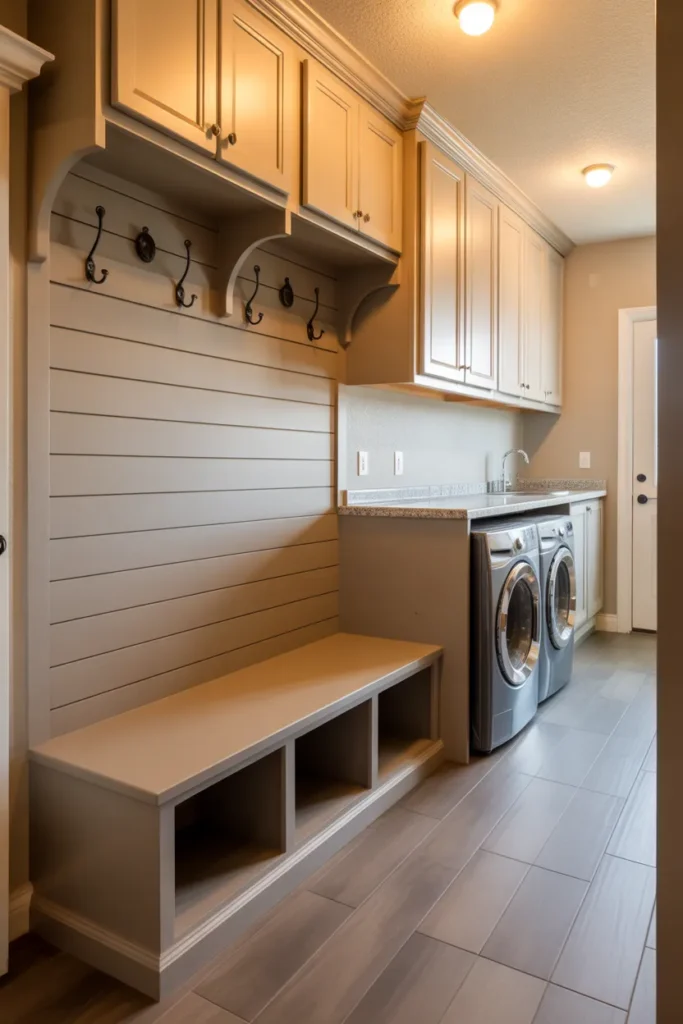
The material choices in a combined laundry-mudroom need to prioritize durability above all other considerations. Luxury vinyl plank flooring — waterproof, scratch-resistant, and comfortable underfoot — is more practical than ceramic tile in a high-traffic entry zone where wet boots, muddy footprints, and dropped gear are daily realities. Wall finishes should be washable: a semi-gloss or satin paint, or a tile wainscot to the bench height, will survive the conditions this room faces better than matte paint or open wood surfaces.
8. Laundry Room With Full Tile Wall Mural and Minimalist Cabinetry for a Statement Utility Room
A full ceramic or porcelain tile mural on one wall of the laundry room — a graphic pattern, a floral design, or a geometric field — is one of the most unexpected and high-impact design decisions available in the laundry room designer ideas 2026 space. The tile mural turns what is typically the most anonymous room in the house into a space with genuine visual identity and design confidence.
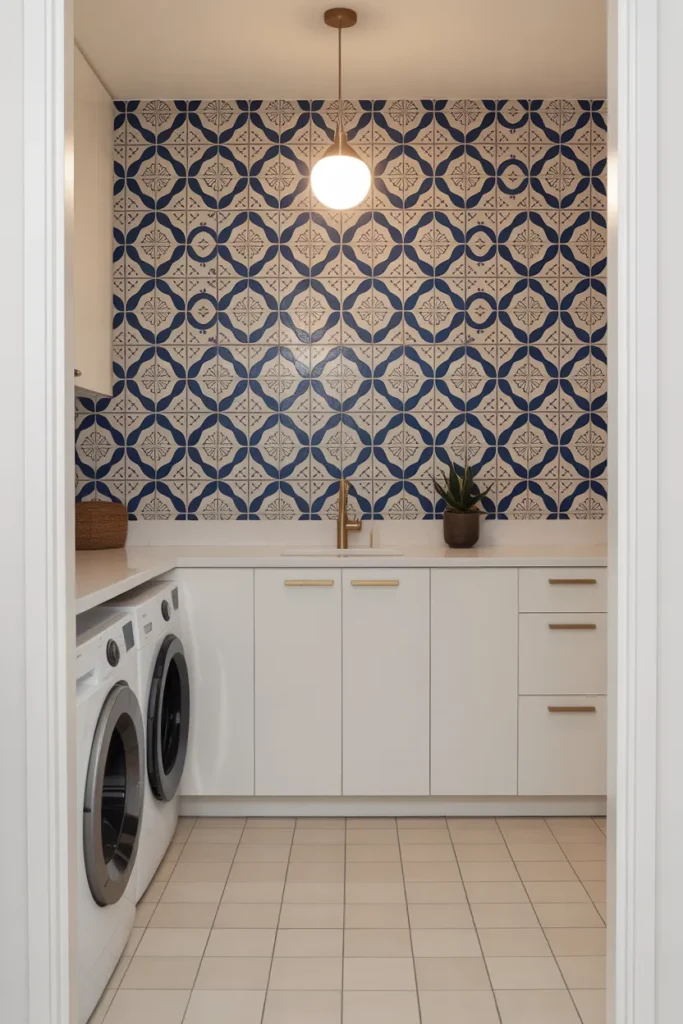
This approach works because the laundry room is a room that is visited frequently but briefly — loads are started and moved, laundry is folded and sorted. The brevity of visits means a bold visual statement reads as energizing rather than overwhelming, in the same way a bold wallpaper in a powder room works. The tile mural has all of the impact of wallpaper with the practical advantage of being waterproof, steam-resistant, and cleanable — properties that are essential in a laundry environment.
Minimalist cabinetry is the correct counterpart to a bold tile mural wall. Flat-front cabinets in a single muted color — warm white, soft gray, or pale sage — allow the tile to dominate without competition. Any hardware should be simple and consistent: small black or brushed brass bar pulls in one continuous profile. The folding countertop should be a plain solid surface — white or gray quartz — with no veining pattern that might conflict with the tile.
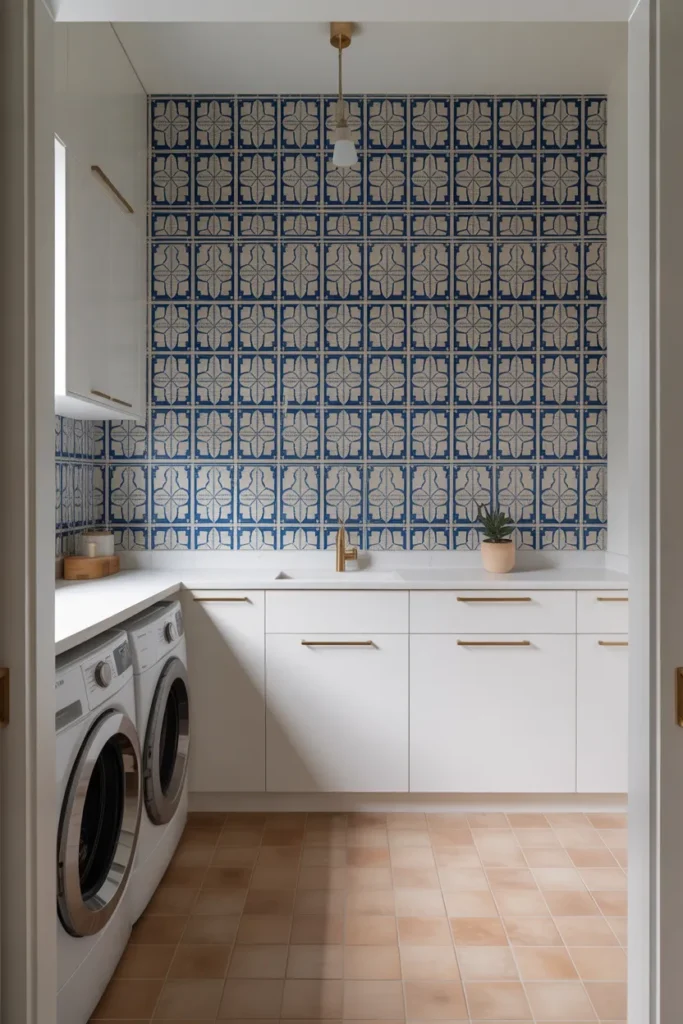
The tile mural wall is almost always the wall visible from the doorway or the wall facing the appliances, not the wall the appliances are on. Placing the mural behind the machines partially conceals it and reduces its impact. The facing wall — the one the person doing laundry looks at while the machine runs — is the correct placement both functionally and compositionally.
9 . Luxury Laundry Room With Quartz Island, Custom Lighting, and Linen Storage Wall for High-End Homes
A dedicated laundry room with a central quartz-topped island — used for folding, sorting, and hand-finishing garments — is one of the clearest indicators of a high-specification home and one of the most genuinely functional laundry room designer ideas 2026 has to offer for larger homes with generous utility space. The island transforms laundry from a task completed hunched over a narrow counter to a workflow organized across a generous, well-lit work surface.
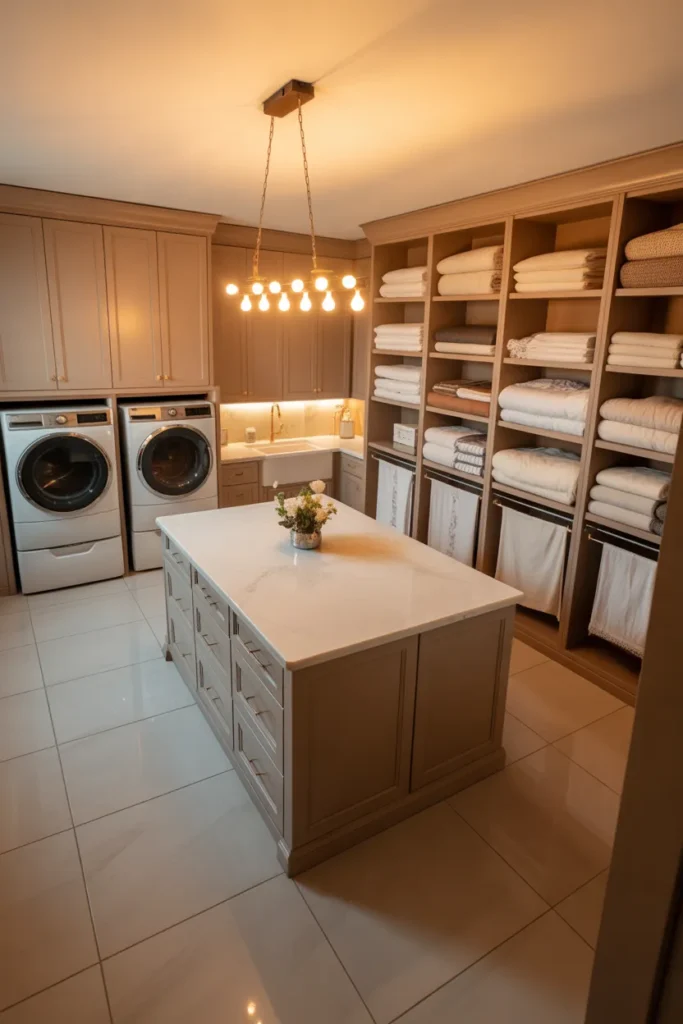
The island in a luxury laundry room should include built-in storage below: deep drawers on one side for folded items waiting to be put away, and open cubby shelving on the opposite side for laundry baskets. This makes the island a sorting and staging hub rather than simply a flat surface. A waterfall quartz countertop edge on the island’s most visible side elevates the material quality of the space and signals the investment level of the overall design.
Custom lighting in a luxury laundry room means layered sources: recessed ceiling lights for overall task illumination, under-cabinet LED strips for countertop-level light above the appliances and sink, and a statement pendant or a linear chandelier above the island. The pendant above the island serves the same compositional purpose it serves in a kitchen — it anchors the island visually and creates a focal point that confirms the island’s status as the room’s primary work surface.
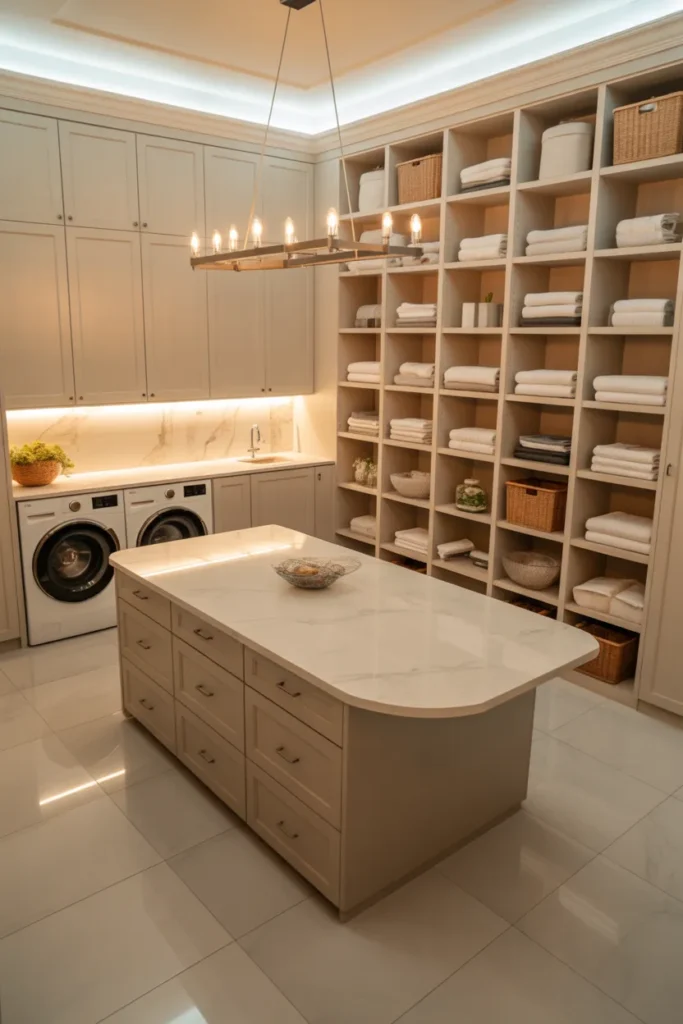
A full linen storage wall — dedicated entirely to clean, folded household linens organized by category in open shelves, pull-out drawers, and hanging compartments — is the detail that distinguishes a genuine luxury laundry room from a simply expensive one. The linen wall addresses the real organizational need that most homes handle with under-bed storage and linen closets scattered across the house, and it brings all household textile management into a single, designed, accessible space.
Final Thoughts
A well-designed laundry room is not a luxury — it is a practical investment in one of the most frequently used spaces in your home. The nine ideas above cover the full range of what laundry room design can deliver in 2026: from small-space stacking solutions to full luxury rooms with islands and linen walls, and from bold color statements to clean all-white systems. The right direction for your home depends on your available space, your household size, and how much of the surrounding home’s design language you want the laundry room to reflect.
Save this post before you move on. Whether you are working with a contractor in the next few weeks or still in the early planning phase, having clear reference points for layouts, materials, and storage systems will make every conversation more productive. If you are still working through the broader utility space planning decisions that a laundry room renovation connects to — mudroom placement, hallway storage, or basement finishing — explore functional home layout guides and small utility room planning resources to make sure every space in your home works as hard as it should.