If you have been searching for vanity desk ideas 2026 that go beyond pretty photographs and actually help you make a real design decision, this guide is built for you. Each idea below addresses a specific room size, layout challenge, or style direction — so you can identify what works for your space and act on it with confidence.
1. A Wall-Mounted Floating Vanity That Works in Tight Bedrooms
A floating vanity desk mounted directly to the wall is the most space-efficient vanity solution available for small bedrooms and apartments. Because it has no legs touching the floor, it visually opens up the room and makes the floor area feel larger than it is.
The ideal mounting height for a seated vanity is 28 to 30 inches from the floor to the surface top. This accommodates most standard vanity stools and allows comfortable elbow positioning for makeup application. Use a stud finder before installation — mounting into drywall alone will not support the weight of a mirror, lighting, and daily-use items.
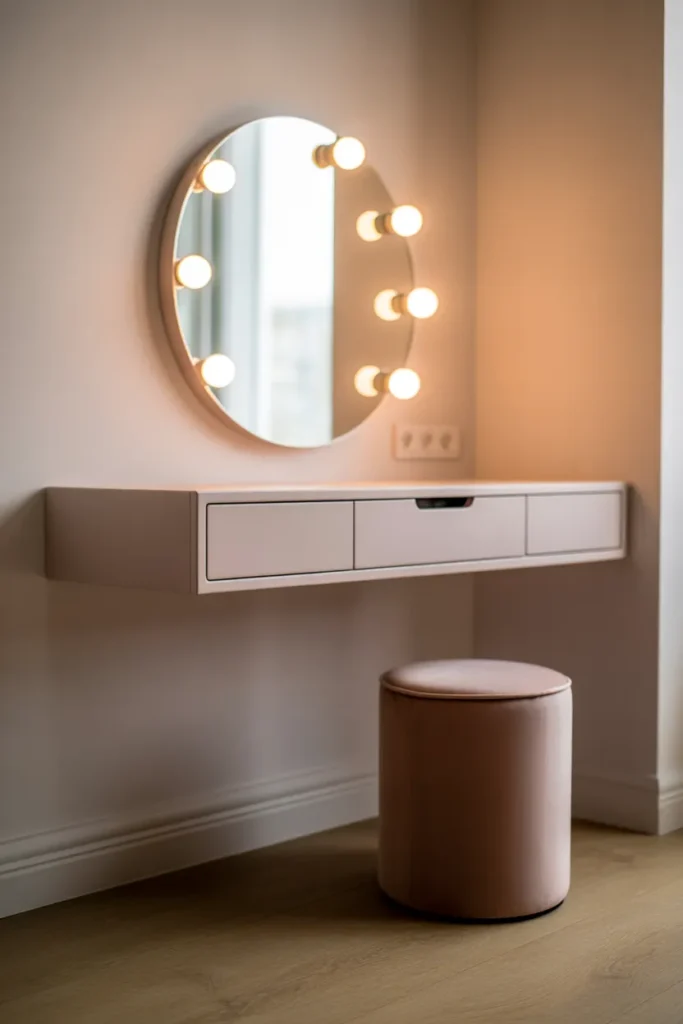

Choose a surface in a material that resists moisture and product spills. Lacquered wood, sealed MDF, or a thin stone-effect laminate all perform well in a vanity context where liquids are common.
The most common mistake with floating vanities is installing them without adequate storage. A floating desk with no drawers becomes cluttered within days. Opt for a wall-mounted design with at least one drawer unit or pair it with a floating shelf above for product storage.
2. A Built-In Vanity Nook Inside a Closet Alcove That Hides Away Completely
Converting an unused closet alcove or a recessed wall space into a built-in vanity nook is one of the most practical vanity desk ideas for homeowners who want full functionality without permanent visual impact on the bedroom.
When the closet doors are closed or curtains are drawn, the vanity disappears entirely. This is particularly useful in studio apartments, shared bedrooms, or smaller primary suites where the vanity would otherwise dominate the floor plan. The nook keeps all beauty tools, lighting, and mirrors contained in a single dedicated zone.
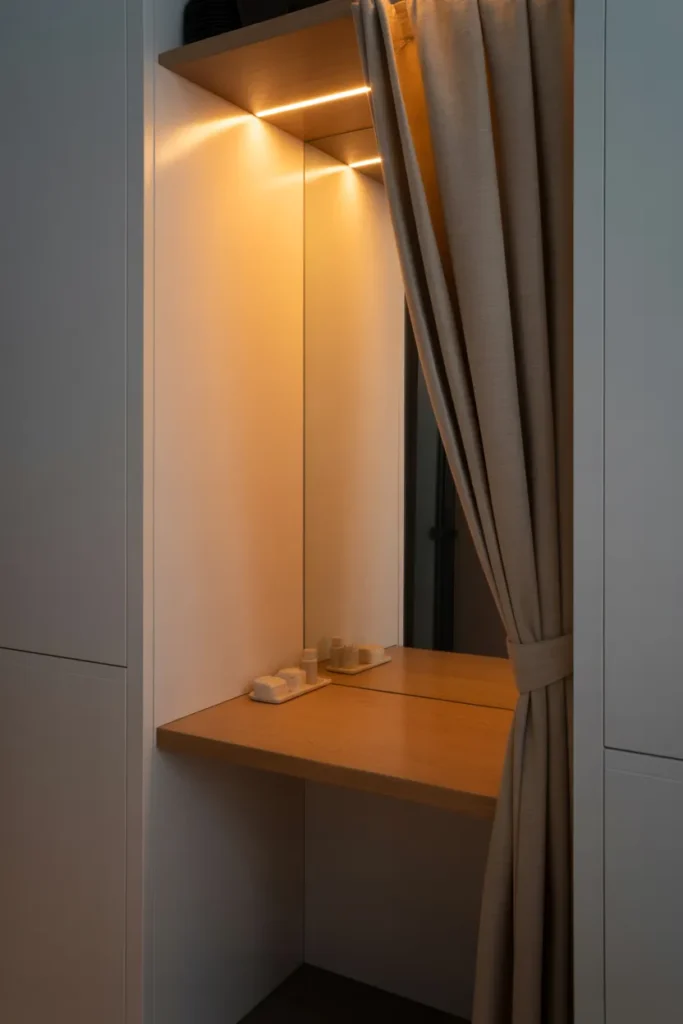
For the built-in setup, install a floating shelf at desk height across the width of the alcove, add an interior light source at the top of the nook (LED strip or small sconce), and mount a mirror on the back wall. Shallow open shelves on either side of the mirror hold everyday products without requiring deep cabinetry.
This setup works best in alcoves that are at least 30 inches wide and 20 inches deep. Anything narrower limits knee clearance when seated and makes the space uncomfortable to use for more than a few minutes.
3. A Minimalist Vanity Desk With a Single Large Mirror for Clean, Uncluttered Styling
In 2026, the design direction for vanity spaces is moving firmly away from ornate Hollywood setups and toward clean, minimal surfaces with one strong focal mirror. This approach works exceptionally well in modern, Scandinavian, and Japanese-influenced bedroom interiors.
The setup is intentionally simple: a narrow desk surface in a natural material — raw oak, light ash, or pale concrete-effect laminate — paired with one large, frameless or thin-framed mirror. No bulb rings, no multiple mirrors, no layered accessories. The restraint is the design.
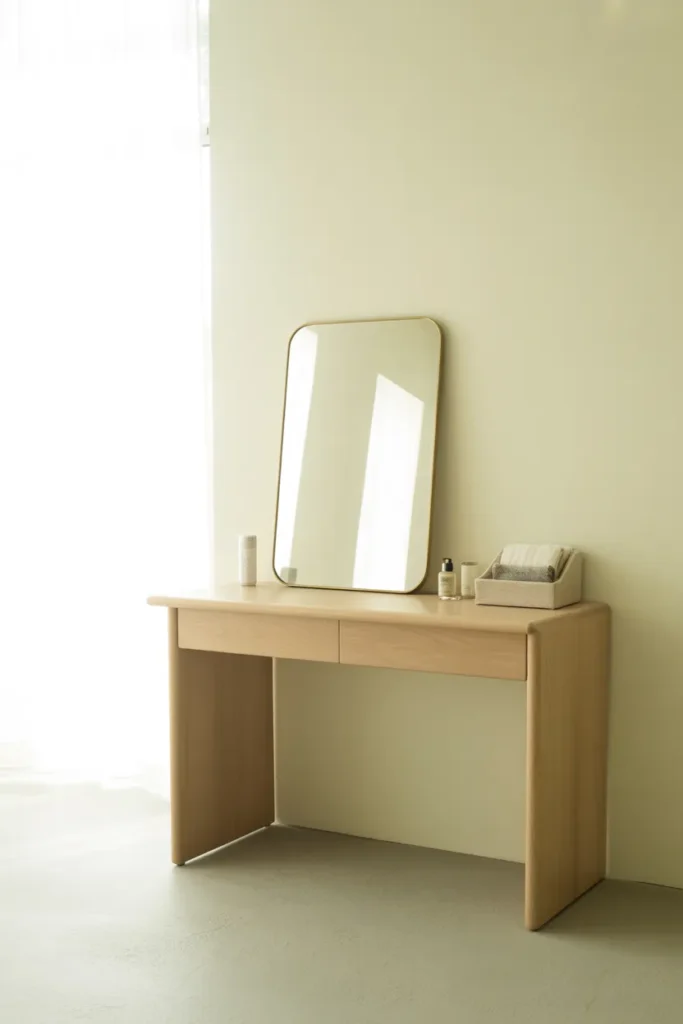
This style of vanity desk works best when the room already has strong natural light. Because the mirror is large and the surface is kept clear, daylight does the heavy lifting for illumination. In north-facing rooms or bedrooms with small windows, add a single slim wall sconce on one side of the mirror to supplement without breaking the minimal aesthetic.
Keep surface items to a maximum of three or four objects: one organizer, one product, one small plant or object. The minimal vanity fails the moment it becomes a storage surface. Drawer storage below the desk is essential to maintaining this look in practice.
4. A Vanity Desk With Full Hollywood Lighting for Professional-Level Illumination
A vanity with dedicated Hollywood-style bulb lighting around the mirror frame remains the most functionally superior option for anyone who applies makeup daily, works on-camera, or needs accurate color rendering at any hour.
The reason Hollywood lighting outperforms ambient bedroom light is simple: it illuminates the face from multiple angles simultaneously, eliminating the shadows created by overhead or side-only lighting. This matters enormously for foundation matching, eye makeup precision, and skincare routines where detail is important.
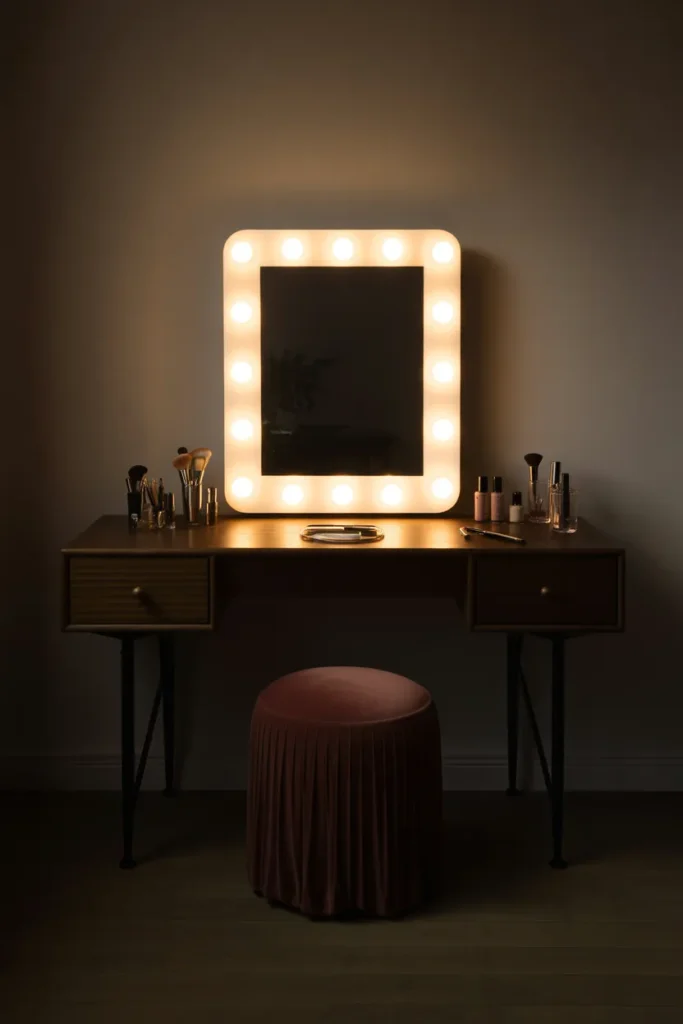
For a 2026-appropriate version of this setup, choose a mirror with adjustable color temperature — typically switchable between warm (3000K), neutral (4000K), and daylight (5600K). This allows accurate color matching regardless of the time of day or the room’s ambient lighting.
The Hollywood vanity works best as a dedicated piece of furniture with its own footprint — not mounted over another desk or dresser. It needs surface space on either side of the seated user and should not be positioned where the mirror reflects a window directly, as this creates glare that undercuts the lighting’s effectiveness.
5. A Corner Vanity Desk Setup That Maximizes Dead Space in Any Bedroom
Corner spaces in bedrooms are chronically underused. A corner vanity desk — whether a purpose-built L-shaped unit or a standard desk angled into the corner — turns the least functional part of most bedrooms into one of the most practical.
The corner placement provides a natural sense of enclosure that makes the vanity feel like a dedicated zone rather than furniture pushed against a wall. It also allows more surface area than a standard straight desk at the same floor footprint, which benefits anyone who needs space for skincare, hair tools, and makeup simultaneously.
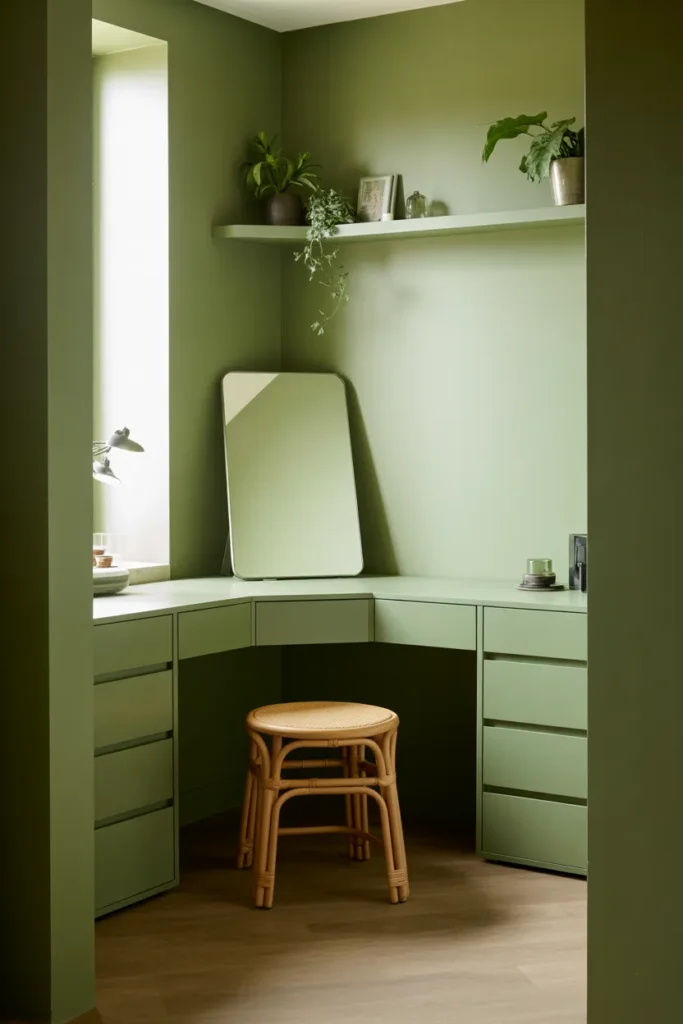
For the most functional corner vanity layout, place the mirror on the diagonal wall directly in front of the seated position rather than on one of the two side walls. This gives a centered view and avoids the neck strain that comes from turning to use a mirror positioned at 90 degrees to the body.
One important consideration: corner placements can create awkward stool access. Make sure there is at least 24 inches of clearance on the dominant side for comfortable entry and exit. A stool without armrests works significantly better in a corner vanity setup than an armchair-style seat.
6. A Vanity Desk Integrated Into the Bedroom Dresser Wall for a Built-In Look
One of the most space-intelligent vanity desk ideas for 2026 is integrating the vanity surface directly into a dresser or wardrobe wall unit. Instead of treating the vanity as separate furniture, it becomes part of a continuous storage system that runs along one wall.
This approach is particularly effective in primary bedrooms where storage is limited and every piece of furniture needs to earn its floor space. The dresser provides clothing storage on either side while the vanity section in the center delivers a dedicated mirror, lighting, and a grooming surface — all within the same wall footprint.
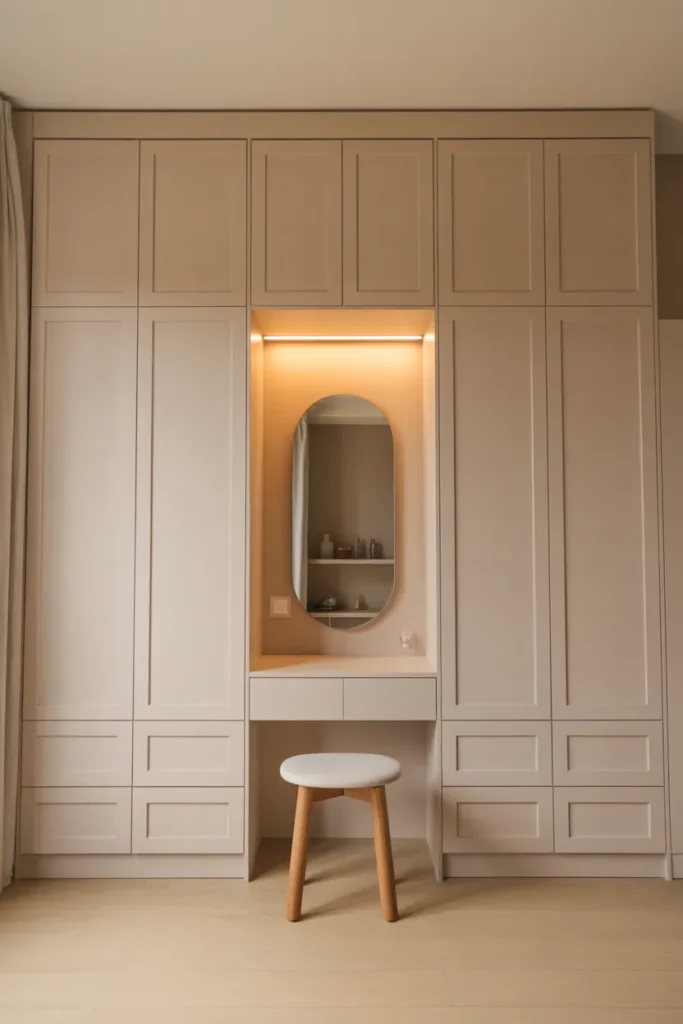
Custom built-ins are the ideal version of this concept, but modular wardrobe systems with open center sections can achieve a similar result at a lower cost. The key is ensuring the center vanity section has adequate depth — at least 18 inches — for knee clearance when seated.
The integrated vanity works best in a bedroom with a long wall of at least 8 to 10 feet. In shorter rooms, the unit can feel disproportionately dominant. In those cases, a freestanding vanity with matching finish to the dresser achieves a similar unified look without requiring the full wall length.
7. A Small Bedroom Vanity on a Narrow Console Table That Costs Almost Nothing to Set Up
Not every vanity desk needs to be a dedicated piece of furniture. A narrow console table — typically 12 to 14 inches deep — can function as a highly effective vanity surface in small bedrooms where a standard desk would be too intrusive.
The narrow profile is the main advantage. A 12-inch deep console fits in spaces that a conventional 20-inch desk simply cannot. Placed against a bedroom wall with a mirror hung above and a stool slid underneath, it is functionally indistinguishable from a purpose-built vanity for most daily routines.
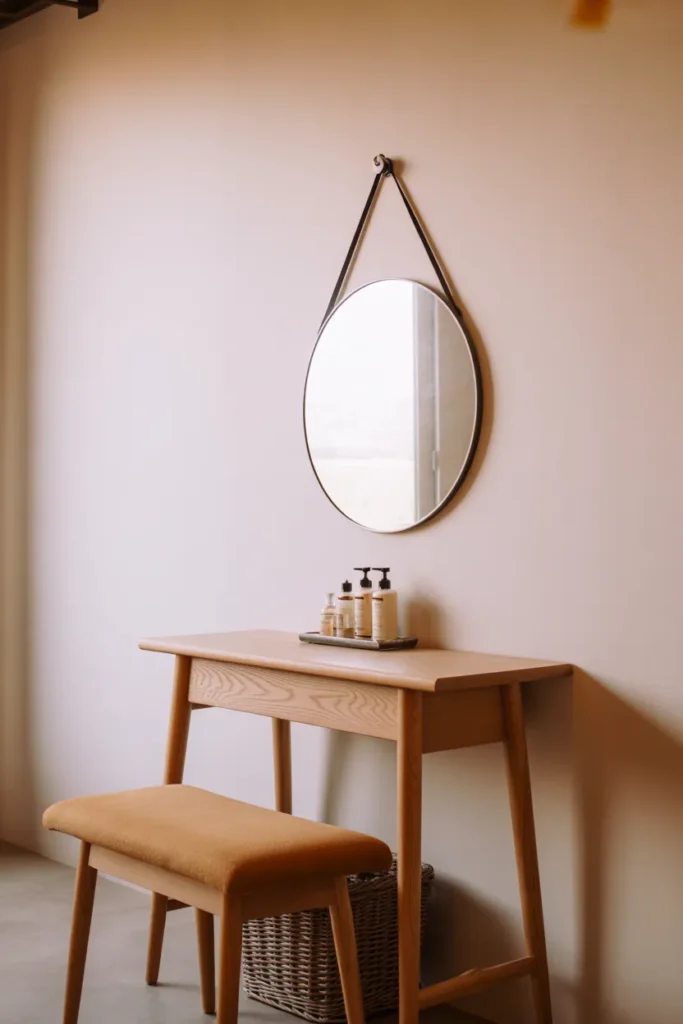
For this setup to work practically, the mirror must be hung at the correct height — the center of the mirror should align with seated eye level, which is typically 48 to 52 inches from the floor depending on user height. Too high is the most common positioning mistake, resulting in a forehead-level view rather than a full-face view.
Storage at a narrow console vanity requires creative problem-solving. Wall-mounted small shelves on either side of the mirror, a small tray on the surface for daily products, and a basket or drawer unit below the console are the three most effective ways to compensate for the lack of built-in storage.
8. A Vanity Desk With a Trifold Mirror for Maximum Viewing Angles
A trifold or three-panel mirror vanity setup provides viewing angles that a single flat mirror cannot — specifically, the side profiles that matter for hairstyling, earring placement, and checking makeup application from multiple directions.
The functional advantage of side panels is practical and immediate. Anyone who styles their hair or checks the back of their head as part of a daily routine will notice the difference immediately compared to a single fixed mirror. The side panels fold in and out, making the mirror compact when not in use and fully functional when needed.
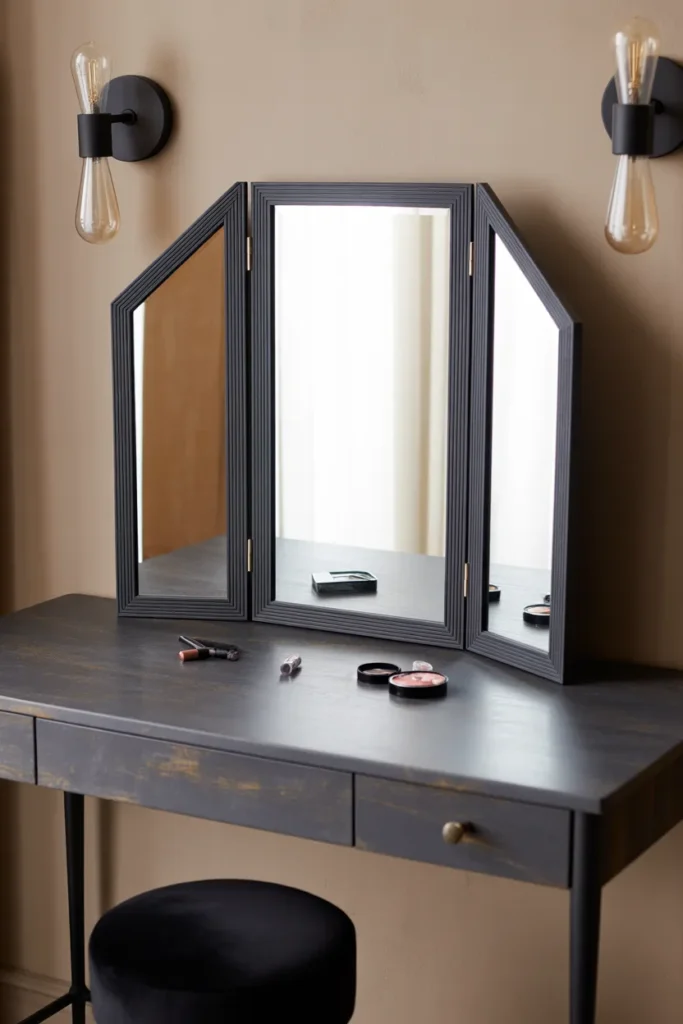
For a modern, non-dated version of this setup, choose a trifold mirror with thin metal frames rather than the bulky ornate wood frames associated with traditional vanity furniture. A slim brass, matte black, or brushed nickel frame keeps the trifold mirror compatible with contemporary bedroom design.
Position the trifold mirror on a surface with at least 30 inches of width to accommodate the open panel spread without overhang. A surface that is too narrow forces the panels to angle inward, which defeats their purpose and creates a cramped, cluttered appearance.
9. A Boho-Style Vanity Desk With Rattan, Dried Florals, and Warm Wood Tones
The bohemian vanity aesthetic remains one of the most-saved and most-searched vanity styles on Pinterest because it delivers warmth and personality without requiring expensive materials or professional installation. In 2026, the boho vanity is more refined than earlier versions — less maximalist, more curated.
The foundation of this setup is warm, natural materials: a light wood or rattan desk frame, a round or arched mirror in a woven or wood frame, and a stool in a natural fiber like rattan or jute-wrapped legs with a cushioned top. Dried floral arrangements — pampas grass, dried lavender bunches, or bleached botanicals — add organic height without the maintenance of live plants.
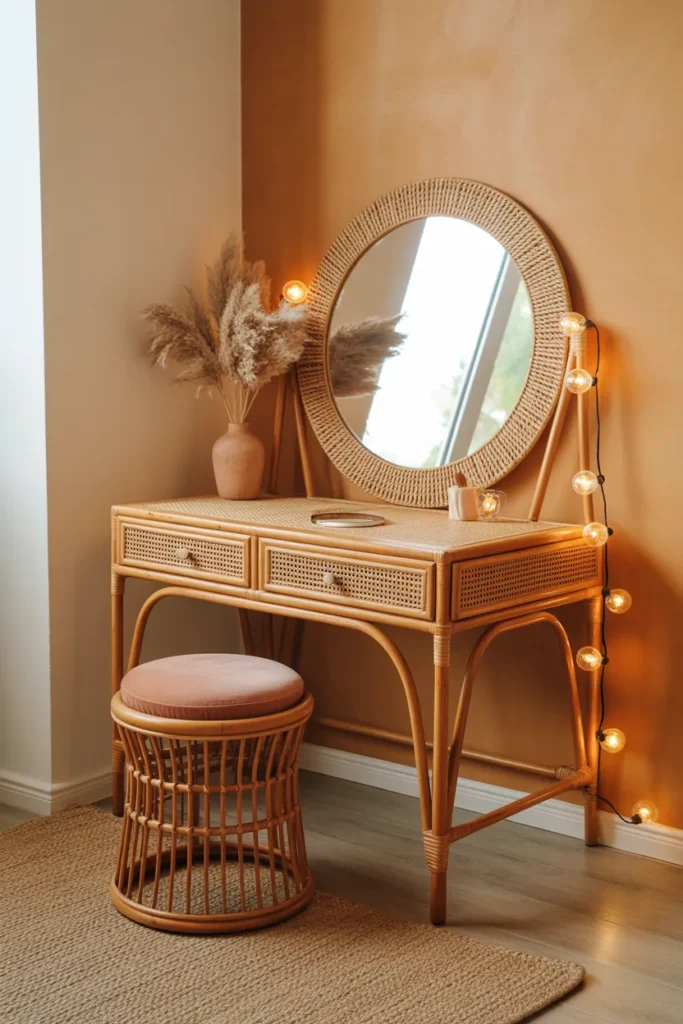
Lighting for a boho vanity should be warm rather than bright. A string of warm Edison bulbs along the mirror edge, a small rattan-shade table lamp on one side of the desk, or a floor lamp positioned behind and above the vanity all work well. Avoid cool-white or daylight-spectrum bulbs in this setup — they clash with the warm organic materials.
The pitfall to avoid is over-accessorizing. The boho vanity tips into clutter very quickly. Set a limit: one dried floral arrangement, one candle or small ceramic, and one organized tray for products. Everything else stays in a drawer or basket below the desk surface.
10. A Luxury Vanity Desk With Stone Surfaces and Backlit Mirror for a High-End Look
The luxury vanity direction in 2026 moves away from high-gloss lacquer and toward natural stone surfaces, warm metal hardware, and architectural backlit mirrors. This setup communicates quality through material choice rather than decorative detail.
A sintered stone or genuine marble surface on a vanity desk serves both aesthetic and functional purposes. Stone does not absorb product spills, resists heat from styling tools, and develops no visible wear over time with basic maintenance. For a vanity desk application, a stone surface 24 to 30 inches deep provides enough workspace for professional-level grooming routines.
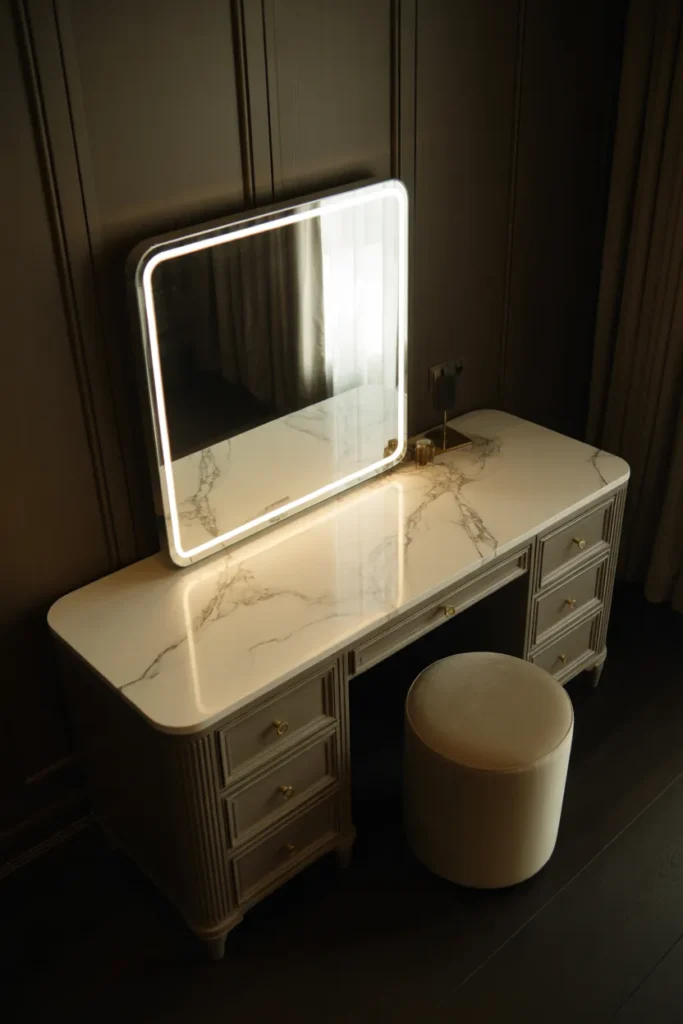
The backlit mirror is the defining element of the luxury vanity setup. Unlike a front-lit Hollywood mirror, a backlit mirror produces a soft glow around the perimeter that adds ambient light to the room while also providing a flattering illumination source. Look for backlit mirrors with adjustable brightness and color temperature — these details matter significantly in a space used morning and evening.
Hardware and fixture finishes should be consistent throughout the setup. Mixing brushed gold drawer pulls with chrome sconce bases creates a visual inconsistency that undermines the luxury aesthetic. Choose one metal finish and apply it to every hardware element in the vanity zone.
11. A Vanity Desk Doubling as a Work-From-Home Desk for Dual-Purpose Rooms
In apartments and smaller homes where room count is limited, the vanity desk often needs to serve two functions: grooming in the morning and working or studying during the day. A dual-purpose setup is one of the most practical vanity desk ideas of 2026, but it requires deliberate design to avoid feeling compromised in both roles.
The key design decision is surface size. A desk that is too small for comfortable laptop use fails as a work surface; a desk too shallow for mirror placement fails as a vanity. A surface that is 48 inches wide and at least 20 inches deep satisfies both functions without sacrifice.
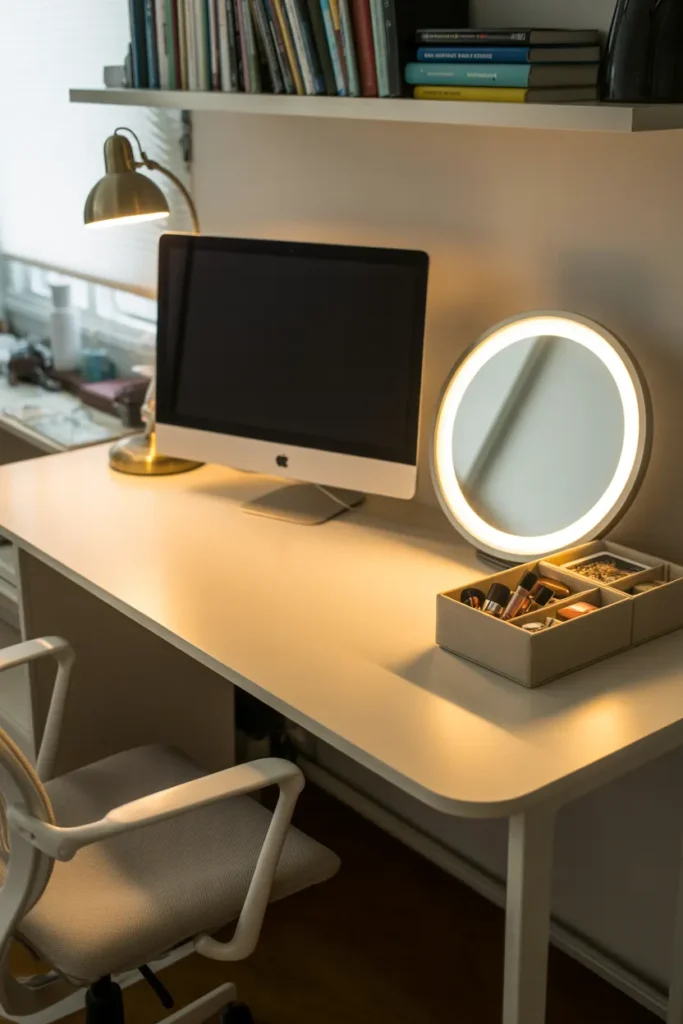
Separation of roles is what makes the dual-purpose desk livable. Keep vanity items in a drawer or closed organizer that can be pushed out of the way during work hours. A monitor riser or adjustable laptop stand on one side and a mirror on the other creates two distinct zones within the same surface area.
Lighting is the primary challenge in a dual-purpose setup. Vanity use requires front-facing facial illumination; work use requires task lighting that reduces screen glare. A single swing-arm desk lamp positioned to the non-dominant side addresses both needs without requiring two separate light sources.
12. A Dark and Moody Vanity Desk Setup That Looks Striking in a Low-Light Room
Dark vanity setups — charcoal walls, deep wood tones, matte black mirrors, and dramatic directional lighting — are significantly underrepresented in vanity design content, yet they perform exceptionally well in bedrooms that already lean toward a moody or maximalist aesthetic.
The foundation of a moody vanity is contrast. A dark desk surface or frame against a dark wall requires strong lighting to define the vanity zone and make it visually distinct from the surrounding room. Without adequate light, a dark-on-dark setup reads as oppressive rather than dramatic. Two side sconces with warm white bulbs, or a backlit mirror with high brightness output, are essential for making this concept work functionally and visually.
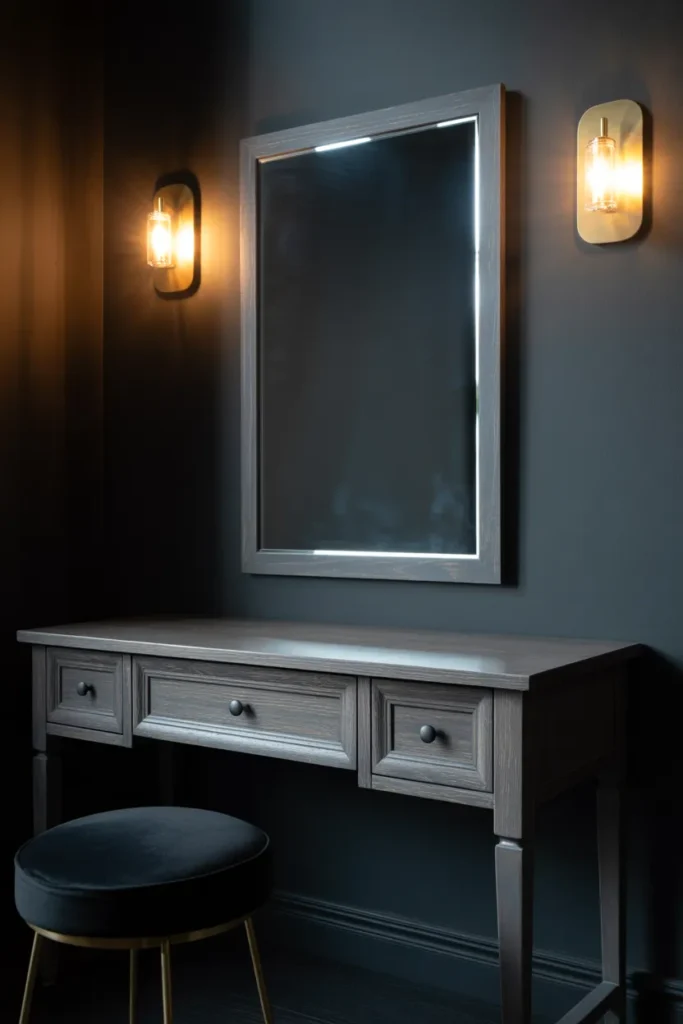
Dark vanity setups are best suited to rooms with at least one other strong natural light source — a window that delivers good daytime light keeps the room from feeling perpetually dim. In a north-facing or window-limited room, a fully dark vanity may make the space feel uncomfortable during daytime use.
Materials that work well in a moody vanity setup include smoked oak, matte black lacquer, dark slate, and black-veined marble. Warm metal accents in brass or unlacquered bronze prevent the setup from feeling cold or industrial and are the single most effective detail for adding richness to a dark color scheme.
13. A Vanity Desk With Open Shelving on Both Sides for Display and Product Storage
An open-shelf vanity — where shelves extend on both sides of the central mirror — is one of the most functional vanity configurations for people with large product collections, extensive skincare routines, or a preference for having everything visible and accessible without opening drawers.
The open shelf layout works best when the products themselves are part of the visual design. Decanted products in uniform glass or ceramic containers, skincare arranged by height, and tools stored upright in organized cups create a display that reads as styled rather than cluttered. If products are in their original mixed packaging, open shelving becomes visually chaotic quickly.
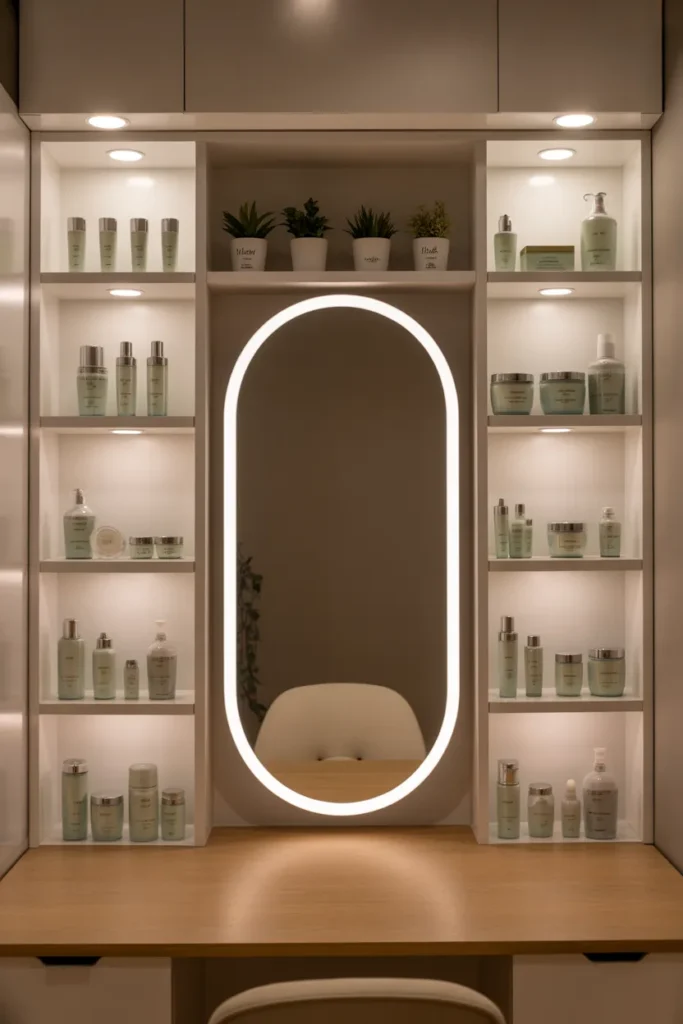
Shelf depth for a vanity application should be between 8 and 12 inches. Deeper shelves make items at the back difficult to reach from a seated position; shallower shelves limit storage capacity. Adjustable shelf height is a strong practical advantage — skincare bottles, perfumes, and hair tools vary significantly in height.
Light the shelf display from above using a small recessed strip or a mounted LED shelf light that illuminates the products without creating glare in the mirror. This also adds ambient warmth to the overall vanity zone when used in the evening.
14. A Vintage-Inspired Vanity Desk With Ornate Mirror and Antique Finish Hardware
The vintage vanity direction is having a genuine resurgence in 2026 — not the country-cottage version of previous years, but a more refined take on antique-inspired furniture with aged finishes, ornate mirror frames, and brass or bronze hardware in a deliberately imperfect patina.
A vintage vanity desk typically features curved or carved furniture legs, a slightly distressed wood or painted finish in a muted tone, and a mirror with an ornate frame — arched, carved, or gilded — that becomes the visual centerpiece of the setup. The furniture intentionally looks like it has history, even when purchased new.
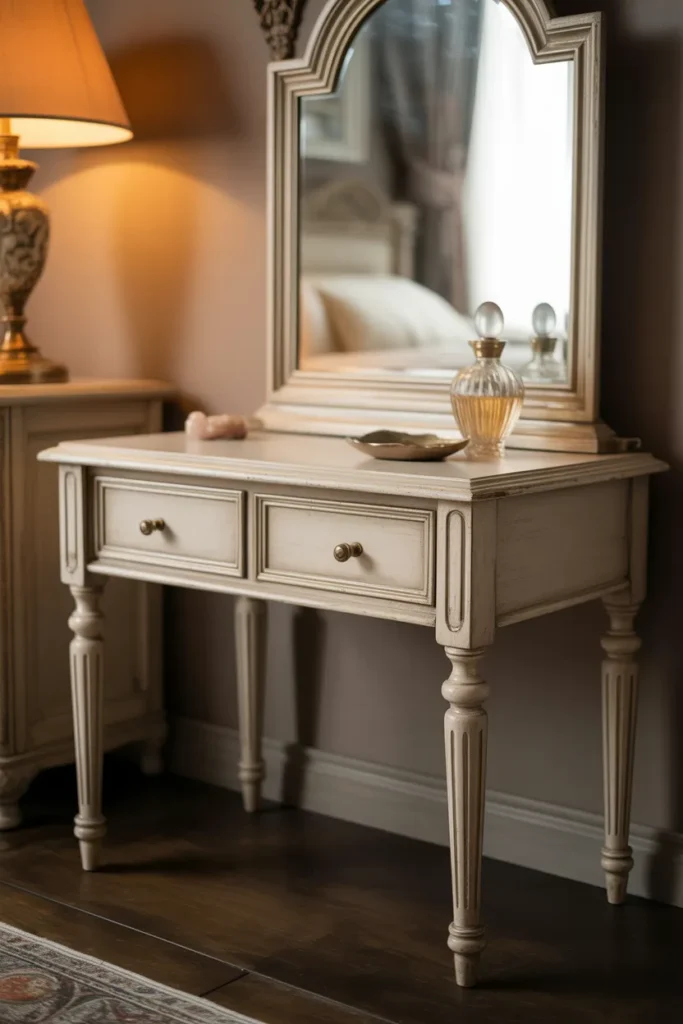
The challenge with vintage vanity design is avoiding the dated or cluttered look that older interpretations of this style produced. The solution is restraint in accessories: one or two carefully chosen vintage-style objects — an antique-style brush set, a small framed art print, a ceramic dish — rather than a collection of mismatched old items.
This vanity style works best in bedrooms that already have classic or traditional architectural details: crown molding, panel wainscoting, or hardwood floors. Placing a heavily ornate vintage vanity in a very modern or minimalist bedroom creates a stylistic conflict that is difficult to resolve with accessories alone.
15. A Teen Bedroom Vanity Desk That Balances Style, Function, and Practical Storage
A vanity desk in a teen bedroom has a different set of requirements than an adult primary bedroom setup. It needs to handle heavier daily use, accommodate both grooming and homework, work within a typically smaller room, and still feel personal and appealing to the user.
The most functional configuration for a teen vanity is a wider desk surface — at least 48 inches — with a mix of open and closed storage: two or three drawers for daily items, a small set of open cubbies for frequently used products, and a medium-sized mirror that does not dominate the desk at the expense of usable surface area.
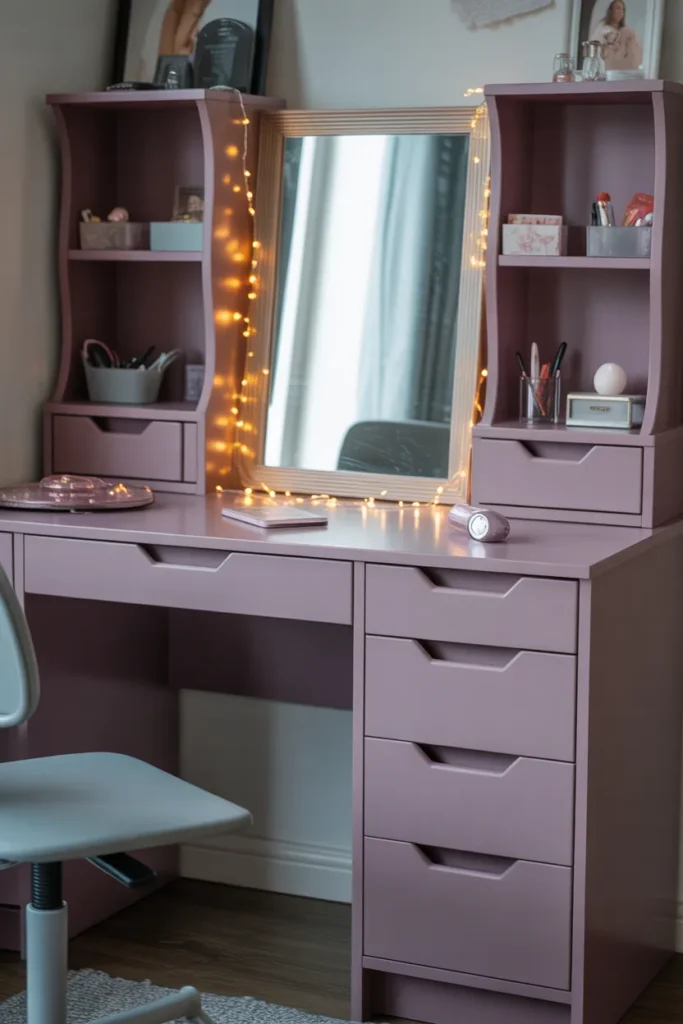
Chair or stool choice matters more in a teen bedroom than in adult setups because the desk will also be used for studying. A height-adjustable desk chair that works for both seated vanity use and extended study sessions is more practical than a fixed-height decorative stool. Prioritize adjustability over aesthetics for the seating component.
Personalization is what makes a teen vanity genuinely used rather than abandoned after a few months. Allow the mirror frame, wall color behind the desk, or the stool fabric to reflect the teen’s actual taste rather than defaulting to a generic neutral setup. A vanity that feels personal gets used consistently; one that feels chosen by a parent often does not.
Final Thoughts
The best vanity desk ideas are the ones that solve your actual room situation — not the ones that look best in a photograph. Whether you are working with a 90-square-foot studio bedroom or a spacious primary suite, there is a vanity desk configuration in this guide that fits your floor plan, your daily routine, and your design direction.
Save this post so you can return to it when you are ready to make each design decision. It is the kind of resource that is useful at every stage — from the initial layout planning to the final styling details. If you found this helpful, explore more bedroom and small space design ideas for practical, room-by-room guidance built the same way.