
Most pantry problems are not space problems — they are shelving problems, and if you have been searching for pantry shelves ideas 2026, you already sense that the standard builder-grade setup is not working for your household. This guide gives you 12 specific, decision-ready shelving systems explained by space type, material, load capacity, and what to avoid, so you can build or buy with confidence.
1. Adjustable Wire Shelving That Gives You a Completely Reconfigurable Pantry
Adjustable wire shelving mounted on a vertical track system is the most flexible pantry shelving solution available for a standard reach-in or walk-in pantry. The tracks attach to the wall studs, and the shelf brackets slide and lock at any height interval, which means you can reconfigure the entire layout in under an hour without tools or wall damage.
The reason this system outperforms fixed shelving in most household pantries is that your storage needs change constantly. A shelf height that works for cereal boxes fails the moment you start buying bulk olive oil or tall pasta jars. With a track-and-bracket system, you adjust rather than rebuild. This is a particularly strong choice for renters who want a functional pantry setup without permanent modifications, since the tracks can be removed and the wall holes patched cleanly.
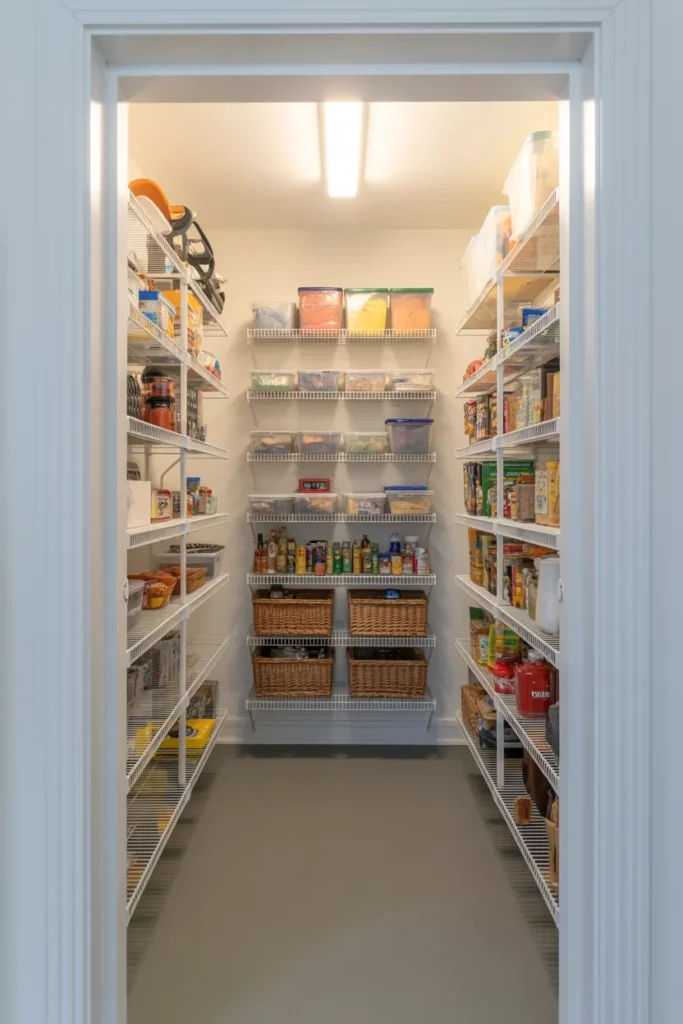

Wire shelving also allows air to circulate around stored food, which matters more than most people realize. Solid shelf surfaces trap moisture underneath containers and around produce, which accelerates spoilage. The open grid of wire shelving keeps airflow consistent at every level.
The one limitation to plan for is that small items fall through wide wire grids. Spice jars, small cans, and single-serve packets need a liner, a shallow bin, or a dedicated solid shelf insert to sit securely. Do not let that detail be a surprise after installation.
2. Deep Fixed Wood Shelves With Front Lip Edging That Stop Items From Falling Forward
Fixed wood shelves built at 16 to 20 inches deep with a routed or applied front lip are the right choice for households that store heavy bulk items, large appliances, or oversized pantry goods that would be unstable on wire. The solid surface handles weight without flex, and the front lip prevents items from sliding off when you pull something from behind.
Solid plywood at three-quarter inch thickness is the material standard for this application. Particleboard or MDF shelves at this depth will bow under the weight of canned goods within one to two years. If you are building fixed pantry shelves and want them to last a decade without sagging, the substrate matters more than the finish material on top.
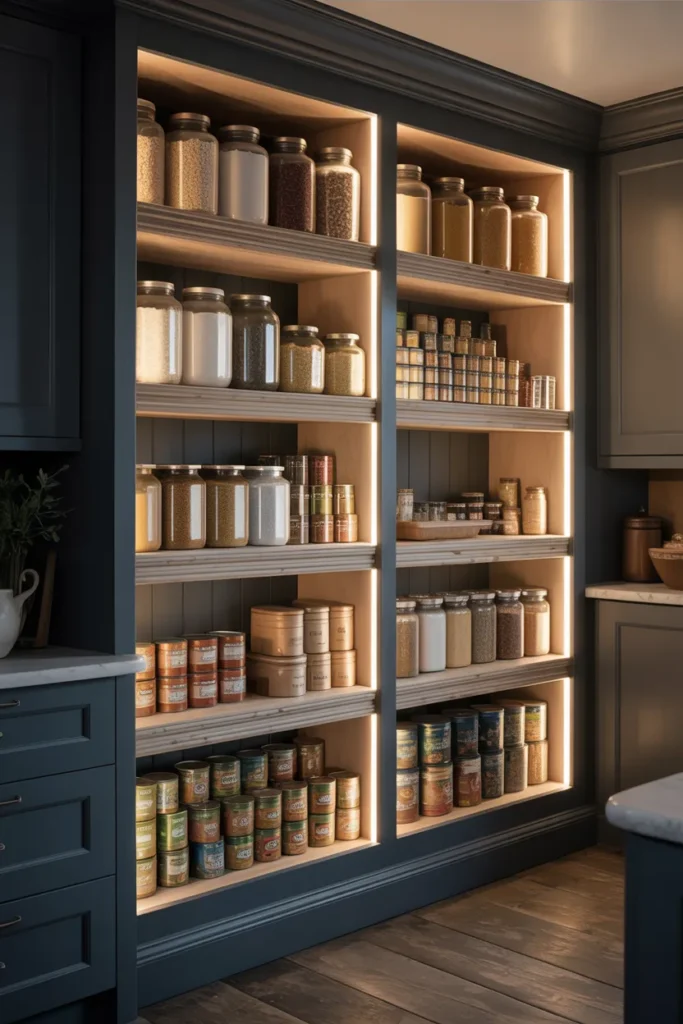
This type of shelving works particularly well in pantries that double as small appliance storage. A stand mixer, a large blender, or a heavy stockpot needs a solid, level surface with enough depth to sit fully on the shelf without overhanging the edge. Fixed deep wood shelves handle that category of storage in a way that wire and narrow shelving cannot.
Space the shelves based on what you are actually storing rather than using a uniform interval. Most pantry items fall into three height categories: under 6 inches for cans and spice jars, 6 to 12 inches for boxed goods and bottles, and 12 to 18 inches for cereal boxes, tall bottles, and bulk containers. Build those three zones into your shelf spacing from the start.
3. Floor-to-Ceiling Open Shelving in a Narrow Pantry That Uses Every Inch of Vertical Space
In a pantry that is narrow — under 24 inches deep — the most effective strategy is to abandon the idea of deep shelving entirely and go floor-to-ceiling with shallow open shelves between 10 and 14 inches deep. At this depth, everything on the shelf is visible and reachable without moving other items, which is the core problem with deep pantry shelving in small spaces.
Shallow floor-to-ceiling shelving turns a narrow closet, a dead-end hallway, or a slim alcove into a genuinely functional pantry. The vertical height compensates for the lack of depth, and because every item is single-row visible, you stop forgetting what you have stored. Lost and expired food is almost always a depth problem — items get pushed to the back of deep shelves and forgotten.
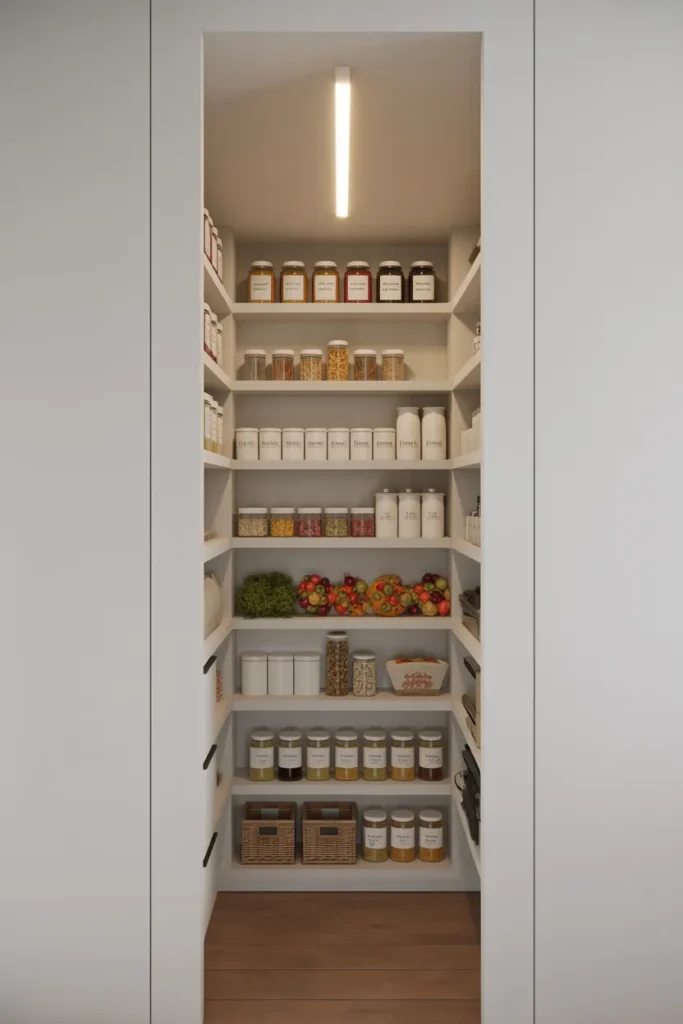
The top two shelves in any floor-to-ceiling pantry should be reserved for overflow, seasonal items, or rarely used equipment. Anything you access more than once a week should sit between shoulder height and knee height for comfortable daily use. Placing frequently grabbed items above your head or at floor level adds friction to every kitchen routine and is one of the most common pantry organization mistakes.
Use the same shelf depth on every level for visual consistency. Mixing 10-inch and 14-inch shelves on the same wall looks unresolved and makes the space feel disorganized even when the contents are tidy.
4. Pull-Out Pantry Shelves That Solve the Dead Zone Problem in Base Cabinets
Pull-out shelves, also called rollout trays or drawer inserts, convert the dead zone at the back of a base pantry cabinet into fully accessible storage. When you slide the tray out, every item on it comes forward with it. There is no kneeling, no reaching blindly, and no reorganizing the front row just to get to something in the back.
This is the right solution for pantries built into kitchen cabinetry rather than dedicated pantry rooms or closets. Base cabinet pantry storage is notoriously underused because the standard fixed shelf forces a two-row system where the back row becomes invisible and inaccessible within weeks. A pull-out tray eliminates that entirely.
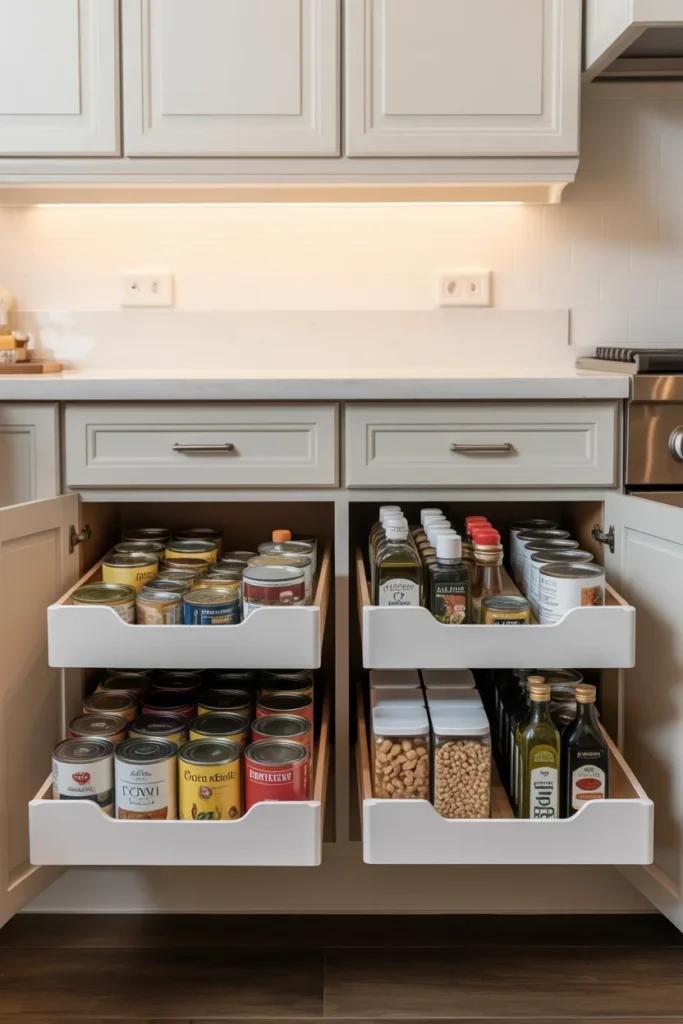
Pull-out shelves work at any cabinet width from 9 to 36 inches, and they install into existing cabinets without a full renovation. The critical specification is the drawer slide rating — the weight capacity stamped on the hardware. For a pantry that stores canned goods, heavy bottles, or bulk oils, use full-extension soft-close slides rated for at least 75 to 100 pounds per tray. Under-rated slides fail within months under pantry load.
The depth of the tray matters as well. A tray that fills the full cabinet depth from front to back maximizes the return on the hardware investment. A tray that only covers two-thirds of the cabinet depth still leaves a dead zone at the back that defeats the purpose.
5. Corner Pantry Shelving With Diagonal or Pie-Cut Shelves That Reclaim Wasted Corner Space
Corner pantry shelving is one of the most underplanned storage decisions in kitchen design. The standard approach — running two flat shelf runs and accepting the dead corner behind them — wastes between 30 and 50 percent of a corner pantry’s potential floor area. Diagonal or pie-cut shelves built at 45 degrees to the corner walls reclaim that space and make it accessible from the center aisle.
This works in any walk-in pantry with an interior corner, which is the most common walk-in pantry configuration in American homes. The diagonal shelf cuts across the corner at an angle, giving you a triangular or trapezoidal shelf surface that stores items without the reaching-around problem of a standard L-shaped shelf run.
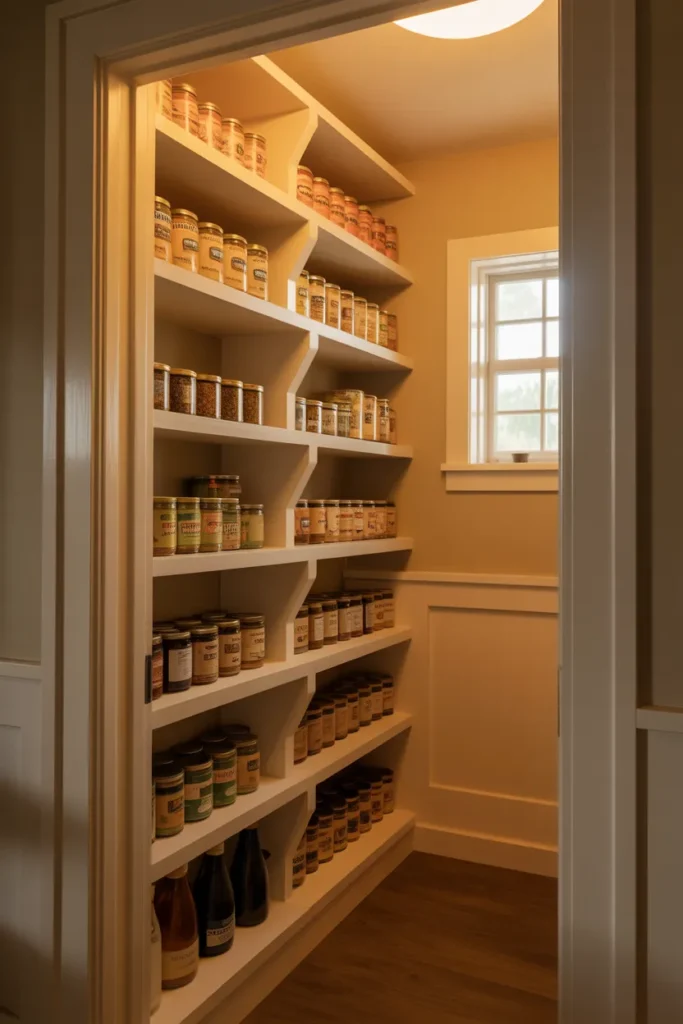
A simpler alternative that does not require custom shelving is a freestanding turntable or lazy Susan unit placed in the corner. A two-tier lazy Susan at 18 to 24 inches in diameter fits most pantry corners and gives you full 360-degree access to everything stored on it with a simple spin. This approach costs a fraction of custom corner shelving and installs in minutes.
What does not work is using a corner as general overflow storage without a system. Loose items piled in a corner are inaccessible, create a visual mess that spreads to adjacent organized areas, and almost always contain expired food. Define the corner storage with a deliberate solution, even a simple one.
6. Floating Pantry Shelves in an Open Kitchen That Work as Both Storage and Display
In kitchens without a dedicated pantry room, a run of floating shelves on an open wall creates a functional pantry zone that is also part of the kitchen’s visual design. At 10 to 12 inches deep and mounted between 7 and 8 feet high, three to five shelves can hold a significant volume of dry goods, oils, vinegars, and cooking staples while keeping them within arm’s reach of the prep area.
This is one of the most searched pantry shelves ideas for apartment kitchens, small homes, and open-plan spaces where a dedicated pantry room is not available. The open format eliminates the need for cabinet doors, which is both a space and a budget advantage, and it creates a visual layer of warmth and lived-in texture that closed cabinetry cannot replicate.
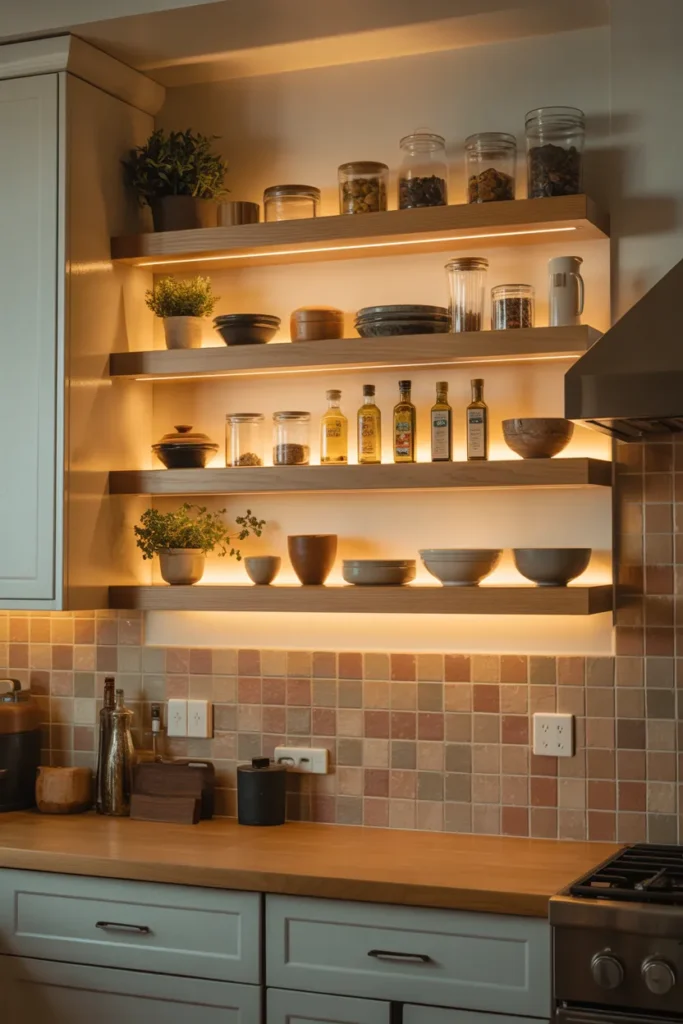
The trade-off is exposure. Open pantry shelves collect dust and grease vapor from cooking faster than closed cabinets. In a high-use cooking kitchen, open shelves need wiping down every one to two weeks to stay presentable. If your household cooks daily with high heat and oil, the maintenance commitment is real. In lighter-use kitchens or in zones away from the stove, the cleaning burden is manageable.
Keep the items stored on open pantry shelves visually consistent. Decanting dry goods into matching glass or ceramic canisters and using uniform baskets for grouped items makes the difference between open shelving that looks designed and open shelving that looks cluttered.
7. A Dedicated Spice Shelf System That Brings Order to the Most Chaotic Pantry Zone
Spice storage is consistently the most disorganized section in any pantry, not because people do not try to organize it, but because standard shelf depth works against spice jars. A 16-inch deep shelf stores spice jars two to three rows deep, which means the back row is permanently invisible and the front row gets shuffled endlessly.
The solution is a dedicated spice shelving system built or installed at 3 to 4 inches deep — exactly one jar deep. At this depth, every spice is visible from the front, labels face forward, and nothing gets lost behind something else. This can be a wall-mounted rail system, a door-mounted rack, a shallow pull-out drawer, or a tiered riser on a standard shelf.
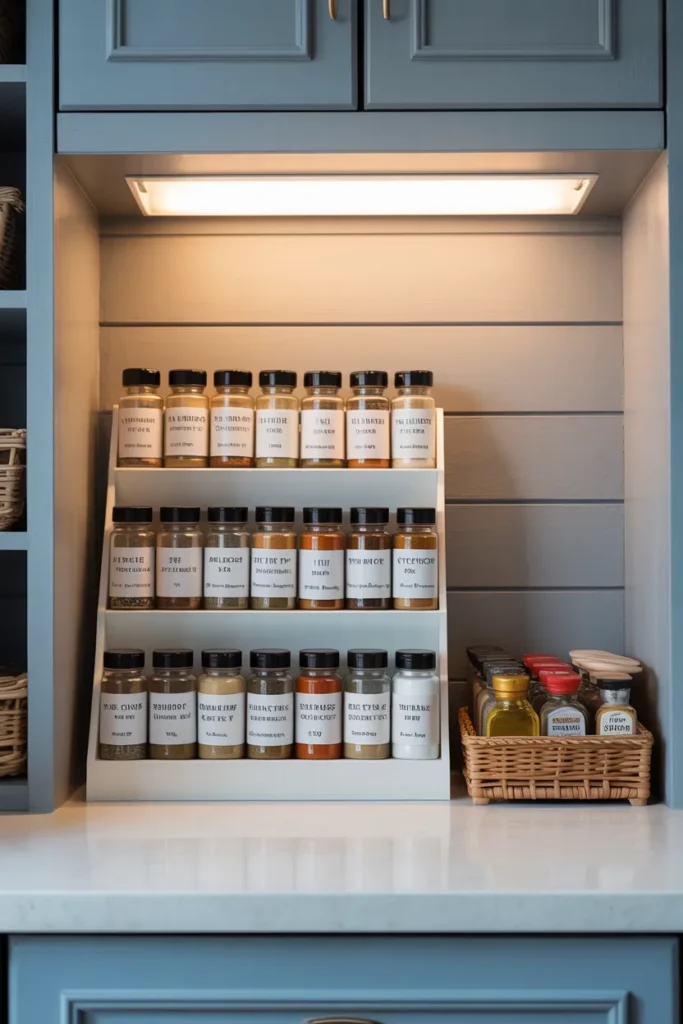
A tiered stepped riser placed on a standard pantry shelf is the fastest and least expensive way to implement this. A three-tier riser at 3 to 4 inches per step raises the back rows high enough to see all labels simultaneously. For a pantry that currently uses flat shelf space for spices, this single addition typically recovers half a standard shelf of space and eliminates the daily frustration of searching for specific jars.
Label the tops of lids, not the jar labels on the front, if you use a drawer-style spice system where jars lay horizontal. Top-of-lid labeling makes every spice identifiable at a glance when looking down into a drawer without lifting a single container.
8. A Pantry Wall With Combination Shelving, Hooks, and Bins That Handles Every Category at Once
A pantry wall that combines open shelves at varying heights with wall-mounted hooks, pegboard sections, and hanging or clip-on bins creates a multi-category storage system that handles dry goods, tools, bags, and small appliances in one continuous wall run. This approach treats the pantry wall as a complete storage wall rather than just a place to park shelves.
This is the right solution for households that store a wide variety of items in their pantry beyond food — reusable grocery bags, kitchen tools, cleaning supplies, small appliances, or children’s snacks that need lower positioning. A single-system approach of all open shelves cannot accommodate the variation in item sizes and access frequencies that a real household generates.
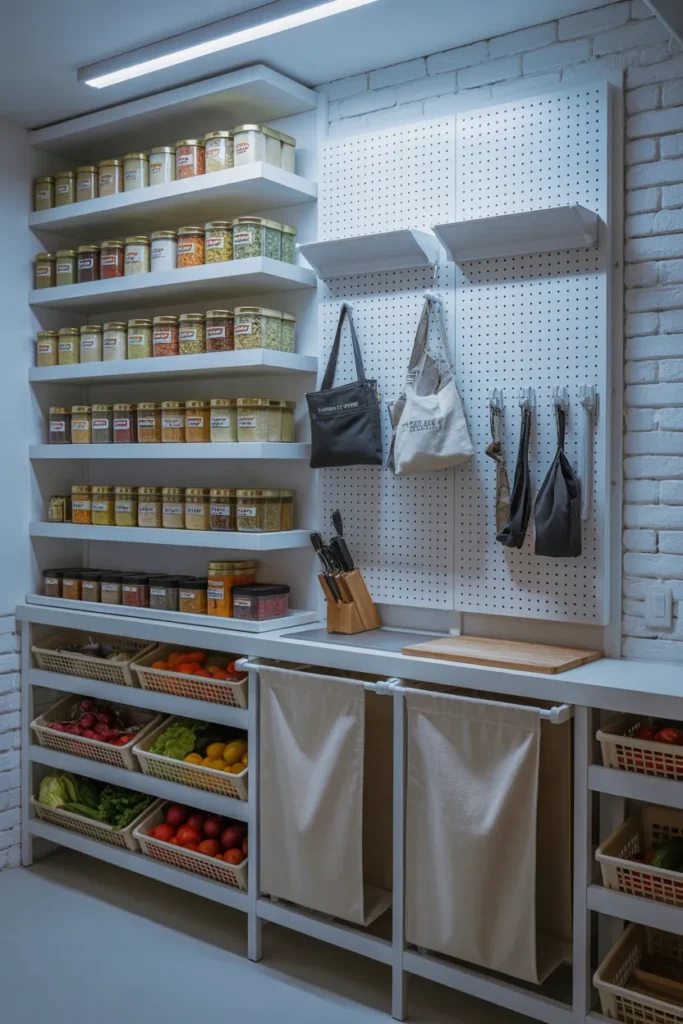
Pegboard is particularly useful in this context because it is infinitely reconfigurable with no wall damage between reconfigurations. A 2×4 foot section of pegboard with assorted hooks accommodates bags, measuring cups, colanders, aprons, and anything else with a hanging point. Mounted at the end of a shelf wall or used to fill a narrow vertical gap between two shelf sections, it captures storage from surfaces that would otherwise be unused.
The planning rule for combination pantry walls is to group by frequency of use, not by category. Items used daily sit at the easiest access height between shoulder and hip. Items used weekly sit above and below that zone. Items used monthly or less go to the top and floor level. Category grouping is secondary to that access hierarchy.
9. A Butler’s Pantry Shelf Layout That Separates Everyday Cooking From Entertaining Supplies
A butler’s pantry is a secondary storage and prep zone positioned between the kitchen and dining room, and the shelving layout inside it should reflect a completely different function from the main pantry. Rather than dry goods and bulk storage, a butler’s pantry shelf system is organized around serving ware, bar supplies, table linens, specialty appliances, and entertaining essentials.
The shelf depth in a butler’s pantry is typically shallower than a main pantry — 12 to 14 inches is the standard — because the items stored are often taller but not as bulky as food storage. Glassware, decanters, serving platters, and stacked plates sit comfortably at this depth and remain visible and accessible without deep reaching.
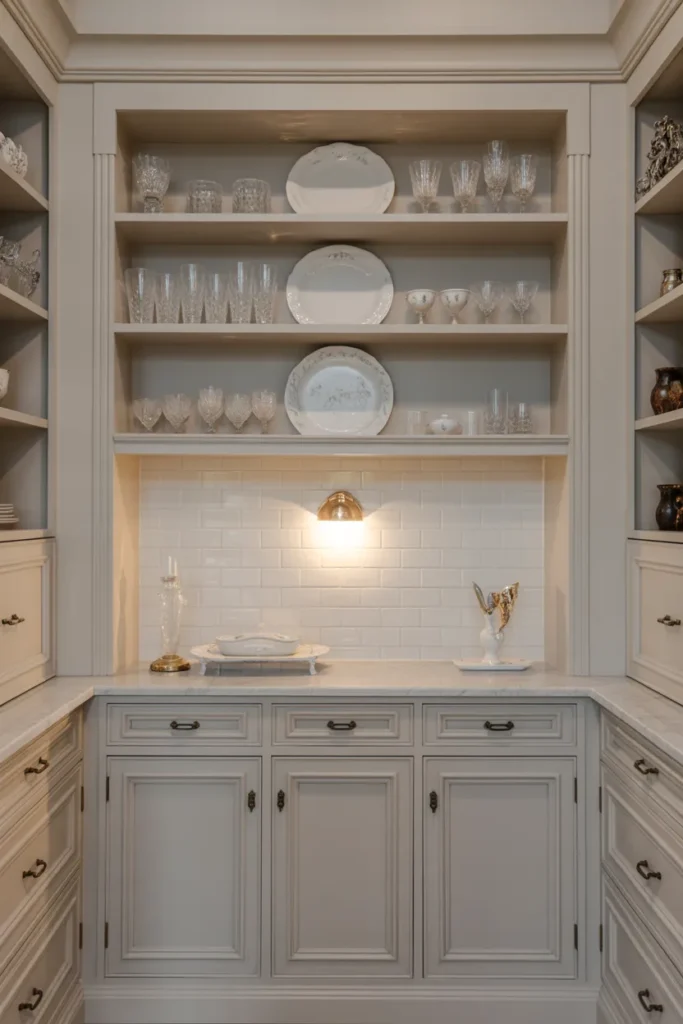
Upper shelves in a butler’s pantry benefit from glass-front doors or no doors at all, since the items stored are attractive and display-worthy. Lower shelves or cabinets with solid doors handle linens, overflow appliances, and anything that does not contribute to the visual presentation. This two-tier aesthetic approach — open above, closed below — is a consistent feature of well-designed butler’s pantry shelving that reads as both functional and finished.
If your home does not have a designated butler’s pantry space, a large kitchen hutch or a dedicated section of kitchen cabinetry can perform the same function. The principle is separating daily cooking supplies from entertaining supplies, which reduces the daily disorganization caused by the two categories sharing the same space.
10. Freestanding Pantry Shelving Units That Work in Rentals and Small Apartments
A freestanding pantry shelving unit — whether a metal industrial rack, a wood étagère, or a closed pantry cabinet — is the most practical approach to pantry storage in a rental apartment, a home without a dedicated pantry room, or any situation where wall mounting is not an option. The unit provides vertical storage without touching the walls and moves with you when you relocate.
Industrial steel wire shelving units in standard 18×48 or 18×36 inch configurations are the most load-bearing freestanding option available. At five shelves high and 72 to 74 inches tall, they hold a volume of food storage comparable to a small walk-in pantry closet. They are also the most affordable per-square-inch of storage of any shelving system.
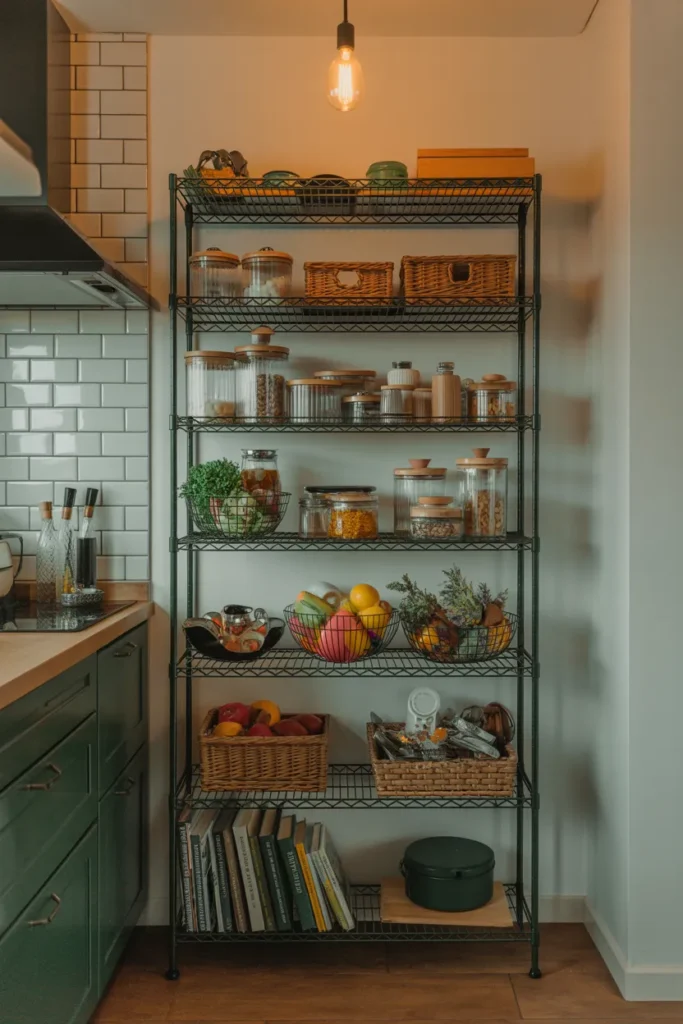
The aesthetic limitation of steel wire freestanding units is real. In a visible kitchen or open-plan space, bare industrial shelving looks unfinished and out of place with most residential interiors. Cover it with a canvas pantry cover, place it inside a closet with the doors removed, or position it behind a curtain panel to get the storage benefit without the visual penalty. Alternately, a wood freestanding unit or a closed freestanding pantry cabinet solves the aesthetic problem entirely at a higher cost.
Anchor any freestanding unit over 60 inches tall to the wall with an anti-tip bracket regardless of whether it is loaded. A fully loaded pantry shelf unit tipping over is a serious safety hazard, particularly in households with children. Anti-tip brackets are inexpensive, take five minutes to install, and are non-negotiable for tall freestanding storage.
11. Under-Stair Pantry Shelving That Converts Dead Space Into Full Grocery Storage
The space beneath a staircase is one of the most underused areas in a two-story American home. Converted into a pantry with built-in shelving that follows the sloping ceiling line, it becomes a surprisingly high-capacity storage area that often holds more than a standard reach-in pantry closet. The graduated shelf heights created by the stair slope are actually an advantage — taller items go to the deep end where ceiling height is greatest, and shorter items fill the shallow end.
This is a particularly strong solution for homes built before 1980, which frequently lack dedicated pantry space in the kitchen layout. Converting the under-stair area requires framing a small doorway, installing a door, adding electrical for lighting, and building fixed shelves that follow the slope. It is a genuine construction project, but the payoff in storage capacity is substantial.
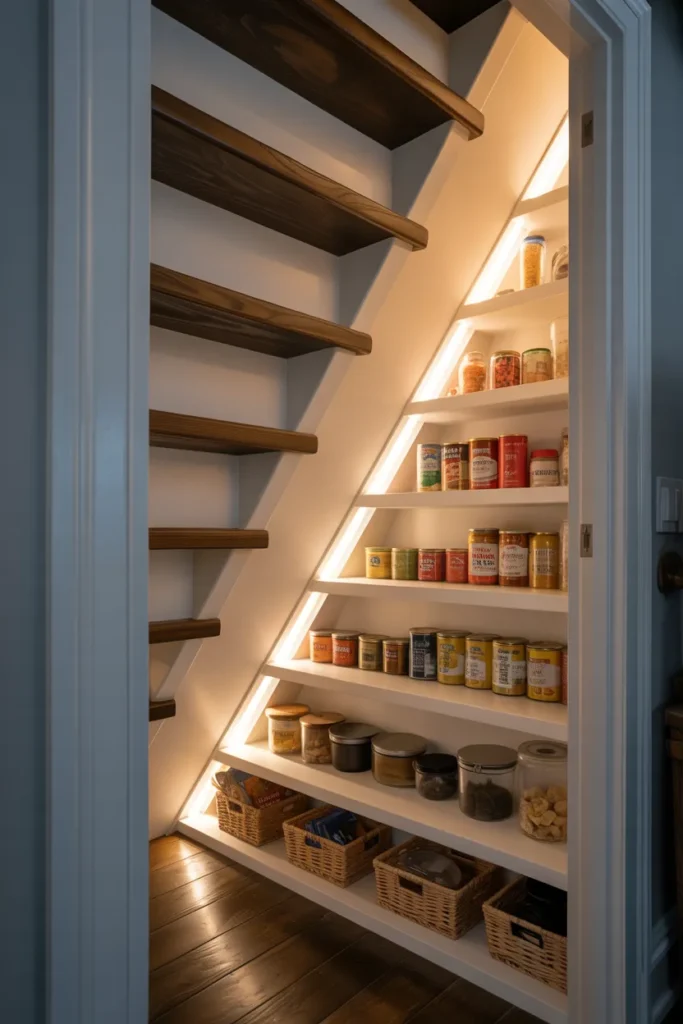
LED strip lighting mounted to the underside of each shelf is the most effective lighting approach for under-stair pantries. The sloped ceiling makes overhead fixtures awkward, and under-shelf LEDs light each level independently without creating shadows in the lower sections. This is one of the pantry shelves ideas where the lighting plan is as important as the shelving plan.
If a full build-out is not in the budget, a simpler version installs freestanding shelving inside an existing under-stair storage door without any framing or construction. The result is less polished but delivers 80 percent of the storage benefit at a fraction of the cost.
12. A Labeled Bin and Basket Shelf System That Maintains Long-Term Pantry Organization
A shelving system built around labeled bins and baskets as the primary storage unit — rather than loose items placed directly on shelves — is the single most durable organization approach for a household pantry. The bins contain categories, labels identify contents at a glance, and restocking goes into bins rather than directly onto shelves, which keeps the overall system intact over months and years.
This works on any shelf type and in any pantry size. The bin-and-label system is the structure that sits on top of whatever shelving you have. Wire shelves, wood shelves, freestanding units, and built-ins all benefit from this approach because it removes the reliance on everyone in the household putting items back in exactly the right spot. You put the item in the right bin, and the bin is always in the right place.
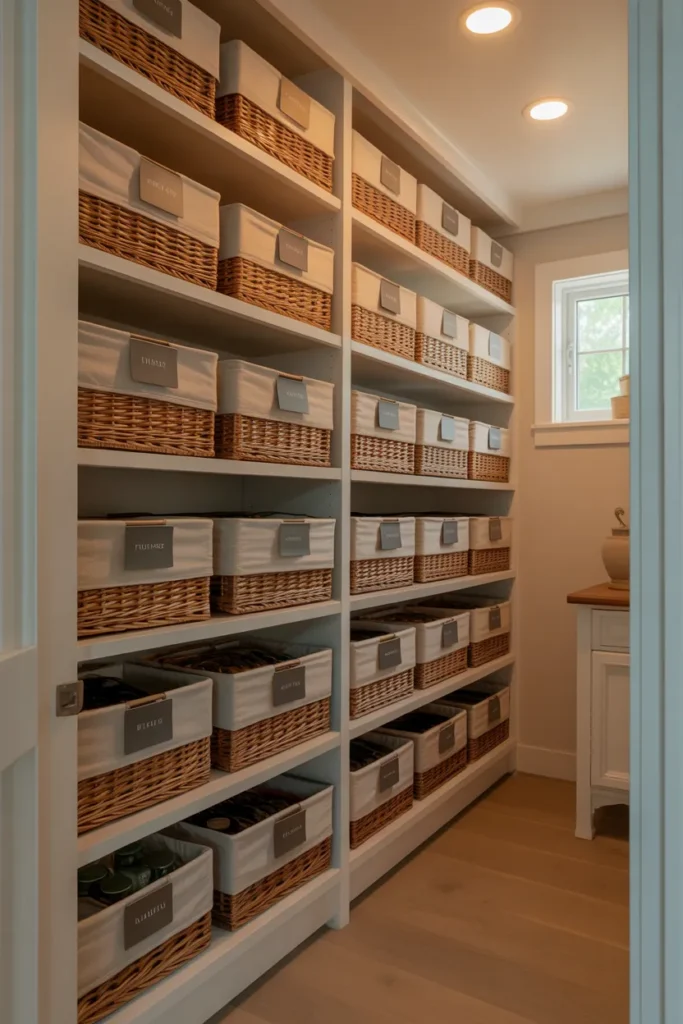
Bin sizing is the most important specification decision. Measure your shelf depth and height before purchasing any bins. Bins that are too tall for the shelf spacing require removing the bin to see inside, which breaks the system immediately. Bins should be two to three inches shorter than the clear shelf height so you can see the contents at a glance by looking straight at or slightly down into the bin.
Clear-front or open-top bins require less labeling discipline because contents are visible. Solid opaque bins require accurate, readable labels on the front or they become mystery boxes within weeks. Choose whichever type matches your household’s realistic maintenance habits rather than the one that looks better in a photo.
Final Thoughts
A pantry that works is not about having more space — it is about shelving that matches how your household actually stores and retrieves food. Whether you are converting a closet, building out a walk-in, or working with rental walls and freestanding units, one of these twelve setups gives you a clear, practical starting point grounded in real storage principles rather than trends.
Save this post to your Pinterest boards before you start planning or purchasing. The shelf depth specifications, load ratings, lighting notes, and organization rules here are easy to lose track of mid-project, and returning to this guide during the planning process will help you avoid the most common and most expensive pantry shelving mistakes. When you are ready to take the next step, explore coordinating kitchen storage and small space organization ideas that work alongside your new pantry system.