
A gazebo without a clear purpose is just an expensive shade structure that collects leaves. These gazebo ideas backyard 2026 are organized by function, yard size, and structural approach so you can identify exactly which configuration solves your specific outdoor living problem before you invest in materials or labor.
1. Hardtop Steel Gazebo With Polycarbonate Panels for Year-Round Outdoor Dining
A hardtop gazebo with a steel frame and polycarbonate roof panels is the most functional all-weather outdoor dining structure available for residential backyards. Unlike fabric canopy gazebos that require disassembly before winter or in high winds, a steel-frame hardtop structure stays in place year-round and requires no seasonal maintenance beyond an annual inspection of the panel fasteners and frame connections.
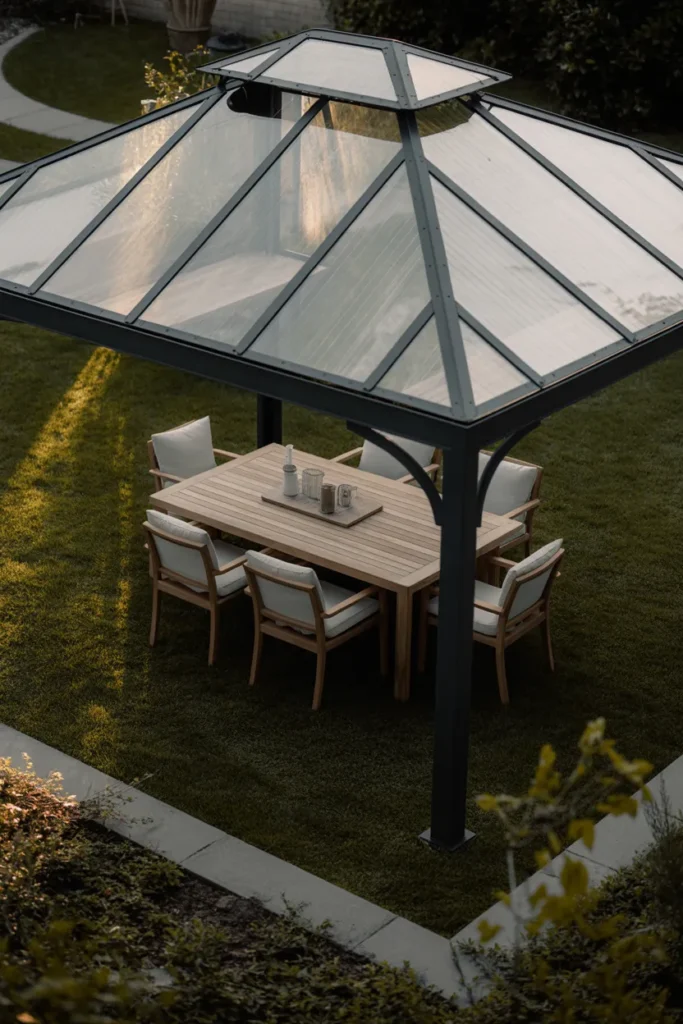
Polycarbonate panels — particularly twinwall or multiwall formats — provide significant insulating value compared to single-layer acrylic or glass alternatives. This keeps the space under the gazebo warmer in spring and fall, extending the usable season without any heating addition. Clear panels maintain the open-sky visual quality. Tinted bronze or gray panels reduce summer heat gain while still admitting natural light.

The sizing decision matters more than most buyers realize. A gazebo intended for dining should accommodate the table, chairs pulled out to seated position, and at least 18 inches of clearance between the chair backs and the gazebo posts. For a standard six-person dining table, this typically requires a minimum 12×12 foot footprint. Undersizing the gazebo relative to the furniture is the most common and least reversible mistake in this category.
2. Open-Air Cedar Octagonal Gazebo That Anchors a Large Backyard Layout
An octagonal gazebo — the traditional eight-sided form — works as a yard anchor in large or open backyard layouts where a rectangular structure would feel disconnected from the surrounding landscape. The multi-sided form has no dominant front face, which means it integrates visually from multiple viewing angles across the yard without requiring a specific approach path or orientation.
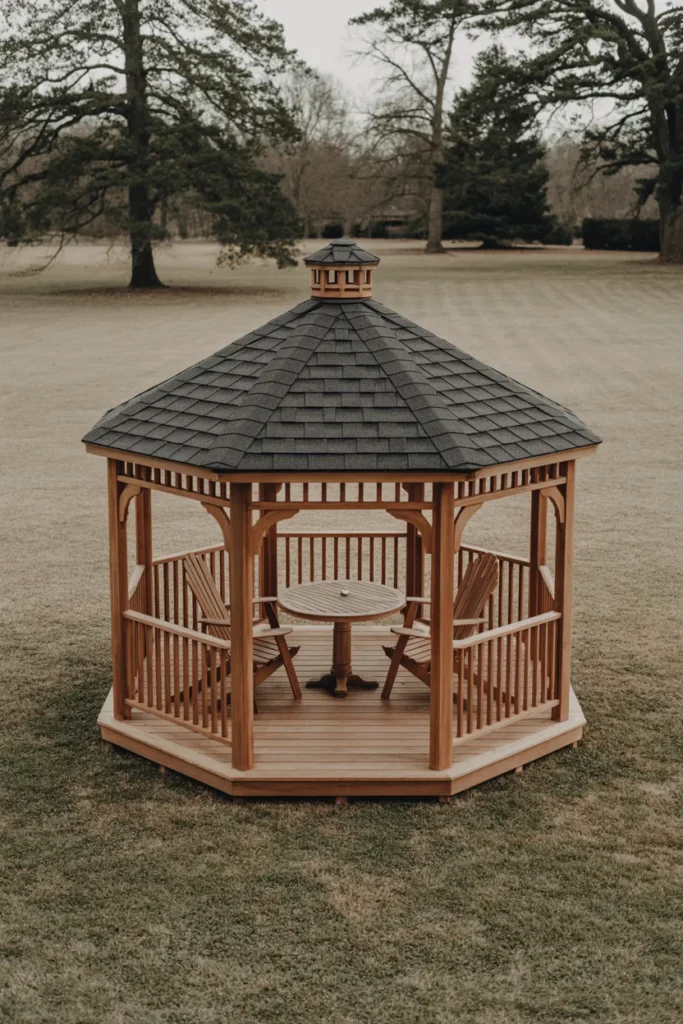
Cedar is the standard material choice for octagonal gazebo construction because it is dimensionally stable, naturally rot-resistant, and carries enough structural weight in post and beam form to support the multi-hip roof that the octagonal plan requires. The roof framing on an octagonal gazebo is significantly more complex than on a rectangular structure — eight hip rafters meeting at a central king post require precise angle cuts that are not forgiving of dimensional lumber inconsistencies.
This is not a straightforward DIY build. If you are not experienced with compound roof framing, a pre-engineered octagonal gazebo kit with factory-cut components is the more reliable path to a structurally sound result. Improvised on-site angle calculations on octagonal roof framing are where most self-built traditional gazebos develop long-term structural problems.
3. Modern Flat-Roof Gazebo With Louvered Side Panels for Adjustable Privacy
A contemporary flat-roof gazebo with motorized or manually adjustable louvered side panels is one of the most versatile backyard structures available for 2026 because it functions as an open pergola, a shaded dining room, a wind-blocked lounge, and a semi-private room depending on how the louvers are positioned. No single fixed structure can match that range of function.
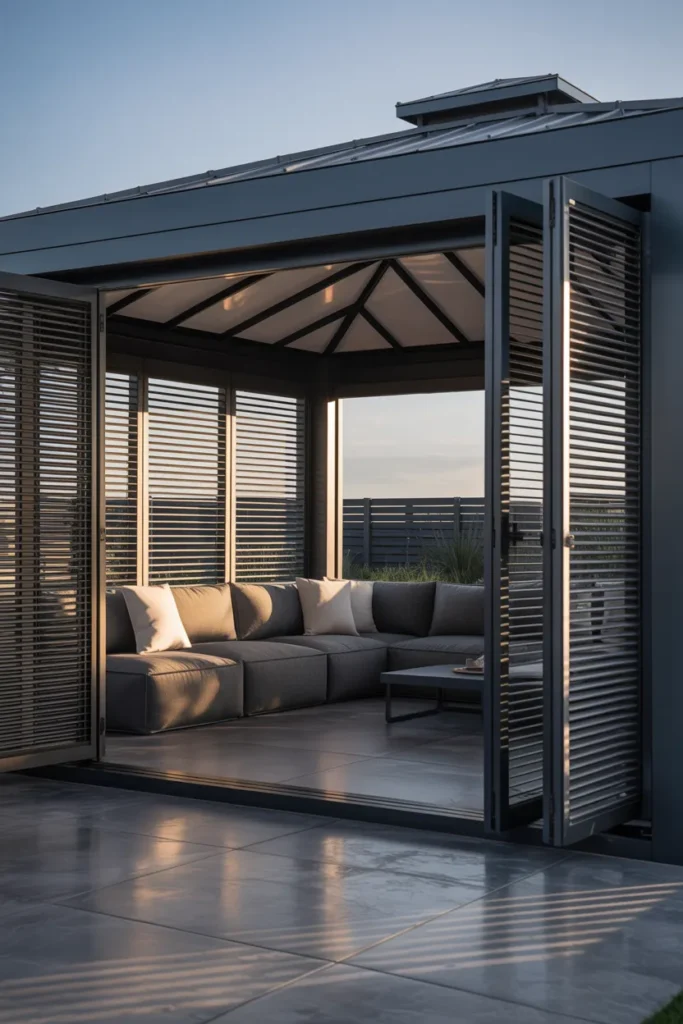
The flat roofline gives this structure a distinctly modern profile that suits contemporary, minimalist, and transitional home styles. It reads as an outdoor room extension rather than a decorative garden feature, which is the correct framing for any backyard structure that will see daily use. When the louvers are open, the gazebo feels like an open pergola. When closed, it blocks sightlines from neighboring properties and reduces wind velocity inside the structure by 70 to 80 percent.
Louvered panel systems in aluminum are the most practical choice for American climates because aluminum does not warp, swell, or rot in moisture, and powder-coated finishes in any RAL color maintain their appearance for decades without repainting. Wood louvered panels are available and look more natural but require annual maintenance in humid climates and are not appropriate for coastal salt-air environments.
4. Backyard Gazebo With a Built-In Outdoor Kitchen and Bar Counter
A gazebo positioned over a built-in outdoor kitchen is one of the highest-utility backyard structures you can invest in because it protects the cooking equipment from weather, creates a defined entertainment zone, and eliminates the ad hoc quality of a freestanding grill on an open patio. The structure also provides overhead mounting points for task lighting, a ventilation hood, and ceiling fans — none of which are possible without a permanent overhead structure.
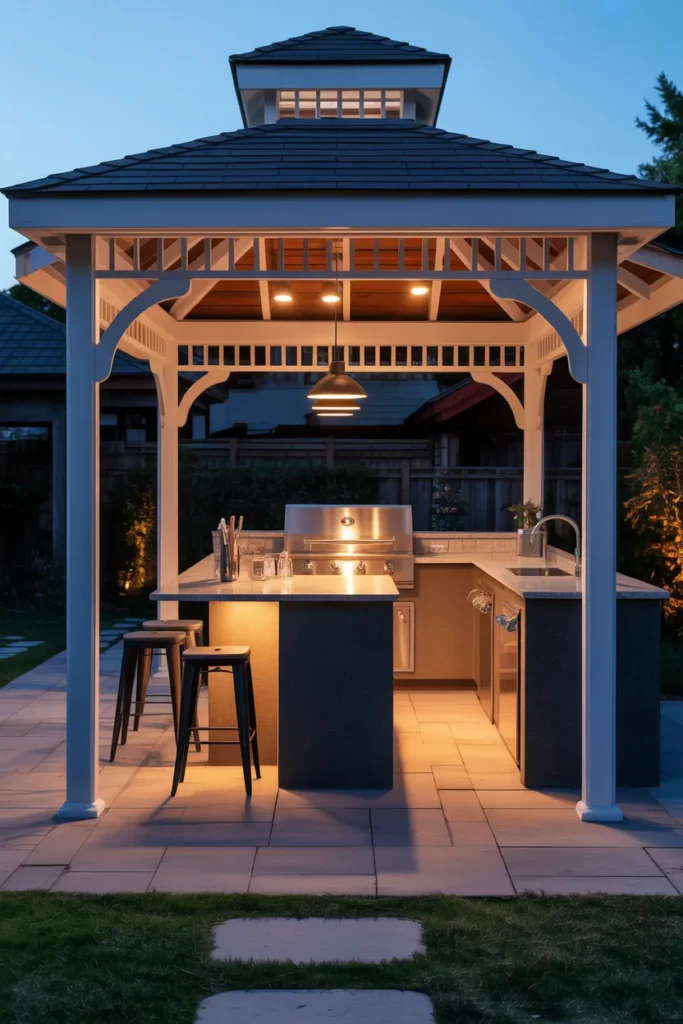
The design principle that makes this work is counter orientation. The cooking counter should run along the perimeter — typically the back wall of the gazebo — with the cook facing inward toward guests rather than away from the social area. This positions the grill, prep surface, and refrigeration in a functional sequence while keeping the cook engaged with the gathering. An L-shaped counter configuration that includes a bar overhang on the social side allows guests to sit at bar height and interact with the cooking zone without entering the work area.
Ventilation is the non-negotiable technical requirement for any gazebo with a built-in grill or cooktop. An enclosed or semi-enclosed structure without adequate ventilation will accumulate smoke, carbon monoxide, and heat. At minimum, two opposing open sides must remain unobstructed during cooking, and any overhead structure must have ventilation openings at the roof peak. A dedicated outdoor-rated ventilation hood connected to an exterior exhaust path is the correct solution for any gazebo with a gas cooktop.
5. Small Backyard Gazebo Under 10×10 Feet That Creates a Reading or Meditation Zone
Not every backyard gazebo needs to be a dining or entertaining destination. A compact sub-10-foot structure positioned in a quiet corner of the yard — away from the main patio or entertaining area — creates a defined retreat zone that serves a single focused purpose: a place to sit outside without distraction. This is one of the most underbuilt gazebo ideas backyard 2026 homeowners tend to overlook because the scale feels modest, but the functional payoff of a dedicated quiet outdoor space is disproportionate to its size.
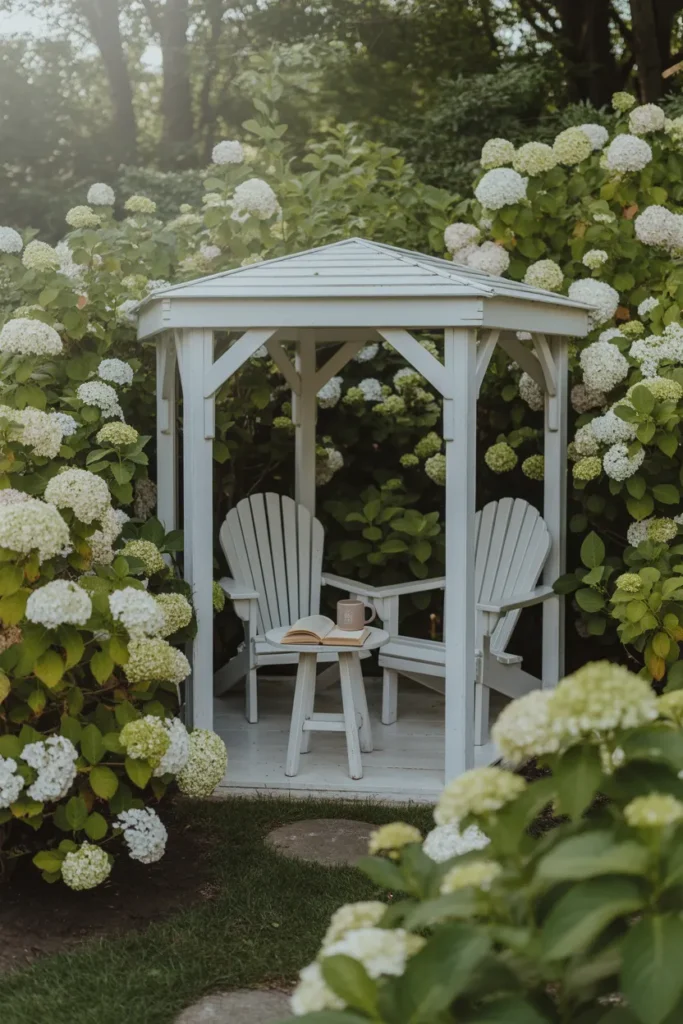
A 10×10 footprint is sufficient for two chairs, a small side table, and adequate circulation space. The structure does not need electricity, a foundation, or any permanent attachment to the ground if it is weighted appropriately. A compact pressure-treated wood or steel gazebo on adjustable base plates can be repositioned seasonally to follow the best shade or sun conditions in the yard.
Keep the interior furnishing extremely simple. A compact gazebo used as a reading or meditation retreat loses its function as soon as it becomes a storage location. Two weather-resistant chairs with cushions, a small table for a drink or book, and a single hanging lantern are sufficient. Any more than this in a 10×10 space begins to create the cluttered, utilitarian feel that defeats the purpose of the structure.
6. Gazebo With String Lights and a Curtain Rail for Backyard Evening Entertaining
A gazebo fitted with a perimeter curtain rail and dimmable string lights transforms from a daytime shade structure into a fully enclosed evening entertaining room without any construction beyond the original build. The curtain rail — mounted to the interior face of the gazebo beams — allows sheer or blackout curtain panels to slide open and closed, creating privacy, blocking wind, and diffusing the light from surrounding fixtures into the interior.
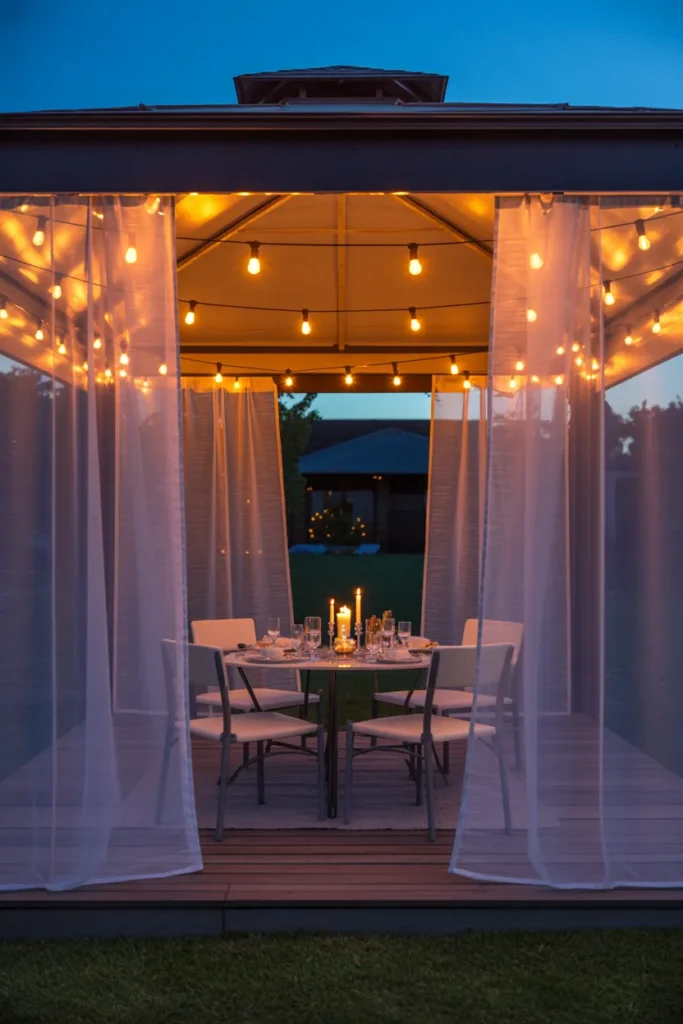
String lights work more effectively in a gazebo than almost any other outdoor lighting format because the overhead enclosure of the structure contains the light and concentrates it within the occupied zone rather than dispersing it across an open yard. Edison-style warm bulb strings at 2700K color temperature create the most livable evening atmosphere — cooler daylight-spectrum strings above 3500K create a functional but harsh quality that is difficult to mitigate with other fixtures.
The curtain material choice determines the year-round usability of this setup. Sheer outdoor-rated polyester curtains provide a soft privacy screen and wind reduction without blocking airflow — appropriate for warm-season use. Insulated outdoor curtain panels with a thermal backing extend the comfortable temperature range into early spring and late fall but require more substantial curtain rod hardware to support their weight. Match the curtain weight to your climate and intended use season.
7. Gazebo With a Retractable Shade Sail Roof for Hot Summer Climates
In regions where summer temperatures regularly exceed 95 degrees — the Southwest, Southeast, and much of the South — a fixed solid roof on a gazebo can create a trapped heat problem that makes the interior uncomfortable even in shade. A retractable shade sail roof system solves this by allowing airflow through and above the structure while still blocking 90 to 95 percent of direct UV radiation. When the sail is fully retracted, the gazebo frame becomes an open pergola that allows free air movement.
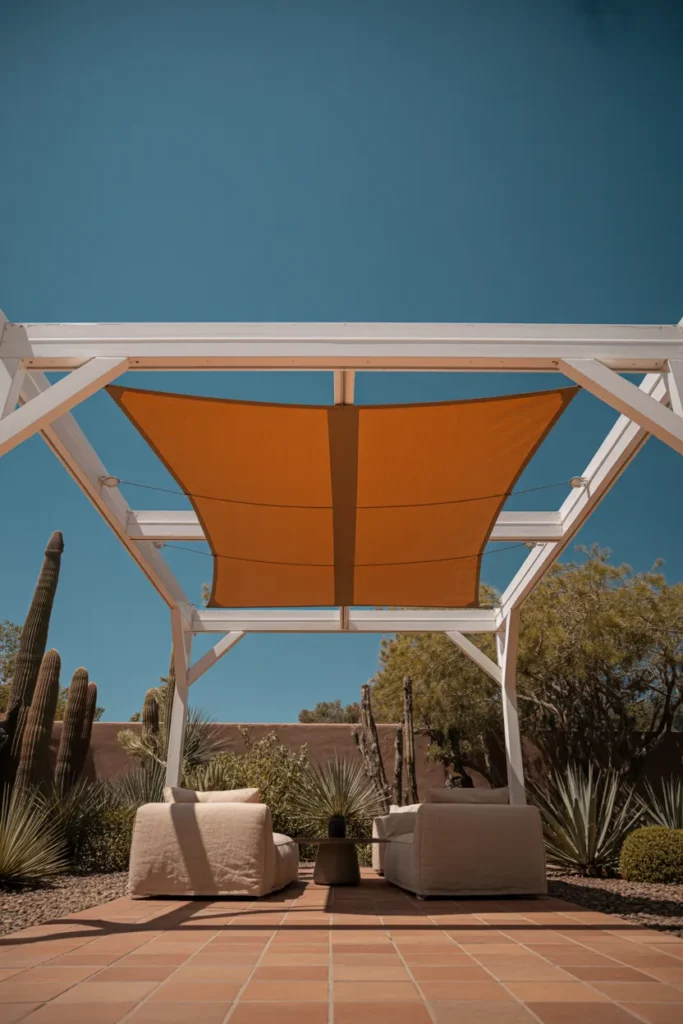
This configuration requires a gazebo frame engineered for lateral tension loads, not just vertical dead loads. A shade sail exerts significant outward tension on its attachment points, particularly in wind. Standard decorative gazebo frames with light-gauge posts and minimal bracing are not appropriate anchor structures for a tensioned sail system. The frame needs to be either purpose-built for sail tension or reinforced with diagonal knee bracing at the post-to-beam connections.
Shade sail fabric selection matters significantly in this application. Standard residential grade shade cloth rated at 85 percent UV block is appropriate for a pergola or garden frame but not adequate as the primary roof of a covered gazebo. For this use, specify a minimum 95 percent UV-rated HDPE shade cloth with heat-welded perimeter edges and stainless steel corner rings. The added material cost is justified by the performance difference in peak summer heat.
8. Japanese-Inspired Open Gazebo With a Curved Roof and Gravel Garden Surround
A Japanese-influenced gazebo design — characterized by a gently curved or upswept roof profile, exposed timber joinery, minimal ornamentation, and a gravel or stone garden setting — creates a backyard focal point that reads as architecturally considered rather than decoratively added. The curved roof form requires either laminated curved rafter components or a traditional purloin-and-batten system over curved hip rafters, both of which are beyond standard residential carpentry but achievable with the right contractor.
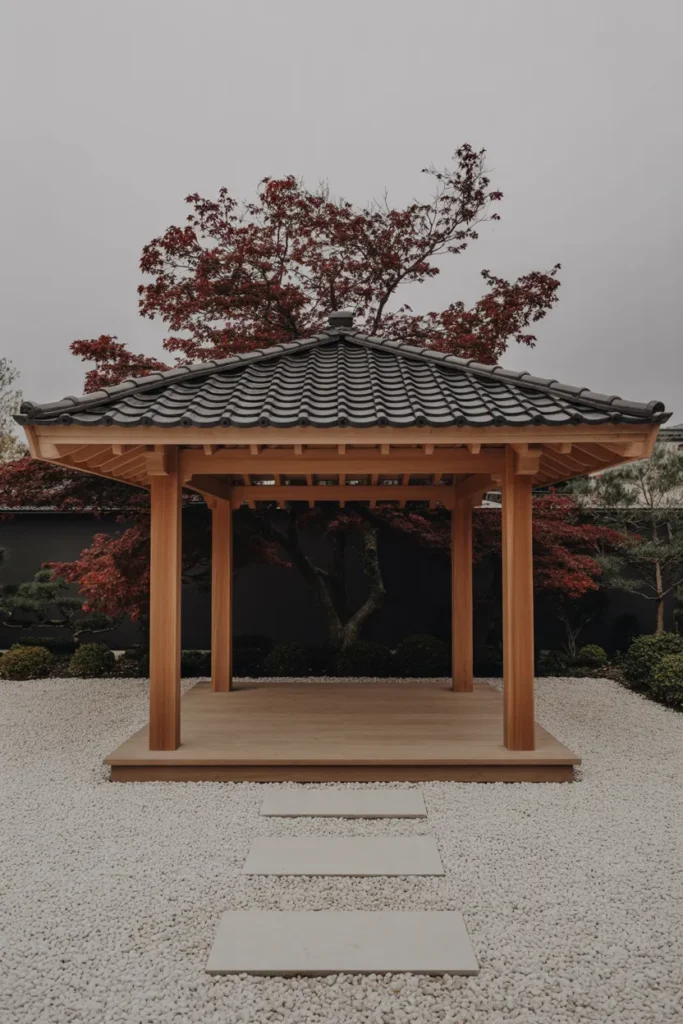
This style of gazebo works best as a solitary structure in a yard where the design language is restrained and the surrounding landscape is deliberate. It does not suit yards with mixed garden styles, bright color schemes, or heavy furniture. The structure’s visual impact depends entirely on the quality of the negative space around it — an uncluttered gravel garden, a single specimen tree, and carefully placed stone elements are the appropriate context.
The post-and-beam joinery in a Japanese-inspired gazebo should be expressed honestly — visible mortise-and-tenon connections or decorative bracket systems at the post-to-beam junction are part of the design vocabulary of this style. Concealing the joinery behind casing or fascia boards eliminates the structural expressiveness that makes this approach visually distinct from a standard Western gazebo form.
9. Backyard Gazebo Converted Into a Four-Season Room With Vinyl Panel Walls
A gazebo with a permanent hardtop roof and a robust post-and-beam frame can be converted into a functional four-season room by adding clear vinyl panel walls on a track system that allows the panels to slide open in warm weather and close in cold. This conversion costs significantly less than a full sunroom addition and requires no new foundation or building permit in most jurisdictions, as the gazebo structure already exists as a permitted accessory structure.
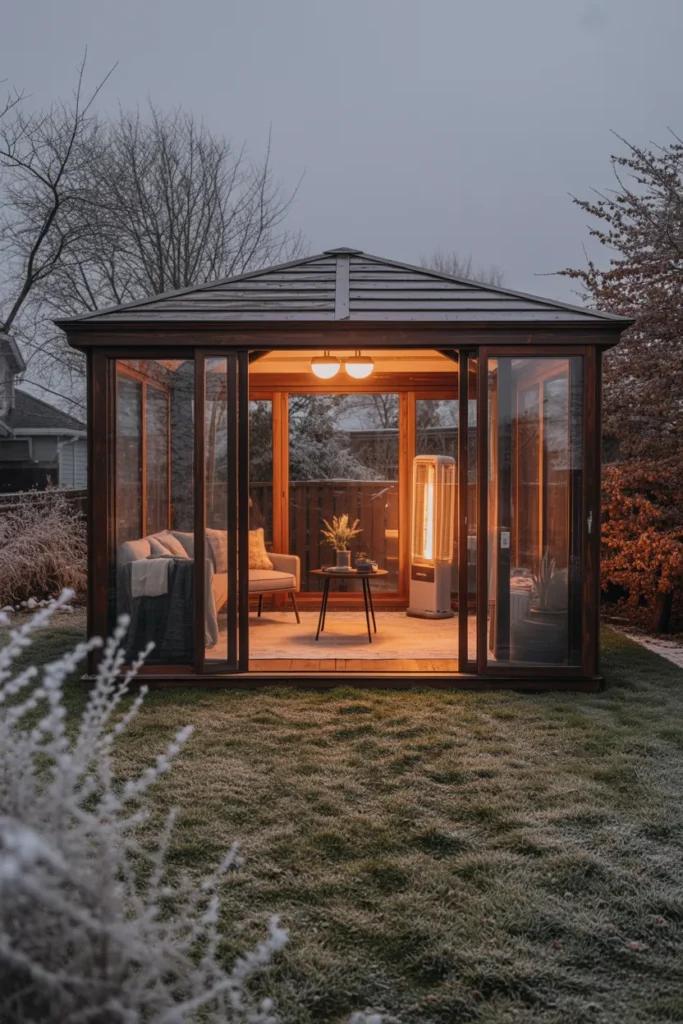
Clear vinyl panel systems designed for pergola and gazebo enclosure are available in track-mount formats that attach to the existing beam structure without permanent modification. In a closed configuration, these panels block wind completely and raise the interior temperature enough for comfortable use down to freezing in most climates — particularly when a portable electric radiant heater is added. In summer, the panels retract fully against the posts and the structure functions as an open gazebo.
The limitation of vinyl panel enclosures relative to glass is optical distortion. Clear vinyl panels are not optically flat and will distort the view of the surrounding yard, which matters if the gazebo is positioned to take advantage of a landscape view or water feature. For view-sensitive applications, specify tempered glass panel inserts on a sliding track system rather than vinyl — the cost is higher but the optical quality is incomparable.
10. Poolside Gazebo With a Thatched Palapa Roof for a Tropical Backyard
A palapa-style gazebo — with a structural wood or steel post frame and a thatched palm frond or synthetic thatch roof — is the defining structure of a tropical-inspired backyard and one of the most effective ways to create a consistent resort aesthetic around a residential swimming pool. Authentic Mexican or Caribbean palm thatch provides excellent shade with natural air circulation through the roof material and has a visual warmth that no synthetic roofing material replicates.
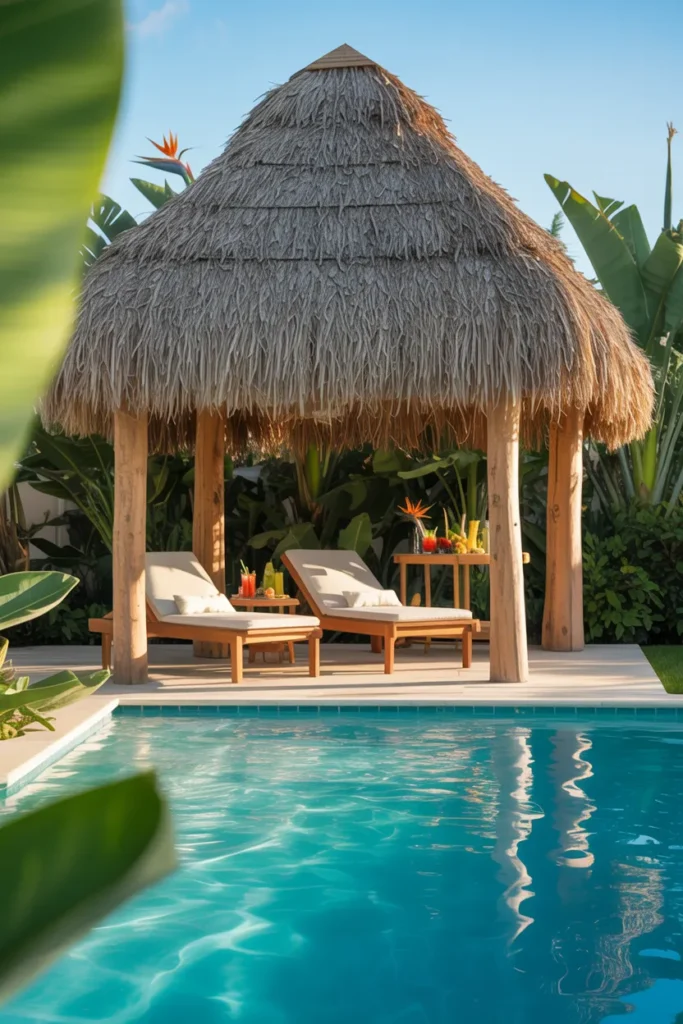
Synthetic thatch — made from UV-stabilized polyethylene fibers woven to simulate palm frond texture — is the more practical choice for most American backyard applications. It carries a Class A fire rating, will not harbor insects or develop mold the way natural thatch does in humid climates, and is available in color-stable formulations that maintain their appearance for 15 to 20 years without replacement. Natural thatch, while authentic, typically requires re-thatching every five to eight years in the American South and is not fire-code compliant in most municipalities without a fire-retardant treatment.
Positioning a poolside palapa requires careful attention to the afternoon sun angle. The structure should be placed on the side of the pool that provides shade over the water and the lounge area during the hottest hours of the day — typically the west or southwest side for most continental US locations. A palapa placed on the east side of the pool will provide morning shade but leave the lounge area fully exposed during peak afternoon heat, which defeats the primary function of the structure.
11. Rustic Wood Gazebo With Stone Pillars and a Firepit at the Center
A gazebo built over a central in-ground or flush-surface firepit is one of the most compelling outdoor gathering structures for climates with cool evenings — the Pacific Northwest, New England, the Upper Midwest, and the Mountain West. The fire element at the center of the structure creates a radiant heat source that extends comfortable outdoor use into temperatures where an open patio would be unusable.
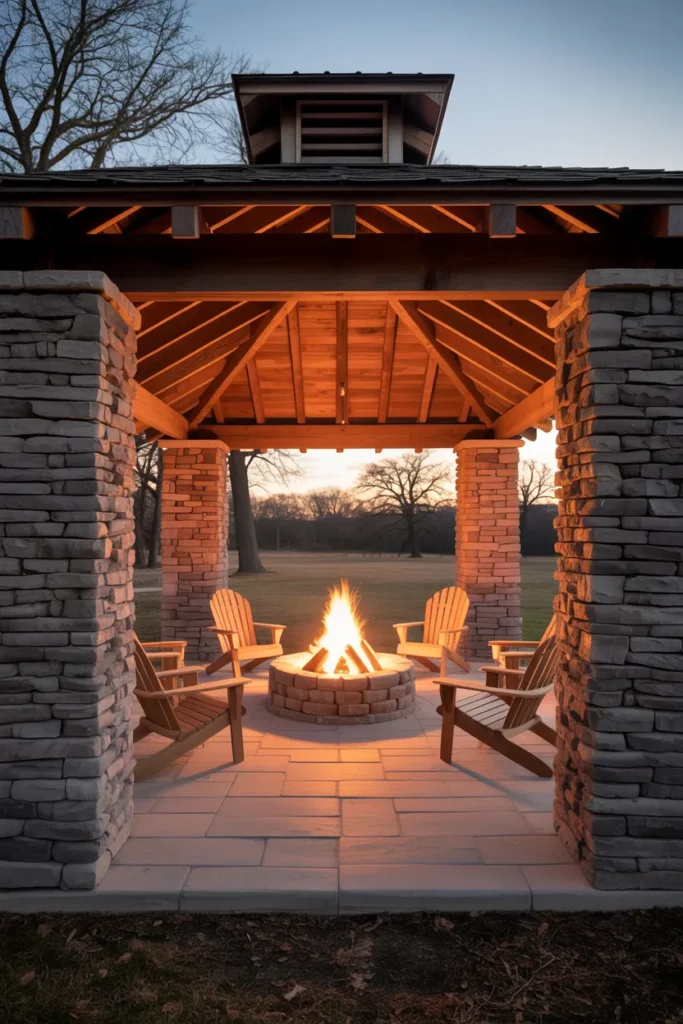
Stone or masonry pillars at the corners of this gazebo type serve a structural and fire-safety function simultaneously. Combustible wood posts positioned close to a permanent firepit require adequate clearance — typically 36 inches or more from the fire opening to the nearest combustible surface. Stone pillar construction eliminates the combustibility concern entirely and allows the post footprint to be positioned closer to the fire zone than wood framing codes would permit.
The roof design for a firepit gazebo requires open venting at the peak. A solid closed roof directly over a wood-burning firepit will accumulate smoke faster than it can dissipate, making the structure unusable whenever the fire is burning. An open cupola vent, a center peak opening of at least 18 inches, or a partial roof with a significant open center section are the three standard approaches to managing smoke in a covered firepit structure.
12. Modern Farmhouse Gazebo With Board-and-Batten Siding on Two Sides
A modern farmhouse gazebo incorporates the exterior cladding language of the main house — specifically board-and-batten vertical siding — on one or two sides of the structure to create an architectural connection between the gazebo and the home that makes the outbuilding feel like a planned extension of the property rather than a separately purchased kit structure.
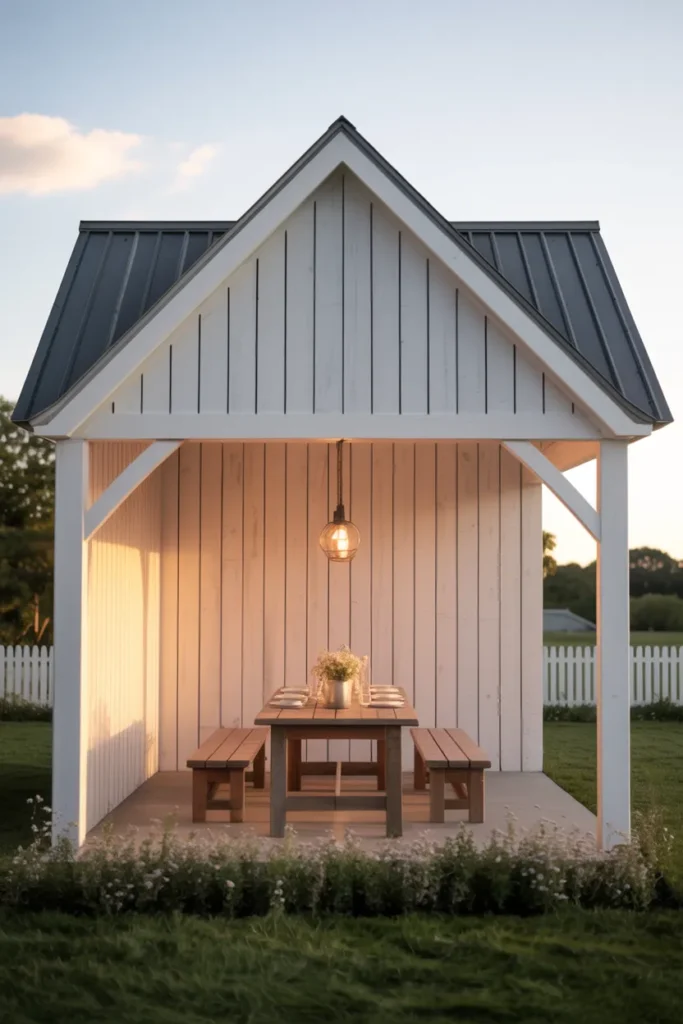
Board-and-batten on two sides of a gazebo provides partial enclosure that blocks prevailing wind from the most exposed directions while keeping two sides fully open for views, ventilation, and the visual openness that makes a gazebo feel like an outdoor rather than indoor space. The siding also provides a mounting surface for exterior sconces, a television, or a mounted outdoor heater on the enclosed faces.
The vertical line of board-and-batten siding has a secondary visual benefit in a gazebo context — it draws the eye upward and makes a standard-height gazebo read as taller and more substantial than it actually is. This matters most on compact structures in small yards where proportional height relative to the yard space determines whether the gazebo reads as an architectural feature or a temporary shelter.
13. Waterfront or Lakefront Gazebo Built on a Floating Dock Platform
A gazebo mounted on a floating dock platform at the edge of a pond, lake, or waterway transforms a standard water feature into a destination — a place to sit over the water, fish from, watch the sunrise, or simply experience the yard from a position and perspective that the land-based portion cannot offer. The floating platform eliminates the need for fixed pilings or below-waterline construction in many applications, reducing both cost and permitting complexity.
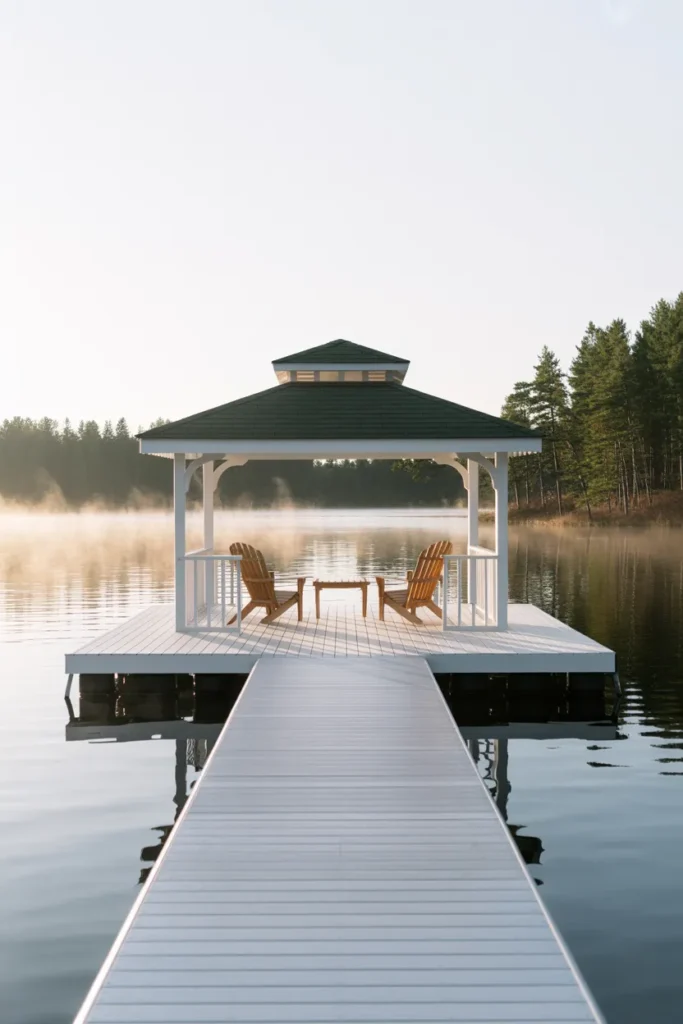
Floating dock gazebo systems use high-density polyethylene float modules as the foundation — the same material used in commercial marina dock systems. These modules are UV-stable, maintenance-free, and carry sufficient load capacity for a lightweight aluminum or treated wood gazebo frame. The platform is anchored with guide posts that allow the dock to rise and fall with water level changes while remaining in a fixed position laterally.
Structural wind resistance is the critical engineering concern for any over-water structure. A gazebo on a floating platform has no soil or foundation engagement to resist lateral wind loads — all wind resistance must be provided by the guide anchor system, the frame bracing, and the roof design. A low-pitch roof with adequate hip or gable end bracing performs significantly better in wind than a tall steeply pitched roof on a floating platform. This is a design detail that should be specified by a structural engineer familiar with dock and marine structure design.
14. Pergola-Gazebo Hybrid With a Partial Solid Roof and Open Lattice Sides
A pergola-gazebo hybrid — where the center of the roof is solid for weather protection and the perimeter transitions to open lattice or rafter-only construction — provides the functional benefits of a covered structure while maintaining the open, garden-integrated quality of a traditional pergola. This is one of the most practical gazebo ideas backyard 2026 for homeowners who want partial weather protection without the enclosed, room-like feel of a fully covered structure.
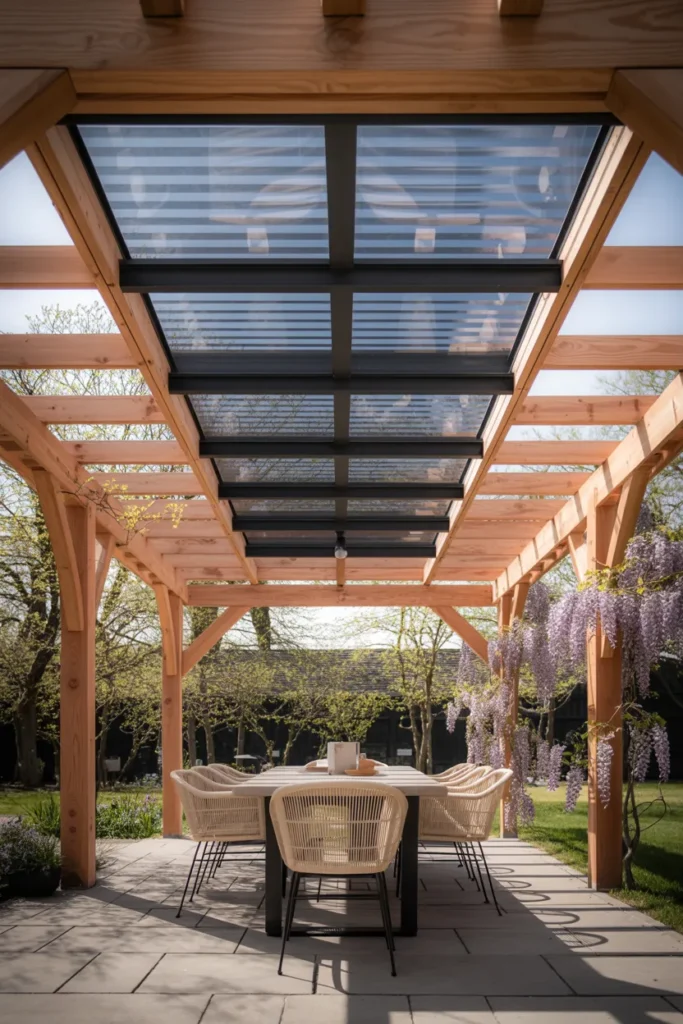
The standard configuration places a solid polycarbonate or metal panel insert over the primary seating or dining zone — typically the center third of the roof area — while the surrounding rafters remain open. This keeps the interior dry during light rain directly overhead while allowing airflow and natural light through the perimeter. It is a particularly effective solution for kitchens or dining areas where protecting the table and food from rain matters more than full enclosure.
Structurally, this hybrid approach requires planning the roof frame to support both the solid panel zone and the open rafter zone from a single consistent beam and post system. The most common mistake is treating the solid and open sections as structurally independent, resulting in an inconsistent beam depth or post spacing that creates visual discontinuity across the roofline. Design the full roof frame as a unified system from the beginning, then specify which bays receive solid panels and which remain open.
15. Screened Gazebo That Solves the Mosquito Problem in Humid Climates
In the Southeast, Gulf Coast, Great Lakes region, and any area with significant summer mosquito or biting insect pressure, an unscreened open gazebo is functionally unusable during the evening hours that outdoor dining and entertaining most commonly occur. A gazebo with full-perimeter fiberglass or aluminum mesh screening is the only structural solution that allows outdoor enjoyment in high-insect environments without chemical repellent dependency.
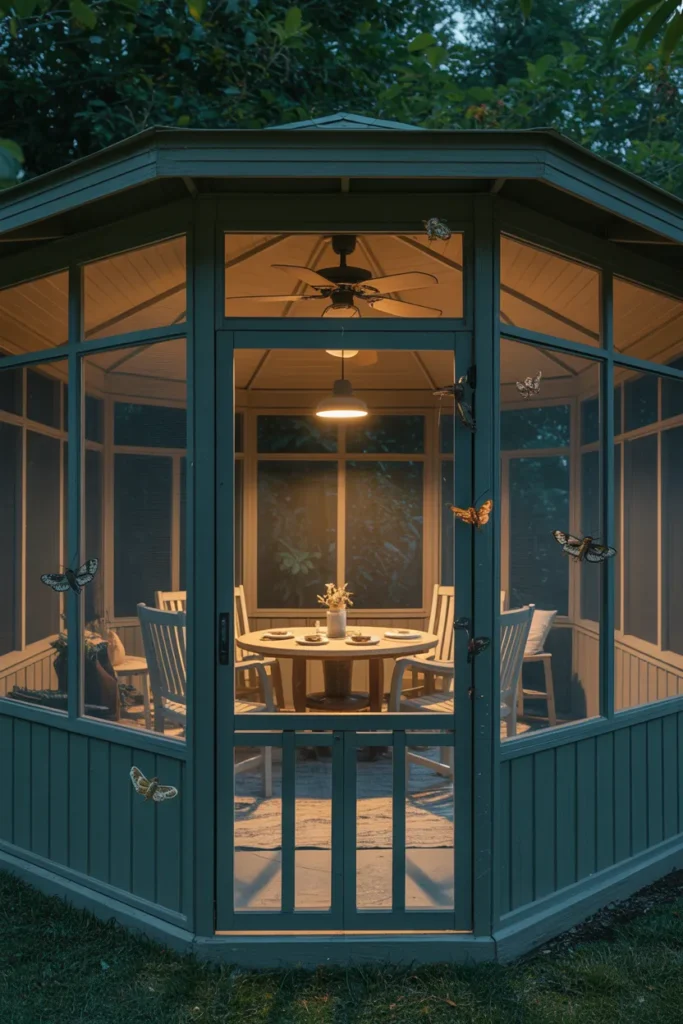
The screening material choice affects both performance and longevity. Fiberglass mesh screening is the standard residential choice — it is inexpensive, easy to repair, and adequate for most insect pressure. In coastal or high-UV environments, specify a UV-stabilized fiberglass or aluminum mesh rated for exterior exposure — standard interior fiberglass window screening will degrade and become brittle within two to three seasons of direct sun and weather exposure.
The frame system for the screening panels determines how easy the gazebo is to use seasonally. Fixed-frame screening panels — where the screen is stapled or splined into a fixed wooden or aluminum frame — are the most durable installation but cannot be removed without tools. Track-mounted removable panel systems allow the screens to be taken down and stored off-season in climates where winter use without screens is preferred. In year-round mosquito climates, fixed screening with a sealed perimeter and screened door is the correct specification.
16 . Two-Story Backyard Gazebo With an Upper Observation Deck for Large Properties
A two-story gazebo — with a covered lower level for dining or lounging and an open upper deck for views — is the most ambitious residential backyard structure in this list and the most appropriate for large rural or semi-rural properties where elevated views of the surrounding landscape, water, or countryside are available. The lower level functions as a standard covered gazebo; the upper level provides an unobstructed 360-degree view platform that no ground-level structure can replicate.
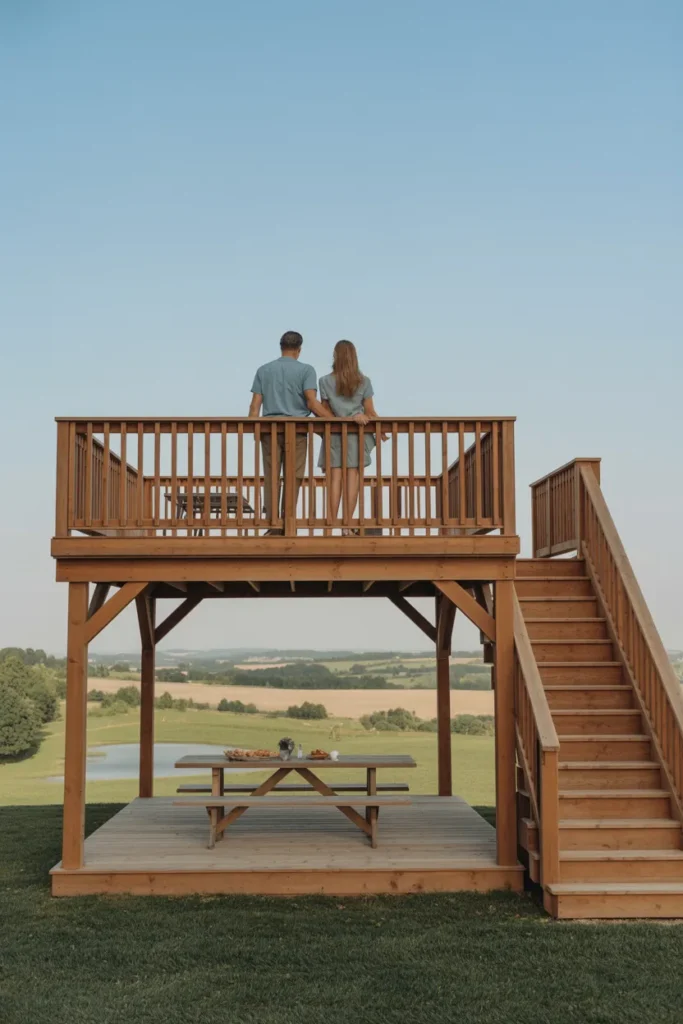
The structural requirements of a two-story gazebo exceed residential deck and single-story gazebo standards significantly. The post sizing, beam connections, and stair attachment all need to be engineered for the combined dead load of the upper deck structure, the live load of occupants on the upper level, and the lateral wind loads on a structure with a substantially higher wind profile than a ground-level build. A structural engineer’s stamp is not optional on this project — it is the document that allows you to pull the building permit and ensures the structure is safe under the loads it will experience.
This structure makes sense on properties where the investment is proportional to the land and view it serves. On a standard suburban lot, a two-story gazebo is disproportionate to the setting and will feel imposing rather than impressive. On a rural property with a pond view, a hillside lot, or a waterfront location, the elevated observation deck delivers a use experience that justifies the additional construction complexity and cost.
Final Thoughts
The most useful backyard gazebo is the one sized correctly for your yard, matched to your climate, and designed around how you actually spend time outdoors. Whether you need a screened room to solve a mosquito problem, a firepit shelter for cool-evening use, or a poolside palapa to complete a tropical landscape, every configuration in this list was chosen because it addresses a specific and real outdoor living condition.
Save this post to your Pinterest boards before you start planning. Having these gazebo ideas backyard 2026 options in one organized reference makes it significantly easier to compare structural approaches and narrow your decision when you are ready to build. For more outdoor living guidance, explore our related posts on backyard pergola designs, outdoor kitchen layouts, and small patio planning ideas that complement any gazebo installation.