
The open layout living room dining room is one of the most common floor plans in American homes today, and also one of the most frequently mishandled. Without walls to define where one room ends and another begins, most homeowners end up with furniture that floats, zones that blur, and a space that looks unfinished regardless of how much they spend on it. This guide covers 18 specific, decision-ready ideas that solve the real problems of open plan living and dining spaces, from zoning and scale to lighting and flow.
1. The Area Rug Zoning Method That Defines Two Rooms Without a Single Wall
Area rugs are the most cost-effective and reversible way to create visual separation in an open layout living room dining room. When placed correctly, two rugs in the same space signal to anyone entering that two distinct rooms exist, even without any physical boundary between them. The effect works because human perception reads a defined floor plane as a defined zone.
The living room rug should be large enough that all four legs of the sofa sit on it, or at minimum the two front legs. The most common mistake is buying a rug that is too small, which makes the furniture look like it is floating rather than anchored. In an open plan space, an undersized rug reads as a decorative accent rather than a zone-defining element, which defeats the purpose entirely.
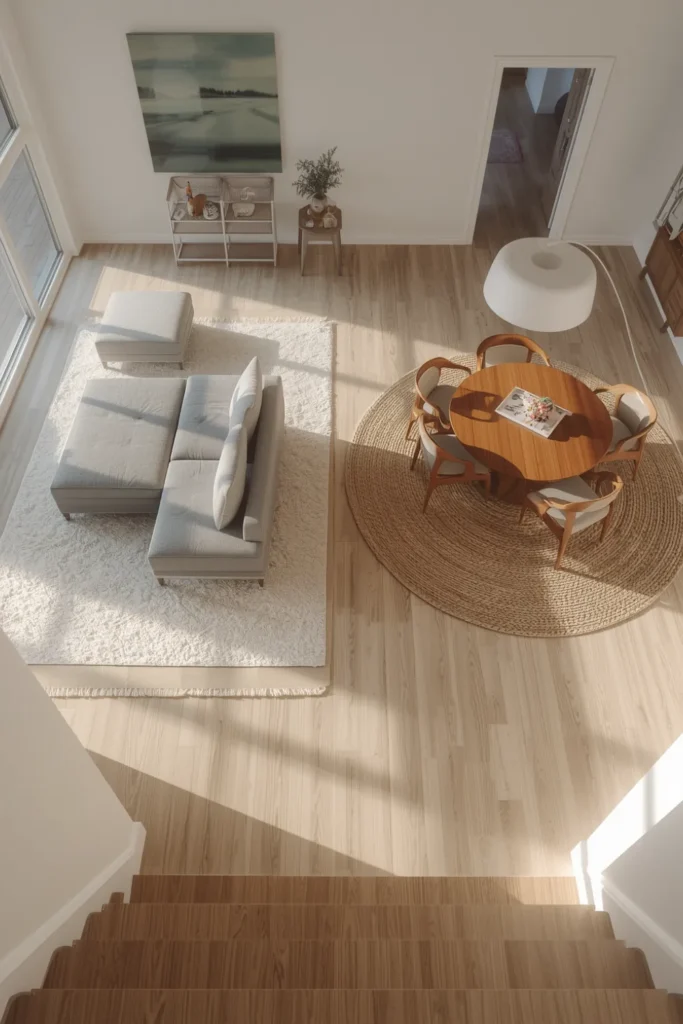

The dining room rug needs to extend at least 24 inches beyond the edge of the table on all sides. This ensures that chairs remain on the rug even when pulled out for seating. A rug that chairs slide off of during a meal is both impractical and visually disjointed.
The two rugs do not need to match, but they should share at least one element, a color tone, a material texture, or a similar visual weight, to keep the overall space cohesive. Wildly contrasting rugs in an open plan pull the space apart rather than organizing it.
2. The Half-Wall Room Divider That Adds Structure Without Closing the Space
A half-wall, typically 36 to 42 inches tall, is one of the most practical structural solutions for an open plan living and dining layout that needs definition without enclosure. It provides a physical boundary between the two zones while keeping sightlines open above it. This makes the space feel purposefully organized rather than casually combined.
Half-walls work best when they run parallel to the longer dimension of the shared space. Placing one perpendicular to the natural flow path between kitchen and living room creates a barrier that interrupts movement. Running it along the side creates definition without blocking any natural traffic line.
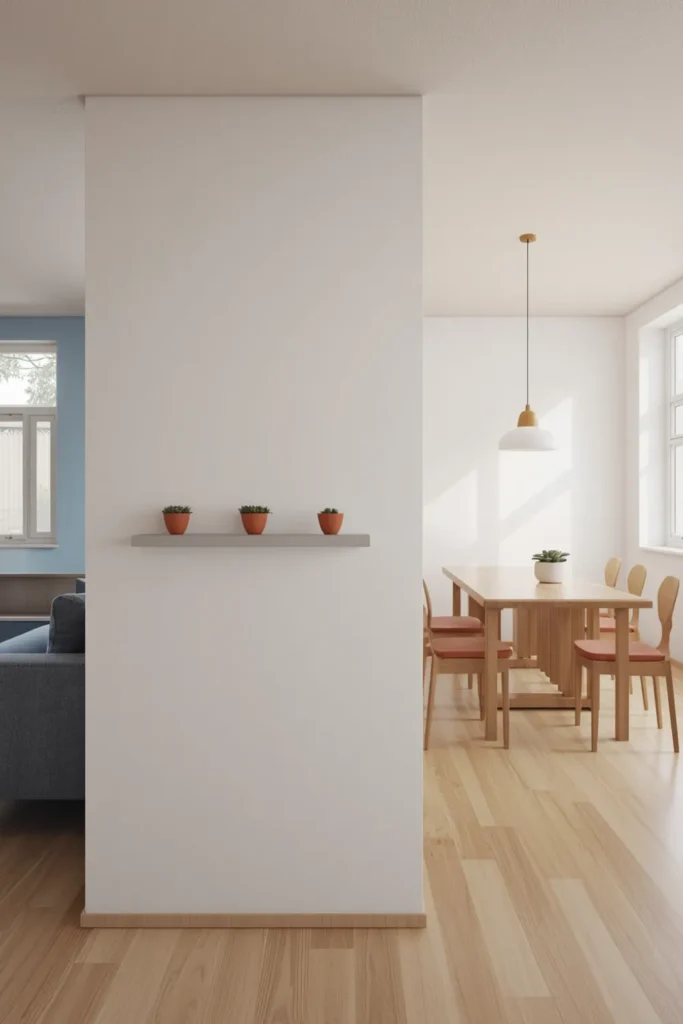
The top surface of the half-wall becomes a functional ledge. In a living and dining context, this ledge works well as a surface for plants, a row of small pendant lights hung above it, or a low decorative element that reinforces the boundary visually. Avoid cluttering this ledge with mismatched items, which negates the clean architectural intention of the wall.
This solution is best for open plans in homes built after 1990 where the open layout was intentional but the scale of the combined space makes it feel unanchored. In older homes with lower ceilings, a half-wall can feel proportionally heavy. Assess ceiling height first: rooms under 9 feet should consider other zoning methods.
3. The Pendant Lighting Strategy That Zones the Dining Area Visually and Functionally
Lighting is one of the most powerful and underused zoning tools in an open layout living room dining room. A pendant light or chandelier hung directly above the dining table creates an immediate visual anchor that defines the dining zone without any physical structure. The light draws the eye downward to the table surface and signals purpose: this is where meals happen.
The pendant should hang 30 to 34 inches above the tabletop for standard 8-foot ceilings. For every additional foot of ceiling height, raise the pendant by 3 inches. Hanging pendants too high disconnects them from the table and reduces their zoning effect. Hanging them too low creates a physical obstruction and limits sightlines across the space.
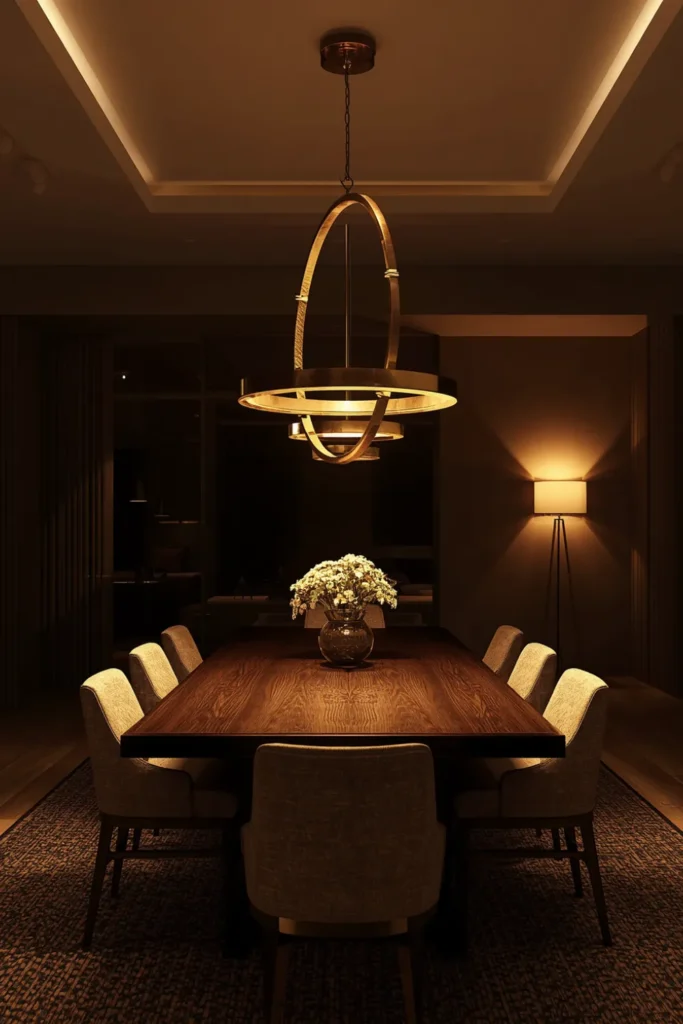
Pendant scale matters as much as height. A single small pendant over a large dining table looks decorative but not architectural. For a table that seats six or more, either use a pendant with a diameter at least half the table length, or hang two or three smaller pendants in a linear row above a rectangular table. The fixture should feel proportionate to the table beneath it.
In an open plan, the dining pendant and the living room lighting should be on separate dimmer switches. This allows each zone to operate at a different brightness level simultaneously, which is the functional equivalent of having two separate rooms. A dining area at full brightness while the living room dims creates a clear evening transition between the two spaces.
4. The Bookshelf Room Divider That Creates Storage and Separation Simultaneously
A freestanding bookshelf used as a room divider is one of the most functional dual-purpose solutions available for open plan living and dining rooms. It creates a visual and partial physical boundary between zones while adding significant storage capacity that most open plan homes lack due to the absence of interior walls.
The bookshelf divider works best when it is open on both sides, meaning no solid back panel, allowing light and partial sightlines to pass through. A fully opaque bookshelf with a solid back creates a wall effect that defeats the purpose of the open plan. Open-backed shelving maintains the connected feel while still providing enough visual distinction to separate the zones.
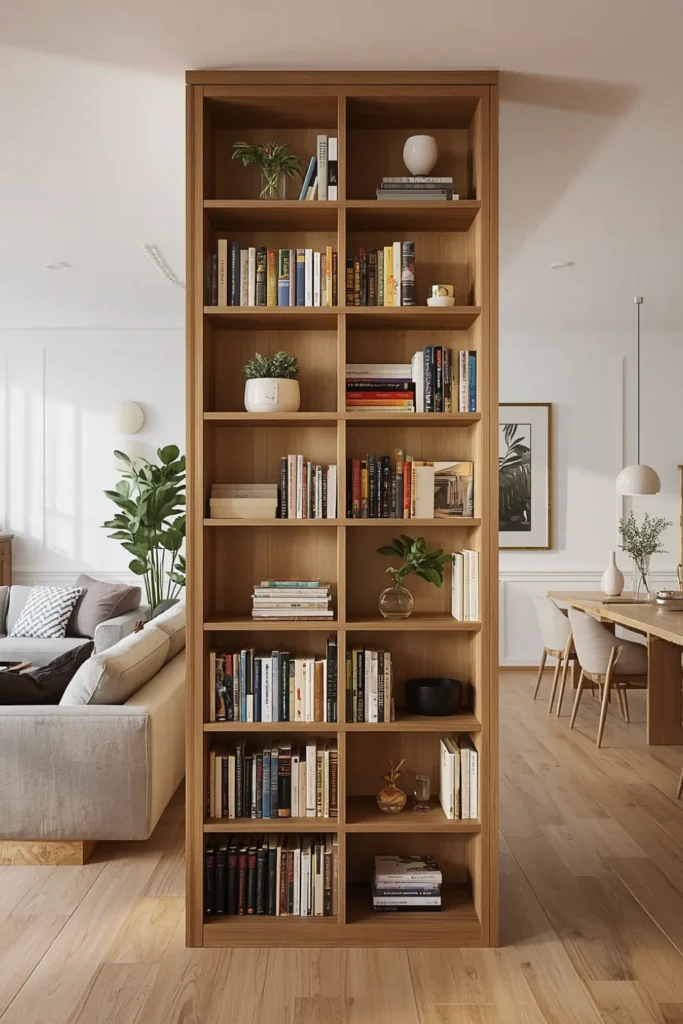
Height is the primary design decision. A shelf that reaches 60 to 66 inches, stopping below the ceiling, maintains the open-plan volume above while still creating a strong zone boundary at standing height. Floor-to-ceiling shelving can work in rooms with ceilings above 10 feet, but in standard 8 or 9-foot ceilings it can feel imposing and reduce the sense of openness that makes open plans valuable.
Position the shelf perpendicular to the longest wall, running into the space rather than along it. This creates two rooms within one footprint rather than simply lining a wall with storage. Style the shelf with a mix of books, plants, and objects that face both the living and dining sides intentionally, since both sides are visible from within the open plan.
5. The Sectional Sofa Placement That Anchors the Living Zone and Faces Away From Dining
Sofa placement in an open layout living room dining room does more zoning work than most homeowners realize. A sectional sofa positioned with its back or side facing the dining area creates a strong, furniture-defined boundary between the two zones. The sofa essentially acts as a low room divider while simultaneously anchoring the living area against the opposite side of the room.
The key is that the sofa back, not the front, faces the dining zone. This orientation gives the living area a clear sense of interiority. Guests seated on the sofa are facing inward toward the television or fireplace, with the dining room behind them. This separation of attention between zones is what makes the two areas feel like separate rooms within the shared space.
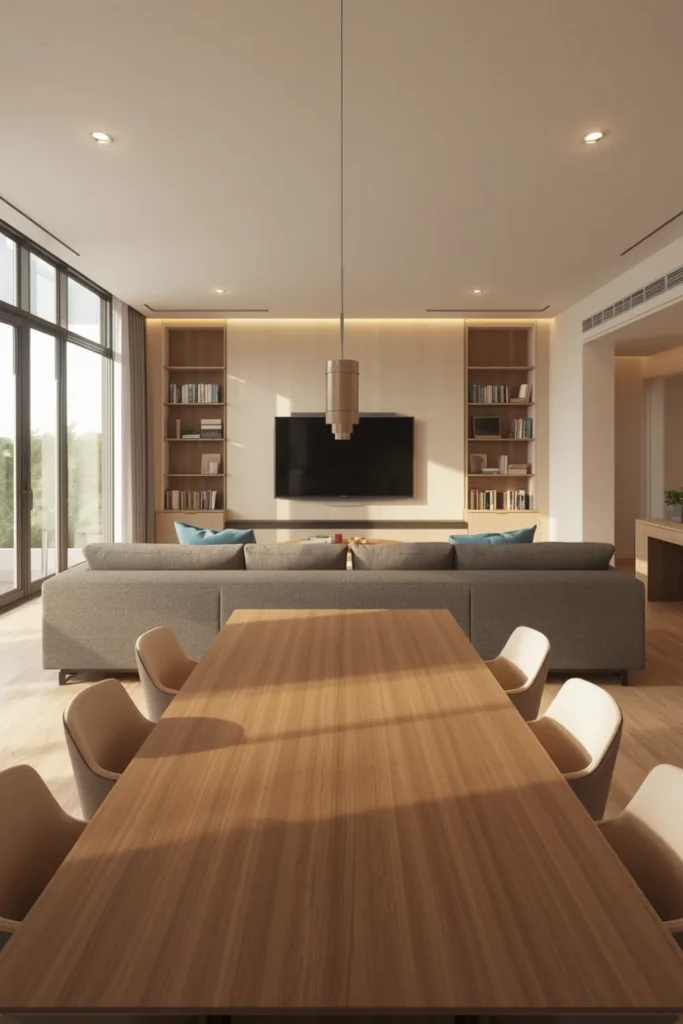
Avoid placing a sectional parallel to the dining table so that guests in the living area face directly into the dining zone. This sightline collision makes both areas feel like they are competing rather than coexisting. The sofa orientation should always create a sense of turning away from the dining zone, not staring at it.
In smaller open plans under 400 square feet combined, a standard sofa rather than a sectional preserves enough floor space between the two zones for comfortable movement. The 36-inch minimum clearance between the back of the sofa and the edge of the dining area is essential for traffic flow and should not be compromised.
6. The Monochromatic Color Scheme That Unifies Two Zones Without Erasing Their Difference
A monochromatic color scheme is one of the most reliable approaches for open plan living and dining rooms because it creates visual unity across the combined space while still allowing each zone to have its own character through variation in tone and texture. Without walls to separate the two areas, a shared color language is what makes the space read as designed rather than assembled.
The approach works by selecting one base color and using lighter, medium, and darker versions of it across both zones. The living area might use the lightest tone on upholstery with the medium tone as an accent. The dining area uses the medium tone on chairs with the darkest version in a rug or table finish. The progression creates natural zonal distinction within a unified palette.
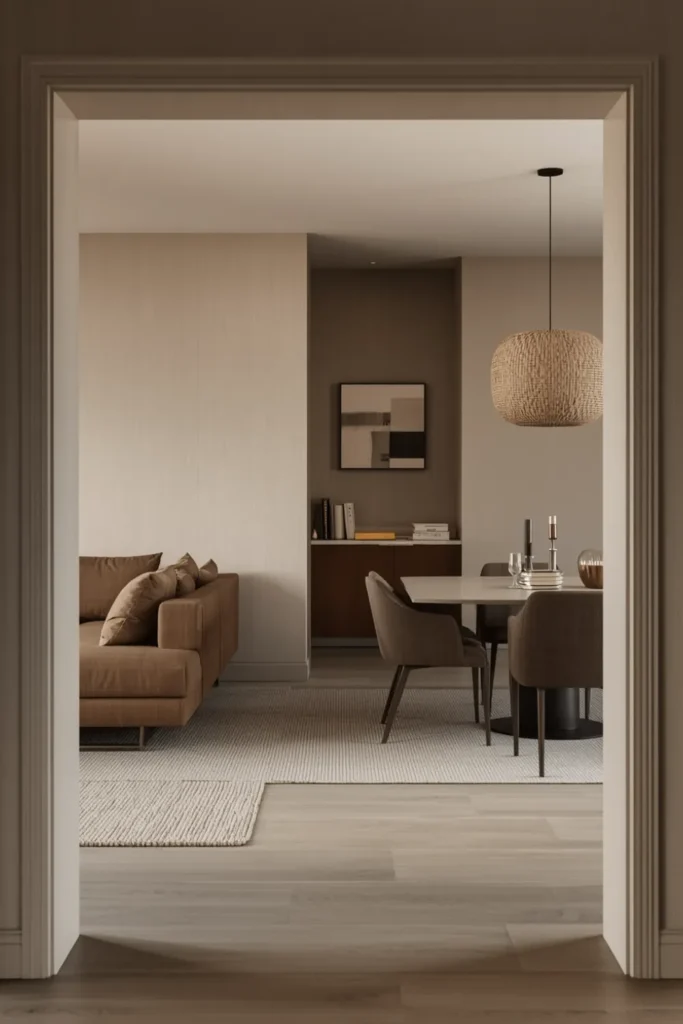
Texture is the variable that keeps a monochromatic scheme from feeling flat. Matte and gloss finishes, smooth and woven fabrics, rough and polished surfaces all read differently even in the same color, which adds depth and visual interest without introducing additional hues that could disrupt the cohesion of an open plan.
This scheme works in any size of open plan living and dining room, but it is especially effective in smaller combined spaces under 350 square feet where a multi-color approach would make the space feel fragmented. When in doubt about whether colors across two zones are working together, a monochromatic edit almost always improves the result.
7. The Kitchen Island as a Natural Transition Point Between Living and Dining Zones
In open plan homes where the kitchen connects directly to both the living and dining areas, a kitchen island positioned strategically becomes the natural architectural transition point between all three zones. It does not belong to any single room, which is exactly what makes it so effective as an organizational anchor in a combined open plan living and dining layout.
The island should be oriented so that its long axis runs parallel to the dining table. This parallel alignment creates a visual rhythm that guides movement through the space and prevents the kitchen from bleeding into the dining area in an uncontrolled way. An island set at a diagonal or perpendicular angle to the dining table disrupts the spatial logic of the open plan.
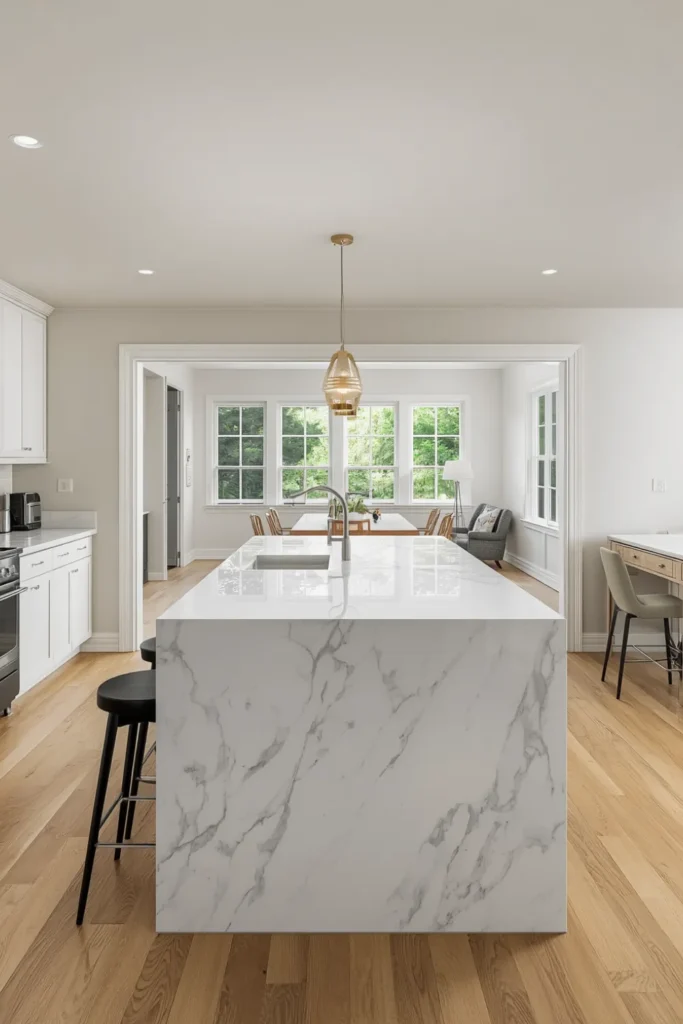
Counter stools on the kitchen side of the island serve an important function beyond seating. They signal that the island itself is a transitional zone, a casual eating and gathering surface that sits between the formality of the dining table and the relaxed quality of the living area. This gradation from formal to informal is one of the hallmarks of a well-planned open floor plan layout.
Keep the island surface height consistent with the dining table height if possible, both at 30 inches, or make the distinction intentional with a counter-height island at 36 inches and a standard dining table at 30. What does not work is a random height differential that happens without deliberate planning, which makes the combined space feel inconsistent.
8. The Ceiling Treatment That Defines Two Zones Without Touching the Floor Plan
Ceiling treatments are one of the most underutilized zoning tools in open plan design, and one of the most effective precisely because they work entirely above the living space without affecting floor area, furniture placement, or traffic flow. A coffered ceiling over the dining area, a wood beam treatment over the living zone, or even a simple change in ceiling paint color between the two areas creates definition that reads immediately upon entering the space.
A painted ceiling medallion or a rectangular ceiling border in a contrasting color above the dining table costs almost nothing and creates a surprisingly strong zone signal. The eye reads the overhead boundary and assigns it spatial meaning even without any vertical element to reinforce it.
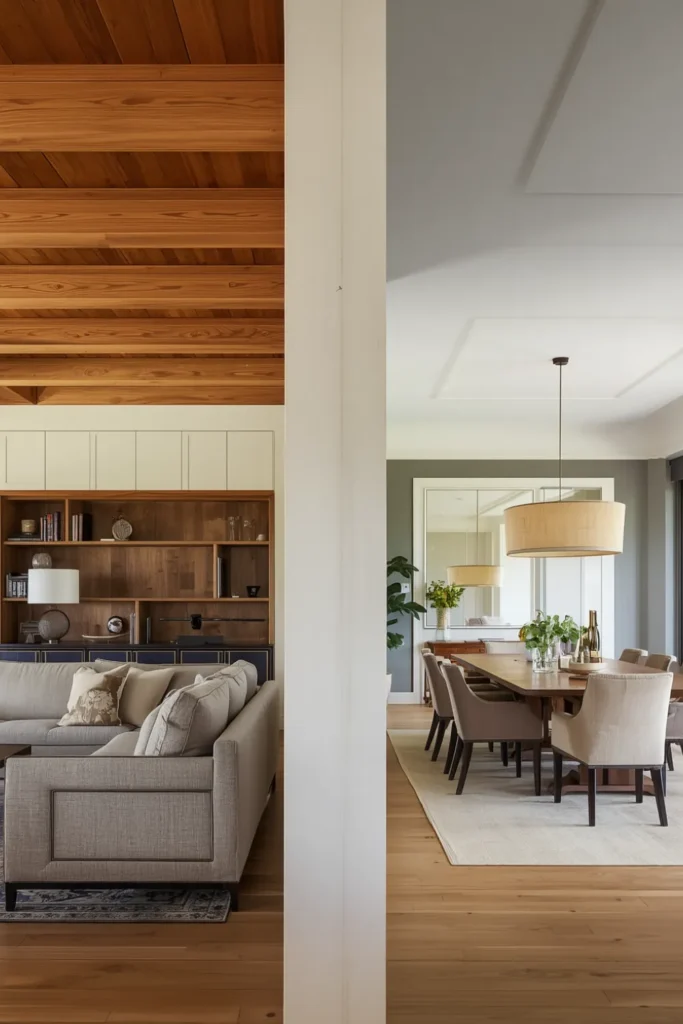
Exposed wood beams, either structural or decorative, installed in a linear pattern over the living area create warmth and definition simultaneously. They lower the perceived ceiling height in that zone, creating a cozier atmosphere that suits relaxed living room activity while leaving the dining zone open and bright above.
For open plans in homes with 9-foot or higher ceilings, a ceiling treatment is worth serious consideration as a primary zoning strategy. In rooms with 8-foot ceilings, overhead treatments can feel oppressive. In that case, stick to floor-based zoning methods and reserve ceiling interest for a single pendant light over the dining table.
9. The Dark Dining Room Within a Light Open Plan That Creates Deliberate Contrast
Creating deliberate contrast between the living and dining zones within a single open plan is a design strategy that experienced interior designers use to solve the most common open plan problem: the space looks like one big room rather than two connected ones. A dark accent wall or deeply colored wallpaper treatment applied exclusively to the dining zone creates immediate visual separation that no rug or lighting arrangement can match in strength.
The contrast approach works best when the living zone remains light and the dining zone goes dark. This follows the natural logic of the two activities: daytime relaxed living benefits from brightness and openness, while dining, especially evening dining, suits a more intimate, enclosed atmosphere. The contrast between the zones reinforces their different functions through color alone.
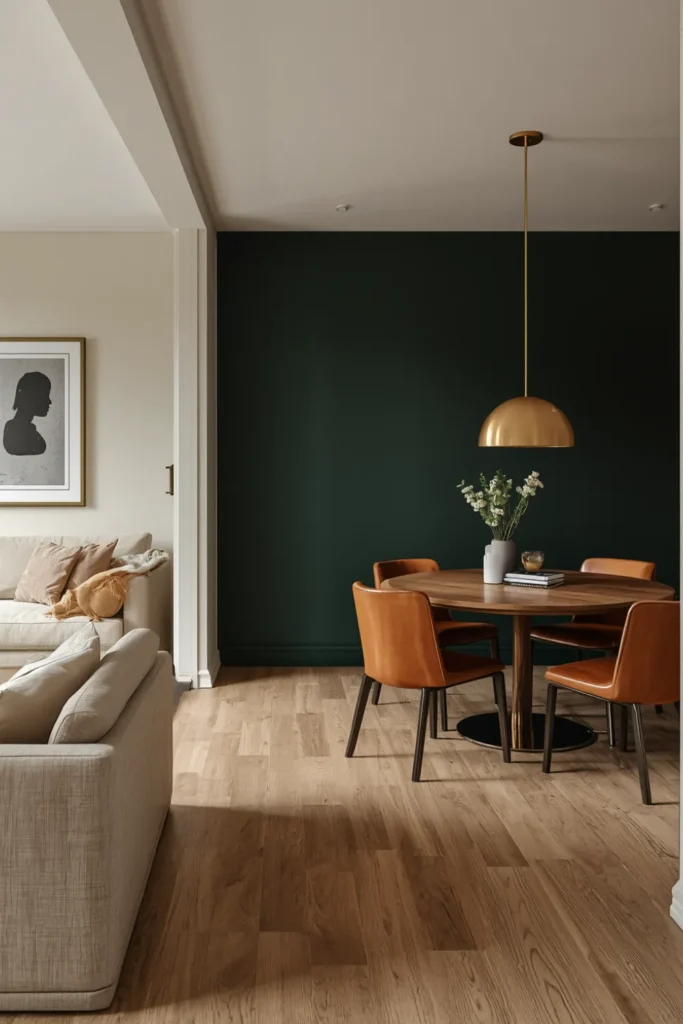
A single deeply saturated wall behind the dining table, in forest green, deep navy, charcoal, or warm terracotta, is enough to signal a separate room without requiring four dark walls. The other three walls of the dining zone can remain consistent with the living area palette. This restraint keeps the open plan from becoming visually fractured while still delivering strong zone definition.
The mistake to avoid is applying dark color randomly to the dining area without considering which specific wall it goes on. The accent wall should always be the wall that the dining table faces or sits against, functioning as a visual backdrop to the meal rather than a random surface treatment.
10. The Open Plan With a Dedicated Console Table at the Zone Transition Point
A console table placed at the boundary between the living and dining zones is one of the most practical transitional furniture pieces available for open plan design. At 12 to 16 inches deep, it takes up minimal floor space while providing a clear physical marker that separates two zones. It also adds a surface that most open plans desperately need: a landing spot between the two areas.
Positioned behind the sofa and facing the dining room, the console table serves as the back of the living zone and the entry point of the dining zone simultaneously. It holds items that belong to neither space specifically: a lamp, books, a tray for keys, a plant, a decorative object. These items give the transition zone its own identity rather than making it a no-man’s land between two furniture groupings.
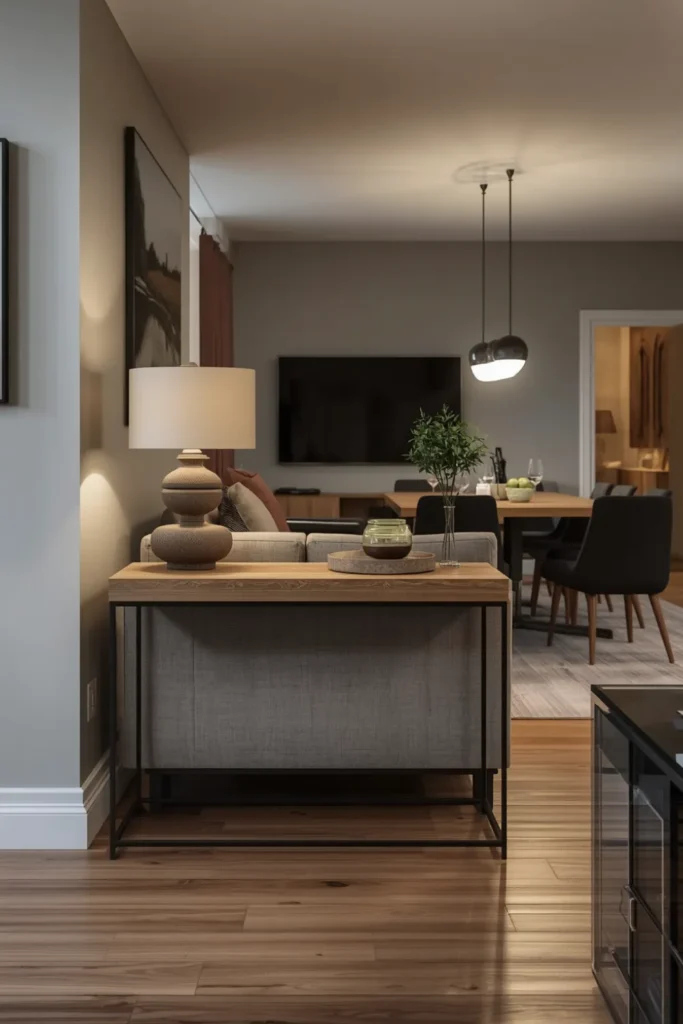
The console table height should align with or slightly exceed the sofa back height, typically 28 to 33 inches. A console that is significantly shorter than the sofa back disappears behind it. One that is taller creates a ledge effect that can work architecturally but requires careful styling to avoid looking like a barrier.
Choose a console table material that bridges the two zones. If the living area features upholstered furniture in soft tones and the dining area features a wood table and metal chairs, a console in natural wood with a metal base serves as a material bridge that makes the transition feel intentional.
11. The Small Open Plan Layout Under 400 Square Feet That Avoids Overcrowding
A small open layout living room dining room under 400 combined square feet presents a specific set of challenges that larger open plans do not. Scale errors that are subtle in a large space become immediately obvious in a small one. The most common mistake is buying full-size furniture and fitting it into a small open plan, which results in a space that functions like an obstacle course.
The furniture scale rule for small open plans is simple: every piece should be proportionate to the zone it occupies, not to the room as a whole. A dining table for four in a combined open plan under 400 square feet should be no longer than 48 inches. A sofa should be no longer than 84 inches. Exceeding these dimensions in a small open plan creates clearance problems that affect daily use immediately.
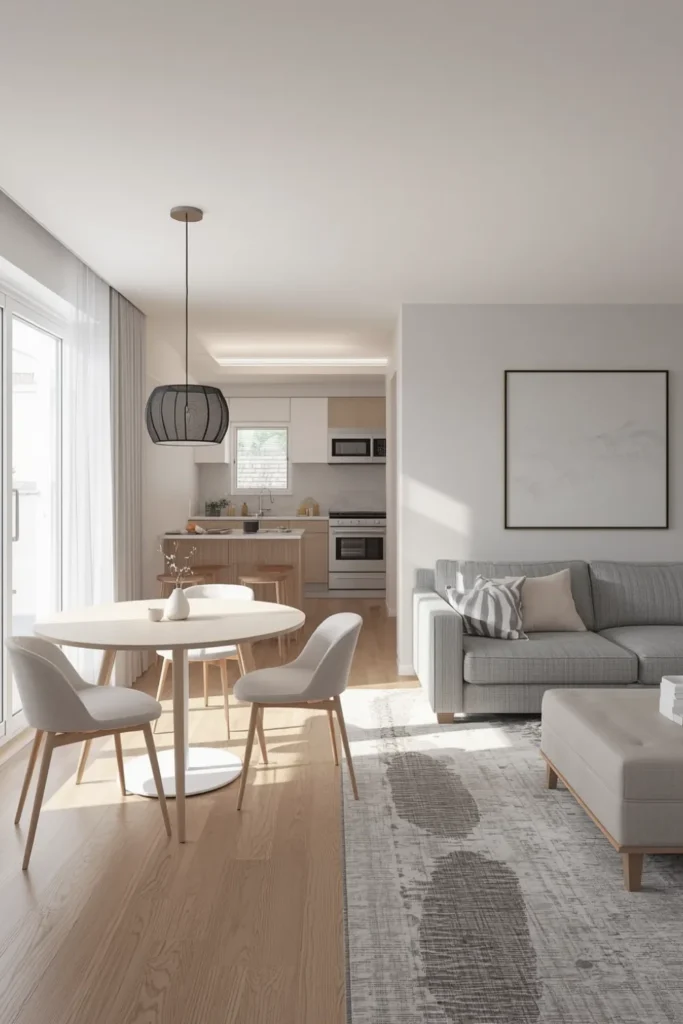
Round and oval dining tables outperform rectangular ones in small open plan dining zones. They seat the same number of people with a smaller footprint, have no sharp corners that create clearance problems in tight spaces, and visually soften the compact environment. A 48-inch round table seats four comfortably and takes up 25 percent less floor space than a 36 by 60-inch rectangle with the same seating count.
Multi-function furniture is essential in small open plans. A dining table with storage underneath, ottomans with internal storage used as a coffee table in the living zone, and a console that doubles as a bar or workspace all increase the functional density of the space without adding floor area.
12. The Statement Wall Behind the Dining Table That Anchors the Zone Architecturally
A statement wall treatment applied specifically to the dining zone wall is one of the most effective methods for giving the dining area in an open plan its own architectural identity. Wallpaper, a plaster texture, vertical shiplap paneling, or a large-format tile applied to the dining backdrop wall signals permanence and intentionality that paint alone cannot achieve.
The statement wall works because it gives the eye a clear destination within the open plan. Upon entering the space, the visual weight of the dining wall treatment draws attention to the dining zone specifically, which tells the room how to be read: not as one large undifferentiated space, but as two rooms with two distinct centers of gravity.
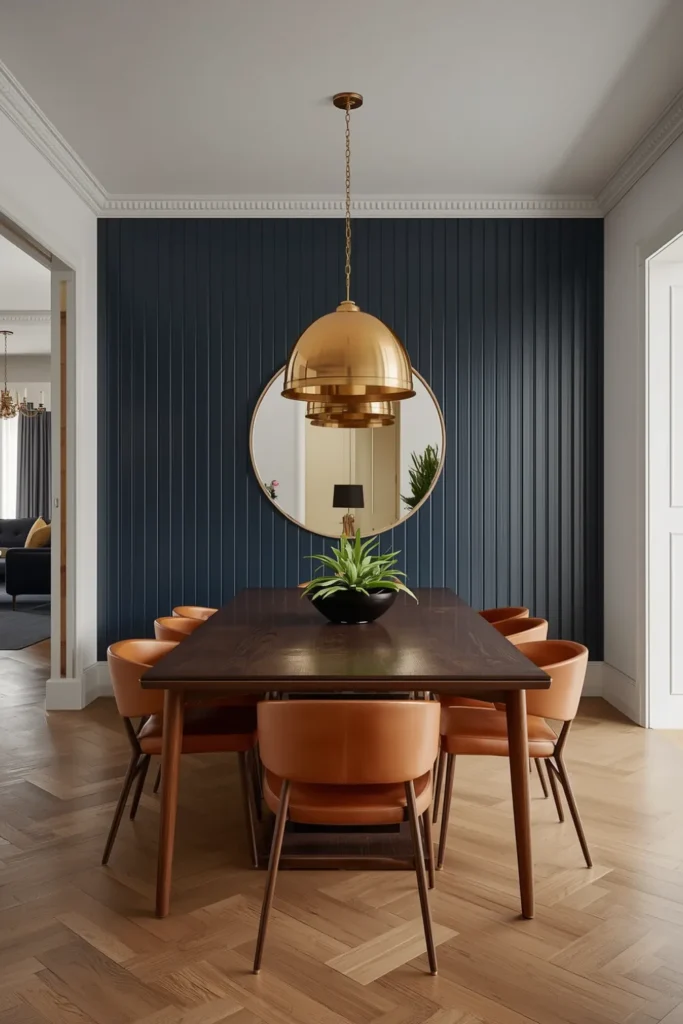
Wallpaper in a bold pattern is the most dramatic version of this approach and works best in dining zones where the table seats six or more, the ceiling is at least 9 feet, and the rest of the open plan is kept neutral. A bold wallpaper in a small dining zone within a small open plan can feel overwhelming and visually compress the space.
For a more restrained but still effective approach, vertical shiplap or thin wood paneling painted in a contrasting tone to the adjacent walls delivers strong zone definition without the pattern commitment of wallpaper. This is the better choice for homeowners who change their interiors frequently or are uncertain about committing to a bold statement wall.
13. The Curtain Room Divider That Gives Open Plans a Soft and Adjustable Boundary
A floor-to-ceiling curtain panel used as a room divider is one of the most flexible solutions for an open layout living room dining room that needs an adjustable boundary. When the curtain is open, the space operates as a single room. When drawn, it creates two fully separate areas, which is useful for households that occasionally need visual privacy between the zones without a permanent structural solution.
The curtain divider works best on a ceiling-mounted track rather than a rod, because the track allows the curtain to stack flat against one wall when open, taking up minimal space and leaving no visual trace of the division. A ceiling rod with visible hardware remains present even when the curtain is fully open, which reduces the effectiveness of the open-plan mode.
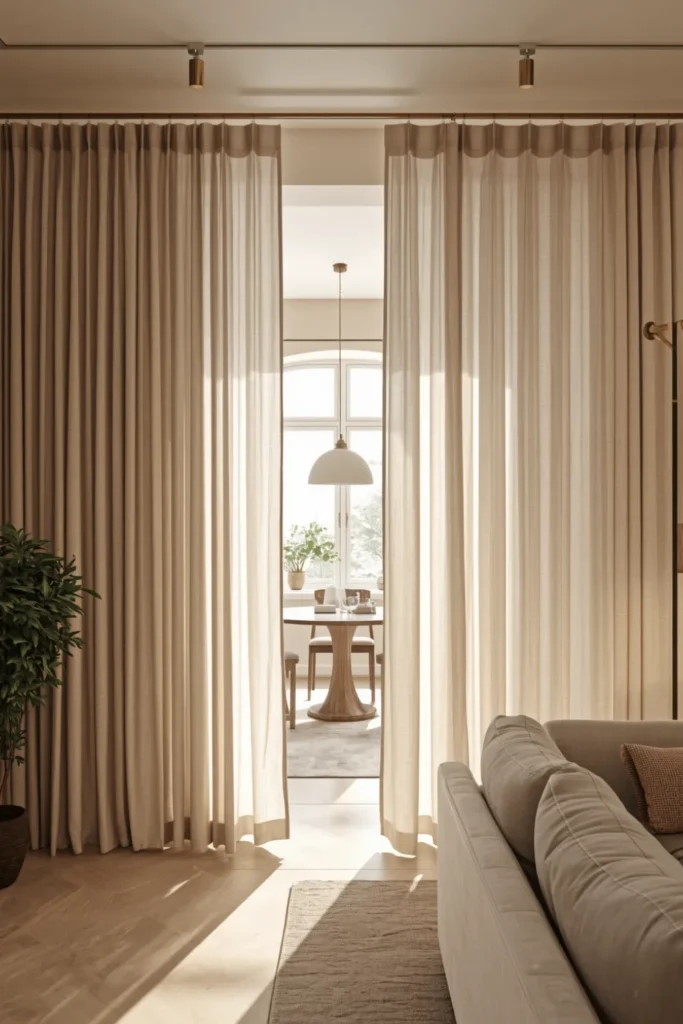
Fabric selection is critical. A semi-sheer linen allows light to pass between zones even when the curtain is closed, maintaining the open-plan quality of light while providing visual separation. A fully opaque blackout fabric creates complete visual separation but also completely blocks light, which can make one zone feel dark and enclosed.
This solution is particularly well suited to open plans where one zone occasionally serves a different purpose: a dining room that doubles as a home workspace, a living room that serves as a guest bedroom using a daybed. The curtain divider makes both modes work without requiring permanent changes to the space.
14. The Luxury Open Plan With Mixed Metals and Natural Stone That Feels Cohesive
A luxury open plan living and dining room using mixed metals and natural stone requires a clear material hierarchy to avoid looking expensive but incoherent. The most common failure in high-budget open plan design is selecting beautiful individual elements that do not form a cohesive language across the combined space. Cohesion in a luxury open plan comes from repeating each material at least twice across both zones.
The material repetition rule works as follows: if brushed brass appears in the dining pendant, it should reappear in the living zone as a side table base, a picture frame, or a floor lamp detail. If Calacatta marble appears on the dining table top, it should reappear in the kitchen countertop or a living zone tray. The repetition creates a thread that connects the two zones visually.
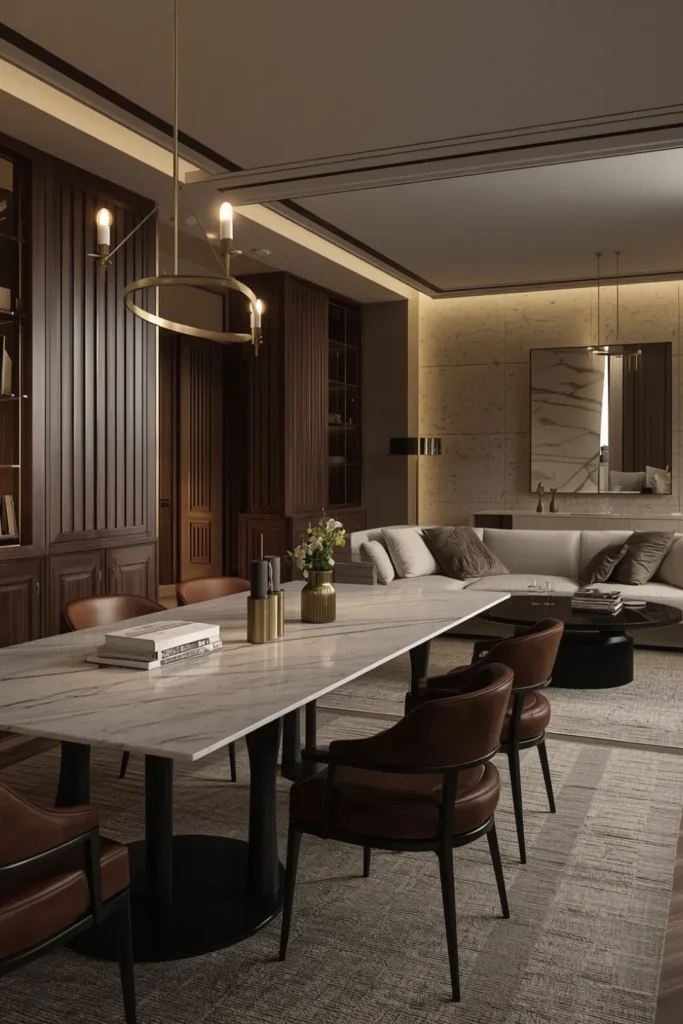
Natural stone in an open plan works best when it appears in a consistent vein direction and color family across all stone applications. Mixing multiple stone types, marble tabletop, travertine flooring, and slate fireplace surround, creates a material collision that reads as indecisive rather than layered. Choose one stone and apply it in multiple locations within the space.
Metal mixing is acceptable and actually adds sophistication when it follows a ratio. One dominant metal, which appears in the largest fixtures and hardware, and one secondary metal used as an accent in smaller elements. Brushed brass dominant with matte black secondary is one of the most resolved combinations for a modern luxury open plan.
15. The Apartment Open Plan That Uses Furniture Placement Alone to Zone Two Rooms
In a rental apartment or any space where structural changes are not an option, furniture placement becomes the only zoning tool available. A well-executed furniture-only zoning strategy in an open plan living and dining room can achieve results that are nearly indistinguishable from architecturally defined rooms, as long as the placement follows a logical spatial logic rather than defaulting to perimeter arrangement.
The perimeter arrangement mistake is extremely common in apartment open plans. Pushing all furniture against the walls leaves a large empty center and makes both zones feel like they are waiting for something to happen in them. Floating furniture away from the walls, with the sofa anchored by a rug and pulled 18 inches from the wall, immediately creates room-like zones within the open plan.
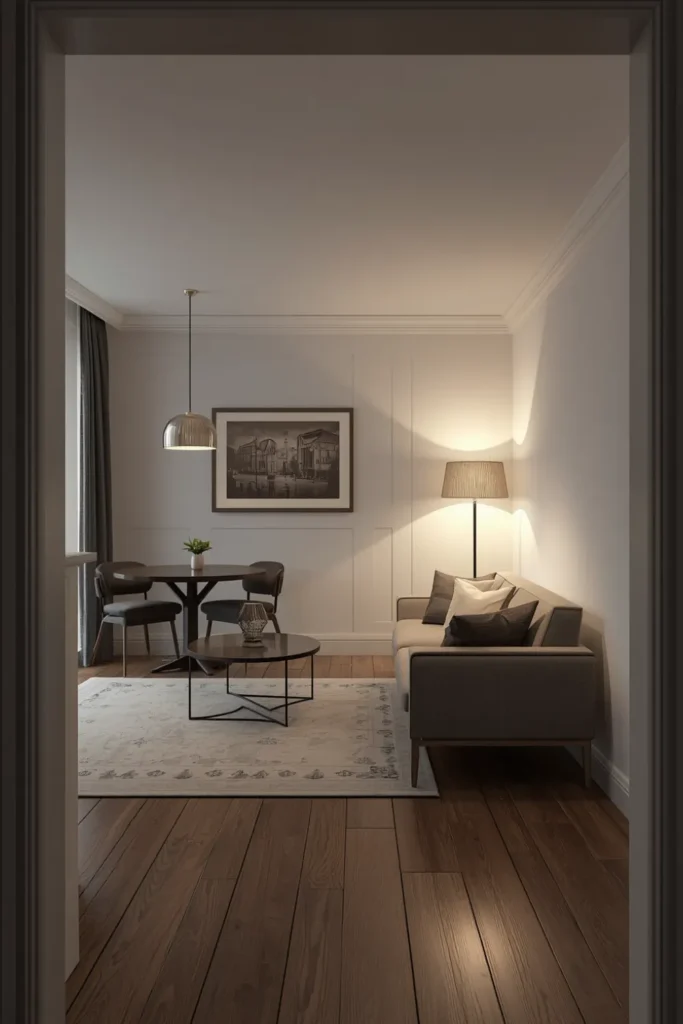
The gap between the living and dining zones should be no more than 24 to 36 inches. More than that and the space between zones starts to read as dead space rather than a natural transition. This gap is where a console table, a floor plant, or a low bookshelf fits to mark the transition without blocking it.
Both zones need their own light source independent of the ceiling fixture. A floor lamp in the living area and a pendant over the dining table give each zone a specific lighting anchor that reinforces the zone identity created by the furniture layout. Without zone-specific lighting, furniture-only zoning loses effectiveness after dark.
16. The Open Plan With a Fireplace That Anchors the Living Zone and Solves the TV Dilemma
A fireplace in an open plan living room is one of the strongest natural anchors available for the living zone. It provides an immediate focal point that draws furniture toward it, defines the boundary of the living area, and solves the most persistent question in open plan living room design: where does the television go.
The television should share the fireplace wall or be mounted directly above the fireplace only when the viewing height from the seated sofa position is comfortable. The comfortable viewing height places the center of the screen at or near eye level when seated, which is typically 42 to 48 inches from the floor. Mounting a television significantly above a fireplace mantel often places the screen too high for comfortable extended viewing.
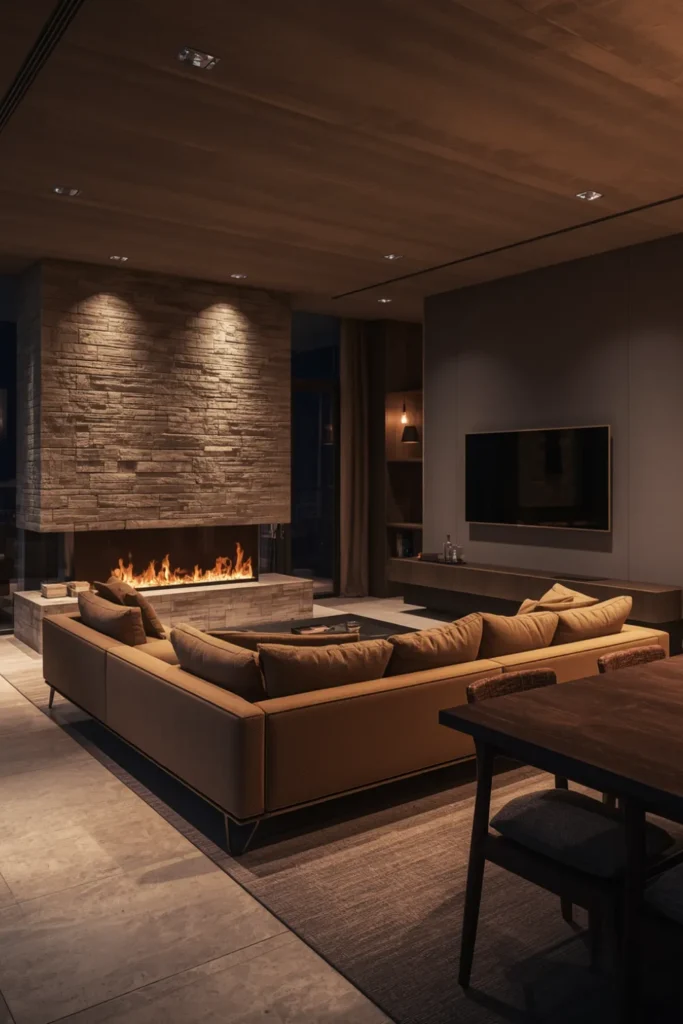
In open plans where the fireplace is on a shared wall with the dining zone, the living room furniture should be arranged in a U-shape facing the fireplace, with the open end of the U facing away from the dining area. This orientation pulls the living zone together around the fireplace and directs its attention inward, away from the dining zone, which reinforces the separation between the two areas.
The fireplace surround material should be chosen with the full open plan in mind. A dramatic stone or marble surround that works beautifully in isolation can visually overpower the rest of the combined space. The surround material should be one that can be echoed or complemented somewhere in the dining zone to maintain material cohesion across the open plan.
17. The Open Plan Designed for Entertaining That Flows Seamlessly Between Three Zones
An open plan designed specifically for entertaining requires a different layout logic than one optimized for daily living. Entertaining open plans need unobstructed traffic flow between all three areas, kitchen, living, and dining, seating capacity that can scale up without rearranging furniture permanently, and lighting that can transition from casual daytime use to formal evening entertaining with a simple dimmer adjustment.
The traffic flow requirement means that no furniture placement should require guests to walk around or between pieces to move from one zone to another. The path from kitchen to dining table and from dining table to living room seating should each be at least 36 inches wide and straight. Furniture that creates a maze-like path between zones is the most common reason entertaining open plans feel chaotic rather than hospitable.
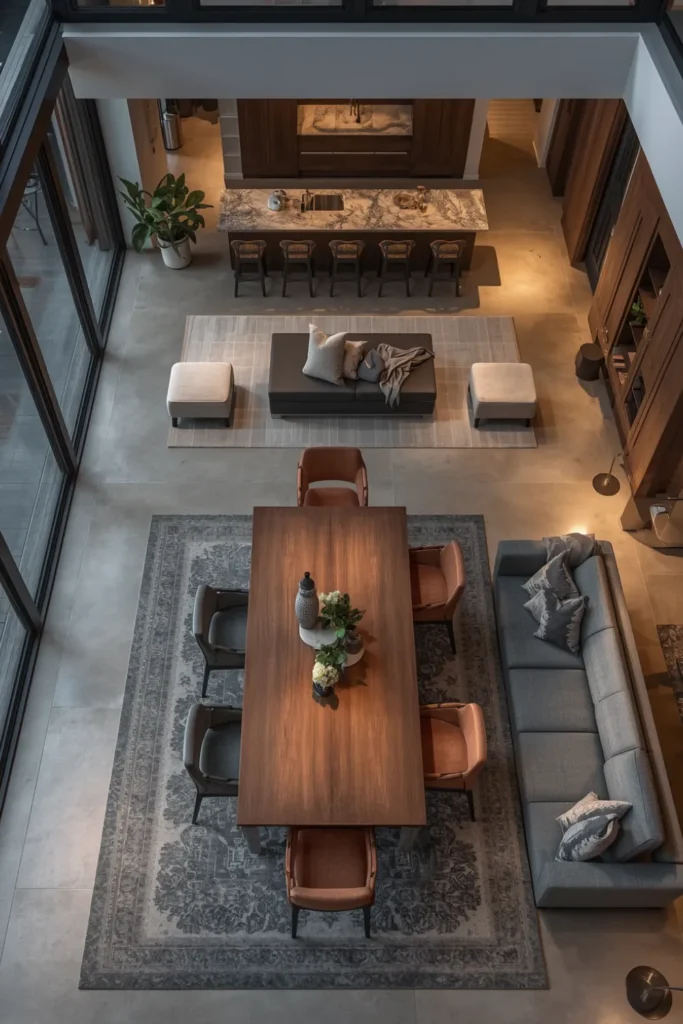
Flexible seating extends the living zone’s capacity during large gatherings. A sectional with a chaise allows additional guests to perch on the chaise end during a party. A pair of upholstered ottomans that stack under the coffee table during daily use can be pulled out as additional seating. Planning for these flex seating moments at the design stage prevents the last-minute scramble for chairs.
The dining table size in an entertaining open plan should be selected for the maximum anticipated guest count, not the daily household size. An extendable table that opens from 60 to 90 inches covers both daily family meals and dinner party capacity without requiring two tables or a permanent oversized footprint in the dining zone.
18. The Japandi Open Plan That Balances Minimalism With Warmth Across Both Zones
Japandi, the design fusion of Japanese minimalism and Scandinavian warmth, is one of the most resolved aesthetics for an open layout living room dining room because its principles are inherently spatial rather than decorative. Japandi does not rely on accessories to create its effect. It relies on proportions, material quality, and restrained arrangement, which are exactly the tools that open plan spaces require to function well.
The material palette for a Japandi open plan is limited to natural wood in medium to dark tones, white or warm off-white on walls and large upholstered surfaces, matte black as an accent in hardware and fixture finishes, and natural textiles in cream, oatmeal, and warm grey. Every material is present in both zones, which creates cohesion without any deliberate color coordination effort.
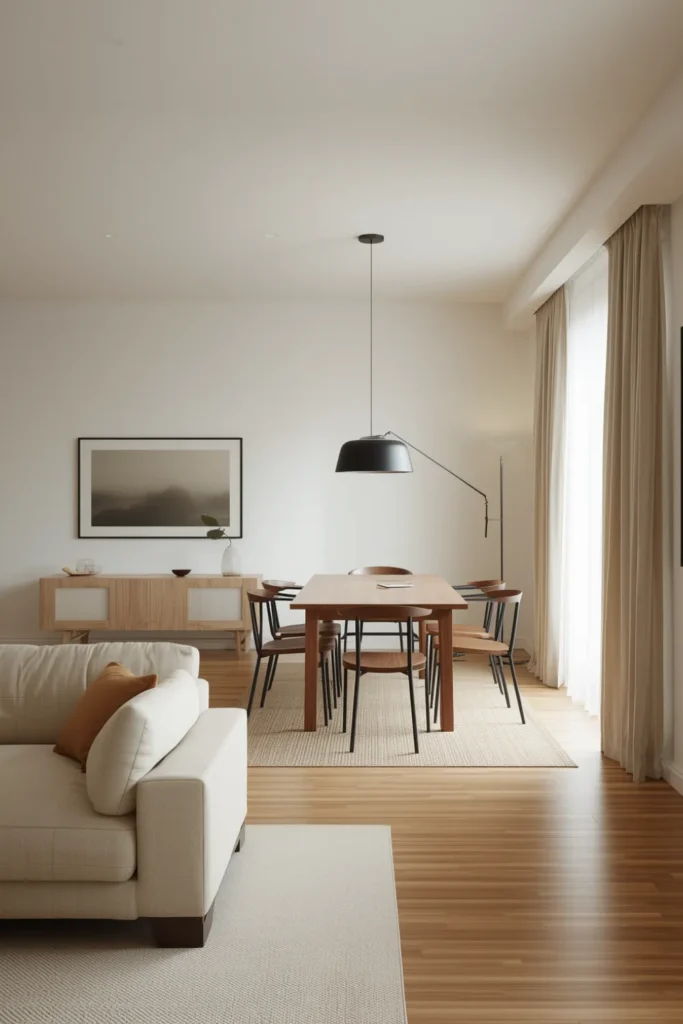
Furniture selection follows the low-profile principle. Sofas sit closer to the floor than standard American furniture proportions. Dining chairs have clean, unornamented frames in natural wood or blackened steel. Coffee tables sit low and are uncluttered. The visual effect of low-profile furniture across an open plan is a sense of calm spaciousness that higher furniture arrangements cannot achieve regardless of the room’s actual square footage.
Negative space is intentional in a Japandi open plan. Blank wall sections, empty floor areas, and uncrowded surfaces are not design failures. They are part of the design. The most common mistake when attempting a Japandi open plan is filling the negative space out of habit or uncertainty, which immediately collapses the aesthetic into something that looks like a conventional interior with natural wood furniture.
Final Thoughts
An open layout living room dining room works when every design decision, from furniture placement and rug sizing to lighting and material selection, serves the dual purpose of connecting the two areas as one space while distinguishing them as two. The ideas in this guide are built around those real decisions, not just visual inspiration.
Save this post now so you can return to it when you are planning, refreshing, or troubleshooting your open plan space. The sizing rules, zoning strategies, and common mistakes covered here apply across every budget and every home type, from a compact apartment to a full open-plan new build.
When you are ready to go further, explore open floor plan furniture arrangement guides, living room layout ideas for large spaces, and modern dining room design strategies to refine every zone of your home.