
Vinyl record wall art ideas are everywhere online, but most guides skip the part that matters: which layouts actually hold up in real rooms, and which ones look cluttered after a week. This post breaks down 12 specific approaches, each with a clear reason it works, when to use it, and what to avoid. Whether you have 10 records or 100, you will find a layout here worth saving.
1. The Floating Grid: Clean Rows That Anchor a Blank Wall
A symmetrical grid arrangement is one of the most reliable vinyl record wall art ideas for large, unbroken walls. It creates immediate visual structure without overwhelming the space. The repeating circular shapes produce a rhythm that feels intentional and modern rather than collected or chaotic.
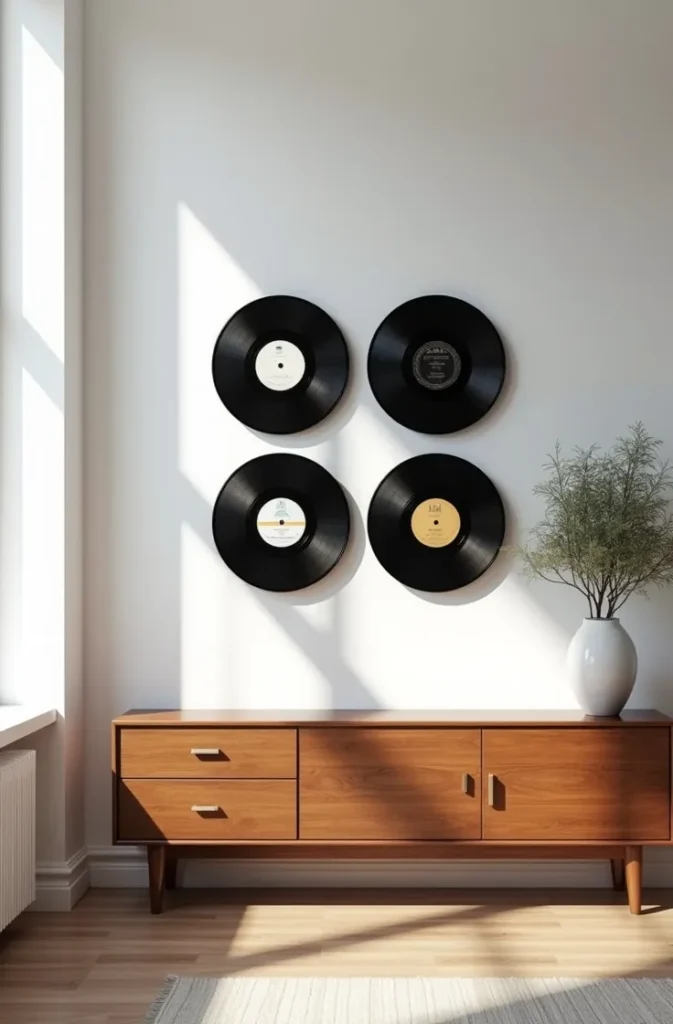
Use a floating grid when your wall is at least 6 feet wide and you have 9 or more records. A 3×3 or 4×4 arrangement works best. Keep the spacing between records consistent, ideally 3 to 4 inches on all sides, and hang them at the same height as you would a single large canvas. This placement makes the collection read as one cohesive piece of art.
The most common mistake is uneven spacing. Even a half-inch difference between gaps becomes obvious once the records are up. Use a level and a measuring tape before committing to any nail holes. Paper templates taped to the wall first can save significant time and wall damage.
2. The Diagonal Scatter: A Relaxed Layout for Creative Spaces
A diagonal scatter arrangement uses records at varied angles rather than hanging them flat and level. Tilting individual records 15 to 45 degrees creates energy without requiring symmetry. This works especially well in music rooms, studios, home offices, or basement listening areas where a looser, more expressive feel fits the purpose of the room.
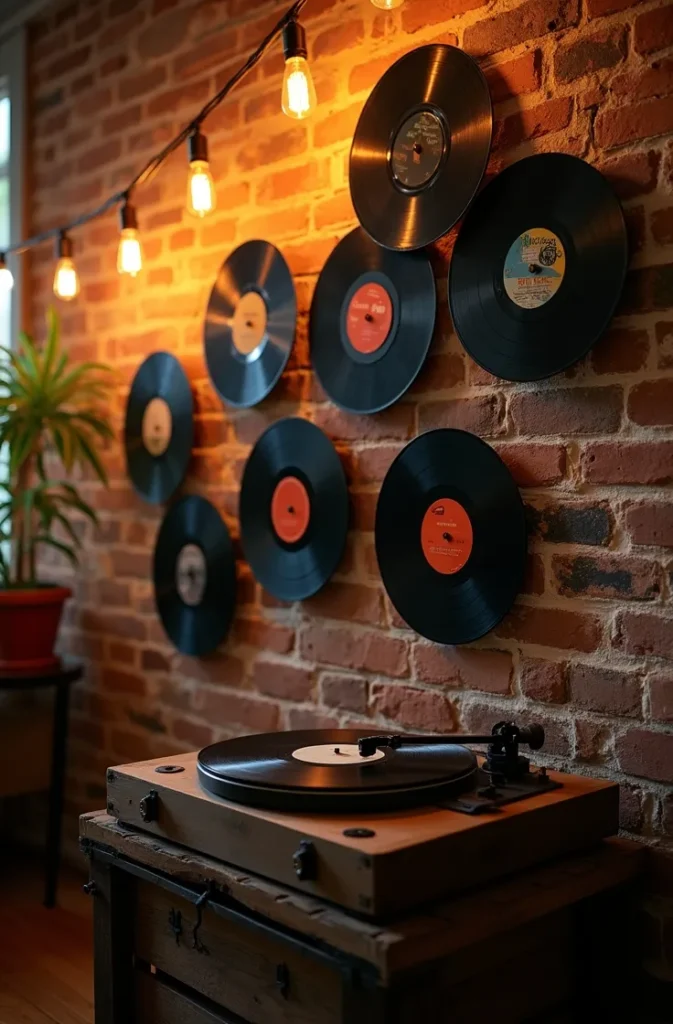
This layout suits walls with irregular features, such as exposed pipes, a window interruption, or a sloped ceiling. The angled placement draws the eye across the wall rather than up and down, which can make low-ceiling rooms feel more expansive. It also allows you to fill corners and irregular shapes that a grid would leave awkward.
Avoid using this layout in formal living rooms or dining spaces where it can feel unfinished. The scatter works when the room already has some intentional edge to it. Pair it with raw wood shelving, industrial lighting, or concrete walls for a cohesive result.
3. The Shelf-and-Lean Display: No Holes, Full Flexibility
Floating shelves with records leaning face-out is one of the most functional vinyl record wall art ideas for renters or anyone who updates their space frequently. You are not committing to nail placement, and the display can be reorganized in minutes. The vertical record sleeves become the visual element, adding color, typography, and graphic variety.
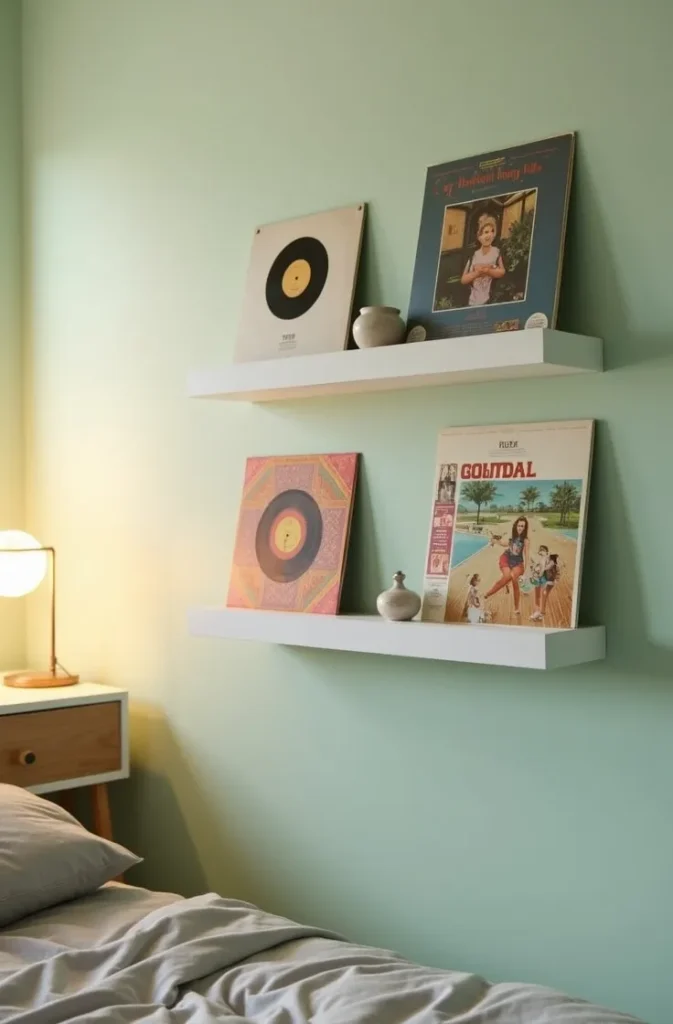
This approach suits narrow entryways, hallways, and bedroom walls where a mounted arrangement would feel too heavy. Use two or three staggered shelves at different heights for visual interest. Face out the records whose covers are most graphic or colorful, and let others remain spine-out for a bookshelf effect.
Overcrowding is the main risk. Leave two to three inches of empty shelf on each end so the display breathes. Shelves packed edge to edge start to look like storage rather than art. Vary the visual weight by mixing a few taller objects, such as a small plant or a framed photo, with the records on the same shelf.
4. The Frame-Within-a-Frame: Turning Records Into Wall Portraits
Individual records mounted inside shadow box frames or deep picture frames elevate the format from display to fine art. The frame creates a clear boundary that signals intention, the same visual logic that makes any object in a gallery feel important. This is one of the strongest vinyl record wall art ideas for formal rooms or spaces where you want a refined look.
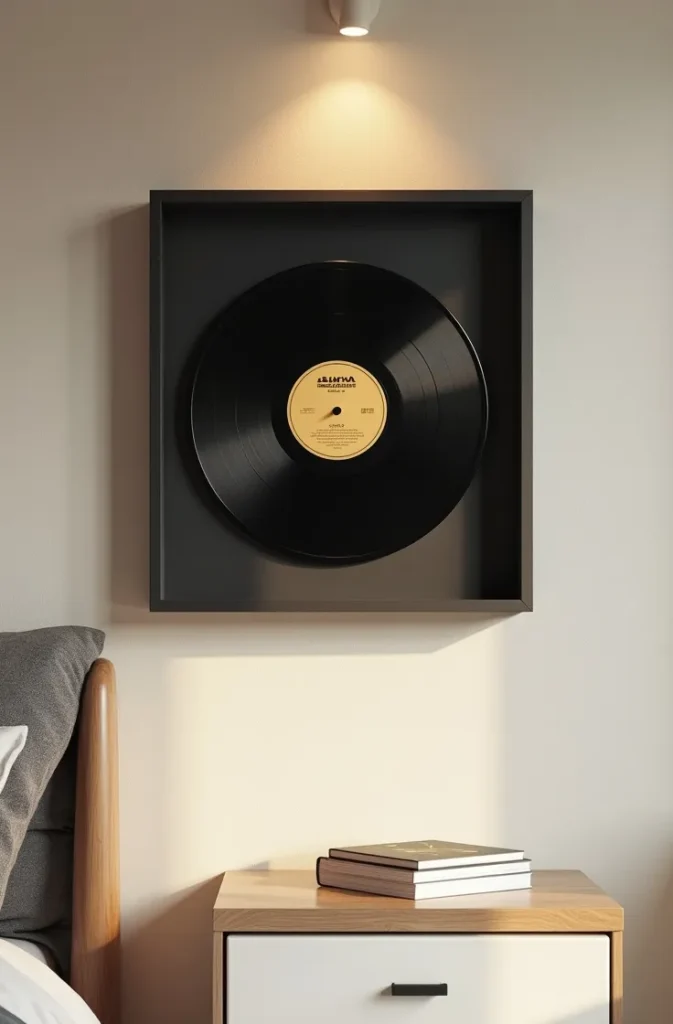
Choose frames with at least 2 inches of depth so the record sits inside without touching the glass. Black, white, or natural wood frames work with nearly any interior palette. Hang one large framed record as a solo statement above a console table or bed, or group three to five in a staggered gallery arrangement.
Avoid cheap frames that bow or flex at the corners. A warped frame will make even the most beautiful record look like an afterthought. If you are investing in the display, the frame quality matters as much as the record itself.
5. The Color-Blocked Cluster: Grouping by Palette for Visual Impact
Grouping vinyl records by the dominant color of their label or sleeve creates a wall arrangement that functions as abstract color art. This is a particularly smart layout for open-plan homes or loft apartments where a wall needs to do significant visual work from across a large room.
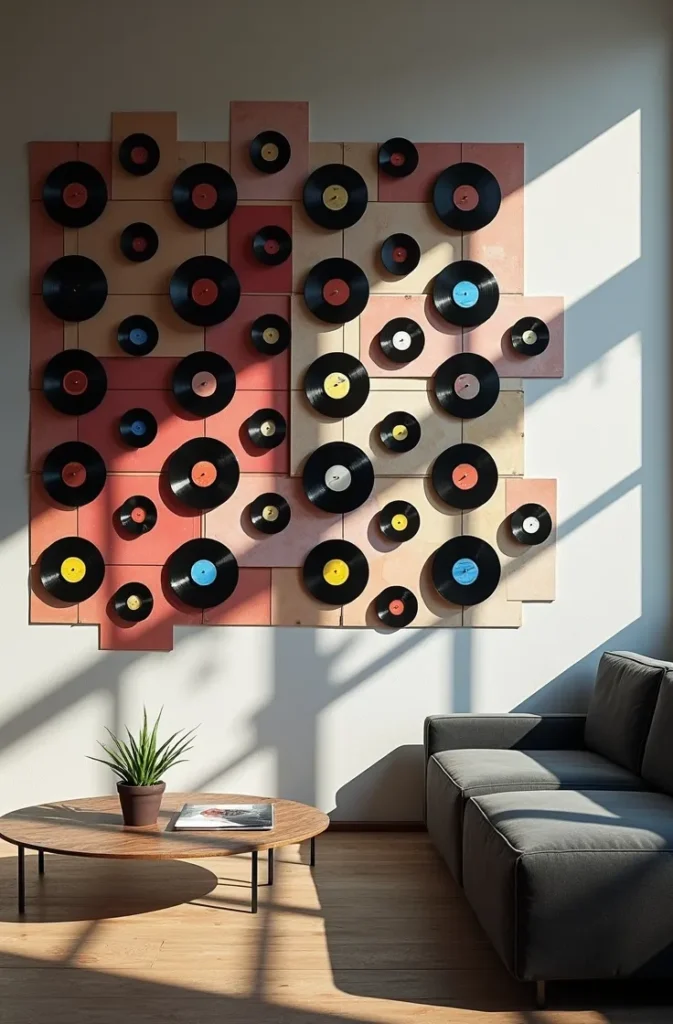
Sort your records before hanging. Pull out those with red labels together, blue labels together, and so on. Arrange each color cluster in a loose organic shape rather than a rigid line. When viewed from a distance, the clusters read as blocks of color that hold together like a painted composition.
This layout requires enough records in coordinating colors to make the groupings obvious. If you only have two red-label records surrounded by black-label ones, the effect is lost. A minimum of four to five records per color cluster tends to be the threshold where the visual intention becomes clear.
6. The Staircase Run: Using Vertical Rise to Create a Gallery Moment
A staircase wall is one of the most underused spaces in American homes, and vinyl records are well-suited to it. Mounted along the diagonal rise of a stair wall, records create a dynamic line that follows the architecture rather than fighting it. This is one of the most photographed vinyl record wall art ideas because the ascending line creates natural visual movement.
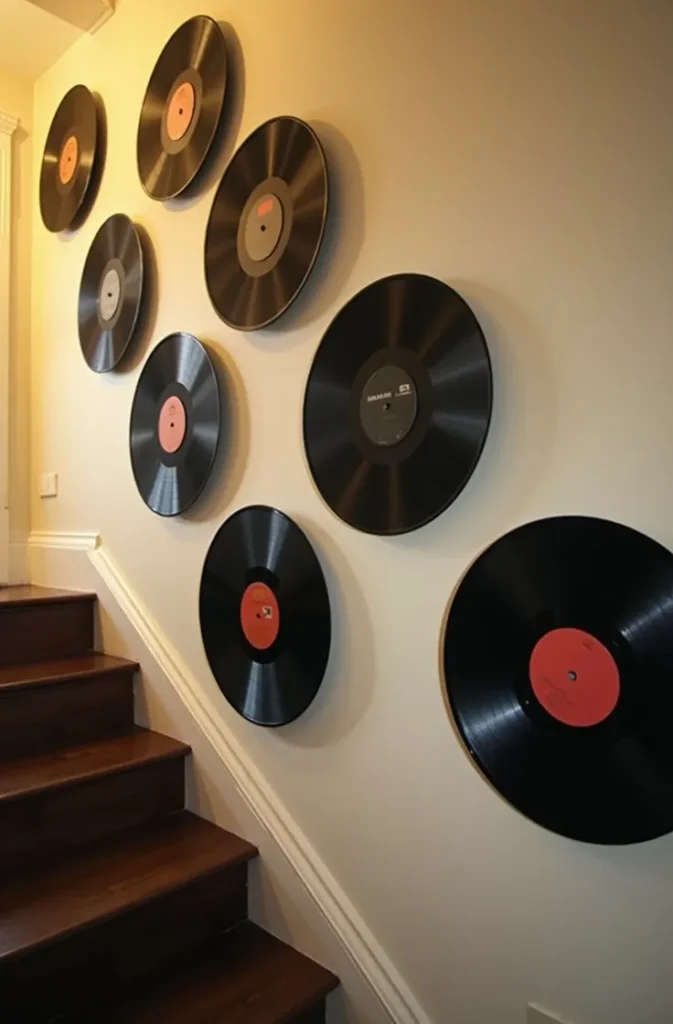
Hang each record slightly higher than the previous one, following the stair angle. Keep them at consistent spacing, roughly 8 to 12 inches apart center to center, for a clean ascending line. The records do not need to be the same size, but they should share a common element, such as all being the same color label or all being displayed without sleeves.
Avoid hanging records too close to the wall edge near the stair handrail, where they could be bumped by people walking past. Leave at least 12 inches of clearance between the outermost record and the rail.
7. The Monochrome Wall: All-Black Records on a Dark or Bold Background
Mounting records on a dark or deeply saturated wall creates a tonal composition that feels curated and high-end. The contrast between the matte black record surface and a charcoal, navy, or forest green wall produces depth without requiring color. This is one of the most effective small-space vinyl record wall art ideas because it makes a compact wall feel intentional rather than small.
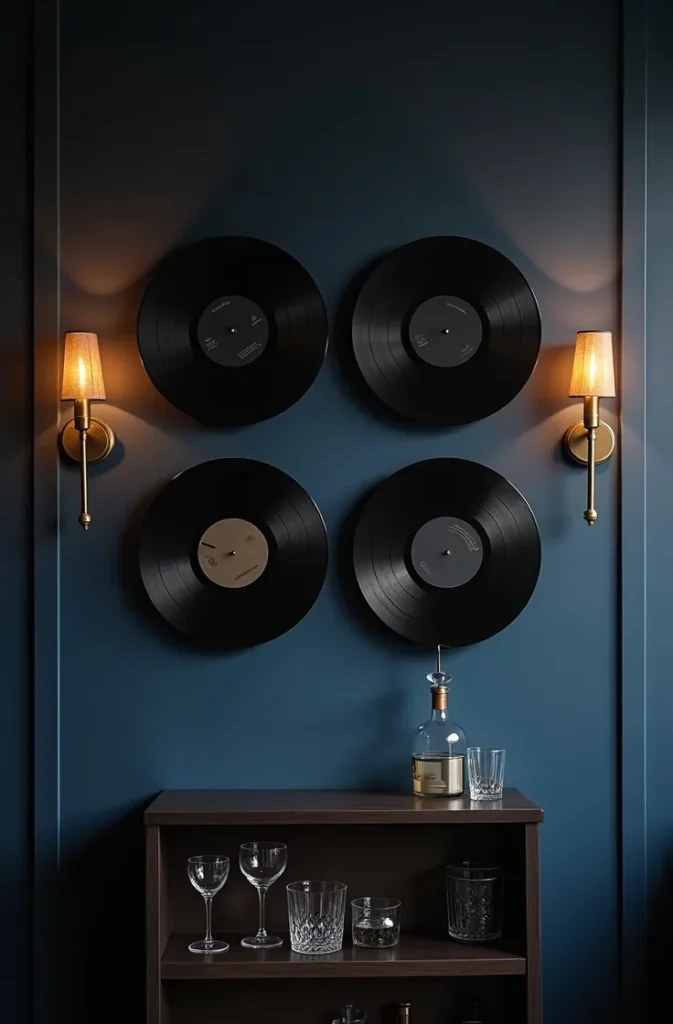
Choose a paint color that is two to three shades darker than your main room tone. Records mounted on this background will appear to float rather than sit flat. Use brass or gold-toned mounting hardware to add warmth and break the all-dark composition.
This layout works best in smaller, enclosed spaces: a reading nook, a home bar, a powder room, or a bedroom accent wall. It can feel heavy in a large, open room unless balanced with significant natural light on the opposing walls.
8. The Mixed-Media Wall: Combining Records With Framed Art and Objects
Vinyl records do not have to be the only element on the wall. Mixing records into a broader gallery wall alongside framed photographs, artwork, or mounted objects creates one of the most personalized and livable displays. This approach works well in homes that already lean toward collected, layered interiors.
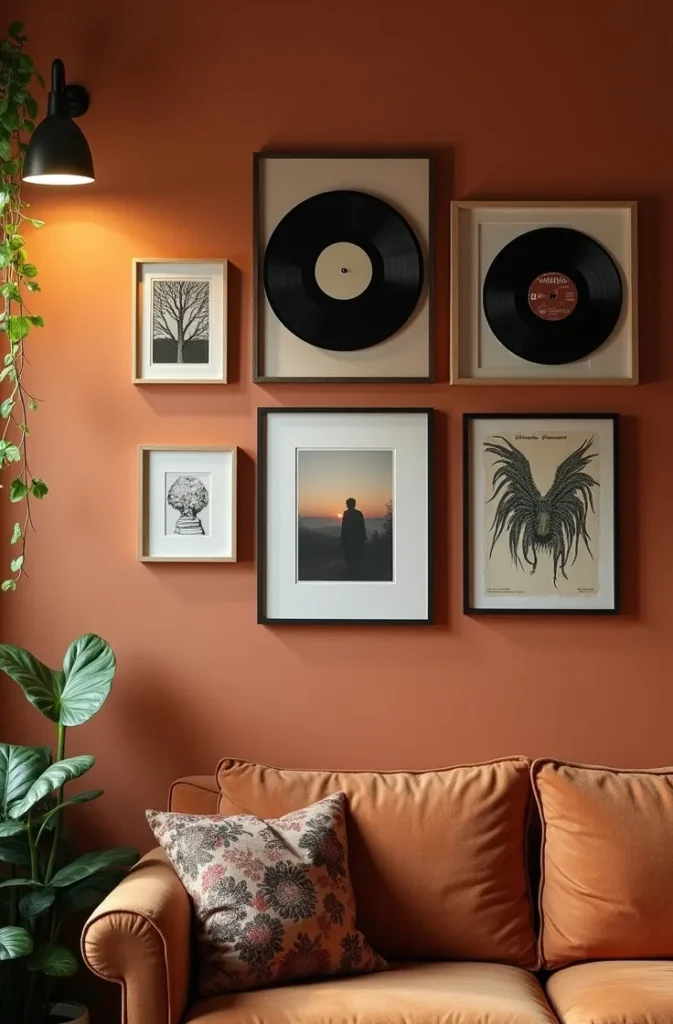
Treat the records as circles in a composition that also includes rectangles, squares, and irregular shapes. The circular records provide visual relief from the uniformity of standard frames. Use the records to fill corners, break up long horizontal lines, or add mass to areas that feel light.
Plan this layout on the floor first before hanging anything. Lay out all the elements and photograph the arrangement from standing height. If it reads well in the photo, it will read well on the wall. Avoid clustering all the records together, which defeats the purpose of integrating them into a mixed display.
9. The Ceiling-to-Floor Column: A Vertical Statement in Narrow Spaces
A single vertical column of records stacked from near the ceiling to near the floor is one of the most striking vinyl record wall art ideas for narrow spaces. It draws the eye upward, making low ceilings feel taller. It also solves the common problem of a skinny wall section between a doorframe and a corner that is too narrow for conventional art.
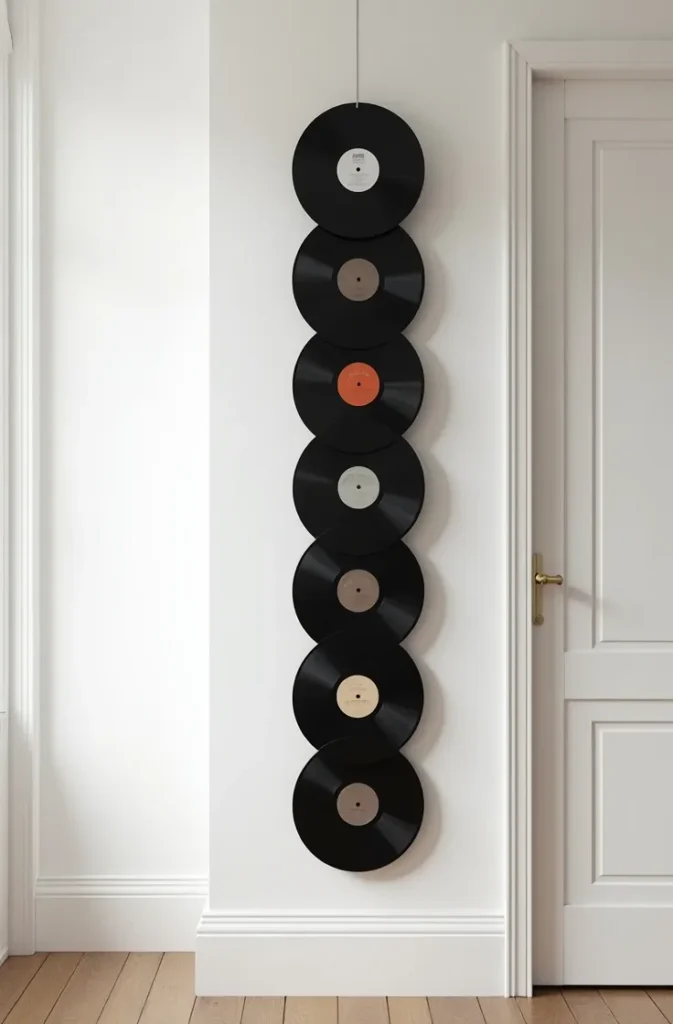
Stack 8 to 12 records in a straight vertical line with consistent 4-inch gaps. Keep all records at the same horizontal center point. The result is a clean vertical stripe of circular shapes that functions like a decorative column. This display type photographs especially well and is highly shareable on social media for that reason.
This arrangement requires precise leveling. A single record hung even slightly off-center will make the entire column look crooked. Use a plumb line or a long level held vertically to mark the center points before hanging.
10. The Bedroom Headboard Replacement: Records as a Functional Focal Point
Mounting a wide arrangement of vinyl records on the wall directly behind a bed, in place of a traditional headboard, is one of the most dramatic vinyl record wall art ideas for master bedrooms. It works in rooms where a physical headboard feels too heavy or where the bed sits in a small space that cannot accommodate a freestanding headboard.
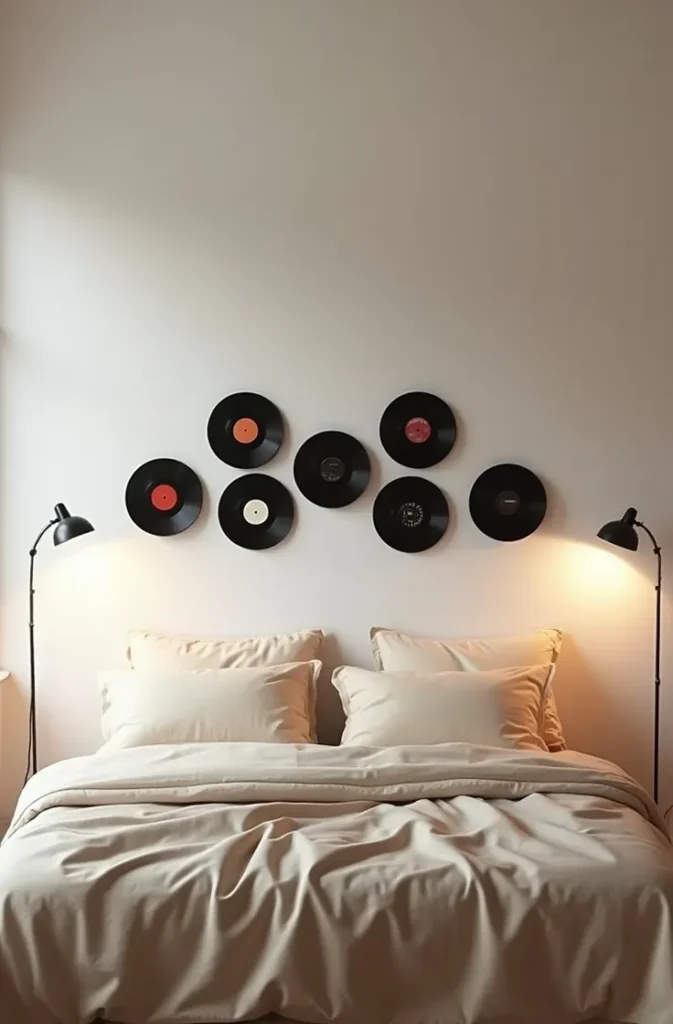
Use a wide, low arrangement that spans roughly the width of the mattress plus 12 inches on each side. A single row of 7 to 9 records at mattress height reads cleanly. Two staggered rows create more visual depth. Keep the records at least 8 inches above the pillow line so they do not interfere with sitting up in bed.
Secure mounting is non-negotiable here. Records above a sleeping area must be anchored into studs, not just drywall. Use appropriate wall anchors rated for the total combined weight and test each mount before considering the job done.
11. The Corner Wrap: Turning a Dead Corner Into an Unexpected Feature
Most wall art planning ignores corners, but wrapping a vinyl record arrangement around an interior corner creates one of the most visually surprising displays in a home. Records mounted on both sides of a corner, continuing as if the corner does not exist, feel architectural and intentional. This is a functional vinyl record wall art idea for apartments and smaller homes where every surface needs to work harder.
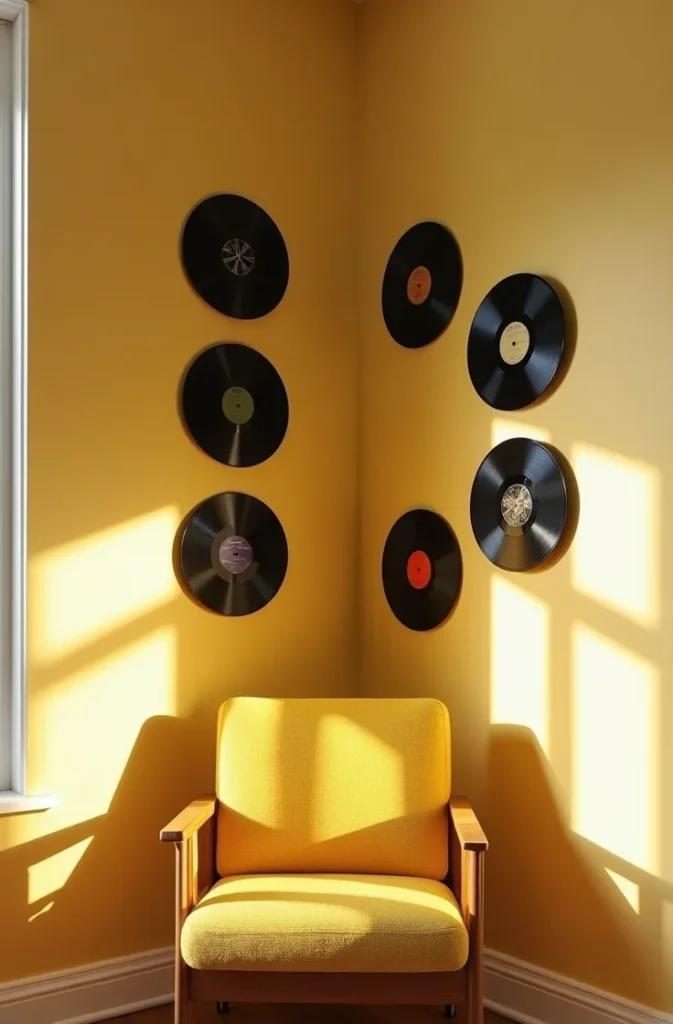
The key to making this work is treating the corner as the center of the composition, not the edge. Hang records that extend from the corner outward on both walls equally. Use the same spacing and height on each side so the arrangement reads as one continuous display that the corner simply folds around.
Avoid placing records so close to the corner that they cannot sit flush. There should be at least 4 to 6 inches of wall surface between the innermost record edge and the actual corner line. Records mounted too close will stick out at an angle as the wall turns, which looks sloppy.
12. The Single Statement Record: When One Is Enough
Not every vinyl record wall art idea requires a collection. A single, oversized or particularly significant record mounted alone on a clean wall makes one of the strongest statements precisely because of its restraint. This approach works in rooms that are already visually active and need a focal point without adding more complexity.
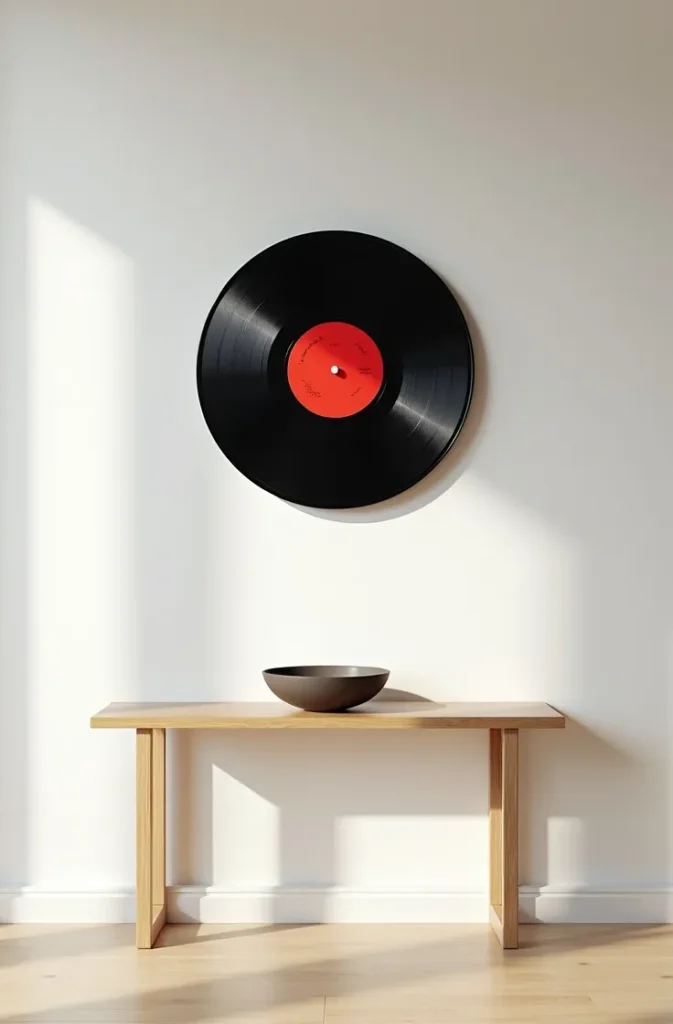
Choose a record with a visually interesting label, one with strong typography, a graphic illustration, or an unusual color. Mount it at eye level on a wall that gets consistent light. The lack of surrounding clutter forces the viewer to look closely at the record itself, which is where the real detail is.
This is the right choice for entryways, small bathrooms, and reading corners where the wall space is limited and any overcrowding will feel cramped. It is also the right starting point if you are new to this type of display and are not yet sure how far you want to take it. One well-placed record is always better than a rushed arrangement of many.
Final Thoughts
These vinyl record wall art ideas cover a wide range of styles, room sizes, and commitment levels, from a single record in an entryway to a full corner-wrap in a living room. The best arrangement is not the most dramatic one. It is the one that fits your actual wall, your actual room, and the number of records you have right now.
Save this post before you start hanging. Having a reference point while you plan and measure will save time and unnecessary wall damage. If you found one layout that fits your space, that is the one worth doing well.
For more wall display ideas that work in real homes, explore layouts focused on gallery walls, floating shelves, and functional bedroom accent walls.