
Outdoor sofa ideas in 2026 have finally caught up to what interior design figured out a decade ago: the distinction between inside and outside is a material choice, not a rule, and the most beautiful outdoor spaces are the ones that stopped pretending otherwise. If your patio still looks like an afterthought — a few pieces that tolerate the weather but do not actually invite you to stay — the problem is not your budget or your square footage. This post will show you exactly which outdoor sofa styles, arrangements, and styling decisions are worth committing to this year, and which ones look extraordinary in a showroom and disappoint by Labor Day.
The Low-Profile Outdoor Sofa Arrangement That Makes a Small Patio Feel Like an Actual Room
The single design decision that separates a styled outdoor space from a patio with furniture on it is seat height. Most standard outdoor sofas sit at interior furniture height — roughly eighteen inches from ground to seat — which creates an awkward, furniture-store-floor quality in an outdoor setting. Dropping to a low-profile outdoor sofa at twelve to fourteen inches of seat height grounds the entire arrangement visually, creates a sense of intentional design, and makes the patio feel like a room with a floor plan rather than a holding area for outdoor chairs.
The physical effect is immediate: a lower sofa pulls the sightline down, which makes the surrounding garden, fence, or landscape fill more of the view. In a small backyard in a California bungalow neighborhood or a townhouse patio in the mid-Atlantic, where the fencing and neighboring structures dominate the upper sightline, this is the arrangement that makes the most of what you are actually looking at — the plantings, the texture, the candles at ground level — rather than the eyesore beyond the fence line.
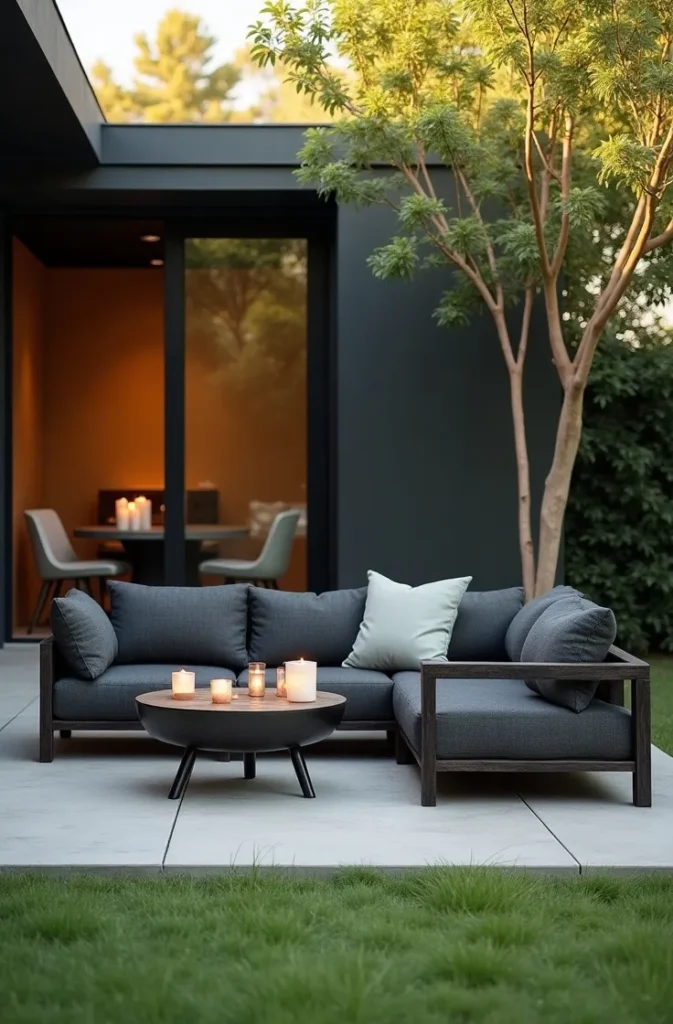

This works best for warm-climate homeowners who spend genuine time outside — in Texas, Florida, Arizona, and coastal California — where the low arrangement invites the long, horizontal lounging that outdoor living in those climates actually involves. It is less practical in climates where outdoor time is short and you need to be able to get in and out of a chair efficiently.
The mistake is choosing a low-profile sofa with thin, flat cushions. A low sofa with a four-inch cushion looks like a pallet with a pillow on it. The seat needs generous cushion depth — six to eight inches — to read as deliberate luxury rather than a budget solution. The low profile is the statement; the cushion depth is what makes it comfortable enough to mean it.
Picture yourself at 7 PM on a warm September evening, sitting close to the ground with a drink in hand and the garden at eye level. That is what this arrangement is for.
The Curved Outdoor Sofa That Turns a Corner Patio Into a Conversation Destination
A curved or crescent-shaped outdoor sofa is the 2026 outdoor furniture silhouette generating the most saves across design Pinterest boards right now, and the reason is not just aesthetic — it is functional. A curved sofa naturally orients every seat toward a central point, whether that is a fire pit, a coffee table, or a garden view, creating a conversation geometry that a straight sofa simply cannot replicate. Everyone faces the center. No one is sitting at an awkward angle looking at the back of someone’s head.
The layout works best on a circular or square patio where the curve mirrors the footprint of the space. In a square patio, position the curved sofa along one wall with its arc pointing inward, and place a round coffee table or a fire pit at the focal center of the arc. The curve frames the central element in the same way a horseshoe arrangement frames a fireplace in a living room. The result feels deliberate and complete — a designed room, not a furniture arrangement.
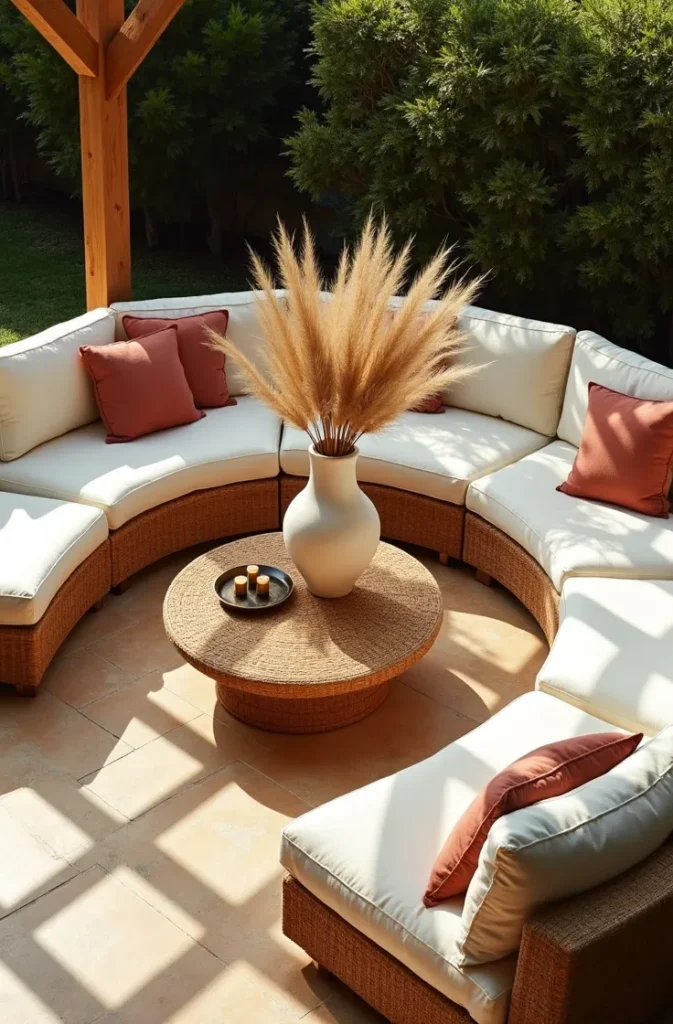
For homeowners in the Southeast, Texas Hill Country, or the suburban Midwest who entertain outdoors regularly, the curved configuration handles six to eight people in a way that a standard three-seat sofa with two additional chairs cannot. The curved form absorbs the group into the seating rather than scattering people around the edges of the patio trying to find a place to sit.
The mistake is placing a curved sofa against a straight wall. The curve was designed to face inward, and backing it against a wall negates the entire spatial logic of the form. If your patio is against a wall, float the curved sofa away from the boundary by at least eighteen inches and treat the gap as an intentional design detail.
The Sectional Outdoor Sofa Configuration That Actually Works for a Narrow Patio
The L-shaped sectional is the most versatile of all outdoor sofa ideas for homeowners working with a patio that is significantly longer than it is wide — a common configuration in townhomes, row houses, and narrow suburban lots across the country. The key is which direction the L faces. The short arm of the L should always face the primary sightline or entrance to the patio, and the long arm should run parallel to the longest wall. This positions the seating to welcome rather than block, and uses the wall as a visual anchor without pressing the furniture flush against it.
The narrow patio challenge — a space that is, say, eight feet wide and twenty feet long — is solved by the L-sectional precisely because it concentrates all the seating into one corner, leaving the remaining length of the patio free for a dining area, a planting bed, or simply a clear walking path to the yard. What kills a narrow patio is trying to face two sofas across from each other: you immediately lose the walkway and the conversation distance becomes uncomfortably close.
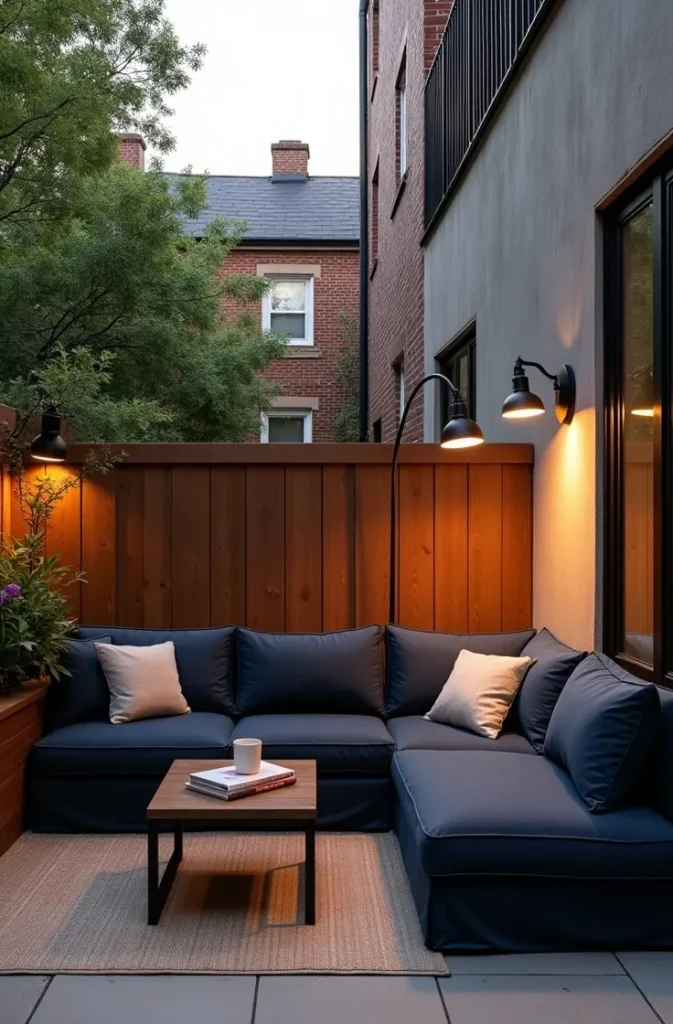
This configuration is particularly effective for row home owners in Philadelphia, Chicago, and Washington D.C., where the back patio is almost always a long, narrow rectangle attached to the rear of the house. The L-sectional is the arrangement that takes this awkward footprint and turns it into something that photographs as well as it functions.
The mistake is choosing a sectional with pieces that are modular but not truly reconfigurable. True modularity means you can rearrange the pieces as your patio use evolves — and it will. Buy sectionals where every piece has its own feet and can stand independently. Sectionals that only assemble in one direction are not modular, regardless of what the product description says.
The Daybed-Style Outdoor Sofa That Serves as Both Seating and the Most Coveted Spot in the Yard
The outdoor daybed sofa — a wide, deep-seated piece with a back that drops flat or a fully backless format with bolster pillows — is the outdoor furniture category that generates the most genuine lifestyle envy, because it signals something specific: this is a home where someone actually rests outdoors. It is not aspirational furniture. It is furniture for someone who has decided her outdoor space is for her, not just for guests.
The functional distinction from a standard outdoor sofa is the seat depth. Where a standard outdoor sofa has a seat depth of twenty to twenty-four inches, a daybed-style sofa has a seat depth of thirty to forty inches — wide enough to curl up sideways, to lie with your legs stretched out, to share with a dog or a child. The difference between twenty-four inches and thirty-six inches of seat depth is the difference between a sofa you sit on and a space you inhabit.
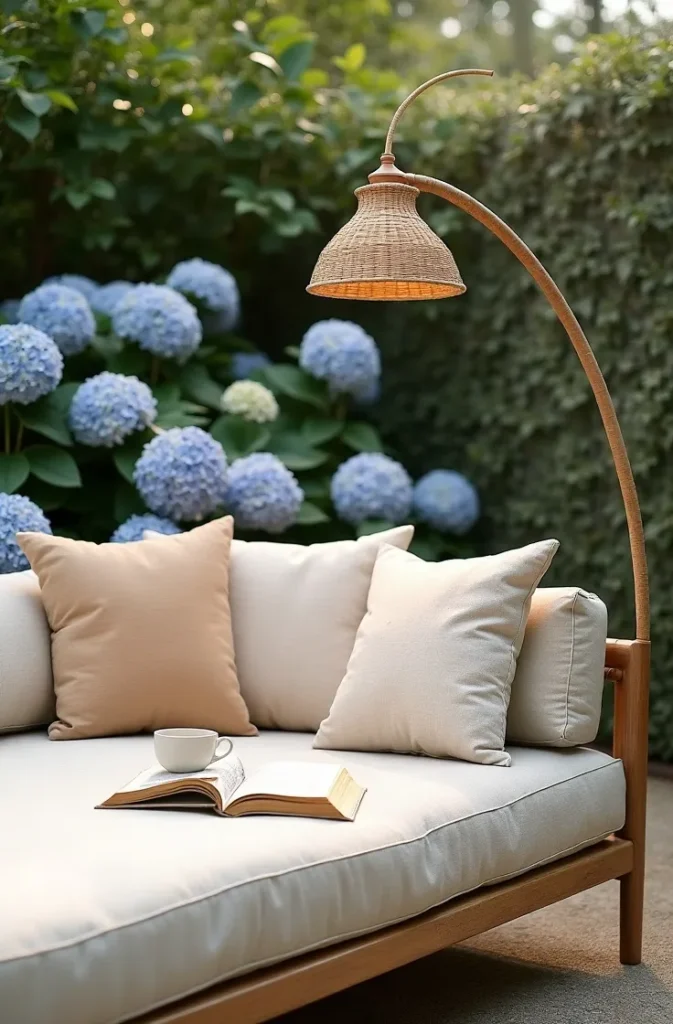
This works best as a freestanding piece on a larger patio or in a garden setting where it can be positioned to face a specific view — a garden bed at peak bloom, a fire pit, a water feature, or simply a quiet corner of the yard that no one else uses. In the Pacific Northwest and New England, where outdoor time is precious and concentrated into specific months, the outdoor daybed becomes the anchor of the entire summer.
What fails is pairing a daybed sofa with a full set of additional seating. The daybed is the destination; it does not need to be part of a furniture suite. One daybed, one low coffee table, and one good side table for a drink is the complete arrangement. Adding two more chairs beside it turns a retreat into a waiting room.
The Wicker and Linen Outdoor Sofa Combination That Ages Into Something Beautiful
Natural wicker — specifically deep-weave natural rattan or synthetic wicker in a natural honey tone — paired with heavyweight linen or canvas cushion covers is one of the most enduring of all outdoor sofa ideas because both materials are specifically designed to get better with use. Natural wicker weathers to a deeper, richer tone in sunlight. Linen softens and relaxes with washing and time. The combination at year three is almost always more beautiful than it was at installation.
The design logic of this pairing is about texture contrast: the rigid, geometric weave of wicker against the soft, directional grain of linen creates a visual conversation between structure and softness that reads as inherently sophisticated. This is the same principle at work in an interior that pairs a rattan chair with a linen sofa — the contrast is the composition.
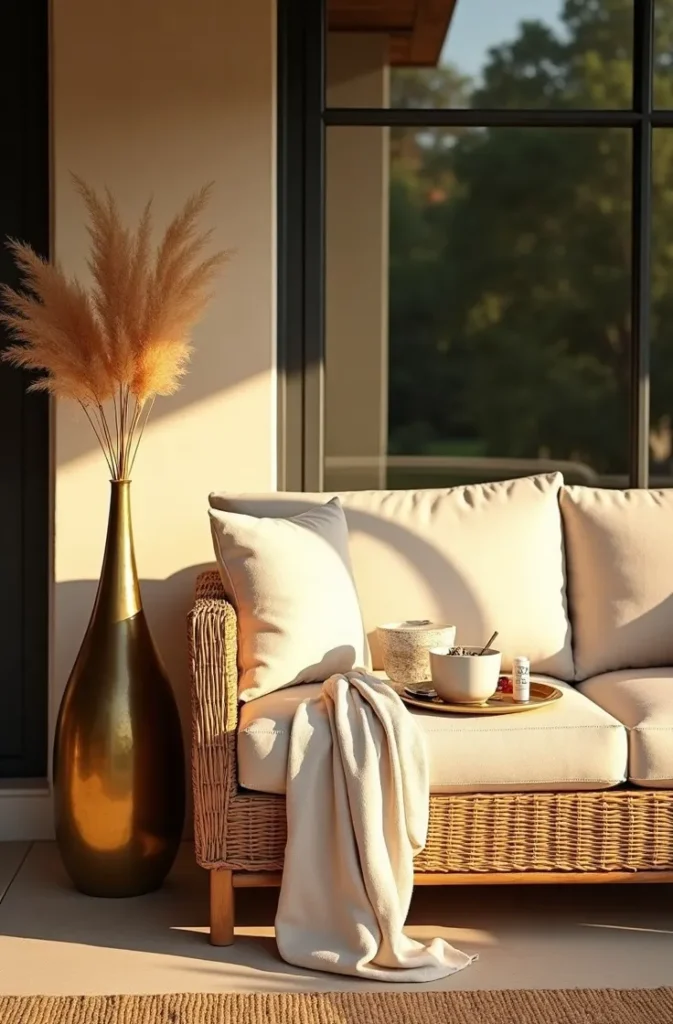
The outdoor application requires attention to the specific wicker construction. Deep, tightly woven wicker frames — where the weave covers the structural frame completely — hold up significantly better in humid or wet climates than loosely woven or partially exposed frames. In Florida, coastal Georgia, and the Gulf States, loose weave collects moisture and debris in the gaps; a tight, dense weave sheds water more effectively and resists mold accumulation.
The mistake is buying natural rattan for a fully exposed outdoor setting. Natural rattan is a patio or covered-porch material, not a full-exposure outdoor material. In direct sun and rain it degrades quickly. Use synthetic wicker in a natural honey or weathered grey tone for fully exposed outdoor settings, and reserve natural rattan for covered porches, pavilions, and screened spaces where the charm of the real material can be maintained.
The All-White Outdoor Sofa Setup That Actually Stays Looking Good
An all-white or near-white outdoor sofa is the most aspirational of all outdoor sofa ideas on Pinterest and also the one most women talk themselves out of for practical reasons — staining, fading, the impossibility of maintenance. The secret is that the women whose white outdoor sofas still look beautiful after three summers made two specific decisions: they chose performance fabric with a tight weave that resists staining at the fiber level rather than relying on surface treatment, and they chose a cushion cover that is fully removable and machine washable.
The layout that supports an all-white outdoor sofa is the edited approach: fewer pieces, more negative space, no clutter. An all-white sofa in a busy, layered patio arrangement looks overwhelmed and high-maintenance. The same sofa on a clean concrete or light stone patio, with one sculptural side table, a simple planter, and nothing else competing for attention, looks intentional and effortlessly expensive.
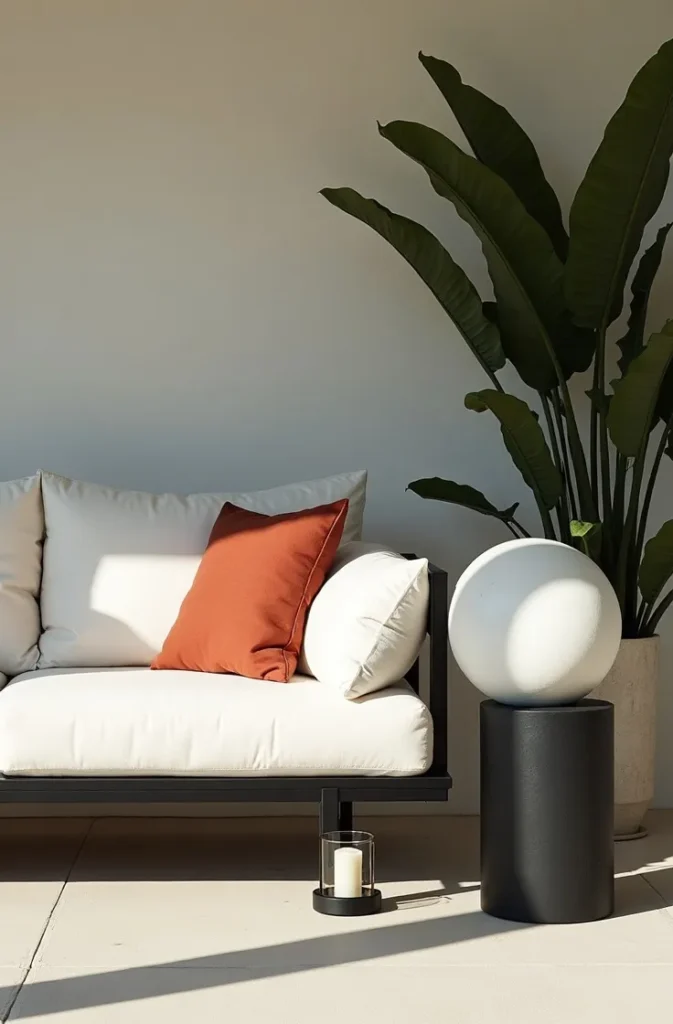
This combination works especially well in California, Arizona, and New Mexico where the strong, bright daylight is suited to white surfaces and the lower humidity keeps the cushions cleaner between washing. In the humid South or the rainy Pacific Northwest, even the best performance fabric requires more frequent maintenance, and the visual payoff of white requires more care than most households sustain realistically.
The mistake is pairing an all-white outdoor sofa with white accessories — white pots, white side table, white lanterns. Everything at the same lightness value creates a flat, washed-out composition with no contrast. Use one dark, warm, or saturated element — a deep terracotta pot, a black iron side table, a single cobalt blue throw pillow — to give the white something to anchor against.
The Outdoor Sofa Positioned for Morning Light — Why Where You Place It Matters More Than What You Buy
The single most underleveraged outdoor sofa idea is not a style, a material, or a configuration — it is orientation. A sofa positioned to catch the morning sun from the east on a south-facing patio will be used every morning by someone who has a coffee-and-quiet routine. The same sofa rotated ninety degrees to face away from the light will sit empty until midday when the sun has moved. How you place the sofa determines when the outdoor space gets used, which determines how much value you actually receive from the investment.
The practical test is simple: stand at your intended sofa position at 7 AM and 6 PM on a clear day and observe what the light is doing. A breakfast-use patio should catch eastern light and have shade by mid-morning. An evening-use patio should be in shade during the heat of the afternoon and have warm western light at dusk. Most homeowners buy outdoor furniture in summer when the light angles are at their most extreme, and then wonder why the space is too hot in August and too dark in October.
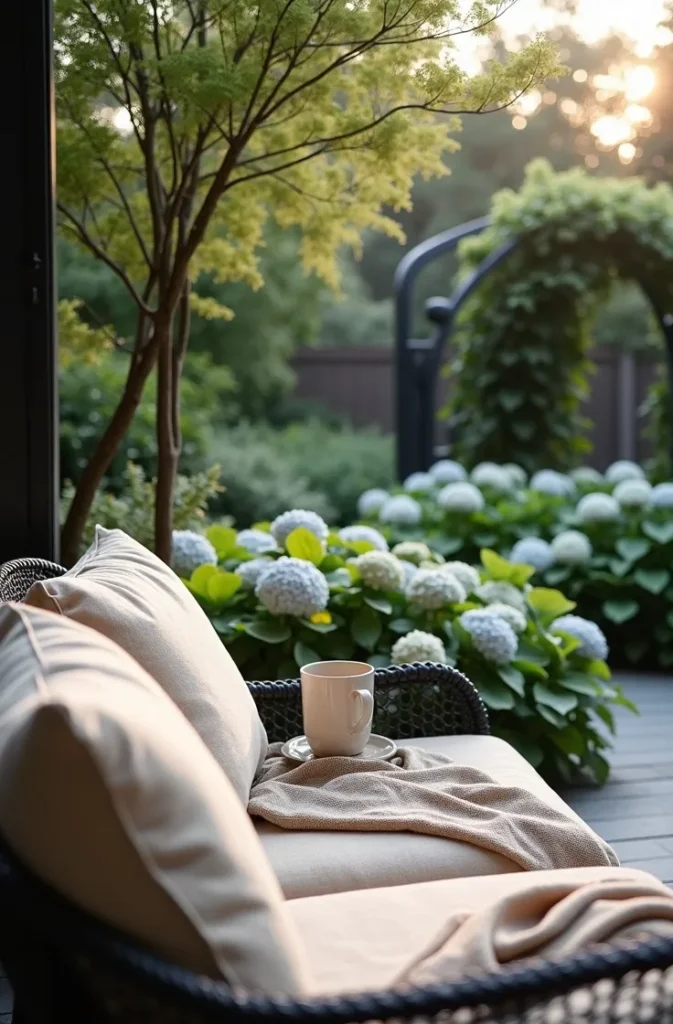
This orientation knowledge applies most critically to homeowners with north-facing backyards — common in older urban neighborhoods in Chicago, Boston, and the mid-Atlantic — where the yard receives limited direct sun and the sofa placement must be optimized to capture whatever light is available. In these yards, positioning the sofa as close to the sun-facing edge of the patio (typically the southern edge) can be the difference between a space that receives two hours of light and one that receives five.
The mistake is designing the outdoor seating arrangement around the visual relationship with the house rather than the relationship with the sun and the view. The back of a house is rarely the most interesting thing to look at. Orient the sofa toward the garden, the trees, the sky — whatever the best view actually is.
The Outdoor Sofa With a Built-In Canopy — Privacy, Shade, and the Resort Feeling Without Leaving Home
A canopy outdoor sofa — a freestanding sofa structure with a built-in overhead shade element, either as a cantilevered pergola attachment or a four-post draped frame — is one of the outdoor sofa ideas with the highest transformation potential in a plain, open backyard. The canopy does not just provide shade. It creates a room within the outdoor space: a defined overhead plane that signals shelter, enclosure, and destination in a way that no amount of cushion or pillow styling can achieve alone.
The draped version — four corner posts with sheer or semi-opaque fabric panels that can be tied back or released depending on sun and privacy needs — is the most design-flexible option and the most achievable at a range of budgets. The sheer fabric diffuses direct light into a soft, even glow beneath the canopy that is genuinely beautiful at midday when the rest of the garden is too bright to sit in. In the late afternoon, when the western sun hits the fabric at a low angle, the effect is cinematic.
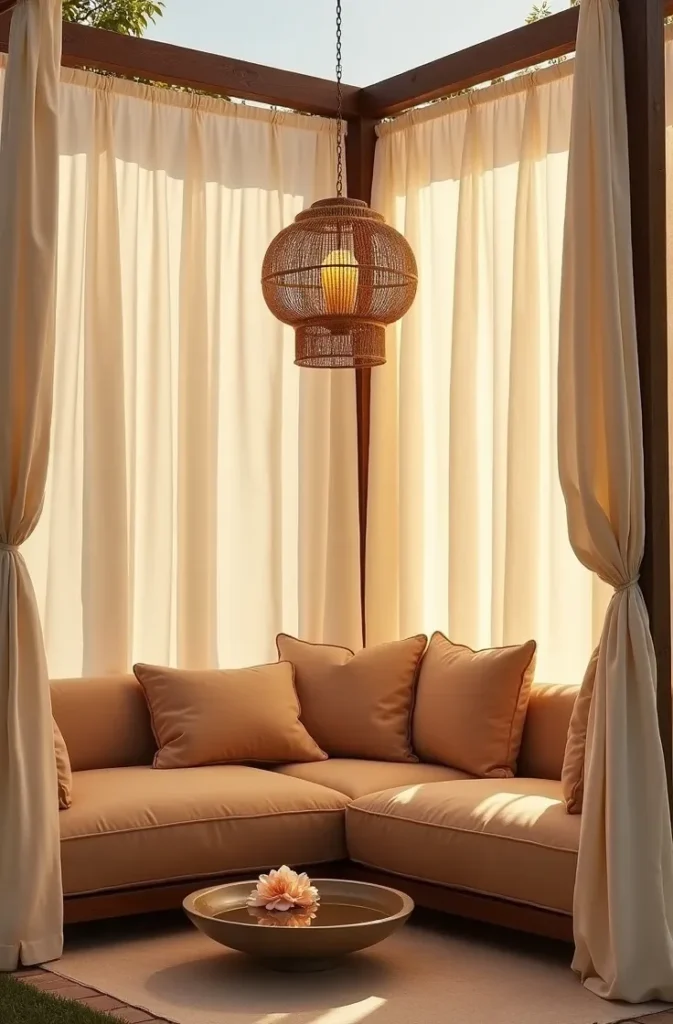
This configuration is especially effective for homeowners whose outdoor seating area is directly overlooked by neighbors — a universal challenge in dense suburban neighborhoods across the country. The canopy panels provide soft visual privacy without the permanence or expense of a fence addition, and they can be removed at the end of the season without trace.
The mistake is using light-gauge fabric that moves dramatically in any breeze. Sheer outdoor fabric needs to be heavy enough to drape with gravity — eight to ten ounces per yard minimum — so that it falls in smooth, clean folds rather than billowing and snapping. A canopy that flaps in every gentle wind is not the serene resort effect you were after.
The Stone-Base Outdoor Sofa Built Into the Landscape — Permanent, Personal, Unmistakably Designed
A built-in outdoor sofa with a stone, brick, or concrete base is the outdoor sofa idea that separates a designed garden from a furnished one. Unlike freestanding furniture, a built-in sofa is part of the landscape itself — the base is constructed, the cushions are applied, and the seating becomes a permanent architectural feature of the outdoor room rather than a movable object sitting on top of it. When done well, a built-in sofa makes the entire garden feel finished in a way that even the best freestanding furniture cannot.
The most achievable version for most homeowners is a dry-stacked stone bench base — rough-cut fieldstone or a regular ashlar pattern — built against a low garden wall or retaining structure, with thick outdoor cushions placed on top. The stone base does not require mortar or a structural engineer; a properly set dry-stack at bench height (seventeen to eighteen inches) is stable and beautiful and requires virtually no maintenance across decades.
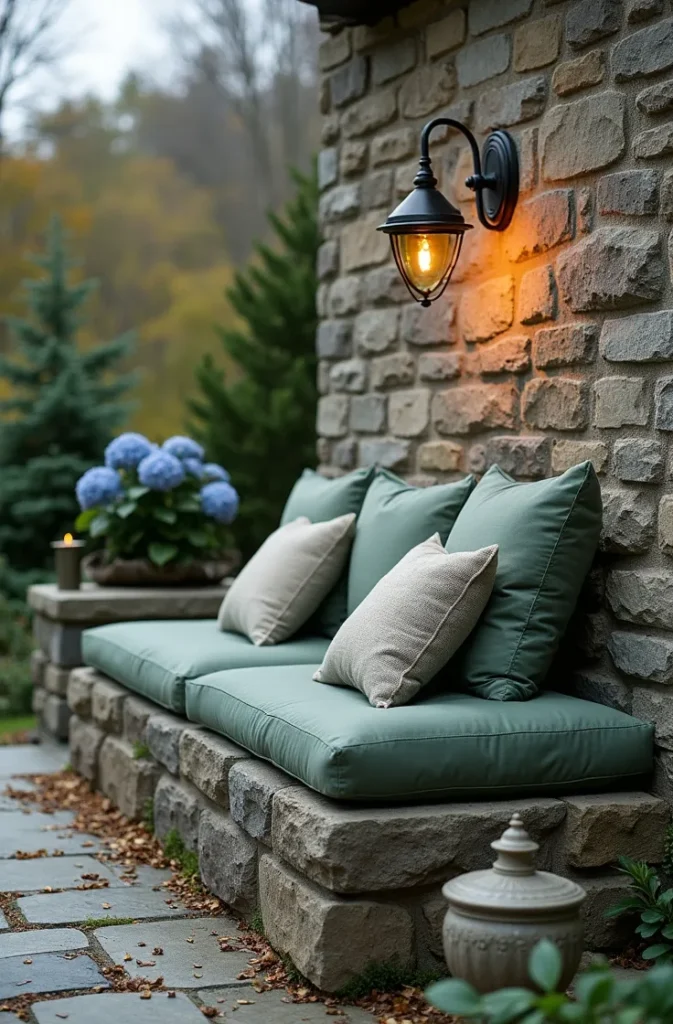
This is the outdoor sofa choice for homeowners with a long view: those who are investing in a property they intend to keep, who want outdoor features that increase appraised value, and who are willing to give the landscape two to three seasons to grow into the built feature. In the American Southwest, where adobe and stone construction is contextually native, the built-in sofa feels indigenous. In New England and the mid-Atlantic, where fieldstone walls are a landscape vernacular, the stone-base sofa fits directly into the existing material language of the property.
The mistake is building a stone base without considering the cushion storage solution. Outdoor cushions need to come inside in most American climates during the off-season. If there is no storage within ten feet of the built-in, the cushions will not be retrieved reliably, and a stone sofa without cushions is a bench. Plan the storage before you build the base.
The Outdoor Sofa and Fire Pit Triangle — the Arrangement Formula That Makes Evenings Last Longer
The relationship between an outdoor sofa and a fire pit is not simply proximity — it is geometry. The arrangement that keeps people outside until midnight is not one where everyone is crammed around a fire at equal distance; it is a triangle formation where the sofa anchors one side, two additional low chairs or a love seat anchor the second side, and the fire pit sits at the apex, approximately six to eight feet from the sofa front. This creates optimal warmth and sightlines for everyone without anyone being either too close to the heat or too far from the conversation.
The six-to-eight-foot distance between the sofa front and the fire pit is a specific and important measurement. At five feet, the sofa cushions accumulate smoke smell and the heat is uncomfortable on warm evenings. At ten feet, the warmth does not carry effectively on cool nights and the fire feels decorative rather than functional. Six to eight feet is the working distance that delivers warmth, allows a clear view of the flames, and keeps the smoke from becoming an issue in a standard backyard.
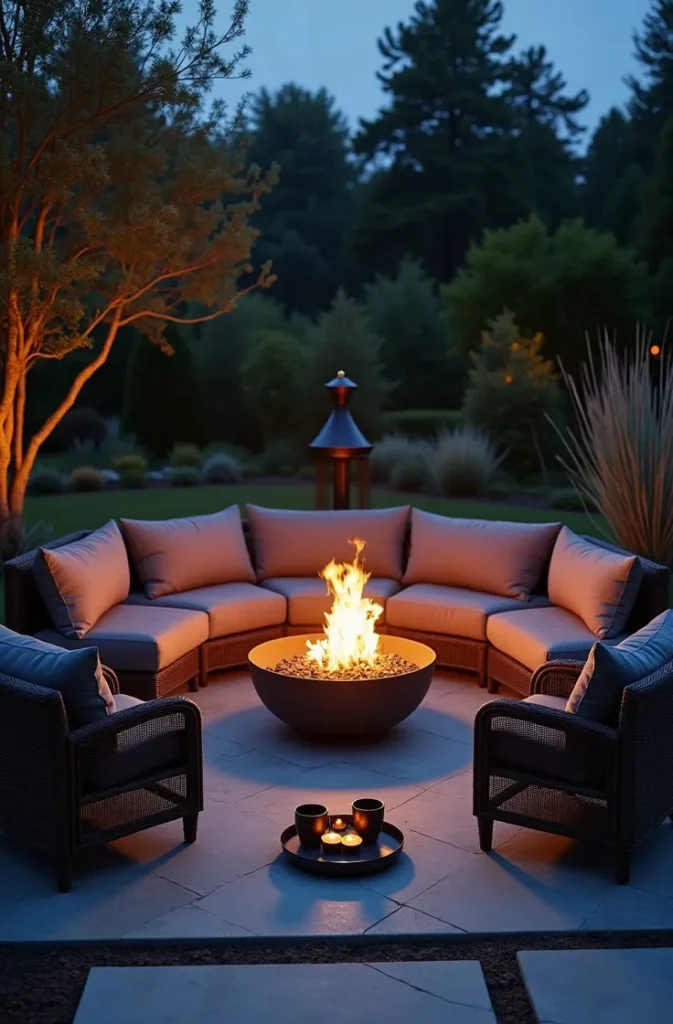
This arrangement is at its best on a patio that is at least sixteen feet wide and eighteen feet deep — enough footprint to allow the triangle formation without crowding. For homeowners in suburban Texas, Tennessee, or the Carolinas where outdoor living season runs from March through November, this is the layout worth building the patio around. The fire pit triangle is the difference between a space you use occasionally and one that becomes the center of social life.
The mistake is placing the sofa so its back is toward the house entrance. Seating with its back to a door is psychologically uncomfortable — the same instinct that makes people choose seats facing the restaurant entrance. Orient the sofa so the seated person has a clear sightline back to the house and can see the fire simultaneously.
The Outdoor Sofa Under a Pergola — How to Style the Overhead Element So It Does Not Look Bare
A pergola-covered outdoor sofa is one of the most saved patio images on Pinterest, and also one of the most commonly half-finished in real life — the sofa and cushions look beautiful, but the pergola overhead is bare wood beams with nothing on them, which reads as the skeleton of an idea rather than a completed design. The overhead element of a pergola-sofa vignette requires its own styling decision, and there are three that work.
The first is the climbing plant approach: wisteria, grape, or climbing hydrangea trained up the posts and across the beams over two to three growing seasons creates an organic, living overhead that is incomparably beautiful. The second is the draped fabric approach: lightweight outdoor sheer panels draped across the beams in loose swags create immediate warmth and the feeling of a room, even when the plant coverage is still establishing. The third is the pendant lighting approach: three to five outdoor pendant lights or a string of globe Edison bulbs suspended between the beams at varying heights creates an evening atmosphere that photographs as well as it feels.
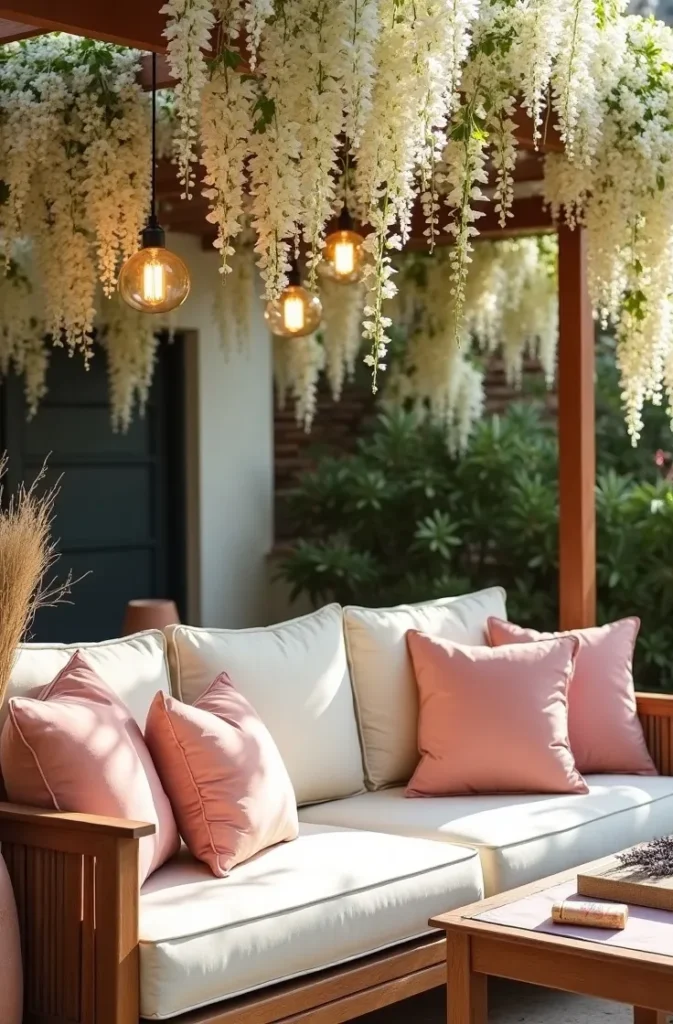
What does not work is waiting for the perfect solution. A bare pergola over a beautiful sofa keeps the space feeling transitional — like a project in progress — which prevents it from being used as the finished room it is meant to be. Choose one of the three approaches, execute it immediately, and let the plants or the patina develop over time.
This is the setup that works best in properties where the pergola is adjacent to or attached to the house — a common configuration in California ranch-style homes, suburban Midwest colonials, and Texas farmhouses — where the overhead structure connects the indoor and outdoor living areas as one continuous experience.
The mistake is choosing plants that grow too slowly for the climate. In a cold-climate garden (Zone 4 to 6), wisteria takes four to six years to cover a pergola meaningfully. In those climates, pair the slower plant with immediate draped fabric so the space is usable while the plant establishes.
The Outdoor Sofa in a She-Shed or Garden Room — How to Bring Interior-Level Comfort Completely Outside
The she-shed or garden room movement has produced one of the most interesting applications of outdoor sofa ideas: a covered, semi-enclosed outdoor structure with the weatherproofing of a screened porch and the aesthetic ambition of an interior living room. In this setting, the furniture rules shift significantly. Because the structure provides protection from direct sun, rain, and significant wind, you can use materials — velvet, linen, lighter-weight cushions, indoor-quality accessories — that would be inappropriate in a fully exposed outdoor setting.
The sofa that works best in a garden room or she-shed is one that blurs the interior-exterior line deliberately: a deep, soft-armed upholstered piece in an outdoor-rated fabric that reads as an interior sofa until you notice the context. Paired with interior-quality lighting, a soft rug that has been chosen for partial weather exposure, and real plants rather than weather-resistant decorative objects, this arrangement creates the most genuinely comfortable and visually rich of all outdoor sofa configurations.
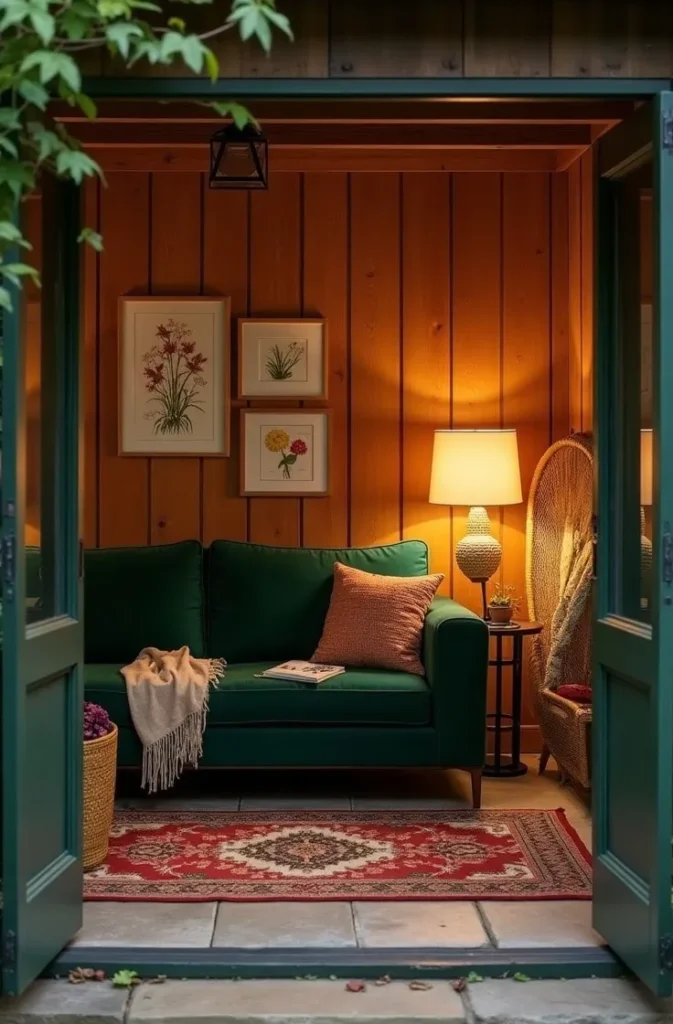
This is particularly well-suited to homeowners in the Southeast, Pacific Northwest, and mid-Atlantic who want year-round outdoor living spaces and have the garden footprint to accommodate a structure. A well-built she-shed with a quality outdoor sofa is, in competitive real estate markets, a genuine selling feature — agents in Nashville, Raleigh, and the D.C. suburbs increasingly list garden rooms as a distinct property feature.
The mistake is bringing real indoor furniture into a garden room without addressing the moisture. Even a covered, ventilated structure has higher humidity than an interior room, especially in the Southeast and Pacific Northwest. Choose fabrics that are outdoor-rated even when they do not look it, and use moisture-resistant cushion inserts rather than standard polyester fill.
The Outdoor Sofa Vignette — Five Objects That Turn Any Patio Sofa Into a Styled Moment
The difference between an outdoor sofa that someone sits on and one that stops a Pinterest scroll is a vignette — a curated cluster of complementary objects that make the sofa feel like a scene from a life worth having. This is not about adding more things. It is about choosing five specific categories of object and placing them with precision. Every outdoor sofa idea in this post benefits from the vignette approach, regardless of style or configuration.
The five categories are: one textile (a throw or an additional texture pillow in a material that contrasts with the cushion fabric), one vessel (a planter, a vase, or a lantern at floor or table level), one tray or surface object (on the coffee table or sofa arm, holding one to three small items), one light source (a candle, a lantern, or a small outdoor lamp that operates independently of the main patio lighting), and one personal object (a book, a ceramic mug, a pair of sunglasses — the thing that signals a person was just here and will be back).
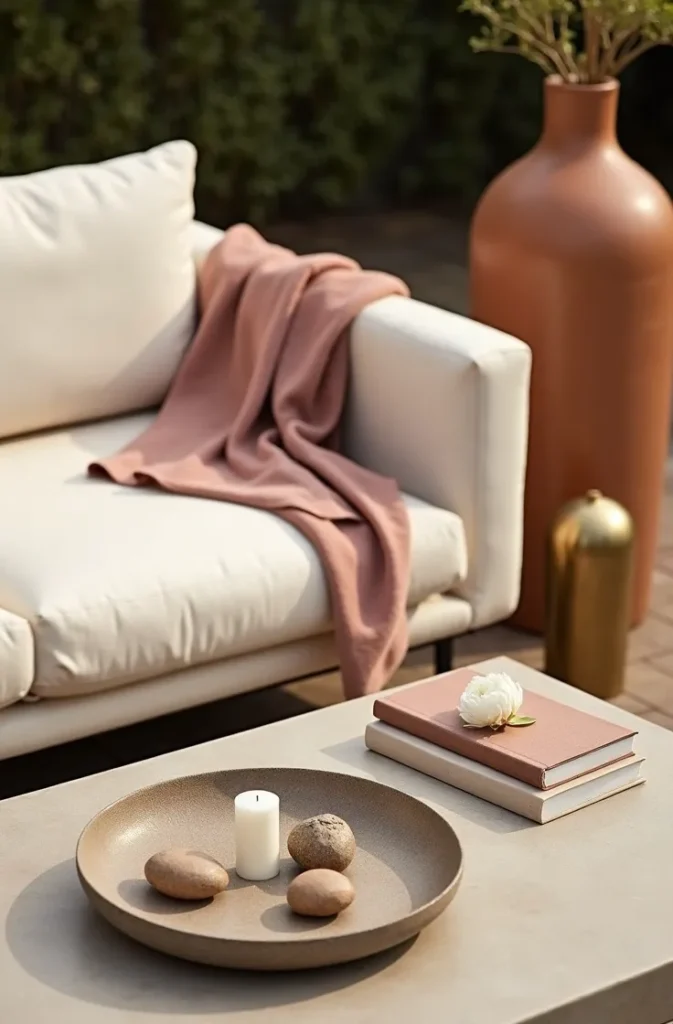
The personal object is the one that most people skip, and it is the one that does the most emotional work in a photograph or in person. A perfectly styled sofa with no personal object reads as a showroom. The same sofa with a turned-down paperback on the cushion and a half-drunk glass of sparkling water on the side table reads as a home. That distinction is the entire difference between aspirational and achievable — which is exactly what makes someone save the image.
Resist the urge to add a sixth or seventh object. The vignette has maximum impact when the five categories are filled and nothing beyond them is visible. Editing down to five takes more confidence than adding more, but it is always the right choice.
The Performance Fabric Deep-Dive — Why the Fabric Decision Matters More Than Any Other Choice on an Outdoor Sofa
Every outdoor sofa idea in this post lives or dies by one decision that happens before the style, the configuration, and the color: the fabric. Outdoor fabric technology has changed significantly in the past five years, and the 2026 performance fabrics available for outdoor cushions bear almost no resemblance to the stiff, shiny, plasticky materials that defined outdoor furniture a decade ago. The best current outdoor fabrics look and feel like interior upholstery. The worst current outdoor fabrics still look and feel like outdoor furniture. The difference is worth researching before any purchase.
The performance fabrics that consistently outperform across all American climates — from Arizona dry heat to Florida humidity to Pacific Northwest moisture — are solution-dyed acrylics in a tight, high-thread-count weave. Solution-dyeing means the color is dyed into the fiber before weaving rather than applied as a surface coating, which makes the color significantly more resistant to UV fading. A cheap outdoor fabric in a beautiful color will look sun-bleached within two seasons in direct-sun climates. A quality solution-dyed acrylic in the same color will hold for five to seven years under the same conditions.
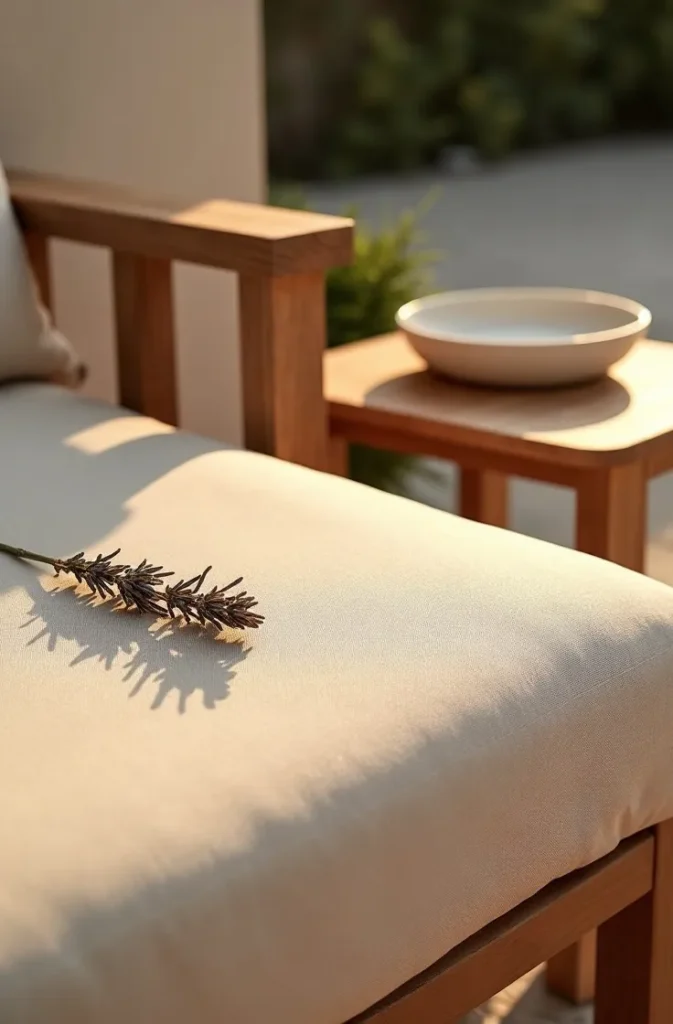
The tactile question matters for the outdoor sofa styles that are meant to be luxurious and livable rather than simply weather-resistant. Velvet-look performance fabrics, linen-texture outdoor weaves, and outdoor canvas in a soft, matte finish have all become genuinely beautiful in recent years, and they are the materials that make the outdoor sofa ideas in this post actually work the way they look in photographs.
The mistake is buying based on color photograph alone. Order samples before committing to any outdoor cushion fabric, handle the sample in direct sunlight if possible, and fold it to assess whether it creases softly (high quality) or holds a sharp, stiff crease (lower quality synthetic). The fold test reveals what no photograph can.
The Outdoor Sofa Color Decision for 2026 — the Palette Shift That Is Replacing Grey and Brown on Every Patio
For the better part of a decade, outdoor furniture defaulted to a narrow range of safe neutrals: charcoal grey, taupe, dark brown, and navy. In 2026, the outdoor sofa ideas generating the most sustained engagement on design platforms are using a different palette — one that is warmer, more complex, and more personal. The shift is toward terracotta, sage green, dusty mauve, warm rust, and deep forest green: colors that connect to the natural world around them rather than neutralizing it.
The design rationale is straightforward. A grey sofa against a green garden is a grey object in a green space — the furniture recedes and the garden overwhelms it. A terracotta or sage sofa against the same green garden participates in the color relationship: the warm terracotta warms the green; the sage sofa creates a monochromatic garden vignette. The furniture becomes part of the landscape rather than furniture sitting in it.
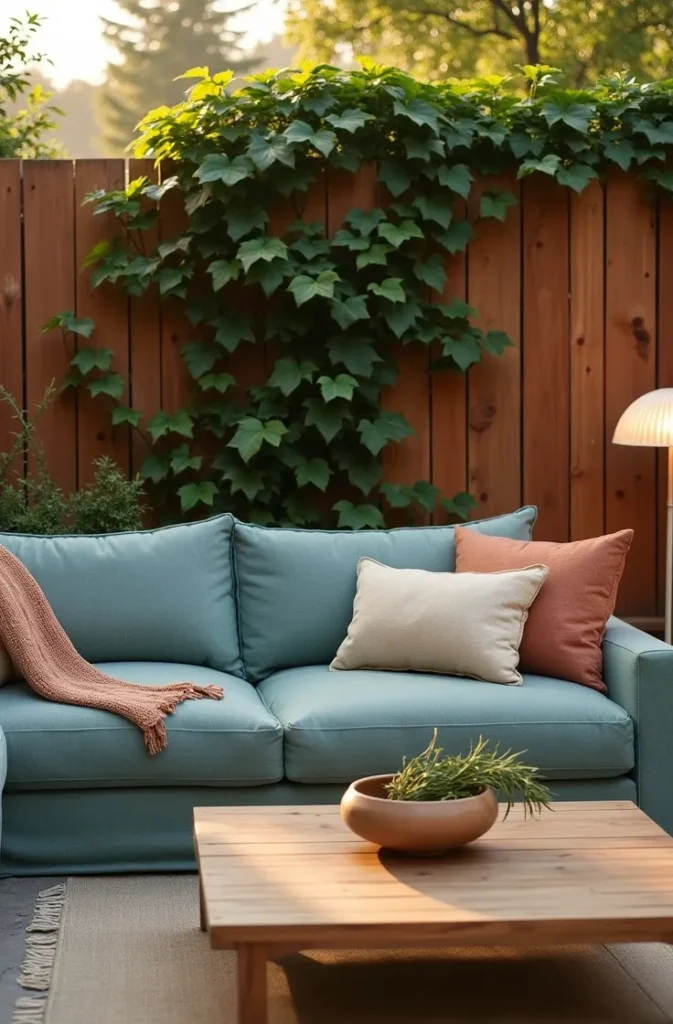
The 2026 color that is consistently outperforming in outdoor design content is deep sage green — not the yellow-sage of a few years ago, but a blue-sage closer to eucalyptus, applied to outdoor sofas in a matte performance fabric. Against natural wood tones, warm stone, and the green of a garden, blue-sage reads as rooted, calm, and completely at home in an outdoor setting in a way that grey simply never has.
The mistake is choosing a color that you love indoors and assuming it will translate. Colors read differently in direct sunlight than in interior lighting. Order fabric samples and place them outside in your specific patio conditions at different times of day before committing. A color that looks saturated and beautiful in your living room may wash out to near-white in direct Arizona sun, or deepen to near-black in the shade of a Pacific Northwest garden.
You came into this with a patio that has potential and a Pinterest board that has not translated into a real space yet. You are leaving with eighteen specific outdoor sofa directions — each with a real design logic, a material understanding, and a placement rationale that works in an actual American backyard, not just in a staging photograph. Save this post now and come back to it when you are ready to make the purchase, because the decision you make about your outdoor sofa will determine how much time you actually spend outside this year. That is the measurement that matters — not what the patio looks like in a listing photo, but how often you are in it at 6 PM with nowhere else you need to be.