
Dorm bedding ideas are not just about covering a mattress — they are the single fastest way to turn a cold, institutional cube into a room you genuinely want to come back to. If you have spent any time saving pins and still feel like your dorm room falls flat compared to what you see online, the problem is probably not your budget — it is the layering, the proportion, and the order in which you are making decisions. This post walks you through eighteen specific, design-informed choices so that by the time move-in day arrives, you know exactly what you are doing and why it works.
The Bedding Layer That Makes Every Dorm Bed Look Like It Belongs in a Boutique Hotel
The biggest visual mistake in most dorm rooms is treating the bed as one flat layer — a fitted sheet, a comforter, done. What makes a bed look designed versus simply made is contrast between texture and weight. A chunky waffle-knit throw draped across the lower third of the bed introduces the kind of layering that stops scrolling on Pinterest, and it costs less than most people expect.
Start with a solid-colored duvet in a muted, warm tone — oatmeal, dusty sage, or a deep terracotta. Then add a textured throw in a coordinating but slightly lighter shade. The visual depth this creates is not accidental: it mimics what interior photographers do in every styled shoot. When two textures sit next to each other in similar tones, the bed looks considered, not cluttered.


This approach works especially well in smaller dorm rooms where you cannot add much furniture to fill the visual field. The bed becomes the art. For women moving into a standard 12-by-10 university dorm — the kind common in Midwest state schools and East Coast residential halls — this layering method photographs beautifully from across the room, which matters because that first impression shapes how the whole space feels.
The one mistake to avoid: matching your throw to your duvet in both color and texture. When everything is the same, the bed reads as flat, and all that money on bedding disappears visually.
Why Your Pillow Arrangement Is Doing More Harm Than Good (And the Fix Takes Two Minutes)
Most dorm students stack two pillows and call it done. What they do not realize is that pillow proportion against a twin XL mattress is one of the trickiest design ratios in a small space — and getting it wrong makes the entire bed look cheap regardless of what you spent on the duvet.
The arrangement that works consistently is a two-euro, one-standard stack at the back, with a single lumbar pillow in front. The lumbar breaks the visual symmetry in a way that reads as intentional. It gives the eye somewhere to land, it adds a color accent opportunity, and it photographs so much better than a flat wall of white pillows.

For women in California college dorms or East Coast apartment-style housing where the bed is always visible from the door, this arrangement also makes the room look pulled-together the second you walk in — even when everything else is a little messy. That first three-second impression is the entire psychology behind why some rooms feel calm and others feel chaotic.
Choose a lumbar cover in a pattern — a thin stripe, a simple block print, or a subtle geometric — rather than a solid. The pattern at the front gives the otherwise quiet bed a focal point without overwhelming the room. This is one of the core dorm bedding ideas that costs almost nothing to execute but reads as genuinely designed.
The Twin XL Bedding Mistake That Makes a Small Dorm Feel Instantly More Crowded
Oversized comforters are the most common and most avoidable bedding error in a dorm room. A comforter that pools onto the floor on both sides does not look luxurious in a 120-square-foot space — it eats the floor plan and makes the room feel consumed by the bed in the worst possible way.
A duvet that ends just at or slightly below the mattress edge keeps the floor line visible, which preserves the sense of open space in a tiny room. This is the same principle that interior designers use when they choose furniture with visible legs — showing floor = showing space. The bed still looks full and beautiful, but the room breathes.
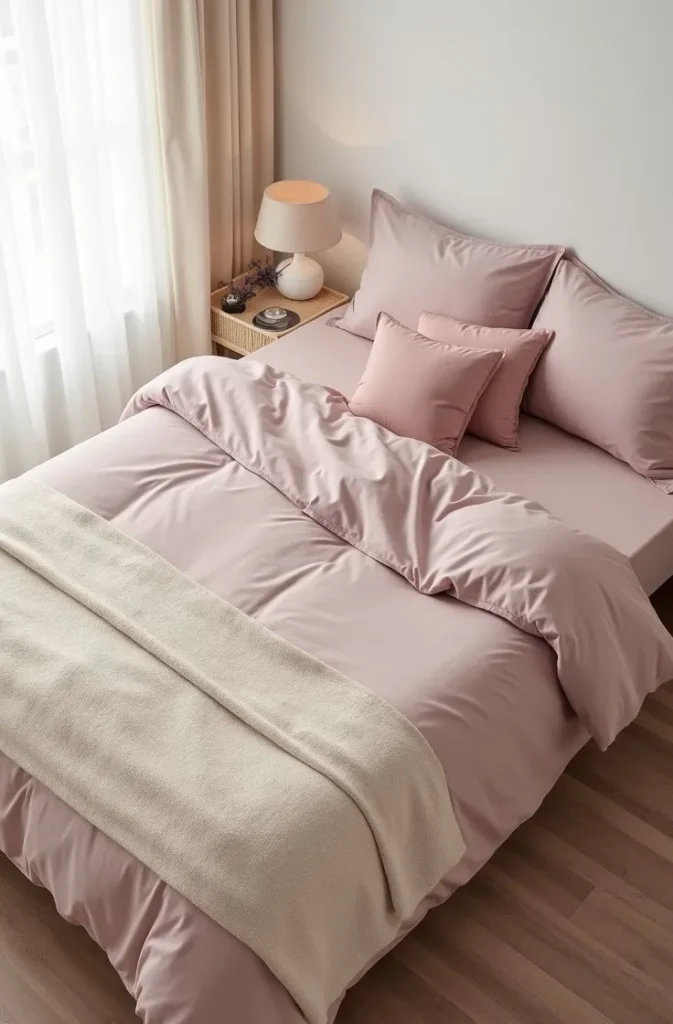
If you love the look of a long overhang on the sides, reserve that for the foot of the bed with a folded throw. Let the throw drape over the edge. It creates the same visual softness without blocking the floor on both sides. This is a cozy dorm room bedding idea that photographs beautifully from above — and it is a detail that most guides skip entirely.
The practical bonus: a properly sized duvet is also easier to manage in a lofted or raised bed frame, which is the default configuration in most university housing from Texas to New England. You are not fighting yards of extra fabric when you are climbing a ladder at 11pm.
How to Pick a Color Palette for Dorm Bedding Without Making the Room Feel Like a Dorm
The color choices available in most big-box college bedding collections are both overwhelming and oddly limiting — bright accent colors, high-contrast patterns, or the same four neutrals in every store. The women who end up with rooms that look genuinely designed choose their palette before they shop, not while they are standing in an aisle.
Start with one anchor color — something that could double as a wall color in a real adult apartment. Think: warm clay, dusty blush, sage green, or a soft charcoal. Then build two supporting colors from that anchor. One should be lighter (cream, warm white, stone), one slightly deeper or warmer (caramel, terracotta, dusty navy). This three-color system is the bedrock of every beautiful dorm bedding setup you have ever saved on Pinterest, whether you realized it or not.
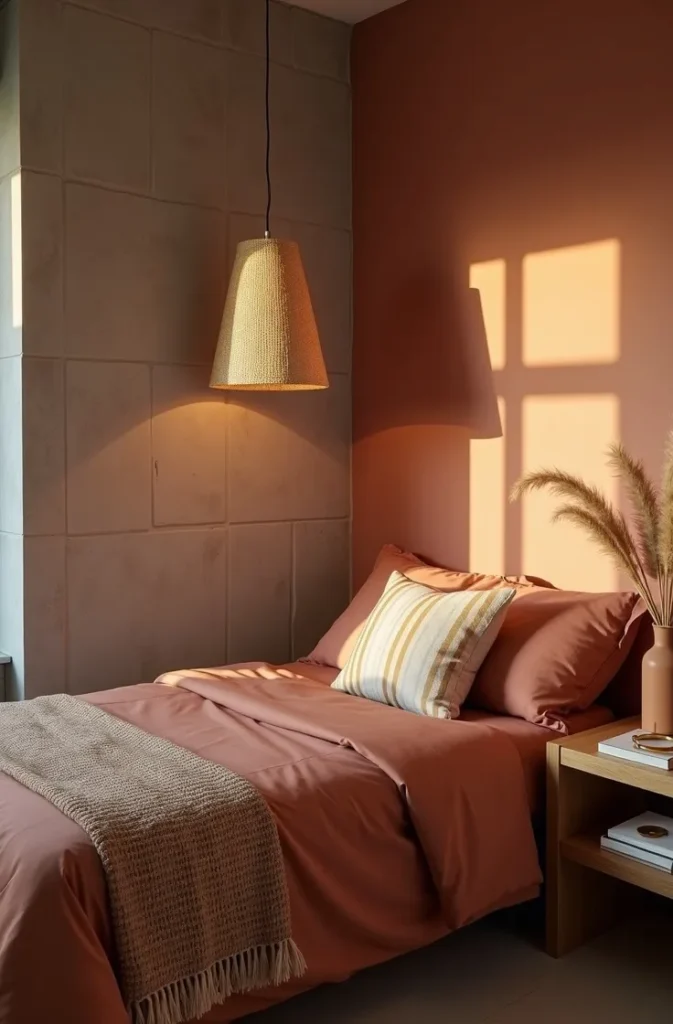
Avoid cool-toned palettes in north-facing dorm rooms — which are common in older Midwest university buildings — because they amplify the institutional coldness rather than fighting it. Warm palettes do the emotional heavy lifting that a small space cannot accomplish through furniture alone. This is one of the most important small dorm room bedding tips that rarely appears in standard college guides.
The mistake that kills otherwise good palettes: adding a fourth color as an accent without testing it against the actual wall color. Bring a swatch home or use the return policy. Cinder block walls in most university housing read as warm gray or cool gray depending on the building, and they will shift your entire palette perception.
The Duvet Cover Fabric That Feels Expensive, Packs Small, and Survives a Shared Laundry Room
Microfiber is what most college bedding is made of, and it is also why most dorm beds look flat and plastic under any kind of light. The fabric reads as cheap because it is — it catches light poorly and wrinkles in a way that looks messy rather than relaxed. Linen and cotton-linen blends do the opposite: they wrinkle in a way that reads as lived-in and beautiful.
A 100% linen duvet cover is the single best investment in the dorm bedding category for women who want the room to look effortlessly styled rather than assembled. It does not need ironing — in fact, it looks better slightly rumpled. It gets softer with every wash. It packs into a backpack for trips home. And it photographs in a way that microfiber simply cannot replicate.
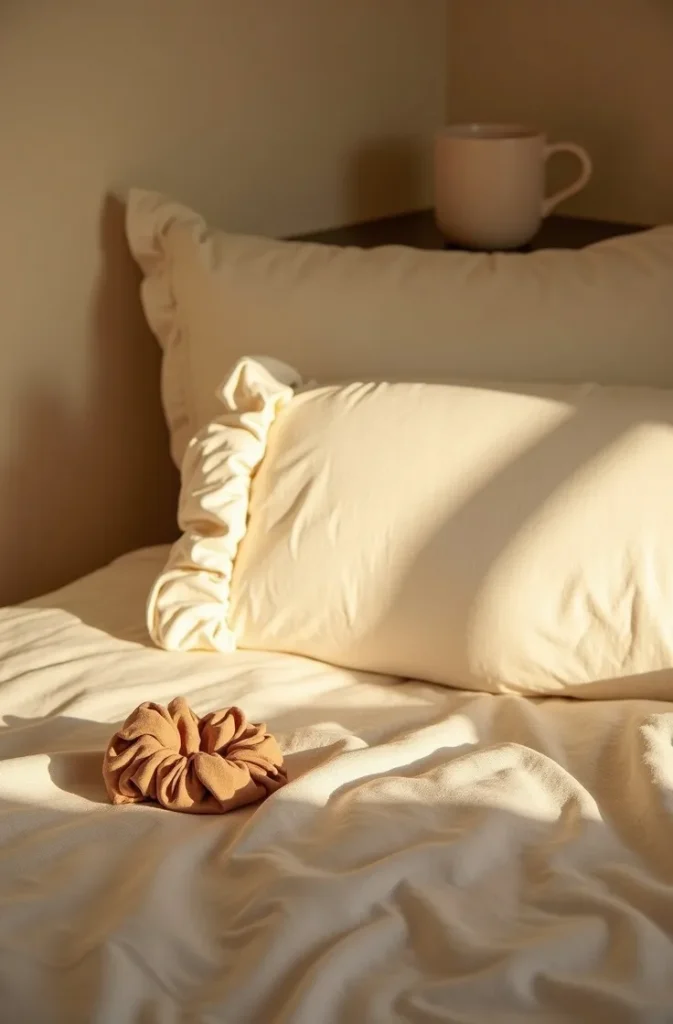
The practical concern most guides skip: linen is not always warm enough on its own in colder climates. Women in dormitories in the Northeast or Upper Midwest should use a linen cover over a down or down-alternative insert rated for the season, rather than relying on the duvet cover itself for warmth. The cover is visual and tactile; the insert is functional. Keep those jobs separate.
For women with sensitive skin — a consideration that matters when you are sleeping in the same sheets for months without the full laundry setup of home — cotton-linen blends are often better than pure linen, which can feel scratchy in the first few washes. A 55% cotton, 45% linen blend gives the visual texture with softness already dialed in.
What to Put Under Your Duvet When Dorm Mattresses Feel Like Sleeping on a Slab
The bedding itself is only half of the sleep equation, and most dorm bedding ideas stop too early — at the top layer — without addressing what is underneath. A standard university mattress, in most housing from California State schools to Big Ten residential halls, is three to five inches thick, usually wrapped in a vinyl-adjacent cover, and built for durability over comfort. It is not built for you.
A mattress topper changes everything about how the bed looks and feels. A two-inch memory foam topper adds height — which changes the visual proportion of the bed relative to the room — and creates the kind of surface that your linen duvet drapes over beautifully rather than lying flat. From a design standpoint, a taller bed with visible mattress height is easier to style than a flat, low profile mattress pushed against the wall.

For the fitted sheet layer, choose cotton sateen over microfiber for the same reason you choose linen for the duvet: it photographs well, feels better against skin, and does not pill. A sateen in a warm white or very pale stone underneath a flax linen duvet creates a layered visual depth that you will notice every single time you walk into your room.
The detail most people miss: the fitted sheet color matters even though it is mostly hidden. When you pull the duvet back in the morning, make a coffee, and sit on the edge of your bed, the fitted sheet is visible. Choosing a shade that coordinates rather than clashes with the duvet makes the bed look thought-through rather than assembled from whatever was on sale.
The Throw Blanket Position That Makes a Dorm Bed Look Styled in Thirty Seconds
Most people fold a throw and place it at the foot of the bed in a neat rectangle. It is tidy, it is inoffensive, and it looks like every hotel bed that has ever left you feeling nothing. The throw placement that actually elevates a dorm bed is the relaxed diagonal drape — pulled from one corner of the foot, across the lower third of the bed, hanging off the opposite side edge.
This diagonal creates a sense of movement and ease that a neat fold kills. It looks like someone has been lying in the room, like the space is lived in and comfortable and not performing tidiness for an audience. That quality — ease, not precision — is exactly what makes a room photograph beautifully and feel calm when you come back to it between classes.

Choose a throw with physical weight for this look: a cotton gauze or a chunky open-weave knit rather than a thin acrylic blanket. Weight is what makes the drape look intentional. A thin blanket just looks like it slipped. A weighty throw in the same position looks like an editorial choice.
For women in shared dorm rooms where the bed doubles as a seating area during the day — which is the reality in most double-occupancy rooms at universities across the Southeast and Northeast — this relaxed styling also signals comfort to guests in a way that a tightly made bed does not. It is a small thing, but it changes the emotional register of the whole room.
The Case for Dark Bedding in a Small Dorm Room (And Why Everything You Were Told Is Wrong)
The conventional advice is always light bedding in a small space — pale tones, white walls, open everything. That advice is not wrong, but it is also the reason most dorm rooms look identical and feel like nothing. Dark bedding, done correctly, makes a small dorm room feel intentional, private, and genuinely personal in a way that light palettes rarely achieve.
A deep forest green, a warm charcoal, or an inky navy in linen or heavy cotton works in a dorm room because it anchors the bed as the clear focal point of the space. The bed stops competing with white walls and becomes the feature. In rooms where you cannot paint, hang wallpaper, or replace furniture, the bedding is the only architectural statement available to you — and dark tones make that statement louder.

The fear most people have with dark bedding in a small room is that it will feel claustrophobic. That only happens when every element in the room is dark — the fear is about contrast, not color. Pair a deep-toned duvet with light walls, a white desk, and light wood or natural rattan accessories, and the room will feel more layered and interesting than any pale-on-pale setup.
This is a specific cozy dorm room bedding idea for women who feel like their current room has no personality. Dark bedding is not a design risk — it is a design decision. And in a 12-by-10 institutional box, deciding is the most powerful thing you can do.
The Sheet Set No One Talks About: Why Your Pillowcases Are the Most Visible Thing in the Room
Dorm bedding conversations almost always focus on the duvet and throw, and almost never on the pillowcase — which is, photographically and visually, the element closest to eye level and closest to the camera in every shot. A plain, uninspired pillowcase undermines everything else you do.
Pillowcases are also the lowest-cost, highest-impact swap in the dorm bedding category. A set of linen pillowcases in a tone that slightly contrasts with your duvet — say, warm cream pillowcases against a dusty sage duvet — adds the layered, tonal quality that makes bedding look curated. You are not matching everything; you are relating everything. That is the difference.
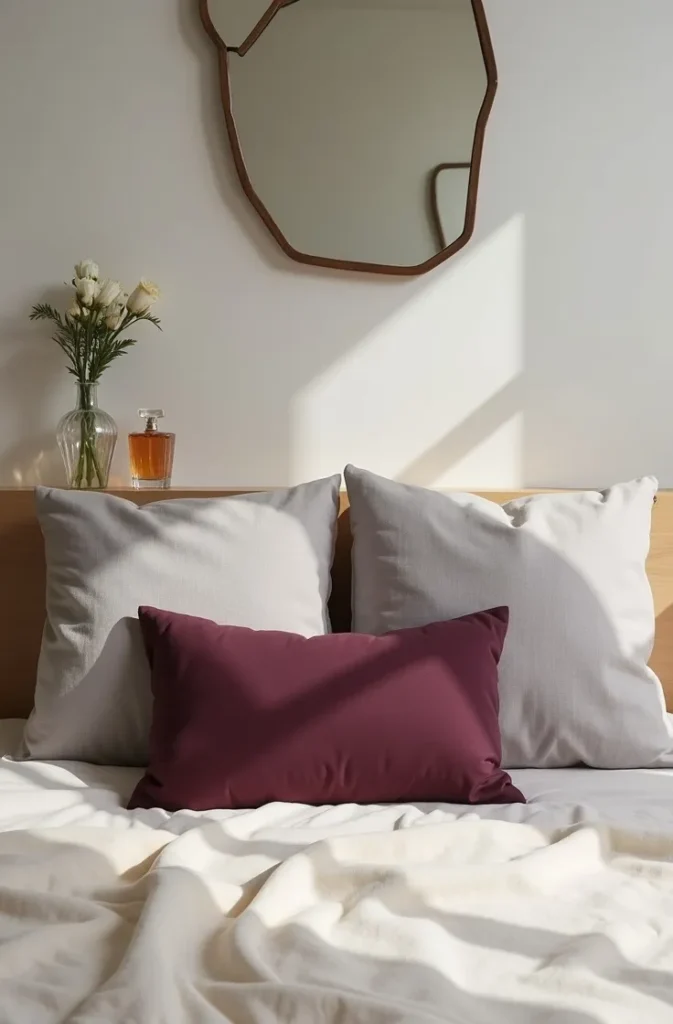
Consider at least one decorative pillowcase with a subtle texture — a ruffle edge, a washed percale with faint stripes, or a solid in a slightly different weight from your main duvet. The contrast in fabric behavior between the pillow surface and the duvet surface creates visual interest that a matchy-matchy set simply cannot generate.
For women who are updating their bedding on a limited dorm budget — which is reality for most students regardless of school — starting with a neutral duvet and investing in two high-quality pillowcases is actually the smarter sequence than buying a full matching set. The cases are visible. The rest can follow.
How to Layer Bedding in a Lofted Dorm Bed Without It Looking Chaotic Up There
Lofted beds are the reality in roughly half of all university housing, and they create a specific visual problem: what looks beautiful at ground level looks entirely different at elevation. The standard approach — same duvet, same throw, same arrangement — often reads as a messy nest rather than a styled bed when viewed from six feet below.
The fix is editing, not adding. Lofted beds benefit from fewer layers, not more. A linen duvet in one tone, one pillow (not three), and one small folded throw at the foot. That is the formula. Every element you add to a lofted bed reads as clutter because the viewer is always looking up at it from an angle.

Color also reads differently at elevation. Slightly deeper tones — a dusty teal, a warm terracotta, a soft mauve — read as more sophisticated from below than pale tones, which tend to disappear into the ceiling or the wall behind them. If you have a lofted bed, this is worth knowing before you buy anything.
The practical secret that no dorm bedding guide mentions: fitted sheets on lofted beds are a wrestling match every time. Invest in a deep-pocket fitted sheet with corner grippers, full stop. It is not glamorous advice, but losing your fitted sheet at 7am changes the emotional experience of your entire morning.
The Bedding Add-On That Doubles as Wall Décor and Costs Almost Nothing
One of the smartest moves in a dorm room with limited wall space and decorating restrictions is turning a folded quilt or blanket into a wall-mounted textile display. A vintage-inspired quilt folded in thirds and hung on a wooden dowel or thin brass rod above the bed creates a headboard effect, a color anchor for the whole room, and a textile art piece — all without putting a single nail into a cinder block wall.
This works because the eye reads a large, patterned textile above the bed as intentional décor rather than just a blanket. It gives the whole room a point of focus, and it visually elevates the bed’s position in the space the way a proper headboard would. For renters and dorm dwellers who cannot install anything permanent, this is one of the highest-value small dorm room bedding tips available.
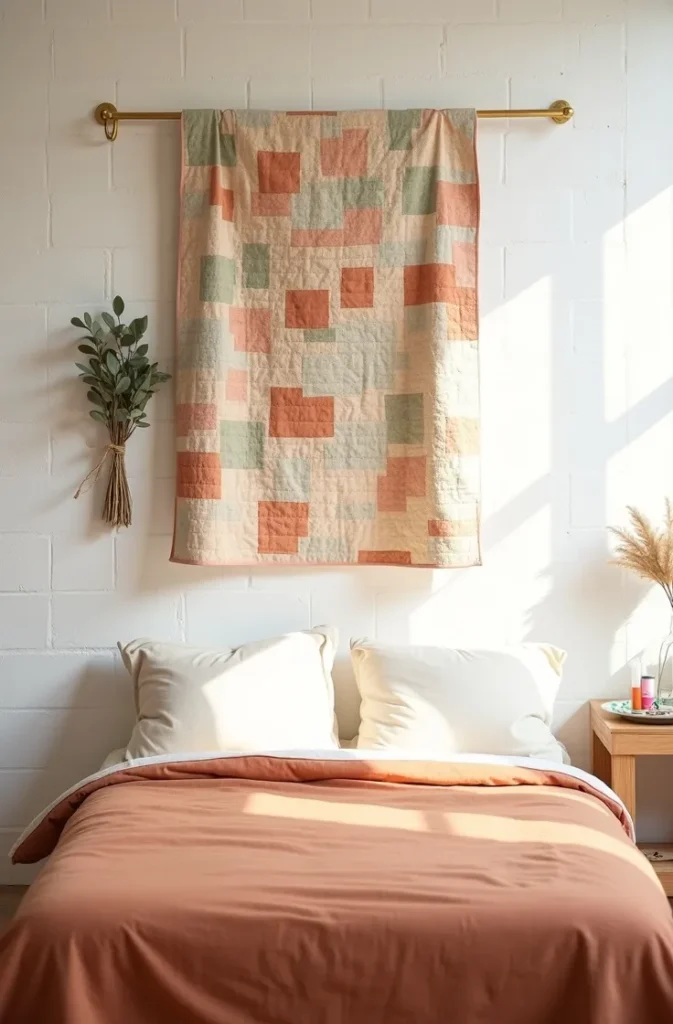
Choose a quilt with a pattern that introduces your secondary color palette: a faded floral in dusty rose and sage, a classic geometric in cream and terracotta, or a modern block-print in your anchor tones. The pattern at eye-height draws the gaze up, which makes the room feel taller — a specific benefit in the low-ceiling drop tiles common in most university housing.
The styling rule for this to work: keep the bedding underneath quieter than the quilt above. If the quilt is the statement, the duvet is the supporting act. A solid linen duvet in one of the quilt’s background tones keeps the room from competing with itself.
The Scent Layer: Why What Your Bedding Smells Like Is Part of the Design
This is not a tip that appears in typical dorm bedding ideas lists, which is exactly why it matters. The sensory experience of a room — including how your bedding smells — determines how that room feels before you consciously evaluate it. A dorm bed that smells like the shared laundry detergent everyone uses on the floor smells like institution. A bed that smells like you is a different emotional experience entirely.
A linen spray — lavender, clean cotton, or a warm sandalwood blend — is a fifteen-second ritual that transforms how your bedding feels the moment you get into it. For women managing stress and academic pressure in small, shared living environments, that sensory shift is genuinely meaningful. This is not luxury for its own sake. It is psychology applied to daily life.
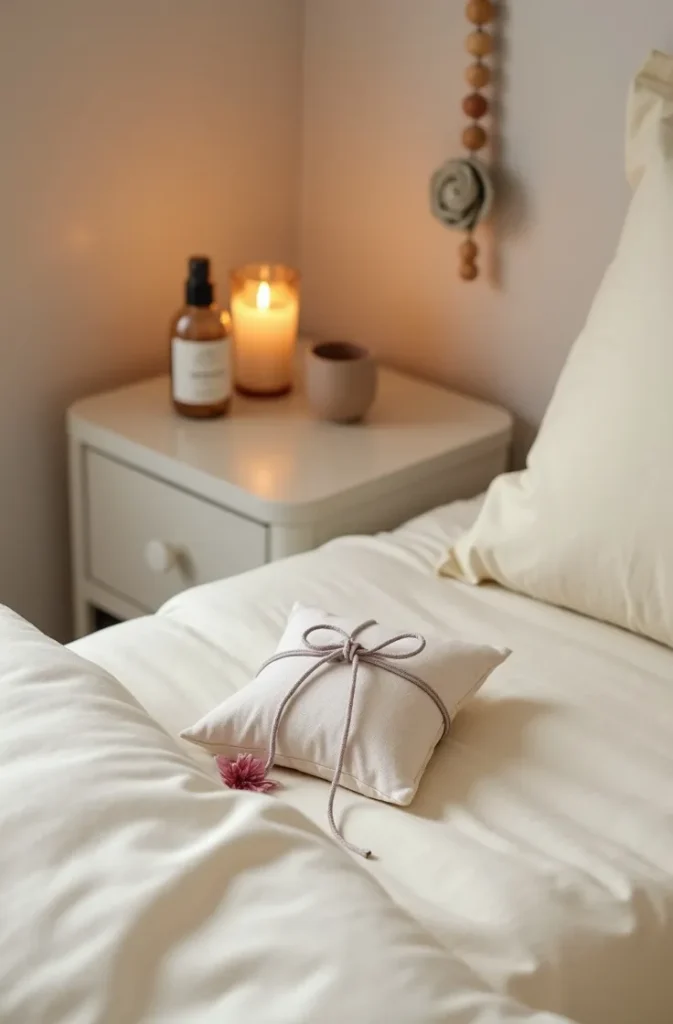
Sachets tucked into pillowcase edges are another option, and they double as a styling detail when left visible on the pillow. A small hand-sewn cotton or linen sachet, simply left on the pillow surface, reads as a quiet, feminine personal touch in a room photograph — the kind of detail that makes a room feel like it was styled for a magazine rather than assembled for survival.
The practical note: avoid oil-based sprays directly on linen or cotton — they can stain. Use water-based linen sprays only, and test on a corner first. Dried herb sachets with no oil are the safest option for light-colored bedding.
Why Your Dorm Comforter Is Failing You in Summer and What to Use Instead
Most dorm move-in happens in late August or early September — peak heat in states like Texas, Georgia, Florida, and California — and yet the default dorm bedding purchase is a heavy comforter rated for winter. The result is sleeping under something that makes the room feel stuffy and the bed feel overwrought before the semester even properly begins.
A lightweight cotton quilt is the summer-to-fall solution that most dorm bedding guides gloss over. It provides just enough warmth for air-conditioned dorm rooms — and most American university dorms run their AC cold enough to require some cover — without the thermal suffocation of a full comforter. It also drapes over the bed beautifully at midday when the bed serves as a sofa.

As temperatures drop through October and November, the layering approach earns its keep: add a light throw first, then swap to a heavier duvet insert in winter while keeping the same duvet cover. This way, the visual language of the room stays consistent all year — only the interior insert changes.
For students at southern universities who will never need a heavy comforter at all, a cotton quilt paired with a waffle blanket is the full-season bedding strategy. This is a practical dorm bedding for college students tip that only becomes obvious after one semester of being too hot to sleep.
The Euro Sham Argument: Why Two Extra Pillows Change the Entire Proportion of a Dorm Bed
Euro shams — the 26-by-26-inch square pillows that most people associate with hotel beds — are almost never included in basic dorm bedding sets, which is a design loss. They are the element that makes a bed look full, considered, and finished in a way that no amount of throw pillows stacked in front of standard pillows can replicate.
The visual function of euro shams is proportion: they are taller than standard pillows, which means they create a better ratio of pillow height to mattress depth on a twin XL bed. Without them, the pillows look short and lost against the wall. With them, the headboard area — even if it is just a wall — has presence.
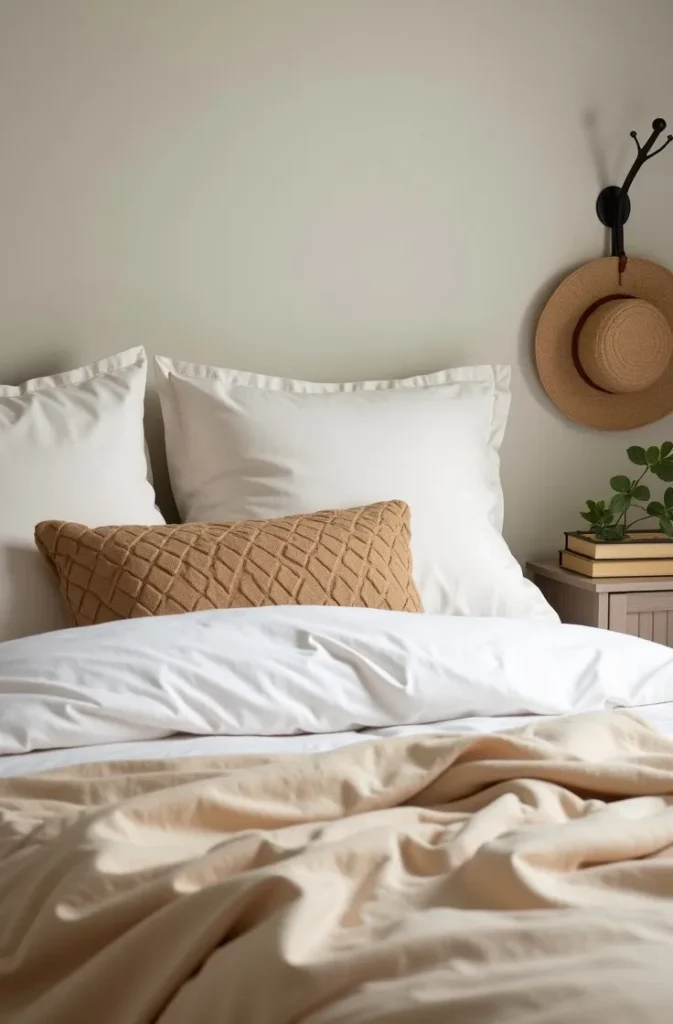
You do not need to purchase an expensive set. Euro sham covers sold separately are often inexpensive, and any inexpensive pillow insert cut to size or a 26-inch form works. The covers are what you see; the forms are just structure.
The important styling rule: euro shams should always be in a solid fabric, or in a very subtle texture. Save pattern for the lumbar and the throw. Euro shams are the canvas, not the painting. This is a minimalist dorm room bedding decision that seems small but completely changes the finished look.
The One Wall Hook That Makes All Your Bedding Decisions Feel Intentional
This is the detail that ties a dorm room together and almost nobody talks about it in the context of bedding: a single wall hook beside the bed, used to hang a throw blanket during the day, becomes the visual bridge between the bed styling and the wall. It makes the throw feel like it belongs in the room rather than tossed on a chair.
When your bed is made and your throw is draped over a matte black or brass hook at headboard height, the bed reads as a designed vignette — not just a mattress with some fabric on it. The hook draws the eye up, introduces the throw’s color and texture as a wall element, and signals that someone made a considered choice about every detail of this space.

This is useful practically as well. In a shared dorm room where a second person’s belongings compete visually with your side, defining your bed as a contained, designed zone — bed, wall hook, throw, small shelf — creates the sense of a personal space within a shared one. It is a boundary drawn in design rather than masking tape.
Adhesive hooks rated for five pounds or more work on most painted cinder block surfaces, though results vary by building. Test adhesion before hanging anything heavy, and use the hook for throws only — not bags or coats — to keep the look intentional rather than utilitarian.
The Neutral Dorm Bedding Formula That Works for Every Roommate Situation
Shared dorm rooms are a specific design challenge that single-occupancy guides completely ignore. When two people split a room, the aesthetic tension — one person loves minimalist neutrals, the other loves maximalist print — is one of the more quietly stressful parts of freshman year. Choosing bedding that holds its own without demanding that the entire room conform to it is a specific and underrated skill.
The formula that works across every roommate dynamic is this: one deeply neutral foundation layer (cream, warm white, oatmeal), one personality color in a single accent piece (a lumbar, a throw), and all other accessories in natural materials (rattan, wood, ceramic). The neutral foundation does not compete with a roommate’s choices. The single accent expresses your personality. The natural materials bridge the visual gap without requiring coordination.

This approach is also what makes the best cute dorm room bedding ideas translate across wildly different room configurations — small rooms at private colleges, larger suites at state universities, and the frustratingly narrow doubles common in New England residential halls. The formula adapts because the neutrals adapt.
What does not adapt: highly specific color palettes with multiple patterns. Two people with competing statement bedding in a 200-square-foot shared room creates visual noise that neither person can solve with accessories. Start with neutral, and let your personality live in one accent layer you can change whenever you want.
The Small Detail That Makes Every Dorm Bedding Setup Look Like It Was Designed for You
There is one detail in every beautifully styled dorm room that never appears in the product listing or the mood board: the personal object. The small thing that signals a real human being lives here, made a choice, and is not trying to replicate a showroom. It is the thing that makes a room feel yours rather than anyone else’s.
In bedding terms, that detail lives on the nightstand or the pillow surface. A specific edition of a book you are actually reading. A small ceramic dish in a shape you chose because it reminded you of something. A dried flower pressed from a trip or a farmers market visit. A single photo in a frame smaller than you think you need.
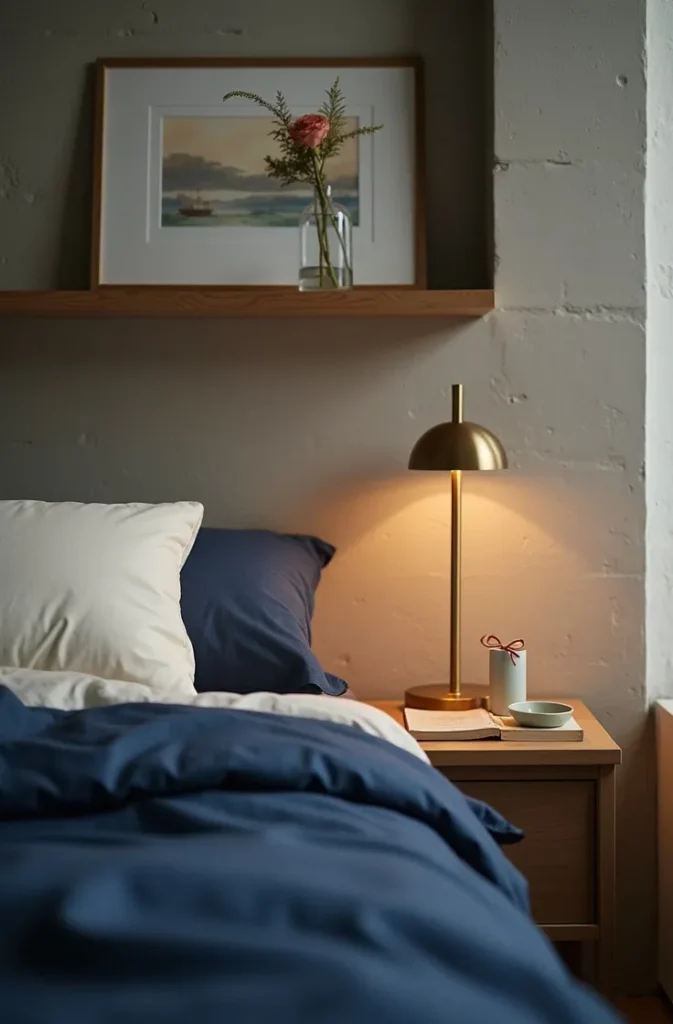
None of these things are bedding. All of them are what makes bedding look intentional. The bedding is the canvas. These objects are the evidence that someone is living inside it.
This is the finishing move in every set of dorm bedding ideas that actually works: stop before you think you are done, and add one small object that has nothing to do with design and everything to do with you. That is the detail that gets saved on Pinterest. That is the detail that makes your room feel like a room and not a setup.
The consistency of every beautifully designed dorm room you have ever saved comes from this: someone made a choice that was entirely personal and left it visible. Do the same.
The Bedding Reset That Takes Fifteen Minutes and Makes Moving Out Feel Like Moving Up
There comes a point in every semester — usually after midterms or during a stretch of difficult weeks — when the dorm room starts to feel like it is closing in. The bedding is wrinkled, the throw is somewhere under the desk, and the whole room has lost the quality it had in September. This is not a décor failure. It is entropy, and the fix is faster than you think.
A fifteen-minute bedding reset — straighten the duvet, refluff the pillows, drape the throw with intention, clear the nightstand to only two or three objects — changes the room more significantly than any new purchase. The design principle at work is signal-to-noise ratio: every unnecessary item on the nightstand is noise. Every removed item makes the remaining objects more meaningful.
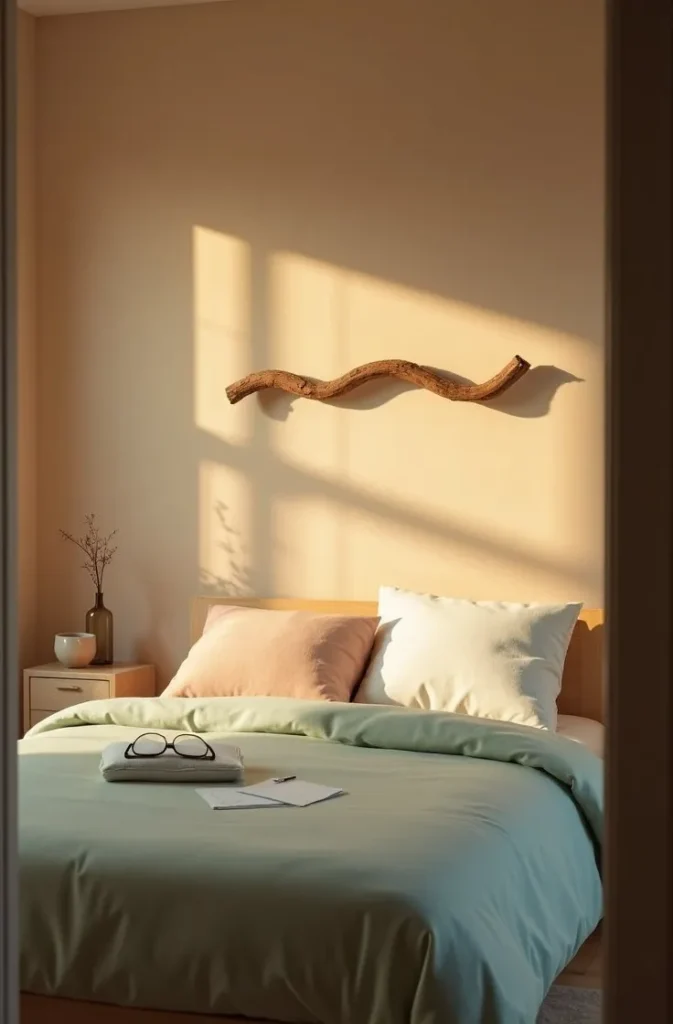
Do this once a week, or even once every two weeks. Treat it like a ritual rather than a chore — it functions that way. Women who live in small dorm spaces and maintain a weekly bedding reset report that the room consistently feels more livable and less stressful, even when everything else in the week has been hard. That connection between visual order and emotional state is not decorating advice. It is how the brain works.
When you pack up at the end of the year, these dorm bedding ideas — the layers, the palette, the personal details — go with you. They become the foundation of the first apartment, the first real bedroom, the first space that is entirely yours. The habit of designing your space with intention does not start when you have more room. It starts now, on a twin XL mattress in a 12-by-10 box, with a duvet you chose and a throw you love.
You came here with a dorm room that needed to feel like more than a place to sleep, and now you have a real plan — not a shopping list, not a mood board with no instructions, but a layered, thought-through approach to bedding that translates to real rooms in real university housing. Save this post the next time you are ready to rearrange, order, or simply reset — the sections are designed to be useful in any order, at any point in the semester. Your space reflects the quality of attention you give it, and now you know exactly where to put that attention.