I’ve stood in hundreds of living rooms that were beautifully furnished — great sofa, perfect rug, considered lighting — and yet something felt unfinished. Almost every single time, it was the walls. Bare, or worse, decorated with something chosen in five minutes because the room needed something. Wall art is the most personal layer of any living room, and it’s the one decision that most people either rush or completely overthink. What I’ve learned, after years of helping people transform their spaces, is that the best wall art doesn’t just fill space — it creates a feeling. It makes a room feel inhabited, intentional, and genuinely yours.
Heading into 2026, the conversation around living room wall art has shifted in a really meaningful direction. People are moving away from the predictable gallery wall of black-framed prints and toward something far more considered: mixed materials, unexpected scale, handmade objects, and art that carries personal resonance rather than just aesthetic convenience. The 15 ideas below are the ones I keep coming back to — ideas that work across different interior styles, different budgets, and different personalities. Each one has the power to completely change how a living room feels. Take your time with them.
1. Oversized Single-Canvas Abstract in Warm Earth Tones
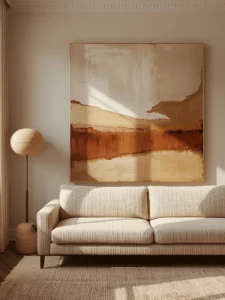
There is nothing in wall art that delivers a more immediate, more confident visual impact than a single oversized canvas — and in 2026, the paintings commanding the most attention are loose, gestural abstracts in warm earth pigments: raw sienna, burnt umber, ochre, warm white, and deep charcoal. These aren’t tight, precise compositions — they’re expressive, layered, and full of the kind of energy that makes a living room feel genuinely alive.
The key word is oversized. A canvas that feels almost too large for the wall is almost always the right choice — it fills the room with presence and eliminates the apologetic, undersized art problem that plagues so many living rooms. Commission from an independent artist or invest in an original piece: the texture, the brushwork, and the physical presence of a real painted canvas on linen is something no print can replicate. This is the living room’s defining statement, and it deserves to be treated as one.
2. Woven Textile Wall Art in Natural Undyed Fibers
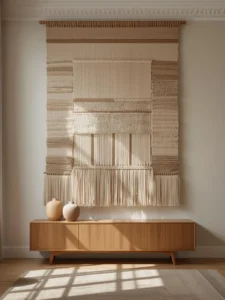
The shift from framed prints to three-dimensional textile art is one of the most significant movements in living room wall design heading into 2026. Large-format hand-woven wall hangings — created in undyed wool, raw linen, cotton rope, and natural jute — bring a level of material depth, warmth, and tactile richness to a wall that no flat artwork can match. They absorb sound, add texture, and introduce the unmistakable signature of the handmade into a space.
The best versions in 2026 are moving beyond the fringed boho hangings of the previous decade toward something more architectural and considered: structured weaves with geometric undertones, layered material combinations, and larger scales that command full walls rather than decorating corners. Commission from an independent weaver or textile artist for a piece that is genuinely one of a kind. The investment is significant, but the result — a wall that is simultaneously art, textile, and sculpture — is entirely worth it. This is art you want to reach out and touch.
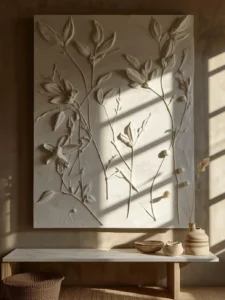
3. Plaster Relief Panel as Living Room Wall Sculpture
Moving completely off the canvas and into three dimensions, the hand-crafted plaster relief panel is one of the most sophisticated and genuinely original wall art directions available in 2026. These are panels — typically mounted on timber backing — where pigmented plaster has been sculpted, impressed, or textured by hand to create a surface of extraordinary depth: organic forms, geometric patterns, botanical imprints, or pure abstract relief that casts its own shadow as light moves across it.
The result is a wall artwork that changes throughout the day as the light source shifts — morning sun creates completely different shadow depths than afternoon light or evening lamplight. In warm white, pale stone, or dusty sand plaster tones, a relief panel blends seamlessly with any neutral living room palette while adding a sculptural presence no print or painting achieves. Independent ceramic and plaster artists are producing extraordinary work in this space right now, and the commissions are more accessible than you might expect.
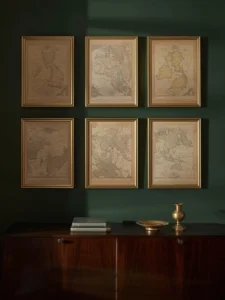
4. Vintage Map Collection in Matching Slim Frames
There is something endlessly compelling about antique cartography — the hand-drawn coastlines, the faded color, the handwritten place names — and in 2026, curated collections of vintage maps are becoming one of the most talked-about living room wall art directions. A grouping of 4–6 genuine antique maps (or high-quality archival reproductions) in matching slim brass or pale ash frames creates a wall installation that is simultaneously intellectual, decorative, and deeply personal.
The maps can be chosen for personal significance — cities you’ve lived in, countries you’ve explored, places that shaped you — or purely for their aesthetic beauty: hand-colored sea charts, early city plans, botanical survey maps. The key is consistency in framing and intentionality in arrangement: a tight, salon-style grid rather than a scattered arrangement. Against a deep-toned wall — forest green, navy, or terracotta — this collection becomes a conversation piece that rewards every visitor who gets close enough to read the details.
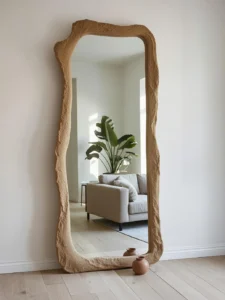
5. Floor-Leaning Oversized Framed Mirror as Art
The oversized leaning mirror has been a living room staple for years — but in 2026 it’s being reframed (literally) as a deliberate wall art choice rather than a functional addition. The difference is in the frame: a substantial, sculptural frame in aged plaster, carved wood, papier-mâché, or cast resin — organic, irregular, or architecturally bold — transforms a mirror from a practical object into the room’s most dramatic focal point.
Leaning rather than hanging communicates ease and intentionality simultaneously — it says the room is curated, not decorated. A mirror of this scale also doubles the perceived size of the room and multiplies the light, making it as practical as it is beautiful. In a living room with a fireplace, lean it on the mantel. Against a plain wall, prop it directly on the floor with a small ceramic object placed at its base. Either way, it anchors the wall with more drama than almost any framed artwork could achieve.
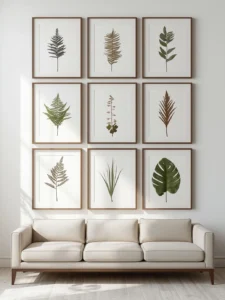
6. Pressed Botanical Grid in Archival Frames
Nature brought indoors — with extraordinary precision and editorial restraint. A grid of pressed botanical specimens, each individually matted with a generous white border and framed in matching slim black or dark oak archival frames, creates a living room wall installation that feels simultaneously scientific and deeply beautiful. In 2026, the most compelling versions use oversized frames (50x70cm or larger) with a single specimen centered on a vast white mat — the negative space is as important as the plant.
Choose specimens with visual drama: large fern fronds, tropical leaves, grasses with seed heads, or flowering herbs. Source genuine pressed specimens from botanical suppliers or press your own — the imperfection of a hand-pressed specimen is part of its beauty and authenticity. Arrange in a tight, evenly spaced grid of 4, 6, or 9 frames. Against a white or pale plaster wall, this installation reads as a private natural history museum — refined, curious, and endlessly rewarding to look at closely.
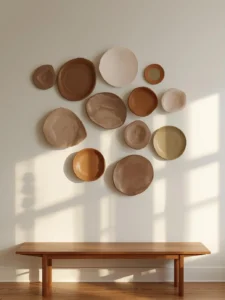
7. Hand-Thrown Ceramic Wall Discs Composition
Individual hand-thrown ceramic wall discs — each one slightly different in diameter, surface texture, and glaze tone — arranged in a loose, organic cluster composition on a living room wall are one of the most quietly stunning art installations possible in 2026. Each disc is a small sculptural object: the finger marks of the maker visible in the clay, the glaze pooling differently in each depression, the edge profile varying subtly from disc to disc.
Together, a composition of 9–15 discs in complementary tones — warm stone, dusty sage, matte cream, pale blush — creates a wall that feels alive with craft, color, and texture. The arrangement should feel intentional but not rigid: varying the spacing, mixing sizes, and allowing the composition to breathe gives it an organic quality that a formal grid cannot achieve. Commission from an independent ceramicist — many now offer living room wall disc sets specifically designed for this purpose. This is art and craft in perfect combination.
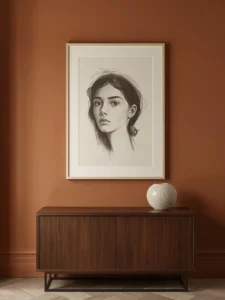
8. Large-Scale Charcoal Portrait Drawing
The portrait — a human face, rendered with skill and sensitivity — is making a powerful return to living rooms in 2026, and the medium driving that return is charcoal on large-format paper or linen. A single large charcoal portrait, loosely and expressively drawn, brings an unmistakable human presence into a room. It doesn’t need to be a recognizable face — the best versions are semi-abstract, the features suggested rather than defined, the expression carrying emotional weight without biographical specificity.
Mounted in a simple wide-mat frame (the mat should be at least 10cm on all sides) and hung as the sole artwork on a significant wall, a charcoal portrait becomes the room’s emotional center. It asks something of the viewer — it creates a relationship between the art and the person standing before it. In a living room designed to be a place of genuine rest and connection, that’s exactly what the best wall art should do. Commission from a figurative artist whose style resonates with you personally.
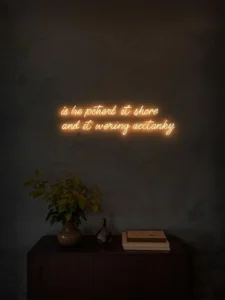
9. Neon Typography Wall Installation
Where every other idea on this list tends toward the quiet and organic, a single neon typography installation cuts through with confident, vibrant energy — and in 2026, it’s being done with far more sophistication than the mass-produced neon signs of recent years. Custom-bent LED neon in a meaningful phrase, a single word, or even a simple abstract form brings living color, warm light, and genuine personality to a living room wall in a way nothing else can.
The key is customization and restraint. One neon piece, on one wall, in a carefully chosen color (warm white and soft gold are the most versatile; deep rose and sage green are the most characterful) against a dark or richly painted wall surface. The neon itself becomes the room’s ambient light source in the evening, transforming the atmosphere entirely. It works in both minimalist spaces (where it provides the single decorative note) and in more eclectic interiors (where it anchors a gallery wall). This is living room wall art that literally glows.
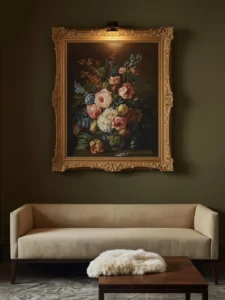
10. Antique Oil Painting in Ornate Gilded Frame
In a design era that has largely embraced the new, the minimal, and the handmade-contemporary, there is something surprisingly radical and deeply compelling about placing a genuine antique oil painting — in a properly ornate gilded frame — at the center of a living room wall. Not a reproduction. Not a thrift store find painted over. A real oil painting, chosen for the quality of the work and the beauty of the frame, hung with intention and confidence.
Antique oil paintings — landscapes, still lifes, figurative works — are more accessible than most people realize through auction houses, antique dealers, and specialist online platforms. In 2026, the design conversation around mixing periods and styles has matured to the point where an 18th-century Dutch still life above a contemporary linen sofa doesn’t create tension — it creates the kind of layered, collected interior that feels genuinely lived-in and impossibly stylish. The ornate gilded frame against a modern backdrop is the contrast that makes both elements sing.
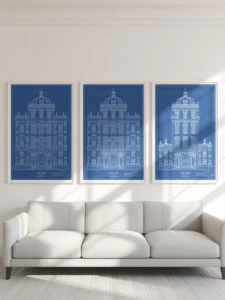
11. Architectural Line Drawing Series in Blueprint Blue
Technical architectural drawings — floor plans, structural elevations, construction details — rendered at large scale in the classic blueprint color palette (white lines on deep Prussian blue) create a living room wall art series that is simultaneously intellectual, graphic, and strikingly beautiful. In 2026, this is being done with original architectural drawings (sourced from demolition archives or architectural estates) as well as newly commissioned drawings of meaningful buildings or spaces.
A series of three vertically oriented blueprint prints in matching slim white or chrome frames, hung in a precise horizontal line, creates a graphic, considered gallery that rewards the viewer who takes the time to read the architectural detail. Choose subjects with personal meaning — the building where you met your partner, the house you grew up in, a building that inspires you — and the installation becomes biographical art. Against a white or very pale wall, the deep Prussian blue provides all the color the room needs.
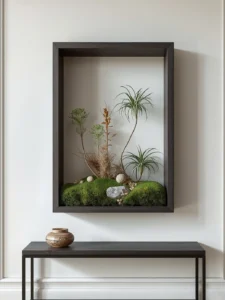
12. Living Plant Wall Frame: Moss & Air Plant Art
The boundary between wall art and living garden dissolves completely in the living plant wall frame — a shadow-box-style deep frame housing a composition of preserved moss, living air plants (tillandsia), dried botanicals, and natural wood elements arranged as a curated three-dimensional tableau. In 2026, these are being designed and installed with the same editorial precision as any framed artwork, and the results are extraordinary.
Air plants require no soil and minimal care — a light misting twice a week — making them the most practical living element possible in an interior context. The preserved moss requires nothing at all. Together, within a beautifully crafted deep frame in oak or blackened steel, they create a wall artwork that is simultaneously botanical, sculptural, and entirely alive. No two pieces are identical, and as the air plants grow and change, the composition evolves over time. It’s the only wall art that grows with you.
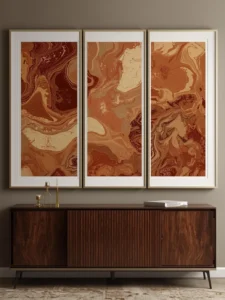
13. Hand-Marbled Paper Panel Series
Marbling — the centuries-old technique of floating oil-based pigments on a water surface and transferring the pattern onto paper or fabric — produces some of the most visually hypnotic surfaces in all of decorative art. In 2026, large-format hand-marbled paper panels (or marbled fabric stretched on canvas frames) are being used as living room wall art with spectacular effect: the fluid, organic swirl of pigment in rich jewel tones or soft neutrals creates a surface that is simultaneously abstract, painterly, and unmistakably handmade.
The most compelling version for a living room is a triptych of three large panels, each marbled in the same color family but with completely different pattern results — because no two marbled sheets are ever identical. In deep terracotta and gold, moody navy and teal, or soft blush and cream, a marbled panel triptych commands a wall with genuine artistic presence. Frame simply — wide white mat, thin profile — to let the marbling speak entirely for itself.
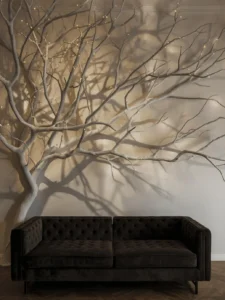
14. Sculptural Branch Installation with Integrated Lighting
The most architecturally ambitious wall art idea on this list — and the one that generates the most visceral reaction when executed well — is the sculptural branch installation: a composition of large, organically shaped branches (dried, bleached, or painted) mounted directly on or projecting from the living room wall, with small integrated LED spotlights or fairy lights woven through the composition to create a living, glowing natural sculpture.
This is not a casual undertaking — it requires planning, proper wall fixings, and an eye for composition — but the result is unlike anything else in interior design. The installation fills vertical space that no conventional artwork could occupy, creates dramatic shadow play on the wall surface, and brings an almost theatrical natural energy into the room. In a tall-ceilinged living room, branches can be scaled to fill the full height of the wall. In a standard room, a more compact composition above a sofa or console creates the same emotional impact at a smaller scale.
15. Personal Photo Collection in Unmatched Vintage Frames
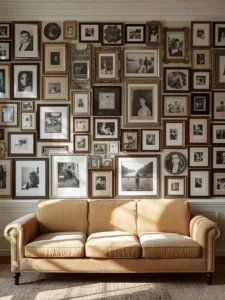
The final idea is also the most personal — and in 2026, intentional personal expression in living room art is the strongest design trend of all. A collection of meaningful personal photographs — printed in black and white or sepia on matte archival paper — displayed in a deliberately eclectic mix of vintage frames (different sizes, different finishes, different profiles, sourced from flea markets and antique shops over time) creates a living room wall that is entirely, irreplaceably yours.
The magic is in the intentional imperfection. The frames don’t match — and that’s the entire point. Each one has its own history, its own patina, its own character. Together, arranged in a salon-style composition that fills the wall generously, they tell the story of a life, a family, a set of experiences that belong to no one else. In an era of mass-produced art and generic aesthetic templates, a wall like this is the most radical and the most beautiful statement a living room can make. It says: someone real lives here.