Over the past few years, I’ve seen more bathrooms than I can count — and the one thing that trips up almost every single project is the cabinet decision. People underestimate how much the cabinet choice defines the entire room. In 2026, I’ve watched bathroom cabinet design evolve from purely utilitarian storage into one of the most expressive design moves in the whole home. The materials, the placement, the hardware, the finish — every detail now carries enormous visual weight.
What I keep seeing is that people searching for bathroom cabinet ideas in 2026 are not just looking for storage. They are looking for a feeling. They want their bathroom to look intentional, calm, considered — like it was designed, not just assembled. These 19 ideas represent the most interesting, forward-thinking directions I’ve encountered this year. Each one solves a real problem while doing something genuinely beautiful at the same time. Read through them carefully — your perfect cabinet solution is almost certainly in here.
1. The Flush Integrated Plaster Cabinet
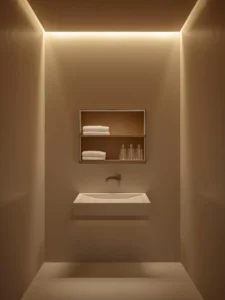
The flush integrated plaster cabinet is built directly into the wall and coated in the same plaster finish as the surrounding surface, making the cabinet face virtually disappear. There are no visible frames, no contrasting materials, no hardware — just a seamless wall that opens to reveal storage. In 2026, this is the ultimate expression of quiet luxury in bathroom design. It works in any size bathroom but is transformative in small ones, where removing visual breaks on the wall makes the entire room read as larger and more composed.
The cabinet doors are opened by a gentle push-to-open mechanism or a slim recessed finger pull pressed flush into the plaster. Inside, shelves are finished in a contrasting warm wood or lacquered surface to create a satisfying reveal. This idea suits people who want their bathroom to feel like a high-end spa where nothing competes for visual attention.
2. The Smoked Glass Front Cabinet
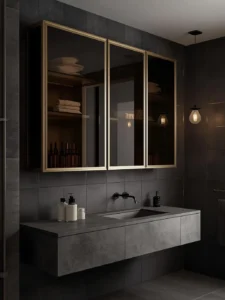
Smoked glass cabinet fronts thread the line between concealing and revealing — you can sense what is stored inside without seeing it clearly, which creates a visual softness that solid doors cannot achieve. In 2026, smoked glass in bronze, charcoal, and deep green tints has become one of the most requested cabinet finishes in bathroom renovations. It brings a moody, layered quality to the space while still reflecting light in a way that opens up the room. It pairs beautifully with warm brass hardware and dark grout lines.
The smoked glass front works especially well for upper wall cabinets where the contents are typically more uniform and decorative — folded towels, matching apothecary bottles, candles — and the gentle visual blur of the glass makes even everyday items look curated and intentional. This is a high-impact upgrade that can be retrofitted onto existing cabinet frames.
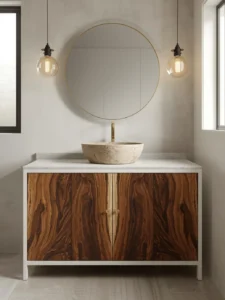
3. The Live-Edge Timber Vanity Cabinet
Incorporating a live-edge timber slab as either the cabinet door face, the vanity top, or a floating shelf element brings raw, unrepeatable natural character into the bathroom in a way that no manufactured finish can imitate. In 2026, the live-edge timber trend has matured from novelty into a genuine design language — used with restraint and paired with mineral surfaces like stone, plaster, and concrete rather than competing materials. Each piece is unique, which makes the cabinet itself a one-of-a-kind object in the room.
The timber must be properly sealed for bathroom humidity, which is now entirely achievable with modern waterproof hardwax oils that preserve the natural texture without plastic-looking coating. Pair with matte black or unlacquered brass hardware to let the timber remain the clear visual star. This idea works especially well in bathrooms that lean into natural, organic, or Japandi-influenced aesthetics.
4. The Recessed Niche Cabinet Tower
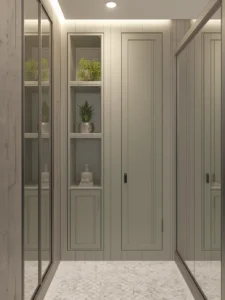
Instead of a freestanding cabinet or a surface-mounted unit, the recessed niche cabinet tower is built entirely within the wall cavity — a full-height vertical tower of shelving and enclosed storage recessed flush with the wall plane. In 2026, this has become the space-saving solution of choice for narrow bathrooms where every centimeter of floor space is precious. The tower sits between wall studs or within a purpose-built recess and provides substantial storage without projecting into the room at all.
The tower can mix open niches for decorative display with closed sections behind flush doors, creating a rhythmic pattern that is itself a design feature. Finished in the same tile as the surrounding wall or in a contrasting material like fluted wood veneer, the recessed tower becomes an architectural focal point rather than simply a storage unit. It is particularly effective on the wall opposite the vanity.
5. The Floating Double Vanity With Waterfall Side Panel
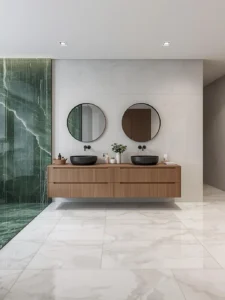
The floating double vanity cabinet is elevated off the floor — typically 40–50 cm above ground — giving the room an airy, generous feel and making cleaning dramatically easier. What makes the 2026 version distinctive is the addition of a waterfall side panel: the vanity material — whether stone, wood, or lacquered board — continues down the outer side face to the floor in one unbroken vertical plane, creating a sculptural, furniture-like finish on the exposed end of the cabinet.
This waterfall panel transforms what is usually a raw side edge into a deliberate design statement. It makes the vanity look custom-built and considered from every angle, not just the front. In shared bathrooms, a double floating vanity with this treatment becomes the visual centerpiece of the room, especially when the waterfall panel material contrasts slightly with the cabinet fronts — a stone-effect panel on an all-wood vanity, for instance.
6. The Fluted Wood Cabinet Front
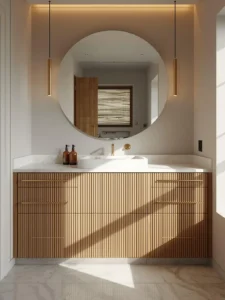
Fluted detailing — vertical parallel grooves pressed or routed into a surface — has become one of the defining textures of 2026 interior design, and nowhere does it land better than on bathroom cabinet fronts. The vertical rhythm of fluting adds enormous visual interest to a flat cabinet face without requiring color, pattern, or ornamentation. It catches and breaks light differently throughout the day, making the cabinet feel alive rather than static. It also disguises fingerprints and minor imperfections far better than a completely flat surface.
In natural oak, walnut, or painted MDF, fluted fronts work across almost every bathroom style — from warm Scandinavian to bold contemporary to relaxed coastal. In 2026, the trend has moved toward wider, more pronounced flutes rather than the fine reeding seen in previous years, giving the cabinet face a stronger, more architectural presence. Pair with a simple bar handle in brushed brass or matte black.
7. The Full-Height Bathroom Cabinet Wall
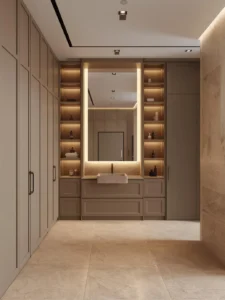
Taking the same logic as the bedroom wardrobe wall, this bathroom approach dedicates one complete wall — floor to ceiling, edge to edge — to a fully integrated cabinet system that combines open shelving, closed storage, mirror panels, and even a concealed laundry hamper into one seamless architectural installation. In 2026, this is the solution that bathroom designers recommend most frequently for family bathrooms and master ensuites where storage demand is high but available wall space is limited to one good wall.
The key to making the full-height cabinet wall feel luxurious rather than institutional is breaking it into visual sections — varying door heights, mixing matt and reflective finishes, incorporating a built-in mirror zone at eye level. When done well, the cabinet wall looks like it was always part of the architecture of the home rather than something installed after the fact.
8. The Aged Brass Hardware Statement Cabinet
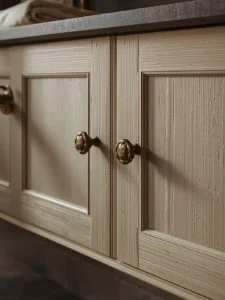
In 2026, the hardware on a bathroom cabinet has become as considered as the cabinet itself — and aged brass has emerged as the finish with the most depth, character, and visual staying power. Unlike polished brass, aged or unlacquered brass develops a living patina over time, deepening and darkening in ways that feel organic rather than manufactured. A simple, otherwise understated cabinet in white or grey instantly reads as sophisticated and deliberate the moment aged brass hardware is applied.
The hardware style matters enormously — chunky artisanal knobs in irregular shapes, long arched pulls, or slim cylindrical bar handles each create a completely different character on the same cabinet body. In 2026, the most compelling combinations pair aged brass hardware with cabinet finishes that have their own quiet texture: limewash paint, stone veneer, ribbed lacquer, or wire-brushed timber. The hardware becomes the jewelry of the cabinet.
9. The Mirror Cabinet That Spans the Full Vanity Width
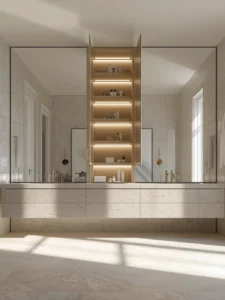
Most mirror cabinets are small, awkward boxes positioned above a single basin — and they look exactly like that. In 2026, the full-width mirror cabinet changes the proposition entirely: it spans the complete width of the vanity below it, reaches to the ceiling, and functions simultaneously as a full-length grooming mirror, generous concealed storage, and a major light-amplifying surface. The result is a bathroom that looks twice the size and is dramatically more functional than any conventional mirror-and-cabinet arrangement.
The full-width mirror cabinet works especially well when the cabinet depth is stepped slightly, with the outer mirror panels flush and the central section recessed to hold deeper items. Interior LED lighting activates when the doors open. The mirror surface — whether plain glass, antiqued, or bronze-tinted — reflects the entire opposite wall and floods the room with borrowed light. This is one of the highest-value upgrades available in bathroom renovation for the space it transforms.
10. The Open Shelf Lower Cabinet With Basket Storage
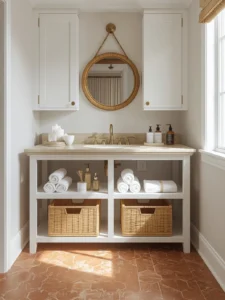
Replacing the lower vanity cabinet doors with an open shelf zone — and using woven rattan, seagrass, or linen baskets to contain the stored items — creates a bathroom that feels lived-in, warm, and intentionally relaxed in a way that fully closed cabinetry rarely achieves. In 2026, this hybrid approach has gained significant momentum because it solves one of the core frustrations of bathroom storage: things that need to be grabbed quickly — toilet rolls, cleaning products, towels — are accessible without opening and closing doors constantly.
The open lower shelf works best when the baskets are matching or tonal, creating a visual consistency that reads as curated rather than cluttered. The upper portion of the vanity can remain closed for items that benefit from concealment. This approach suits coastal, rustic, Japandi, and warm contemporary bathroom styles and photographs exceptionally well — a key consideration for anyone planning a home that appears on social media or is being prepared for sale.
11. The Tall Freestanding Linen Tower Cabinet
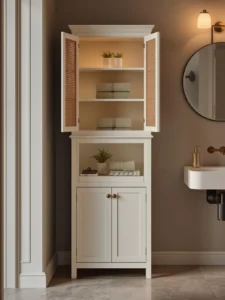
The freestanding linen tower is a slim, full-height cabinet — typically 30–40 cm wide and 180–200 cm tall — that sits beside the vanity or in a corner and provides generous, vertical storage without requiring any installation or wall fixings. In 2026, the linen tower has been redesigned for a new era: it is no longer a boxy, old-fashioned piece but a considered furniture object with architectural proportions, interesting material combinations, and hardware that ties it to the rest of the bathroom’s design language.
The modern linen tower combines open upper shelves with closed lower doors, often in a contrasting material — a white lacquer body with a cane insert panel, a walnut body with smoked glass, a fluted oak tower with aged brass knobs. Crucially, it is designed to be a visual statement in its own right rather than something that looks like it is trying to hide. For renters or those in temporary accommodation, this is the most impactful cabinet addition that requires zero commitment to the walls.
12. The Illuminated Toe-Kick Cabinet Base
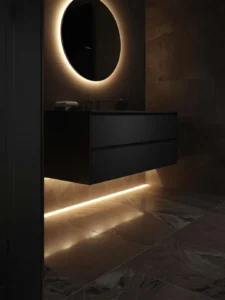
The toe-kick is the recessed strip at the very base of a cabinet — typically 10–15 cm high — that allows you to stand comfortably close to the counter. In 2026, designers have transformed this overlooked zone by running continuous LED strip lighting inside it, so the cabinet appears to float above the floor on a ribbon of warm light. The illuminated toe-kick is one of the highest visual-impact, lowest-cost upgrades in bathroom design, and yet it remains genuinely underused outside of high-end renovations.
The floating light effect works with any cabinet style and dramatically changes the atmosphere of the bathroom at night when overhead lights are dimmed. It makes even a modest vanity look architecturally elevated and spa-like. The LED color temperature matters enormously — 2700K warm white is the standard for relaxing bathrooms, while cooler 3000K suits more clinical or contemporary spaces. This single detail can transform the entire evening experience of your bathroom.
13. The Curved Corner Cabinet
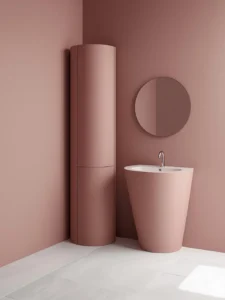
Most bathrooms have at least one awkward corner that sits entirely unused — and in 2026, the curved corner cabinet has emerged as the most elegant solution to that wasted space. Rather than a sharp-edged box unit crammed into the corner, the curved cabinet has a gently rounded front face that flows from one wall plane to the other in a smooth arc. This curve instantly softens the whole room, introduces movement and interest, and makes the corner feel purposeful rather than problematic.
The curved front can be achieved in timber with steam-bent veneers, in lacquered MDF with a factory-curved door, or in a custom plaster surround that treats the cabinet as built architecture rather than furniture. In 2026, curve-forward design is one of the strongest macro trends across all of interiors, and the curved corner cabinet brings that language into even the most practically-constrained bathroom spaces. It works particularly well as a tall storage column in family bathrooms.
14. The Medicine Cabinet With Integrated Phone Shelf
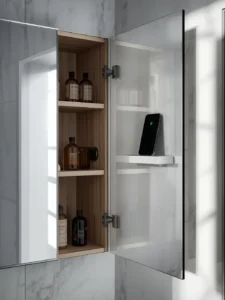
The modern bathroom is where many people spend time scrolling, playing audio, managing routines — and the 2026 medicine cabinet has been designed to accommodate this reality rather than pretend it doesn’t exist. Integrated within the cabinet frame, at a comfortable viewing height, is a slim horizontal niche or shelf — deep enough to prop a phone upright and fitted with a discreet USB-C charging port recessed into the back surface. The phone can be consulted, charged, or used for audio without resting on the wet counter.
This design is a direct response to how people actually use their bathrooms today, and it removes one of the most common sources of bathroom clutter — the phone sitting awkwardly on the counter or balanced on a soap dish. The integrated shelf and charge point are flush with the cabinet interior and entirely invisible when the door is closed. This is a small detail with enormous daily functional impact, especially for people with detailed morning routines.
15. The Two-Tone Cabinet Finish
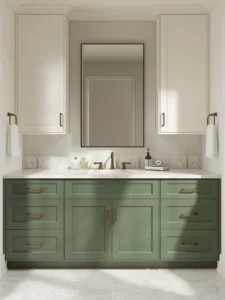
Choosing two complementary but distinct finishes for the upper and lower cabinets in a bathroom — rather than a uniform single finish throughout — creates visual layering, depth, and a custom-designed quality that single-finish cabinetry simply cannot match. In 2026, the most refined two-tone combinations pair a darker, richer lower cabinet with a lighter, quieter upper section — deep sage lower with soft white upper, warm walnut lower with pale linen upper, charcoal lower with blush upper. The contrast draws the eye downward, grounding the room visually and making ceilings feel higher.
The two-tone approach is also one of the most effective ways to refresh existing cabinetry without full replacement — repainting or reskinning either the upper or lower set while leaving the other in place creates an almost entirely new room for a fraction of the cost. This is one of the reasons this idea has resonated so strongly in 2026: it is both aesthetically forward and practically achievable for almost any budget and skill level.
16. The Outdoor-Inspired Teak Cabinet
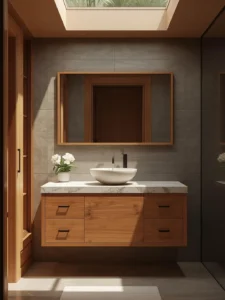
Teak’s extraordinary natural resistance to moisture, swelling, and humidity makes it one of the most intelligent timber choices available for bathroom cabinetry — and in 2026, it has crossed over from outdoor furniture into bathroom interiors with remarkable visual impact. The warm honey-to-amber tones of teak, its tight grain, and its oily natural finish bring the feeling of a tropical resort spa into a domestic bathroom in a way that is both authentic and deeply practical. It requires no sealing and ages gracefully over time.
Teak bathroom cabinets work at their very best when paired with stone surfaces — particularly white marble, dark slate, or sandy limestone — and with brushed stainless or matte black hardware that complements rather than competes with the timber’s warmth. In 2026, designers are using teak not just for vanities but for full-height tower cabinets, recessed shelving, and even cabinet fronts in wet rooms and open showers where its water-resistance is most valued.
17. The Hidden Laundry Hamper Cabinet
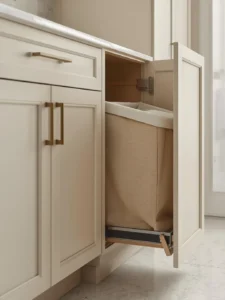
One of the most searched bathroom frustrations in 2026 is the laundry hamper problem — the basket that sits on the floor, collects clutter, and makes even a beautiful bathroom look untidy. The hidden laundry hamper cabinet solves this completely by building a tilt-out or pull-out hamper directly into the vanity cabinet structure. From outside, it looks like any other door. Open it and a fabric-lined hamper swings or slides out to accept laundry, then disappears again behind the closed door.
The built-in hamper can be incorporated into the end section of a floating vanity, a purpose-built tall column cabinet, or even a base cabinet beneath a counter. In 2026, designers are adding a second compartment alongside the hamper — a smaller pull-out bin for bathroom waste — so the entire under-counter zone becomes a clean, functional, permanently tidy system. This is the bathroom cabinet idea that gets the most enthusiastic response from people who see it in person for the first time.
18. The Cabinet With Integrated Dimmable Mirror Lighting
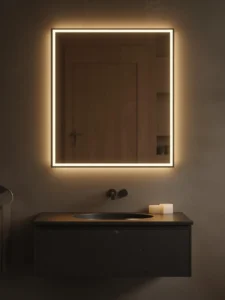
In 2026, the way a bathroom cabinet interacts with light has become as important as its material or form. The cabinet with integrated dimmable mirror lighting builds the light source directly into the cabinet frame or mirror surround — typically as a slim LED border that illuminates the face from multiple sides simultaneously, eliminating unflattering shadows and providing genuinely useful task lighting for grooming. The dimmer function allows the same fitting to serve as bright task light in the morning and soft, atmospheric candlelight-equivalent in the evening.
The integrated light eliminates the need for a separate wall sconce or overhead light above the vanity, simplifying the entire wall and giving the cabinet a hotel-suite quality that feels effortlessly luxurious. In 2026, the most sophisticated versions include a color temperature dial — shifting between warm 2700K and neutral 4000K — so the light can be matched to whatever the space requires at any given moment. This is the single cabinet upgrade that changes how the bathroom feels at every hour of the day.
19. The Japandi Bathroom Cabinet
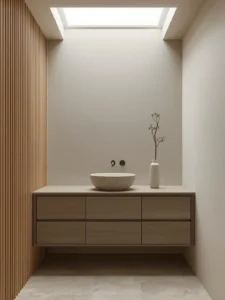
Japandi — the design philosophy merging Japanese minimalism with Scandinavian warmth — has produced some of the most compelling bathroom cabinet work of 2026. The Japandi cabinet is characterized by natural timber in muted, desaturated tones such as grey-washed oak, dark smoked ash, or pale natural hinoki wood; by hardware that is either absent entirely or reduced to the simplest possible form; and by a proportion system that favors low, horizontal layouts that sit close to the ground, referencing Japanese furniture traditions.
The Japandi cabinet deliberately avoids anything decorative — no carved details, no pattern, no contrast for its own sake. Instead it relies entirely on the quality of the material, the precision of the joinery, and the rightness of the proportion. It is an intensely considered aesthetic that rewards a bathroom with very little in it. Paired with a stone basin, a bamboo or linen accessory set, and a single large plant, the Japandi cabinet transforms a bathroom into something that genuinely feels like a wellness retreat rather than a utility room.