Minimalist bathroom design continues to evolve in 2026, bringing fresh interpretations of simplicity and function. These six ideas prove that less truly can be more, combining clean aesthetics with smart, livable solutions that work in real homes.
1. Integrated Concrete Vanities with Hidden Storage
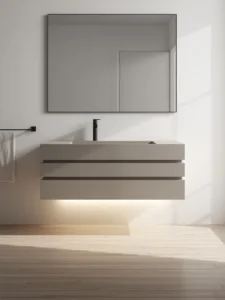
Concrete surfaces have moved beyond industrial spaces and now define sophisticated minimalist bathrooms. The 2026 approach features custom-poured concrete vanities with integrated sinks, creating seamless surfaces without visible joints or hardware. These pieces eliminate visual clutter while introducing tactile warmth through hand-troweled finishes that reveal subtle variations in tone and texture.
The beauty of integrated concrete vanities lies in their hidden storage systems. Drawers operate through push-to-open mechanisms, maintaining clean facades without handles or pulls. In a typical installation, a 60-inch floating vanity can house full-depth drawers for linens and toiletries while the countertop extends slightly beyond the cabinet edge to create shadow lines that emphasize the floating effect. Pair with recessed medicine cabinets and wall-mounted faucets to keep the horizontal plane completely clear.
2. Linear Drain Wet Rooms with Continuous Surfaces
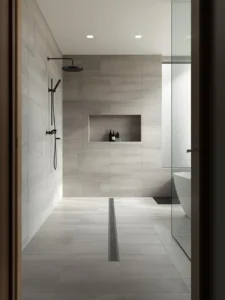
Wet room design has been refined for 2026 to emphasize uninterrupted surfaces and invisible drainage. Linear drains positioned flush with large-format porcelain slabs create the illusion of a single continuous plane, where walls flow seamlessly into floors. This approach removes the visual fragmentation caused by traditional shower curbs, glass enclosures, and circular drains, resulting in bathrooms that feel larger and more intentional.
Installing a linear drain system requires careful waterproofing and precise slope calculations, typically a gradient of 1/4 inch per foot toward the drain channel. For a standard 8-by-5-foot wet room, position the drain along the far wall to maximize the open floor area. Use 24-by-48-inch porcelain tiles in neutral tones with minimal grout lines, and extend the same material from shower area to dry zones for complete continuity. A recessed niche for products eliminates the need for caddies or corner shelves.
3. Freestanding Tubs Under Architectural Skylights
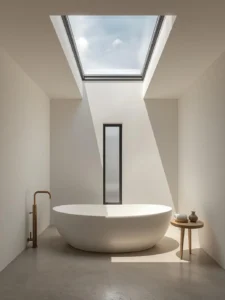
The freestanding bathtub remains a minimalist staple, but the 2026 version focuses on its relationship to natural light. Positioning a sculptural tub directly beneath a skylight transforms bathing into a meditative experience while eliminating the need for decorative distractions. The tub becomes a functional sculpture, enhanced by changing daylight patterns rather than surrounding accessories or materials.
Select tubs with simple geometric forms in matte white or stone composite finishes that complement rather than compete with the architecture. An oval tub measuring 67 inches long and 32 inches wide works well in most bathrooms, centered under a 4-by-4-foot skylight for maximum effect. Keep surrounding surfaces minimal with concrete or porcelain flooring and unadorned walls in soft white or warm gray. A single floor-mounted tub filler in brushed nickel or matte black provides the only necessary fixture, while a small side table in wood or metal holds essentials without cluttering the visual field.
4. Japanese-Inspired Wood Slat Accent Walls
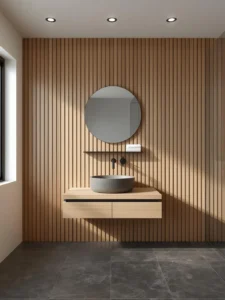
Minimalism and Japanese design principles converge in 2026 through the strategic use of wood slat accent walls. These vertical installations introduce warmth and rhythm without overwhelming the space, serving as focal points that ground minimalist bathrooms in natural materials. The slats create subtle shadow play throughout the day while providing textural contrast to smooth tile and stone surfaces.
Installing a wood slat wall requires spacing precision and moisture-resistant materials. White oak or teak slats, each 2 inches wide with 1-inch gaps between, should be mounted on a moisture barrier backing system. For a typical 8-foot-tall by 6-foot-wide installation behind a floating vanity or alongside a shower, use horizontal mounting to emphasize width or vertical to emphasize height. Treat wood with water-resistant oil finishes that enhance grain while protecting against humidity. Pair with stone vessel sinks, minimal fixtures in matte black or brushed brass, and uncluttered counter surfaces to maintain the minimalist intent.
5. Monochrome Terrazzo with Selective Metal Accents
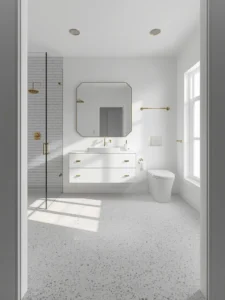
Terrazzo flooring returns in 2026 with a minimalist restraint that avoids the colorful maximalism of previous decades. Contemporary terrazzo in monochrome palettes features subtle aggregate variations within a tight tonal range, creating visual interest through texture rather than color contrast. When paired with carefully selected metal accents in warm brass or brushed gold, these floors anchor minimalist bathrooms with sophistication.
The key to successful terrazzo integration lies in restraint. Choose compositions with small to medium aggregate in shades of white, cream, and light gray set in white or pale cement for a cohesive neutral base. For a 100-square-foot bathroom, terrazzo flooring provides durability and seamless coverage without transitions or grout lines. Introduce warmth through brushed brass hardware on a floating vanity, gold-toned mirror frame, and matching towel bars. Keep walls pure white and fixtures minimal to let the floor’s subtle complexity and metal accents create all necessary visual interest.
6. Seamless White Tile Wet Rooms with Recessed Lighting
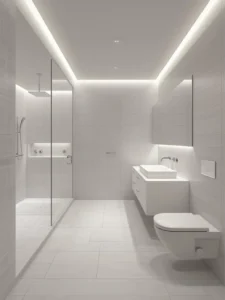
All-white wet rooms achieve new levels of refinement in 2026 through attention to surface continuity and lighting integration. Using single large-format white tiles across walls, floors, and ceilings creates enveloping brightness, while recessed linear LED channels eliminate the need for surface-mounted fixtures. This approach produces bathrooms that feel both expansive and serene, where light itself becomes the primary design element.
Executing this concept requires precise tile selection and lighting strategy. Specify rectified white porcelain tiles in 24-by-48-inch format with minimal grout lines in matching white. Extend the same tile from floor up walls and across ceiling for complete envelope effect. Install recessed linear LED channels in ceiling perimeter to wash walls with indirect light, plus additional recessed spots over key task areas. A wall-mounted white vanity with integrated sink, white fixtures, and a frameless mirror maintain the monochromatic discipline. The result is a space defined entirely by form, light, and shadow rather than material contrast.