I’ve been specifying tiles for bathroom projects for years now, and I can tell you honestly that 2026 has brought the most exciting shift in tile design I’ve witnessed in a long time. The conversations I’m having with clients have completely changed — people are no longer asking for safe, neutral, easy-to-live-with tiles. They are asking for tiles that make a statement, tell a story, and create a feeling the moment you walk through the bathroom door. The tile has become the most powerful design tool in the room.
What I keep noticing is that the people searching for bathroom tile ideas in 2026 are not casual browsers. They are in the middle of a decision — a renovation, a new build, a refresh — and they need ideas that are genuinely inspiring but also practical enough to actually commit to. They want to feel confident in their choice. These 15 ideas are drawn directly from the most compelling bathroom tile work I’ve encountered this year. Each one is distinct, purposeful, and designed to help you land on the right direction for your specific space with clarity and confidence.
1. The Full-Room Zellige Wrap
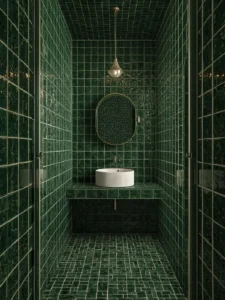
Zellige is a handmade Moroccan clay tile with a glossy, irregular glaze surface that catches and fractures light in a way no factory tile can replicate. Each piece is slightly different in tone, thickness, and reflectivity — and when you wrap an entire bathroom in zellige from floor to ceiling, including the shower enclosure, the effect is nothing short of extraordinary. In 2026, the full-room zellige wrap has become the defining move of bathrooms that want soul, depth, and an almost jewel-like luminosity that changes character depending on the light source and time of day.
The color range for zellige in 2026 has expanded dramatically beyond the traditional blues and whites. Deep forest green, burnt amber, dusty rose, graphite, and warm ivory are all appearing in full-room applications. The irregular grout lines and subtly undulating surface mean the room is never flat, never boring, and genuinely impossible to replicate exactly — every installation is unique. This is the tile idea for anyone who wants their bathroom to feel like a piece of craftsmanship rather than a product.
2. The Limewash-Effect Large Format Tile
One of the most searched surface treatments of 2026 is limewash — the ancient technique of applying thinned lime paint in layered washes to create a soft, cloudy, weathered patina on walls. The limewash-effect tile takes that aesthetic and delivers it on a porcelain large format tile that is fully waterproof, completely grout-friendly, and installable in wet zones where real limewash plaster cannot survive. The tile surface mimics the clouded, atmospheric depth of genuine limewash with subtle tonal variation across each tile face.
In bathroom applications, this tile creates a wall surface that looks ancient and deeply considered — like the walls of a centuries-old Italian villa or a Provençal farmhouse bathroom — while being entirely practical and low-maintenance. It pairs beautifully with raw plaster-look grout, unlacquered brass fittings, and warm timber vanities. In 2026, it is the tile of choice for anyone who wants the organic warmth of limewash without the fragility of actual plaster in a wet room.
3. The Vertical Subway Tile in Unexpected Color
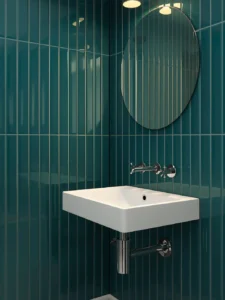
The subway tile is the most enduring tile format in bathroom history — but in 2026 it has been reoriented and recolored in ways that make it completely unrecognizable from its traditional application. Installing subway tiles vertically rather than horizontally immediately changes the proportion of the room: walls feel taller, ceilings feel higher, and the familiar brick pattern takes on a more dynamic, contemporary quality. The vertical orientation also echoes the lines of fluted surfaces and ribbed textiles that define 2026 interiors broadly.
Paired with an unexpected color — deep petrol blue, terracotta burnt orange, dusty burgundy, or warm mushroom — the vertical subway becomes a bold, characterful tile choice that reads as considered and current rather than safe and generic. In 2026, designers are specifying these in a slightly longer format than classic subway proportions — closer to 7.5×30 cm — which amplifies the vertical energy further. A single contrasting grout color, particularly a mid-tone grey or charcoal on a light tile, gives the pattern maximum graphic definition.
4. The Terrazzo Feature Floor
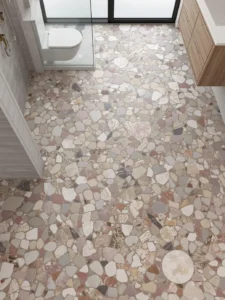
Terrazzo — the ancient composite material of marble chips, glass, stone, and quartz set in a cement or resin binder — has had a sustained revival over the past several years, but in 2026 it has arrived in bathroom flooring with a specificity and sophistication that earlier iterations lacked. The 2026 terrazzo floor is characterized by larger, more dramatic marble chip sizes, a more tightly curated color palette that ties directly to the rest of the bathroom’s material story, and a honed rather than highly polished finish that gives the surface a soft, matte depth.
What makes terrazzo so powerful as a bathroom floor in 2026 is its ability to function simultaneously as a neutral backdrop and as a focal point — it has pattern and color without imposing a single dominant color, which means it works with almost any wall tile, vanity finish, or hardware selection. It is also genuinely durable, warm underfoot when used with underfloor heating, and visually rich in a way that plain porcelain can never achieve. The bespoke nature of terrazzo — each floor is mixed to specification — means no two bathrooms share exactly the same floor.
5. The Ribbed 3D Wall Tile
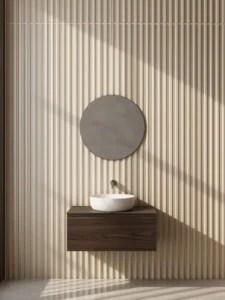
The ribbed or fluted 3D wall tile takes a flat surface and introduces continuous parallel ridges across its face — either shallow and fine for a textile-like effect or deep and pronounced for a strongly architectural, shadow-casting result. In 2026, this tile format has become one of the most requested in bathroom renovations because it does something no flat tile can do: it changes appearance throughout the day as natural light shifts, and it reads entirely differently under artificial evening light than it does in morning sun. The tile is effectively a dynamic surface, not a static one.
In matte white, warm ivory, or pale stone tones, the ribbed 3D tile creates a bathroom that feels richly textured and spa-like without any strong color or pattern. In deeper tones — slate grey, dark olive, midnight navy — the ridges cast strong shadows that give the room a genuinely dramatic, almost theatrical quality. This tile is used most effectively as a full feature wall behind the vanity or as the shower enclosure surround, where its texture can be appreciated from multiple angles and distances.
6. The Arched Tile Niche as Feature
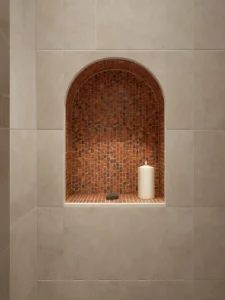
Rather than tiling a shower niche as a simple rectangular recess, the 2026 approach introduces a fully arched niche — with a curved top cut into the tile surround — that becomes a miniature architectural feature within the shower wall. The arched niche frames its contents like a painting: a single candle, a sculptural soap dish, a small plant. In an age where the bathroom is being treated as a gallery of considered objects, the arched niche elevates what would otherwise be a purely functional storage recess into something genuinely beautiful.
The tile treatment inside the niche can match the surrounding shower tile for a seamless, architectural look, or it can contrast in color or format — a deep zellige insert in an otherwise plain white tile shower, a mosaic tile lining inside a large format stone surround. In 2026, the arched niche has also appeared in bathroom walls outside the shower, tiled as a display niche for a single decorative object or plant at eye level, bringing gallery-like intentionality to bathroom wall design.
7. The Continuous Floor-to-Ceiling Stone-Look Porcelain
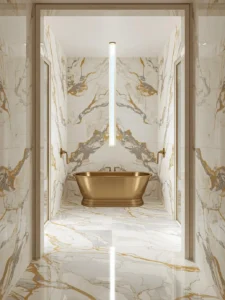
Using a single large format stone-look porcelain tile — typically 120×240 cm or even 120×360 cm — continuously from floor to ceiling on all bathroom surfaces, with book-matched panels creating a seamless natural stone vein pattern across the full height of the room, is the most uncompromisingly luxurious tile direction of 2026. The visual result is a bathroom that appears to have been carved entirely from a single block of natural stone — deeply calm, monumental, and unhurried. It is the tile choice that makes every other surface unnecessary.
The technical execution requires careful planning: the tile layout must be mapped digitally before cutting to ensure the vein continues correctly across surfaces. The grout lines are kept as tight as 1–2 mm and matched precisely to the tile base color so they recede completely. The result is a surface that reads as slab stone rather than tiled. In white Calacatta, warm Rosso Levanto, or grey Pietra Serena tones, this treatment transforms a bathroom into something that feels like the interior of a monument rather than a domestic room.
8. The Encaustic Cement Tile Feature Floor
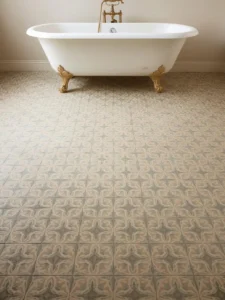
Encaustic cement tiles are handmade, pigment-saturated tiles with a pattern embedded throughout the tile thickness rather than printed on the surface — which means the pattern never wears away and the colors deepen and enrich over time rather than fading. In 2026, the encaustic tile has moved into bathroom floors with a new generation of patterns: geometric abstractions, loosely botanical forms, and tone-on-tone tonal designs that are more subtle and contemporary than the traditional bold Moroccan patterns most people associate with encaustic tiles.
The encaustic cement floor works best when the walls above it are kept deliberately quiet — limewash plaster, plain large format porcelain, or whitewashed brick — so the floor carries the full visual weight and complexity of the room. Sealed correctly, cement tiles are entirely suitable for bathroom use including wet rooms. In 2026, muted palettes using dusty sage, terracotta, ink blue, and warm sand are dominating encaustic tile choices, replacing the saturated primary color palettes of earlier years.
9. The Dark Grout Transformation Tile
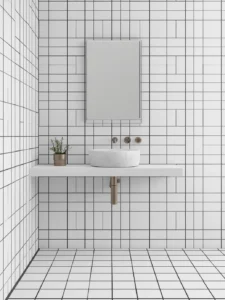
Dark grout — charcoal, slate, graphite, or near-black — applied to a light or white tile fundamentally changes the visual character of a tiled surface, emphasizing the geometry of the tile pattern and creating a bold graphic grid that reads as designed rather than default. In 2026, dark grout has become one of the most recommended tile styling decisions because it is achievable within almost any budget by simply changing the grout color specification without changing the tile itself. A plain white subway or square tile becomes a completely different visual experience with charcoal grout.
The dark grout tile works particularly effectively in bathrooms that want graphic energy without committing to a strongly colored tile — it adds visual intensity and contemporary edge while keeping the tile itself neutral and timeless. It is also dramatically more forgiving in terms of maintenance: dark grout does not show staining or discoloration the way white or pale grout does, which makes it a practically intelligent choice in addition to an aesthetically compelling one. This is the tile idea that offers the biggest return for the simplest decision.
10. The Warm Travertine Tile Bathroom
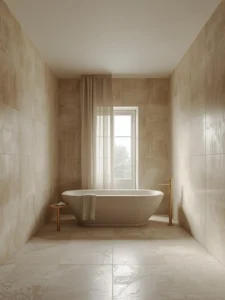
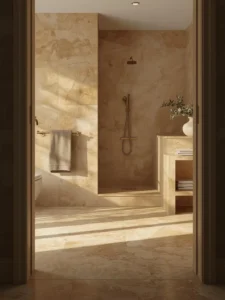
Travertine — the ancient sedimentary limestone with its characteristic natural pitting, veining, and warm honey-to-cream color palette — has undergone a major resurgence in 2026 bathroom design, moving far beyond its early 2000s oversaturated appearance into something genuinely refined and contemporary. The 2026 travertine bathroom uses the stone in a honed or brushed finish rather than polished, which reveals the natural texture and makes the surface feel organic and warm rather than cold and corporate. The unfilled pitting is embraced as character rather than concealed with filler.
Used on floors, walls, and shower surrounds in complementary large formats — 60×60 on the floor, 30×60 on walls, or matching large slabs throughout — travertine creates a bathroom that feels warm, ancient, and effortlessly refined. It pairs naturally with unlacquered brass, dark bronze tapware, warm timber, and raw linen textiles. In 2026, the travertine bathroom is the antidote to the cold, grey, overtly minimalist bathrooms that dominated the previous decade.
11. The Mixed Format Tile Composition
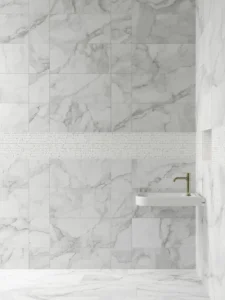
Rather than using a single tile format uniformly across a surface, the mixed format tile composition deliberately combines two or three tile sizes from the same material or color family in a planned layout — large format slabs on the lower wall, a band of small mosaic tiles at eye level, large format again above — to create a horizontal layering effect that reads like a designed composition rather than a simple tiled surface. In 2026, this approach has emerged as a key differentiator between bathrooms that feel custom-designed and those that feel assembled from a catalog.
The band of smaller tiles acts as a visual break and adds texture and detail at the zone where the eye naturally rests. In all-marble or all-stone applications, the mixed format emphasizes the material itself by showing it at different scales. The composition can also be used to zone different functional areas — a different tile format in the shower versus the main bathroom wall — in a way that reads as intentional architecture rather than awkward tiling around an enclosure.
12. The Handpainted Tile Mural Shower Wall
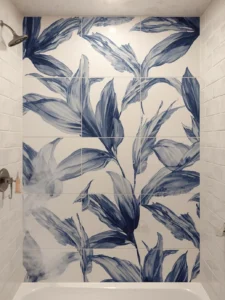
Rather than using a repeated pattern tile, the handpainted tile mural treats the shower wall as a canvas — a single continuous scene or abstract composition painted across multiple individual tiles that, when assembled, form one large artwork. In 2026, this concept has moved from heritage restoration contexts into contemporary bathrooms, with designers commissioning tile murals in abstract botanical forms, loose gestural landscapes, Japanese ink-painting aesthetics, and minimal line-drawing compositions in a single color on white. The result is a shower that functions as a gallery installation.
The handpainted mural tile is fired with the design sealed beneath the glaze surface, making it fully waterproof and permanent — the artwork will not fade or wash away. It can be commissioned from ceramic artists or increasingly ordered from specialist tile studios that produce bespoke murals to specification. In 2026, even a single mural panel of four to six tiles on a shower niche wall creates an element of genuine artistry in an otherwise standard bathroom renovation. This is the tile idea for anyone who wants their bathroom to contain something truly irreplaceable.
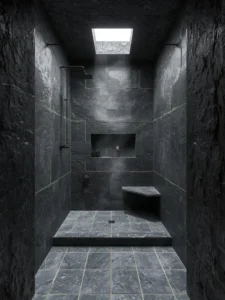
13. The Tone-on-Tone All-Black Tile Bathroom
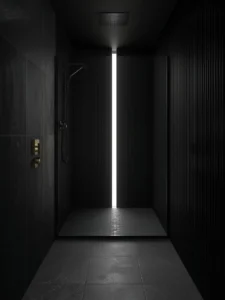
The all-black bathroom — floor, walls, ceiling, and shower in varying textures and finishes of black tile — is the most dramatic tile direction of 2026, and when executed with subtlety and material variation, it produces a space of extraordinary depth and atmosphere. The key to making the all-black bathroom work is never using a single uniform black tile everywhere: instead, the tonal layering of matte black on the floor, a slightly textured matte on the walls, and a more reflective dark glaze in the shower creates a richly varied field of black that reads as complex and three-dimensional rather than flat and oppressive.
Contrary to what many people expect, the well-designed all-black bathroom feels warm rather than cold, intimate rather than clinical, and deeply spa-like in its enveloping quality. It is most effective in bathrooms with good natural light, where the light source becomes the dramatic counterpoint to the dark surround, and with warm gold or unlacquered brass hardware that glows with maximum effect against the dark background. In 2026, the all-black tile bathroom is the choice of the genuinely fearless decorator.
14. The Scallop Fan Tile in a Tonal Palette
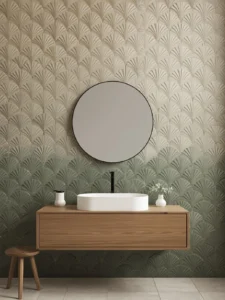
The scallop or fan tile — with its repeating curved, overlapping shape that mimics fish scales or draped fabric — brings a lyrical, organic rhythm to bathroom surfaces that grid-based tile formats simply cannot achieve. In 2026, the scallop tile has been elevated from a decorative accent to a serious design element, particularly when used in a sophisticated tonal palette — three shades of the same color, graduated from light to dark, laid so the color shifts gradually across the wall surface like a wash of watercolor. The effect is deeply original and unlike anything achievable with rectangular tiles.
The tonal scallop tile works on feature walls, shower surrounds, and bathroom floors in different scales — small 5×5 cm scallops create a delicate, almost textile-like surface, while large 20×20 cm fan tiles make a bold architectural statement. In sage green, dusty blue-grey, warm terracotta, or muted blush, the tonal scallop palette produces a bathroom surface that reads as artistic rather than simply patterned. It is a relatively bold commitment that yields a bathroom unlike any other.
15. The Outdoor Stone Tile Brought Indoors
One of the most compelling cross-category tile movements of 2026 is the application of tiles traditionally specified for outdoor terraces, garden paths, and pool surrounds inside the bathroom — creating a continuity between interior and exterior that feels genuinely architectural and connected to the landscape. Rough-textured basalt, sandblasted granite, tumbled limestone, and split-faced slate all bring an outdoor, elemental rawness to the bathroom that polished or rectified indoor tiles cannot approximate. The surface texture references nature directly.
These outdoor stones are specified in their external grade and applied with appropriate water-resistant adhesives and grouts for wet room use. The resulting bathroom has an almost geological quality — like bathing inside a cave, a rock pool, or a natural spring. In 2026, this direction pairs most powerfully with a large format skylight or full-height window that brings actual outdoor light and landscape views into the tiled space, completing the circuit between inside and outside. It is the tile idea for anyone who feels most alive outdoors and wants that energy available every morning.