
If your dining room feels either too cold and warehouse-like or too safe and predictable, soft industrial design offers the fix. This post walks through 18 practical soft industrial dining room ideas for a balanced home — covering layouts, materials, lighting choices, and common mistakes — so you can make real decisions, not just gather vague inspiration.
1. Pair a Concrete-Look Table with Upholstered Bench Seating for Instant Balance
A raw concrete or concrete-finish dining table is one of the most defining elements of industrial style, but without something soft beside it, the room tips cold fast. A long upholstered bench along one side — in boucle, linen, or velvet — immediately counters that harshness without abandoning the aesthetic.
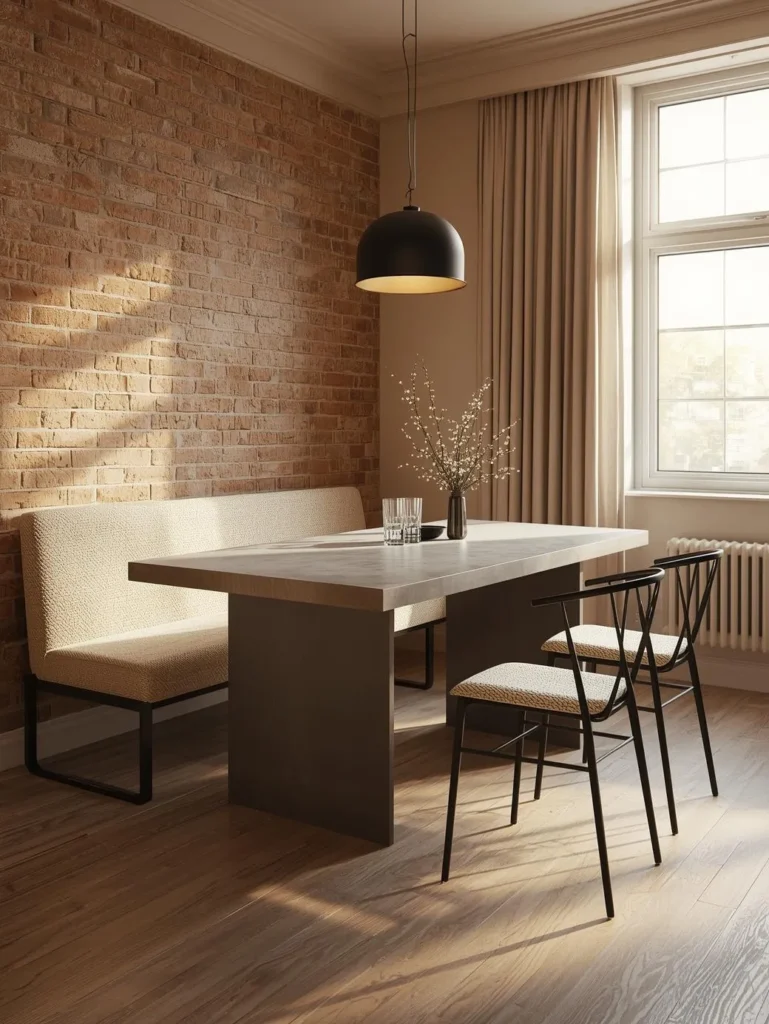
This pairing works especially well in narrow dining rooms where a traditional four-chair arrangement feels cramped. The bench slides under the table cleanly, opens up floor space, and seats more people comfortably. On the opposite side, two or three metal-frame chairs with thin cushions keep the industrial thread going while adding visual lightness.

Avoid benches with ornate carved legs or overly decorative fabric patterns. The upholstery should be solid or subtly textured — not floral, not patterned — or it breaks the tonal consistency of the room.
2. Use a Matte Black Dining Frame with Warm Wood Tabletop to Soften the Look
The combination of a matte black steel base with a live-edge or smooth warm wood tabletop is one of the most reliable moves in soft industrial design. Steel reads industrial. Wood reads natural and warm. Together, they cancel each other’s extremes.
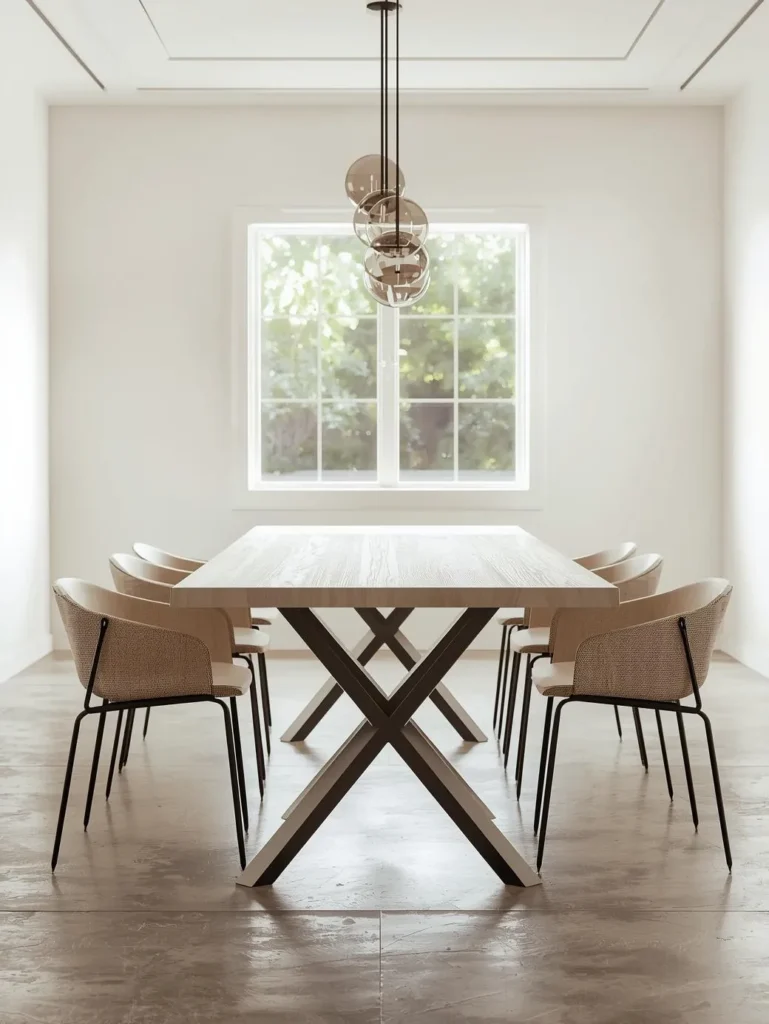
This works in almost any room size. In smaller dining rooms, a round or oval tabletop on a black hairpin base creates the same effect without dominating the space. In larger open-plan homes, a rectangular walnut or white oak slab on a structural black frame holds its own visually and anchors the dining zone.
The mistake most people make here is choosing wood that’s too dark. Dark walnut on matte black creates a heavy, low-contrast result. Lighter woods — ash, white oak, natural pine with a matte finish — contrast better against black steel and keep the room from feeling dense.
3. Layer Textile Warmth with Industrial Bones Using Woven Pendant Lights
Most people focus on furniture when they think about soft industrial design, but lighting is where the real tonal shift happens. Replacing a hard metal pendant with a woven rattan, sisal, or bamboo pendant light immediately softens the ceiling zone of a dining room — while the table, chairs, and hardware below stay industrial.
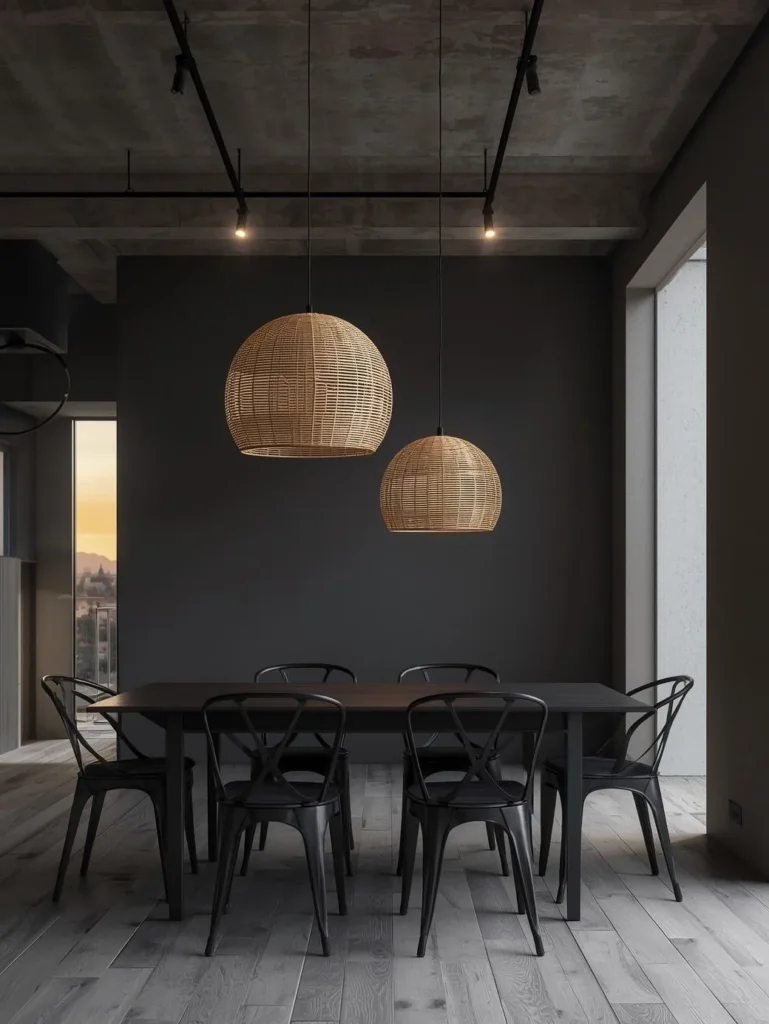
This technique is particularly useful in open-plan homes where the dining area shares visual space with a kitchen or living room. The woven light becomes a visual marker for the dining zone and adds a layer of textural warmth that no paint color can replicate.
Stick to natural or bleached finishes for the pendant. Avoid dark or stained woven pendants — they absorb light rather than diffuse it, making the room feel dim. Also avoid pairing woven pendants with ornate chandeliers nearby, as the contrast in style becomes distracting rather than layered.
4. Introduce a Velvet Accent Chair at the Head of the Table for a Luxe-Industrial Contrast
Not every seat at the dining table needs to match. Placing one or two velvet accent chairs at the head positions — while keeping the remaining seats in metal or natural wood — creates a deliberate contrast that feels curated rather than accidental.
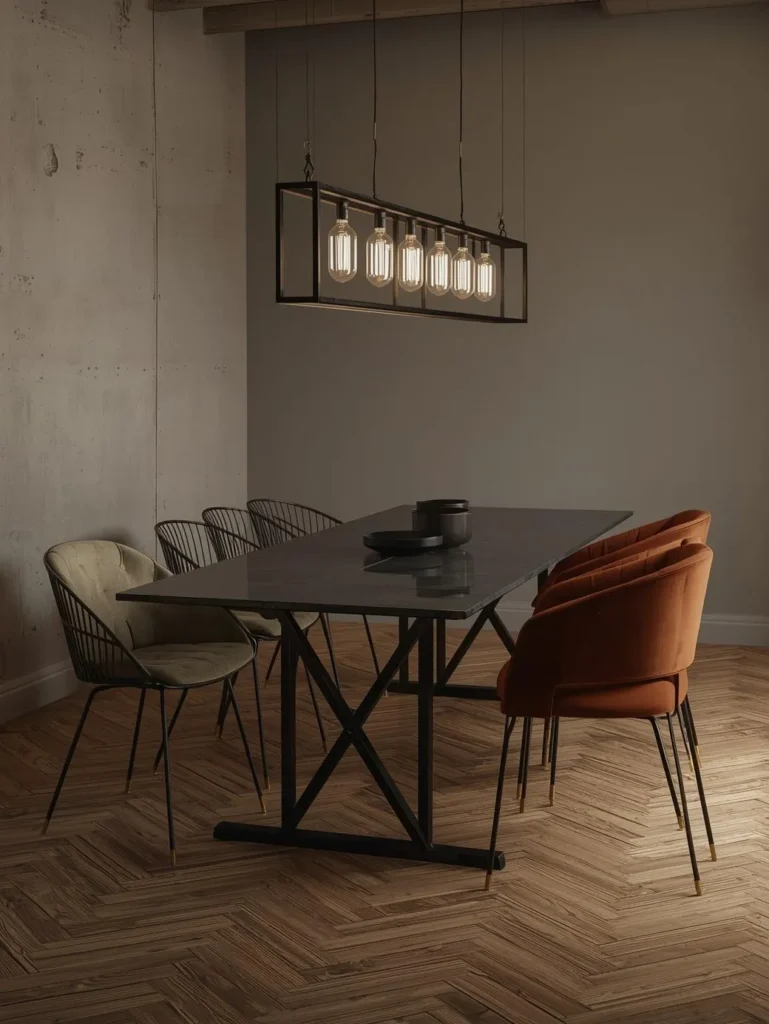
This approach works well for rectangular tables in dining rooms that serve both daily use and occasional entertaining. The velvet chairs signal a sense of occasion without requiring a full dining room redesign. In smaller homes or apartments, even one statement chair adds enough contrast to shift the room’s personality.
Choose velvet in a muted, complex tone — dusty sage, warm terracotta, steel blue, or aged burgundy. Avoid bright or saturated velvet colors against raw industrial materials; the gap between them becomes jarring rather than elegant.
5. Use Whitewashed Brick as a Feature Wall to Warm an Industrial Frame
Raw red or dark brick is strongly industrial. Whitewashed or limewashed brick holds the texture and structural character of brick while cooling its color temperature — making it far easier to build a softer palette around.
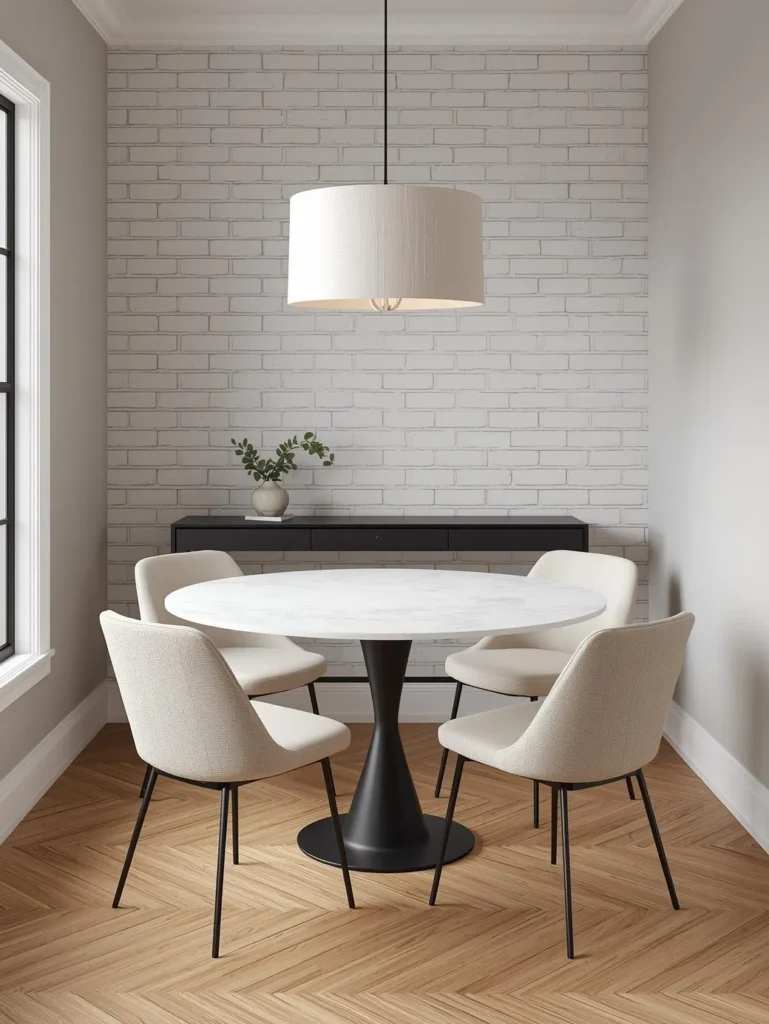
A whitewashed brick feature wall behind the dining table or buffet sideboard grounds the room with a sense of permanence and age without making it feel like a Brooklyn loft. It pairs well with light wood furniture, cream or greige upholstery, and matte black hardware.
Avoid whitewashing only a partial section of a wall. Either commit to the full wall or leave the brick entirely raw. A half-finished look reads as an afterthought rather than a design decision. Also avoid pairing whitewashed brick with stainless steel — the cold tones clash.
6. Go Monochromatic in Grey to Unify an Industrial Dining Room Without Harsh Contrast
Strong contrast — black steel against white walls, dark table against light floor — is a common industrial default. But a tonal grey palette in different textures (matte, glossy, woven, concrete, velvet) achieves the same industrial weight with a far more refined, livable feel.
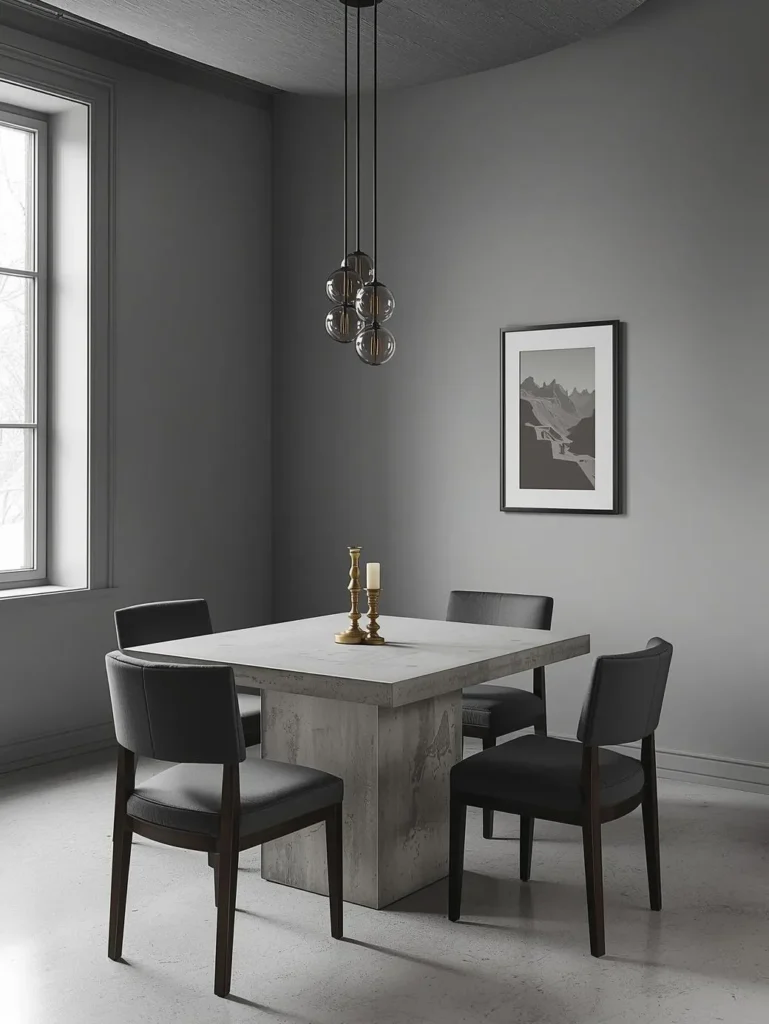
This strategy works best in square or box-shaped dining rooms where too much contrast can feel overwhelming. Layering light grey walls, medium grey upholstered chairs, a charcoal table, and a white-grey concrete floor creates depth through texture rather than color conflict.
The key risk here is monotony. Break it with one warm element: a natural wood bowl on the table, a warm brass pendant, or a single cream-toned throw draped over the bench. Without this anchor, an all-grey room reads as sterile rather than sophisticated.
7. Combine Open Metal Shelving with Styled Dinnerware to Bridge Function and Warmth
Industrial design frequently incorporates open shelving, but bare metal shelves look cold and unfinished in a dining space. Styling those shelves intentionally — with textured ceramics, stacked linen napkins, wooden serving boards, and trailing plants — transforms them from a storage solution into a warm focal point.
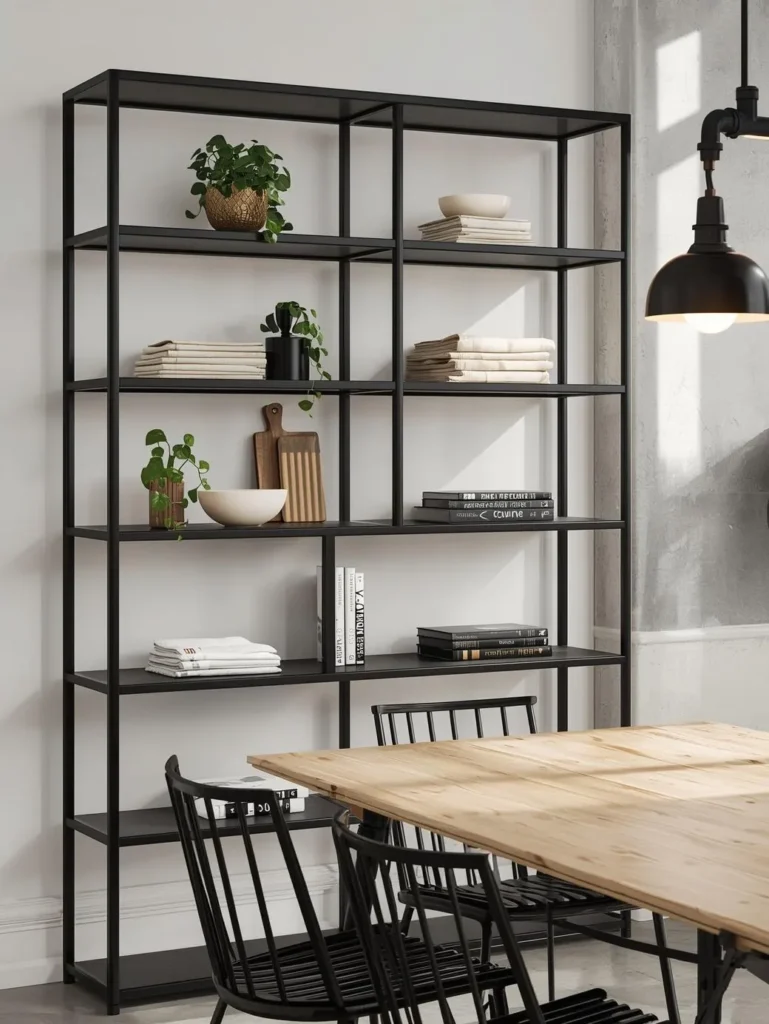
This works well in dining rooms adjacent to a kitchen in small to mid-sized homes where storage is a practical need. The shelving does double duty: holding functional items and adding visual layering that a bare wall cannot provide.
Avoid overcrowding the shelves or mixing too many colors. A tonal approach — all cream ceramics, neutral linens, natural wood — reads calm and intentional. Adding too many bright-colored items or mismatched pieces makes the shelving look like overflow storage rather than a designed element.
8. Use a Statement Arch Mirror to Amplify Light and Add Softness to Industrial Lines
Industrial interiors are built on straight lines, right angles, and hard edges. Introducing a curved element — particularly a large arch mirror — creates a direct visual contrast that softens the room without changing a single piece of furniture.
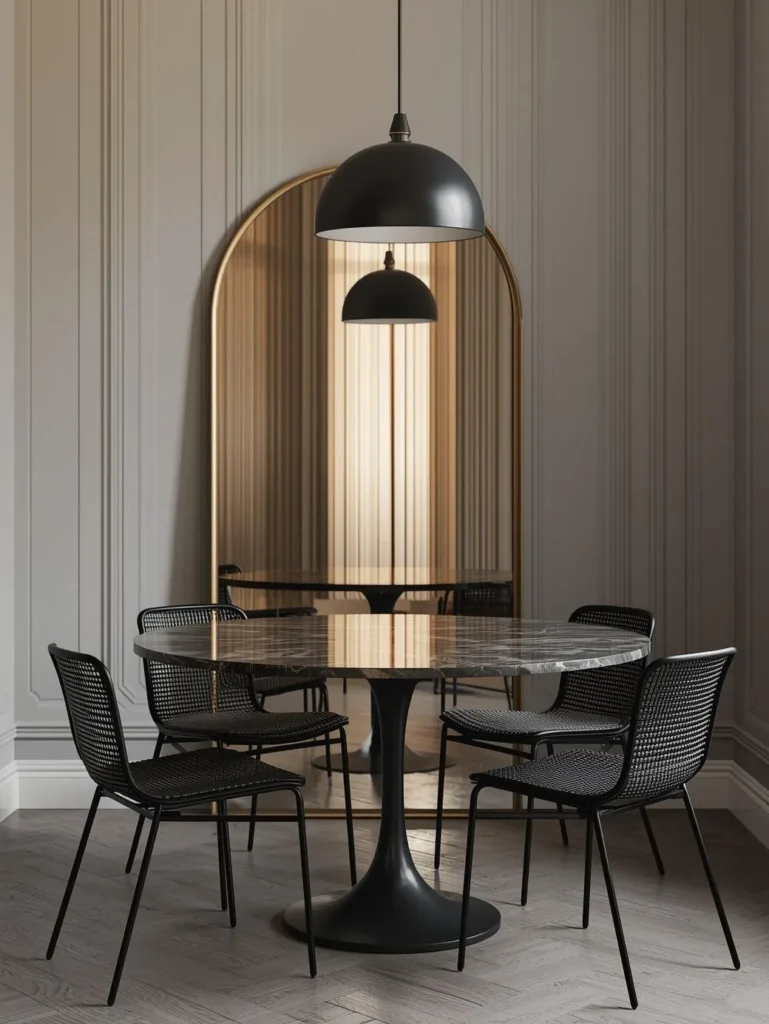
An arch mirror mounted or leaned against the wall behind the dining table reflects light, makes the room feel larger, and introduces an organic shape into an otherwise rectilinear space. In apartments or smaller dining rooms with limited window access, this is one of the most effective ways to brighten and balance simultaneously.
Choose mirrors with thin metal frames — brass, black, or aged bronze — to stay within the industrial palette. Avoid ornate or heavily carved mirror frames; they conflict with the clean structural lines of industrial furniture and create a style mismatch.
9. Choose a Live-Edge Wood Dining Table for Organic Character in an Industrial Room
Live-edge wood — where the natural edge of the timber slab is preserved — brings an unfiltered organic quality into an industrial dining room. Unlike a perfectly squared tabletop, the irregular edge signals something handmade, grown, and irreproducible, which immediately counters the mechanical quality of steel and concrete.
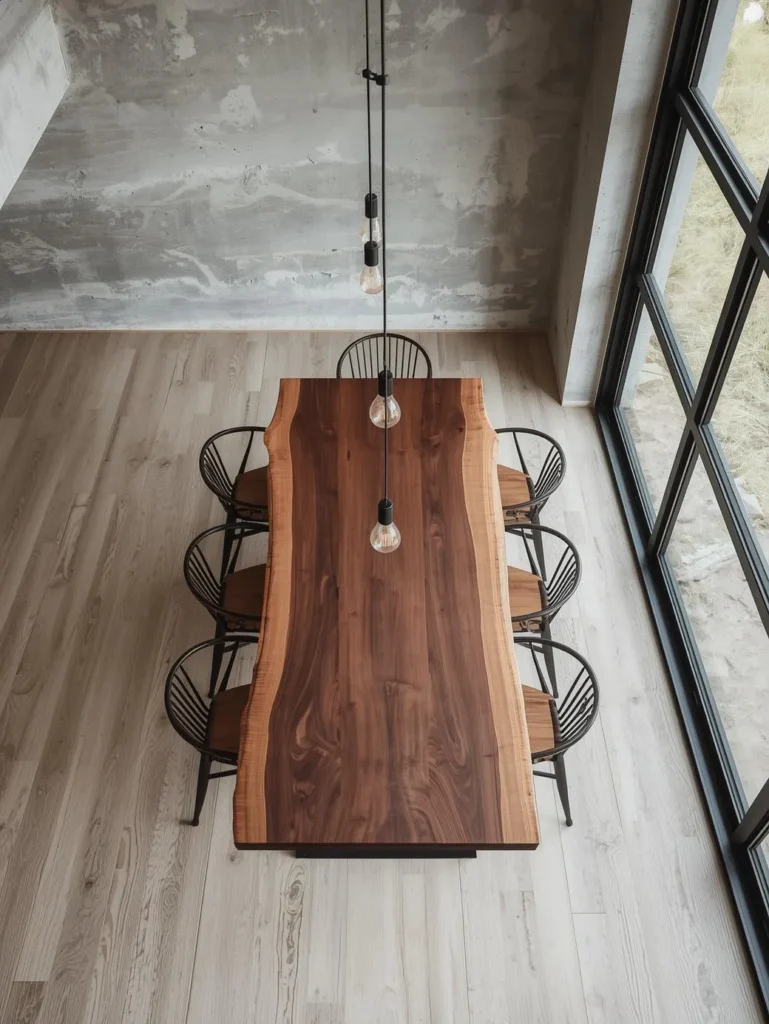
This works particularly well as the hero piece in a room with otherwise restrained industrial elements: black chairs, exposed pipe lighting, concrete walls. The live-edge table becomes the visual anchor that everything else is organized around.
Avoid live-edge tables with brightly pigmented epoxy fills — electric blue or neon green resin crosses into novelty territory and undermines the calm tone of soft industrial design. Clear or natural-tint epoxy fills only.
10. Layer a Flatweave Rug Under the Dining Table to Define the Zone and Add Warmth
An area rug under the dining table is one of the quickest ways to add warmth and acoustic softness to a hard-surfaced industrial room. Concrete floors, tile, or dark hardwood all benefit from the visual interruption and tactile layering a rug introduces.
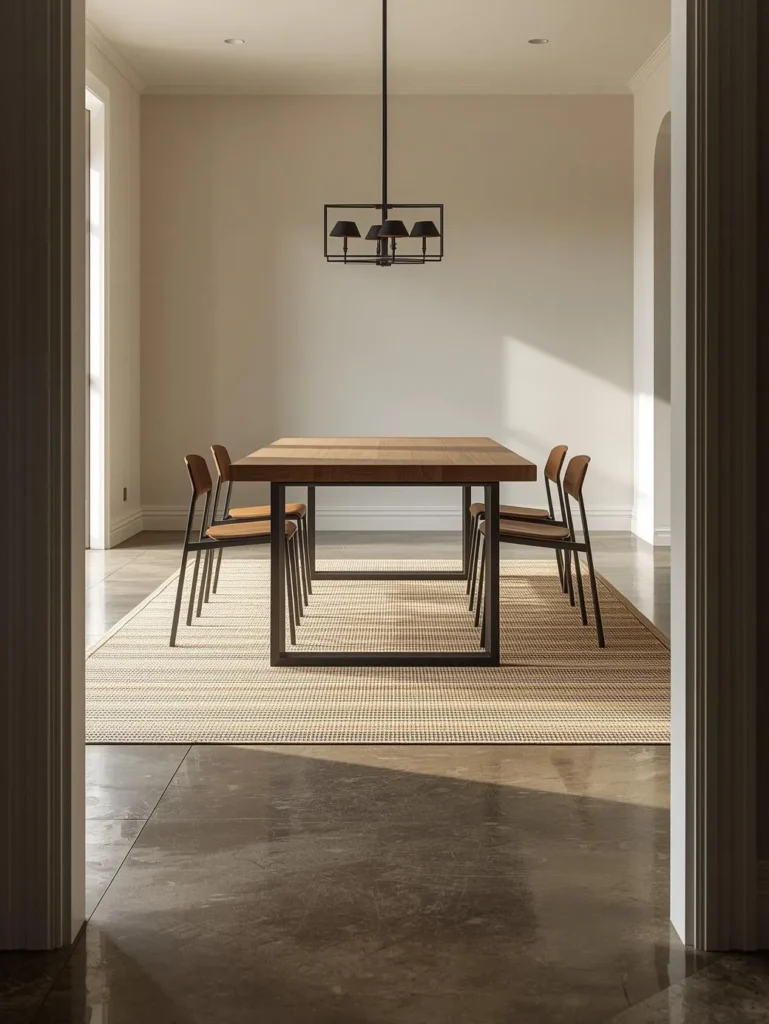
For dining rooms, choose a rug large enough that all chair legs remain on it even when chairs are pulled out — typically 8×10 ft for a six-person table. A flatweave or low-pile rug works better than a thick shag or high-pile option, which catches chair legs and creates a tripping hazard.
In terms of pattern, subtle geometric weaves — thin stripes, tone-on-tone grids — stay within the industrial vocabulary while adding visual interest. Avoid large floral or ornate medallion patterns; they shift the room’s register entirely and fight the industrial bones.
11. Install Dimmable Edison Bulb Pendants for Flexible Mood Control Over the Table
Lighting temperature and intensity directly controls how industrial a room feels at any given moment. A dining room that reads cold and harsh at full brightness can shift to warm and intimate with dimmable Edison bulbs pulled low over the table.
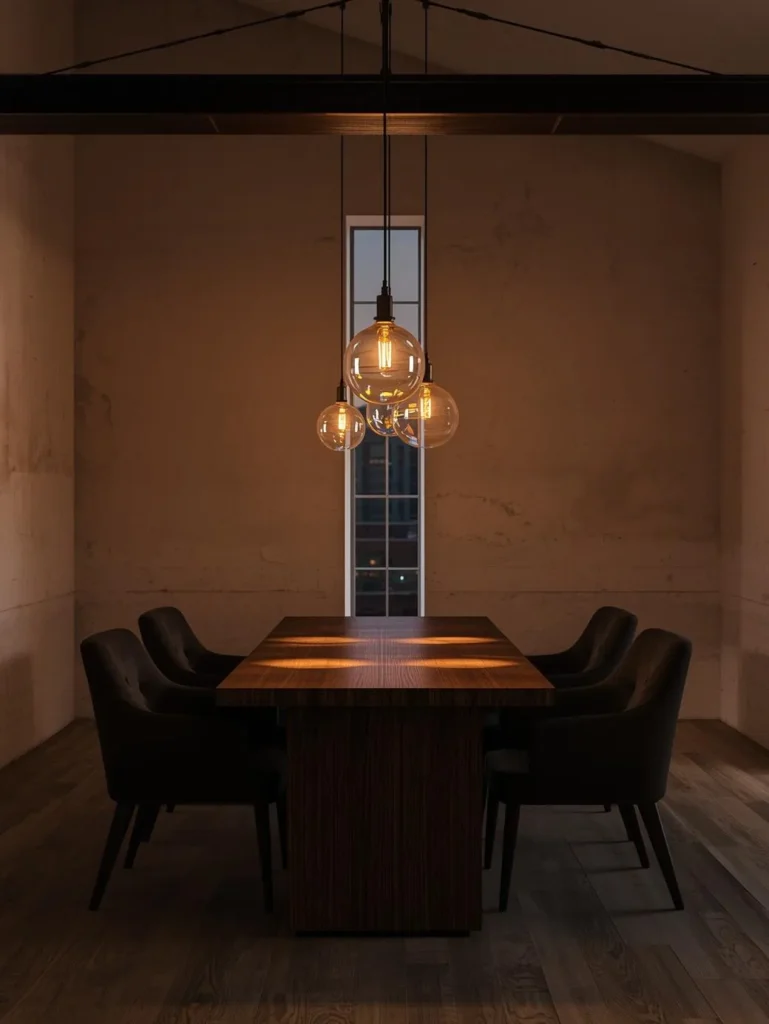
Edison or filament-style bulbs in vintage-style clear glass emit a warm amber light that naturally softens surfaces — concrete looks more like stone, black steel looks more like wrought iron, and raw wood reads richer. The key is pairing them with a dimmer switch so the room functions for both daytime practicality and evening ambiance.
Keep pendants low over the table — around 28 to 34 inches above the surface — for maximum impact. Avoid cage-style pendants that fully enclose the bulb and restrict the warm glow. Open pendants, globe shapes, or simple dome shades in black or copper allow the filament’s warm hue to spill into the room.
12. Bring in Structured Indoor Plants to Add Life to a Hard-Material Industrial Room
Plants introduce the one element industrial design naturally lacks: life. A dining room built around steel, concrete, and dark wood can feel static and closed without something living in it. The right plant placement loosens the room and signals a home that is cared for.
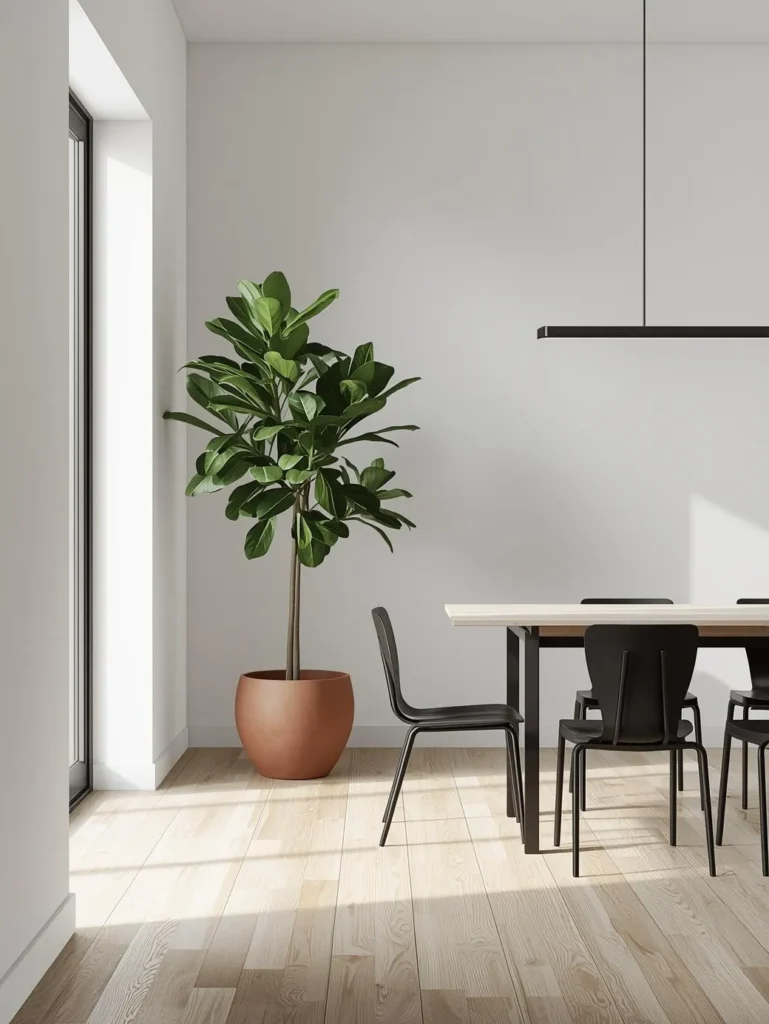
The key word is structured. Tall, upright plants — fiddle leaf figs, snake plants, olive trees in ceramic pots, or Monstera in a woven basket — add verticality and presence without cluttering the space. Place them in corners or beside the feature wall, not on the dining table where they compete with place settings.
Avoid small collections of mixed plants in mismatched pots on the floor. One or two large-scale plants in clean, simple vessels — matte black ceramic, raw terracotta, simple white pot — make a bigger impact with less visual noise.
13. Paint Exposed Ceiling Joists Matte Black for Architectural Character Without a Renovation
Few elements communicate industrial character as clearly as the ceiling. If your home has exposed structural beams or joists, painting them matte black transforms them from an eyesore into a deliberate architectural feature. If they are not naturally exposed, adding reclaimed wood beams achieves a similar warmth.
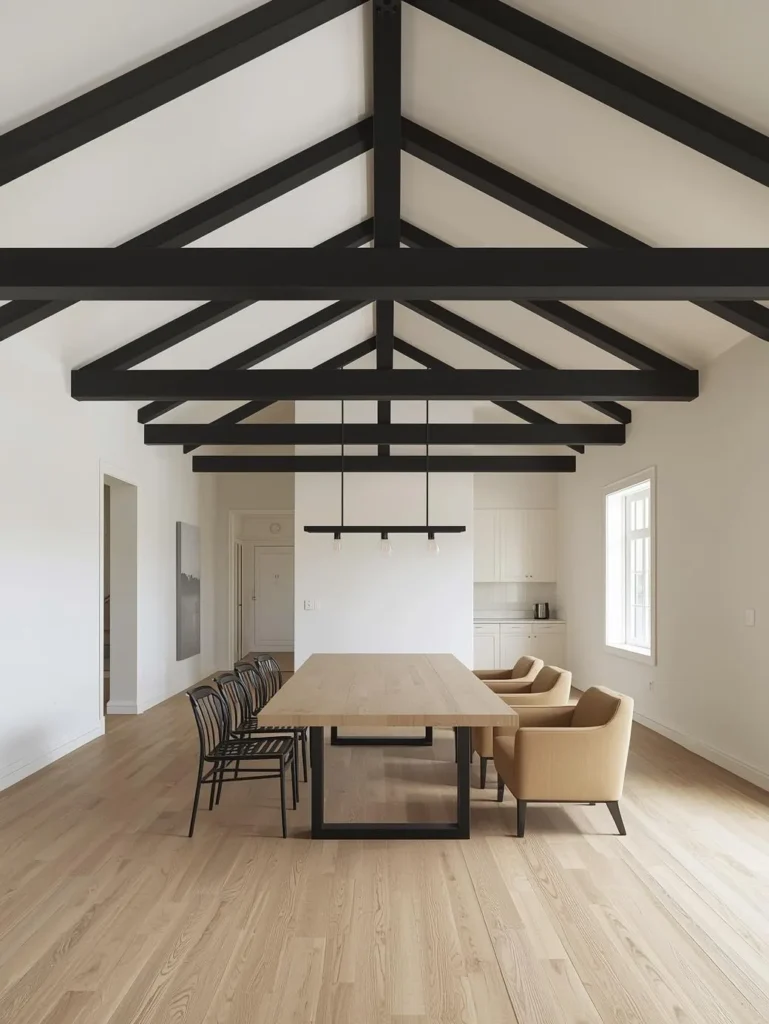
This works best in rooms with ceiling heights above 9 feet. In lower-ceilinged rooms, dark painted joists can feel oppressive and make the room feel smaller. In those cases, opt for natural wood-toned beams only, which add warmth without visually dropping the ceiling.
Avoid mixing beam styles. Reclaimed rough-hewn beams and sleek black-painted joists in the same room read as unresolved. Commit to one language — raw wood or painted black — and pair your furniture and lighting accordingly.
14. Add a Black Metal and Wood Sideboard to Ground the Room and Create a Styled Surface
Most dining rooms benefit from a secondary storage piece — a sideboard, credenza, or buffet — placed against the wall. In soft industrial design, this piece should carry the same material logic as the table: a combination of black steel frame and warm wood, or blackened wood with metal hardware.
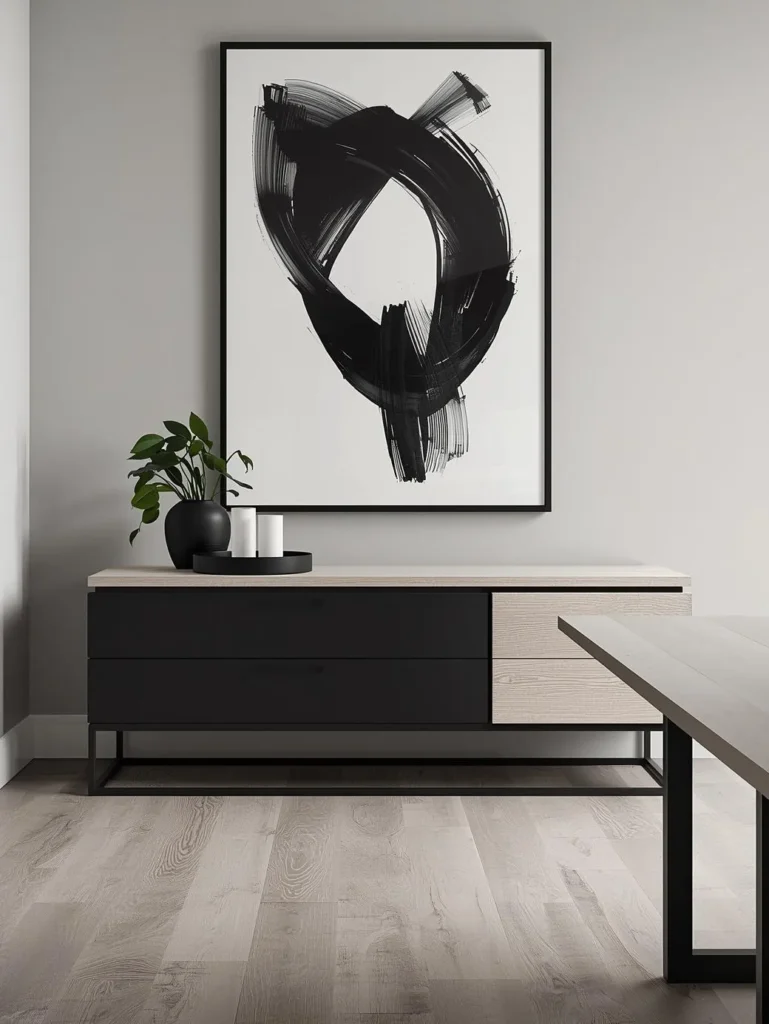
Beyond storage, the sideboard gives you a horizontal display surface. A tray with a candle and a small plant, a stacked collection of design books, or a single sculptural object creates a vignette that adds personality to the room without cluttering it.
Avoid sideboards with overly traditional silhouettes — raised panel doors, turned legs, ornate hardware. The lines should be clean, the hardware minimal, and the finish matte. Glossy lacquered sideboards interrupt the quiet material story of an industrial room.
15. Design a Built-In Dining Nook with Steel-Frame Windows for Maximum Efficiency
If your dining room is small or part of a kitchen extension, a built-in dining nook is one of the most space-efficient layouts you can create. A U-shaped or L-shaped cushioned bench along two or three walls, paired with a central table and one or two chairs on the open side, maximizes seating in a minimal footprint.
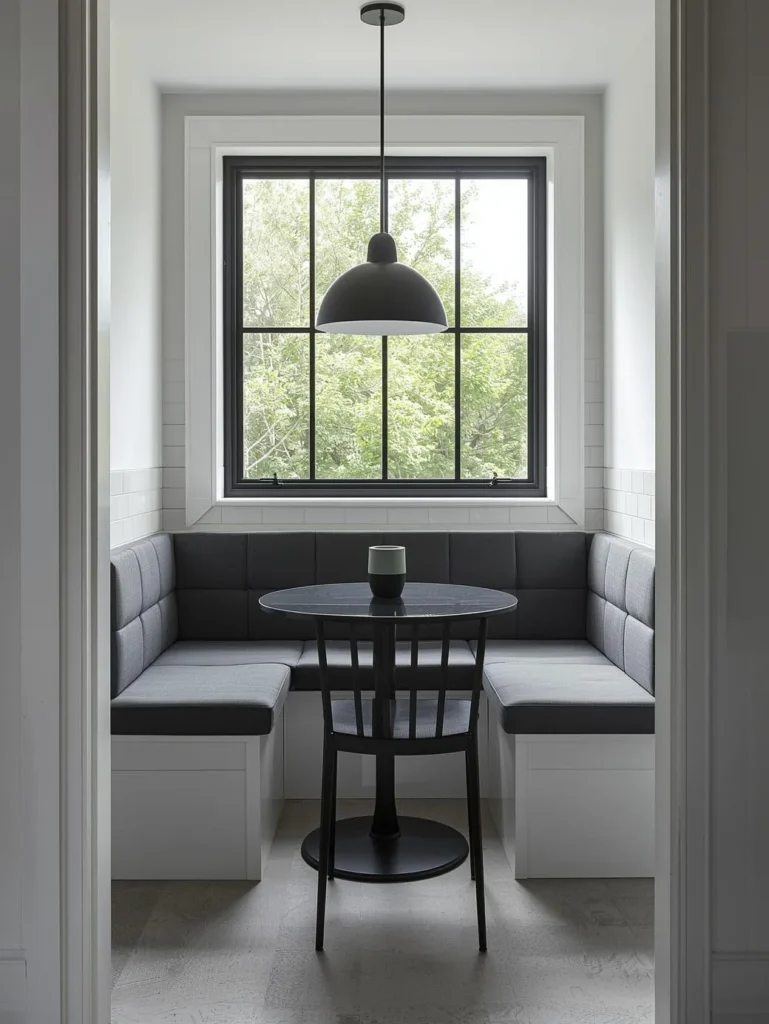
Adding steel-frame windows or internal steel-frame glass partitions to the nook immediately grounds the space in industrial vocabulary while maintaining an open, light-filled feel. This combination is particularly effective in kitchen-dining extensions where light flow matters.
The risk with built-in nooks is over-softening. If cushions, walls, and table all trend warm and neutral with nothing structural to anchor the look, the result feels like a country cottage rather than a soft industrial space. Keep the table surface, window frames, and pendant in darker or more structural materials to maintain the balance.
16. Add Industrial Wall Sconces on Either Side of Artwork for Layered Evening Lighting
Overhead pendants are the most common lighting choice in dining rooms, but they create a single light source that leaves walls flat and unlit. Adding articulated arm, pipe, or cage-style wall sconces on either side of a mirror or large piece of artwork creates layered, directional light that makes the room feel designed rather than just functional.
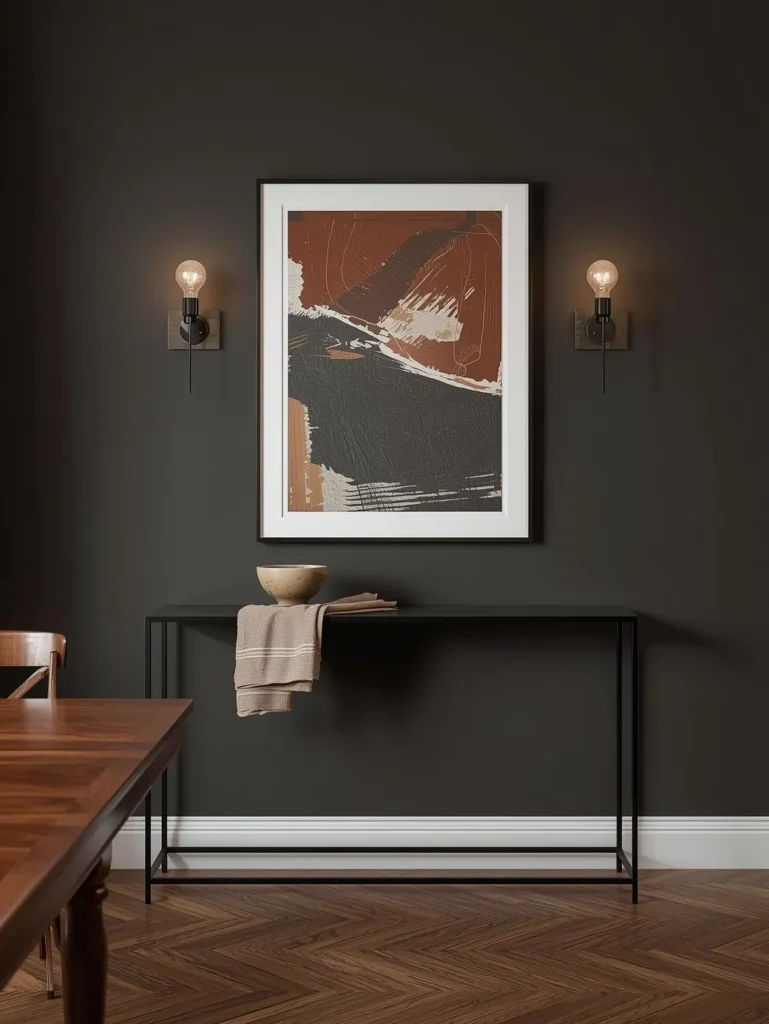
This is particularly useful in dining rooms that double as entertaining spaces, where a single overhead pendant feels too stark. Sconces at eye level beside a feature wall element warm the perimeter of the room and balance the central pendant overhead.
Choose sconces in matte black or brushed iron with a warm bulb. Avoid chrome or polished nickel finishes, which pull the room toward contemporary rather than industrial. Also avoid matching the sconce too exactly to the pendant — a slight variation in style between the two reads more curated than a matching set.
17. Use Deep Dark Painted Walls to Make Warm Industrial Materials Glow
Light-walled industrial rooms are common, but a deep painted dining room — charcoal, dark slate, near-black, or deep forest green — does something dramatically different: it pushes warm materials like wood, brass, and amber-lit glass into high relief, making the room feel rich and immersive rather than cold.
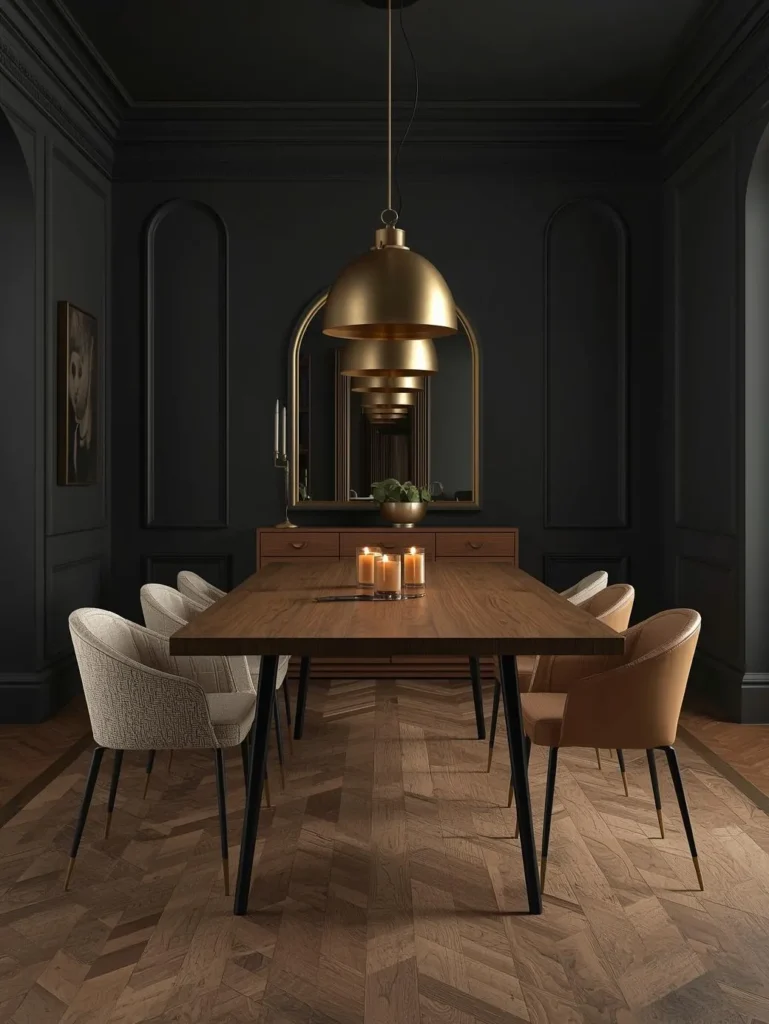
This works best in dedicated dining rooms rather than open-plan spaces, where a dark wall color is easier to contain. It requires good lighting — both natural and artificial — to prevent the room from feeling cave-like. At least one large window, or a well-placed mirror for light reflection, is essential.
The soft industrial balance in a dark-walled room comes from ensuring the furniture is not also all dark. A warm wood table, cream or sand-colored upholstery, and brass hardware against near-black walls creates the contrast needed to keep the room lively and not oppressive.
18. Finish the Room with a Metal-Framed Gallery Wall That Reinforces the Industrial Identity
An empty wall in a dining room is one of the most common design afterthoughts. A gallery wall — done correctly — can anchor the room’s identity, fill vertical space, and reinforce the soft industrial tone without adding furniture or changing the layout.
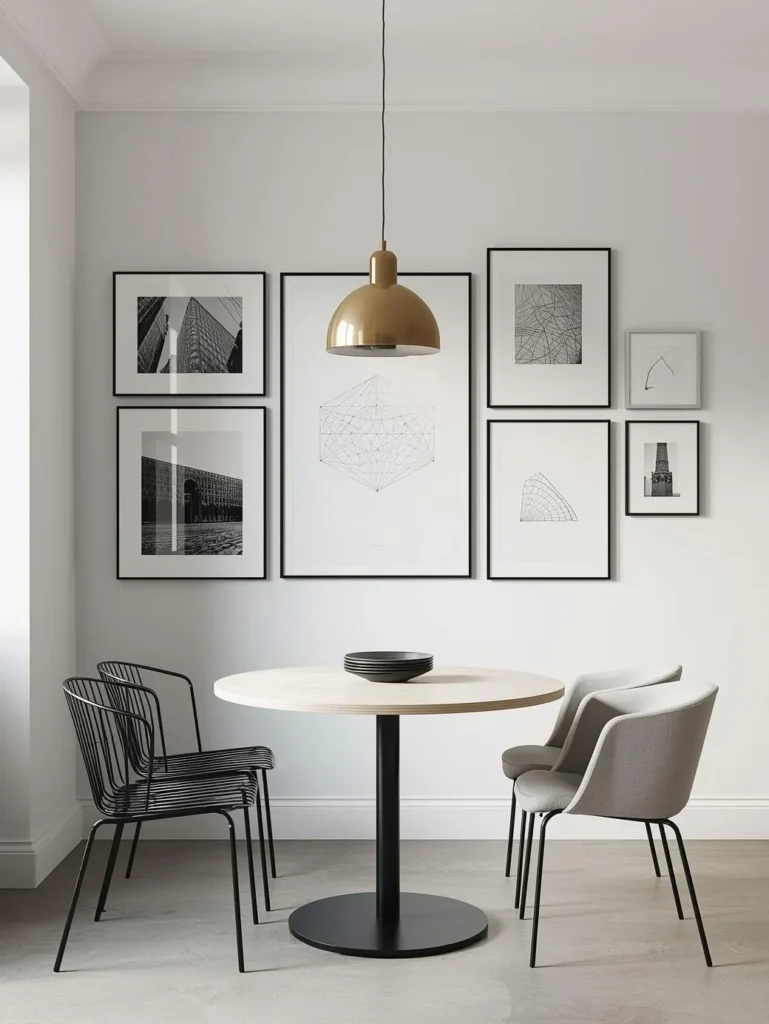
For soft industrial, the formula is simple: thin black or raw metal frames in mixed but related sizes, paired with abstract black-and-white photography, architectural prints, topographical maps, or minimal line drawings. The frame weight, not the print content, should be the dominant visual element.
Arrange the frames on the floor before committing to wall placement. Avoid grids that are too rigid — a slight asymmetry reads more curated. Also avoid mixing frame finishes (black, gold, silver) within the same gallery wall. One finish, varied frame weights, keeps the composition cohesive.
Final Thoughts
These 18 soft industrial dining room ideas for a balanced home cover the full range of decisions — from your table base and upholstery pairings to ceiling treatment, lighting layers, and wall finishes. The through-line in every idea is the same: industrial structure plus soft material creates a room that feels both designed and livable.
Save this post for your next design project or when you are ready to make a specific change to your dining space. Whether you are starting from scratch in a new home or refining a room that has never quite felt right, the ideas here give you a clear, practical starting point. Explore more functional kitchen layout ideas and open-plan dining space planning guides for additional direction on how layout choices shape the way a room actually lives.