
If you are searching for japanese garden ideas 2026 that go beyond bamboo and gravel, this guide is built for you. Most American homeowners struggle to translate Japanese garden principles into their actual yard size, climate, and maintenance reality, so every idea here comes with practical guidance on what to plant, how to lay it out, and what to avoid so the result looks intentional rather than imitated.
1. The Dry Zen Garden (Karesansui) That Works in a Small Front Yard
A dry Zen garden, known in Japanese design as karesansui, uses raked gravel or decomposed granite to represent water, with carefully placed stones representing land forms. It is one of the most practical japanese garden ideas for small front yards because it requires almost no irrigation, produces no fallen leaves to manage, and looks polished year-round with minimal upkeep.
The layout works by using negative space deliberately. The raked gravel is not a filler; it is the primary design element. Choose two to five stones of varying height and mass and place them asymmetrically, grouping them in odd numbers. Even spacing between stones kills the naturalistic effect immediately. The stones should look like they arrived there through natural geological process, not like they were placed by someone following a grid.
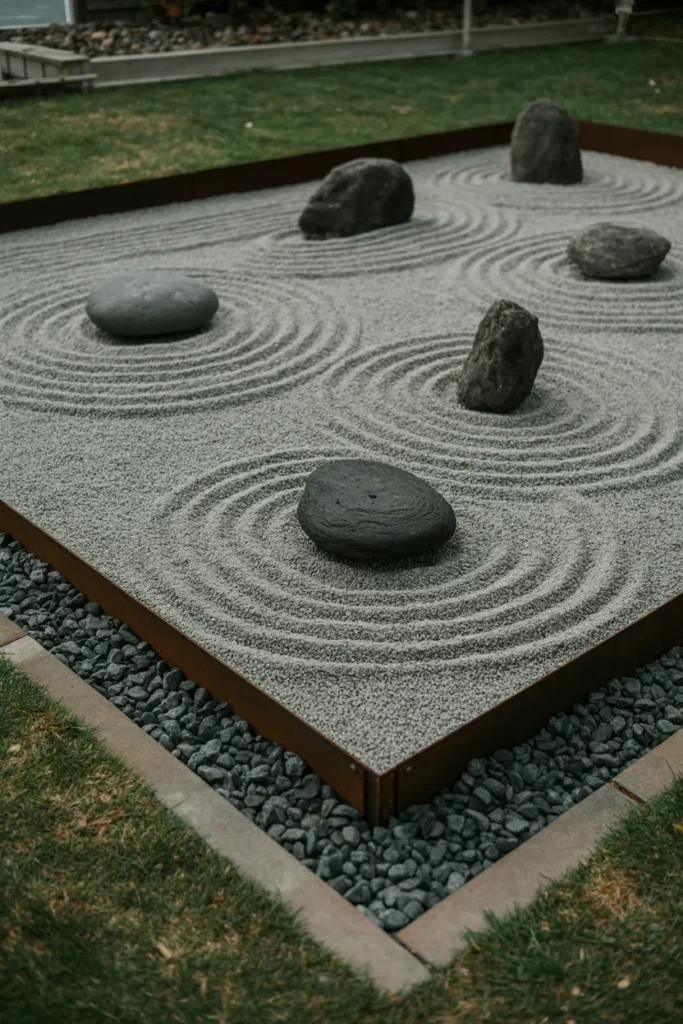

For American yards, decomposed granite in a warm buff or gray tone works better than imported white gravel, which can read as stark against typical suburban landscaping. Border the dry garden with a low dark timber or Cor-Ten steel edge to define it cleanly from the surrounding lawn or planting beds.
This layout is the right choice for drought-prone regions, low-water landscaping requirements, HOA front yards where lawn is being replaced, and homeowners who travel frequently and need a garden that maintains itself.
2. The Shaded Moss Garden Layout for Pacific Northwest and Southeastern Yards
Moss gardens are among the most underused japanese garden ideas in the United States, despite the fact that large portions of the Pacific Northwest, Southeast, and mid-Atlantic states have exactly the moisture and shade conditions that moss requires to thrive without supplemental irrigation.
A moss garden works by replacing lawn with a continuous carpet of low-growing moss species, typically a combination of sheet moss and cushion moss, laid over a prepared surface of compacted soil with a slightly acidic pH between 5.0 and 5.5. The result is a dense, velvety green surface that requires no mowing, no fertilizer, and very little water once established. It tolerates foot traffic in moderation, which makes it usable as a garden path surface as well as a ground cover.
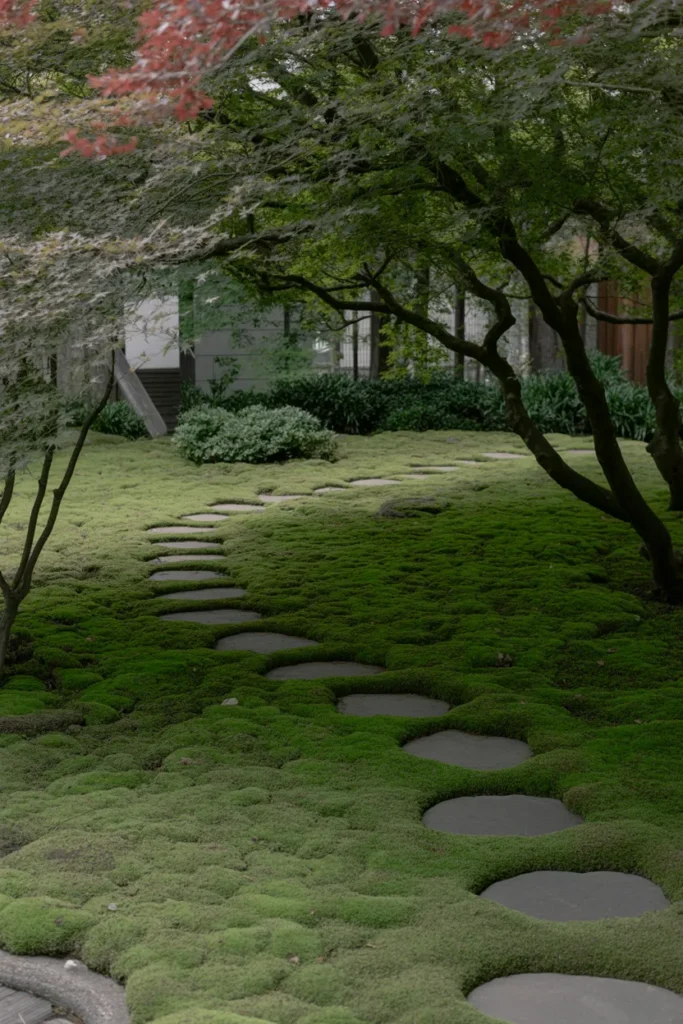
For the layout, use a single stepping stone path of irregular flat stones running through the moss field rather than a gravel path. The contrast between the cool green moss and the warm gray stone is one of the defining visual elements of traditional Japanese moss garden design and it translates directly into American residential yards.
Avoid planting moss in areas that receive more than four hours of direct sun per day. Sun-exposed moss turns brown and dies within a season. This layout is specifically suited to the shaded north or east sides of a property, under established tree canopies, or along the shaded foundation of a house.
3. The Japanese Water Feature Layout That Fits a Side Yard Corridor
A shishi-odoshi, the traditional Japanese deer scarer made from a pivoting bamboo tube that fills with water and tips to strike a stone, or a simple tsukubai stone basin with a bamboo spout, fits perfectly in a side yard corridor that is too narrow for conventional landscaping but too visible to ignore.
The water feature becomes the organizing element of the side yard layout. Position the basin or shishi-odoshi at the midpoint of the corridor and work outward from it with planting and stone. A border of black river pebbles around the base of the basin, a single upright stone beside it, and two or three clumps of Japanese forest grass at the base creates a complete composition in a space as narrow as four feet wide.
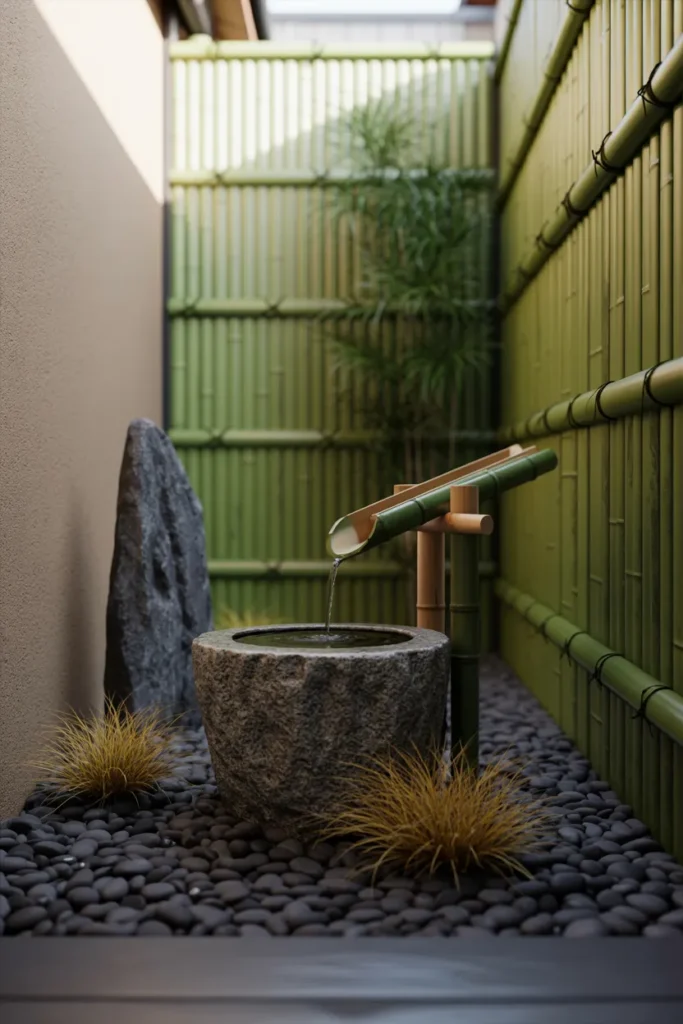
The sound element is as important as the visual one. The rhythmic sound of water in a Japanese garden is a deliberate design choice that creates a sense of calm that purely visual design cannot achieve. In a side yard that sits between the street and the main backyard, the sound also serves as a gentle acoustic buffer.
For year-round function in climates with freezing winters, choose a recirculating pump with a submersible heater rated for outdoor use, or design the feature to be winterized by draining it completely between November and March. A feature that cracks from ice damage in the first winter is not a design investment; it is a design mistake.
4. The Koi Pond Layout That Is Actually Manageable for a Residential Yard
A koi pond is one of the most aspirational japanese garden ideas, and also one of the most abandoned within two years because homeowners underestimate the biological and mechanical requirements before they build. A pond that is designed correctly from the start requires far less ongoing effort than one that was built on budget without proper filtration.
The minimum viable koi pond for residential use is 8 feet by 10 feet with a depth of at least 3 feet. Shallower than that and the water temperature fluctuates too quickly for fish health, algae becomes unmanageable, and predators such as herons can reach the fish easily. The depth also determines how many koi the pond can support. A 240-cubic-foot pond supports roughly six to eight medium-sized koi when paired with an appropriately sized biological filter.
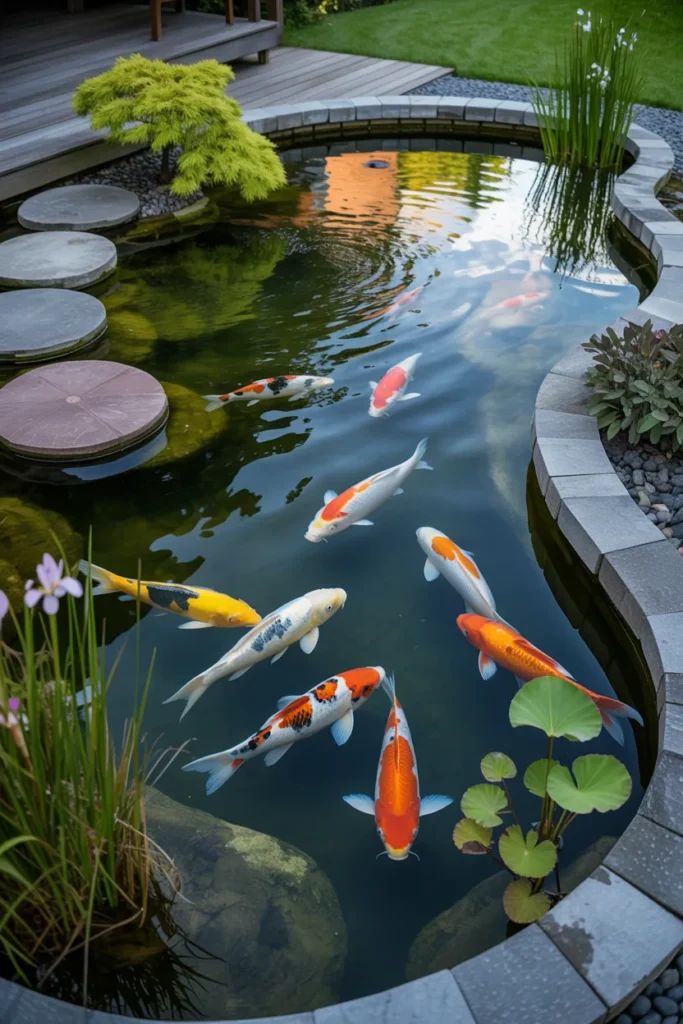
For the layout, position the pond so it is visible from an indoor window as well as from the primary outdoor seating area. A koi pond you cannot see from the house loses most of its value during the months when you are not outside. The viewing angle from the main seating spot should look across the pond rather than down into it, which is the angle where the fish and the reflection of surrounding plants are most visible.
Surround the pond edge with a mix of flat stepping stones and low spreading plants such as dwarf horsetail, creeping Jenny, or water iris. Avoid planting trees with aggressive roots or heavy leaf drop within 10 feet of the pond. Autumn leaf fall into a koi pond is one of the leading causes of water quality problems that beginners do not anticipate.
5. The Japanese-Inspired Courtyard Garden for an Urban Townhouse
Urban townhouses and row homes with small enclosed courtyards are ideal candidates for a Japanese courtyard garden because the enclosed walls replicate the walled temple garden aesthetic that is central to traditional Japanese garden design. The walls are not a limitation; they are a design asset.
The layout principle for a Japanese urban courtyard is to make the space feel larger than it is through restraint and borrowed scenery. Use one focal tree, typically a multi-stem Japanese maple or a cloud-pruned boxwood, positioned off-center in the courtyard. Place a single flat stone lantern at ground level in the opposite corner. Add a gravel or moss ground plane and leave significant empty space between the elements.
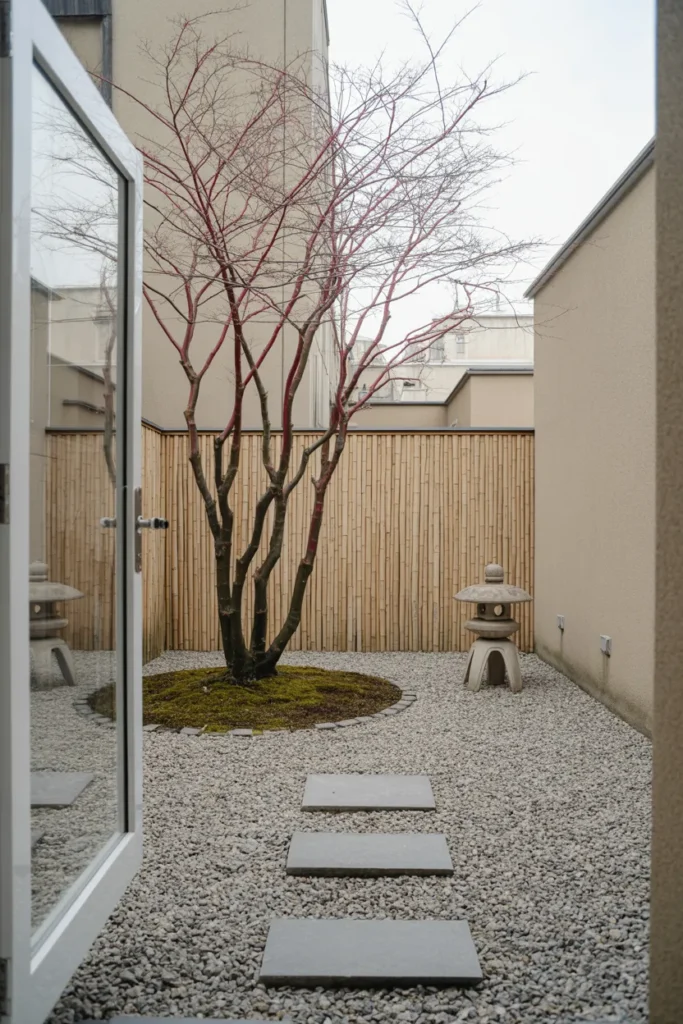
The mistake most people make in a small courtyard is adding too many elements because the space feels bare. Bare in a Japanese garden is not empty; it is composed. The open ground plane between the tree and the lantern is as intentional as the tree and the lantern themselves. Resist the impulse to fill every corner.
For the walls themselves, a bamboo panel fence installed inside the existing wall softens the hardscape and adds a distinctly Japanese material layer to the courtyard without requiring any structural change to the existing wall. Dark stained timber, bamboo, and weathered concrete all read as authentically Japanese in a way that painted CMU block walls do not.
6. The Naturalistic Japanese Path Design That Connects Two Yard Zones
A Japanese-style garden path does more than connect two points. It controls the pace at which someone moves through the garden, directs where the eye falls, and creates a sense that the journey matters as much as the destination. In American yards, this principle translates most effectively as a stepping stone path that meanders slightly rather than running in a straight line between two points.
The stones should be large enough that each step lands fully on the stone, roughly 18 to 24 inches across, and spaced so that a person of average stride walks at a naturally unhurried pace. Stones spaced too far apart create an awkward hop. Stones placed too close together encourage fast walking, which defeats the purpose. A 12 to 16-inch gap between stone faces, measured center to center, produces the right pace for most adults.
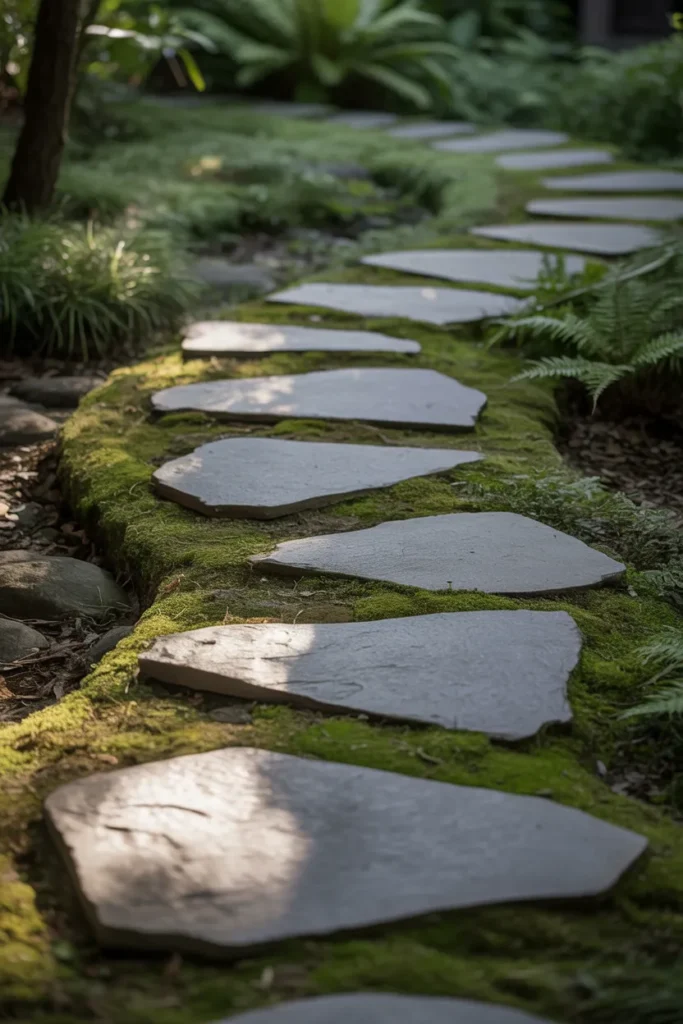
Set the stones at grade or just below it so the path surface is level with or slightly above the surrounding ground. Stones that sit high create tripping hazards. Stones that sink below grade collect standing water and become slippery. The surrounding material between stones, whether moss, gravel, or low ground cover, should be flush with the stone surface, not packed against the side.
This path layout works in backyards of any size to connect a patio to a garden feature, a gate to an entry, or a lawn to a shade garden. It requires no edging, no border, and no structural installation. Properly selected and set stepping stones are one of the most achievable and most impactful japanese garden ideas for a first project.
7. The Bamboo Screen Garden That Creates Instant Privacy in a Suburban Backyard
Bamboo used as a privacy screen rather than a landscape plant is one of the most practical and fastest-results japanese garden ideas available for American homeowners who need to block a neighbor’s view, an unsightly fence, or a utility area within a single growing season.
The critical distinction is between running bamboo and clumping bamboo. Running bamboo spreads aggressively through underground rhizomes and can invade neighboring properties, which creates both a relationship and a legal problem in many states. Clumping bamboo varieties expand slowly outward from the center crown by two to four inches per year and stay where you plant them. For residential use in the US, always choose clumping bamboo.
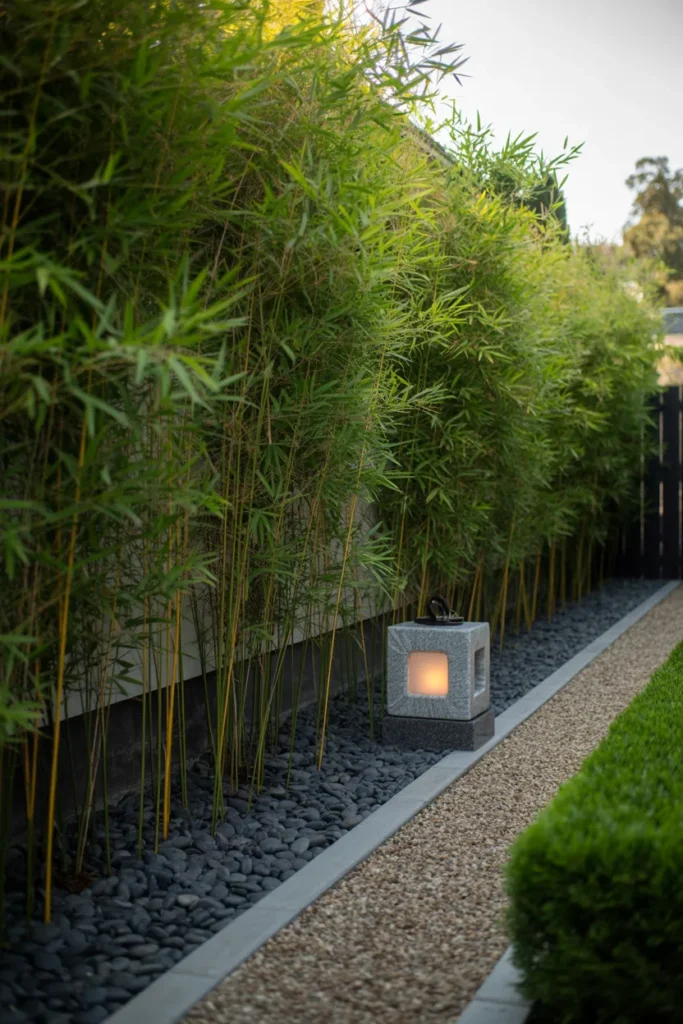
For a privacy screen, plant clumping bamboo in a linear arrangement 3 to 4 feet apart in a well-draining bed with consistent moisture. Within two to three growing seasons, the plants fill to a continuous dense screen. Install a rhizome barrier during planting as an additional safeguard even with clumping varieties, particularly in warmer USDA zones where any bamboo grows more aggressively.
Frame the bamboo screen with a path of dark river pebbles at its base and one or two stone lanterns placed at intervals along its length. This elevates the screen from a functional planting to a designed garden element and gives the bamboo a composed, Japanese context rather than just a row of tall grass.
8. The Japanese Rock Garden Design for a Dry Slope or Hillside
Sloped yards are a landscaping challenge that most homeowners solve with retaining walls or erosion ground cover. A Japanese rock garden approach to a dry slope solves the same erosion and aesthetics problem while producing a result that improves visually with age rather than requiring constant replanting.
The technique involves placing large anchor stones at the upper end of the slope and allowing the planting and gravel to flow downward from those anchors, mimicking the way water and sediment would naturally move down the hillside. The largest and most visually dominant stones go at the top and sides. Smaller stones fill the spaces between them. Gravel or decomposed granite covers the ground plane between the stones and plants.
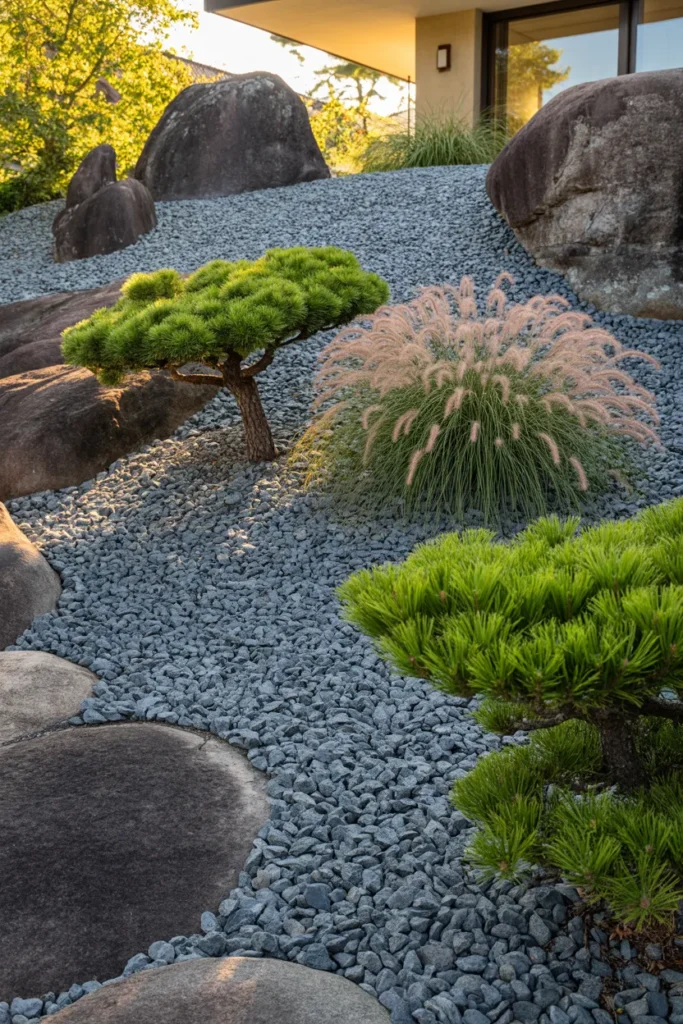
Plant selection for a dry slope Japanese garden in most American climates should focus on low-water ornamental grasses, dwarf conifers, and ground-hugging sedums. Japanese black pine in dwarf form, muhly grass, and spreading junipers all suit the aesthetic and the slope condition simultaneously. Avoid plants that need consistent supplemental irrigation on a slope because water runs off before it penetrates.
This is one of the most functional japanese garden ideas for western US homeowners where water restrictions apply, for fire-wise landscaping zones where combustible plants must be minimized, and for any property with a slope that currently grows nothing useful because it is too dry, too steep, or too difficult to mow.
9. The Wabi-Sabi Inspired Garden That Embraces Imperfection and Age
Wabi-sabi is the Japanese aesthetic principle of finding beauty in imperfection, impermanence, and incompleteness. In garden design, it means choosing materials and plants that weather and age gracefully rather than materials that need to stay pristine to look good. For American homeowners who are tired of maintaining perfect lawn edges and pressure-washing everything annually, this is a deeply practical design philosophy.
A wabi-sabi garden uses weathered stone, moss-covered surfaces, aged timber, and asymmetric plant forms as its primary design vocabulary. A concrete lantern that has developed a moss patina is more valuable in this design language than a new one. A slightly leaning stone is more interesting than a perfectly upright one. Rusted Cor-Ten steel, weathered teak, and rough-hewn granite all read as authentically wabi-sabi in a way that smooth polished surfaces do not.
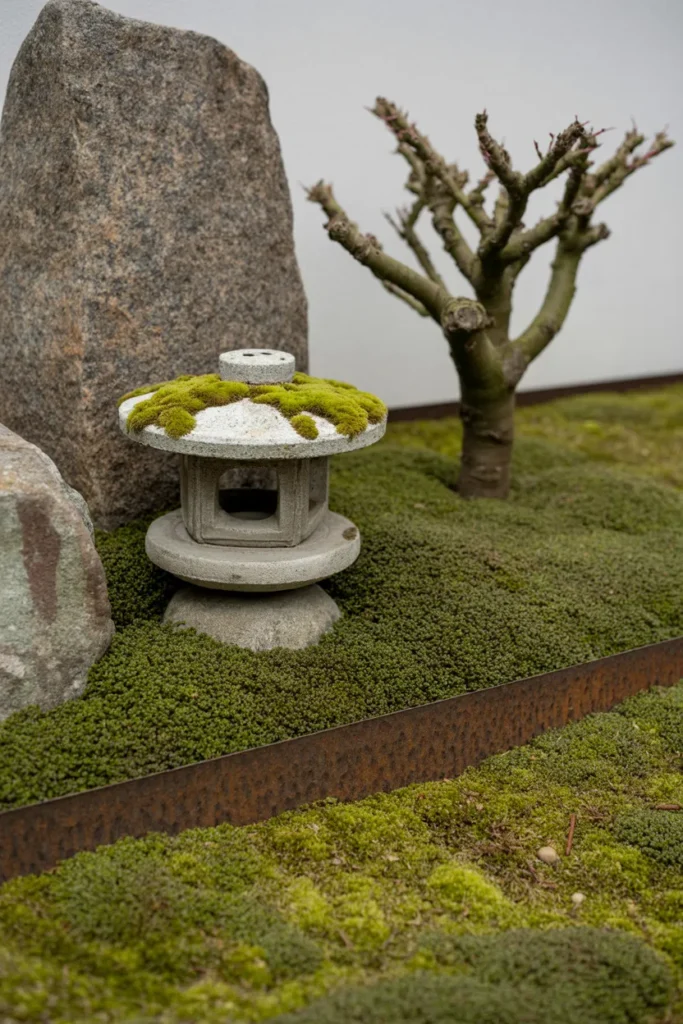
For layout, the wabi-sabi garden avoids straight lines, matched pairs, and symmetry. One stone lantern, not two. Plants placed individually, not in mirrored arrangements. A path that bends for no functional reason other than to create a moment of pause. The organization is there, it is simply not obvious, and that hiddenness is part of the aesthetic.
This approach suits homeowners who want a garden that looks better at year five than at year one, who do not want to repaint, replant, or reseal their outdoor surfaces annually, and who prefer a garden that feels discovered rather than constructed.
10. The Night-Lit Japanese Garden That Looks as Good After Dark as It Does by Day
Most residential Japanese gardens are designed for daytime viewing and become invisible after sunset. A Japanese garden with an intentional nighttime lighting plan is a far more valuable outdoor asset, particularly for homeowners who are at work during the day and experience their garden primarily in the evening.
Japanese garden lighting should be low, directional, and warm-toned. Up-lighting placed at the base of a specimen tree illuminates the branch structure from below, which is a completely different and often more dramatic view of the tree than daylight provides. A single in-ground spot aimed at a stone lantern creates a focal point that reads across the entire garden from inside the house.
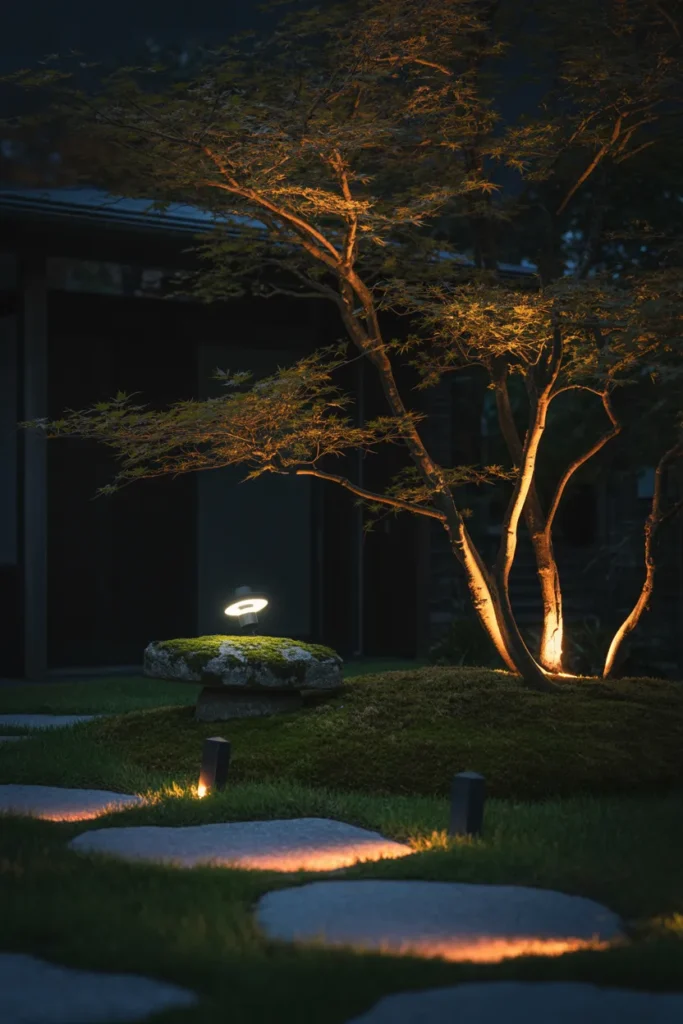
Path lights in a Japanese garden should be set into the ground at the edge of the path rather than installed on stakes above it. Ground-level lighting creates a soft pool of light on each stepping stone without the visual clutter of stake lights competing with the garden composition. Keep the color temperature at 2700K or below for a warm amber tone that suits the natural materials of the garden.
The rule of restraint applies to lighting as strongly as it does to plants and stones. Four well-placed lights in a Japanese garden outperform twelve mediocre ones. Start with the single most important element in the garden, the specimen tree, the water feature, or the stone lantern, and light that one element beautifully before adding anything else.
11. The Tsukubai Stone Basin Feature for a Garden Entry or Transition Point
A tsukubai is a low stone water basin traditionally placed at the entrance to a Japanese tea garden to allow guests to rinse their hands before entering. In a residential American garden, the tsukubai translates perfectly as a focal water feature at a gate entry, at the transition between a front path and a back garden, or at the threshold of a dedicated meditation or seating area.
The defining characteristic of a tsukubai is its low height. The basin sits close to the ground, typically 12 to 18 inches high, intentionally requiring the viewer to lower themselves to interact with it. This physical gesture of looking down, of stopping and pausing, is the functional design intent. It creates a moment of transition that taller fountain features cannot replicate.
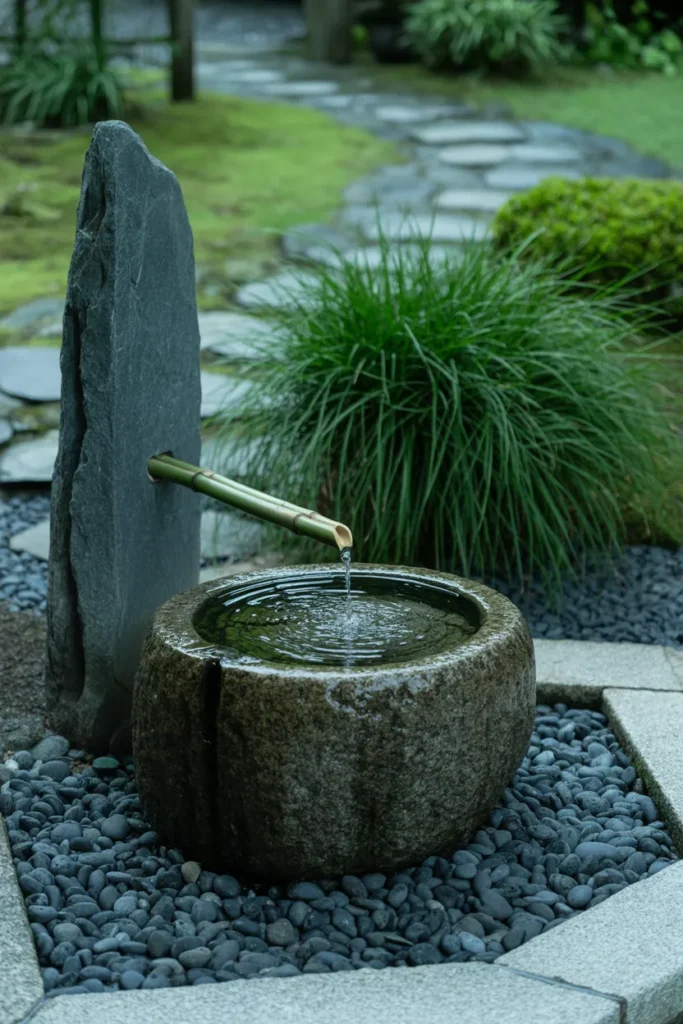
Pair the basin with a bamboo spout that delivers a quiet, steady stream of recirculating water. The surrounding composition should be simple: black pebbles immediately around the basin base, one upright stone to one side, and low planting of mondo grass or dwarf fern on the other. Three elements, not more.
Position the tsukubai so it is encountered naturally in the course of moving through the garden, not tucked in a corner as an afterthought. It should be something visitors move toward, pause at, and then continue past. This sequencing principle, the orchestrated garden journey, is fundamental to japanese garden design ideas that feel authentic rather than decorative.
12. The Low-Maintenance Japanese Garden Front Yard That Replaces Lawn in Any US Climate
Replacing a front lawn with a Japanese-inspired planting plan is one of the most searched japanese garden ideas in the US for 2026, driven by water restrictions, lawn care cost, and the growing appeal of landscape that looks considered rather than conventional. The key is choosing plants and materials that suit your specific USDA hardiness zone rather than defaulting to plants that appear in Japanese garden photographs but do not survive an American winter.
For cold climates in USDA zones 4 through 6, Japanese maples in cold-hardy varieties, ornamental grasses, and spreading junipers form the planting backbone. For warmer zones 7 through 10, add bamboo, nandina, and liriope. The gravel or decomposed granite ground plane works in every zone and is the element that most strongly reads as Japanese regardless of what plants surround it.
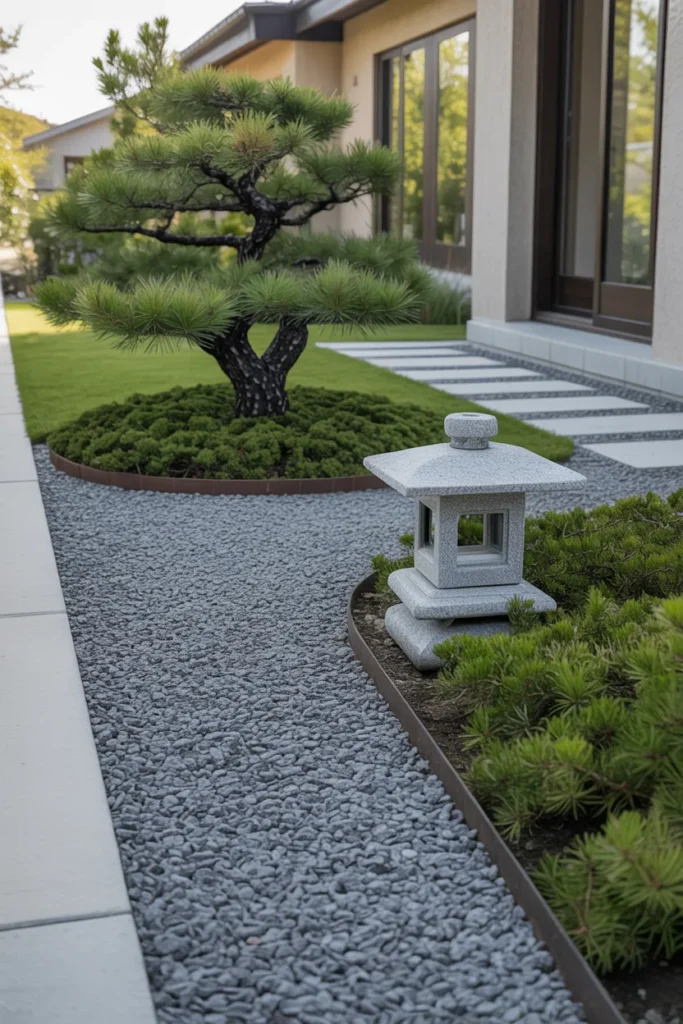
The front yard layout should establish one clear focal point visible from the street. A single specimen tree, a stone lantern at the path edge, or a composed stone grouping at the center of the gravel field. Everything else in the layout supports that one focal element rather than competing with it. Front yards that try to have three focal points end up with none.
Install a defined path from the sidewalk to the front door that is clear, direct, and wide enough for two people to walk side by side. The Japanese garden aesthetic around the path can be asymmetric and layered, but the path itself should be unambiguous. Guests should never have to guess where to walk in order to reach the entrance.
Final Thoughts
The best Japanese garden ideas for 2026 are the ones that match your climate, your yard size, and your honest maintenance commitment, not the ones that look most dramatic in photographs. Every idea in this guide is chosen because it translates into real American residential yards and delivers results that improve with time rather than requiring constant renewal.
If one of these layouts fits your property or planning goals, save this post to your Pinterest boards so you can return to it when you are ready to design or build. And if you are still exploring, browse more Japanese garden design and small yard landscaping ideas to find the approach that works for your specific space and growing zone.