
If your bathroom storage is failing you, the shelving layout is almost always the real problem. This guide covers the best bathroom shelves ideas 2026 has to offer — from compact floating setups in small apartments to full-wall built-ins in primary suites — so you can make a smart decision based on your actual space, not just what looks good on a mood board.
1. Floating Teak Shelves Above the Toilet: The Vertical Storage Fix Most Bathrooms Are Missing
The space above the toilet is one of the most underused areas in any bathroom. A set of two or three floating teak shelves installed vertically in that zone gives you meaningful storage without touching your floor plan. This works especially well in narrow bathrooms where wall space is limited on every other wall.
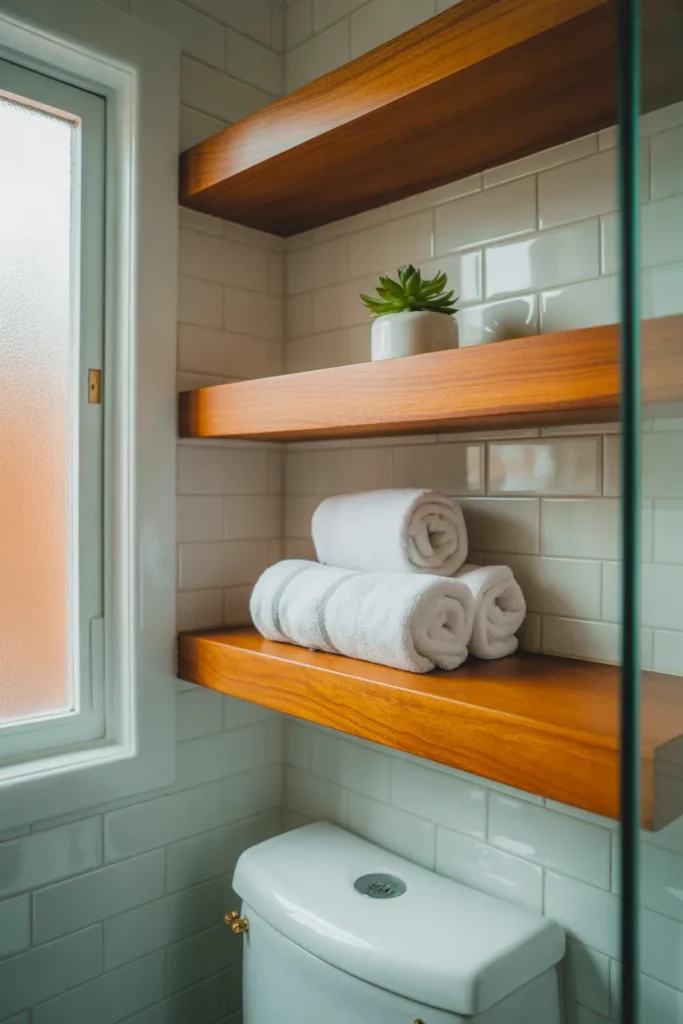
Teak holds up well in humid conditions, which makes it more practical than standard pine or MDF in a bathroom setting. Keep shelf depth between 8 and 10 inches so items stay accessible without the shelf feeling intrusive. Stagger the heights slightly rather than spacing them evenly — it makes the wall feel intentional rather than utilitarian.

The most common mistake here is mounting shelves too high. The top shelf should sit no higher than 60 to 65 inches from the floor, or you lose usability entirely. Style with rolled towels on the lower shelf and open containers on the upper ones to keep the look clean.
2. Recessed Niche Shelves in the Shower Wall: Built-In Storage That Disappears Into the Design
A recessed niche cut directly into the shower wall is the cleanest shelving solution available for wet zones. Because it sits flush with the wall surface, it adds zero visual bulk to the shower space — critical in smaller bathrooms where every inch of perceived space matters.
Standard niche dimensions run 12 by 24 inches, which fits most tile layouts cleanly. Positioning matters significantly: a single large niche at chest height serves most users better than two small ones stacked vertically. If you have a double shower, consider one niche on each side wall rather than two on the same wall.
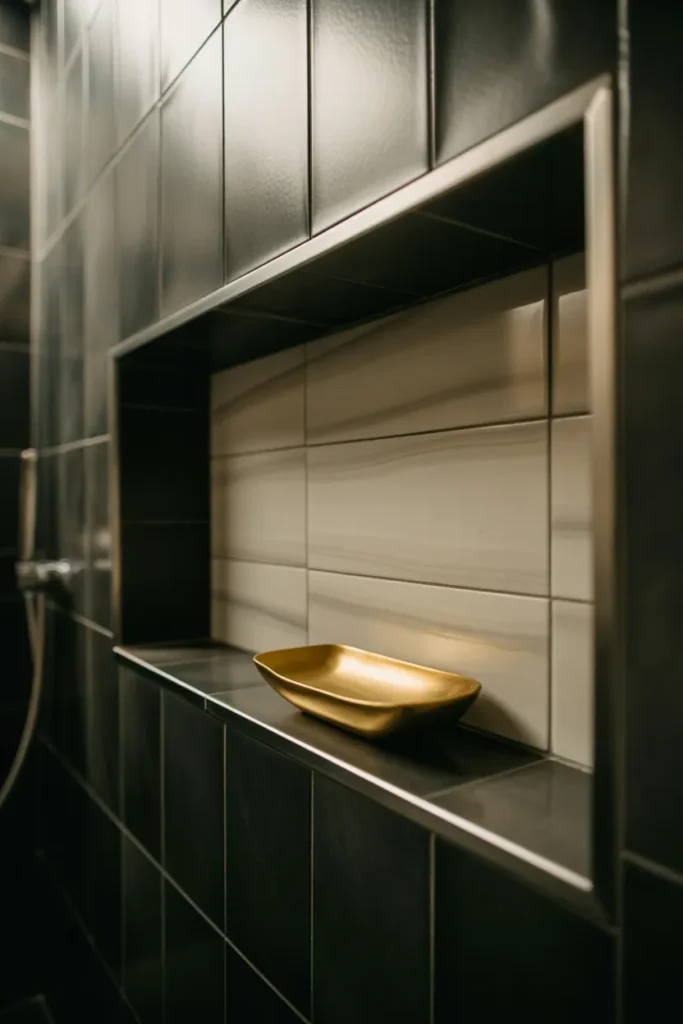
Avoid placing a niche on an exterior wall — moisture and insulation issues make this a structural problem in most climates. The back wall or the side wall opposite the showerhead are both reliable choices.
Grout the niche interior in a contrasting color or use a mosaic tile inset to define the space without adding hardware. This small detail is what separates a niche that looks designed from one that looks like an afterthought.
3. Full-Height Open Shelving Unit Beside the Vanity: Replacing the Linen Closet You Don’t Have
In bathrooms without a linen closet, a floor-to-ceiling open shelving unit placed beside the vanity functions as a true storage system rather than a decorative gesture. This layout works in bathrooms that have at least 18 inches of clearance beside the sink cabinet.
Use adjustable shelves so you can configure the spacing around what you actually store — tall bottles, folded towels, and small baskets all have different height requirements. A unit that is 12 inches deep is the right balance between storage capacity and walkway clearance.
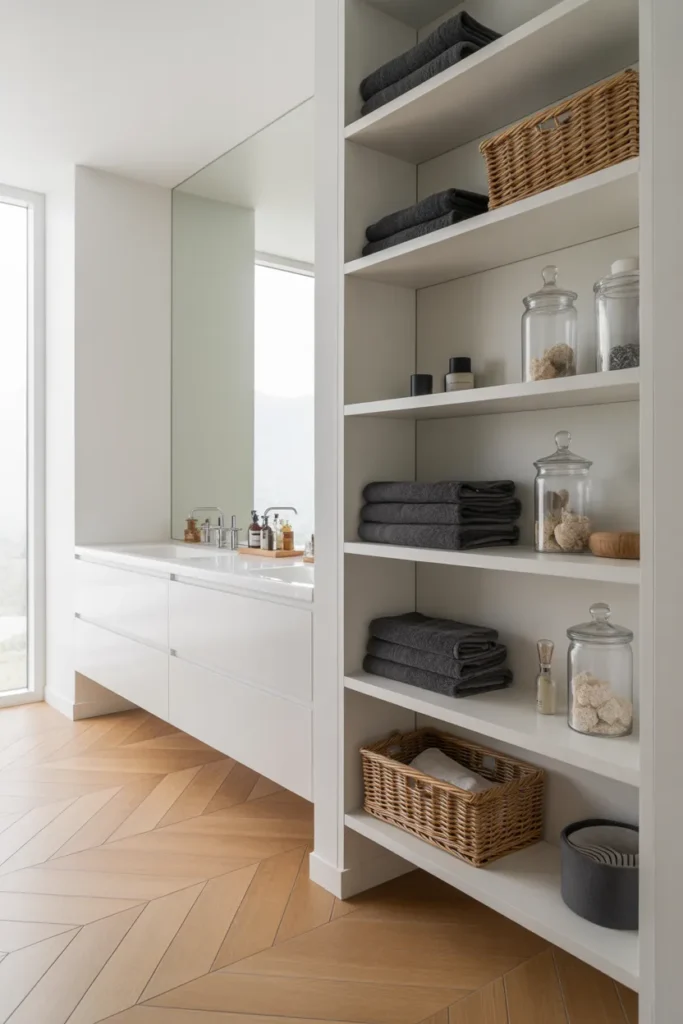
Paint or finish the unit the same color as the wall to reduce visual weight, particularly in bathrooms under 60 square feet. This makes the shelving feel architectural rather than like furniture that was added after the fact.
Do not use this layout directly adjacent to a shower or freestanding tub — sustained moisture exposure will warp wood and peel painted finishes regardless of how well the unit is sealed. Reserve it for the dry zone of the bathroom.
4. Ladder Shelf Leaning Against the Wall: Flexible Storage for Renters and Small Bathrooms
A leaning ladder shelf is the most practical no-drill shelving option for bathrooms, making it the right call for renters, temporary setups, or anyone who wants to reconfigure their space without committing to wall anchors.
The geometry of a ladder shelf — wider at the base, narrower at the top — naturally suits bathroom storage. Heavier items like extra toilet paper and stacked towels go on the lower rungs; lighter decorative pieces or a small plant go near the top. This distribution also prevents the unit from tipping.
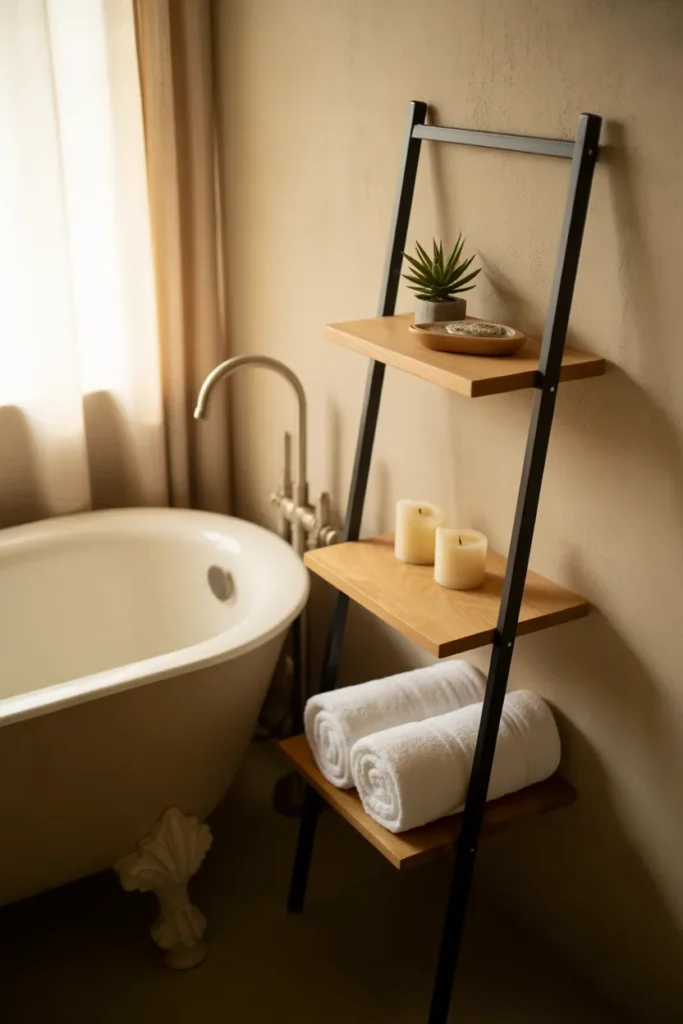
Black powder-coated metal frames paired with thin natural wood shelves are the most durable combination for humid environments. Avoid solid wood-only ladder shelves in bathrooms without exhaust fans — the wood will swell and warp within months.
Keep the ladder positioned in a corner rather than flat against a wall. The angled placement in a corner gives it structural stability without wall anchors and takes up less floor space than it appears to.
5. Glass Shelves with Chrome Brackets: The Right Move for Dark or Small Bathrooms
Glass shelves with polished or brushed chrome brackets are one of the most effective tools for maintaining light and openness in a small or windowless bathroom. Because glass is transparent, shelves disappear visually and avoid the wall-closing effect that solid wood or painted MDF creates in tight spaces.
Tempered glass is non-negotiable in a bathroom setting — standard glass is a safety hazard near hard tile floors. Most glass shelves sold for bathroom use are already tempered, but confirm before purchasing. A thickness of 3/8 inch provides enough stability for everyday bathroom items without flex.
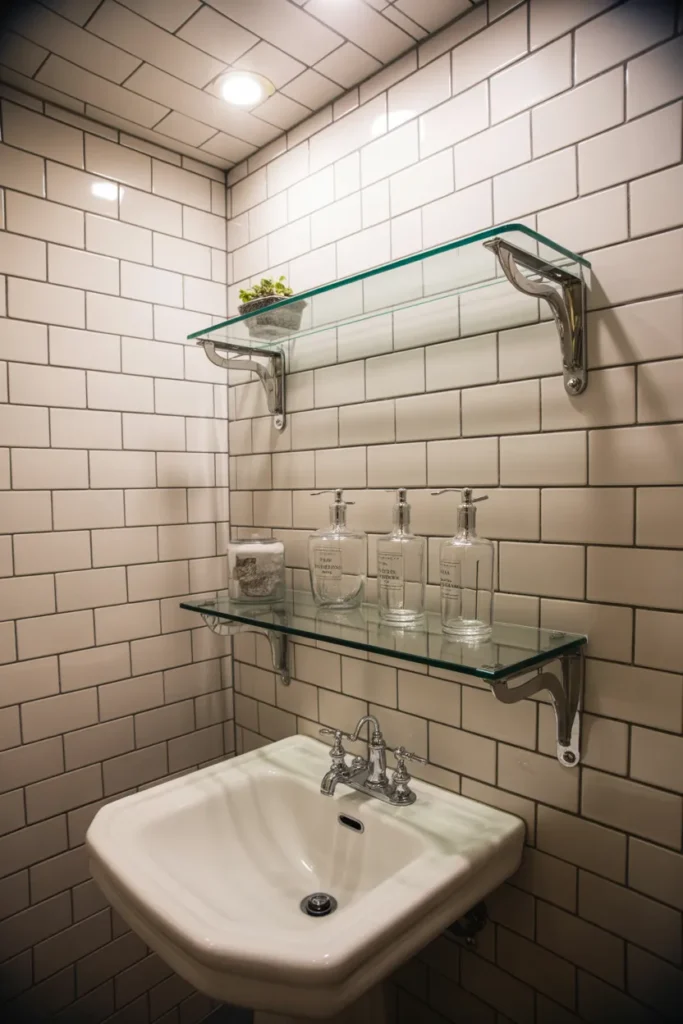
This shelving type works particularly well above a pedestal sink, where there is no vanity cabinet for under-sink storage. Two glass shelves flanking or directly above the mirror reclaim storage without interrupting the visual flow of the wall.
Avoid overloading glass shelves with heavy ceramic or glass containers. Distribute weight evenly across the shelf length and keep the heaviest items centered over the brackets, not at the edges.
6. Arched Alcove Shelving Built Into a Nook: When Architecture Does the Heavy Lifting
If your bathroom has an existing alcove, nook, or recessed wall — common in older homes and some converted spaces — building shelves directly into that void is the most efficient use of an otherwise wasted recess. This approach requires no additional floor space and creates a storage feature that looks custom-built into the architecture.
Alcove depth typically ranges from 4 to 8 inches in residential construction. At 4 inches, you can store toiletries, small bottles, and candles comfortably. At 6 to 8 inches, rolled towels and larger product bottles fit without overhang.
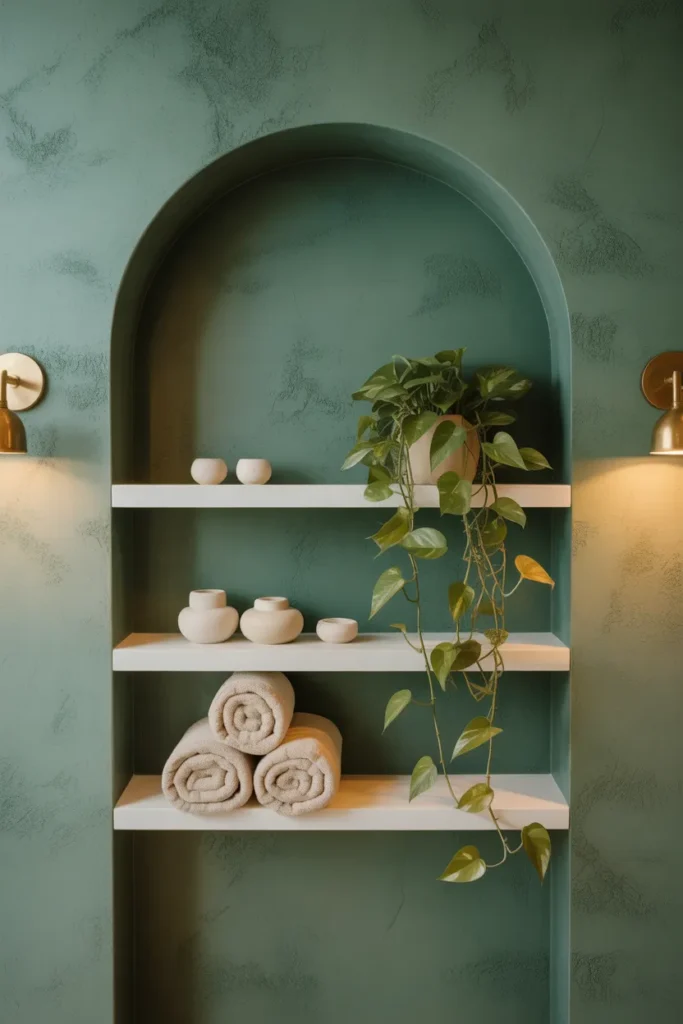
Finishing the interior of the alcove in a contrasting paint color or small-format tile makes the shelving feel purposeful and designed. A warm terracotta interior with white shelves, or a deep navy interior with natural oak shelves, are two combinations that read as intentional in both photography and real life.
If your bathroom does not have a natural nook, this is not the right shelving idea for your space. Attempting to recreate the alcove effect by floating shelves in a random wall section does not produce the same architectural result.
7. Pipe and Wood Industrial Shelves: Raw Material Contrast That Works in Modern Bathrooms
Black iron pipe brackets with rough-cut or live-edge wood planks create a material contrast that reads as intentional in modern, industrial, and even transitional bathroom designs. This shelving style is significantly more structural than it looks — pipe hardware is load-bearing by design.
This layout works best in bathrooms with a neutral or monochrome palette. The hardware becomes the visual statement, so the walls, tile, and fixtures should remain understated. White or light grey walls make the black pipe pop without creating a chaotic look.
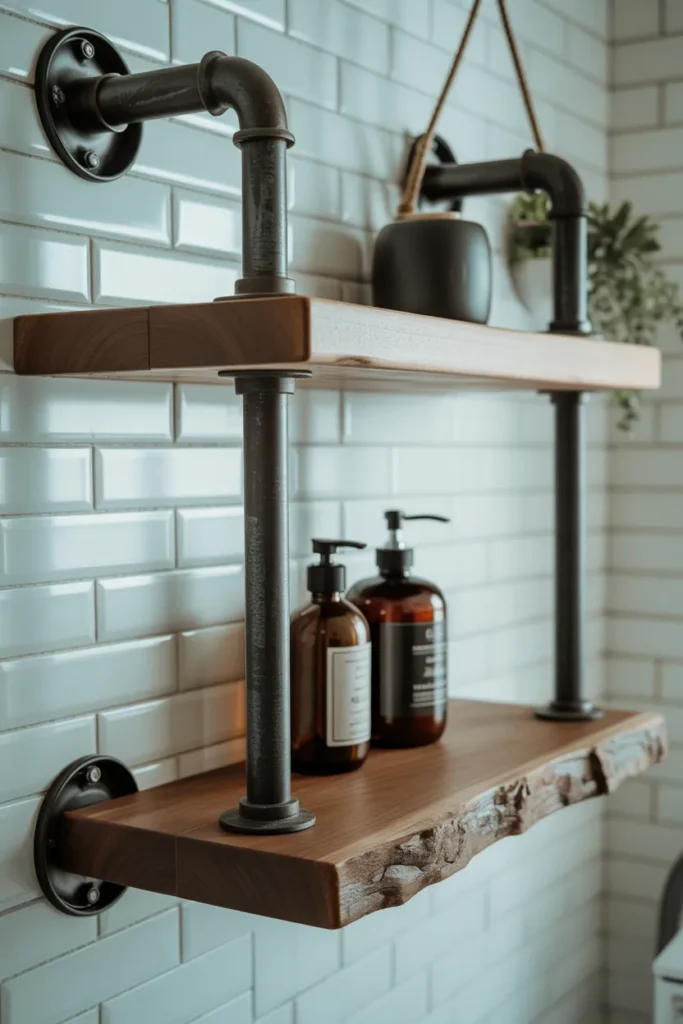
Pipe shelf kits are available in standard lengths and can be cut to fit non-standard wall widths, which makes them adaptable for awkward wall configurations that standard shelf brackets cannot span cleanly. This is useful in bathrooms with windows, radiators, or doors that interrupt normal shelf placement.
Seal the wood thoroughly with a waterproof finish before installation. Raw or lightly finished wood in a bathroom will absorb moisture and develop mold within the grain regardless of how well-ventilated the space is.
8. Corner Triangle Shelves Stacked Vertically: Solving the Hardest Storage Problem in Small Bathrooms
Corner space is consistently wasted in bathrooms because standard rectangular shelves cannot fill it without protruding awkwardly into the room. Corner triangle shelves — purpose-built with a right-angle back edge — fit flush into the corner and use space that is otherwise unusable.
Three to five corner shelves stacked vertically in a bathroom corner create meaningful storage in a footprint of less than one square foot on the floor plan. This makes them the most space-efficient shelving option available for bathrooms under 40 square feet.
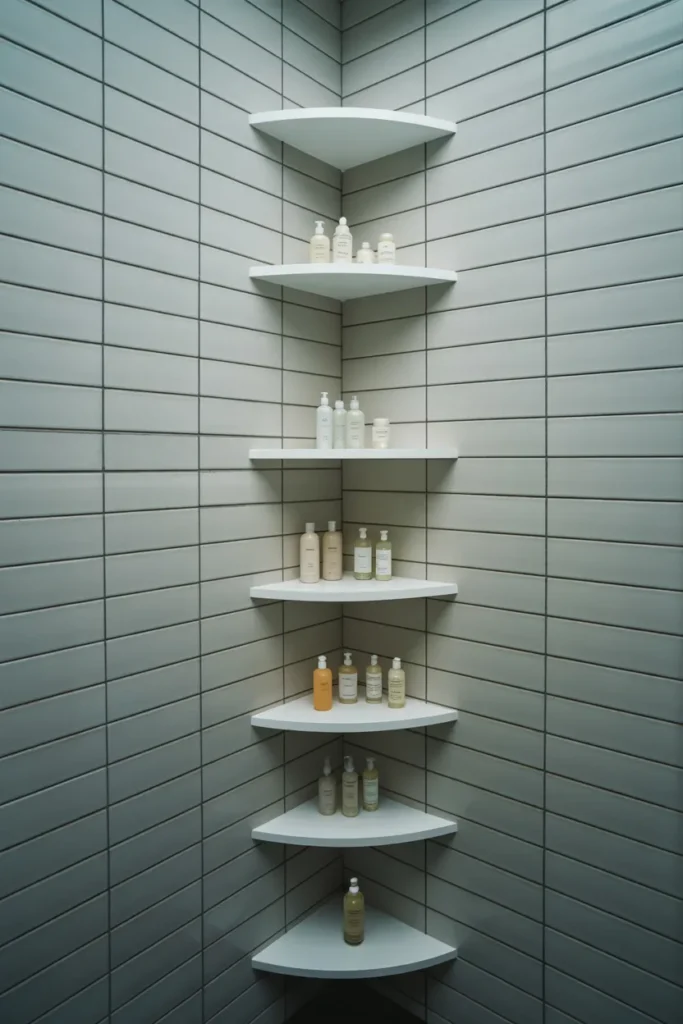
White or off-white corner shelves mounted on white walls are the right choice for very small bathrooms — keeping the materials the same color as the wall makes the shelving blend into the architecture rather than compete with it. In slightly larger spaces, a contrast material like walnut or black-stained wood reads better.
Corner shelves work particularly well in shower corners for shampoo and soap storage, as an alternative to or in combination with a recessed niche. In the shower, choose solid stone, porcelain, or stainless steel rather than wood or painted MDF.
9. Floating Shelves Flanking a Bathroom Mirror: Symmetry That Solves Storage and Style at Once
Placing two matching floating shelves on either side of the bathroom mirror — at the same height, using the same material — creates bilateral symmetry that feels designed and intentional while solving a real storage gap. This layout works above a vanity where there is no medicine cabinet and no room for one.
The shelves should sit at or slightly above mirror height so they do not interrupt sightlines when standing at the sink. Depth should be kept at 5 to 6 inches maximum to avoid collision with someone leaning toward the mirror.
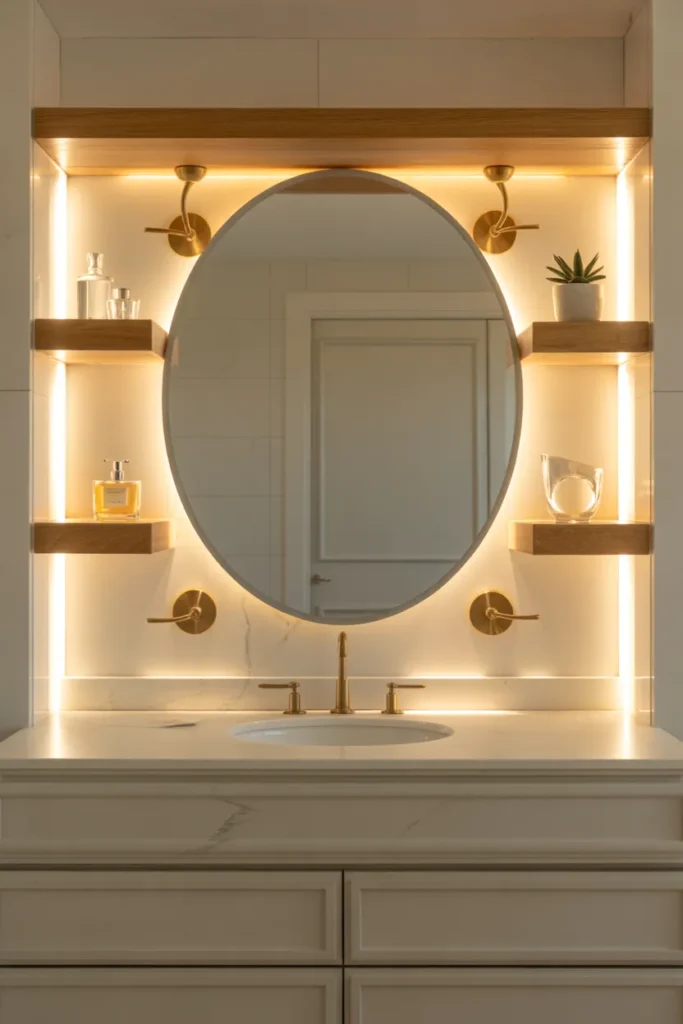
This configuration is particularly effective in bathrooms shared by two people. Each person gets one shelf — one on the left, one on the right — which creates a natural organizational division without requiring labeled storage.
Match the shelf material to the vanity hardware or light fixture finish for cohesion. If your fixtures are brushed gold, use shelves with brushed gold brackets. If your vanity handles are matte black, use black brackets. This one decision connects the shelving to the room rather than leaving it looking like an add-on.
10. Built-In Shelving Inside a Recessed Medicine Cabinet: Hidden Storage That Keeps the Wall Clean
A recessed medicine cabinet with interior shelving solves the surface-clutter problem that open shelving creates. Everything is stored behind a mirror door, the wall remains visually uninterrupted, and the items on the shelves are completely concealed. This is the right choice when a bathroom needs significant storage but visual minimalism is a priority.
Standard recessed medicine cabinets fit between wall studs at 14.5 inches wide. For wider cabinets, a structural assessment is needed to determine whether studs can be relocated or a header installed. In most existing bathrooms, a standard-width recessed cabinet is the more realistic option.
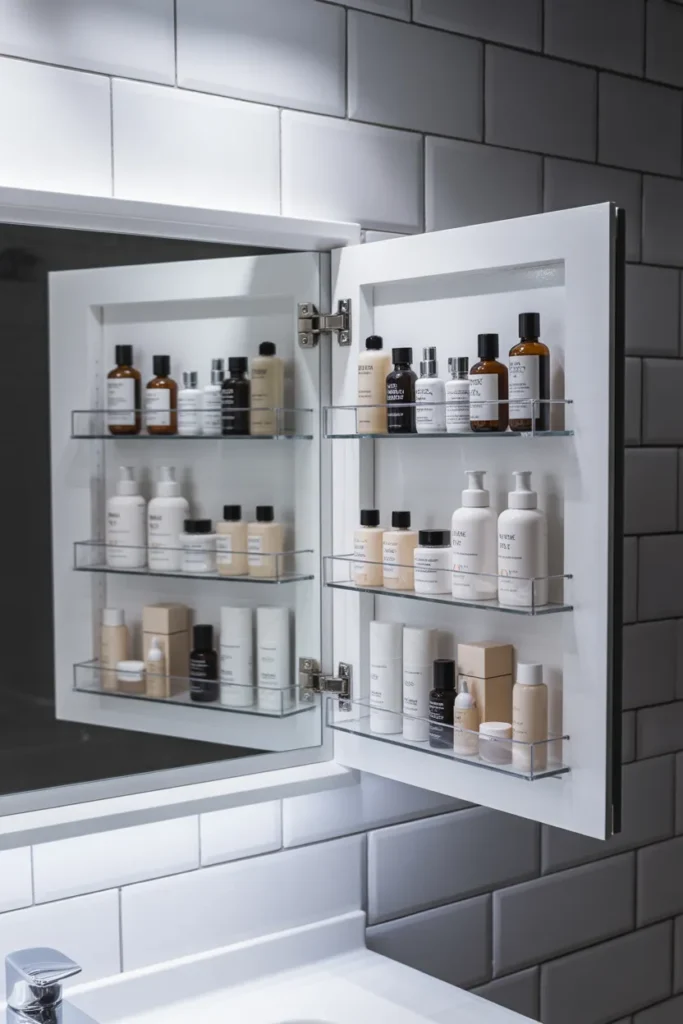
Interior shelf adjustability is the most important feature to prioritize when selecting a medicine cabinet. Fixed shelves are a long-term inconvenience because product heights change over time. Adjustable shelves accommodate everything from contact lens cases to tall serums.
Surface-mount medicine cabinets are an alternative when recessing into the wall is not possible, but they protrude from the wall and reduce the perceived depth of a small bathroom noticeably. If the wall cannot be recessed, a different shelving strategy will serve the space better.
11. Bamboo Freestanding Shelf Tower: A Natural Material That Handles Humidity Better Than Most Woods
A freestanding bamboo shelf tower placed in the bathroom corner or beside the toilet provides multi-level storage without any wall mounting. Bamboo’s natural density and moisture resistance make it one of the few organic materials that holds up reliably in bathroom humidity without sealing or special treatment.
Bamboo shelf towers typically offer four to five shelves in a compact 12-by-12-inch footprint, making them suitable for bathrooms with open floor space but no clear wall zone for mounting. They are also fully portable — useful in rental units or for anyone who rearranges their space seasonally.
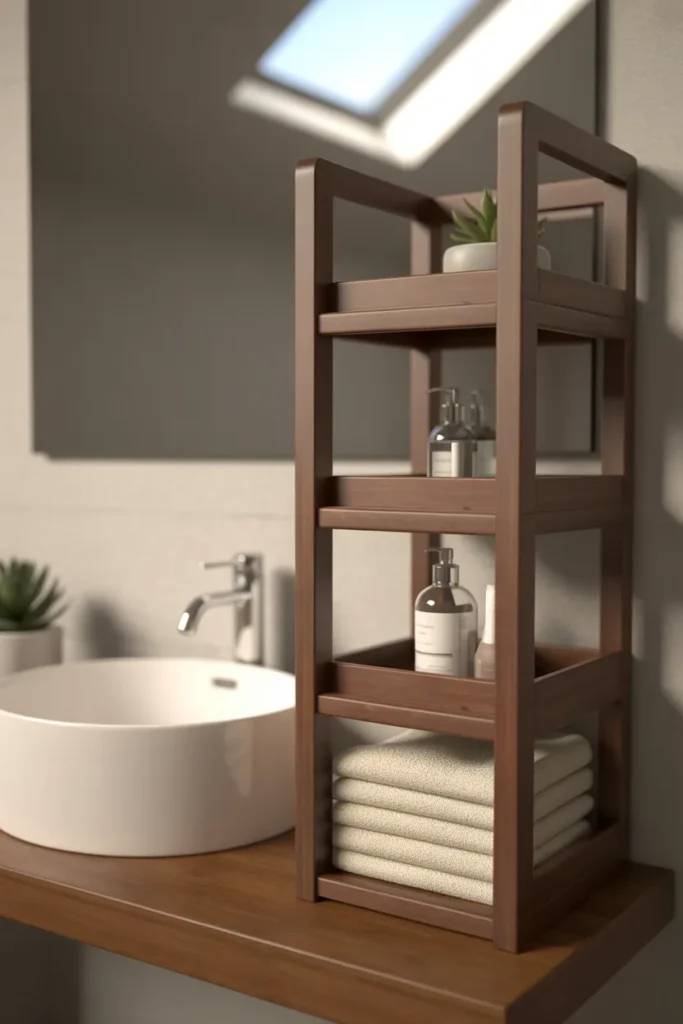
Dark-stained bamboo reads as more contemporary and pairs well with matte black fixtures and dark tile. Natural or light bamboo works better in white, beige, or Japandi-style bathrooms. Both finishes age gracefully rather than showing wear the way painted wood does.
The structural limitation of a freestanding bamboo tower is weight capacity. These units are not designed for heavy ceramic or thick glass storage. Use them for toiletries, small folded towels, and lightweight baskets rather than stacked bottles or multiple heavy items per shelf.
12. Open Shelf Below a Floating Vanity: Using the Gap That Most People Ignore
The open space beneath a floating vanity is one of the most consistently overlooked storage zones in modern bathroom design. A single low-profile shelf installed in that gap — or the vanity unit itself designed with an open lower shelf — turns dead space into functional storage without adding visual weight to the room.
This layout works best in bathrooms where the vanity floats at 18 to 22 inches from the floor. Below 16 inches, the shelf becomes difficult to access without kneeling. Above 22 inches, the gap feels proportionally awkward and the shelf can look disconnected from the vanity above it.
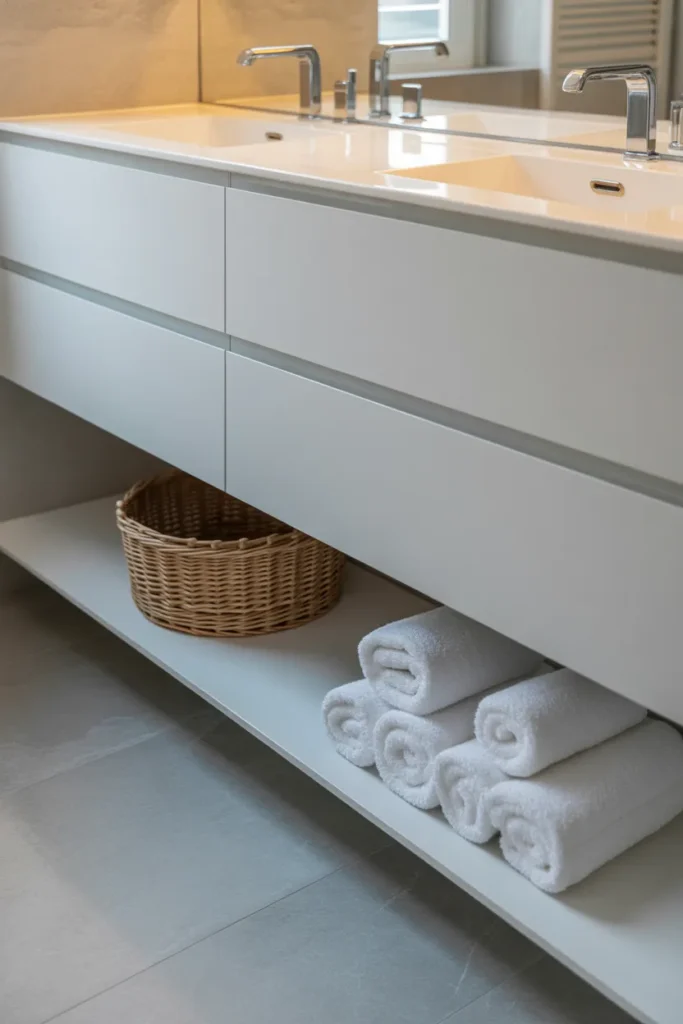
Use this zone for items that are used daily but do not need to be at countertop height: a stool, extra rolls of toilet paper in a basket, a small hamper, or a floor-level plant. The key is keeping the items on this shelf intentional — a cluttered lower shelf defeats the open and airy effect that floating vanities are designed to create.
In terms of materials, a shelf that matches the vanity finish — same wood tone, same paint color — reads as part of the furniture rather than an afterthought. A contrasting material calls too much attention to what is functionally a utility zone.
13. Windowsill Shelf Extension: Turning Natural Light Into a Functional Surface
In bathrooms with a deep windowsill — typically 6 inches or wider — a custom or fitted shelf extension transforms the sill into a usable surface without blocking natural light. This is particularly effective in bathrooms where wall space is fully occupied by the vanity, toilet, and shower, leaving no obvious place to mount additional shelving.
A windowsill shelf works for plants, small candles, and decorative objects. It is not the right location for everyday products like shampoo, cleanser, or razors — the proximity to the window and the exposed surface make daily items look untidy and can expose products to UV degradation over time.
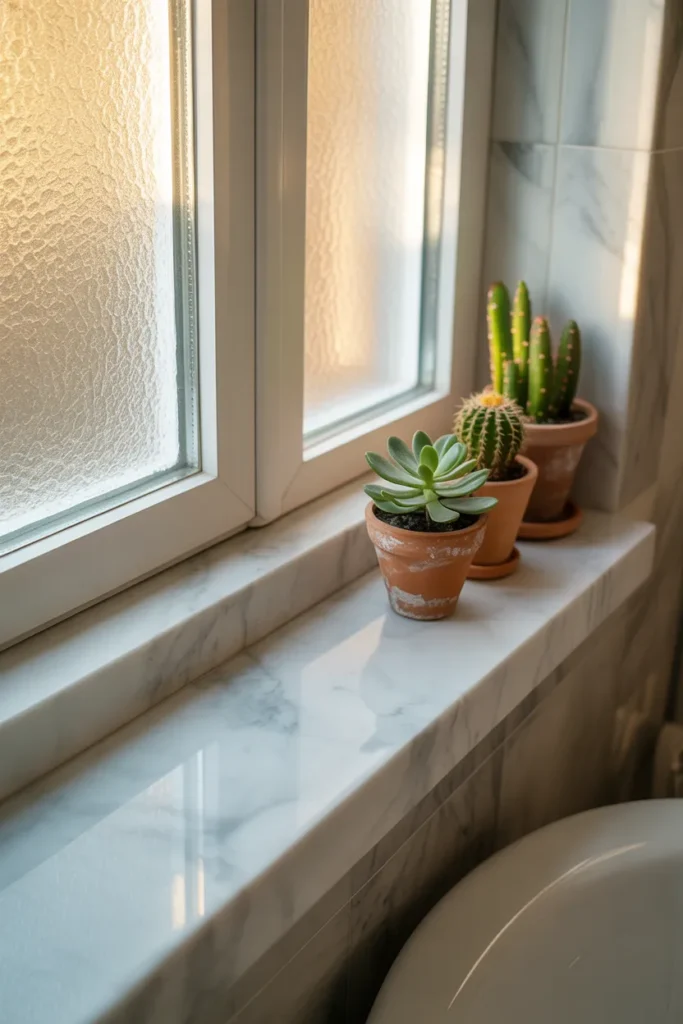
Use the same material as your vanity or floor trim for a cohesive built-in appearance. A floating shelf that exactly matches the existing sill depth and width looks custom-built regardless of whether it was.
In bathrooms with frosted or privacy-glazed windows, a shelf extension does not compromise privacy. In bathrooms with clear glass, consider that items on the shelf will be silhouetted or visible from outside depending on interior lighting conditions.
14. Staggered Asymmetric Floating Shelves: Solving Storage Without Creating a Grid
Asymmetric floating shelves — placed at intentionally varied heights and widths rather than aligned in a uniform grid — create visual interest on a plain wall while providing more practical storage configurations than evenly spaced shelves do. Different heights accommodate different product sizes without forcing everything into the same shelf zone.
This layout is well-suited to the wall beside the toilet, the wall opposite the shower, or any uninterrupted wall section longer than 36 inches. It reads as curated rather than functional, which makes it one of the more Pinterest-friendly bathroom shelves ideas for 2026 — but the storage value is genuine.
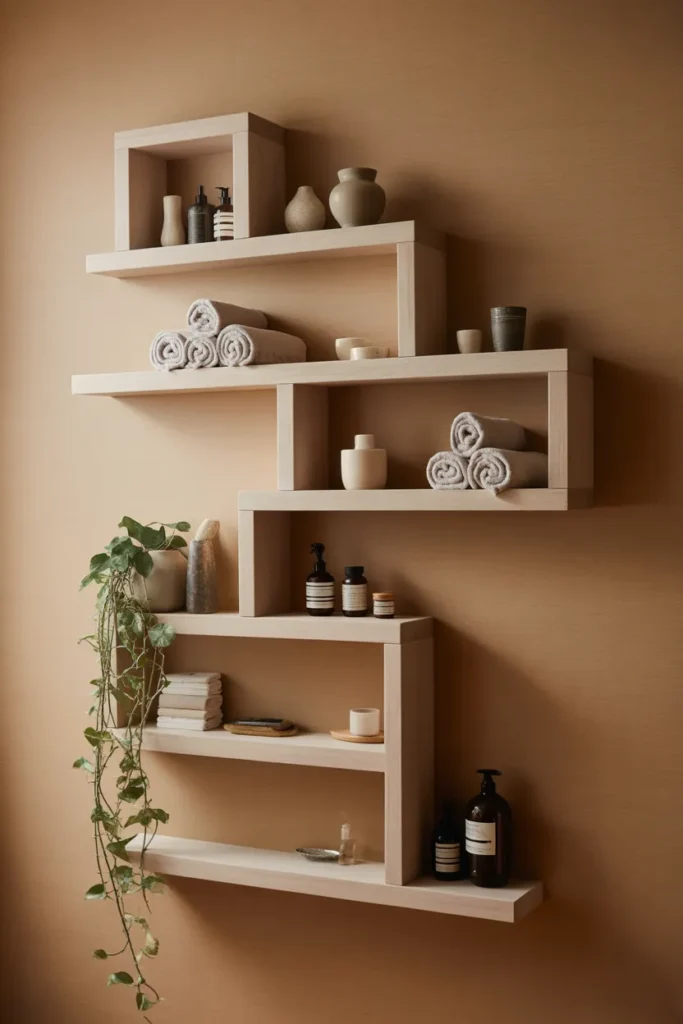
Plan the layout on paper or tape out the shelf positions on the wall before drilling. The most common mistake is making the arrangement look random when it should look considered. There is a difference between asymmetry that has internal logic and asymmetry that looks like shelves were added one at a time without a plan.
Keep materials consistent across all shelves in the arrangement — the same wood species, same finish, same depth. The asymmetry in placement provides enough visual complexity. Varying the materials as well pushes the arrangement into visual chaos.
15. Shelf With Integrated Towel Bar Below: Double-Function Hardware for Tight Bathrooms
A floating shelf with a built-in or attached towel bar along its lower edge combines two hardware pieces into one wall installation. In bathrooms where wall space is genuinely limited — a half bath, a powder room, or a bathroom where every section of wall has a fixture, door, or window — this combination solves two problems with a single mounting footprint.
The shelf above stores everyday items while the towel bar below keeps a hand towel or two within reach of the sink. This eliminates the need to find separate wall space for a towel ring or bar, which is one of the most difficult placement problems in compact bathroom layouts.
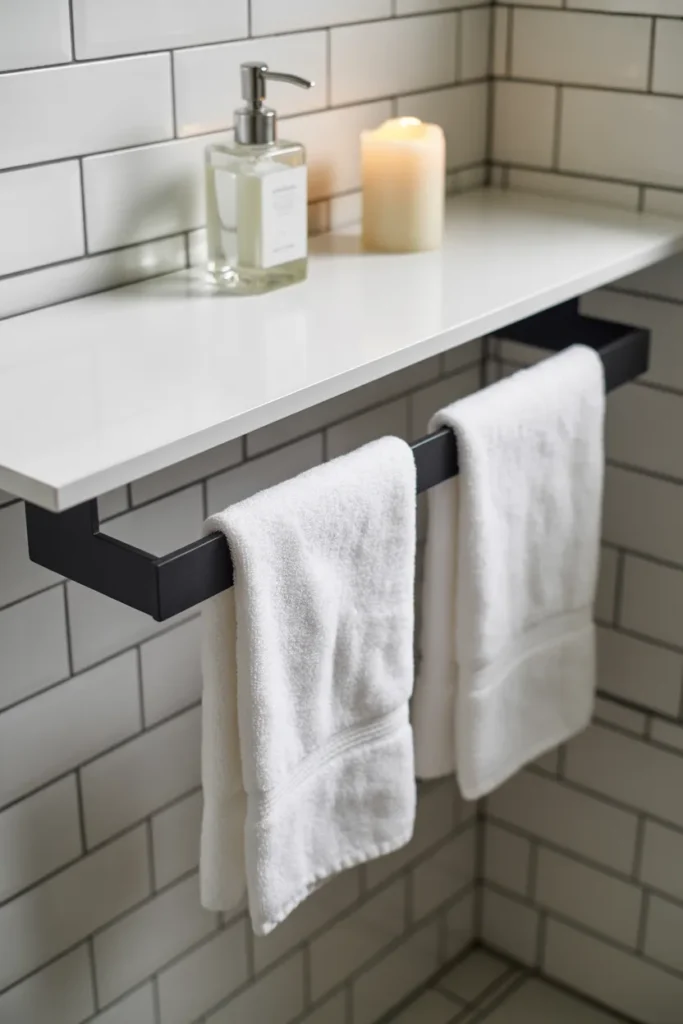
Brass, matte black, and brushed nickel are the most widely available finishes for combination shelf-and-bar units. Select the finish before selecting the unit — matching your existing fixtures will always matter more than a particular shelf material or brand.
Mount this unit at 48 to 52 inches from the floor. Lower than that and the towel will drag on the countertop if mounted near the sink. Higher than that and the shelf portion becomes difficult to access without reaching.
16. Built-In Bookcase-Style Shelving Between Two Walls: When the Layout Allows a Real Storage System
In bathrooms where two opposing or adjacent walls create a natural alcove or corridor — such as between a wall and a knee wall, or in a hallway bathroom — a built-in bookcase-style shelving system spanning wall to wall transforms the bathroom’s storage capacity entirely. This is the approach used in high-end primary bathroom renovations and produces the most functional result of any shelving layout.
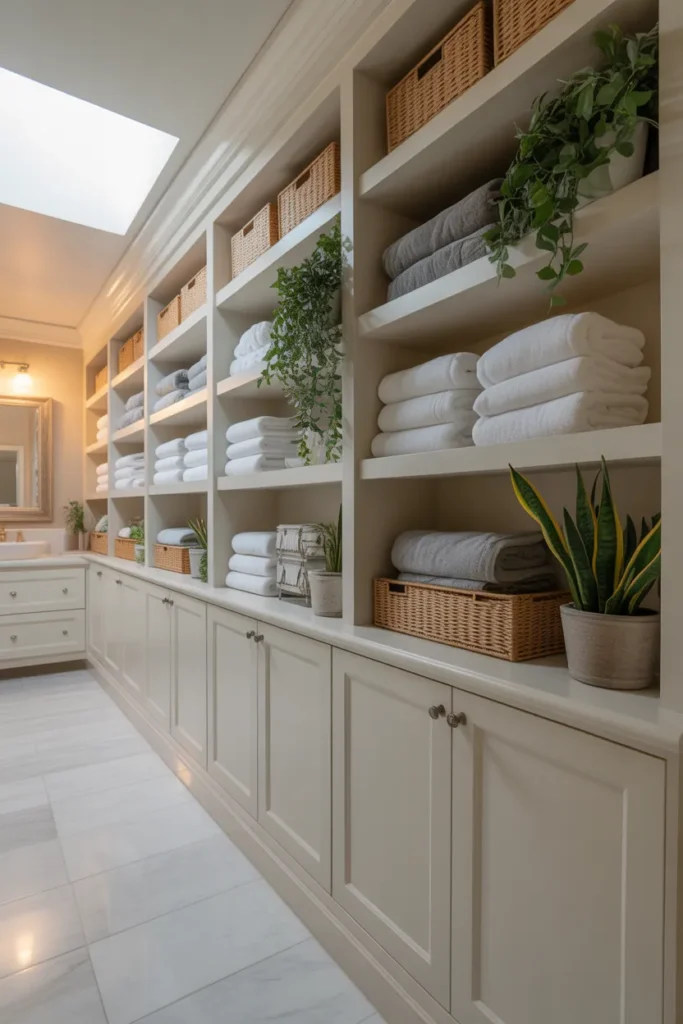
Floor-to-ceiling built-ins in this configuration can store everything from linens and towels to toiletries and extra hardware in an organized, concealed, or semi-open system. The closed lower cabinets hide utilitarian clutter; the open upper shelves carry curated items and folded textiles.
This is a construction-level project in most homes. It requires precise measurement, a carpenter or cabinetmaker, and in many cases a building permit depending on local codes. It is not appropriate to improvise with flat-pack furniture — the gaps, wobbles, and mismatches will undermine the entire effect.
If the budget and timeline allow for it, this is the most enduring bathroom shelving investment available. A well-built built-in adds measurable resale value and completely solves the bathroom storage problem rather than working around it.
17. Magnetic Spice Rack Repurposed as Bathroom Shelf: Small-Scale Storage for Vanity Countertops
A wall-mounted magnetic spice rack — the type with small metal containers on a magnetic strip — serves as a compact and highly functional countertop alternative for small product storage in the bathroom. This is not a conventional shelving approach, but it solves a specific and common problem: too many small items (bobby pins, cotton swabs, hair ties, small tubes) cluttering the vanity surface.
Mounted on the wall directly beside or above the vanity, the magnetic strip holds small metal containers that organize individual product categories at eye level. The system is modular and reconfigurable — containers can be added, removed, or rearranged without tools.
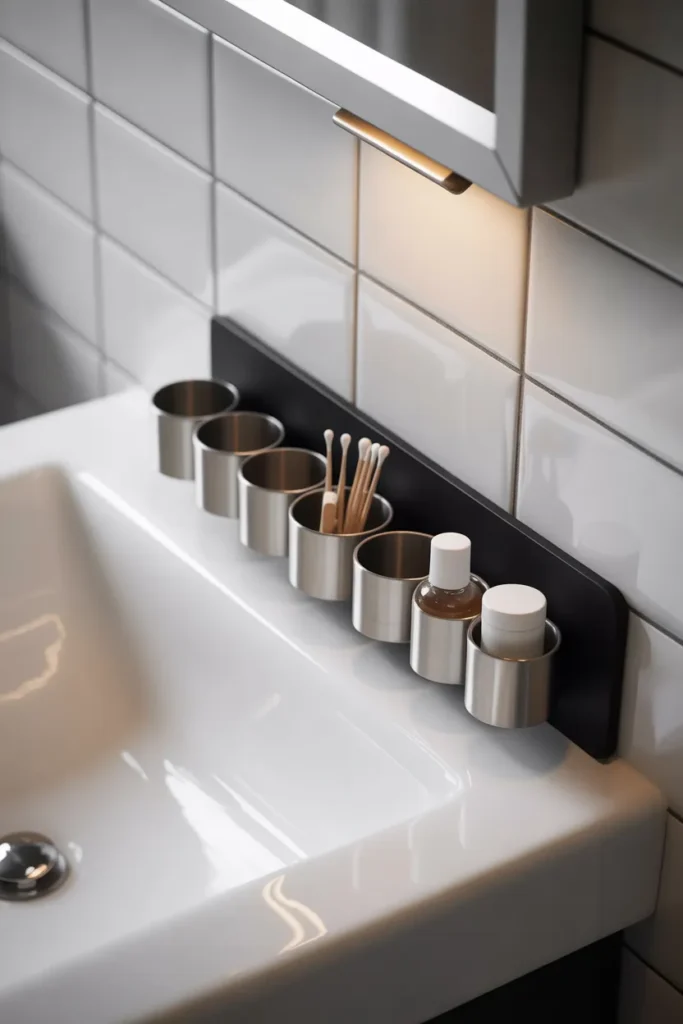
This solution is best suited for bathrooms where countertop clutter is the primary frustration rather than a shortage of larger storage. It does not replace conventional shelving but supplements it for the category of items that tend to scatter across surfaces.
Choose a magnetic strip finish that matches your existing fixtures. The containers themselves are usually stainless steel, which tends to read as neutral against most tile and paint colors. Label the inside of containers if multiple people share the bathroom.
18. Fold-Down Wall Shelf: On-Demand Surface That Disappears When Not in Use
A fold-down wall shelf — hinged at the wall and supported by a fold-out leg or cable when open — provides a usable surface exactly when needed and folds completely flat against the wall when not in use. In extremely small bathrooms, bathrooms that double as laundry rooms, or compact guest baths, this is the only shelving approach that does not permanently claim wall or floor space.
When folded down, the shelf functions as a counter for folding towels, setting down products during a routine, or staging items while cleaning. When folded up, the wall is completely clear, which is essential in tight spaces where even a few inches of protrusion creates a navigation problem.
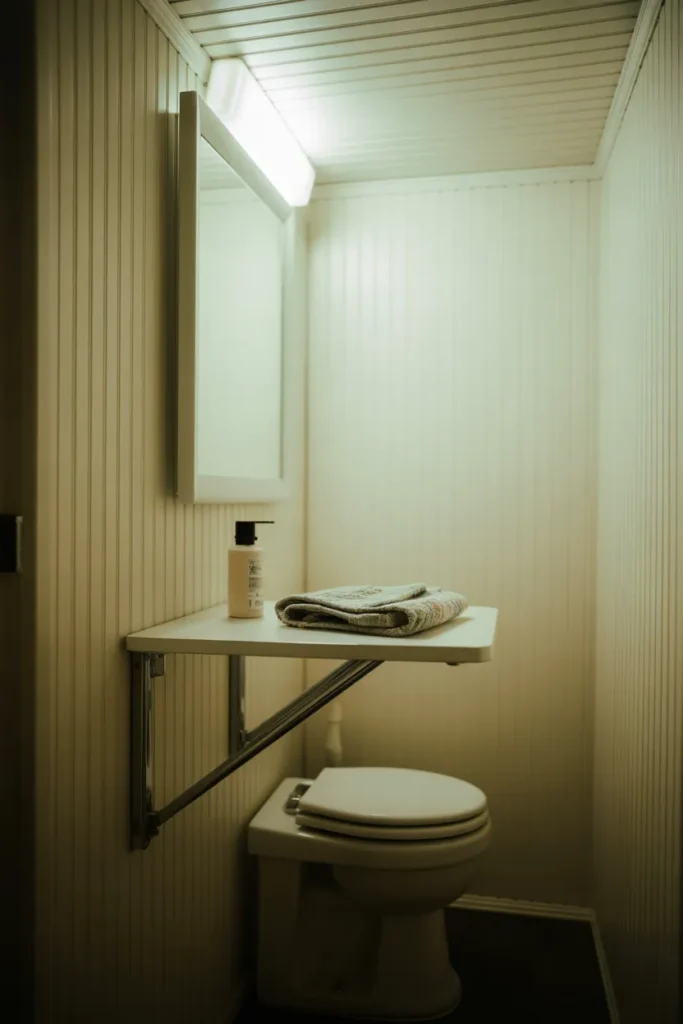
The hinge hardware and the cable or leg support are the structural elements to evaluate carefully. Cheap hinges fail quickly with repeated daily use. Look for units with piano hinges or heavy-duty butt hinges rated for the shelf weight you intend to place on it.
Finish the outward-facing side of the fold-down shelf in the same color as the wall for a seamless closed appearance. In the folded-up position, the shelf should read as a wall panel, not as a piece of furniture.
Final Thoughts
The best bathroom shelf setup is the one that matches your actual wall configuration, traffic patterns, and storage needs — not the one that photographs well in isolation. The bathroom shelves ideas 2026 covered in this guide range from no-drill solutions for renters to full built-ins for primary suite renovations, which means there is a functional option at every level of investment and commitment.
Save this post to your Pinterest boards so you can reference it when you are ready to make decisions — whether that is this week or during a future renovation. And if you are planning a larger bathroom layout update, explore small bathroom space planning guides and bathroom storage organization ideas alongside this one for a complete picture.