If you are searching for bohemian mirror ideas that go beyond basic round mirrors and generic gallery walls, this guide gives you twelve distinct directions with practical guidance on placement, sizing, framing, and styling for real rooms. Mirrors are one of the highest-impact and most underutilized design tools in bohemian interiors — used correctly, they amplify light, create depth, and deliver the layered, collected quality that defines the boho aesthetic at its best.
1. Oversized Arched Rattan Mirror Leaning Against the Wall for Effortless Boho Height
An oversized arched mirror with a rattan or woven frame leaning against the wall — rather than hung on it — is one of the most immediately recognizable bohemian mirror ideas in current interior design. The arch introduces a soft architectural curve that contrasts beautifully with the hard geometry of furniture and walls, while the rattan frame connects the mirror to the natural material vocabulary that defines the boho aesthetic.
Leaning rather than hanging is both a practical and stylistic choice. Leaning allows the mirror to sit at floor level, which extends the reflective surface to the ground and maximizes the amount of light and space the mirror amplifies. It also gives the room a relaxed, lived-in quality that a precisely hung mirror does not — which is specifically aligned with the boho design philosophy of spaces that feel accumulated rather than styled.
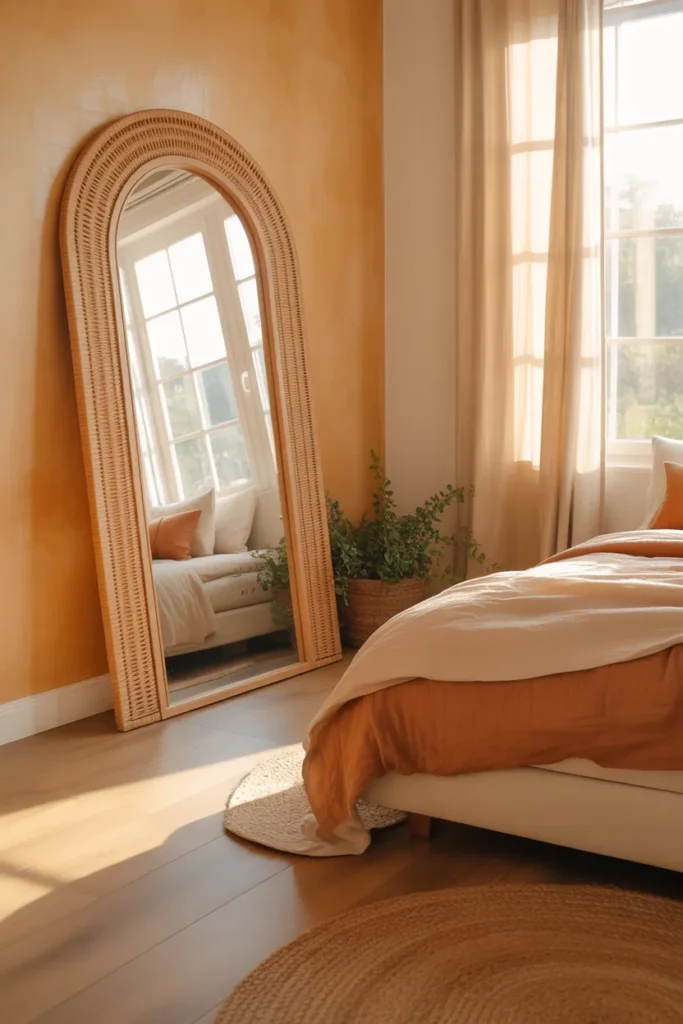
The scale of this mirror matters significantly. An arched rattan mirror that is shorter than 60 inches tall loses the dramatic vertical quality that makes it work. The ideal height range for a leaning arched mirror is 65 to 72 inches — tall enough to visually extend the wall, but not so large that it overwhelms a standard-ceiling room.
This approach works in virtually every room in a bohemian home — bedroom wall, living room corner, entryway, dining room side wall — but it performs especially well in small rooms and apartments where the full-length reflective surface creates the illusion of additional space. Position it to reflect a window or a light source rather than a blank wall for maximum spatial impact.
2. Moroccan-Style Carved Wood Mirror as a Bedroom Focal Point Above the Dresser
A Moroccan or Middle Eastern-inspired carved wood mirror — with pointed arch detailing, geometric lattice carving, or intricate filigree work around the frame — is one of the most culturally rich and visually complex bohemian mirror ideas available. The handcrafted quality of the carved wood frame is impossible to replicate with manufactured alternatives, and that authenticity is exactly what elevates a dresser wall from generic to genuinely designed.
Above the dresser is the most functional placement for this type of mirror because it serves the practical need for a reflection surface while also anchoring the dresser as a composed vignette. The carved frame needs visual breathing room — do not crowd it with small frames or accessories on either side. Let the mirror be the singular statement on the wall and keep the dresser surface below it edited to two or three intentional objects.
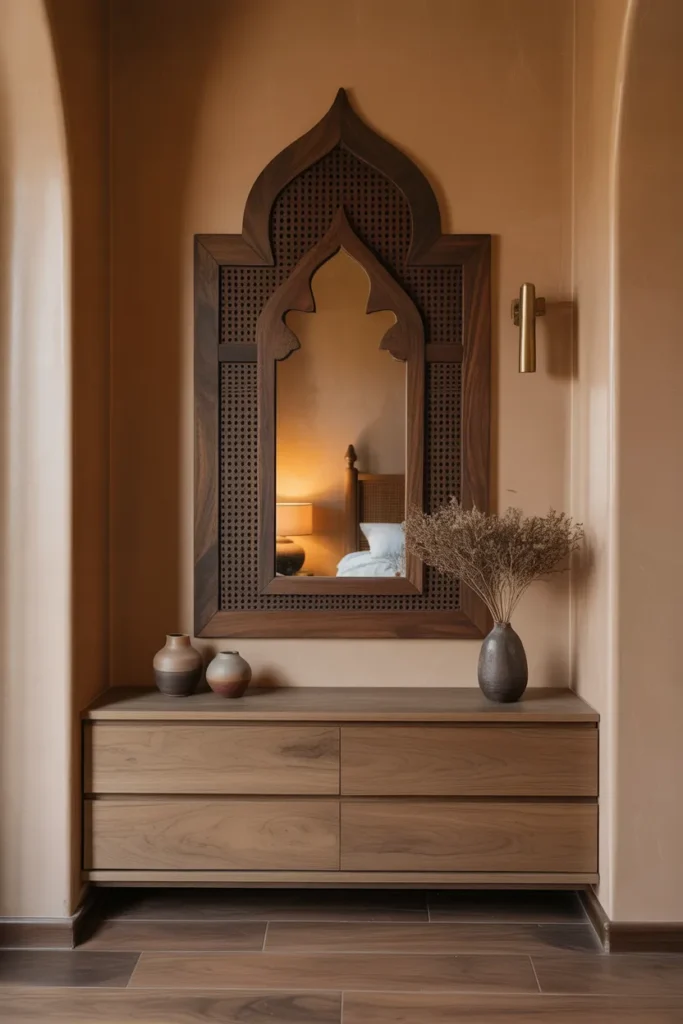
The frame’s carved wood color matters as much as the design. A deep walnut or ebonized dark wood frame reads as dramatic and anchoring — appropriate for a dark, moody boho bedroom. A natural or lightly bleached wood frame reads as lighter and more organic — better suited to a sun-filled, neutral-toned bohemian room. The frame color should be chosen in relation to the room’s existing wood tones, not in isolation.
This mirror type is not suited to rooms with a very clean, minimal, or contemporary aesthetic. Its ornate quality needs a supporting context of layered textiles, warm colors, and natural materials to read as intentional rather than out of place. In the right bohemian bedroom or dressing room, it is one of the most impactful single objects you can introduce to a wall.
3. Sunburst Mirror Cluster on a Gallery Wall That Replaces Standard Art Framing
Using three to five sunburst or starburst mirrors of different sizes arranged as a gallery wall — in place of or mixed with framed art — is one of the most dynamic and three-dimensional bohemian mirror ideas for living rooms and hallways. Sunburst mirrors extend into the wall space around their reflective center with radiating spokes in natural wood, rattan, or metal, which creates a sculptural quality that flat-framed art cannot replicate.
The arrangement logic for a sunburst mirror cluster follows the same principles as any gallery wall: establish a center point, vary the sizes from large to small, and maintain consistent spacing between pieces of eight to twelve inches. The difference with sunburst mirrors is that their radiating spokes need enough clear wall space around them to be legible — sunbursts packed too closely together lose their individual sculptural identity and read as a single messy shape.
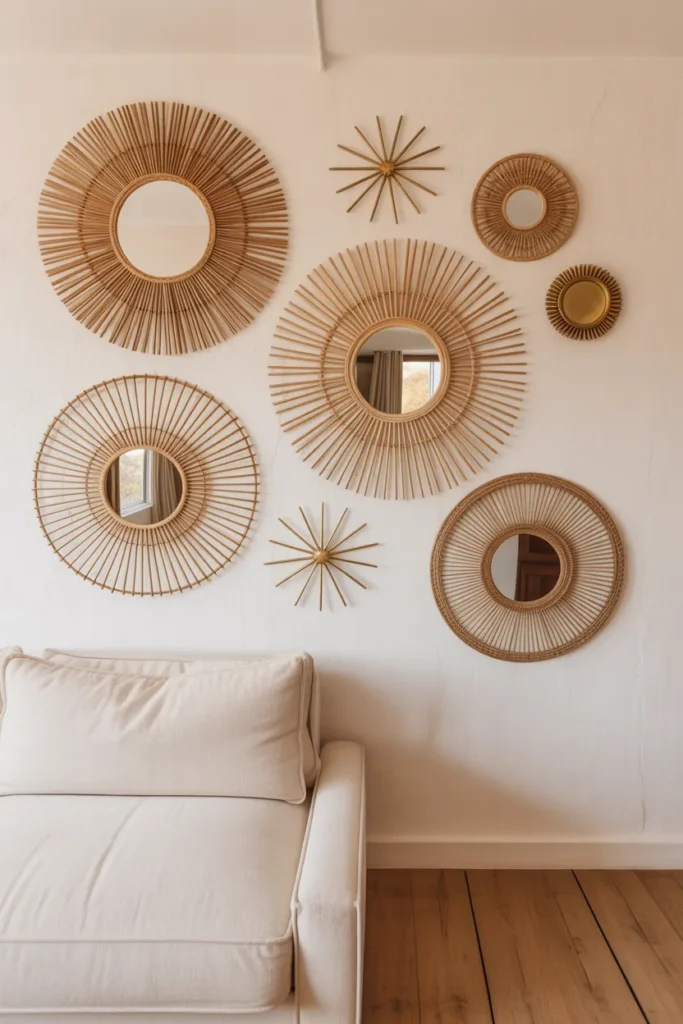
A cluster of sunburst mirrors works best on a wall with minimal competing elements. A wall with a sofa beneath it, no overhead shelving, and no adjacent furniture pressing close on either side gives the cluster room to breathe and be appreciated. The reflective centers of the mirrors will catch and scatter light across the wall throughout the day, creating a dynamic quality that changes with the light.
Mix materials within the cluster for the most visually interesting result. A large natural rattan sunburst paired with a medium dark walnut one and a small gold-tipped metal one creates the material variety that gives a boho gallery wall its collected, multi-sourced quality. All-matching sunbursts in the same material read as a purchased set, which is the opposite of the bohemian aesthetic.
4. Vintage Ornate Gold Mirror Above a Boho Living Room Sofa for Maximalist Warmth
A large ornate gold-framed vintage or vintage-style mirror positioned above the sofa is one of the most classically bohemian mirror ideas because it introduces the gilded, slightly decadent quality that differentiates maximalist boho from the simpler, more restrained versions of the aesthetic. The gold frame’s scrollwork or cast plaster detail catches warm lamp light and creates a richness that contemporary minimal frames simply cannot produce.
The scale of the mirror above the sofa is the critical decision. The mirror should be approximately two-thirds the width of the sofa it sits above — for a standard 84-inch sofa, this means a mirror of 56 to 60 inches wide. A mirror significantly narrower than this will look undersized and unrelated to the sofa below it. A mirror wider than the sofa creates a top-heavy effect that can make the seating arrangement feel unstable.
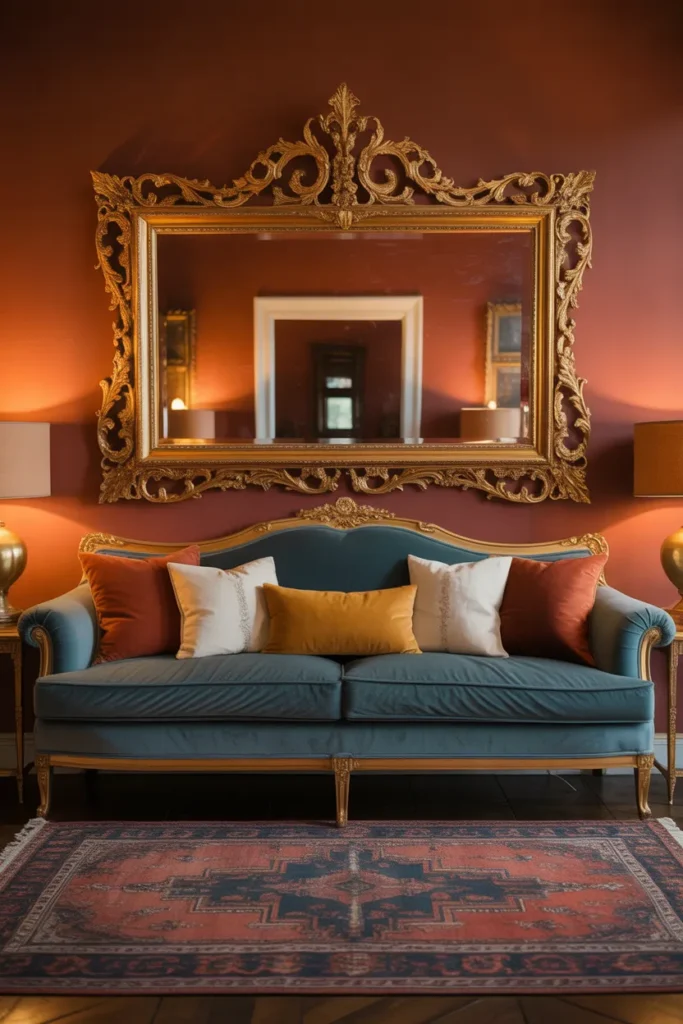
The bottom of the mirror frame should sit six to eight inches above the top of the sofa back — close enough to clearly relate to the furniture below, but far enough to allow decorative pillows to be adjusted without touching the frame. This gap is a standard interior design rule that most people ignore when hanging mirrors above sofas, and its violation is one of the most common reasons a mirror above a sofa looks awkward.
This direction is specifically suited to bohemian rooms with layered textiles, warm wall colors, and a mix of old and new furniture. The ornate gold mirror reads as a found or inherited piece — even when purchased new — which contributes to the accumulated, traveled quality that defines maximalist boho at its best.
5. Small Boho Mirror Cluster in the Entryway Using Mixed Frames and Organic Shapes
An entryway mirror arrangement using five to eight small mirrors in mixed organic shapes — round, oval, irregular, arch, teardrop — with varied frame materials is one of the most welcoming and personality-rich bohemian mirror ideas for the first impression space of a home. The mix of shapes and materials creates the sense of a collection assembled over time rather than a purchased set, which immediately communicates the boho aesthetic to anyone entering the space.
Entryways are particularly well-suited to mirror clusters because the practical need for a reflection surface is met by multiple pieces simultaneously, while the decorative impact of the cluster is out of proportion to the small scale of most entryway walls. In a narrow hallway or small entry where a single large mirror would feel overwhelming, a cluster of small mirrors distributed across the wall delivers visual interest without spatial dominance.
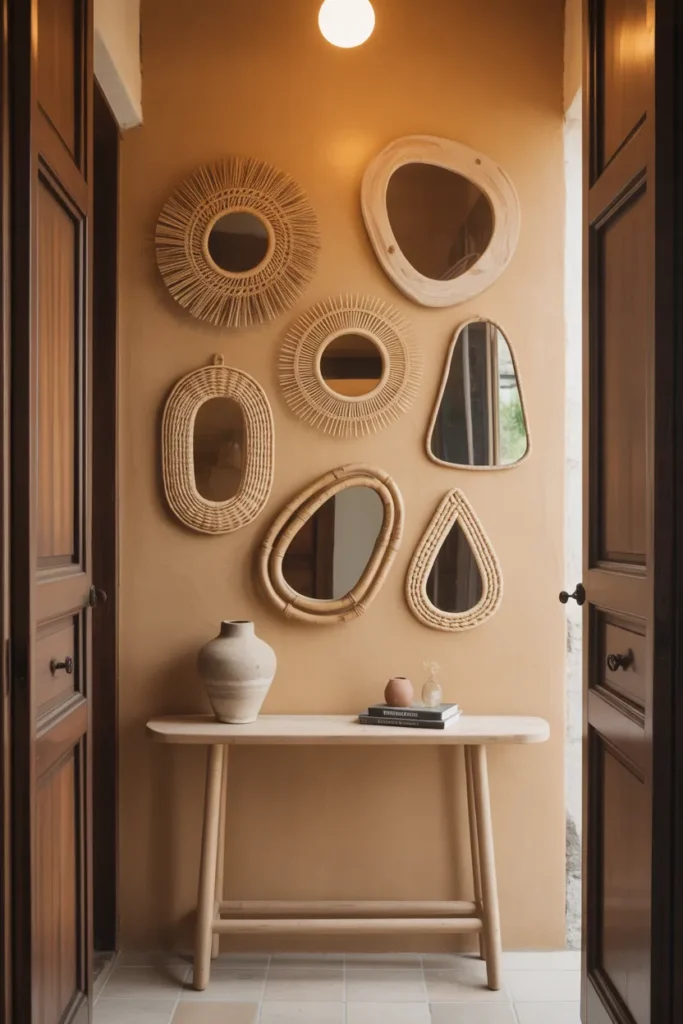
The arrangement should be organic rather than grid-based. Start with the largest piece at the center or slightly above center, and work outward with smaller pieces. Allow some mirrors to overlap in their negative space — meaning the visual boundary of one mirror’s frame comes close to another’s — without the frames actually touching. This closeness creates cohesion without rigidity.
Frame variety within the cluster should still maintain some coherence. A cluster where every frame is in a different color and material family can feel chaotic. Limiting the palette to two or three frame materials — natural rattan and raw wood, for example, or aged brass and dark iron — while varying the shapes keeps the cluster feeling collected but composed.
6. Floor-Length Jute or Macrame-Framed Mirror for a Boho Bedroom Corner
A floor-length mirror with a frame constructed from natural fiber — jute rope wrapping, macrame knotting, or thick cotton cord winding — is one of the most tactile and materially specific bohemian mirror ideas available. The natural fiber frame transforms the mirror from a reflective surface into a textile object, connecting it to the broader soft furnishing language of a bohemian bedroom — throws, pillows, woven rugs, and hanging textiles.
This type of mirror works best in a bedroom corner where it can lean at a slight angle against the wall without blocking a doorway or window. The corner placement allows the mirror to reflect a wider angle of the room — catching both the bed area and the window light — which maximizes its spatial amplification effect. It also creates a styled corner vignette when paired with a floor plant, a stack of books, or a small woven basket beside its base.
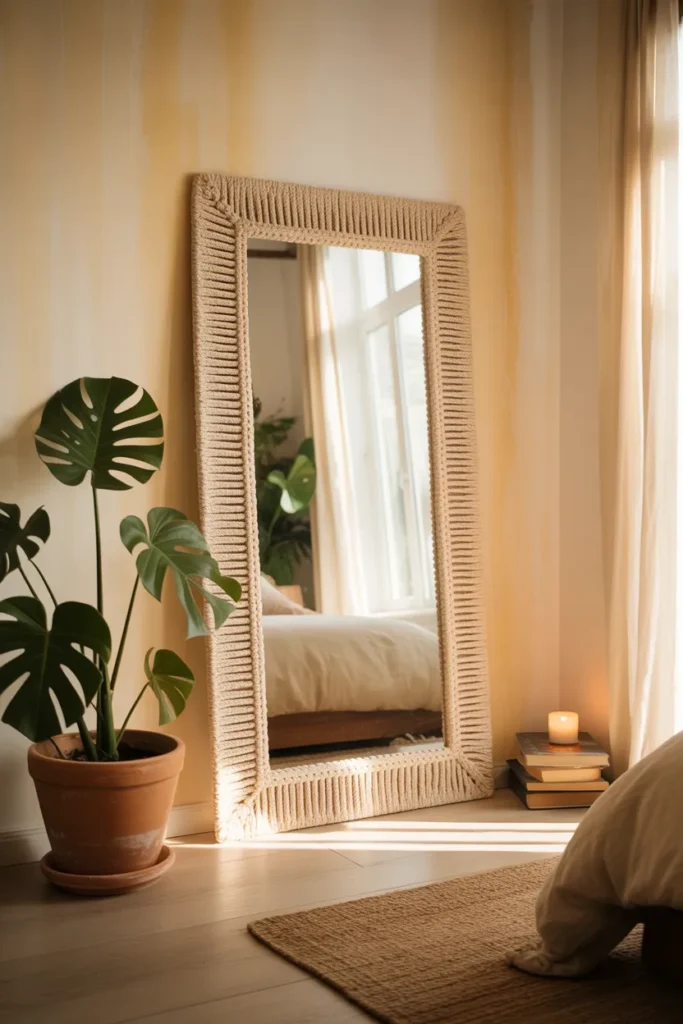
The jute or macrame frame is inherently casual and handmade-looking, which makes it tonally appropriate for relaxed, organic bohemian rooms but not for more refined or elevated boho aesthetics. If your boho bedroom leans toward the luxurious or the globally-inspired — with silk textiles, ornate objects, and rich colors — a macrame mirror frame may read as too rustic or craft-oriented for the room’s register.
Sizing for this mirror should prioritize height over width. A floor mirror in the 60 to 72-inch height range with the natural fiber frame adds approximately four to six additional inches of visual width through the frame material, which means the reflective glass inside can be narrower than a standard full-length mirror while still reading as a substantial piece.
7. Hammered Metal or Brass-Edged Mirror as a Boho Dining Room Statement Piece
A large circular or oval mirror with a hammered metal or beaten brass frame is one of the most globally-inspired bohemian mirror ideas for dining rooms — a space that typically receives less design attention than living rooms or bedrooms but benefits enormously from a single strong visual statement. The hammered texture of the metal frame catches and scatters light differently at different angles, creating a dynamic quality that a smooth or matte frame cannot produce.
In a dining room, the mirror performs two distinct functions: it visually expands the space by reflecting the table, chairs, and ceiling fixture, and it adds a material dimension — metallic, tactile, artisan — that most dining rooms lack. Above a sideboard or credenza, a large hammered brass mirror transforms the functional storage piece below it into a composed vignette with genuine design authority.
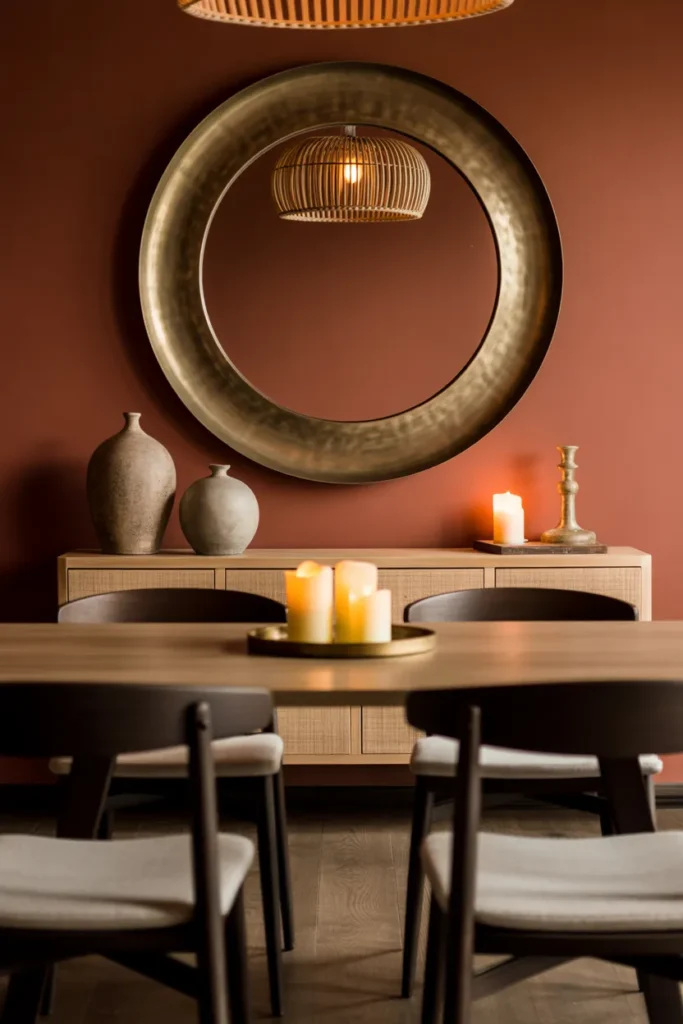
The size of the mirror relative to the sideboard follows the same proportional rule as in other rooms: the mirror should be approximately two-thirds the width of the furniture it sits above. For a standard 60-inch sideboard, this means a mirror of 38 to 42 inches in diameter for a round mirror, or 40 to 48 inches wide for an oval. Go larger rather than smaller — a dining room mirror that is slightly too generous reads as confident, while one that is slightly too small reads as tentative.
Hammered brass or beaten copper frames suit warm-toned dining rooms with terracotta walls, warm wood furniture, and organic textile elements. In a cooler or more neutral dining room, a hammered silver or dark iron frame delivers the same artisan quality with a cooler material tone. The frame color should connect to at least one other metal element in the room — light fixture, hardware, or candle holders.
8. Mirror With Driftwood or Reclaimed Wood Frame in a Coastal Boho Living Room
A mirror framed in natural driftwood, rough-cut reclaimed timber, or live-edge wood slab sits at the intersection of coastal and bohemian design — a combination that is particularly popular in American homes along both coasts and in lakeside communities across the Midwest and South. The unpredictable, organic quality of driftwood framing means each mirror is genuinely unique, which is consistent with the boho principle of collected, one-of-a-kind objects.
The driftwood or reclaimed wood frame works best in a living room that already uses natural materials extensively — jute rugs, linen upholstery, raw wood furniture, woven baskets, and ceramic vessels. In this material-rich context, the mirror’s frame reads as part of a cohesive natural material story. In a room with primarily synthetic or highly refined materials, the raw wood frame can feel jarring and inconsistent.
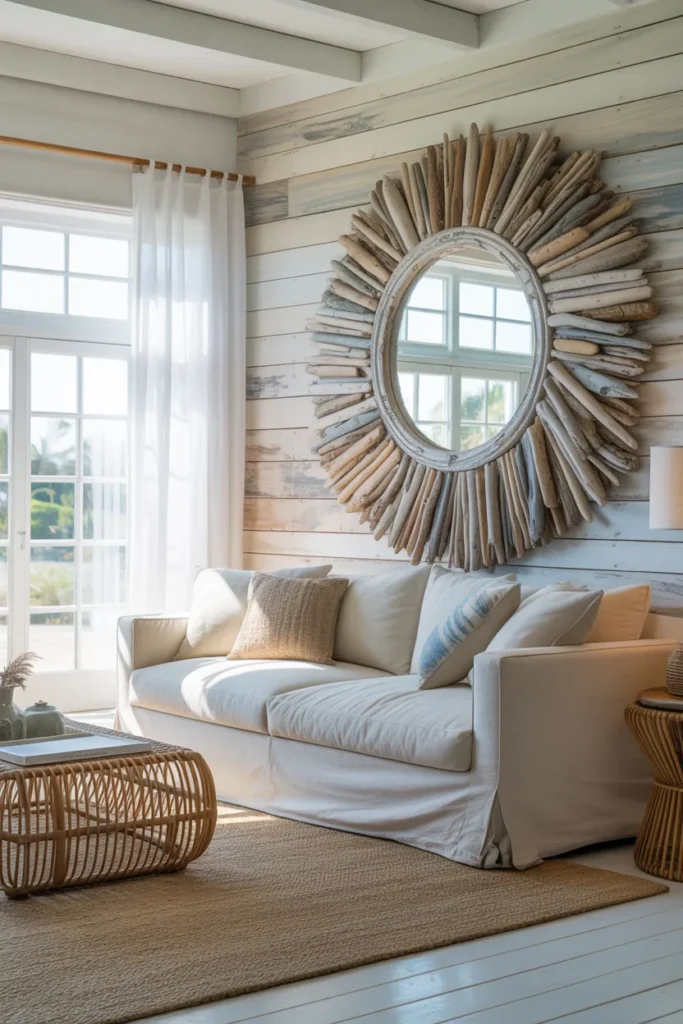
Placement for this mirror type should prioritize walls that receive direct natural light — a wall adjacent to a large window or facing an exterior wall with good daylight exposure. The reflective surface will amplify natural light beautifully, and the driftwood frame’s naturally weathered gray or bleached tone reads best under daylight rather than warm artificial light, which can make it look muddy or flat.
Round or irregular shapes work better than rectangular for driftwood-framed mirrors. A rectangular reclaimed wood frame reads as more rustic-farmhouse than coastal boho. A round or organic-edge mirror with driftwood arranged concentrically around its edge — like rays of a sunburst or a wreath — delivers the organic, found-nature quality that defines this specific design direction.
9. Beaded or Shell-Trimmed Mirror in a Maximalist Boho Bathroom for Full Sensory Impact
A mirror with a frame constructed from beads, shells, semi-precious stones, or mixed organic materials is one of the most sensory and material-rich bohemian mirror ideas available for bathrooms — a space where the humidity-resistant quality of these natural materials is a practical advantage as well as an aesthetic one. Beaded frames in bone, wood, or resin beads create a surface texture that no other mirror frame material can replicate.
In a maximalist boho bathroom, the beaded or shell mirror is positioned above the vanity where it occupies the most prominent and functional mirror location in the room. The material richness of the frame elevates the vanity area from utilitarian to designed without requiring any structural changes to the bathroom. The mirror becomes the room’s focal object — the piece around which every other design decision is organized.
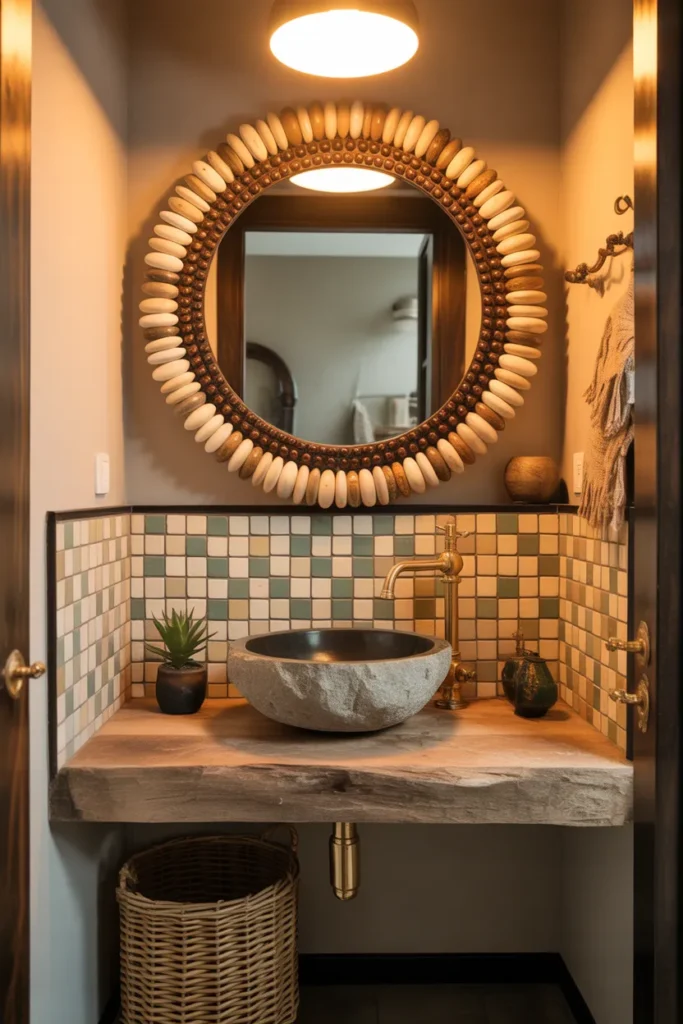
This type of mirror requires a supporting context of equally rich materials and textures to read as intentional rather than excessive. Zellige or handmade tile, natural stone surfaces, brass or copper fixtures, woven textile storage baskets, and live plants create the layered, material-dense environment that makes a beaded mirror look collected and appropriate rather than out of place.
The practical limitation of beaded and shell frames is maintenance. These frames cannot be aggressively cleaned with chemical sprays without risk of damage to the binding materials. Position the mirror high enough above the sink that daily splash and steam contact is minimal, and clean the frame with a slightly damp cloth rather than household cleaning products.
10. Layered Mirror and Textile Wall Combining a Mirror With Woven Hanging for Depth
Combining a bohemian mirror with a woven wall hanging — a macrame panel, a tapestry, or a textile art piece — on the same wall creates a layered wall composition that has both reflective and textural depth. This is one of the most genuinely boho approaches to mirror placement because it treats the mirror not as the sole object on a wall but as one element within a multi-material wall composition.
The arrangement can take two forms. In the first, the mirror is hung at eye level and the textile hangs above or beside it, with both pieces overlapping slightly in their visual zones. In the second, the textile is hung first as a backdrop, and the mirror is positioned in front of it or offset to one side, so the mirror reflects the textile behind it — creating a visual layering effect that is genuinely three-dimensional.
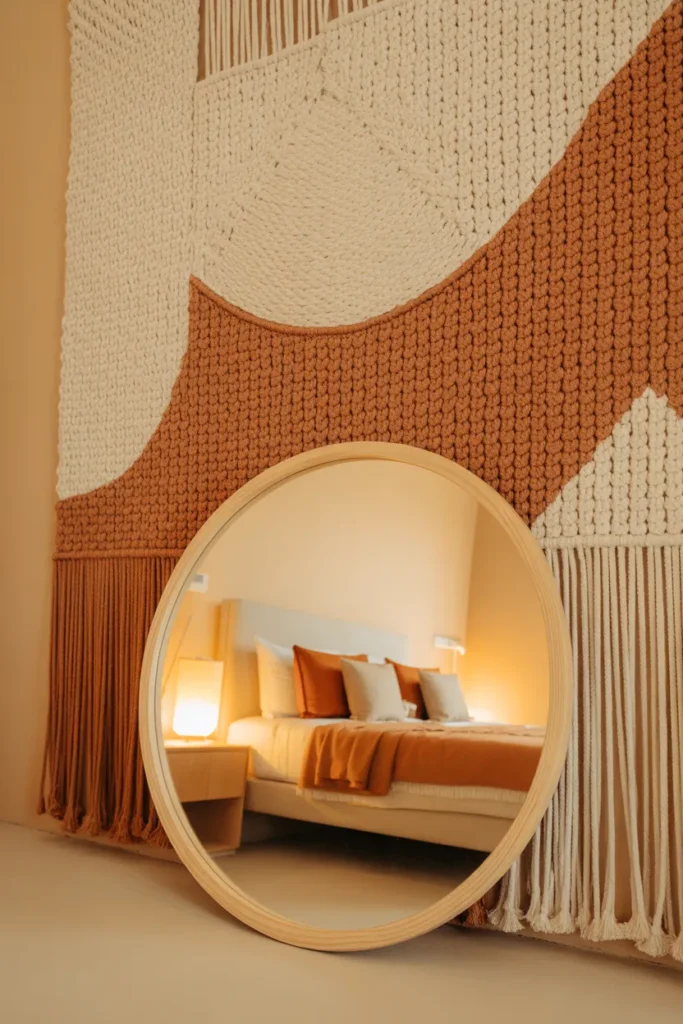
This wall composition works best on large walls in living rooms, bedrooms, or studios where the scale of the combined pieces — mirror plus textile — is proportional to the wall space available. On a small wall, the layered composition can feel cluttered. On a generous wall with at least 48 inches of horizontal width and good ceiling height, it reads as a considered, museum-quality installation.
The mirror in this context should be relatively simple in frame — a thin natural wood circle, a plain oval, or a basic arch — because the textile provides the visual complexity. A mirror with an ornate or heavily detailed frame competing with a busy woven textile creates visual noise. The simplicity of the mirror’s frame lets it serve as the light-reflecting and spatial element while the textile provides warmth, texture, and color.
11. Antique or Thrifted Mirror With Painted Boho Frame Detail for a Personal Touch
Taking an antique or thrifted mirror — found at an estate sale, a flea market, or a secondhand store — and transforming its frame with painted bohemian detail is one of the most authentic and cost-effective bohemian mirror ideas available. The base mirror already carries the aged quality and irregular character that manufactured boho mirrors attempt to replicate. Adding hand-painted detail — geometric patterns, floral motifs, or abstract color blocking — to the frame layer personalizes it in a way that no purchased mirror can match.
The painting technique does not require professional skill. A frame painted in a solid deep color — terracotta, indigo, forest green, or warm black — with a thin contrasting geometric border in gold or cream applied with a fine brush delivers a result that reads as deliberate and artisan at a distance. Closer up, minor imperfections in the hand painting reinforce rather than undermine the authenticity of the object.
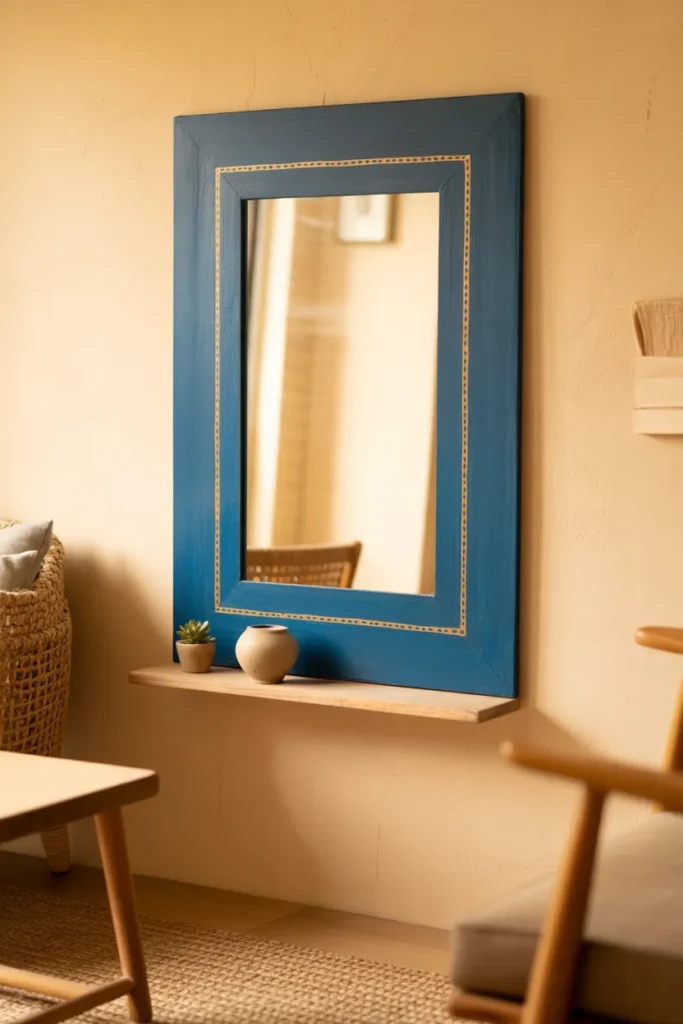
An antique or thrifted mirror with a painted frame works best as a standalone piece — a single statement object on a wall rather than part of a cluster. Its individuality and visual specificity are its primary design value, and clustering it with other mirrors dilutes that value. Give it a wall to itself, paired with a simple shelf below or a single ceramic object hung beside it.
This approach is one of the most relevant recommendations in this guide because it reflects genuine design knowledge: the understanding that a uniquely modified, personally meaningful object carries more design authority in a boho space than any mass-produced mirror regardless of how accurately it references the aesthetic. Bohemian design has always been about the individual story of objects.
12. Stacked and Overlapping Mirrors at Different Heights for a Floor-to-Ceiling Boho Installation
A floor-to-ceiling mirror installation using three to five mirrors of varying sizes, shapes, and heights — some hung, some leaning, some overlapping in their visual zone — is the most ambitious and dramatic of all bohemian mirror ideas and the one that most fully transforms a wall into an architectural feature. When executed correctly, the installation feels like a wall covered in windows and light rather than a collection of decorative objects.
The composition starts with the largest mirror — typically a full-length or oversized leaning piece at floor level — and builds upward and outward with smaller hung pieces at different heights. Some mirrors should appear to be at different distances from the wall (leaning versus hung creates this naturally), which adds genuine three-dimensional depth to the composition. The overlapping of one mirror’s reflective field with another’s creates an infinite-mirror quality that amplifies space far beyond what a single mirror can achieve.
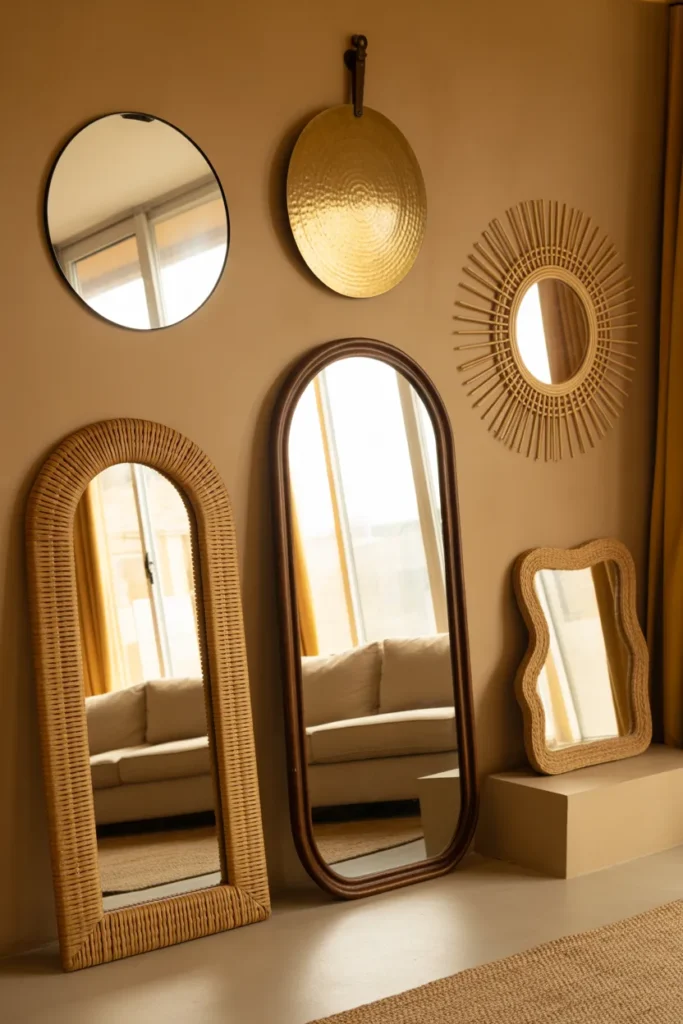
This installation is most appropriate for a living room, studio apartment, or loft where one full wall can be dedicated to the composition without interruption from doorways, windows, or built-in furniture. A wall broken by a doorway or window cannot support the visual continuity the installation requires. In a studio apartment, the wall behind the main seating area or opposite the bed is often the best candidate.
The practical planning process for this installation is to lay all the mirrors on the floor first in the arrangement you intend to recreate on the wall, photograph the arrangement from directly above, and then transfer the composition to the wall using that photograph as your reference. Attempting to plan the arrangement directly on the wall without this floor-layout step almost always results in uneven spacing and poor compositional balance.
Final Thoughts
Bohemian mirror ideas in 2026 are defined by material honesty, organic form, and the courage to use mirrors as genuine design statements rather than functional afterthoughts. The twelve directions above cover the full range of the boho mirror spectrum — from a single oversized arched leaning piece to a full wall installation, from handmade macrame frames to hammered antique brass, from thrifted painted frames to shell and bead-trimmed bathroom pieces. The right choice depends on your specific wall, your room’s material palette, and the register of your overall bohemian aesthetic.
Save this post before you move on. Whether you are styling one wall this weekend or planning a full room redesign, having a clear reference of well-considered bohemian mirror directions will make your decisions faster and more confident. If you are still working through broader room layout and furniture arrangement questions that mirror placement depends on, explore bohemian living room layout guides and small apartment boho decor resources to make sure every design decision in your space supports the others.