
Most people searching for dream bedroom inspiration end up with a collection of images that look nothing like their actual room. This guide cuts through that gap by giving you 18 actionable bedroom ideas that are grounded in real design principles, covering every style, room size, and budget level so you can make confident decisions for your own space.
1. The Platform Bed Layout: Why Lower Profiles Make Small Bedrooms Feel Bigger
A platform bed sits closer to the floor than a traditional bed frame, and that single design choice changes the entire visual scale of a room. In a small or medium-sized bedroom, a lower bed creates the illusion of taller ceilings and more open space above the sleeping area.
The impact is strongest in rooms with standard eight-foot ceilings, which describe the majority of American homes and apartments. A tall headboard in the same space compresses the room visually and makes the ceiling feel lower than it is.
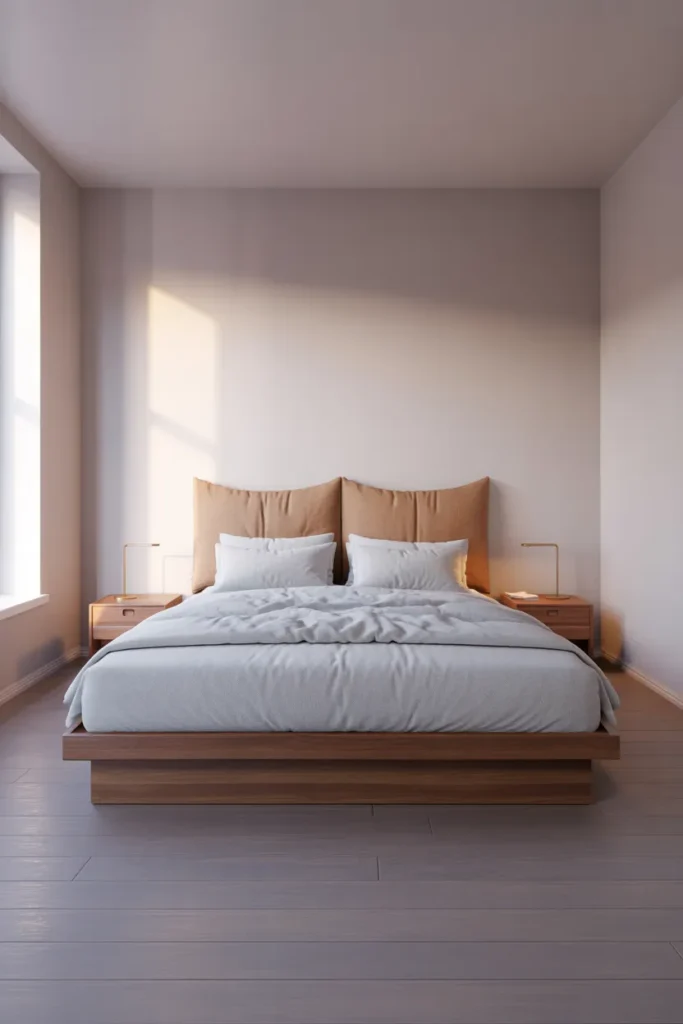

Choose a platform bed with a simple, upholstered headboard in a neutral tone. Avoid ornate or canopy-style frames in compact rooms because they fight the ceiling line rather than working with it.
This layout is the right choice when your bedroom feels boxed in or when you want a modern, streamlined look without architectural changes.
2. Neutral Warm Tones: The Color Formula That Makes Every Bedroom Feel Like a Retreat
Cool greys and stark whites used to dominate bedroom design, but warm neutral palettes have proven consistently more effective at creating a space that feels restful and welcoming. Warm whites, soft creams, greige walls, and sandy tones reduce visual tension in a way that cooler palettes cannot.
The science behind this is simple. Warm tones lower visual alertness, which supports the mental transition from activity to rest. This is why hotel rooms with warm, neutral palettes consistently feel more relaxing than stark white rooms despite being similar in size.
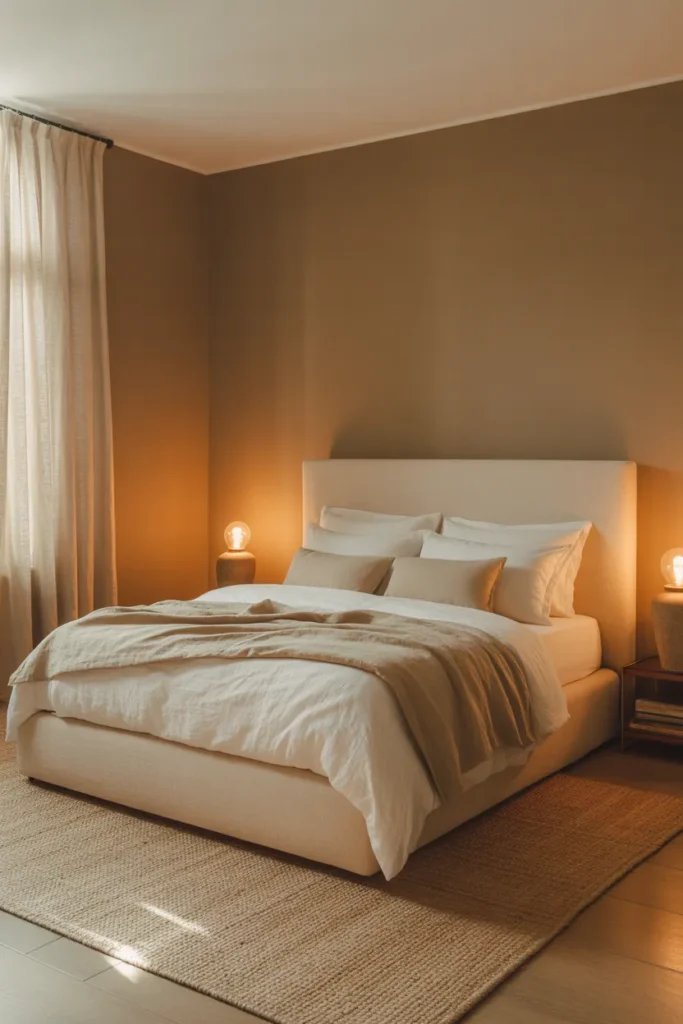
Use warm white on walls and ceiling, layer in deeper warm neutrals through bedding, rugs, and curtains, and introduce one earthy accent through a throw pillow or side table. This three-layer approach gives the room depth without requiring a dramatic commitment.
Avoid mixing warm and cool neutrals in the same space. Warm greige walls with a cool grey rug cancel each other out and create a flat, unresolved look.
3. The Accent Wall Behind the Bed: How to Anchor the Room Without Repainting Everything
An accent wall behind the headboard is one of the most cost-effective ways to create a focal point in a bedroom. It draws the eye immediately to the bed, which is architecturally and functionally the room’s anchor, and gives the space intentional structure.
The most effective accent treatments are deep paint colors, limewash or Venetian plaster finishes, wood slat panels, or wallpaper. Each creates a different mood. Deep paint is dramatic. Limewash is textured and organic. Wood slats are warm and modern. Wallpaper adds pattern and personality.
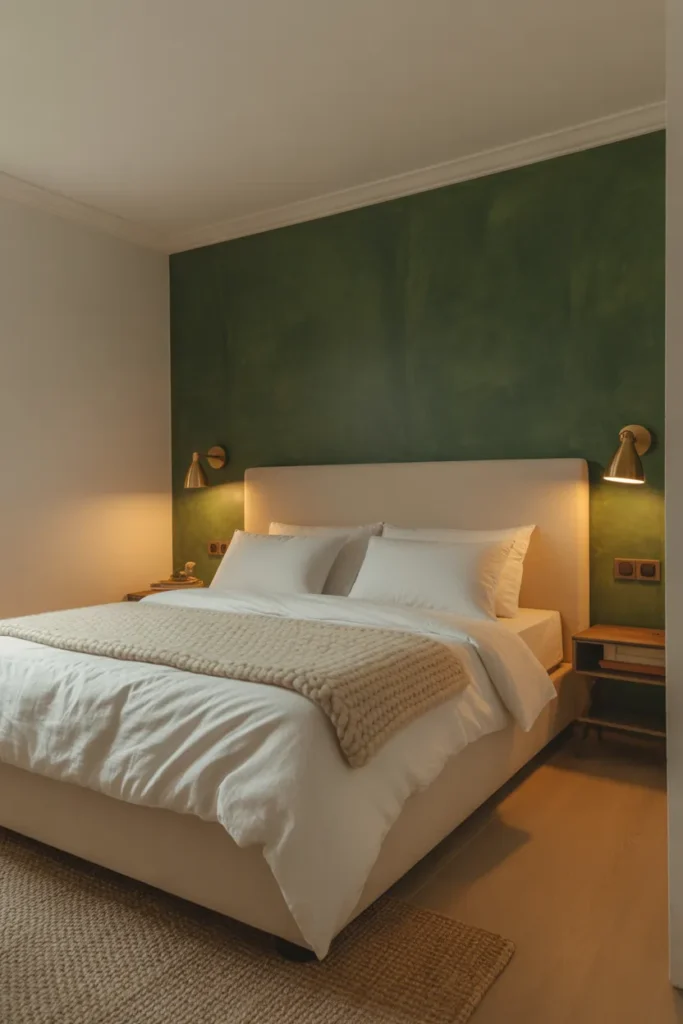
The wall treatment should span the full width of the wall, not just behind the headboard. A partial treatment that ends abruptly at the headboard edges looks incomplete and draws attention to the unfinished boundary.
This is the right approach when you want a significant visual impact without committing to a full-room color change. It works in every room size and requires minimal investment relative to its visual return.
4. Layered Lighting: The Three-Layer System That Transforms Any Bedroom at Night
A bedroom that relies only on an overhead light fixture will never feel like a dream bedroom inspiration at night, regardless of how well it is decorated during the day. Layered lighting is what separates a hotel-quality bedroom from an average one.
The three-layer system works as follows. The first layer is ambient light from an overhead fixture or recessed lighting, used for general visibility. The second layer is task lighting from bedside lamps or wall sconces, used for reading and close-up activities. The third layer is accent lighting such as LED strip lights behind furniture, candles, or floor lamps, used for atmosphere.
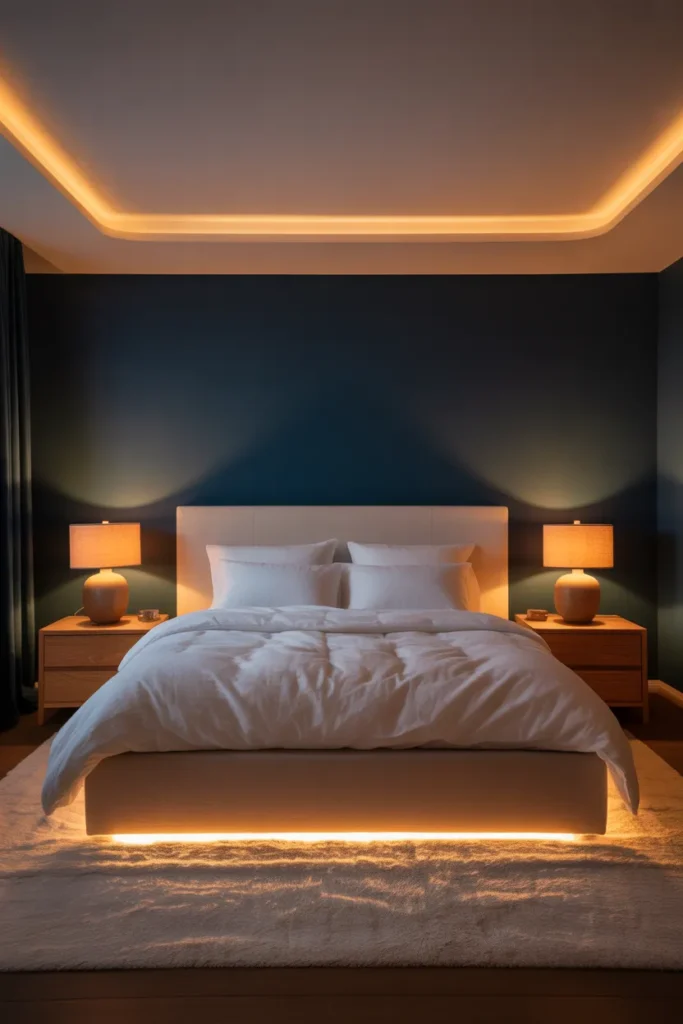
In most American bedrooms, only the first layer exists. Adding just the second layer, a pair of matching bedside lamps with warm bulbs, transforms the evening mood of the room immediately and at low cost.
Install all bedroom lighting on dimmers. A dimmer switch costs under ten dollars and gives you control over the entire emotional tone of the room at different times of day.
5. The Minimalist Bedroom: Why Removing Furniture Often Improves the Design
Minimalism in bedroom design is not about sparse living or bare walls. It is about removing everything that does not serve sleep, comfort, or intentional decoration, and keeping only what earns its place in the room.
In practical terms, this means evaluating each piece of furniture for function. A desk chair left in the corner becomes a clothing pile. A decorative bench at the foot of the bed that nobody sits on consumes visual space. A second dresser that stores out-of-season items is storage pretending to be bedroom furniture.
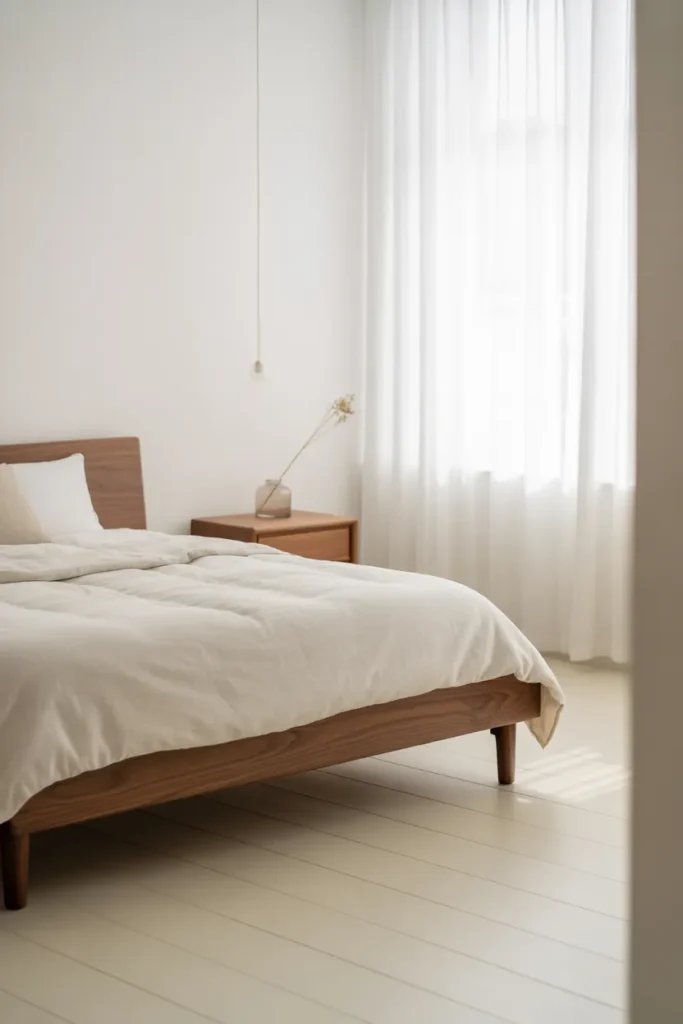
Start by removing everything from the room and only bringing back what you actively use. In most cases, the room is noticeably better with a bed, two nightstands, a dresser, and one seating piece. Everything beyond that needs to justify its presence.
Minimalist bedrooms feel larger, calmer, and easier to maintain. They also photograph and film better, which matters for anyone building a home aesthetic for social platforms.
6. Dark and Moody Bedrooms: When Deep Color Works and When It Does Not
A dark bedroom done correctly is one of the most striking and luxurious outcomes in residential interior design. Done incorrectly, it looks like a room that was painted in the dark. The difference is in how the other design elements respond to the deep color.
Dark walls require more light sources, not fewer. A common mistake is painting a room dark and then using the same amount of lighting as a white room. The result is a cave, not a sanctuary. Multiple warm light sources, reflective surfaces like brass or gold hardware, and light-toned bedding all balance and activate the dark wall color.
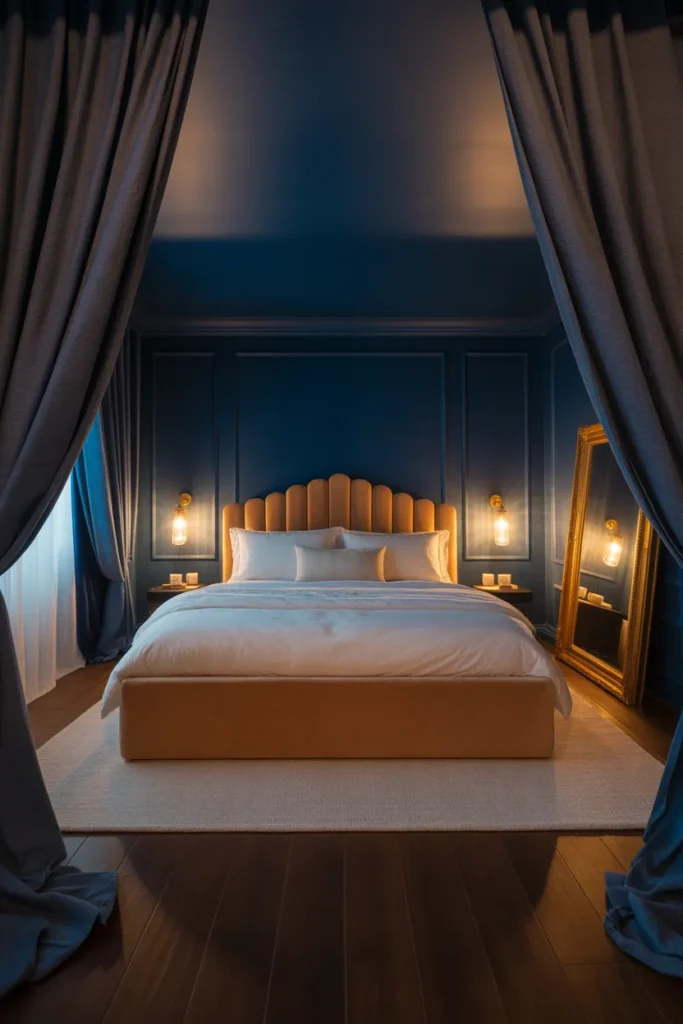
The best dark tones for bedrooms are warm-based: forest green, dusty blue-green, deep burgundy, warm charcoal, and rich navy. Avoid cold or neutral dark tones like cool grey or blue-black in rooms without strong natural light.
Dark bedrooms work best in rooms with at least one window and ideally work best in rooms facing south or west where natural light is stronger during the hours the room is most used.
7. Built-In Wardrobes and Storage Walls: The Design Move That Eliminates Bedroom Clutter for Good
Freestanding wardrobes and dressers are space-inefficient in most bedrooms because they stand out from the wall, collect dust on top, and break the visual continuity of the room. Built-in or semi-built-in storage changes the relationship between storage and space entirely.
A full wall of built-in cabinetry from floor to ceiling uses the same square footage as a freestanding wardrobe but provides dramatically more storage volume and creates a clean architectural line that makes the room feel finished and custom.
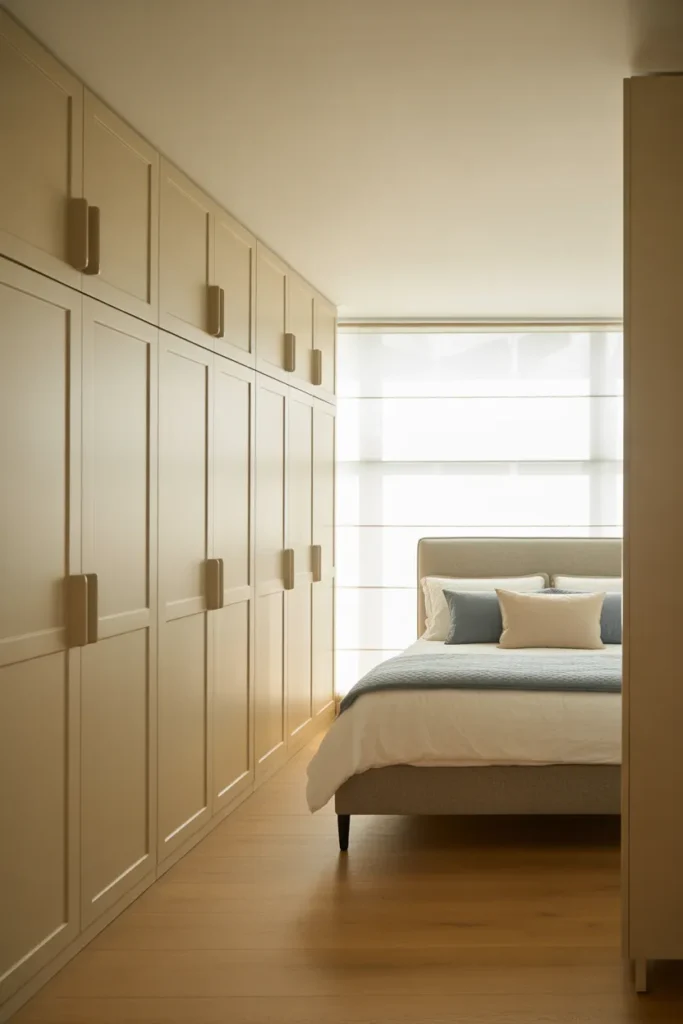
In rooms where true built-ins are not possible due to renting or budget, an IKEA-style modular system pushed flush to the wall with matching fronts achieves a similar effect at a fraction of the cost. Paint the fronts to match the wall for a seamless built-in appearance.
The biggest design upgrade you can make in most bedrooms is eliminating visible clutter entirely. Built-in storage is the structural solution that makes this possible.
8. Bedroom Rug Placement: The Sizing Mistake That Makes Most Bedrooms Look Unfinished
The single most common design error in American bedrooms is using a rug that is too small. A small rug in front of the bed that does not extend past the nightstands makes the room look piecemeal and unresolved. Correct rug sizing is one of the highest-impact, lowest-effort improvements available.
For a queen bed, the rug should be at least an 8×10 foot size. For a king bed, a 9×12 is ideal. The rug should extend at least 18 to 24 inches beyond the sides of the bed so that when you step out of bed in the morning, your feet land on the rug rather than the floor.
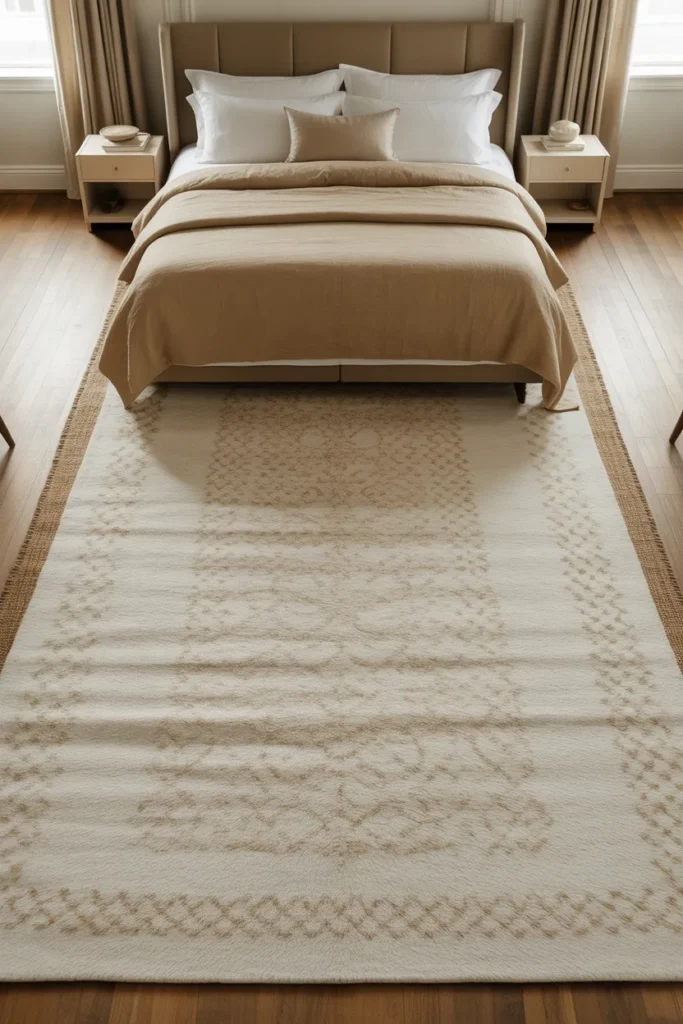
In terms of placement, two options work well. The first is placing the rug so that two-thirds of it sits under the bed with the front third exposed. The second is placing it entirely in front of the bed. Both work depending on the room layout.
Avoid placing a rug only at the foot of the bed. This positions the rug incorrectly relative to the bed and creates an awkward visual gap.
9. Bedroom Ceiling Design: The Fifth Wall That Most Homeowners Completely Ignore
The ceiling is the one surface in a bedroom that is in your direct sightline while lying down, and in most American homes it is painted flat white and entirely ignored. Treating the ceiling as a design opportunity, even subtly, elevates the entire room.
The most accessible ceiling treatments are paint, wallpaper, and wood planking. A painted ceiling in the same tone as the walls creates an enveloping, cocoon-like effect that feels intentional and sophisticated. Wallpaper on the ceiling adds texture and pattern in a place where it is unexpected and impactful. Wood planks add warmth and architectural interest in rustic, coastal, and contemporary country styles.
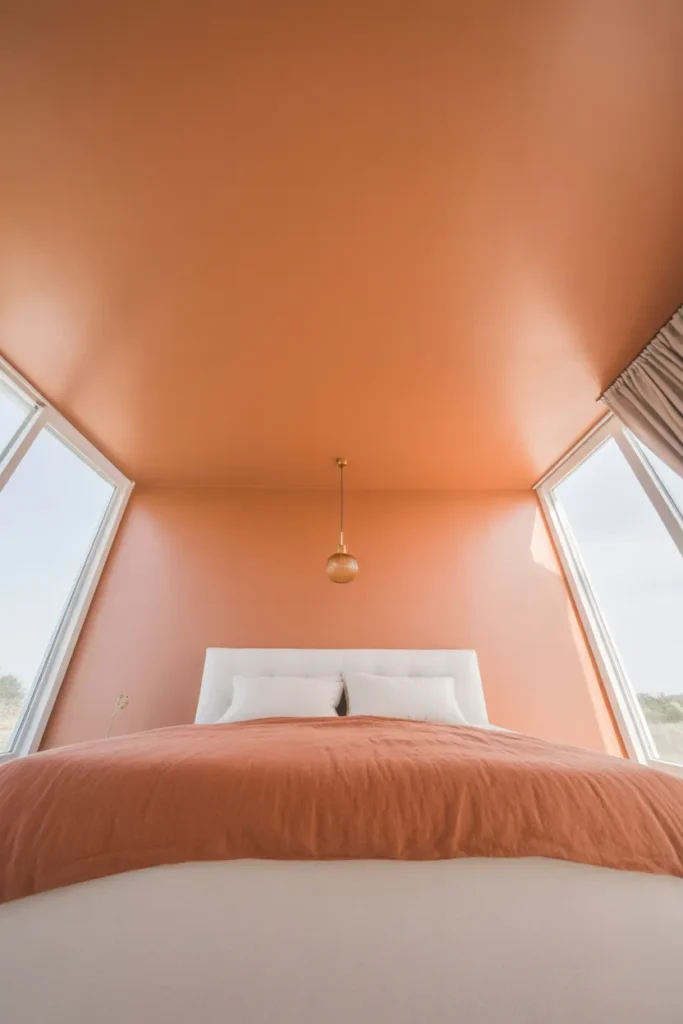
For renters or those with limited budgets, a simple statement pendant light fixture hung from the center of the ceiling is a ceiling design choice. A beautiful fixture draws the eye upward and makes the ceiling feel considered.
The most important rule for ceiling design is that whatever treatment you choose should relate to at least one other material or tone already present in the room. Isolated ceiling treatments look like accidents rather than decisions.
10. Small Bedroom Makeover: Four Layout Principles That Create More Functional Space
A small bedroom does not need more furniture. It needs a smarter layout. The four principles that consistently improve small bedroom function are: floating the bed, using vertical space, choosing dual-purpose furniture, and eliminating visual breaks.
Floating the bed means positioning it against one wall with clear floor space on the remaining sides. This maximizes the visible floor area, which is the primary factor in how large a room feels. A bed placed in the middle of a small room consumes floor space from all sides.
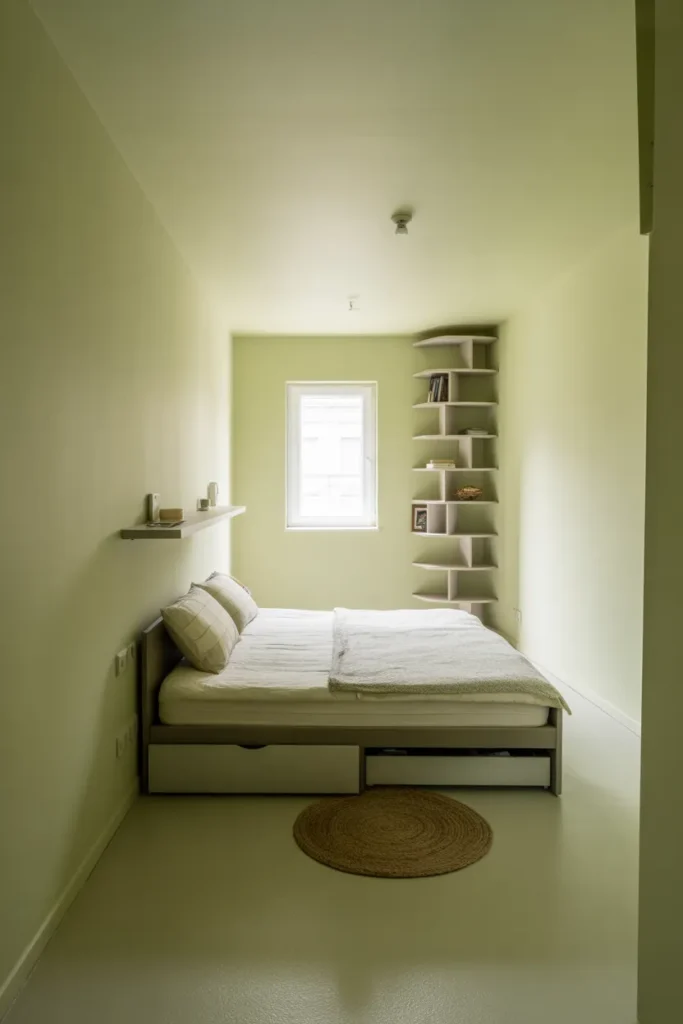
Using vertical space means prioritizing tall furniture over wide furniture and using wall-mounted shelves above eye level for storage and decor. Most small bedrooms have unused vertical space above four feet from the floor.
Dual-purpose furniture in a small bedroom includes beds with drawer storage underneath, nightstands with shelving, and ottomans that serve as both seating and storage. This reduces the number of individual pieces while maintaining full function.
11. Bedroom Curtain Length and Placement: The Hanging Mistake That Shortens Your Walls
Curtain placement has a greater impact on how a bedroom feels than most people expect. Curtains hung at window height rather than ceiling height make the room appear shorter and the windows appear smaller. This is one of the most common and most fixable bedroom mistakes.
Hang curtain rods as close to the ceiling as possible, ideally within four to six inches of the ceiling line. Let the curtains fall to the floor, with a slight break or light pool at the base. This vertical line draws the eye upward and creates the illusion of taller walls and larger windows.
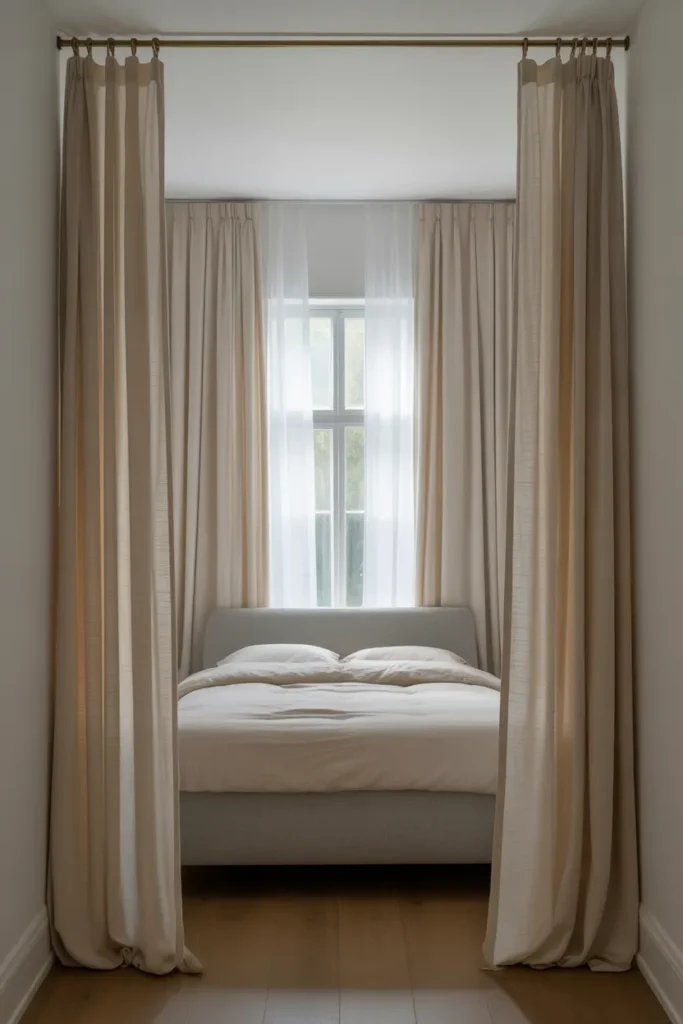
Choose curtains that are wide enough to extend well past the window frame on both sides when open. The panels should cover only the wall beside the window, not the window itself, allowing full light when open. Panels that cover part of the window when fully opened block natural light and make the window look smaller.
In bedrooms where light control is important, layer sheer curtains under heavier drape panels. This gives you full light, filtered light, and blackout options from one curtain system.
12. The Luxury Bedroom on a Realistic Budget: Where to Spend and Where to Save
The visual cues that read as luxury in a bedroom are specific and learnable. They are not the result of expensive furniture. They come from texture quality, cohesion of palette, intentional lighting, and the absence of visual clutter. Understanding this changes how you allocate your bedroom budget.
Spend where it directly touches you. A high-quality mattress, good bedding with a high thread count or natural fiber content, and a well-made bed frame justify higher spend because you use them daily and they affect both health and visual quality.
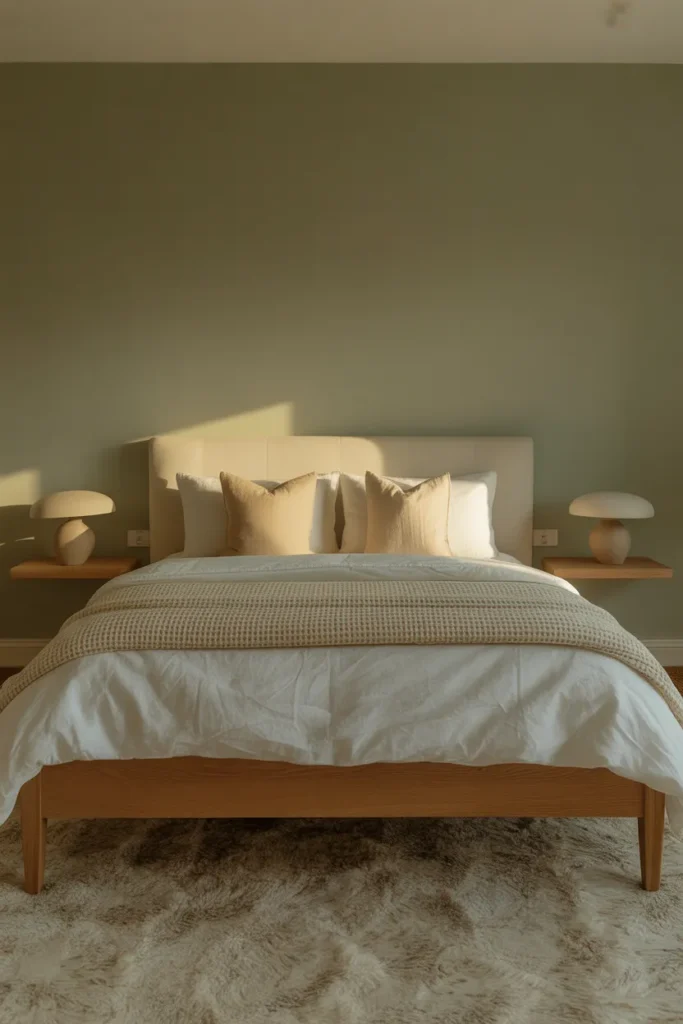
Save where it is decorative. Wall art, throw pillows, decorative objects, and curtains can all be sourced at low to mid price points without sacrificing visual quality if the palette and proportion are correct.
The single highest-return investment in bedroom luxury aesthetics is bedding. A well-dressed bed with layered neutral-toned linens looks more expensive than any piece of furniture in the room and sets the entire tone of the space.
13. Bedroom Plants: Which Work, Where to Place Them, and What to Avoid
Plants in a bedroom add organic texture that no decorative object can replicate, but placement and species selection matter significantly in this room because of low light conditions and the need for clean air and minimal maintenance.
The best bedroom plants for low light conditions are pothos, snake plants, and peace lilies. All three tolerate limited natural light, require infrequent watering, and maintain an attractive appearance without significant care. Snake plants are particularly effective in bedrooms because they release oxygen at night, supporting better air quality while sleeping.
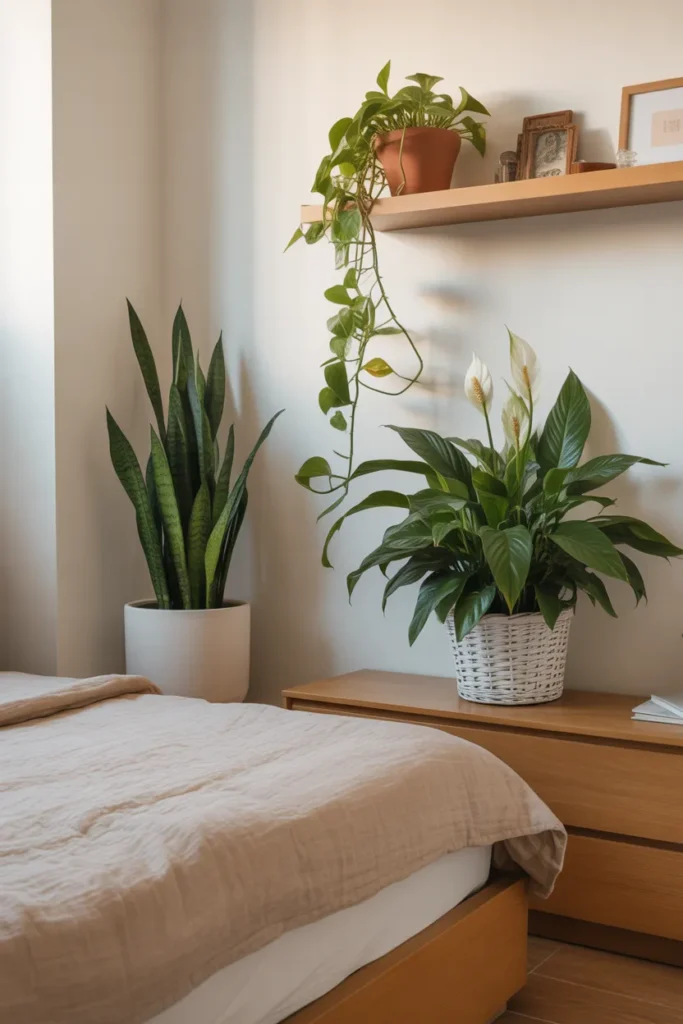
Place plants at different heights rather than clustering them on a single surface. A tall floor plant in a corner, a mid-height plant on a dresser, and a small plant on a nightstand or floating shelf creates a vertical distribution of organic texture across the room.
Avoid high-maintenance plants like orchids or fiddle leaf figs in bedrooms because a struggling plant looks worse than no plant at all. A dying plant introduces a visual of neglect that undermines the entire room.
14. Bedroom Gallery Walls Done Right: Avoiding the Chaotic Look
A gallery wall in a bedroom is one of the most popular elements in dream bedroom inspiration content, but it is also one of the most frequently executed poorly. The difference between a gallery wall that looks curated and one that looks cluttered comes down to three decisions: frame consistency, spacing discipline, and alignment structure.
Frame consistency means using frames in one finish family. All black, all natural wood, or all white frames work. A mix of gold, black, silver, and natural wood frames looks chaotic regardless of how good the art is.
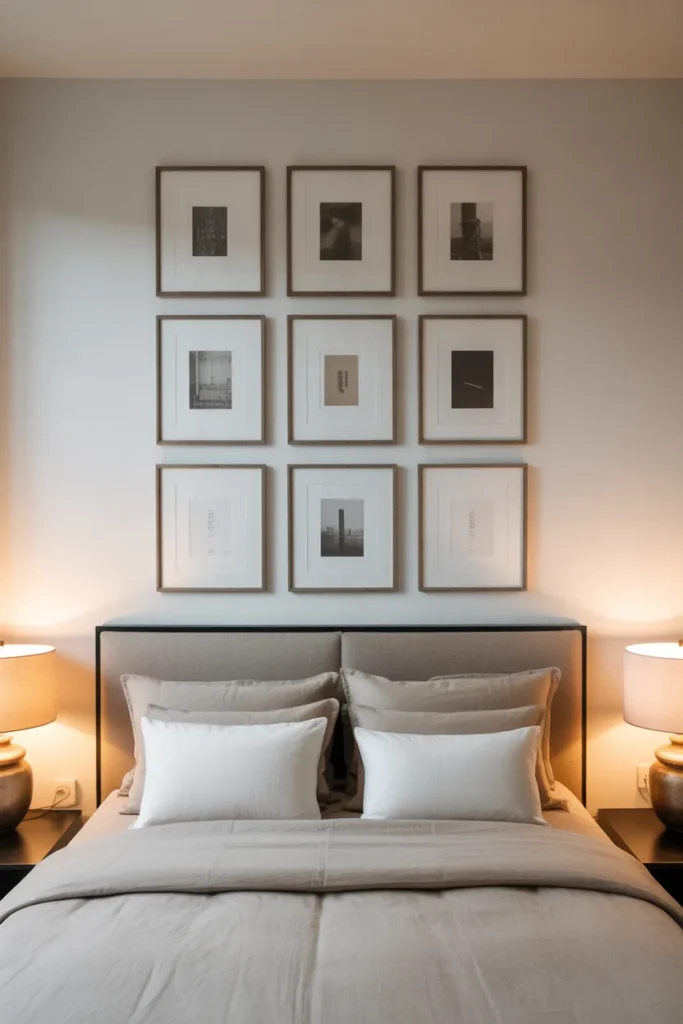
Spacing discipline means maintaining an even gap between every frame, typically two to three inches. Uneven spacing is the most visible technical error in gallery wall execution and is easy to measure and correct.
Alignment structure means deciding whether the gallery is grid-aligned (all edges line up horizontally or vertically) or organic-aligned (centered on a midpoint with pieces radiating outward). Choose one intentionally. A gallery that is neither grid nor organic reads as accidental.
15. Master Bedroom Layout for a Symmetrical Feel: Why Balance Reads as Luxury
Symmetry in bedroom design is one of the most reliable visual shortcuts to a space that reads as planned, polished, and high-end. The human eye finds bilateral symmetry restful because it signals order and intentionality.
The classic symmetric layout centers the bed on the dominant wall with matching nightstands, matching lamps, and equal space on both sides. This arrangement works in almost any room size and in virtually every design style from traditional to contemporary.
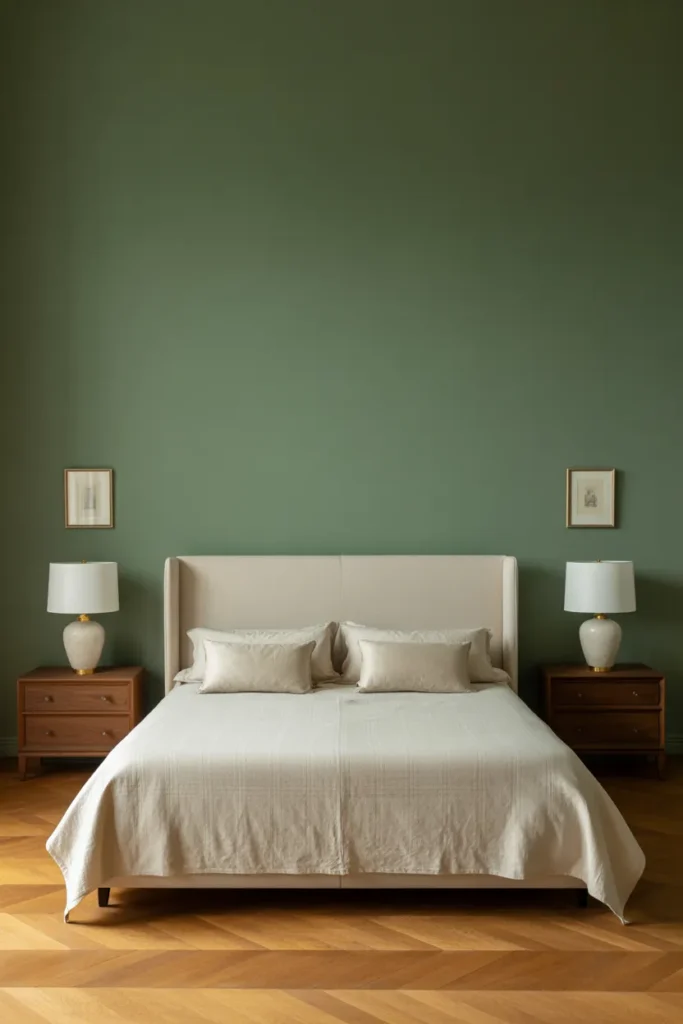
The most important element of symmetry is not having identical objects but having balanced visual weight. Two different nightstands of similar scale with lamps of similar height create symmetry even if the pieces are not exact matches.
Asymmetric bedrooms can look equally beautiful but require significantly more skill to execute. For most homeowners, a symmetric layout delivers the most reliable and sophisticated outcome, especially in a master bedroom where the investment in furniture and bedding is highest.
16. Coastal Bedroom Ideas That Look Refined, Not Beachy
Coastal bedroom design in the USA is one of the most popular aesthetics searched, but it is also one of the most easily overdone. A refined coastal bedroom suggests the sea through texture, tone, and material without a single starfish, anchor, or nautical print in sight.
The palette of a refined coastal bedroom lives in sand, driftwood, ocean-bleached white, pale blue-grey, and warm linen. These tones evoke shoreline environments organically without requiring themed objects.
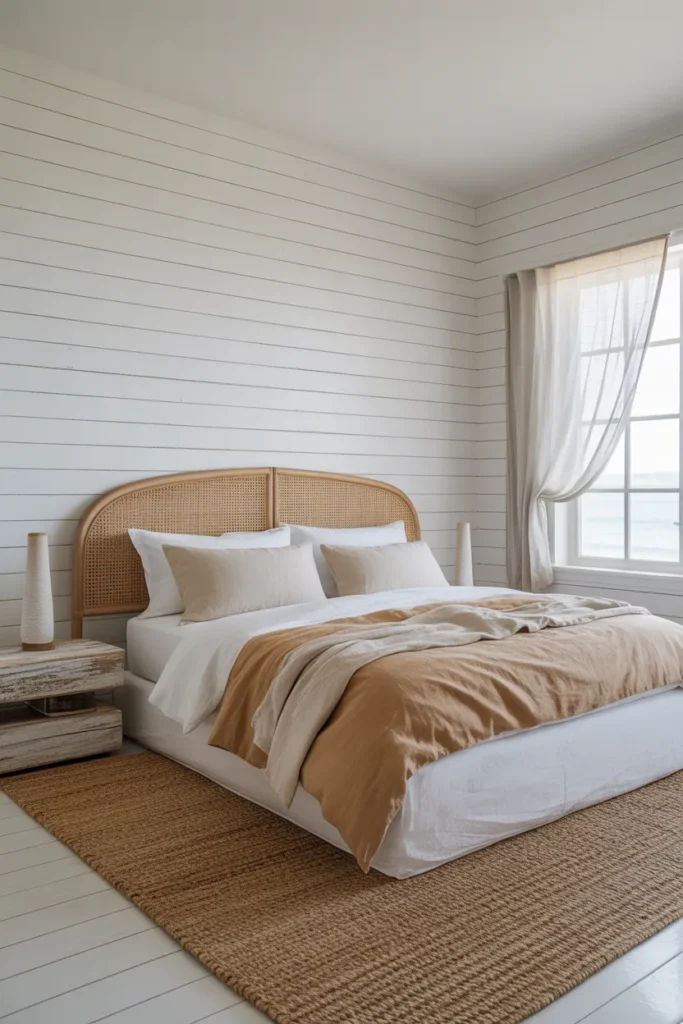
Texture carries the coastal feeling in place of literal objects. Natural rattan or cane headboards, linen bedding, jute or sea-grass rugs, whitewashed wood, and woven baskets all communicate coast through material origin. Layer these textures and the room tells the coastal story with sophistication.
Limit pattern to one element in a coastal bedroom, typically a subtle stripe in the bedding or a woven texture in the rug. Too much pattern in a coastal palette begins to feel busy and pulls the room toward beach-house-themed rather than refined coastal.
17. Bedroom Scent and Texture: The Two Sensory Layers That Complete a Dream Bedroom
A bedroom that looks beautiful but does not feel or smell pleasant is incomplete. The most memorable bedroom spaces engage more than just vision. Scent and tactile texture are the two sensory layers that elevate a bedroom from well-styled to genuinely immersive.
Scent in a bedroom should be subtle and consistent. A diffuser with a single essential oil, a high-quality candle in a calming fragrance like sandalwood, eucalyptus, or warm cedar, or a linen spray used on pillowcases creates an olfactory association with the room that builds over time. Avoid mixing multiple scents in one space.
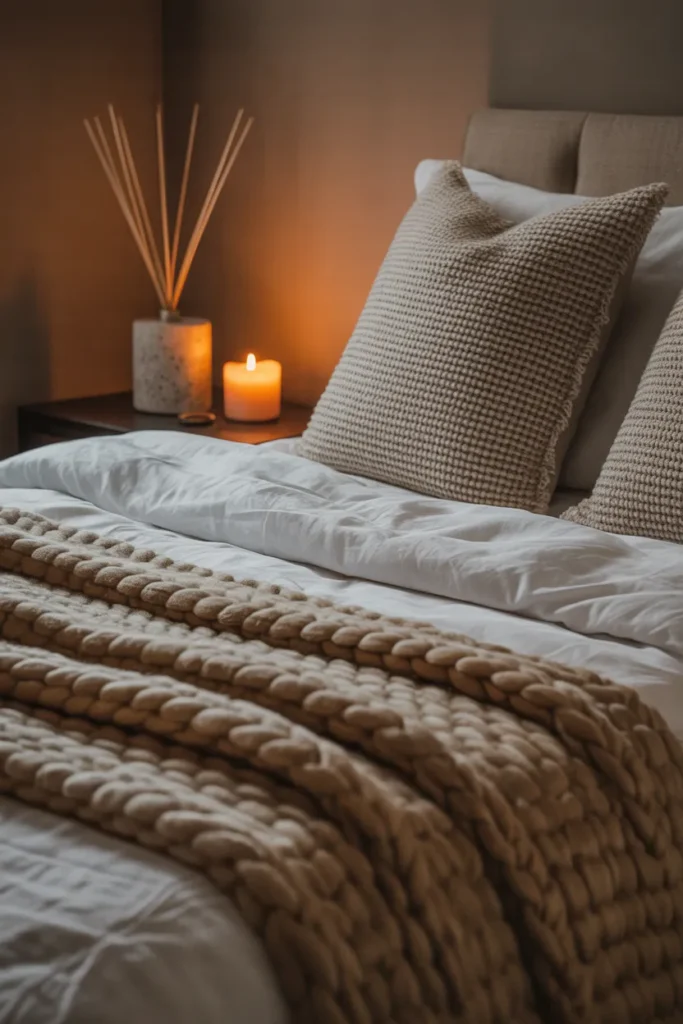
Tactile texture in a bedroom is built through the layering of different fabric weights and weaves. Smooth cotton sheets, a rougher waffle-weave blanket, a chunky knit throw, and a plush rug under bare feet on a cold morning together create a physical richness that a single-fabric room lacks.
Both scent and texture are inexpensive to introduce and have a disproportionately large impact on how a bedroom is experienced. This is the level of detail that separates a styled bedroom from a truly well-designed one.
18. Bedroom Refresh Without Renovation: Five Changes That Transform the Room in a Weekend
Not every bedroom transformation requires renovation, new furniture, or significant expense. Five specific non-renovation changes consistently deliver dramatic visual improvements in a single weekend.
The first change is repainting one wall a deep or warm accent color. One wall takes one day and shifts the entire room. The second is replacing existing light fixtures and bulbs with warm-toned alternatives. Cool white LED bulbs kill bedroom atmosphere; warm tone bulbs at 2700K restore it.
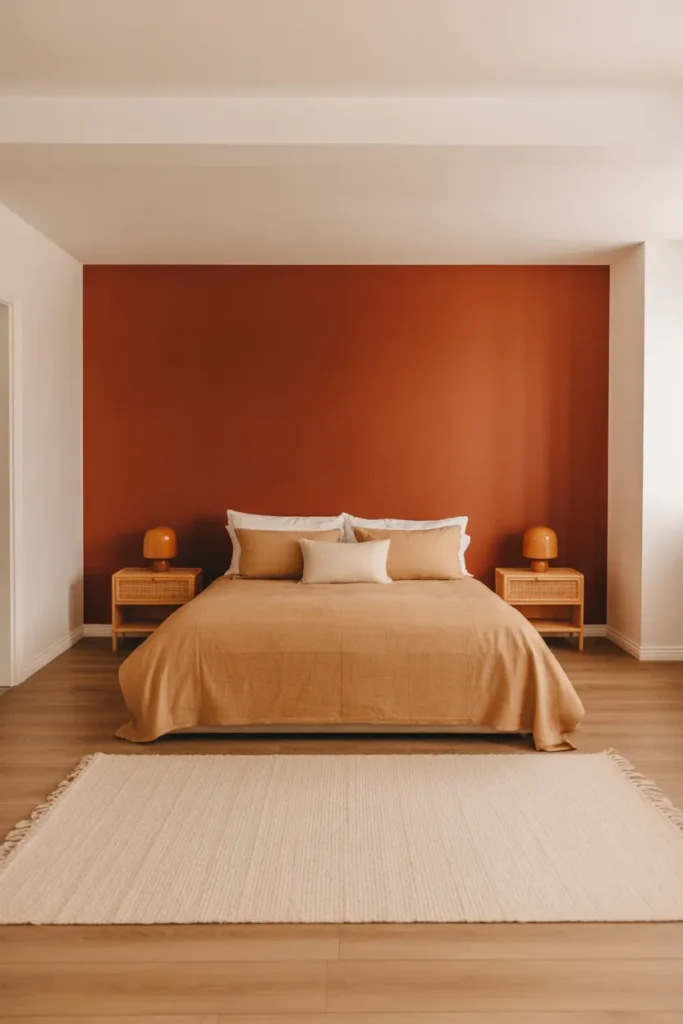
The third change is replacing one or both nightstands with better-proportioned alternatives. Mismatched or poorly scaled nightstands are visually disruptive, and replacing them is one of the most affordable room upgrades. The fourth is adding or upsizing the bedroom rug. As covered earlier, rug size is one of the most commonly underdone elements.
The fifth is editing out unnecessary furniture. Most bedrooms have at least one piece of furniture that does not serve the room. Removing it costs nothing and immediately opens space. The dream bedroom inspiration you have been looking for is often hidden under the clutter of furniture that has no reason to be there.
Final Thoughts
Turning your bedroom into the space you have always wanted does not require a complete renovation or a large budget. As this guide shows, the most impactful improvements come from understanding proportion, light, texture, palette, and layout, and applying those principles one decision at a time. Every idea here works in a real home, not just in a styled photo. Dont miss these elegant bedroom ideas!
If this guide gave you a clearer direction for your bedroom, save it to your Pinterest boards so you can reference specific ideas as you work through your space. Explore more bedroom design ideas to build on these foundations and create a room that is as functional and comfortable as it is beautiful.