
Garden wood fence ideas in 2026 have moved so far past the standard six-foot cedar panel that comparing the two feels like comparing a builder-grade kitchen to a renovated one — same bones, completely different life. If your backyard feels like a rented parking lot with plants in it, it is not a plant problem or a furniture problem; it is a boundary problem, and the right fence is the design decision that changes everything. By the end of this post, you will know exactly which wood fence style belongs in your specific outdoor space, how to style it to look intentional rather than installed, and which combinations are actually surviving weather, HOA scrutiny, and five-year wear tests.
The Horizontal Slat Fence That Makes a Narrow Yard Feel Like a Private Retreat
Most homeowners default to vertical fence panels because that is what comes in a box at the hardware store — but vertical boards draw the eye upward and make a narrow yard feel like a corridor. Horizontal slat fencing does the opposite: it pulls the eye laterally across the fence line, widening the visual perception of the space significantly. In a yard that is longer than it is wide — common in Midwest starter homes and California bungalow lots — this single change to fence orientation reframes the entire outdoor experience.
The physical mechanic is straightforward. Cedar or pine boards are run parallel to the ground with quarter-inch gaps between them, mounted to posts set every six to eight feet. The gaps serve two functions: they allow airflow (critical in humid climates like Houston or Atlanta where solid fence panels trap heat and moisture), and they create a striped shadow pattern across the ground at certain hours that is genuinely beautiful. This is a fence that looks different — and better — depending on the time of day.
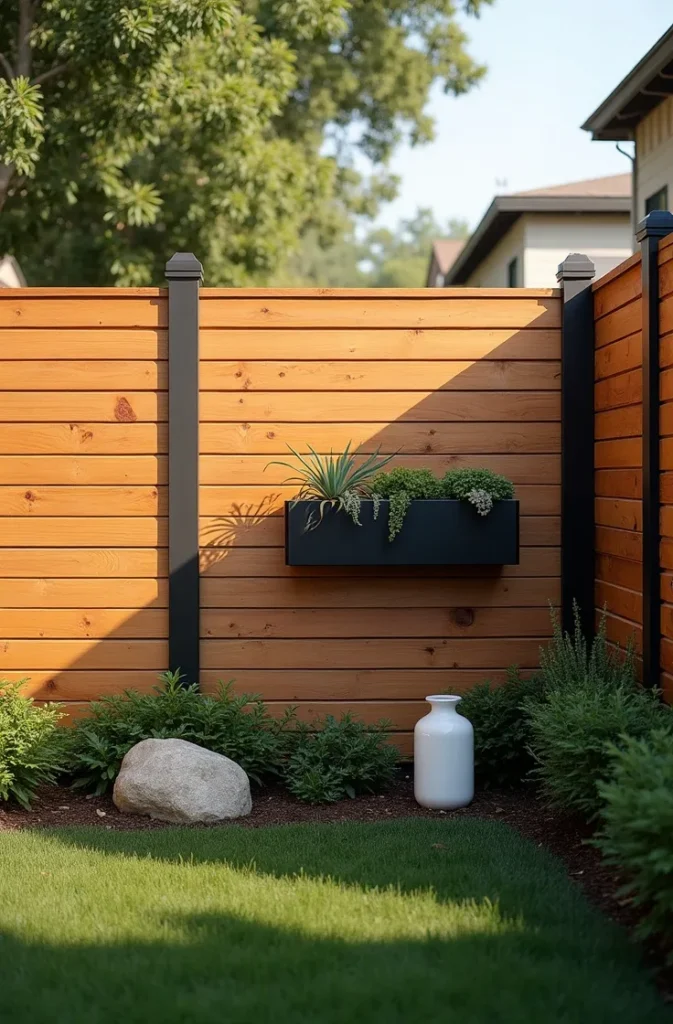

This style works especially well for backyards in California, the Pacific Northwest, and Texas Hill Country, where the horizontal line echoes the landscape and the warm wood tone grounds the space without competing with plantings. It also photographs better than any other fence style, which matters when you are trying to create outdoor content or simply want your backyard to look considered rather than built.
The mistake is using boards that are too wide. A four-inch board with quarter-inch gaps is the proportion that reads as refined. A six-inch board with the same gaps starts to look like a deck rather than a fence. Keep the boards narrow, keep the gaps consistent, and let the rhythm of the horizontal lines be the statement.
Picture yourself standing at your kitchen window looking out at a fence line that actually looks like it was designed. That is what the horizontal slat does that the standard panel never will.
Why a Staggered-Height Wood Fence Creates the Garden Drama You Have Been Missing
A fence that runs at one uniform height from post to post is functional but visually flat. The staggered-height fence — where individual boards or fence sections vary between five and seven feet in a deliberate, rhythmic pattern — introduces the kind of architectural interest that a garden bed or trellis alone cannot deliver. It is one of the most visually dynamic garden wood fence ideas currently showing up in landscape design portfolios, and it works across a wide range of yard sizes.
The design logic is borrowed from interior architecture: varying ceiling heights create drama and definition in a room, and the same principle applies outdoors. Where the fence height rises, it signals enclosure and privacy. Where it drops, it opens a sightline to a plant or garden feature beyond. When planned intentionally, the staggered height guides the eye around the garden in the same way a well-placed doorway guides movement through a home.
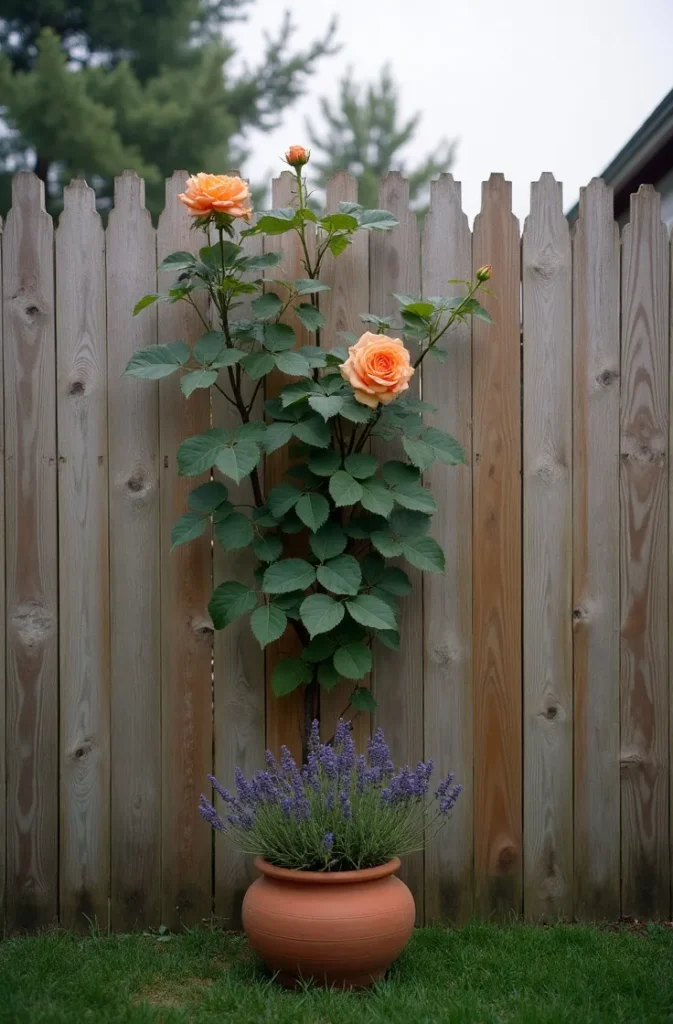
This works best for corner lots, wrap-around yard configurations, or homeowners who want their garden to read as a series of distinct rooms rather than one undifferentiated rectangle. In a Dallas suburb or a New England colonial yard where the architecture itself has varied rooflines and elevations, the staggered fence echoes the visual language of the house rather than contradicting it.
What to avoid: randomizing the heights without a pattern. Staggered height that follows no rhythm looks like the fence was built in sections by different people. Decide on a two-height or three-height repeat before the first board goes up, and stick to it across every panel.
The Lattice-Top Wood Fence That Lets Your Climbing Plants Do Half the Design Work
The lattice-top fence is one of the most underused garden wood fence ideas for women who want privacy without losing the light and airiness of an open yard. The concept is simple: a solid wood privacy panel for the lower four to five feet, topped with a twelve-to-eighteen-inch lattice section that allows light, air, and partial sightlines through while still providing significant privacy from standing-height neighbors or passersby.
The design payoff comes when the lattice is planted. A single jasmine vine or a climbing hydrangea, trained up from the base of the fence and woven through the lattice over one to two seasons, turns the upper section of the fence into a living wall. The wood structure disappears into the foliage and what remains reads as a garden feature rather than a boundary marker. This is one of the most photographically compelling outcomes in residential garden design, and it requires almost no design budget beyond the initial plant investment.
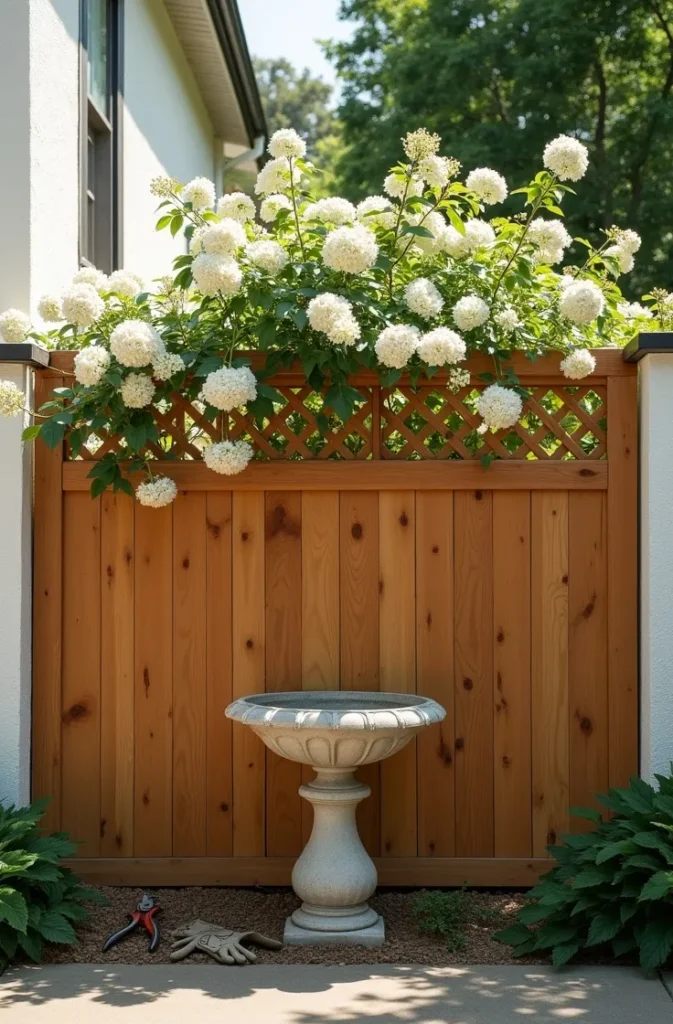
This approach works especially well for homeowners in mild climates — coastal California, the Southeast, the mid-Atlantic — where climbing plants establish quickly and maintain their foliage through most of the year. In colder climates like Chicago or Minneapolis, use a more structural climbing plant like a climbing hydrangea or a Virginia creeper that provides winter branch texture even when not in leaf.
The mistake is buying a pre-made diamond lattice panel in white vinyl and topping a wood fence with it. The material mismatch is jarring. Use wood lattice in the same species as your fence panels, or commission a custom square-grid lattice in the same finish — it is a minor material cost that makes a significant visual difference.
The Shou Sugi Ban Wood Fence That Stops Every Neighbor in Their Tracks
Shou sugi ban — the Japanese technique of charring wood to preserve and harden it — has been used in traditional Japanese architecture for centuries, but its application as a garden fence material in American residential yards is one of the most visually striking garden wood fence ideas to emerge in the last five years. The deep charred black surface, which can range from matte and velvety to almost iridescent depending on the finishing technique, creates a fence that functions as outdoor art.
The practical case is as strong as the aesthetic one. Charred wood is significantly more resistant to moisture, insects, and UV damage than untreated or even stained wood. In regions like Florida and the Gulf Coast where standard cedar fences require restaining every two to three years, a properly charred fence can last fifteen to twenty years with minimal maintenance. The char itself is the sealant.
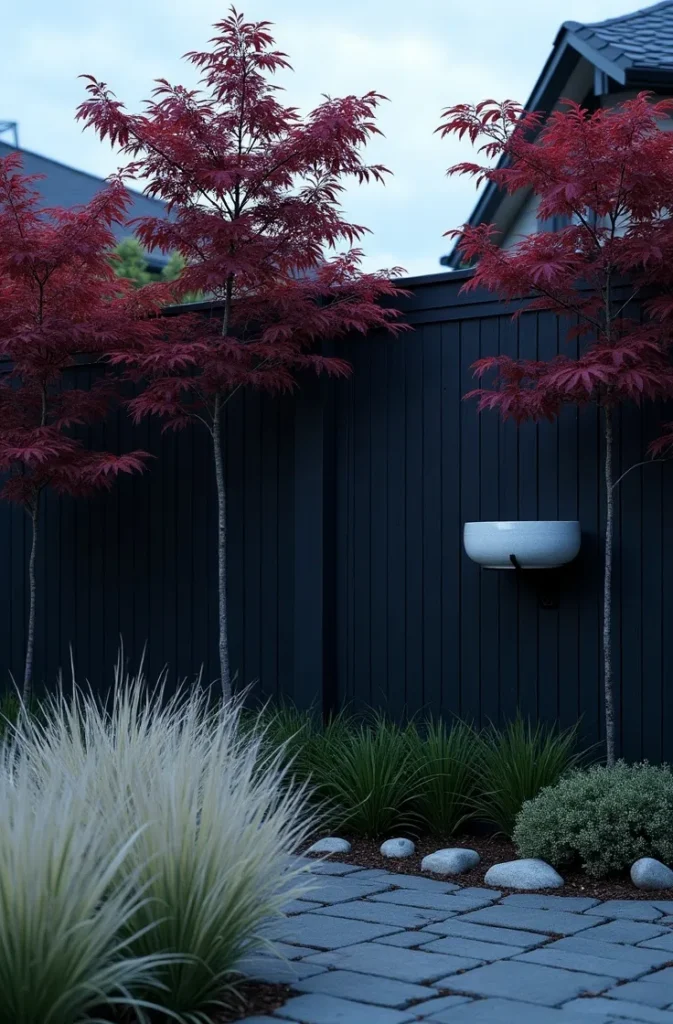
Against a lush green garden — even a modest one — the black fence reads as a dramatic, sophisticated backdrop in a way that no brown or grey stained fence can replicate. Low ornamental grasses, Japanese maples, and white or cream flowering plants are particularly effective against shou sugi ban, creating a high-contrast tableau that looks like a deliberately curated landscape photograph rather than an average backyard.
This fence is not for everyone. In a neighborhood of warm-toned cedar and painted white picket fences, a charred black fence will stand out. Understand your HOA guidelines and your neighborhood’s visual language before committing. In the right setting, it is extraordinary. In the wrong one, it is just dark.
The Split-Rail Wood Fence That Defines a Garden Without Closing It In
The split-rail fence is one of the most misunderstood garden wood fence ideas — frequently dismissed as rustic or rural when, styled intentionally, it is one of the most graceful boundary solutions available for a residential garden. The defining quality of a split-rail is its openness: two or three horizontal rails between posts with no solid infill. It marks a boundary, guides movement, and creates definition without blocking air, light, or sightlines.
This is the fence for the homeowner who wants to frame a garden bed, define the edge of a lawn, or create a visual separation between two areas of the yard without the enclosure of a privacy fence. In a large property — a rural lot in Vermont, a generous Southern suburban yard, a farmhouse property anywhere in the mid-Atlantic — the split-rail fence creates the pastoral, intentional quality of a designed landscape rather than an uncontrolled property edge.
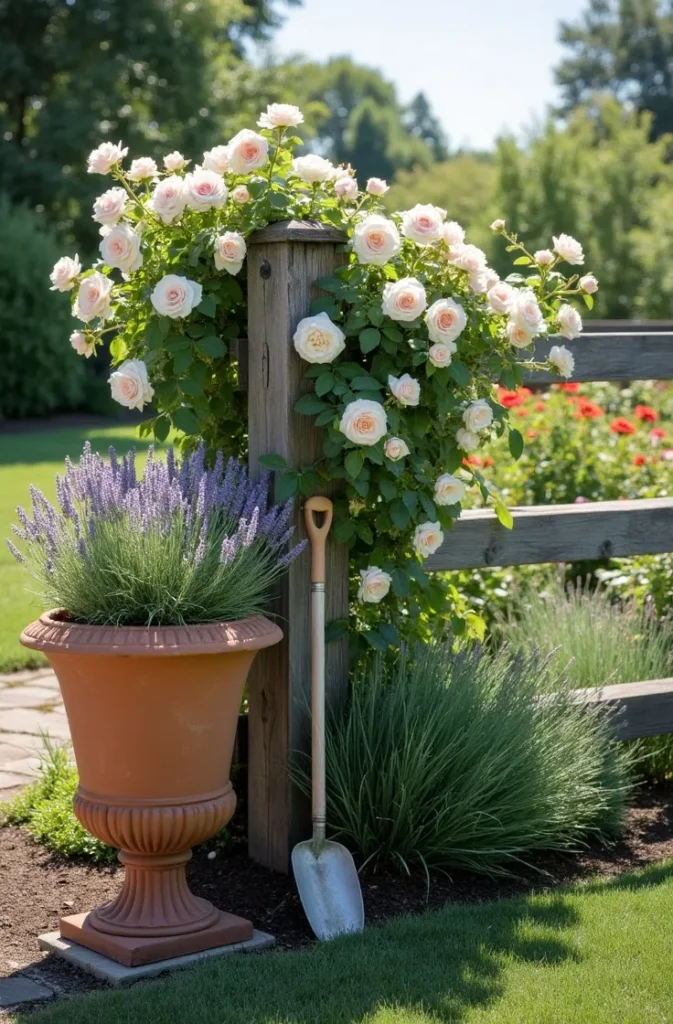
The styling opportunity with split-rail is in what you plant beside it. Climbing roses allowed to drape over the top rail without being trained tightly create a romantic, overgrown quality that is genuinely stunning in June and July. Native wildflowers planted along the fence line — black-eyed Susans, coneflowers, wild bergamot — create a meadow-edge effect that is both beautiful and ecologically meaningful.
The mistake is installing split-rail with treated pine and leaving it raw. Treated lumber has a greenish cast that weathers poorly. Use black locust, white oak, or cedar rails and let them silver naturally — the weathered grey of aged wood against a blooming garden is one of the most beautiful things a backyard can offer.
The Board-on-Board Privacy Fence That Looks Beautiful From Both Sides
The board-on-board fence — where alternating boards are placed on opposite sides of a horizontal rail, overlapping slightly — is one of the most structurally sound and visually generous garden wood fence ideas for homeowners who share a property line with neighbors. Unlike a standard stockade fence where one side is finished and one side shows the structural frame, the board-on-board presents a clean, finished appearance on both sides of the boundary.
The physics of the overlap give you privacy without solid infill: the alternating boards block direct sightlines while still allowing air and some light to pass through. This makes it significantly better than a solid privacy fence in warm climates where air circulation matters for both comfort and plant health. The slight breeze that moves through a board-on-board fence is not a small thing when you are sitting in a Houston or Phoenix backyard in August.
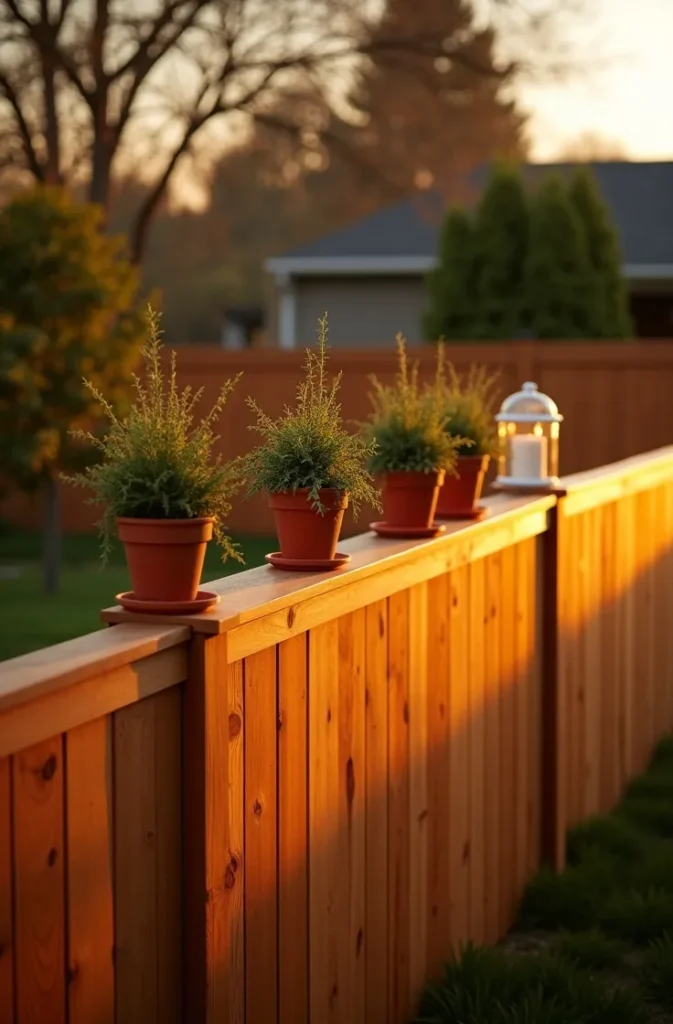
The design opportunity with board-on-board is in the cap rail — the horizontal board that runs along the top of the fence. A wide, flat cap rail in a contrasting finish (or simply in a smoother cut than the vertical boards) gives the fence a finished, architectural quality that the standard fence lacks. It also serves as a shelf for potted plants, lanterns, or a line of small outdoor candles for evening use.
The mistake is spacing the alternating boards too far apart for the sake of cost savings on lumber. The overlap must be at least one inch per side to maintain privacy. Anything less and you have an expensive fence that does not do its primary job.
The Picket Fence Reimagined — Why the 2026 Version Looks Nothing Like Your Grandmother’s Yard
The picket fence has spent the last twenty years being the punchline of design conversations, and the 2026 version is the correction. The reimagined picket fence uses the same structural principle — evenly spaced vertical boards between posts — but changes every other variable: the board profile (flat-top or pointed square rather than the traditional spear or dog-ear), the height (three to four feet rather than the standardized two-and-a-half), the spacing (wider, more graphic gaps), and the finish (raw cedar, black painted, or charcoal stained rather than white).
A flat-top cedar picket fence stained in a warm charcoal or deep slate grey, set at three and a half feet with one-and-a-half-inch gaps, reads as completely modern. It is still unmistakably a picket fence — the rhythm and proportion are there — but it bears no resemblance to the small-town-America cliché. This version shows up on design-forward residential streets in Portland, Austin, and the outer neighborhoods of Chicago where front yard curb appeal is a legitimate cultural value.
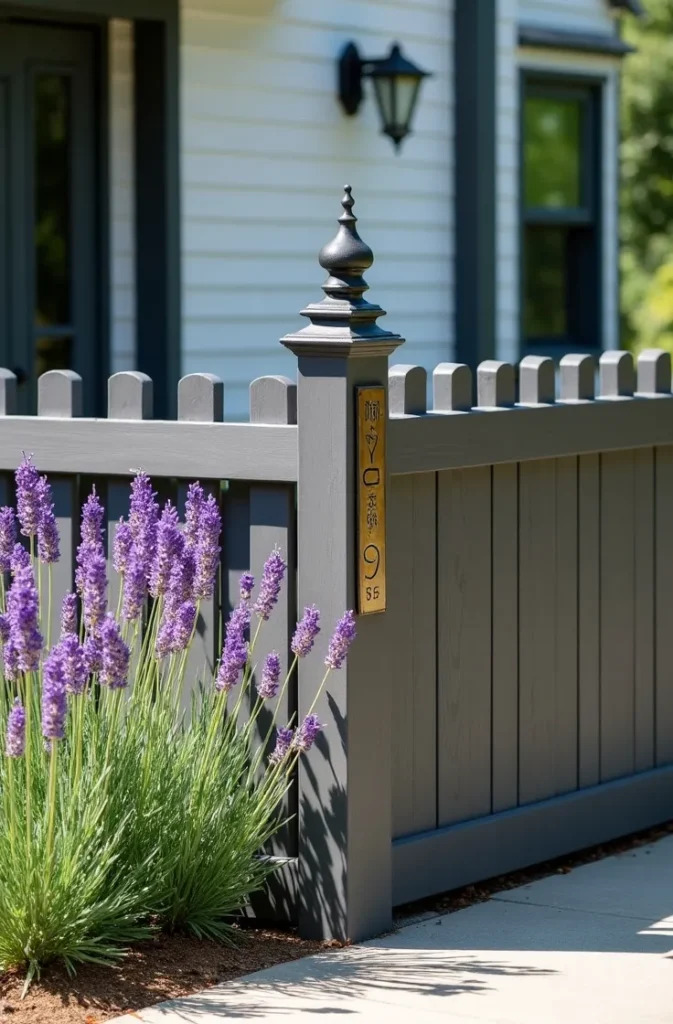
The plant pairing that elevates this fence is lavender. A row of English lavender planted along the inside of the fence, allowed to grow up to and slightly through the pickets, creates a scented, textured border that photographs beautifully in purple bloom and dries to a silvery-grey that complements the wood perfectly through the rest of the year.
The mistake is painting a reimagined picket fence white. White paint signals the original version, not the reinvented one. If you want a light finish, use a white-wash or a diluted grey stain that lets the wood grain show through rather than covering it with opaque paint.
The Gabion-and-Wood Combination Fence for the Garden That Wants to Look Like a Magazine
The gabion-and-wood combination fence uses steel wire cages filled with stones or river rocks as the structural anchor, with wood panels or horizontal boards inserted between or beside the gabion sections. The result is one of the most material-rich and architecturally sophisticated garden wood fence ideas available at a residential scale — a fence that combines the permanence of stone with the warmth of wood in a way that reads as designed rather than assembled.
The layout that works best alternates gabion columns (two to three feet wide, filled with uniform-sized river stones or granite chunks) with wood panel sections of equal width. The gabion columns function as the posts and provide significant ballast and privacy while the wood panels introduce color, warmth, and grain texture between the stone masses. The visual rhythm between stone and wood is the design.
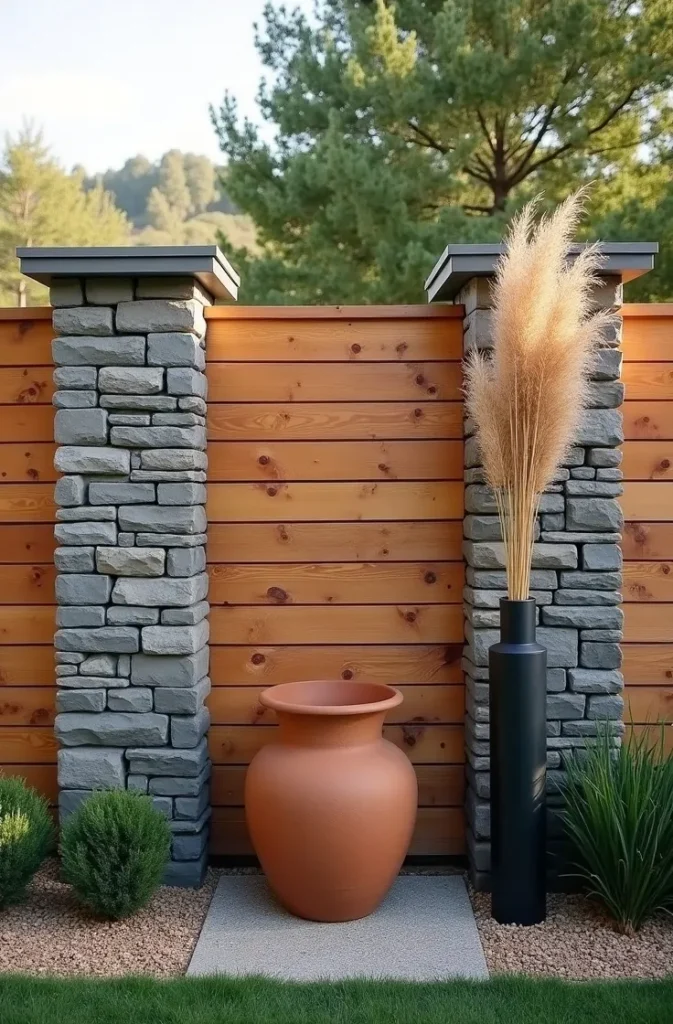
This fence works especially well for homeowners building a contemporary or modern farmhouse garden in the American West, where raw stone materials are contextually appropriate and the horizontal landscape calls for materials that feel anchored to the ground. It is also a permanent solution that adds measurable property value in markets where outdoor living space is priced carefully.
The mistake is using small, rounded pea gravel in the gabions rather than larger, more angular stones. Pea gravel shifts, compresses unevenly, and reads as fine and fussy rather than weighty and deliberate. Use river stones that are at least three to four inches in diameter for a result that looks intentional and holds its form across years.
The Low Wood Garden Fence That Frames Beds Like a Painting Frame
A low wood edging fence — twelve to eighteen inches tall — placed around a garden bed is one of the most quietly transformative garden wood fence ideas available at any budget level. The low fence does not provide privacy or mark a property boundary. It does something more subtle and, in design terms, more valuable: it frames the garden as a deliberate, finished composition rather than a patch of plants that happens to be there.
The framing effect works exactly the same way that a picture frame elevates what is inside it. A garden bed that is edged with a continuous low wood rail has a start, a middle, and an end. The eye reads it as complete. The same plants without the frame read as a work in progress. This is one of those garden wood fence ideas that costs almost nothing relative to its visual return.
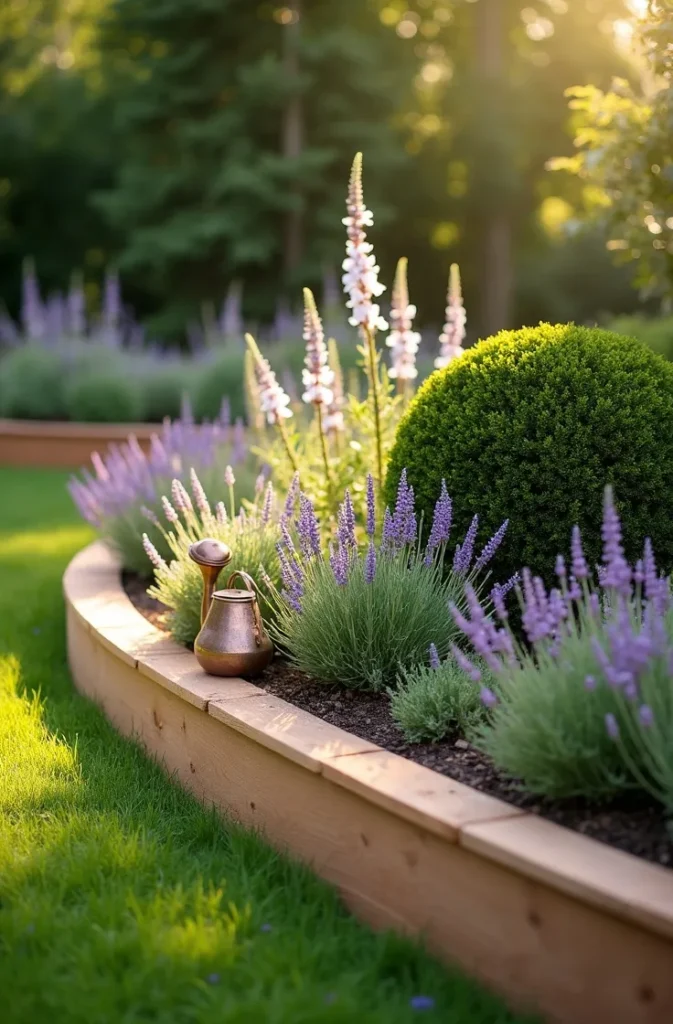
Low wood garden edging works for every garden style. In a cottage garden — lavender, roses, foxglove, sage — use slightly irregular or rough-hewn wood for a hand-made quality that complements the informal planting. In a more formal or minimalist garden, use clean-cut cedar or ipe boards with a milled edge and a consistent finish. The material quality should match the planting discipline.
This is particularly effective in front yards and entry gardens where the view from the street or the front door needs to be composed and intentional. Real estate agents in competitive markets like Northern Virginia, Denver, and the Bay Area will tell you that a landscaped front garden with edged, framed beds reads significantly better at first impression than the same plants without definition.
The mistake is using pressure-treated lumber for low edging without proper finishing. The green tinge of fresh treated lumber is distracting, and it weathers unevenly. Use cedar, ipe, or black locust for low edging — species that hold up to ground contact without the chemical treatment process.
The Living Wood Fence — How to Combine Planted Posts With Willow Weave for a Boundary That Grows
A living fence blends planted wood elements — willow stakes, hazel rods, or dogwood cuttings pressed directly into the soil — with woven natural wood structures in a way that produces a boundary that is literally alive and changing with the seasons. The planted stakes root into the soil, send out leaves in spring, and after two to three seasons produce a dense, layered structure that is part fence, part hedge, and fully its own category of garden feature.
The technique is ancient — wattle fencing has been used in British and European gardens for thousands of years — but the contemporary version, installed in American gardens with native materials and maintained with modern understanding of plant growth, is one of the most living and textured of all current garden wood fence ideas. It is gaining significant traction in naturalistic and ecological garden design circles, particularly in the Pacific Northwest and New England where the climate and material availability support it well.
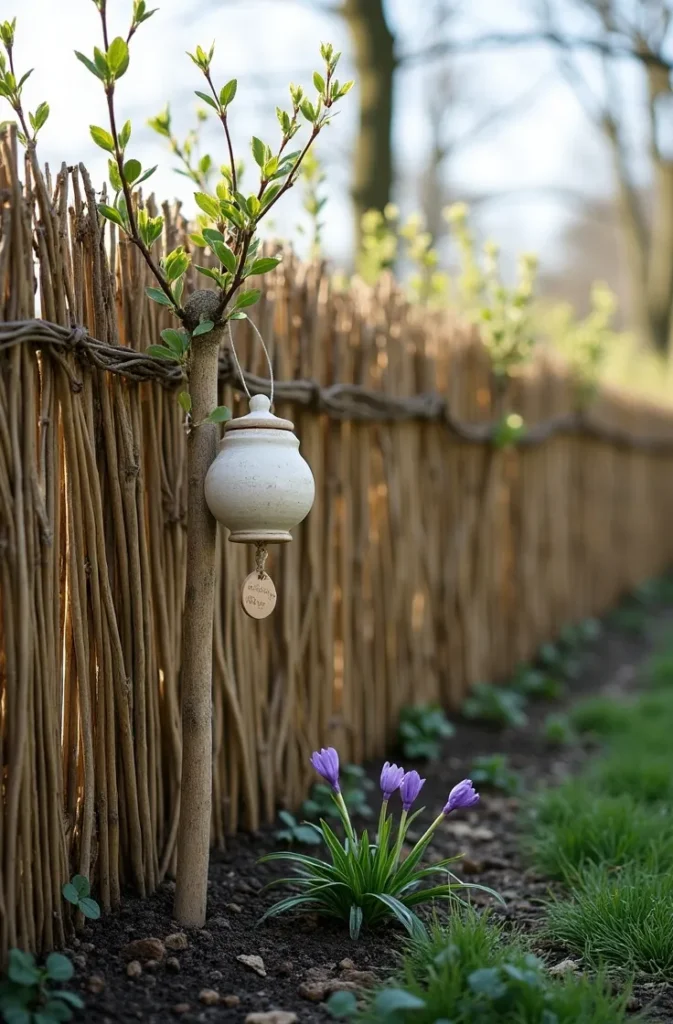
In practice, the fence is built by driving sharpened willow or dogwood stakes into the ground at six-inch intervals, then weaving thinner, more flexible rods horizontally between them in a basket-weave pattern. The living stakes root and leaf out while the woven structure provides immediate privacy and definition. Over time, the line between planted stake and woven rod disappears into the growing structure.
The mistake is using dried or kiln-dried wood for the living posts. Only freshly cut cuttings from actively growing species will root. Purchase willow stakes from a nursery that sells them as living material, or cut them yourself in late winter when the plant is dormant but the cutting will survive. Using dry lumber defeats the purpose entirely.
The Scalloped-Top Wood Fence That Brings Architectural Grace to a Plain Backyard
The scalloped-top fence — where the top edge of each fence panel follows a gentle, repeating curved arc between posts — is one of the garden wood fence ideas that most reliably generates saves on design and home Pinterest boards, and it deserves the attention. The curve at the top of a fence does not just look different from a flat-top panel; it introduces an entirely different emotional quality. Where a flat-top fence reads as functional and direct, a scalloped top reads as considered, generous, and finished.
The curve itself can be a shallow, broad arc spanning the full width between posts (which reads as formal and architectural) or a deeper, more dramatic dip (which reads as cottage and romantic). The depth of the scallop should correspond to the garden style: a shallow scallop for a modern or transitional yard, a deeper one for a cottage or traditional garden.
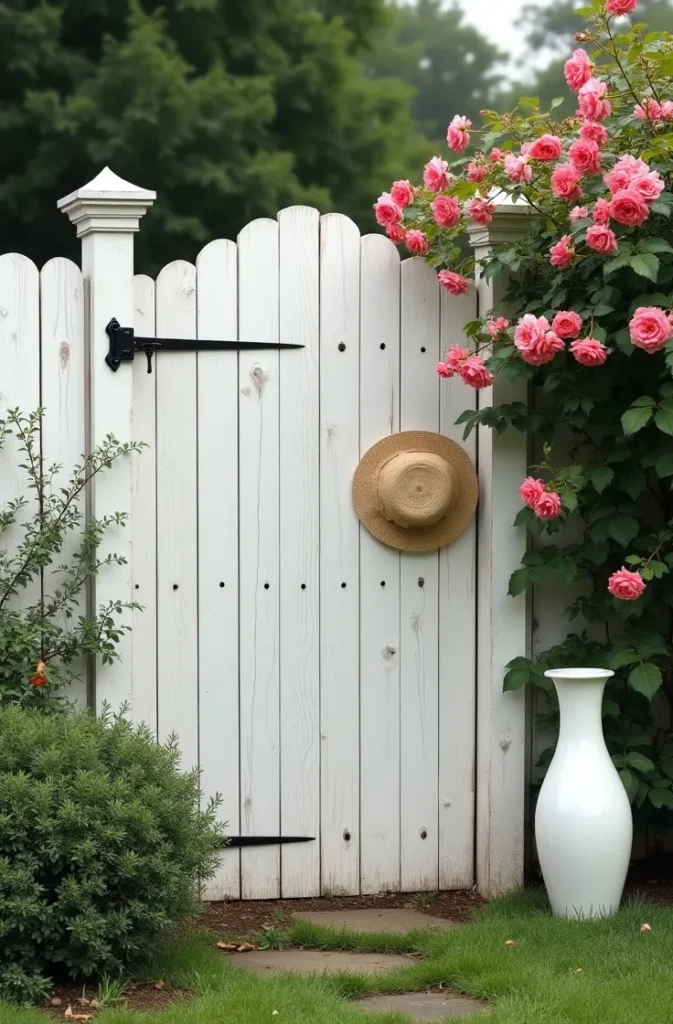
This fence style works particularly well in front yards and gardens that are viewed from a distance — from the street, from a porch, from an upstairs window — where the curved silhouette against the sky or a backdrop of foliage creates an image. It is the fence equivalent of a crown molding: a detail that does not change the function but changes the entire quality of the perception.
The practical note: scalloped-top panels are typically cut by a mill or fence contractor rather than assembled from stock lumber. Budget for the custom cut, because attempting to hand-cut a consistent scallop without a template and a jigsaw with a steady hand produces results that read as imprecise rather than graceful.
The Mixed-Material Fence That Uses Wood and Metal Together Without Looking Industrial
The combination of wood and metal in a garden fence — specifically cedar or teak boards with black steel or corten steel frame elements — is one of the most sophisticated garden wood fence ideas for homeowners who want a contemporary look with genuine material depth. Wood provides warmth and texture; metal provides precision, permanence, and a strong graphic edge. Together, they create a fence that reads as designed rather than built.
The most effective version of this combination uses steel posts and horizontal rails as the structural skeleton, with wood boards or panels inserted between the steel sections. The steel remains visible as a deliberate design element — typically in a powder-coated matte black or in the warm rust of weathering corten steel — rather than being hidden behind the wood. The contrast between the black steel edge and the warm grain of cedar or teak is, in daylight, genuinely beautiful.
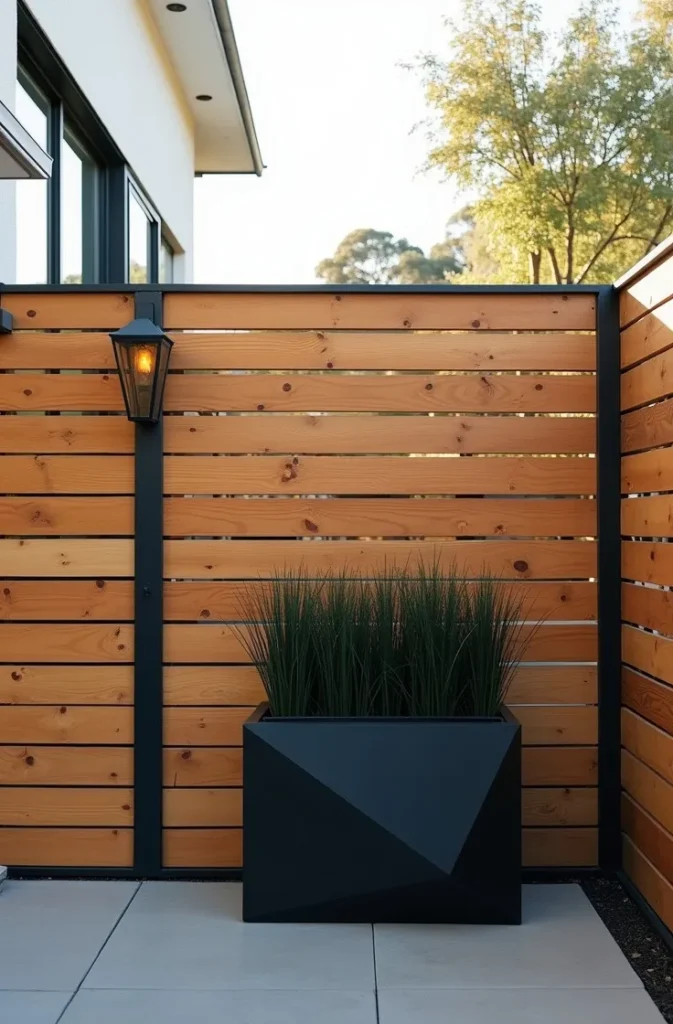
This fence style is most at home in contemporary, mid-century modern, and minimalist landscapes — a new construction in a suburban Texas development, a remodeled property in the Southwest, a modern farmhouse renovation anywhere in the rural Midwest. It does not belong in a Victorian cottage garden or a traditional New England yard where the industrial material language would conflict with the architecture.
What fails is using thin, lightweight steel hardware-store conduit as the metal element rather than proper steel post profiles. The entire aesthetic depends on the steel having weight and presence. Thin conduit reads as scaffolding rather than architecture.
The Shadowbox Fence Panel That Adds Three-Dimensional Texture to a Flat Yard
The shadowbox fence — a variation on board-on-board where the alternating boards on each side of the rail are positioned slightly farther apart to deliberately create a deep shadow between them — is not widely understood as a design choice separate from standard board-on-board, but the visual difference is significant. Where standard board-on-board creates a relatively flat appearance, the shadowbox creates genuine three-dimensional depth on the fence surface that changes hour by hour as the light angle shifts.
The shadow that forms in the gaps between the offset boards is not incidental — it is the feature. At certain times of day, particularly in the morning and late afternoon when light strikes at a low angle, a shadowbox fence creates a pattern of deep parallel lines across its surface that looks more like a piece of land art than a garden boundary. For homeowners who spend time in their backyard at golden hour, this fence is specifically and consistently beautiful in those light conditions.
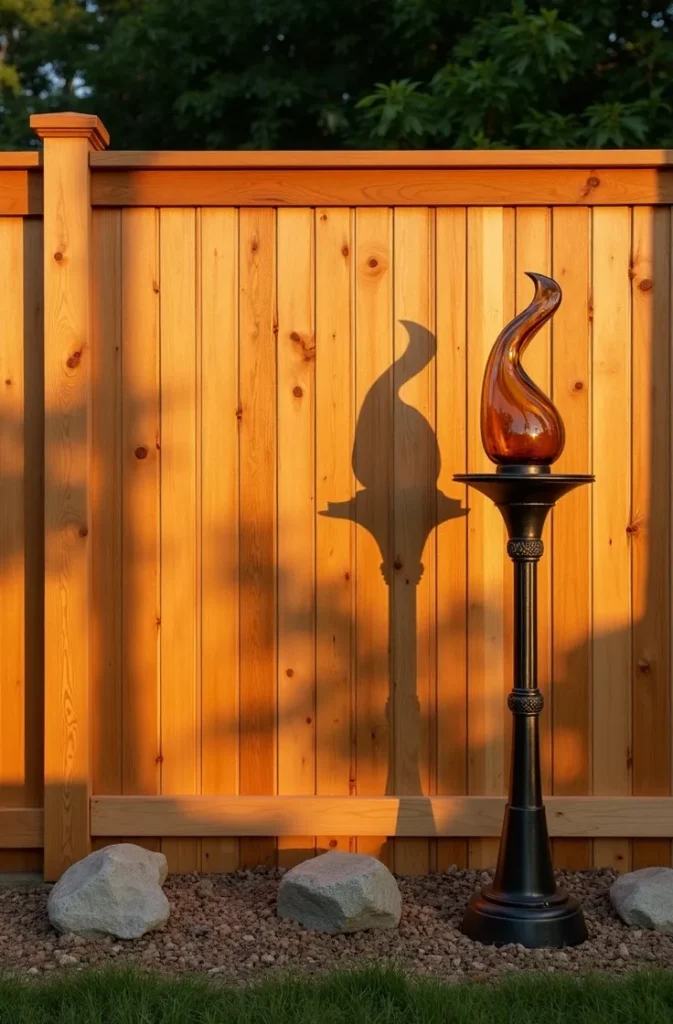
The practical benefit is the same as board-on-board: full privacy from standing height, significant airflow, and a finished appearance on both sides. The shadowbox achieves all of that and adds the sculptural surface quality.
Use rough-sawn cedar rather than smooth-planed lumber for maximum texture and shadow depth. The rough surface catches more shadow, weathers more beautifully to a silver-grey, and holds stain more evenly when you eventually choose to refinish it.
The Reclaimed Wood Fence That Tells a Story No New Lumber Can
A fence built from reclaimed barn wood, salvaged railway sleepers, or repurposed structural timber brings something into the garden that no amount of fresh lumber can replicate: visible history. The greys, the worn knots, the occasional nail hole, the subtle variation in board width — these are not imperfections. They are the material’s autobiography, and in a designed garden, they read as depth and authenticity.
The practical sourcing step that most homeowners skip is vetting the reclaimed material before purchase. Barn wood from agricultural settings is often treated with lead paint or agricultural chemicals that are not appropriate for a residential garden where children or pets are present, or where food plants grow nearby. Source reclaimed wood from reputable salvage yards that can document the origin and treatment history of their materials, and have untreated samples tested if you are uncertain.
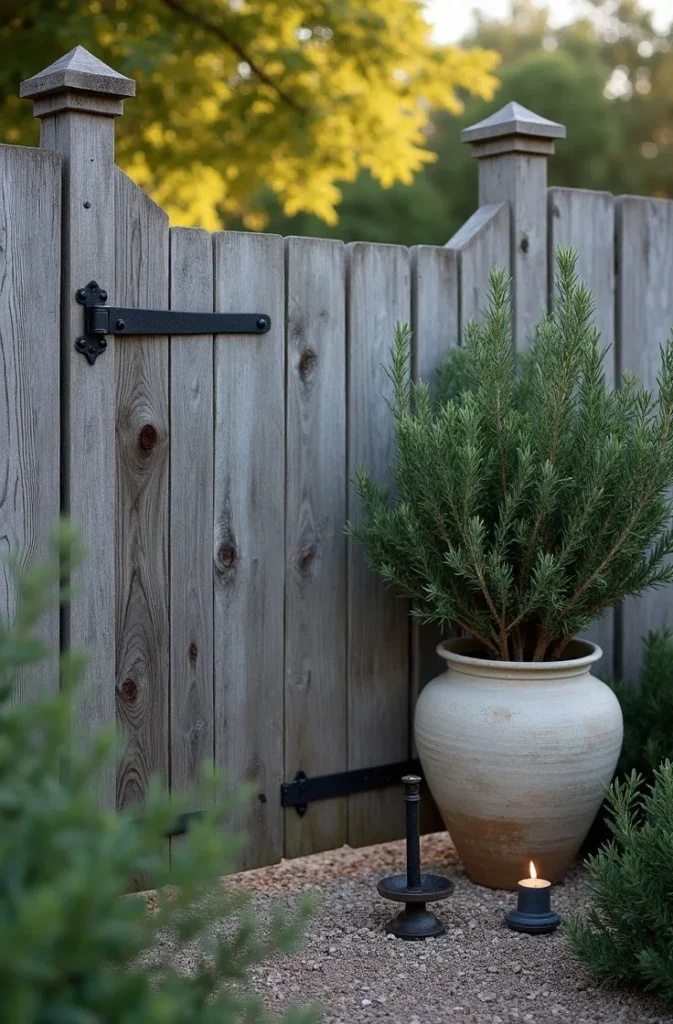
Used thoughtfully, reclaimed wood creates a garden fence that looks as if the garden has been there for decades — the single most desirable quality in a new landscape. It also integrates effortlessly with naturalistic planting styles: native meadow gardens, cottage gardens, kitchen herb gardens, and orchard-style yards all look more rooted and intentional when bordered by reclaimed material.
The mistake is mixing reclaimed wood with bright, new, clean hardware — shiny stainless fasteners, brand-new black powder-coated post caps, fresh gravel at the base. The contrast is jarring. Age the hardware intentionally: use blackened screws, antique-finish post caps, and aged mortar or packed earth at the base rather than new gravel.
The Fence-as-Backdrop Approach — How to Style a Plain Wood Fence Into the Best Feature in Your Garden
A plain wood fence — the standard six-foot cedar stockade that comes with most American suburban homes — is not a design failure. It is a blank canvas that most homeowners completely underuse. The fence-as-backdrop approach treats the existing fence structure as the most significant vertical surface in the garden and styles it deliberately with mounted planters, artwork, lighting, and trained plants in the same way you would treat a large empty wall inside your home.
The first decision is the planter arrangement. A series of wall-mounted planter boxes — three to five, hung at staggered heights along the fence — filled with trailing and upright plants creates immediate vertical density without permanent structural change. This is especially valuable for renters or homeowners who want to enhance an existing fence without replacing it. The planter boxes can come down without trace; the design effect while they are up is significant.
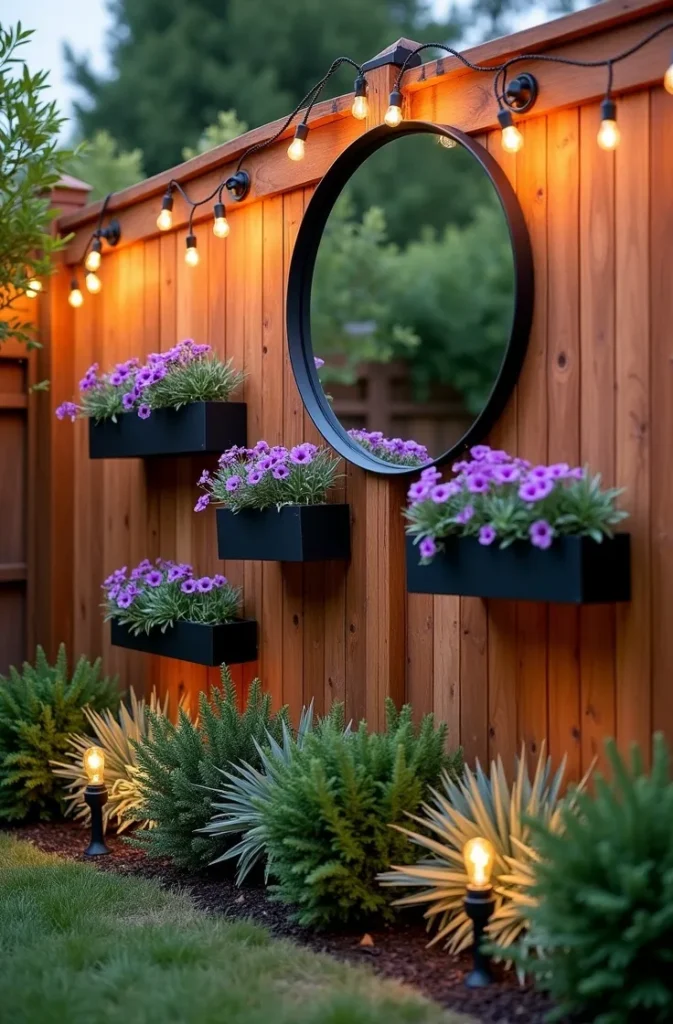
The lighting layer is where the fence-as-backdrop becomes genuinely magical for evening use. A series of outdoor wall sconces or solar spike lights placed at the base of the fence and angled upward create a wash-lighting effect on the wood surface that turns the plain fence into a glowing amber backdrop for evening entertaining or quiet outdoor dining.
The mistake is trying to cover the entire fence with objects and plants until the fence itself disappears. The fence-as-backdrop only works when the fence surface remains visible as a material. You are curating what is in front of and on the fence, not hiding it.
The Cedar and Copper Detail Fence That Ages Into Something Even Better Than It Starts
The combination of cedar fence boards with copper hardware details — cap rail inserts, post top finials, or decorative strap elements — is one of the longest-term garden wood fence ideas available, because both materials are specifically selected to improve visually with age. Cedar silvers beautifully over five to ten years without treatment. Copper oxidizes from bright penny-tone through warm brown to verdigris green over the same time period. A fence built with both materials is a ten-year design investment that delivers increasing returns.
The copper elements do not need to be structural. A copper post finial, a copper cap rail strip along the fence top, or a single copper name plate at the gate are enough to introduce the material and begin the oxidation clock. The patina that develops on copper is contextually appropriate alongside aged cedar in a way that almost no other metal achieves — it is warm, organic, and completely at home in a garden setting.
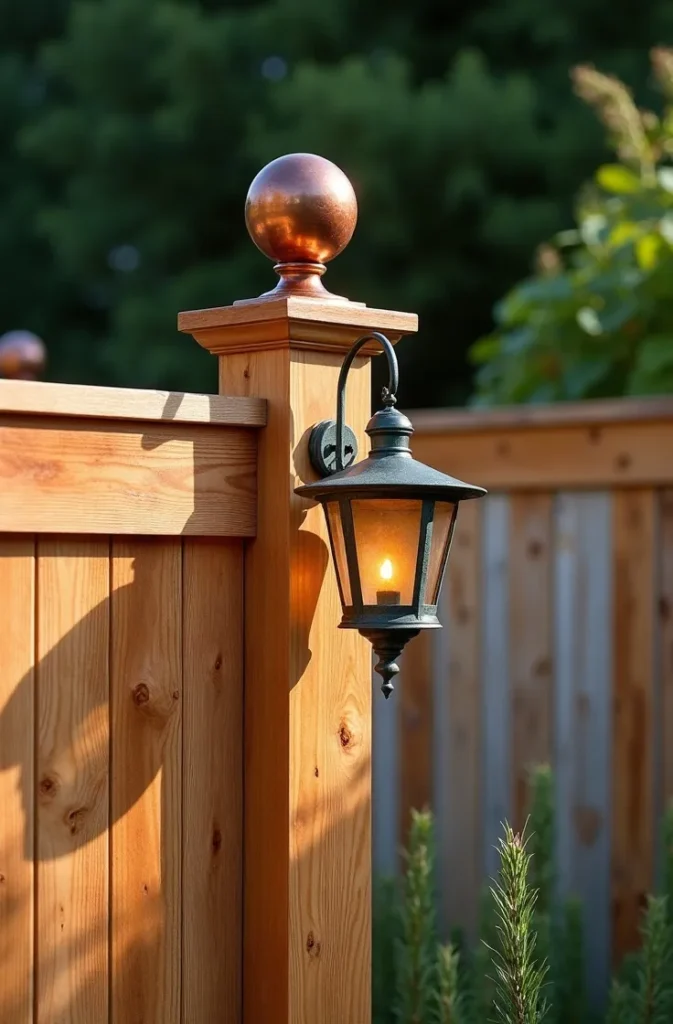
This fence suits heritage-style homes: craftsman bungalows in Seattle or Portland, Victorian-era properties in the Midwest, colonial revival homes along the East Coast. The copper-and-cedar combination speaks to a material tradition that these architectural styles already live in, and it reads as period-appropriate rather than retrofitted.
The mistake is sealing the copper to prevent patina. The whole point is the patina. A polished, bright copper accent on an aged cedar fence looks out of time. Let everything age together and the fence becomes, genuinely, more beautiful at year eight than it was at installation.
The Geometric Pattern Cut Fence That Functions as Outdoor Wall Art
CNC-cut or hand-routed geometric pattern fence panels — where the solid wood face is cut with a repeating geometric motif (hexagon, diamond, overlapping circle, or abstract botanical) — represent one of the most design-forward garden wood fence ideas currently being installed in residential landscapes. The panels function simultaneously as privacy screens, decorative features, and light diffusers: the cut pattern casts graphic shadows onto surfaces behind and below the fence that change as the sun moves through the day.
The material choice is critical for this application. The panel must be thick enough to have structural integrity after the pattern cuts are made, which means using cedar or hardwood panels at a minimum of one inch thick, and ensuring that the pattern maintains enough solid material between cuts to remain strong. A pattern that is sixty percent cut-out will not survive wind load; forty percent cut-out is the practical maximum for most residential applications.
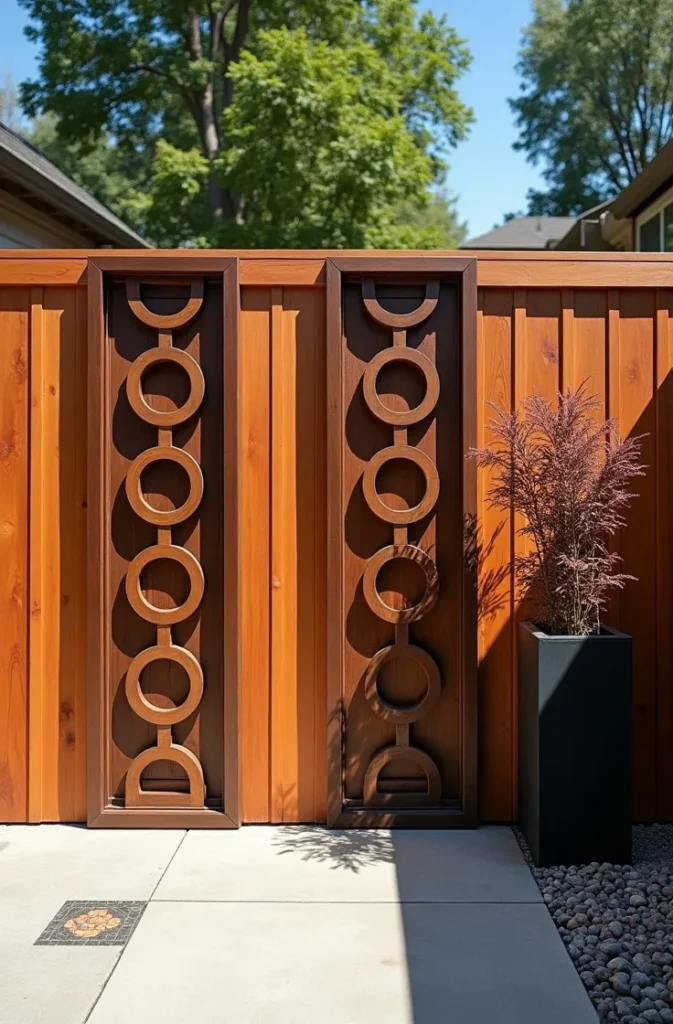
These panels work best as accent sections rather than the entire fence run. Two or three decorative panels set between standard solid fence sections — perhaps at the focal point of the garden, flanking a gate, or at the far end of a sightline — create moments of visual punctuation without requiring the expense of cutting an entire fence run.
The shadow play is the real event. On a bright afternoon, a geometric cut-panel fence can cast a pattern onto a concrete patio, a garden wall, or a gravel path that functions exactly like projected light art. Position the panel with this effect in mind rather than as an afterthought.
The Wrapped-Post Pergola Fence Hybrid That Makes a Small Garden Feel Architecturally Complete
The pergola-fence hybrid — where fence posts are extended well above the fence height and connected across the top with horizontal beams, creating a covered or partially covered outdoor room structure — is the single most architectural of all the garden wood fence ideas in this post. It is also the one with the highest return on investment in terms of how it changes the quality of time spent in the outdoor space.
The structural logic is straightforward: instead of capping fence posts at six or seven feet, you extend them to nine or ten feet and run horizontal crossbeams between them. You can run the beams at right angles to create a pergola ceiling, or run a single beam along the top of the fence run to create a linear shade structure. Both convert a flat fence line into a three-dimensional outdoor architecture element.
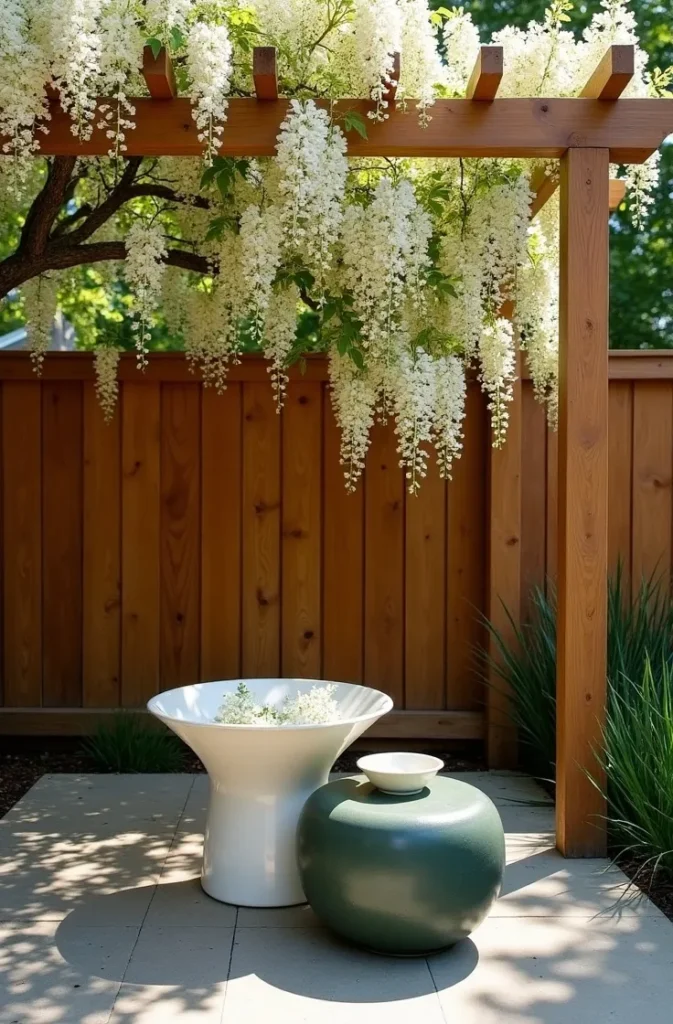
What this does to the garden emotionally is significant. An outdoor room with architectural overhead structure feels habitable in a way that an open yard does not — the structure creates a sense of enclosure, shelter, and intention that is, for most people, the difference between furniture parked outside and an actual outdoor living room. This is the design decision that gets houses sold in markets where outdoor living is valued: Northern California, Austin, the Pacific Northwest, coastal New England.
The planting that activates the pergola-fence structure is the overhead climber. A wisteria, a climbing rose, a grape vine, or a passionflower trained up the posts and across the top beam turns the structure from architecture into garden. Give it two full growing seasons and the beams will be draped in foliage and bloom; by year three, the structure will feel as if it has always been there.
The mistake is building this structure without proper post footings. Fence posts extended to nine or ten feet create significant wind load and must be set in concrete footings at least thirty inches deep in most climates. A pergola-fence built on four-inch surface-mount post brackets will not survive the first major storm.
You now have a real design direction for your garden boundary — not a mood board full of fences you admired but could not build, but a specific understanding of what each style does, why it works, and where it belongs. Save this post and come back to it when you are standing in your yard with a measuring tape, because that is when these ideas stop being inspiration and start being a plan. The right wood fence does not just close in a yard — it defines a garden. That distinction is everything.