Pulling off maximalist living room ideas for a bold, luxurious home requires more than stacking up patterns and objects — it requires a structured approach to layering, color, and scale that prevents the room from tipping into chaos. This guide gives you 18 distinct, decision-ready maximalist concepts, each with practical guidance on how to execute the look in a real living room, what materials and proportions to use, and what mistakes to avoid before you commit.
1. Layer Three Distinct Patterns in One Room Without It Looking Cluttered
Pattern mixing is the foundation of maximalist design, but most people either go too timid — one pattern feels minimal, not maximalist — or too random, which produces visual noise rather than richness. The rule that works consistently is to mix patterns at three different scales: one large-scale pattern, one medium-scale pattern, and one small-scale repeat.
A large geometric or botanical wallpaper anchors the room at the largest scale. A medium-scale upholstery pattern — a classic stripe, a damask, or a jacquard weave on the sofa — carries the eye across the seating area. A small-scale pattern in throw pillows or a woven rug provides detail that rewards close inspection without competing with the larger elements.
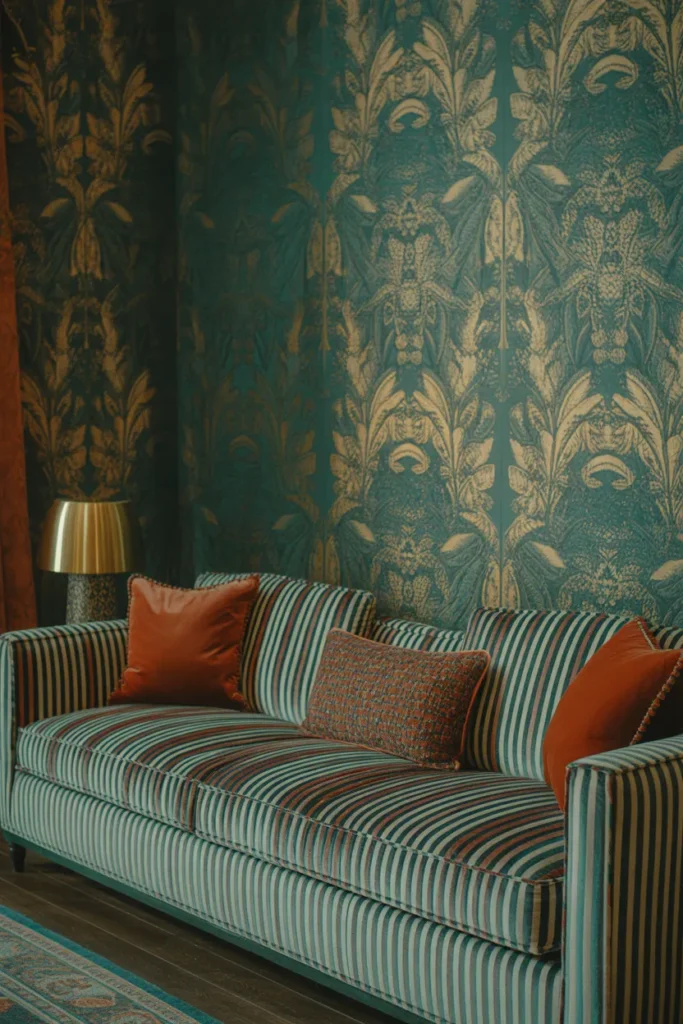
The key to making this work is holding the color palette consistent across all three patterns. Pull one to two colors from each pattern and ensure they all share at least one common tone. Three perfectly coordinated patterns in a cohesive palette read as designed and deliberate. Three patterns in three unrelated palettes read as accidental.
Avoid using patterns of the same scale in the same visual zone. Two large-scale patterns on adjacent walls will compete directly and cancel each other out. Give each pattern its own territory within the room.
2. Use Floor-to-Ceiling Jewel-Tone Walls to Create Immersive, Cocoon-Like Luxury
In maximalist design, painting only the lower half of a wall or choosing a single accent wall is a missed opportunity. Painting all four walls — and ideally the ceiling — in a deep jewel tone creates a fully immersive environment that feels genuinely luxurious rather than decoratively cautious. Colors that perform best in this application are deep sapphire blue, forest green, plum, burnt amber, and rich burgundy.
The reason this works in a living room is that the color wraps around all the light in the room, including reflected light from lamps and natural daylight, creating a warm glow effect that no single accent wall can produce. When the ceiling matches the walls, the room loses its hard edges and feels more like a curated interior environment than a painted box.
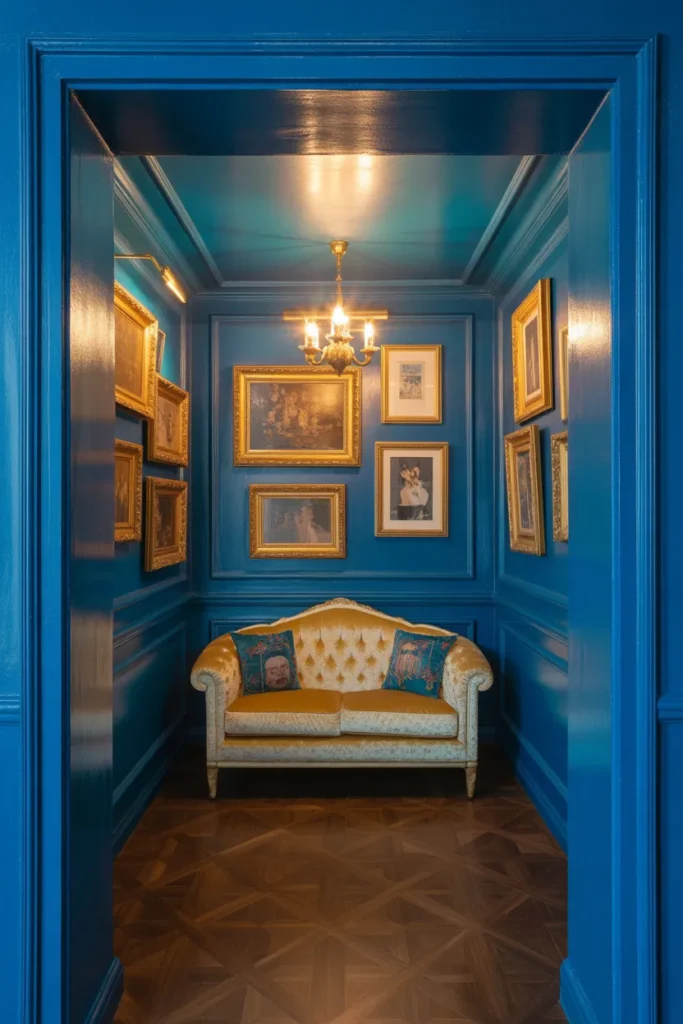
This approach suits formal living rooms, townhouse sitting rooms, apartments with high ceilings, and any space where creating a strong mood is the priority over maximizing perceived square footage. It is not ideal for very small rooms with low ceilings where a full-envelope dark color will feel compressive rather than cocooning.
Finish the walls in a satin or eggshell sheen rather than flat. Flat paint absorbs light in dark rooms and can make the walls look dusty or chalky. A subtle sheen allows the color to interact with lamp and natural light, producing the rich depth that makes jewel-tone rooms so visually compelling.
3. Build a Salon-Style Gallery Wall That Functions as the Room’s Main Design Statement
A salon-style gallery wall — frames of varying sizes arranged edge-to-edge across an entire wall surface in a dense, layered composition — is one of the most authentically maximalist design moves available in a living room. Unlike a curated grid of matching frames, a salon wall uses mixed frame sizes, mixed frame finishes, and mixed content to create a wall that tells a visual story.
The starting point for a successful salon wall is the largest piece. Place it first, roughly at eye level and slightly left or right of center — not perfectly centered, which reads as too formal. Build outward from that anchor piece, working toward the edges of the wall and filling gaps with progressively smaller frames. The goal is density without uniformity.
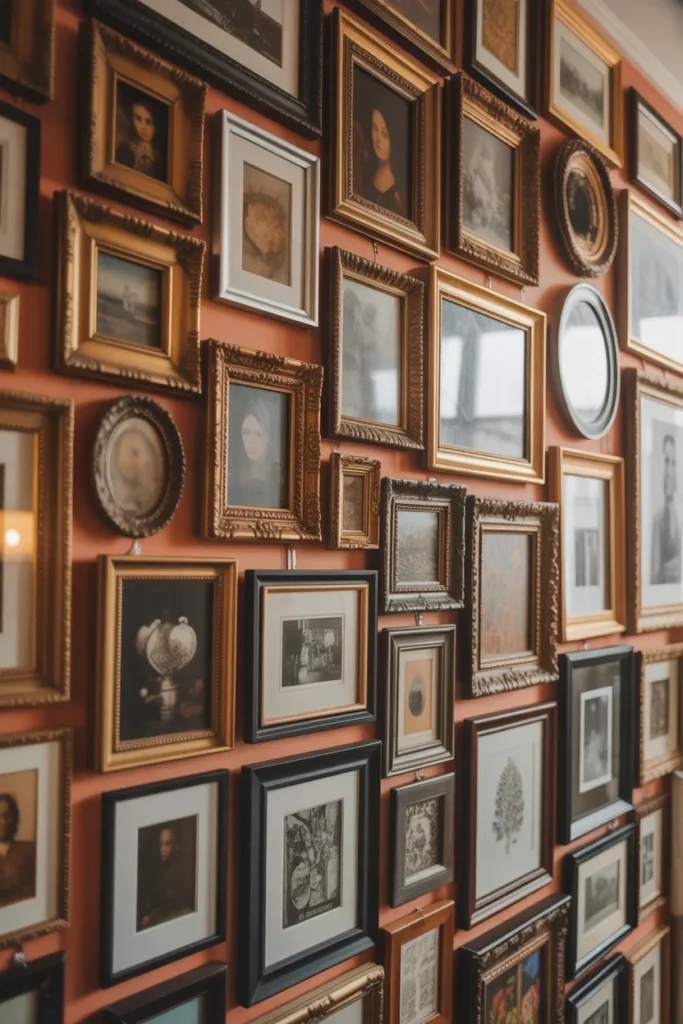
Mix oil painting reproductions, graphic prints, photography, mirrors, small sculptural wall objects, and decorative plates within the same composition. The variety of content is what distinguishes a salon wall from a photo gallery. Gold, black, and antique silver frames work well together because they share a warm or neutral undertone. Mixing all three across one wall creates collected, not matchy, richness.
Do not leave more than two to three inches of wall visible between frames once the composition is complete. The power of a salon wall comes from its density — sparse spacing between pieces undermines the maximalist effect and makes the arrangement look like a gallery wall that ran out of content.
4. Choose a Curved Velvet Sofa in a Deep Color as the Maximalist Room’s Anchor Piece
In any maximalist living room, the sofa functions as the room’s visual and spatial anchor — the piece everything else organizes around. A curved or serpentine sofa in a deep, saturated velvet — forest green, midnight blue, burgundy, or terracotta — carries enough visual weight to hold a maximalist room together while simultaneously becoming its most striking single element.
The curved silhouette is important for two reasons. Practically, it softens the hard angles present in most rooms and creates a sense of flow in a space that may already carry significant visual complexity from layered patterns and objects. Aesthetically, the curve reads as sculptural — it elevates the sofa from furniture to statement.
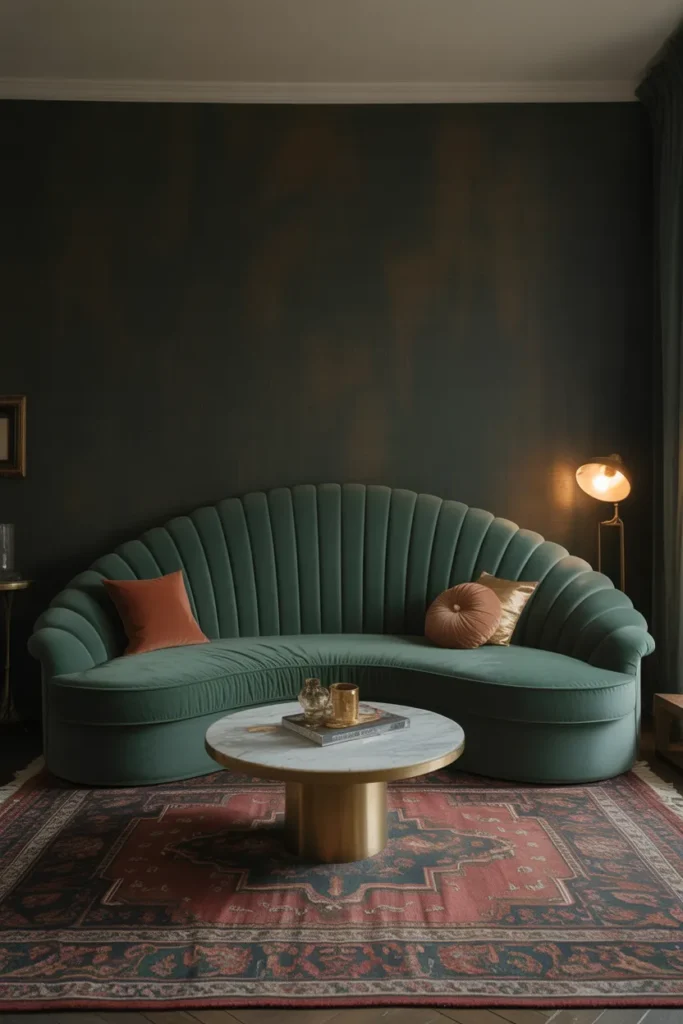
Velvet is the correct upholstery choice for this role because of its light-reactive quality. Velvet changes tone subtly as viewing angle shifts, giving the sofa a depth and richness that flat or textured woven fabrics cannot produce. This quality is particularly effective under warm lamp light, which is the dominant light source in most maximalist interiors.
Size the sofa proportionally to the room. A curved sofa that is too small for the space will float awkwardly in the room rather than anchor it. In a standard living room, a sofa between 90 and 110 inches works. Pair with a large round coffee table or an upholstered ottoman to reinforce the soft, curved vocabulary.
5. Install Dramatic Ceiling Treatments — Wallpaper, Paint, or Plasterwork — to Activate Unused Space
The ceiling is the single most underused surface in American living rooms, and in maximalist design it is one of the highest-impact opportunities available. A maximalist ceiling treatment — whether bold wallpaper, a contrasting paint color, applied plaster molding, or a painted mural — activates the full volume of the room and signals that the design was considered in three dimensions, not just on the walls and floor.
A wallpapered ceiling using the same paper as a feature wall creates a fully wrapped effect that is particularly striking in rooms with architectural detail like crown molding. The molding acts as a natural frame between the wall and ceiling paper. A ceiling painted two to three shades darker than the walls creates depth and visual compression that feels deliberate and intimate rather than mistaken.
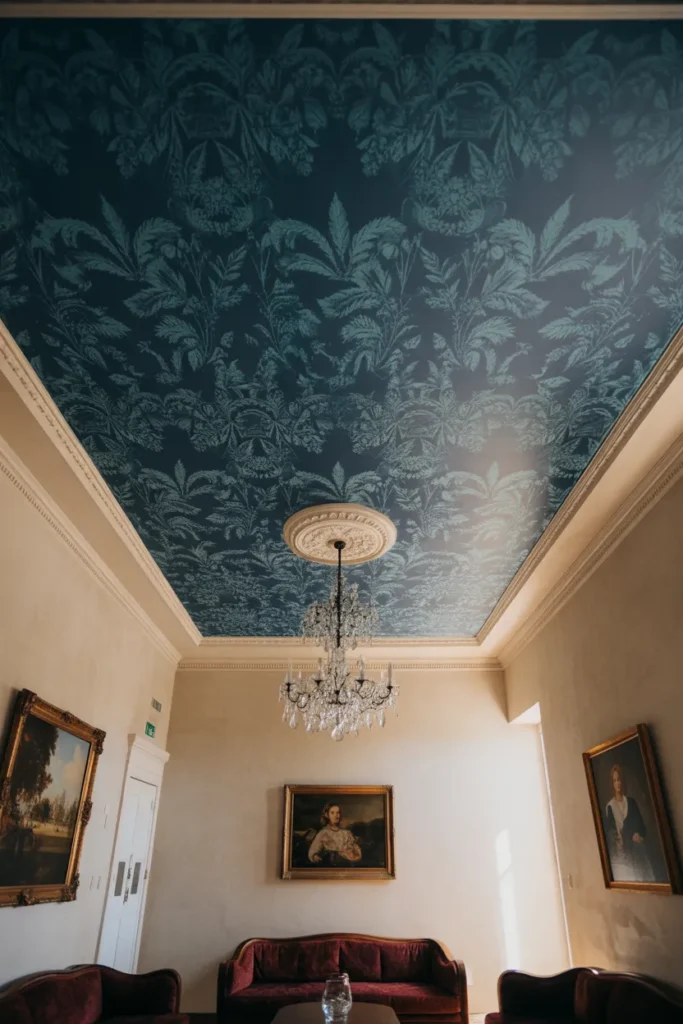
Applied plaster rosettes, ceiling medallions around a light fixture, or a simple painted geometric design are all effective in rooms where wallpaper installation is not practical. Any of these treatments signals craftsmanship and attention to detail that elevates the room’s perceived quality significantly.
This treatment works in rooms with ceiling heights of eight feet or above. In rooms shorter than eight feet, a dramatically treated ceiling can feel oppressive. In those spaces, a lighter or more subtle ceiling treatment — a pale metallic paint, a soft pattern — delivers some maximalist intent without compressing the room vertically.
6. Layer Five or More Textiles in One Seating Area for Tactile Maximalist Richness
Textile layering — stacking multiple fabric types, weights, and textures within a single seating area — is what separates a visually maximalist room from one that is also sensorially rich. A truly maximalist living room should feel as complex to touch as it looks to the eye. Achieving this requires deliberate variety across five or more distinct textile types in the same zone.
A practical layering sequence for a single seating area starts with a foundational rug in a woven or hand-knotted material. Layer a smaller accent rug on top at an angle. Add a velvet or bouclé sofa as the primary textile surface. Introduce linen or silk cushion covers in mixed patterns. Drape a fringed wool throw across one armrest. Hang velvet or heavy linen curtains in a contrasting tone on the adjacent window wall.
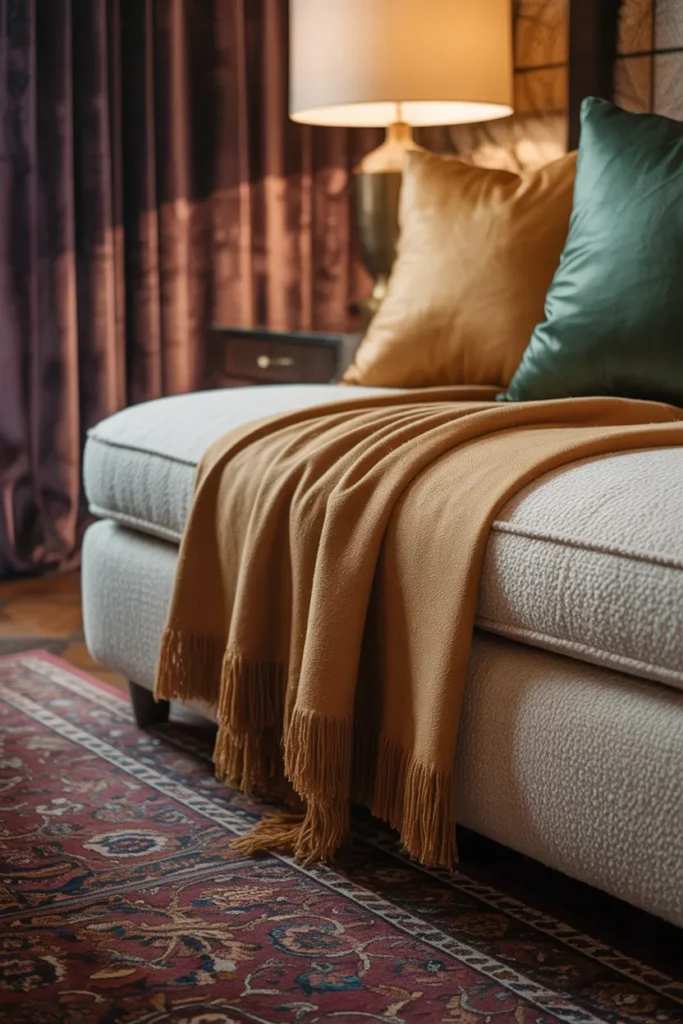
Each textile should differ from its neighbors in at least two of three qualities: material, texture, and weight. Velvet next to linen next to fringed wool creates contrast in all three dimensions. Velvet next to velvet next to velvet creates density but not complexity, which is a common maximalist mistake.
The color palette across all five to six textiles should remain within a cohesive range — three to four colors maximum, with one dominant and the others supporting. Textile layering in too many colors becomes chaotic. In a controlled palette, the same layering becomes sumptuous and collected.
7. Mix Antique and Contemporary Furniture in the Same Room to Create Collected Luxury
One of the defining qualities of genuinely luxurious maximalist interiors — as opposed to simply busy or cluttered ones — is the presence of furniture from multiple eras living together convincingly. A room furnished entirely from one era, even a beautiful one, reads as a showroom. A room where a Georgian wing chair sits beside a contemporary lacquered side table and an Art Deco mirror reads as a home with history and taste.
The practical approach to mixing eras is to maintain consistency in finish tone rather than in style. Furniture in warm wood tones — walnut, mahogany, amber oak — from different periods share a common visual language even when their silhouettes are completely different. A 1920s mahogany secretary desk and a 1970s walnut credenza and a contemporary oak coffee table can share a room without conflict because their finish tones are in conversation.
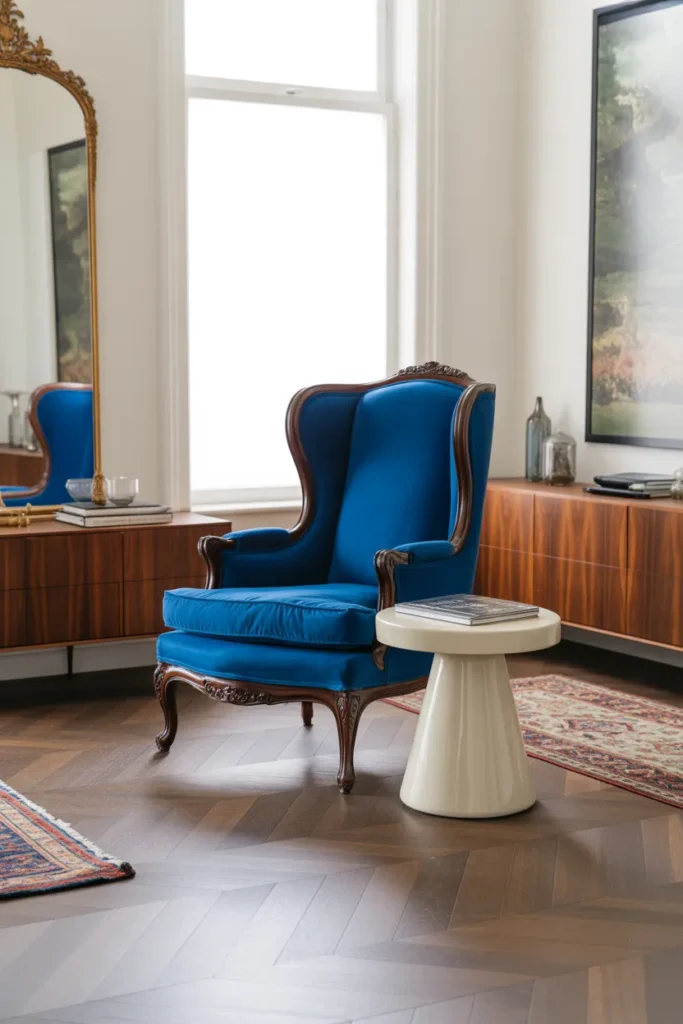
Upholstery is the variable that allows the most creative freedom in era mixing. Reupholstering an antique armchair in a contemporary fabric — a bold geometric, a vivid solid, a punchy plaid — updates its period without erasing its silhouette. This single intervention pulls an antique piece firmly into the present without the awkwardness of a completely period-accurate arrangement.
Avoid buying antiques and contemporary pieces at equal visual weight throughout the room. Choose one era as the dominant voice and the other as the counterpoint. Two or three strong antique pieces among contemporary furniture, or two or three striking contemporary pieces in an otherwise antique room, creates a clear design hierarchy.
8. Use Maximalist Wallpaper on Every Wall Including Behind Shelving for Full Commitment
Half-committed wallpaper — one feature wall in an otherwise plain room — is one of the most common design compromises that produces neither the freshness of minimalism nor the richness of maximalism. In a maximalist living room, wallpaper should cover every wall, including behind bookshelves and built-in cabinetry, to create the sense of a fully inhabited, fully considered interior.
Papering behind open shelving is one of the most effective maximalist moves available because it creates a rich, patterned backdrop that makes every object displayed on the shelf read as more curated and more intentional. Books, vases, sculptures, and framed photos arranged against a bold botanical or geometric wallpaper look like they belong to a designed composition rather than a random collection.
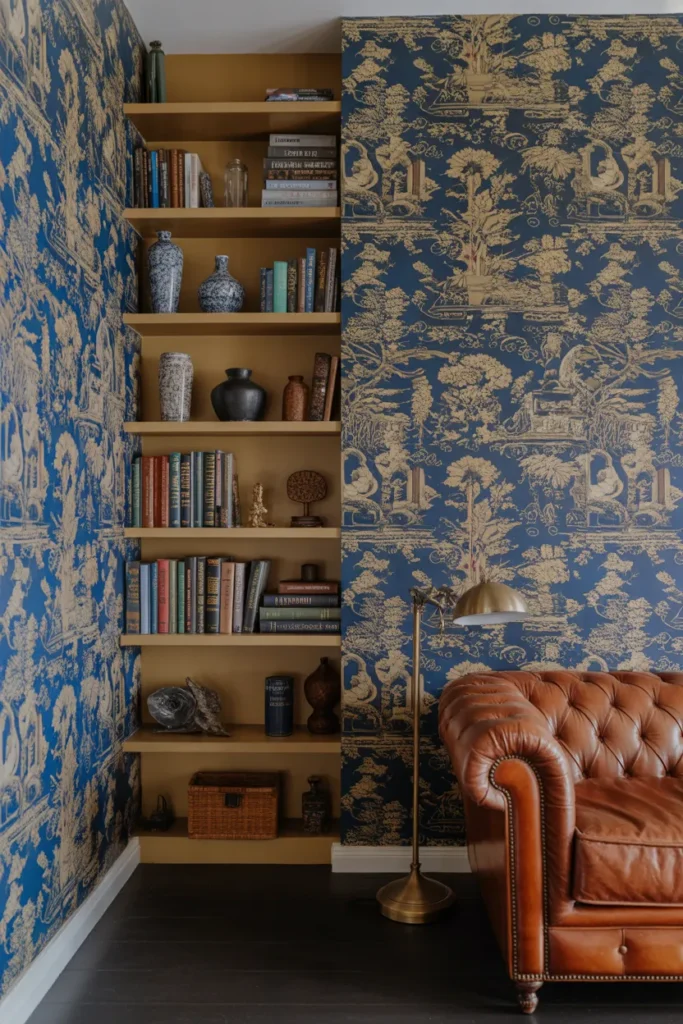
Large-scale botanical patterns, maximalist florals, chinoiserie designs, and painterly abstract wallpapers all perform well in full-room applications. The scale of the pattern should relate to the room size — a very large-scale repeat in a small room can feel disorienting if each wall only shows one repeat. Medium-scale patterns are more forgiving and work across a wider range of room proportions.
When papering behind shelves, paper the wall before installing or returning shelves to their position. Attempting to paper around installed shelving is imprecise and the seams near the shelf edges rarely look clean.
9. Introduce a Statement Chandelier That Is Visibly Oversized for the Room
In maximalist design, the guiding principle for lighting fixtures is that bigger is almost always better — and the most common mistake is choosing a chandelier that disappears into the room rather than commanding it. A statement chandelier sized one to two steps above what conventional guidelines recommend becomes a sculptural ceiling installation as much as a light source.
A chandelier in a maximalist living room should be visible and significant from every seating position in the room. Crystal, smoked glass, mixed metal, and sculptural plaster chandeliers all work well depending on the room’s dominant aesthetic. A crystal chandelier in a jewel-toned room creates a dramatic light-refracting effect. A sculptural plaster or organic-form chandelier in a more eclectic room adds material contrast without the formality of crystal.
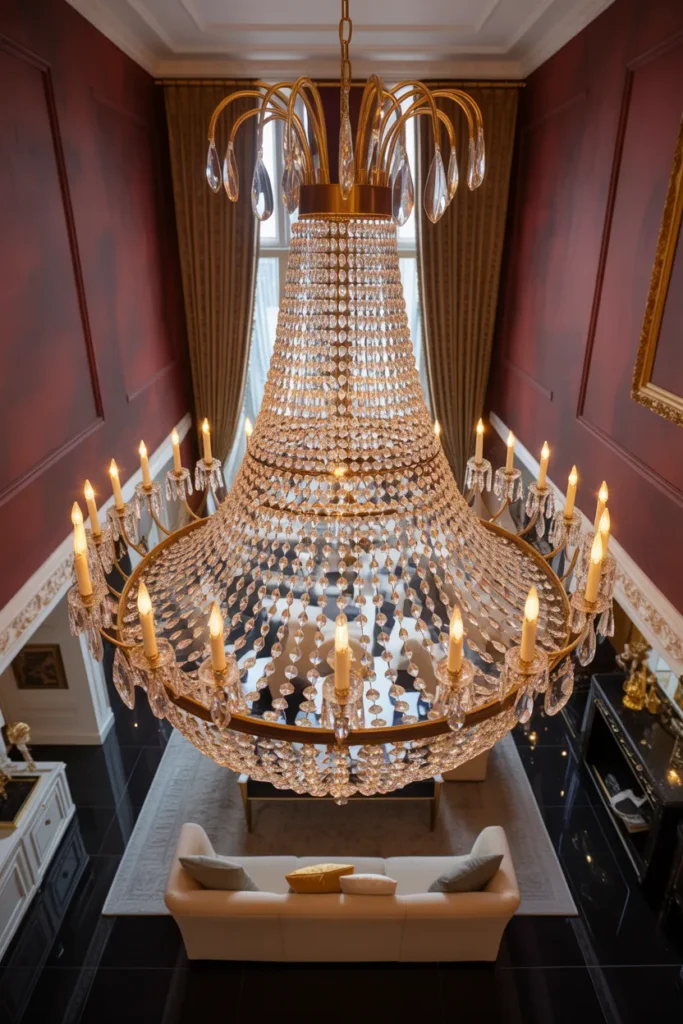
For a standard eight to nine-foot ceiling living room, a chandelier 30 to 36 inches in diameter is the typical recommendation. In a maximalist context, go to 40 to 48 inches. In a room with ten or twelve-foot ceilings, go larger still. The fixture should feel slightly too large — that tension is what makes it a statement rather than a fixture.
Layer the chandelier with additional light sources at lower levels — floor lamps, table lamps, and sconces. A chandelier alone produces flat overhead light that flattens the room’s surfaces and textures. Multiple layered light sources create the warm, complex, multi-directional ambient glow that maximalist interiors require to look their best.
10. Cover the Floor with an Oversized Hand-Knotted Rug That Extends Under All Furniture
The floor covering in a maximalist living room is not background — it is a central design element that needs to be sized, patterned, and positioned with as much intention as any wall or furniture choice. The most common floor mistake in living rooms across all design styles, including maximalist, is using a rug that is too small. In maximalist design, this mistake is amplified because a small rug under a richly furnished room looks particularly out of scale.
A hand-knotted rug — Persian, Moroccan, Indian, or Turkish in origin — brings pattern, history, and craft into the room at the floor level that no mass-produced rug can replicate. The irregular slight variations in a hand-knotted pile, the slight inconsistencies in the dye lots, and the visual complexity of a traditional pattern all contribute to a sense of age and authenticity that maximalist interiors depend on.
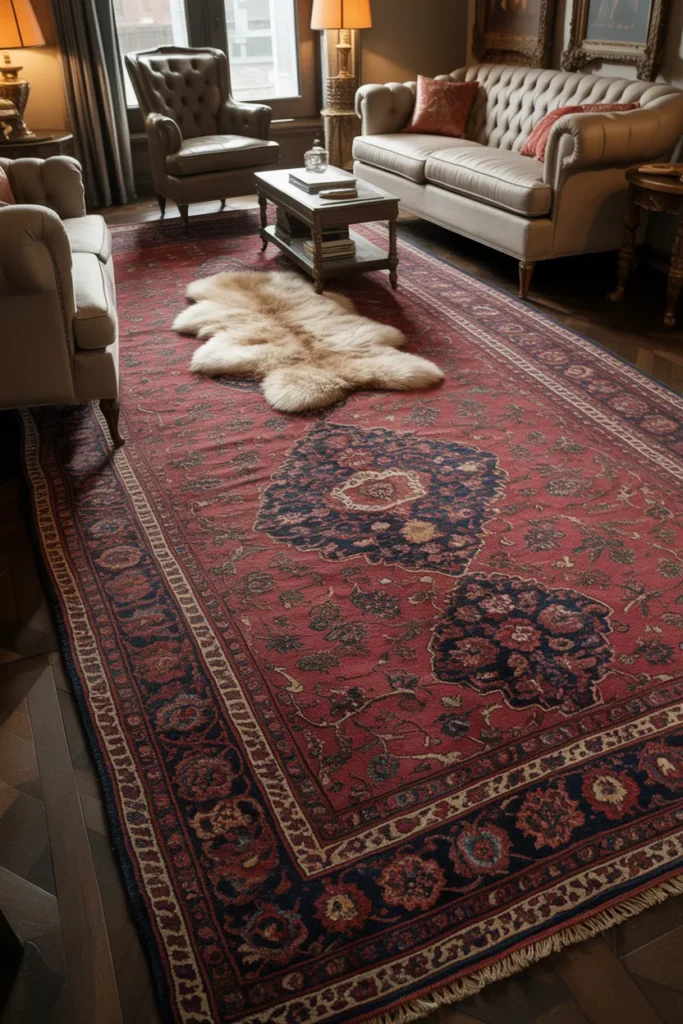
The rug should be large enough that all primary seating furniture — sofa, chairs, ottoman — sits fully on the rug with at least 18 to 24 inches of rug visible beyond the furniture legs on all sides. In a 12×15 foot living room, this typically means an 10×14 foot rug minimum. Most people default to an 8×10 in this room size, which leaves too much bare floor visible at the perimeter.
Layering a smaller accent rug — a sheepskin, a small kilim, or a geometric flatweave — on top of and at an angle to the main rug adds the final layer of textile complexity that distinguishes a fully maximalist floor from a simply well-furnished one.
11. Create a Reading Nook with Floor-to-Ceiling Curtains, a Canopy Effect, and Layered Lighting
A dedicated reading or conversation nook within a larger maximalist living room gives the space a sense of rooms within a room — one of the hallmarks of truly luxurious interior design at any scale. Creating this effect does not require architectural intervention. Floor-to-ceiling curtains hung from ceiling-mounted rods on three sides of a corner, or a decorative canopy frame draped with fabric, define the nook as its own enclosed zone within the open room.
Choose curtain fabric that is heavier and more textural than the main room’s window treatments — velvet, embroidered linen, or jacquard — to reinforce the sense of enclosure and separation. Color can match the main room or contrast deliberately. A nook lined in a different color from the main room creates a jewel-box effect where stepping into the nook feels like entering a second, distinct interior environment.
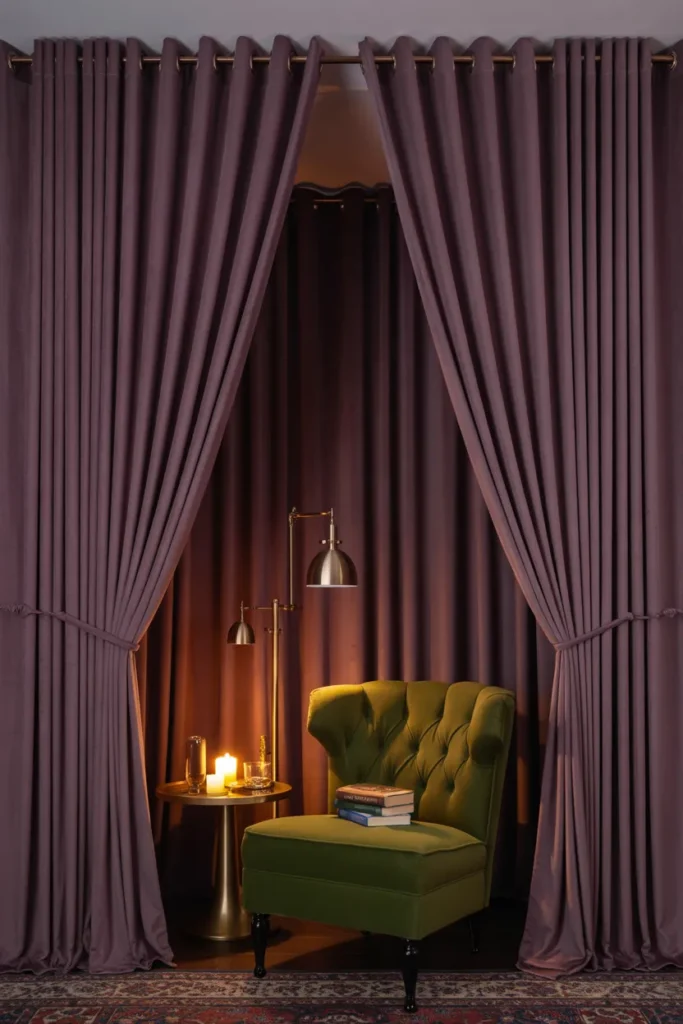
Within the nook, layer a minimum of three light sources: a small chandelier or pendant overhead, a wall-mounted swing-arm reading lamp, and a candle or low-level accent light at floor or table level. The layering of light at different heights creates intimacy and warmth that a single overhead source cannot produce.
Furnish the nook with a single deep armchair or a small loveseat — not a full sofa, which would eliminate the sense of enclosure. A small side table, a stack of books, and a footstool complete the arrangement without overloading the confined space.
12. Use Maximalist Shelving Styled as a Full Wall Display to Showcase a Curated Collection
A full wall of floor-to-ceiling shelving styled as a maximalist display — densely filled with books, art objects, ceramics, sculptural pieces, plants, and framed photographs — is one of the most powerful and practical expressions of maximalist living room design. Unlike gallery walls that present content flat on a surface, a styled shelving wall adds depth, dimension, and the third plane to the room’s visual composition.
The styling principle that separates a maximalist shelf display from a cluttered bookcase is the presence of considered groupings. Arrange objects in clusters of three to five items — varying height, material, and color within each group — with books used both vertically and horizontally to create varied heights and landing surfaces for smaller objects.
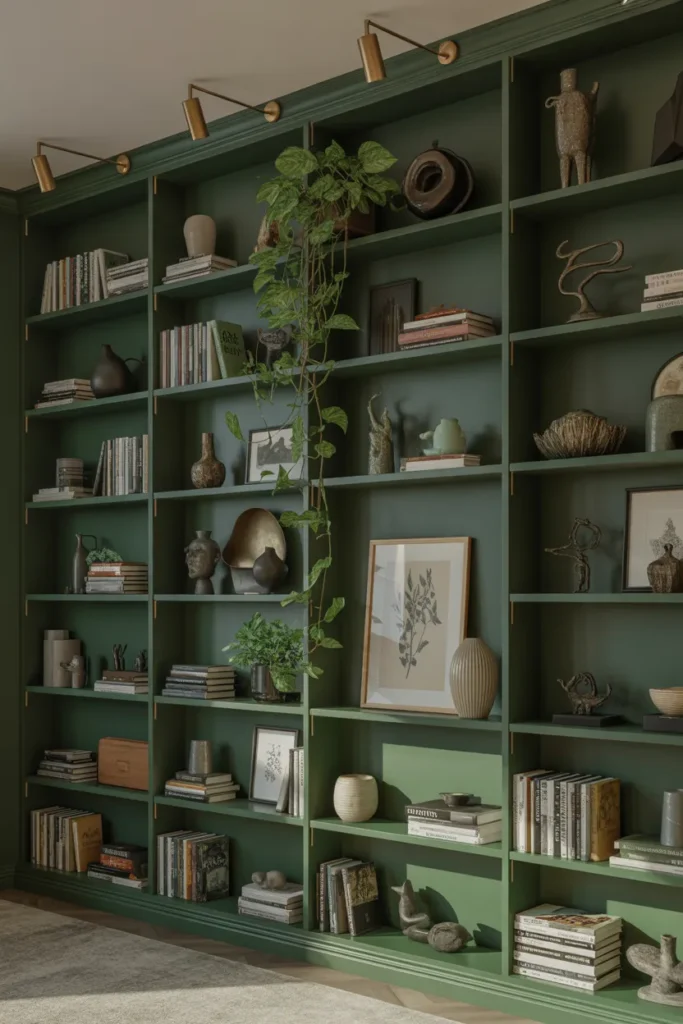
Introduce living elements — trailing pothos, small succulents, or a single dramatic plant at a key point in the arrangement — to add organic movement and color. Plants within a shelf display break the static quality of objects and books and create the sense of an environment that is alive.
The backdrop of the shelving matters as much as the objects. Paint the inside of the shelving unit in a contrasting deep color, or wallpaper the back of each shelf section with a bold pattern. This creates visual depth and makes each object displayed within the shelf read against a rich, considered background rather than a plain white box.
13. Add a Bold, Oversized Abstract Painting as a Single-Wall Maximum Impact Statement
When the approach to maximalist living room ideas for bold, luxurious home interiors does not include a gallery wall or full wallpaper installation, a single oversized abstract painting — genuinely large, taking up 60 to 80 percent of a wall’s width and height — can serve as the room’s primary visual anchor with equal impact. The key word is genuinely large: a 24×36 inch painting on a 10-foot wall is decoration. A 60×72 inch painting on the same wall is architecture.
Abstract art in a maximalist context works because it introduces color, movement, and compositional energy without the representational specificity that might conflict with other strong design choices in the room. A painting that contains the room’s dominant colors — even loosely — ties the art to the space in a way that feels designed rather than hung.
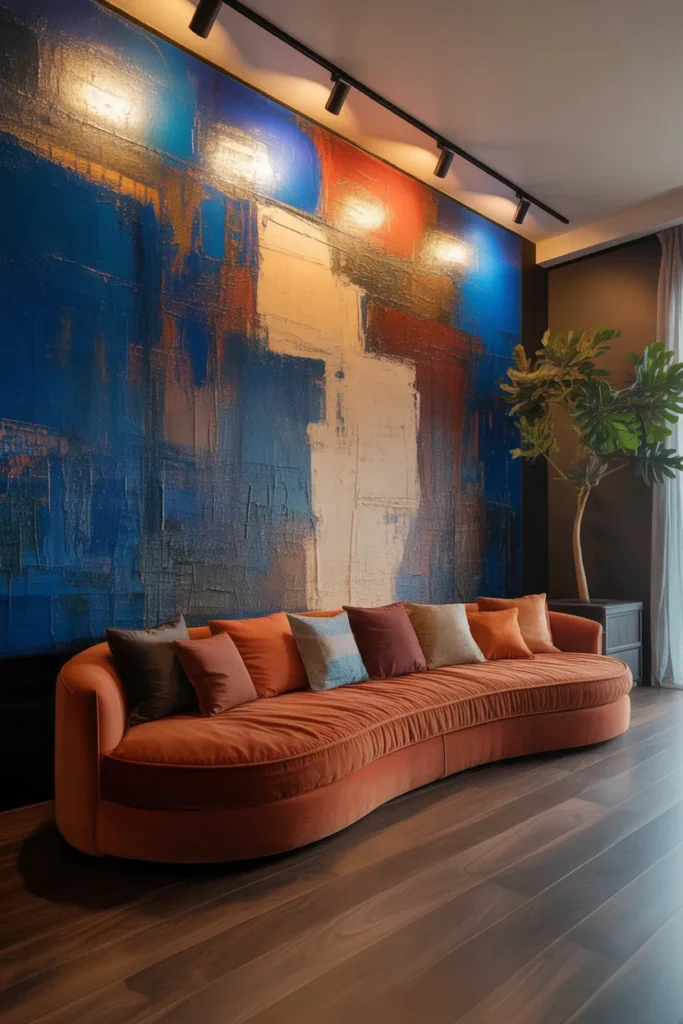
Position the painting so its vertical center sits at approximately eye level — 57 to 60 inches from the floor to the painting’s center is the standard gallery placement that translates well to residential spaces. In rooms with very high ceilings, hanging art at standard height actually grounds the scale better than attempting to fill the full ceiling height with a taller piece.
Light the painting with a dedicated picture light or a pair of adjustable directional track lights aimed at the canvas surface. Unlit art in a dim maximalist room disappears. Properly lit art becomes the focal point it is intended to be regardless of other competing elements in the room.
14. Introduce Maximalist Color Blocking with Three Wall Colors in One Room
Color blocking — dividing a room’s wall surfaces into distinct zones of solid, contrasting color — is an advanced maximalist technique that, when done correctly, makes a room feel designed with architectural intention. The approach requires three colors: a dominant color for the largest wall surface, a secondary color for two side walls, and an accent color reserved for a single architectural element — a chimney breast, an alcove, or the ceiling.
The colors should be related in tone — all warm, all cool, or all drawn from the same color family at different saturations — while being distinct enough that the blocking reads clearly. A deep olive green paired with a warm terracotta and accented with a burnt sienna on the chimney breast creates a warm, earthy composition where each color is independent but all three belong together.
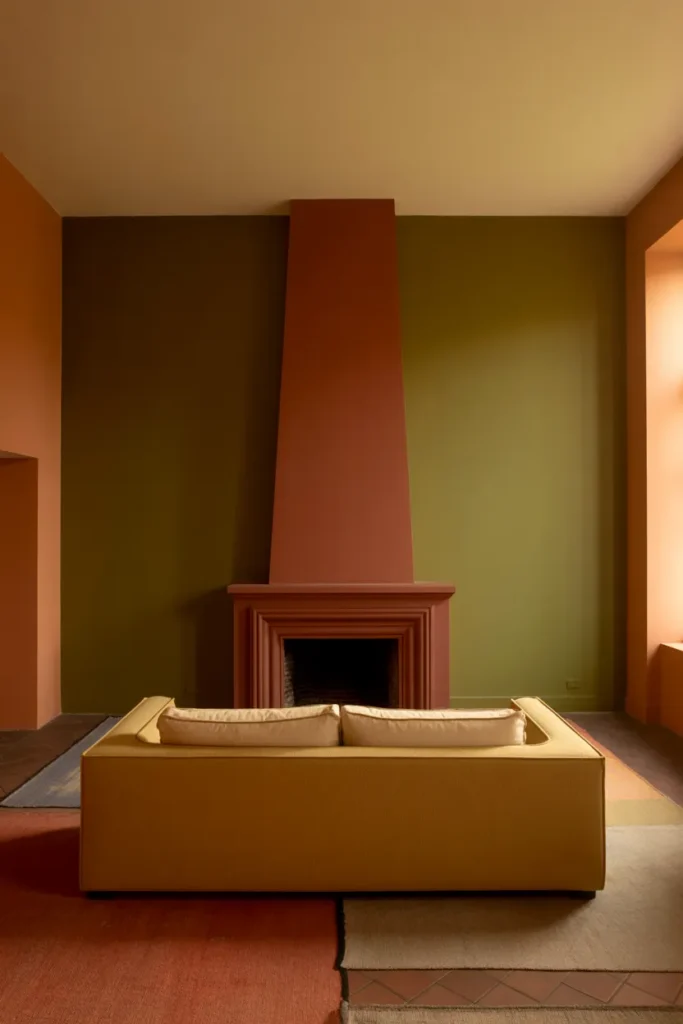
This technique works best in rooms with at least one distinct architectural element — a fireplace, an alcove, a bay window — that provides a natural break point for the accent color. Without an architectural anchor, the third color can feel arbitrarily placed.
Avoid equal distribution of all three colors across the room. Unequal distribution — 60 percent dominant, 30 percent secondary, 10 percent accent — creates a clear hierarchy that feels designed. Equal thirds feel undecided and can make the room appear unsettled.
15. Use Dark Wood Paneling Combined with Rich Fabric to Create a Moody, Club-Like Living Room
Dark wood wall paneling — applied as full-height wainscoting, board and batten, or shiplap in a deep stained finish — combined with rich upholstered furniture and layered lighting creates a club-room atmosphere that represents one of the most enduringly luxurious expressions of maximalist interior design. This look translates well to American homes with formal living rooms, basement lounges, and study-adjacent sitting spaces.
The wood paneling functions as a textural wall treatment that adds architectural depth without the pattern complexity of wallpaper. In a maximalist context, this makes it an effective counterpoint — it carries the visual weight of a bold wall treatment while allowing the room’s other maximalist elements (furniture, textiles, objects) to compete for attention without the wall fighting back.
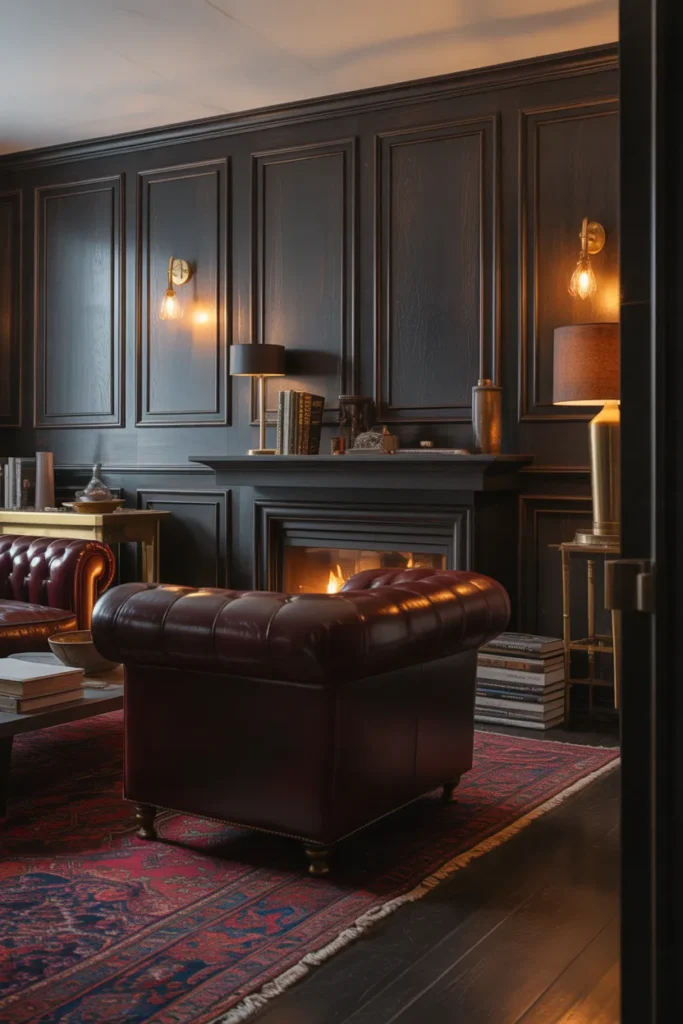
Stain or paint the paneling in a deep tone — espresso, dark walnut, hunter green, or near-black navy — and pair it with upholstered furniture in contrasting rich colors. A burgundy leather Chesterfield sofa against dark walnut paneling, for example, creates the warmth and enclosure of a private library or a high-end hotel bar.
Lighting in a paneled room requires more planning than in a light-walled space because dark surfaces absorb ambient light significantly. Layer wall sconces, table lamps, and picture lights generously — a dark paneled room with only overhead lighting feels dim and heavy, not luxurious.
16. Style a Maximalist Mantle as a Dense, Layered Display with Varying Heights and Depths
A fireplace mantle in a maximalist living room is not a place for three symmetrically placed objects — it is one of the room’s primary display stages and should be treated with the same density and intentionality as a gallery wall or a styled shelving unit. A maximalist mantle display layers objects at three to four different height levels, varies material and finish across every object, and uses the depth of the mantle shelf deliberately.
Start with the tallest objects — a large mirror, a significant artwork, or a grouping of tall candlesticks — at the back of the shelf. Move forward in height with medium objects: vases, framed photos, small sculptures. Bring the smallest objects to the front edge. This three-plane depth arrangement makes the mantle display read as dimensional rather than flat.
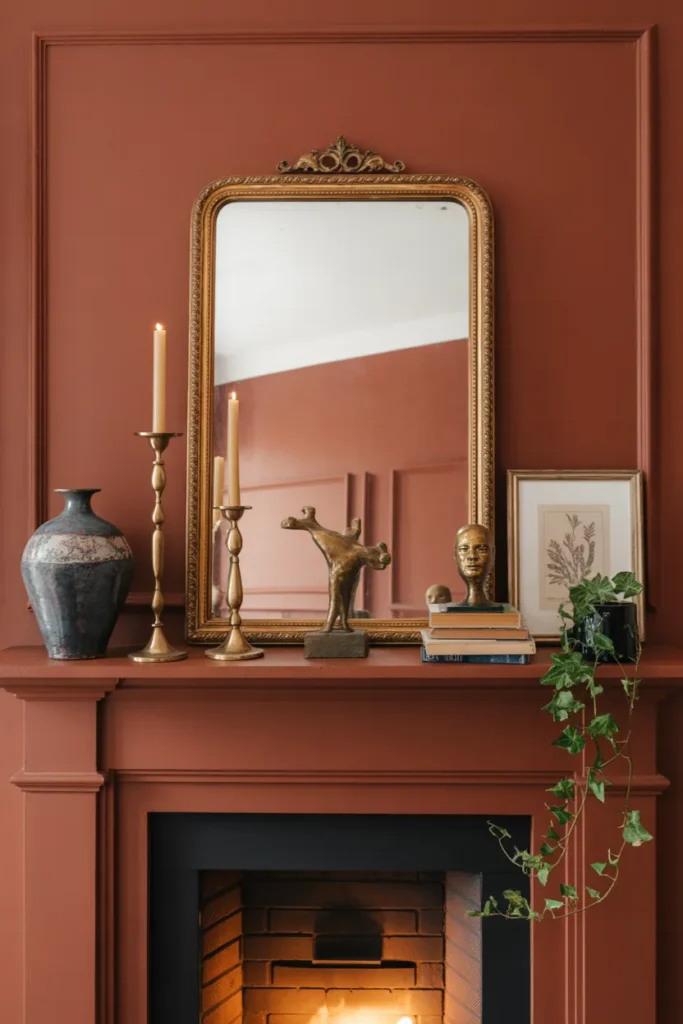
Mix material categories deliberately: something reflective (a mirror or metallic object), something matte (a ceramic or stone sculpture), something organic (a branch, a dried floral arrangement, a plant), and something with sentimental or collected value (a travel object, a vintage find, a piece of inherited decor). The variety of material origin is what creates the sense of a collected, lived-in display.
Avoid strict symmetry across the mantle surface. Perfect mirror symmetry reads as formal and conventional, not maximalist. Asymmetrical arrangements with a clear visual center of gravity — the heaviest visual element slightly off-center — create the dynamic tension that maximalist displays require.
17. Combine Animal Prints with Solid Jewel Tones for a Glamorous Maximalist Living Room
Animal print — leopard, zebra, cheetah, or abstract animal-inspired pattern — is one of the most polarizing choices in interior design and also one of the most effective in a maximalist context when used as a neutral rather than as an accent. The key insight that professional designers use but homeowners rarely apply is that animal print behaves like a neutral: it grounds other colors rather than competing with them.
A leopard-print armchair in a room with forest green walls and a sapphire velvet sofa functions as a visual bridge between the two strong colors, not as a third competing element. The warm caramel and brown tones of a leopard print work with virtually every jewel tone — green, blue, burgundy, plum, emerald — because they share the warm undertone that makes jewel tones rich rather than cold.
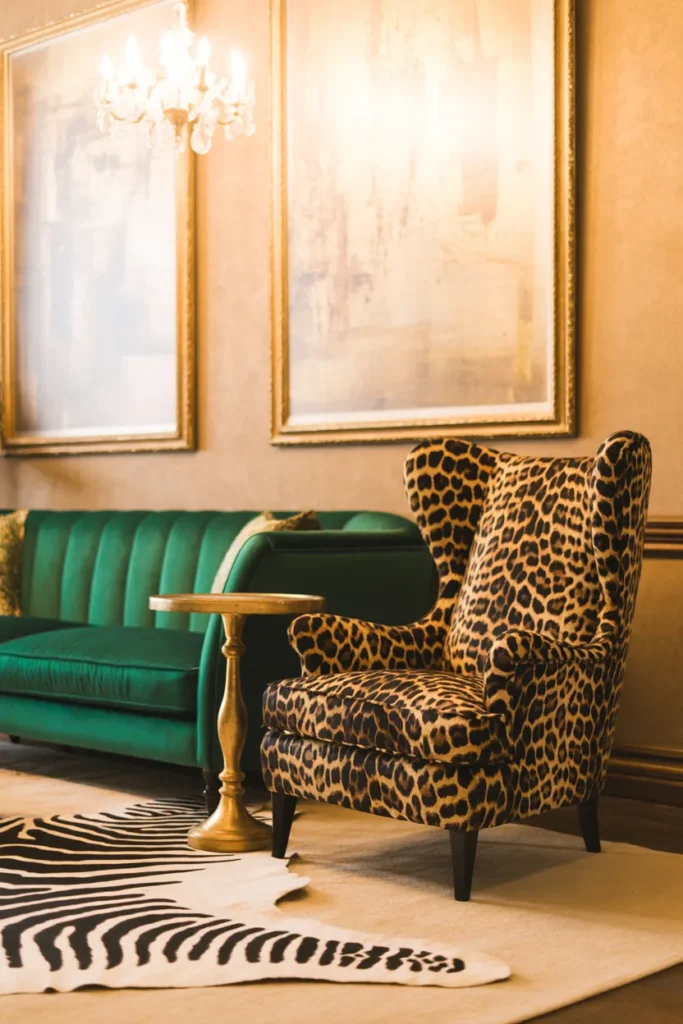
Limit animal print to one or two pieces — an armchair, a pair of accent cushions, a footstool, or a rug border. More than two animal print elements in one seating area tips from glamorous into themed, which is a different and less sophisticated effect.
Pair animal print pieces with smooth, solid upholstery in deep colors — velvet works particularly well — and warm metal finishes in brass or antique gold throughout the room. This combination creates the classic Hollywood Regency-adjacent maximalist glamour that is visually striking and consistently well-received across American interior design aesthetics.
18. Layer Maximalist Decor in a White Room to Prove Maximalism Does Not Require Dark Walls
The most persistent misconception about maximalist living room design is that it requires dark, moody wall colors to work. A fully white or cream-walled living room layered with maximalist furniture, abundant pattern, rich textiles, and dense object styling proves that maximalism is a density and layering approach, not a color approach. And in white-walled rooms, the maximalist elements carry even more visual power because they have no competition from the wall color itself.
In a white-walled maximalist room, the sofa, rug, and curtains need to carry the full visual load that dark walls carry in a jewel-tone scheme. Choose a sofa in a strong, saturated color — cobalt, emerald, or burnt orange — rather than a neutral. Layer the floor with a large-scale patterned rug and a smaller accent rug on top. Install floor-to-ceiling curtains in a bold printed or textured fabric that extends from wall to wall rather than just flanking the window opening.
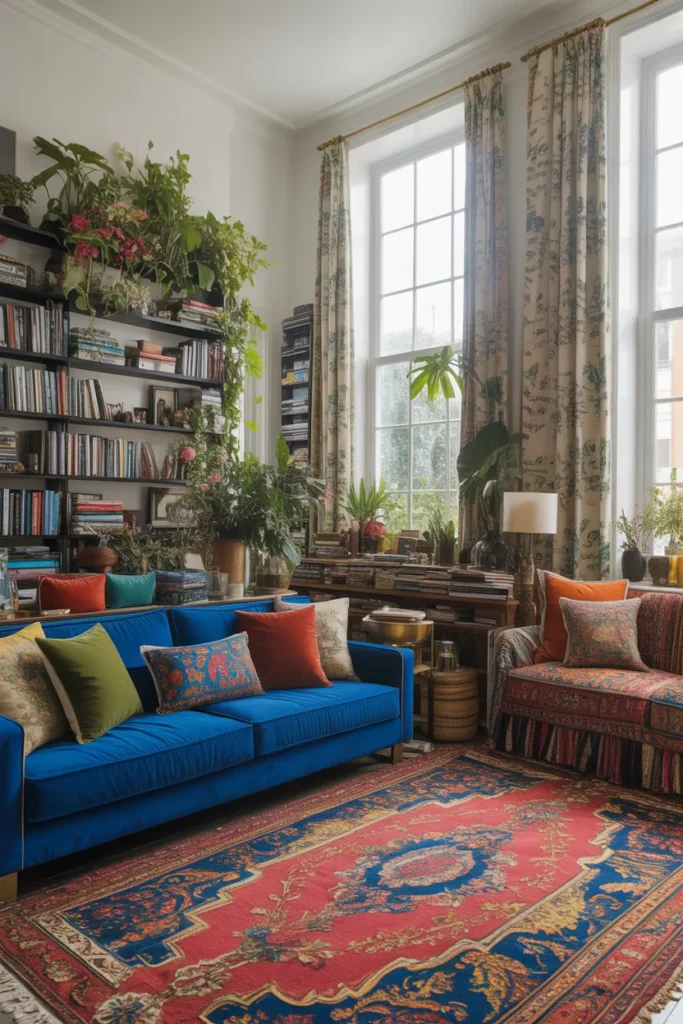
Dense object styling on shelves, tables, and window ledges — plants, ceramics, books, sculptural objects — at every surface level fills the room’s volume with visual content that dark walls would otherwise provide. In white-walled maximalism, every surface must work harder.
This approach is ideal for rental apartments where painting walls is not permitted, rooms that share natural light with adjacent spaces, and homeowners who want maximum richness without committing to a dark room that may eventually feel constraining.
Final Thoughts
Maximalist living room ideas for a bold, luxurious home work best when they are executed with clear intention — every layer, every pattern choice, and every object placement should be deliberate rather than additive. The difference between a room that reads as maximalist luxury and one that reads as clutter is always the underlying structure: a controlled palette, a clear focal point, and a disciplined approach to what earns its place in the room.
Save this guide to your Pinterest boards before you start shopping or planning — having these ideas organized and accessible makes it far easier to identify which combination of elements fits your specific room, your existing furniture, and your design confidence level. There is no single correct version of maximalism, which is precisely what makes it one of the most exciting and personal approaches to living room design available today.