
Most homeowners with compact outdoor spaces assume a pool is off the table — but mini pools for small yards have changed that entirely. This guide covers 16 distinct small pool designs, each with real layout logic, material guidance, and practical advice so you can make a confident decision about what works for your specific yard size, budget category, and lifestyle.
1. The Rectangular Plunge Pool That Fits a 10-Foot Wide Side Yard
A narrow rectangular plunge pool is the most space-efficient pool format available for small urban and suburban yards. Widths as narrow as 6 feet and lengths of 10 to 14 feet can be installed in a side yard corridor that most homeowners treat as dead space.
The layout works because it follows the natural linear geometry of a narrow lot. There is no wasted perimeter — the pool edge aligns with the fence or wall on one side, leaving the remaining yard open for a seating area or planting bed. It reads as a design feature rather than an afterthought.
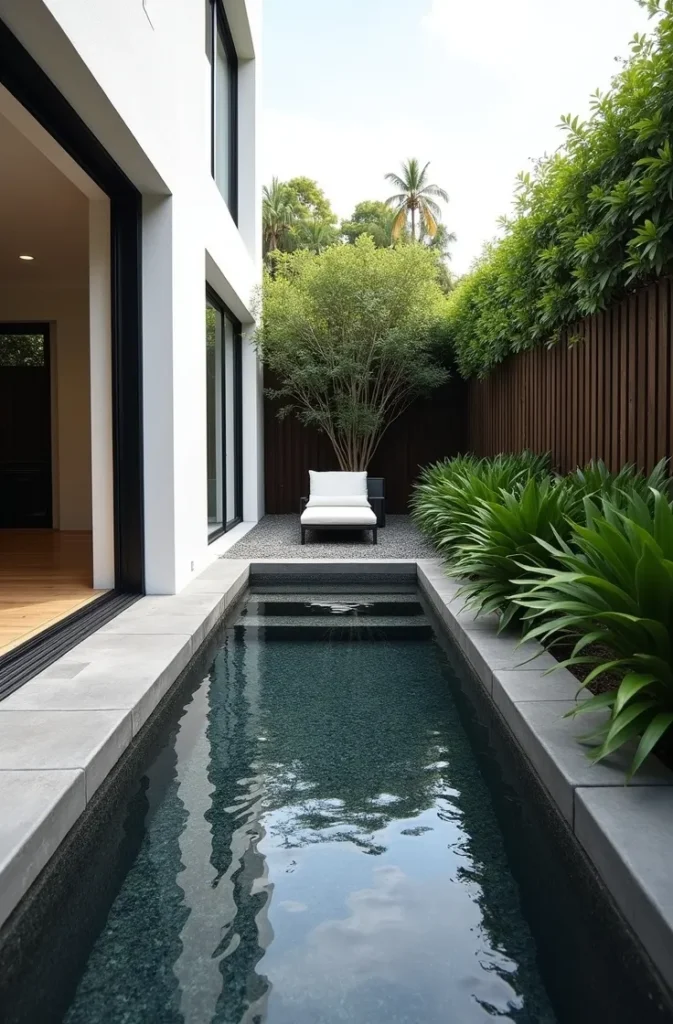

Plunge pools are not lap pools. They are designed for cooling off, hydrotherapy, and small-group relaxation — typically holding 2 to 4 people comfortably. If you expect more than that regularly, this format will feel limiting.
The most common mistake is sizing the surrounding coping too wide. Keep coping and decking to 18 to 24 inches on the open sides to preserve usable yard space.
2. The Sunken Courtyard Pool That Turns a Tiny Patio Into a Resort Feature
A sunken pool sits below the existing grade of the yard — typically 18 to 36 inches below the surrounding patio level. This approach is visually striking and practically smart: it keeps the pool from dominating the eyeline when viewed from inside the home and creates a natural windbreak around the water surface.
The design works particularly well in small enclosed courtyard spaces where the pool would otherwise feel cramped at ground level. Stepping down into the pool area creates a defined zone that feels private and deliberate even in a yard under 400 square feet.
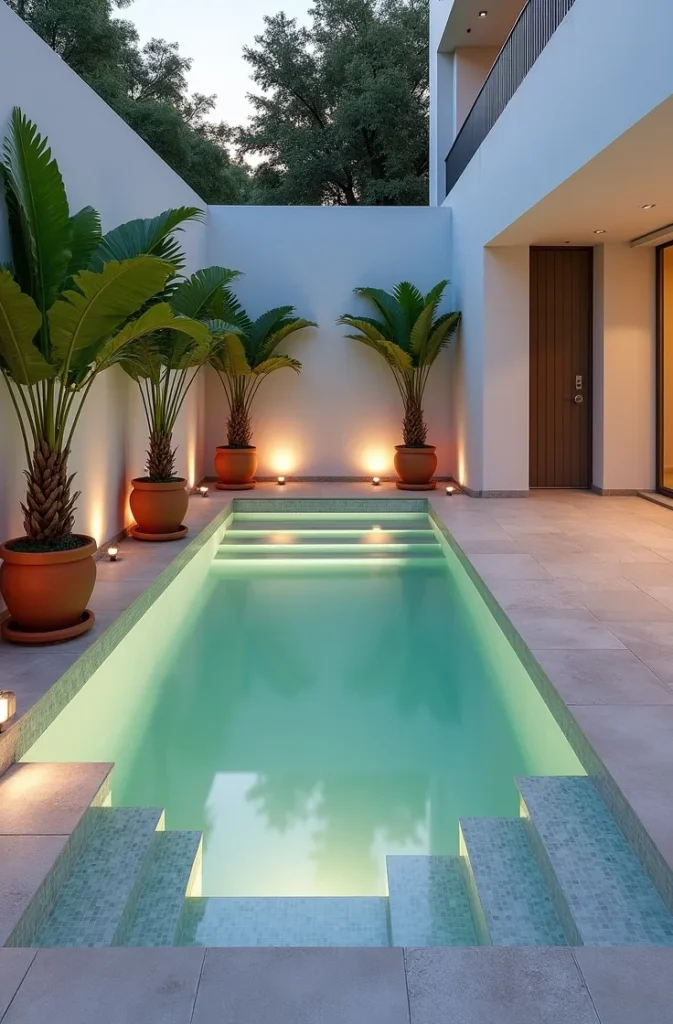
Excavation cost is the primary consideration. Sunken installations require more groundwork than above-grade or semi-inground options. Soil type, drainage requirements, and proximity to existing foundations all affect feasibility and cost. A geotechnical assessment is advisable before committing.
Use this format when your yard has a natural grade change you can work with, or when the yard is fully enclosed and visual privacy at water level is a priority.
3. The Above-Ground Cocktail Pool That Installs in a Weekend Without Excavation
Above-ground cocktail pools — prefabricated units that sit at or just above existing grade — are the fastest and most permit-friendly small pool option for homeowners who want water without a full construction project. Many units arrive ready to fill within days of delivery.
The trade-off versus in-ground pools is visual weight. An above-ground pool has visible walls that need to be addressed with cladding, decking, or landscaping. Timber decking wrapping the pool perimeter is the most common solution — it visually integrates the pool into the yard and creates a built-in entertaining platform.
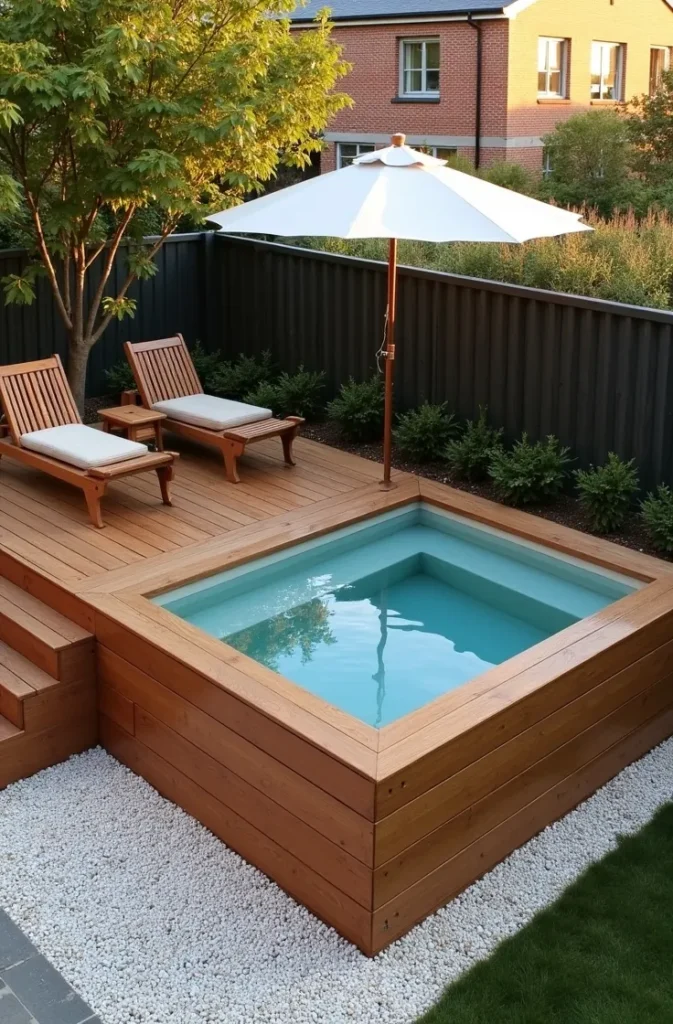
This format is the right choice for renters with owner permission, homeowners in high-water-table areas where excavation is problematic, or anyone who needs a functioning pool within a short planning timeline.
Avoid placing an above-ground pool directly on lawn without leveling preparation. An unlevel pool stresses the walls unevenly and compromises structural integrity over time.
4. The Lap Pool Corridor Design for Narrow Backyards Under 15 Feet Wide
A lap pool in a narrow yard is one of the most functional mini pool for small yards solutions for fitness-focused homeowners. A true lap pool requires a minimum of 40 feet in length, but semi-functional swim lanes can work at 25 feet when paired with a swim jet system that creates resistance current for stationary swimming.
The corridor design runs the pool parallel to the longest fence line, leaving a single-width patio path of 4 to 6 feet on the opposite side. This preserves access to the far end of the yard and keeps the space from feeling completely consumed by water.
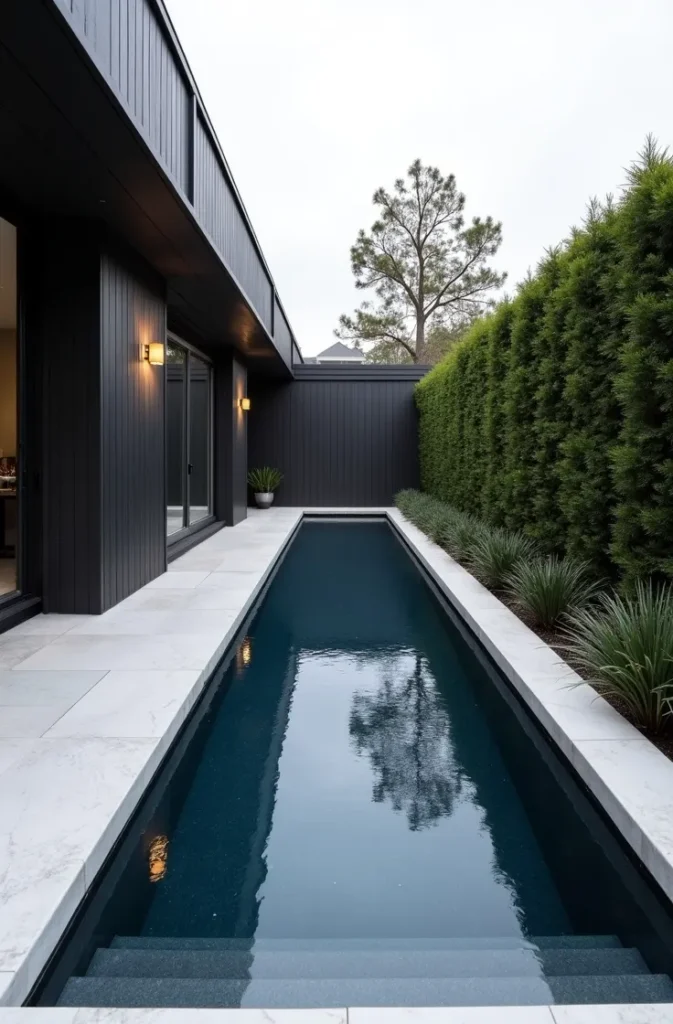
The swim jet component is worth considering carefully. A good jet system means you can use a 20-foot pool the way most people use a 40-foot lap pool. Without it, anything under 30 feet becomes more of a plunge pool in practice.
Do not locate a lap pool corridor perpendicular to the main house view unless the yard is very long — a short pool viewed end-on reads as a rectangular spa, not a pool.
5. The Geometric Splash Pool With a Built-In Bench Seat for Small Family Yards
A splash pool with a built-in perimeter bench seat is the highest-utility small pool design for families with young children. The bench sits 18 to 20 inches below the water surface, creating a shallow seating ledge around the entire perimeter — adults sit comfortably while children play in water that reaches chest-height on a toddler.
The geometry is usually square or hexagonal to maximize bench perimeter relative to total surface area. A 12-foot square pool with a 24-inch bench all around delivers a usable sitting surface of roughly 36 linear feet — enough for 8 to 10 adults seated comfortably.
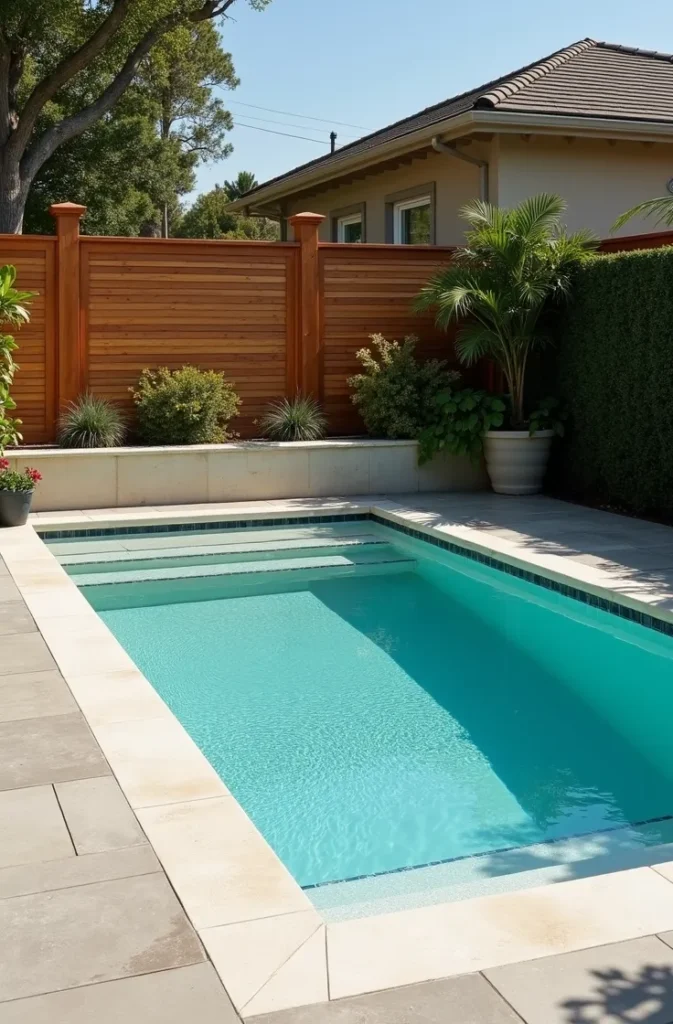
Pool depth beyond the bench drops to 4 to 4.5 feet in the center, which is swim-safe for children while keeping overall excavation volume manageable. This shallower average depth also reduces water heating costs significantly.
The limitation is clear: if lap swimming or diving are priorities, this format does not serve those uses. It is optimized for leisure and family use, not fitness.
6. The Infinity Edge Mini Pool That Works on a Sloped Small Yard
A sloped yard is typically seen as a problem for pool installation. An infinity edge — or negative edge — design turns that slope into the defining feature. One wall of the pool sits lower than the others, allowing water to flow over the edge into a catch basin below, creating the visual illusion that the water extends to the horizon.
This design requires a meaningful slope — at least 18 to 24 inches of grade change across the pool’s width — to work visually. On a flat yard, an infinity edge is just an expensive vanishing border with no visual payoff.
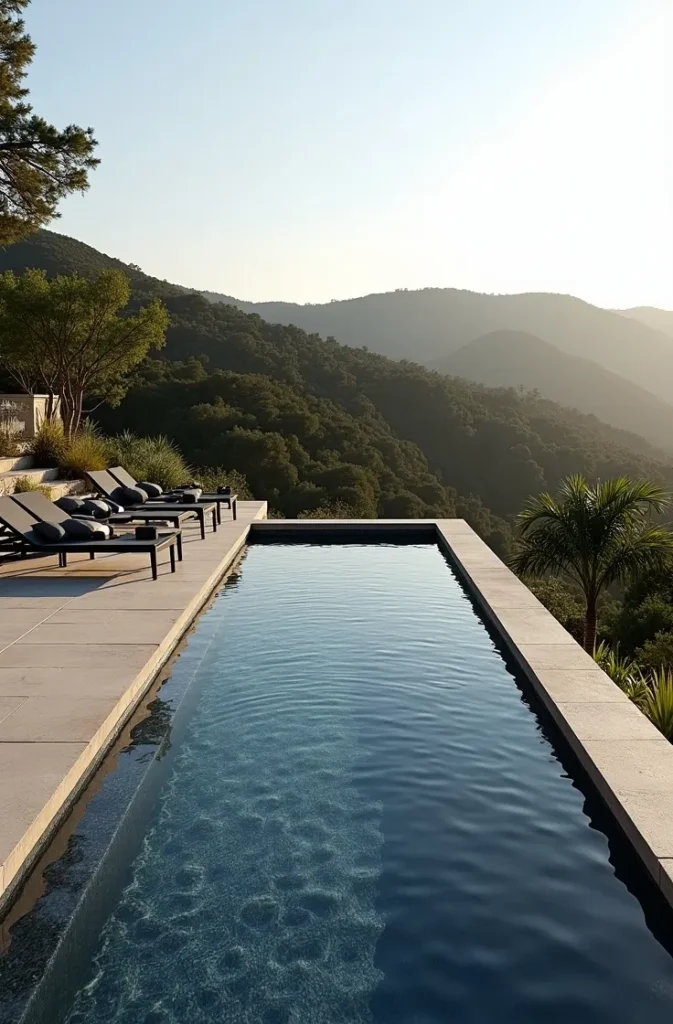
The catch basin and pump system add mechanical complexity compared to a standard pool. Budget for more sophisticated filtration equipment and ongoing maintenance access to the basin on the downslope side.
Small infinity pools in the 12-by-16-foot range work particularly well on hillside properties, raised decks, or yards that back onto a view — a greenbelt, a water feature, or a distant skyline.
7. The Stock Tank Pool Elevated on a Timber Deck for a Minimal Footprint
Stock tank pools — large galvanized steel agricultural tanks repurposed as swimming pools — have moved well past trend status into a legitimate small-yard pool solution. A standard 8-foot round tank holds approximately 700 gallons, requires a simple pump and filter setup, and can be operational within a few days.
Placed on or integrated into a timber deck, the tank transitions from utilitarian to architectural. Wrap the exterior in weathered timber planks, mount it flush with the deck surface, or keep it raw and industrial — each works depending on the surrounding aesthetic.
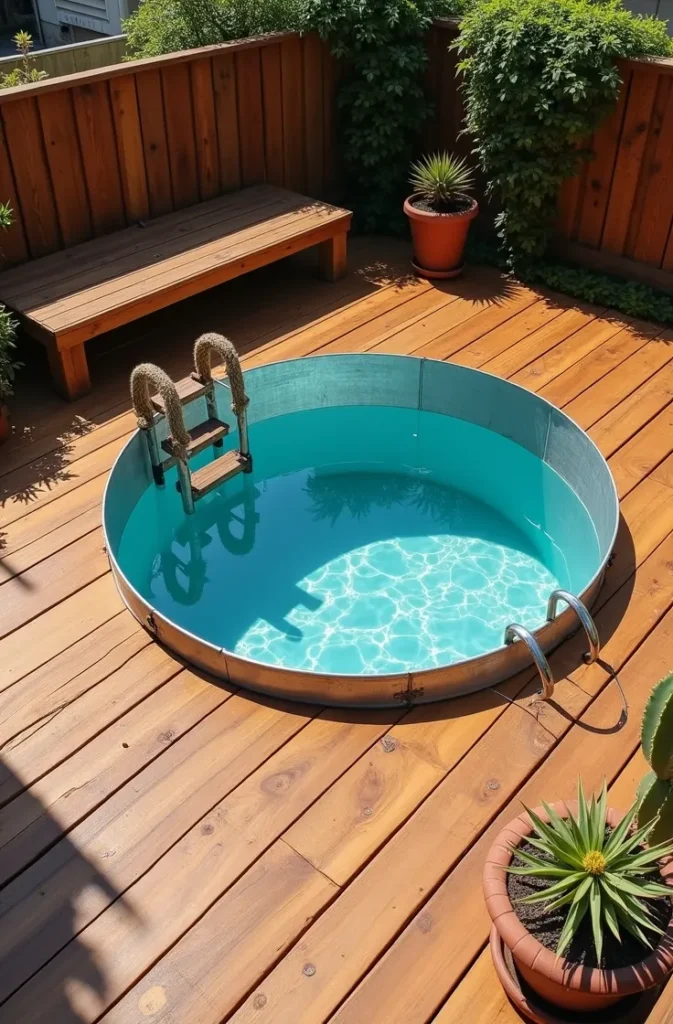
The limitation is capacity and comfort. An 8-foot tank holds two to three adults without feeling crowded. Water temperature in a metal tank fluctuates more than in in-ground pools — it heats faster in direct sun and cools faster at night. A shade structure or cover helps regulate this.
This is the right solution for renters, for homeowners who want to test pool ownership before committing to in-ground installation, and for yards under 300 square feet where any in-ground option would dominate the entire space.
8. The L-Shaped Mini Pool That Follows the Perimeter of an Irregular Yard
Irregular yard shapes — lots with angled property lines, offset corners, or multiple grade levels — create awkward dead zones that standard rectangular pools leave wasted. An L-shaped pool configuration follows the perimeter geometry of the yard rather than fighting it.
The shorter arm of the L typically serves as a shallow lounge zone or wading area, while the longer arm holds swimming depth. This creates functional differentiation within the same water body without requiring two separate pool structures.
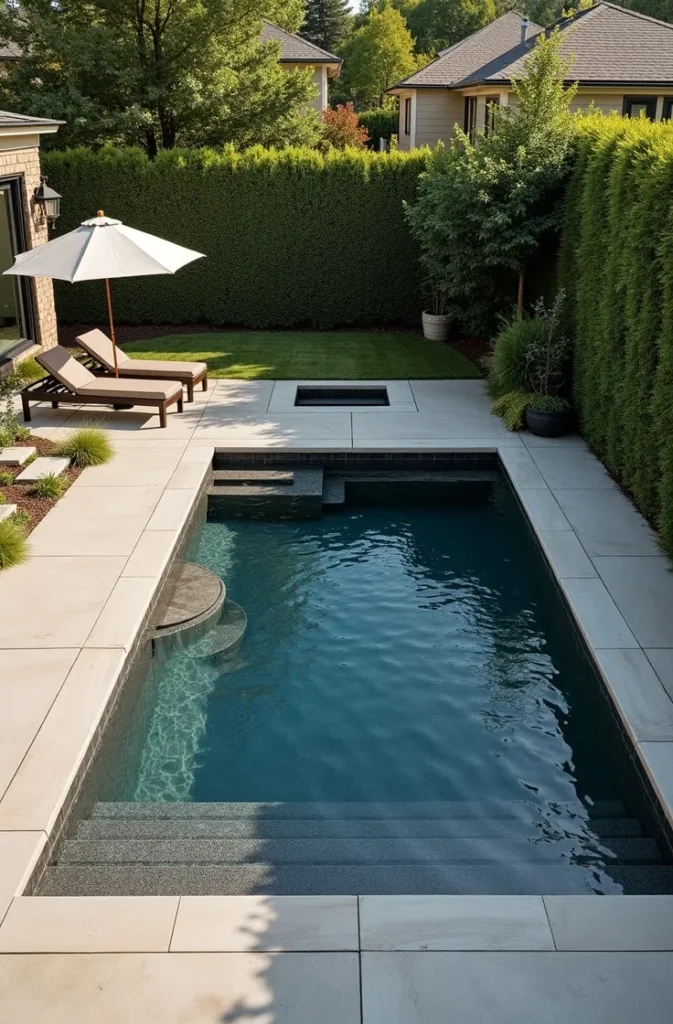
L-shaped pools require more formwork and gunite complexity than rectangular pools, which increases construction cost. They are not the most budget-efficient option, but they are the most space-efficient for yards where a rectangle would leave large awkward unused corners.
Use this format when your yard has a natural L-shape created by the house footprint, an existing structure, or an angled property line — and when you want the pool to feel like it belongs to the yard rather than being dropped into it.
9. The Natural Swimming Pool With a Planted Filtration Zone for Chemical-Free Yards
A natural swimming pool — sometimes called a bio pool — uses a planted regeneration zone filled with aquatic vegetation to filter water biologically rather than chemically. The pool and plant zone share one connected water body, separated by a submerged wall that keeps the swimming area clear.
This format works well in yards with a minimum of 400 to 500 square feet of total outdoor space, since the planted zone typically needs to equal 50 percent of the swimming area to maintain water clarity. For a small yard, this means a compact 8-by-10-foot swim zone paired with a planted gravel-bed zone of similar size.
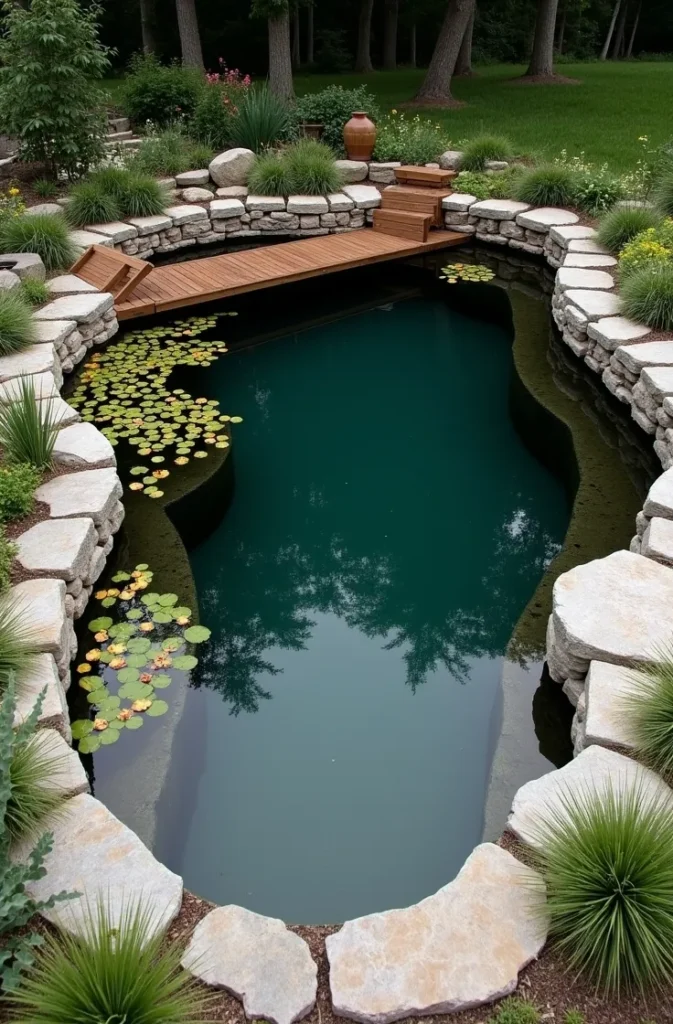
The appeal is genuine: no chlorine, no chemical storage, and a pool that integrates into the landscape rather than contrasting with it. The water looks and feels different from a chemically treated pool — softer, slightly tea-colored in some climates, and cooler.
Maintenance is different, not less. Aquatic plants need seasonal trimming, the gravel substrate needs periodic raking, and algae management requires understanding biological balance rather than just adding chemicals. This is not a low-maintenance option — it is a different maintenance approach.
10. The Spa-Pool Combo That Serves Two Functions in a Single Compact Footprint
A combination pool and spa unit — also called a spool — integrates a small pool and a heated spa into one connected structure, typically within a footprint of 12 by 16 feet or less. Jets in one zone provide hydrotherapy, while the adjacent pool zone gives enough room to swim a few strokes or float freely.
The spool is arguably the highest-function per square foot of any small pool design. It replaces two separate structures — a hot tub and a pool — with one that shares filtration, plumbing, and heating infrastructure. For small yards, this is a meaningful efficiency gain both spatially and operationally.
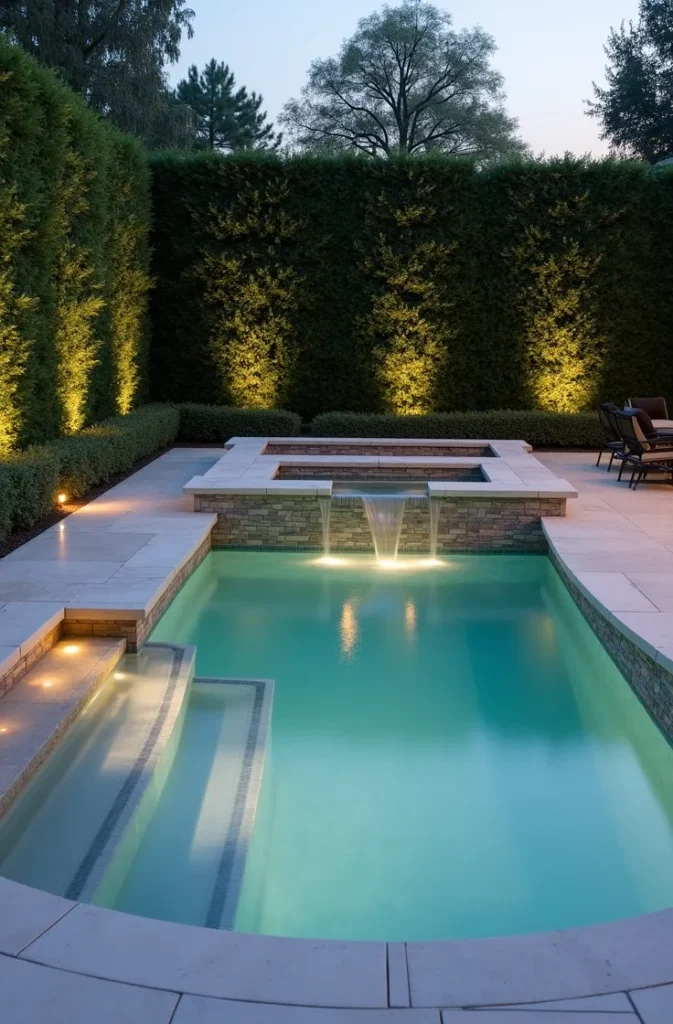
Temperature management is the main design consideration. Running the pool and spa at the same temperature defeats the purpose of having both. Most spools operate with a thermal barrier or separate heating circuit so one side stays warm while the other holds a cooler ambient temperature.
This is the right format for households that use a pool for both summer cooling and year-round relaxation. It justifies its cost by eliminating the need for a separate hot tub entirely.
11. The Rooftop Mini Pool for Urban Homes With No Backyard
Urban townhouses and flat-roofed row homes with no usable ground-level yard can still accommodate a small pool — on the roof. Rooftop pools are not exclusive to luxury hotels; a prefabricated fiberglass or steel plunge pool rated for rooftop loads can be installed on a structurally suitable flat roof with the right engineering support.
Structural assessment is non-negotiable before any rooftop pool project. Water weighs 8.34 pounds per gallon — a 500-gallon plunge pool adds over 4,000 pounds of live load. The roof must be evaluated by a structural engineer before planning begins.
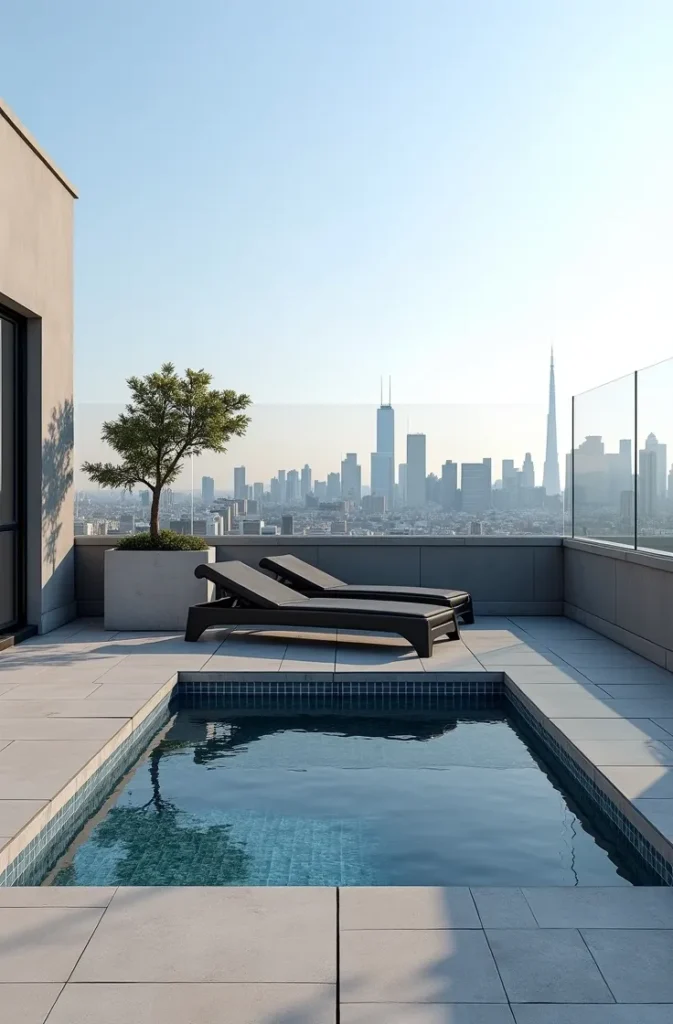
Waterproofing and drainage design are the second critical layer. A leak in a rooftop pool is a building envelope failure — it must be treated with the same seriousness as a roof membrane installation.
When conditions are right, a rooftop pool delivers something no ground-level installation can: unobstructed sky views, complete privacy, and a feature that sets a property apart entirely. This is a long-term capital investment in property value, not a quick outdoor upgrade.
12. The Courtyard Plunge Pool Framed by Raised Garden Beds for a Garden-Integrated Look
Placing a plunge pool at the center of a small courtyard and surrounding it with raised garden beds creates a layered, garden-integrated space that feels much larger than its actual footprint. The pool becomes the focal point of a designed outdoor room rather than a standalone water feature dropped into the yard.
The raised beds serve multiple functions: they visually frame the pool, provide a physical buffer that reduces the need for a separate pool fence in some jurisdictions (verify local code), and allow planting of screening shrubs, ornamental grasses, or culinary herbs close to the water without affecting pool chemistry.
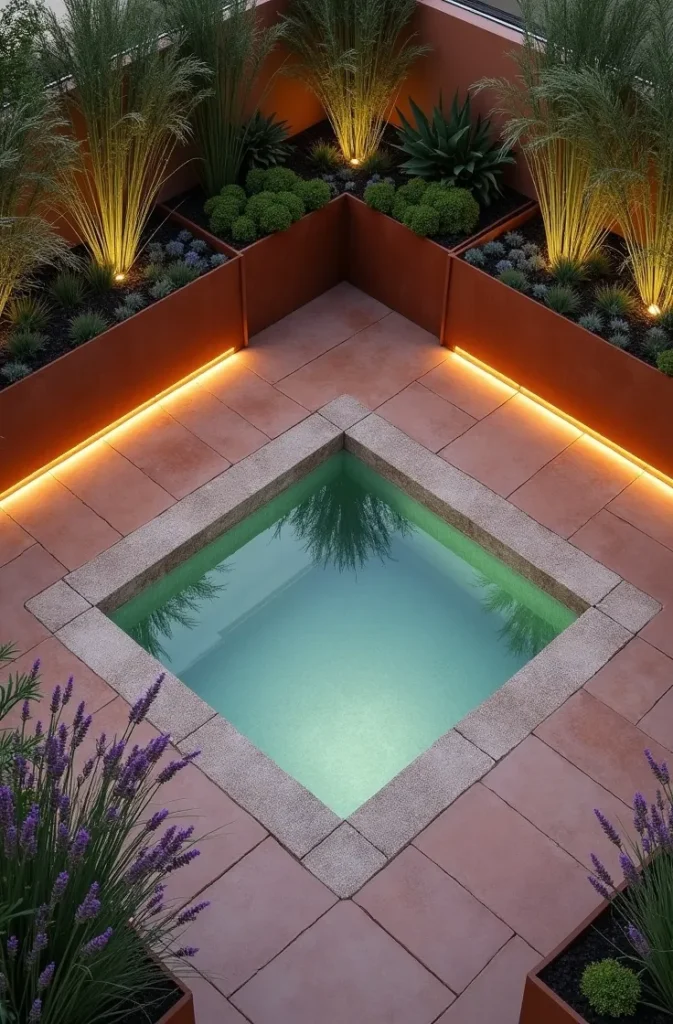
The critical planning consideration is drainage. Raised beds adjacent to a pool must have internal drainage that directs soil runoff away from the pool water — not into it. Overflow from heavy rain can carry fertilizer and organic material directly into pool water if the grade is not managed correctly.
Use this layout in courtyards or small enclosed gardens where you want the pool to feel embedded in a landscape rather than existing separately from it.
13. The Semi-Inground Pool for Sloped or Uneven Small Yards
A semi-inground pool is partially excavated into the ground and partially above grade — typically split roughly half and half. This approach is both structurally efficient and visually interesting: the above-grade portion can be faced with timber, stone, or tile cladding, while the in-ground portion benefits from the thermal insulation of surrounding soil.
This format is the practical solution for yards with shallow bedrock, high water tables, or moderate slopes that make full excavation expensive or structurally complicated. Rather than engineering around the obstacle, semi-inground installation works with the existing conditions.
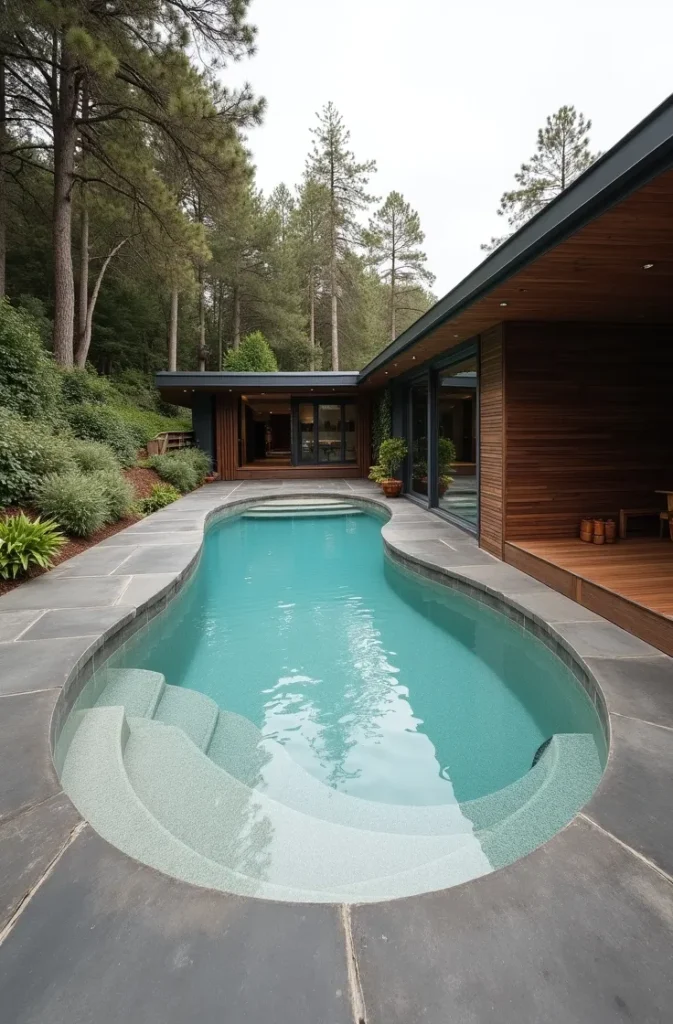
The above-grade walls need to be designed and clad intentionally — a semi-inground pool with bare walls reads as an unfinished project. Timber decking that steps down to pool level is the most common integration strategy and one that works in almost any yard style.
Avoid placing a semi-inground pool at the highest point of a sloped yard. Water drainage during rain events should flow away from the pool area, not toward it.
14. The Japanese-Inspired Soaking Pool With Stone and Bamboo for a Zen Backyard
A Japanese soaking-style pool — deep, compact, and designed for stillness rather than active swimming — is one of the most architecturally refined small pool solutions for compact yards. Inspired by the ofuro tradition, the pool sits 4 to 5 feet deep with a small footprint of 6 by 8 feet, optimized for immersion rather than movement.
The surrounding material palette uses natural stone, dark pebble, bamboo screening, and water-worn gravel to create a sensory environment that makes the pool feel part of a broader landscape composition. A simple bamboo spout or stone fountain adding a trickle of water completes the acoustic atmosphere.
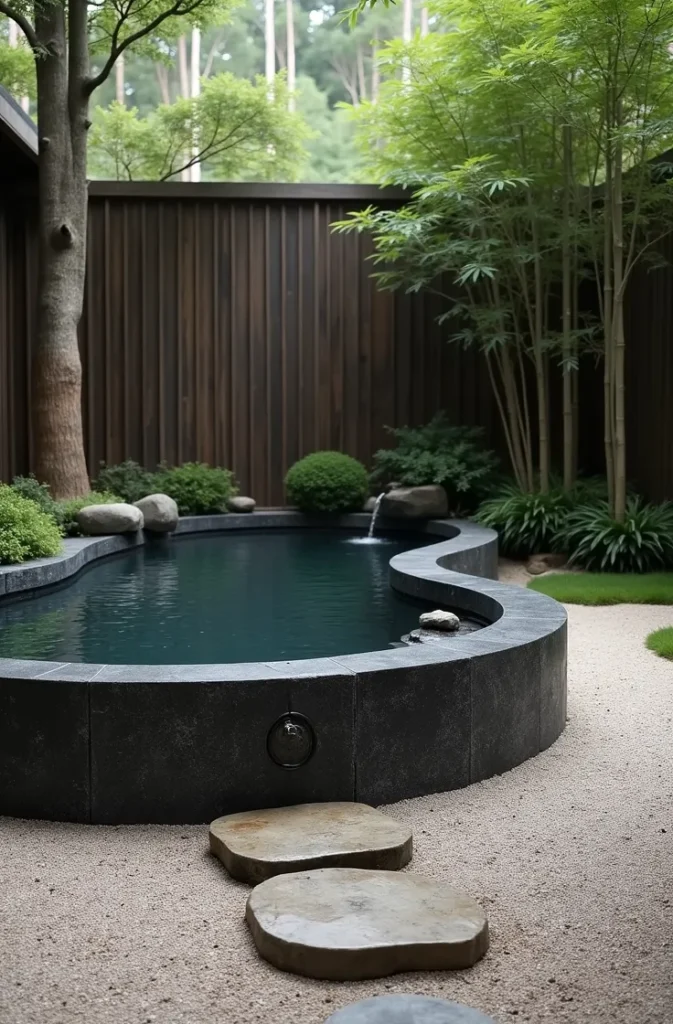
Water temperature in a soaking pool is typically maintained warmer than a standard pool — between 98 and 104 degrees Fahrenheit — making it a four-season amenity even in colder USA climates when paired with an insulating cover.
This format is not for yards where a cooling summer swim is the primary use. It is designed for meditative soaking, muscle recovery, and quiet relaxation. The footprint is small enough to fit in yards as compact as 15 by 20 feet when combined with a gravel or stone ground treatment.
15. The Swim Spa That Replaces Both a Pool and a Gym in a Small Side Yard
A swim spa is a prefabricated unit combining a powerful resistance current system with a full spa section, all in a package that fits in a space as small as 8 by 15 feet. It is the most functionally dense small pool option available — it replaces the swimming pool, the hot tub, and partially, the cardio gym in a single installation.
The current system creates a laminar flow of water strong enough to swim against continuously, eliminating the need for flip turns or lap counting. Speed and resistance are adjustable, making it suitable for casual use and serious training.
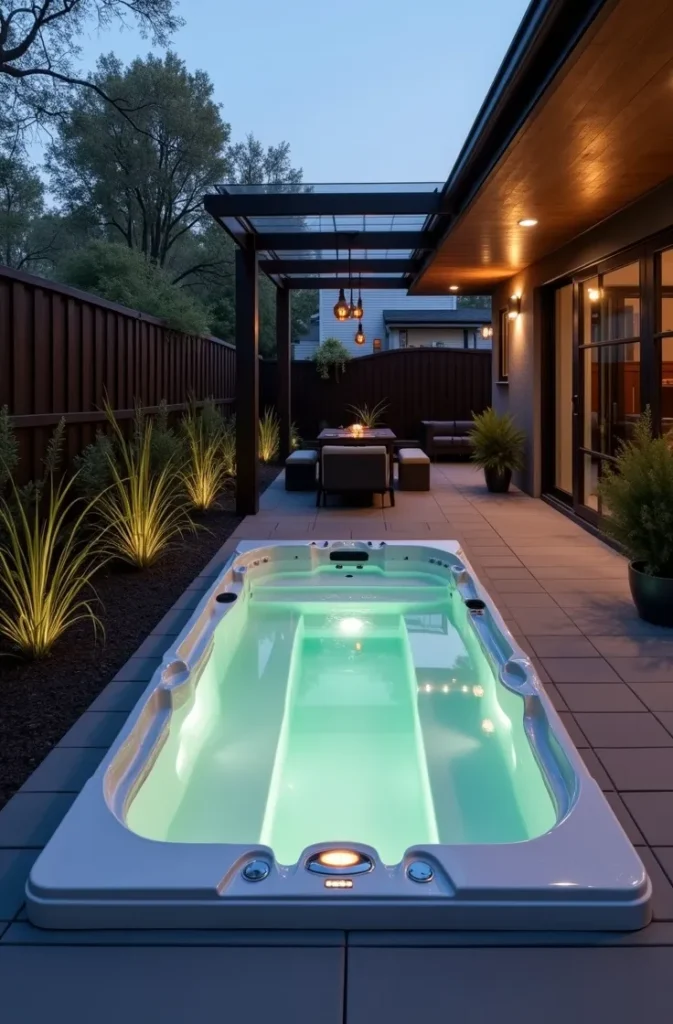
Installation is straightforward compared to in-ground pools: most swim spas are delivered as complete prefabricated units, require only a level pad and electrical hookup, and are operational within days. They can also be relocated, which in-ground pools cannot.
The primary limitation is aesthetic. A swim spa is a manufactured product with visible cabinetry — it does not integrate visually into a yard the way a custom in-ground pool does. Decking, pergola structures, and perimeter plantings are the most effective ways to give a swim spa a more permanent, designed presence.
16. The Plunge Pool With an Integrated Water Feature Wall for a High-End Look in a Tiny Footprint
A plunge pool paired with a floor-to-ceiling water feature wall — water sheeting silently down a stone or tile surface into the pool below — is the single highest-impact visual upgrade for a small pool space. It adds sound, movement, and architectural scale without increasing the pool’s physical footprint.
The water feature wall serves both aesthetic and functional purposes. The sound of moving water creates acoustic privacy by masking street noise and neighbor activity — a meaningful benefit in dense urban or suburban settings. It also oxygenates the pool water, which supports water quality.
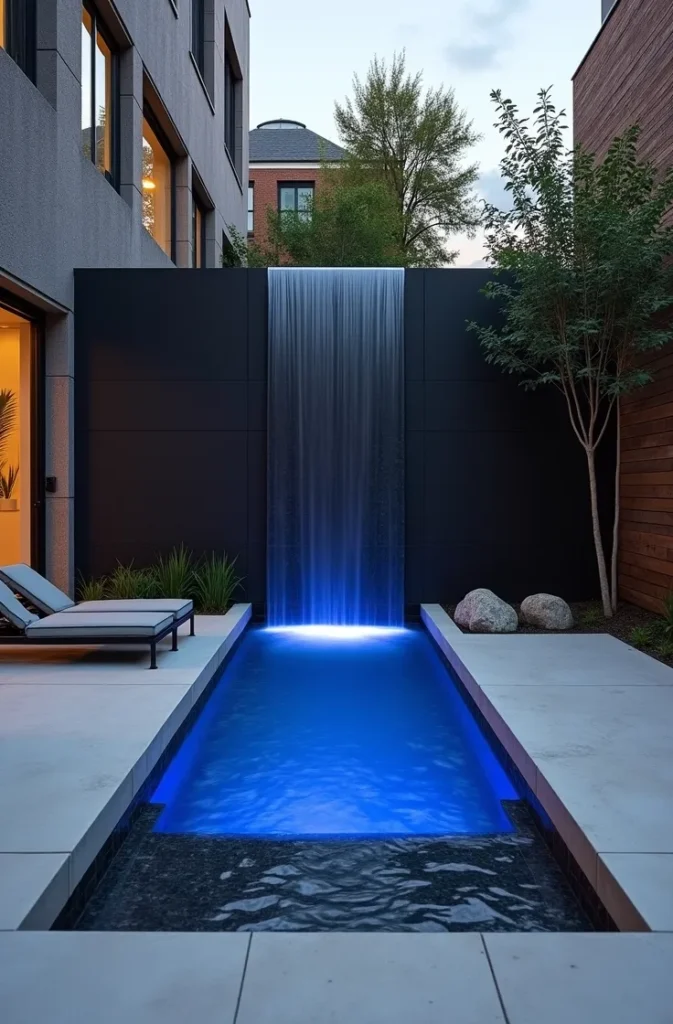
Material selection for the wall matters significantly. Absolute black granite, large format charcoal porcelain, and honed basalt all produce the darkest, most dramatic water sheeting effect because water reads clearly against the dark surface. Light-colored walls reduce the visual impact considerably.
This design works in the smallest yards precisely because it operates vertically — adding visual scale and ambiance without consuming any horizontal ground area. Even a 6-by-10-foot plunge pool paired with a water feature wall creates a space that reads like a luxury resort feature.
Final Thoughts
Mini pools for small yards have reached a level of design sophistication where almost any outdoor space — a side corridor, a rooftop, a courtyard under 400 square feet, or an irregular sloped lot — can accommodate a pool that is both functional and genuinely beautiful. The key is matching the pool format to the yard’s actual constraints rather than forcing a standard design into a space it does not suit.
Save this post so you can return to it when you are ready to plan, get quotes, or compare formats side by side. Each section above is built around real installation logic — not just visual inspiration — so the guidance holds up through the entire decision process. For your next step, explore small backyard landscape design ideas and compact outdoor entertaining layouts to plan the full space around whichever pool format you choose.