
A chaotic entryway is one of the most solvable problems in a home — yet most households never address it with intention. These 18 mudroom ideas for a perfectly organized entryway will show you exactly what works, what to avoid, and how to build a drop zone that functions for your specific household size, home layout, and daily routine.
1. The Built-In Locker System: Individual Storage That Eliminates Entryway Chaos
A built-in locker system assigns every person in the household their own vertical storage column — hooks, a shelf above, and a cubby or cabinet below. This is the single most effective mudroom layout for families because it removes the argument of whose stuff is whose and gives every item a permanent home.
Each locker unit should be at least 15 to 18 inches wide to fit a backpack, coat, and pair of shoes without compression. Narrower than that and items get stacked rather than stored, which defeats the purpose. The height should reach ceiling or close to it — wasted vertical space in a mudroom is a missed storage opportunity.
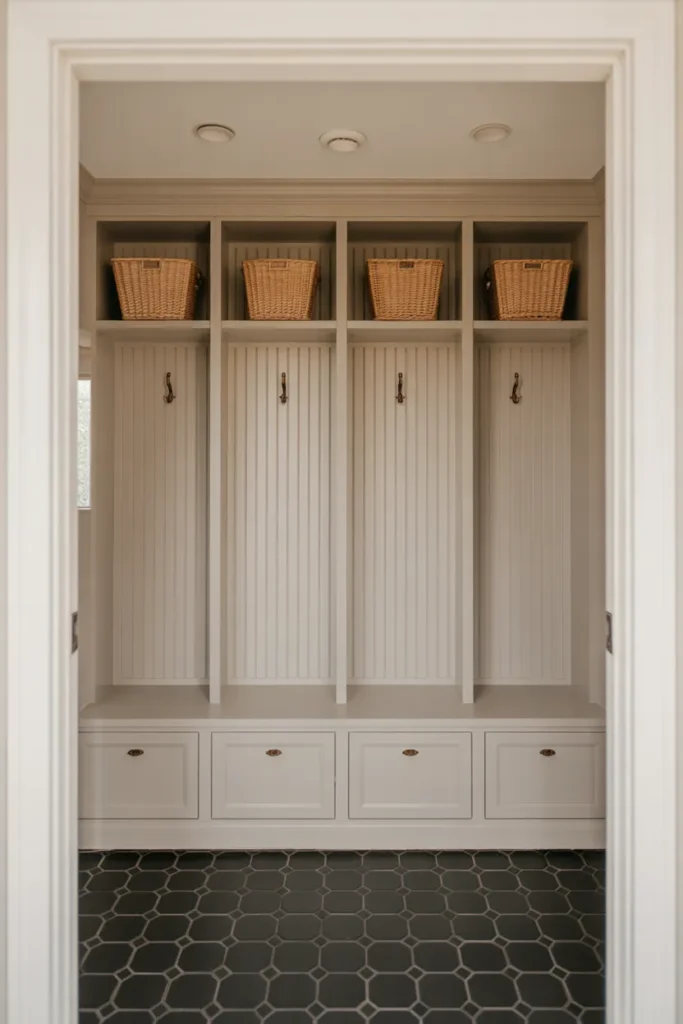

Use closed lower cabinets rather than open cubbies at floor level if you have young children. Open cubbies at shoe height become dumping zones within a week. A door with a magnetic latch keeps the mess invisible without requiring any effort from kids or adults.
This layout works best in dedicated mudroom rooms or wide hallway entries of at least 6 feet. In a narrower space, a single-column locker on one wall still outperforms a row of hooks.
2. The Bench-and-Hook Wall
A simple wall-mounted bench paired with a row of hooks above it is the most space-efficient mudroom configuration available. It requires as little as 18 inches of depth and 4 feet of wall width — which means it fits in apartments, small ranch homes, and narrow side entries where a full built-in system is not possible.
The bench serves two functions: seating for putting shoes on and off, and a surface that catches bags and jackets in transition. The hooks above handle coats, hats, and dog leashes. When the two elements are correctly proportioned — hooks at 60 to 66 inches from the floor, bench at 18 inches high — the layout works for adults and children alike.
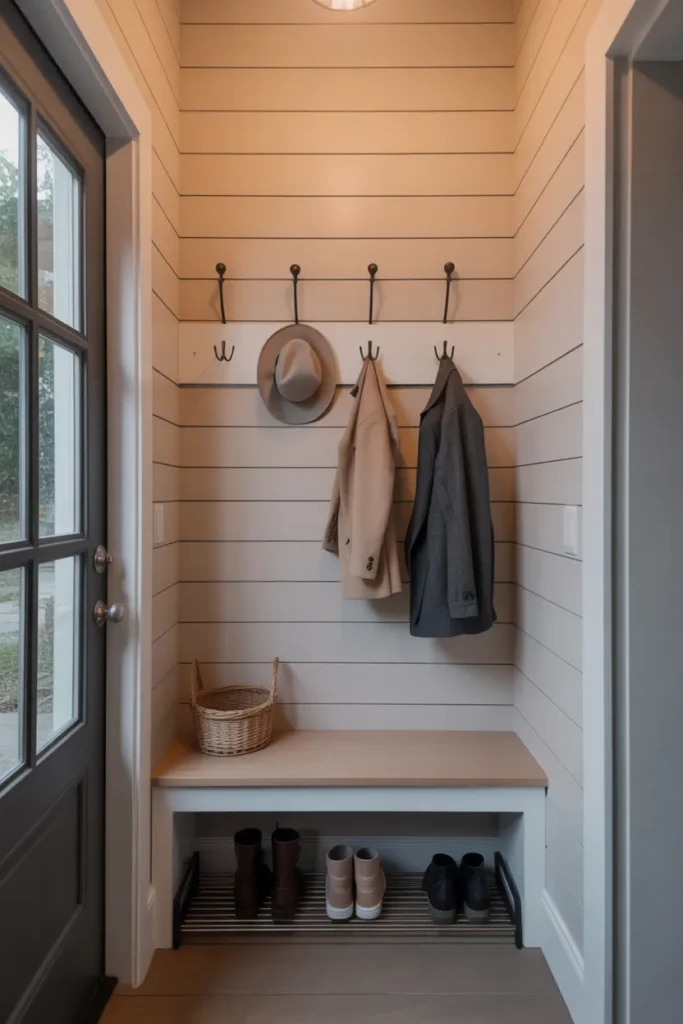
The most common mistake with this setup is using too many hooks too close together. Six hooks crammed into three feet of wall creates a tangled mess of overlapping coats. Space hooks at least 6 to 8 inches apart and limit the row to what you can actually use without crowding.
For a modern organized entryway look, mount the bench with floating hardware so the floor beneath is clear and easier to sweep. Add a shoe tray beneath the bench rather than storing shoes on the bench surface itself.
3. The Drop Zone With a Command Center
A mudroom drop zone that includes a small command center — a chalkboard or framed corkboard, a shelf for mail and keys, and a charging station — turns your entryway into the operational hub of the home. Everything that enters and exits the house gets managed in one spot.
This works particularly well for busy households where school schedules, permission slips, keys, and to-do lists need a physical home. The key is to keep the command center compact and vertical so it does not compete with the primary storage function of the mudroom. One 12 by 18 inch board and a narrow shelf is all that is needed.
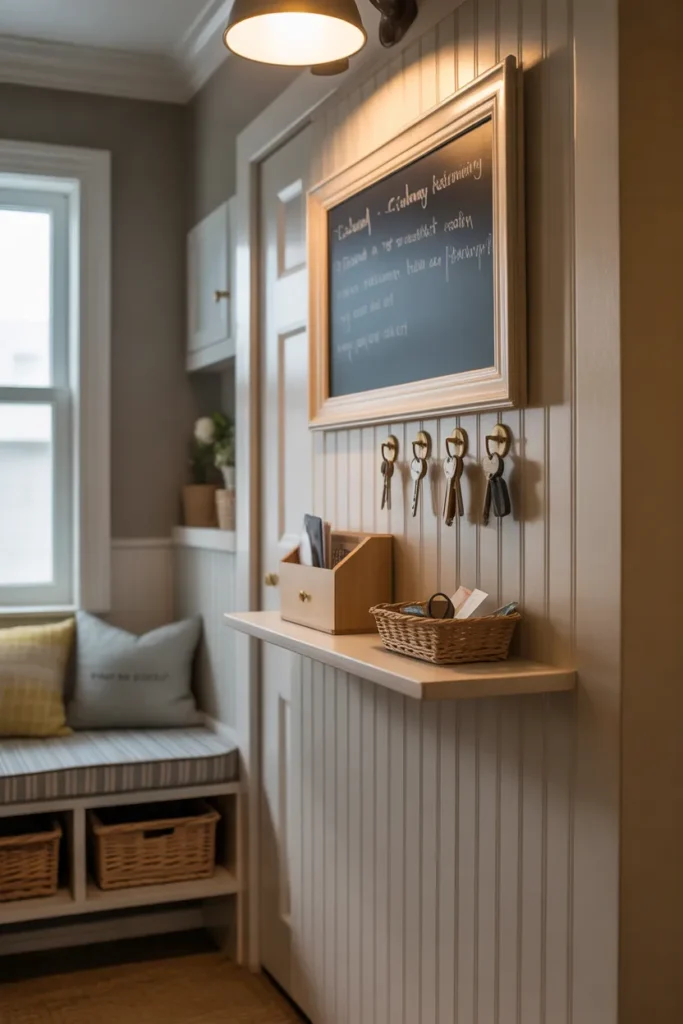
Mount the key hooks at eye level directly beside the door — not across the room. The closer the hooks are to the door handle, the more likely household members are to actually use them. Proximity drives habit.
Avoid turning the command center into a catch-all. One small tray for incoming mail, one for outgoing, and a single row of labeled key hooks keeps the system from collapsing into visual noise within a week.
4. The Open Cubby Shelf System
Open cubby shelving in a mudroom gives every category of item a visible, accessible home — shoes on the bottom, baskets in the middle, and seasonal items on top. Unlike closed cabinetry, open cubbies require no handles and no opening — items go in and come out in seconds, which matters in a high-traffic morning routine.
This layout works best in households that are disciplined about putting items away or in homes where the mudroom is tucked out of sightlines from the main living area. If your entryway is directly visible from the living room or kitchen, the open system requires more consistent maintenance to avoid looking cluttered.
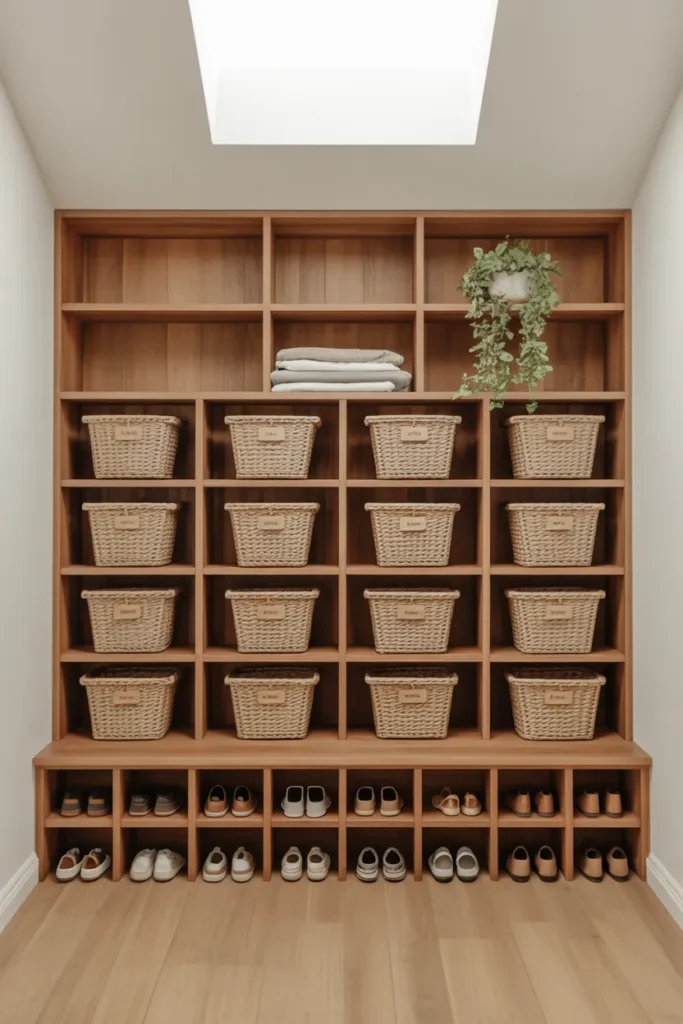
Use uniform baskets or bins in every open cubby to contain loose items. A cubby with a labeled basket reads as organized even when the contents inside are not perfectly tidy. Without containers, open cubbies become visual chaos within days.
Size the cubbies correctly: shoe cubbies should be at least 13 inches wide and 6 inches tall to fit adult shoes flat. Cubbies sized for children’s shoes will frustrate adults and quickly get misused.
5. The Garage Entry Mudroom
The garage-to-home entry is one of the most used and least designed spaces in the American house. Shoes, sports equipment, reusable bags, seasonal gear, and pet supplies all pass through this door daily — yet most garage entries have nothing more than a doormat and a single hook.
A functional garage entry mudroom does not need to be large. A 4 by 6 foot zone with a built-in bench, overhead cabinets, and wall hooks handles the majority of what a typical household carries in and out. Closed upper cabinets are especially important here because the garage entry tends to accumulate items that are not aesthetically pleasing.
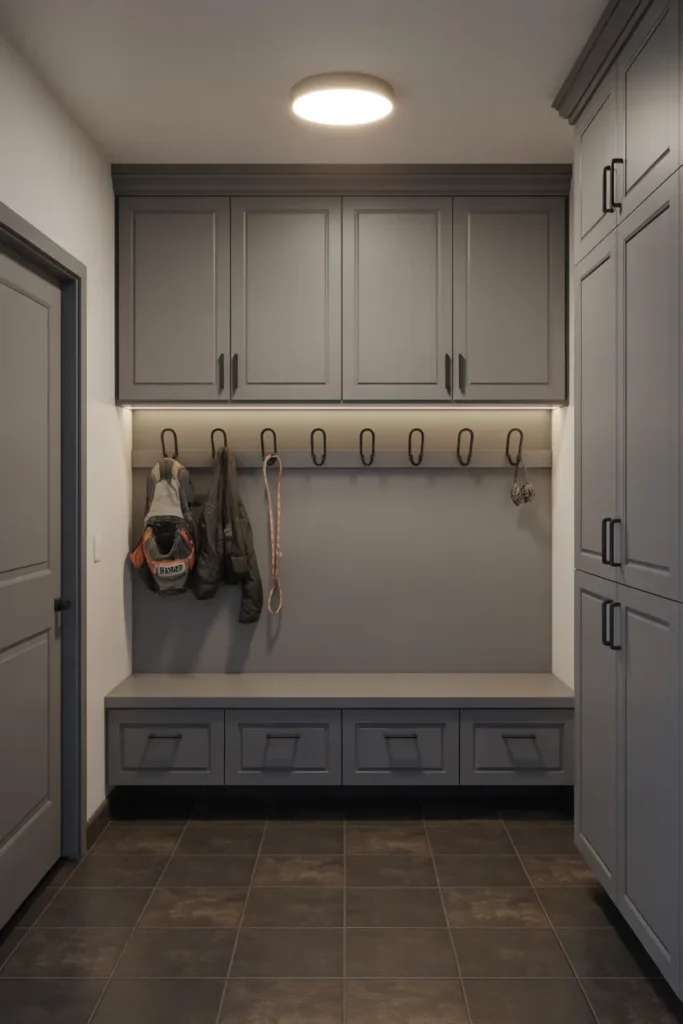
Use durable, easy-clean surfaces in a garage mudroom: porcelain tile or luxury vinyl plank on the floor, painted MDF or thermofoil cabinetry on the walls, and stainless or powder-coated metal hooks rather than decorative ones that corrode with moisture.
Add a utility sink if the space and plumbing allow — a mudroom sink at the garage entry dramatically reduces the amount of dirt that travels deeper into the home, particularly for households with dogs, young children, or outdoor hobbies.
6. The Mudroom Laundry Combo
Combining a mudroom and laundry room in the same space is one of the most functional decisions available in home design. Dirty clothes, wet sports gear, and soiled shoes all arrive in the same entry point — having the washer and dryer immediately accessible means the mess stops there instead of traveling through the house.
This combination works especially well in single-story homes, ranch-style layouts, and homes where the laundry room already sits near the back or side entry. The key is to zone the two functions clearly: the mudroom drop zone occupies one wall or corner, the laundry equipment occupies another, with a folding counter bridging the two if space allows.
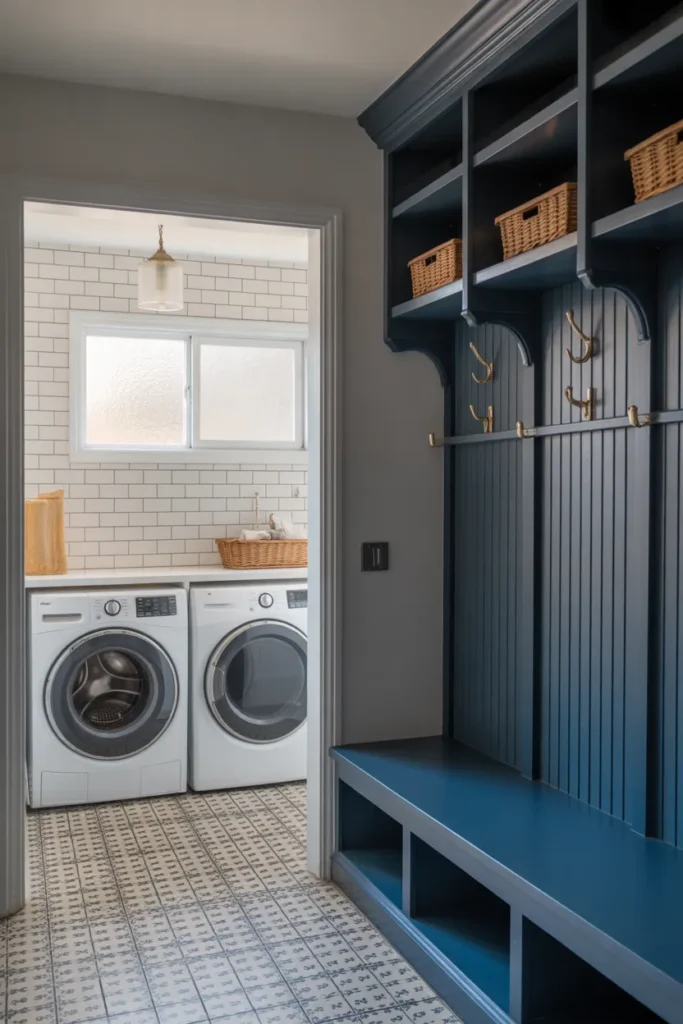
Keep the mudroom storage closed — cabinets rather than open hooks — in a laundry combo room so that lint and moisture from the machines do not settle on outerwear or shoes. Ventilation is also more important in a combined space; ensure adequate airflow to prevent mildew odor.
A stacked washer-dryer unit frees up more floor space for mudroom function in rooms under 100 square feet. Side-by-side units work better in rooms over 120 square feet where the counter space above is genuinely usable.
7. The Minimalist Mudroom With Hidden Storage
A minimalist mudroom hides all the storage behind flush cabinet doors and recessed hooks — so from the entryway, the space appears nearly bare, with no visual clutter. This approach is ideal for open-plan homes where the entry connects directly to the living area and every sightline matters.
The design relies on flush-front cabinetry — no visible hardware, no protruding hooks, no open shelving. Coat hooks recess into the cabinet interior behind a full-height door. Shoes sit inside closed lower cabinets. The only visible elements are a bench, a mat, and perhaps a single mirror.
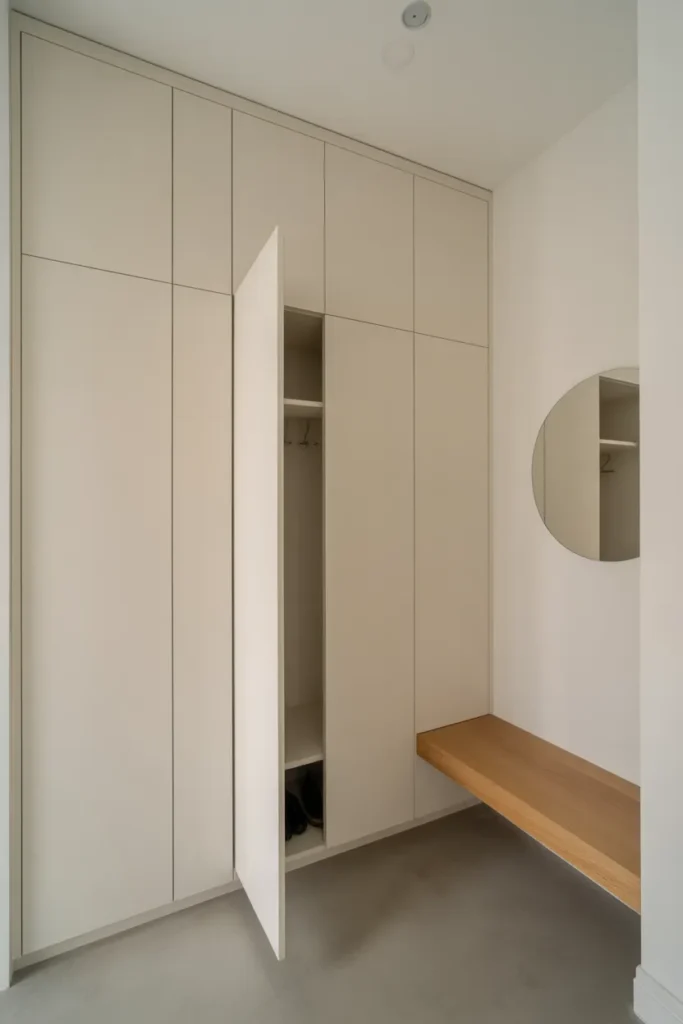
This is a higher-cost approach than open systems because custom or semi-custom cabinetry is required to achieve the flush, hardware-free look. However, it delivers the highest return in homes where resale value and design continuity with the rest of the home matter.
Avoid going so minimal that the system becomes impractical. If closing a cabinet door requires two hands and significant effort, the family will stop using it within a week. Choose soft-close hinges and touch-latch or finger-pull hardware — the easier the system is to use, the more consistently it will be maintained.
8. The Farmhouse Mudroom
A farmhouse-style mudroom combines high function with visual warmth — shiplap walls, painted beadboard, apron-front sinks, vintage-style hooks, and painted wood benches. It is one of the most popular mudroom aesthetics in the USA because it pairs the practical demands of a working entry with materials that feel inviting rather than purely utilitarian.
The design works well in traditional homes, craftsman bungalows, and suburban family homes where the rest of the interior has a relaxed, casual character. It is less suited to modern minimalist or urban industrial homes where the aesthetic contrast would be jarring.
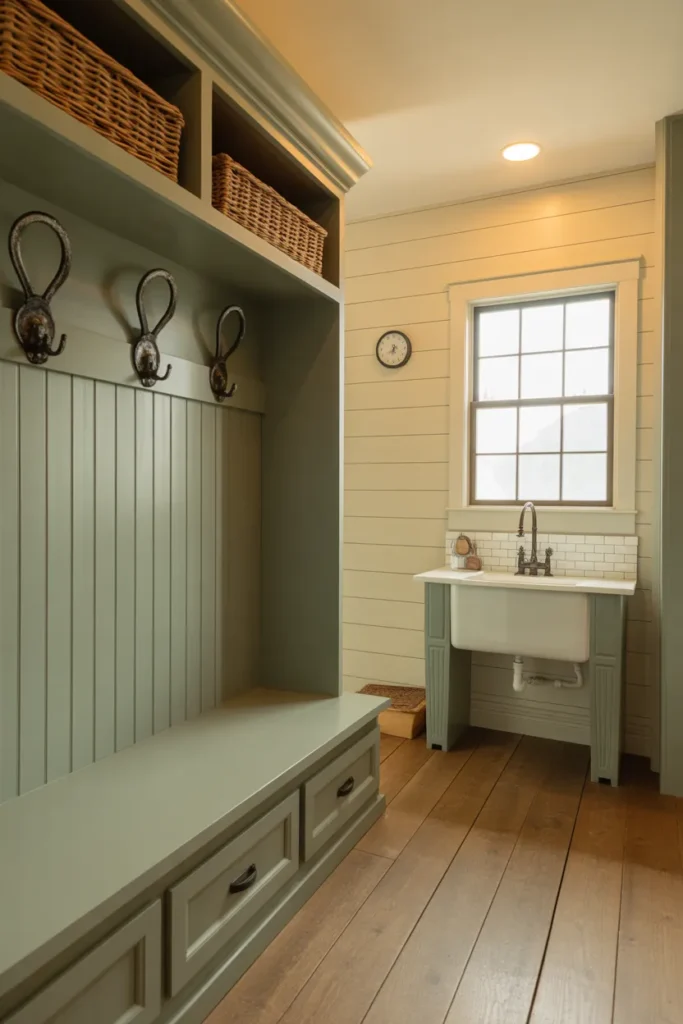
Keep the palette tight: white or cream beadboard, one accent color on the bench or cabinet (navy, sage green, or black are reliable choices), and warm metal hardware in oil-rubbed bronze or aged brass. Avoid mixing too many material finishes — the farmhouse look relies on simplicity and repetition to feel intentional rather than cluttered.
Add a vintage-style clock or a small framed chalkboard sign to give the space personality without adding clutter. Functional decor only — nothing that collects dust or requires dusting around other items.
9. The Mudroom With Pet Station
A mudroom designed with a built-in pet station — a built-in dog wash station or a low feed area — is one of the most practical upgrades available for pet-owning households. In the USA, where over 65 percent of households own a pet, the mudroom is the natural location for pet gear, food storage, leashes, and post-walk cleaning.
A dog wash station at the mudroom entry is a low curb shower pan with a handheld sprayer and a non-slip surface. It eliminates the need to bring muddy dogs through the house to the bathroom. The station does not need to be large — a 30 by 36 inch footprint is functional for most dog sizes — but it does need a proper drain, a waterproof wall surface, and a door or curtain to contain splash.
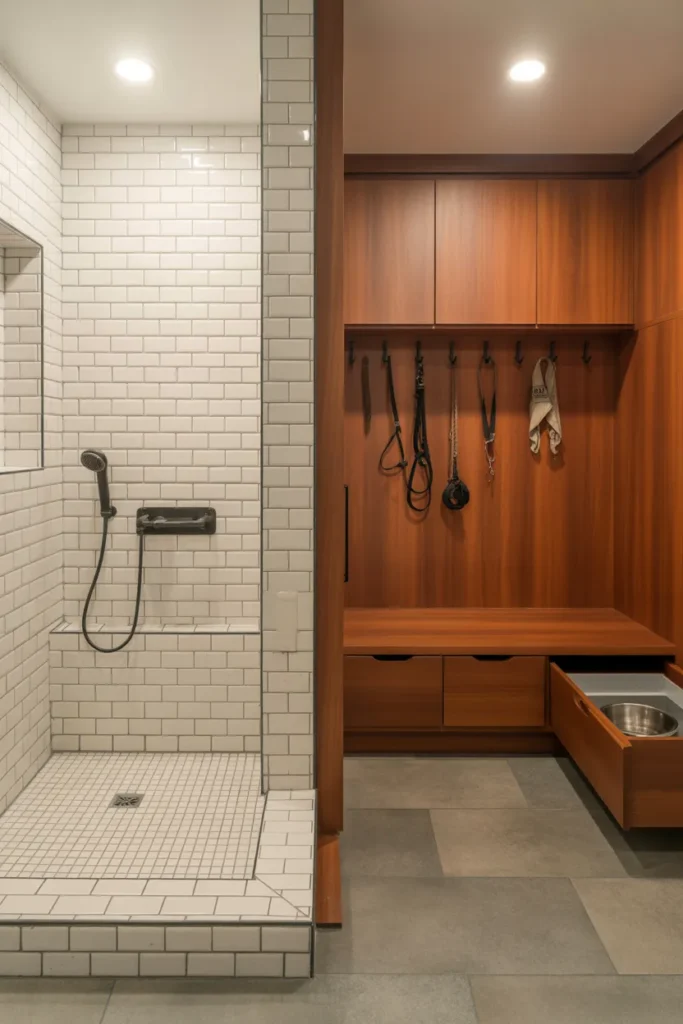
For households without space for a full wash station, a pull-out drawer with a built-in stainless steel bowl for food and water keeps the feeding area off the floor and easy to clean. Mount leash hooks at hip height beside the door — the proximity to the exit point makes grabbing the leash automatic.
Use tile or sealed concrete in any mudroom with pet traffic. Hardwood floors in a pet mudroom will show water damage and scratching within months, regardless of finish quality.
10. The Mudroom Bench With Shoe Drawers
The floor shoe pile is the most common entryway problem in American homes. A bench with deep pull-out shoe drawers directly beneath it solves this without requiring a separate shoe rack, cabinet, or cubby system. Shoes go directly from foot to drawer in one motion.
Each drawer should be at least 5 inches in height to accommodate flat shoes and low sneakers. For households with boots, one deeper drawer at 8 to 10 inches handles tall footwear without forcing it in sideways. Pull-out drawers on soft-close slides feel intentional and are more durable than flap-down cubby doors.
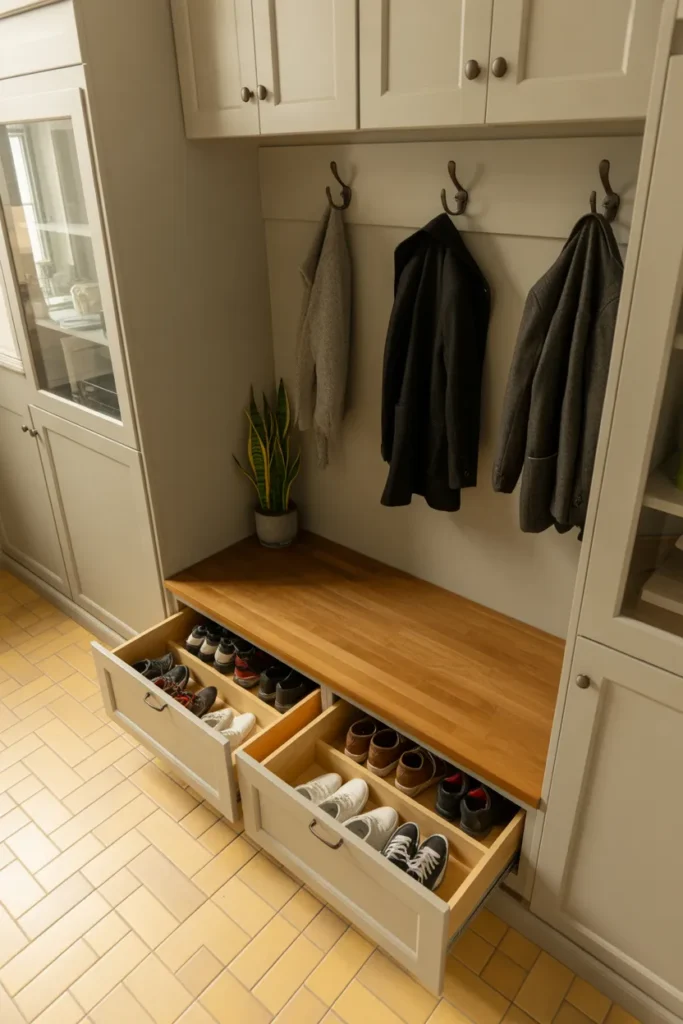
This configuration works in any mudroom with at least 18 inches of depth and 36 inches of linear bench space. It is particularly effective in households where visual tidiness matters — the floor remains completely clear and the bench surface is open for sitting.
A common mistake is sizing the bench too short in length. A bench under 36 inches does not allow an adult to sit comfortably while putting on shoes. 42 to 48 inches is the functional target for a primary household entryway.
11. The Mudroom Coat Closet Conversion
Converting an existing coat closet near the entry into a proper mudroom alcove is one of the highest-return projects for homes without a dedicated mudroom room. Remove the closet rod and shelf, and replace them with a built-in bench, hooks, and a combination of open and closed storage designed for the way your household actually uses the entryway.
A standard coat closet is 24 inches deep and 36 to 48 inches wide — enough to build a bench, a row of hooks, a shelf above, and either open cubbies or cabinet doors below. Removing the door and replacing it with an open archway makes the alcove feel intentional rather than like an unfinished closet project.
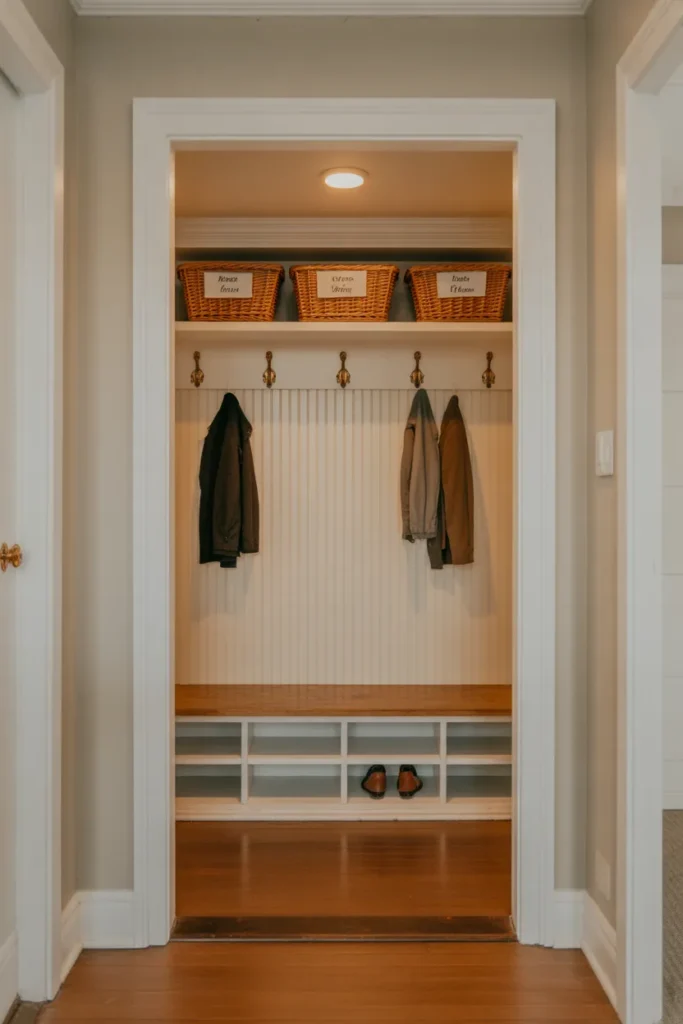
The key decision is whether to close off the alcove with a door or leave it open. An open alcove is more accessible and feels larger but exposes the contents to sightlines from the entry and adjacent rooms. A barn door or a set of louvered doors provides a middle ground — easy to open when in use, easy to close when guests arrive.
Use vertical space to the full ceiling height. A shelf at 72 to 78 inches height handles seasonal items, rarely used bags, and backup storage — items you need occasionally but not daily.
12. The Mudroom With a Charging Station and Tech Hub
In a home where every family member carries a phone, tablet, and wireless earbuds, a charging station built into the mudroom is a modern necessity rather than a luxury. A dedicated charging drawer or shelf with a power strip and cable management keeps devices off kitchen counters and dining tables.
The most functional version is a shallow drawer — 4 to 6 inches deep — lined with a non-slip mat and a built-in power strip with USB-A and USB-C ports. Cables feed through a grommet hole in the back of the drawer. The drawer closes completely when not in use, keeping the surface clean.
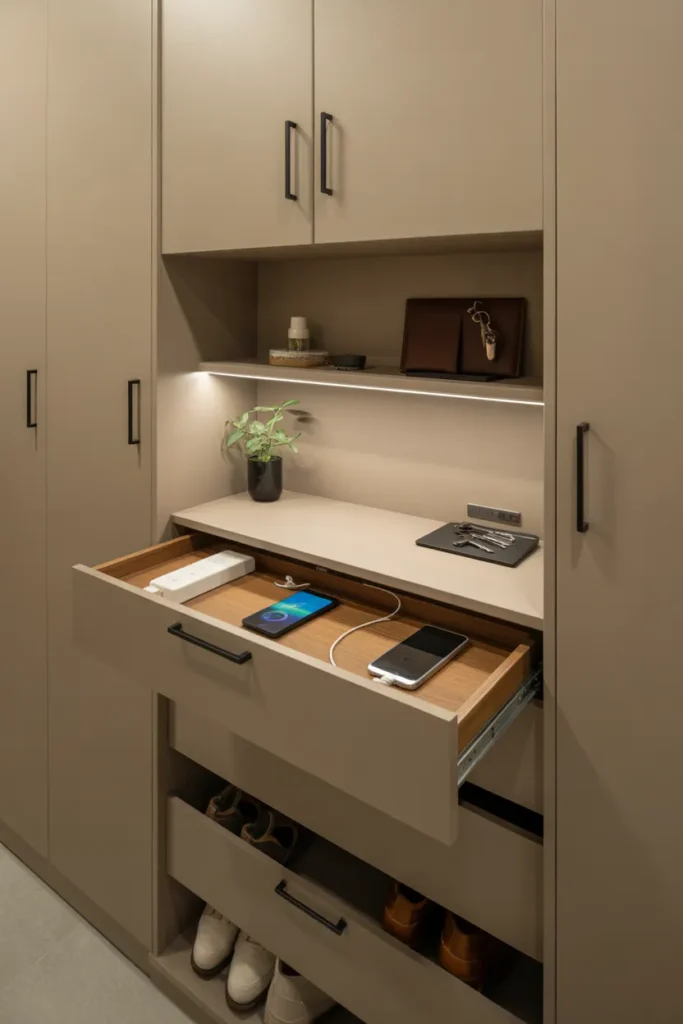
Place the charging station at a height that is easy to reach from standing — 42 to 48 inches from the floor. At this height, devices can be grabbed and go without bending. Below bench height is too inconvenient; above shoulder height requires deliberate effort that most people will not maintain.
This feature pairs well with the command center concept but does not require one. Even a simple charging shelf with a dedicated outlet is a functional improvement over the current reality in most American homes, where phone cables snake across kitchen counters indefinitely.
13. The Mud Room With Hooks at Every Height
A hook wall designed with hooks at three distinct heights — low for children, mid for teenagers, and high for adults — is a small design decision that makes a dramatic difference in a multi-person household. When hooks are all at adult height, children cannot reach them and their belongings end up on the floor every time.
Place the lowest row of hooks at 42 to 48 inches from the floor — reachable for a child aged 4 and up. Mid hooks at 56 to 60 inches serve older kids and shorter adults. The highest row at 66 to 72 inches holds adult coats, hats, and bags. Each row can have a different function: the top row for coats, the middle for bags and backpacks, the bottom for items kids use daily.
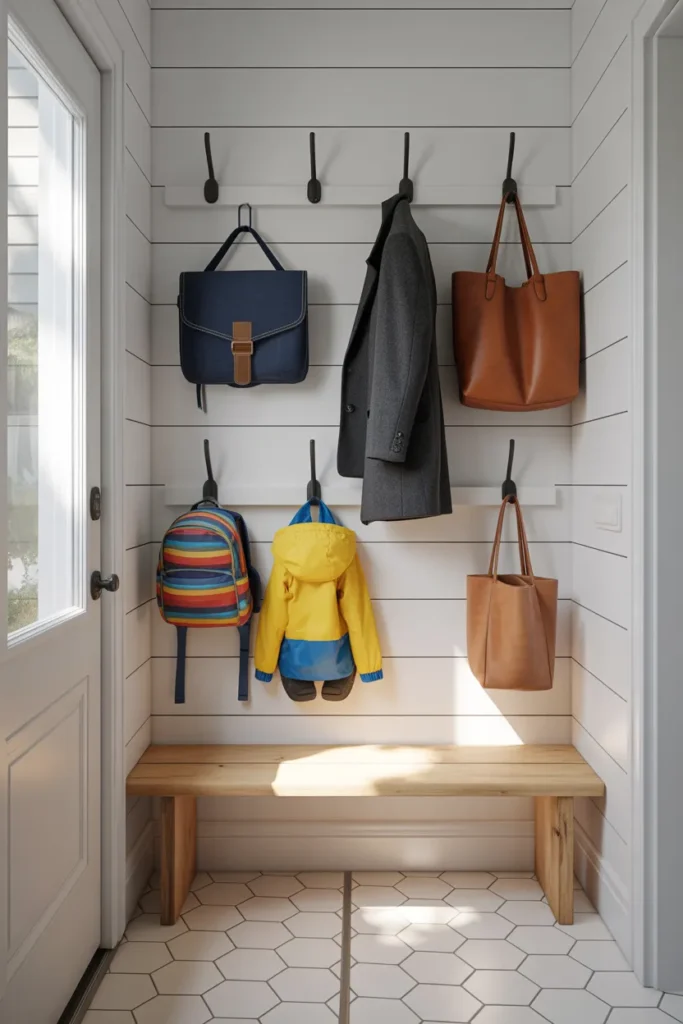
Use a single consistent hook style in a graduated row rather than three mismatched hook types. Visual consistency makes the wall look designed rather than improvised, even when the layout is entirely practical.
Label the hook zones if you have young children — a name or a photo icon above each child’s hook set eliminates the daily conflict over whose stuff goes where.
14. The Mudroom With Wallpaper Accent
Wallpaper in a mudroom is one of the most underused design moves in entryway planning. Because the mudroom is a transitional space, not a living area, it tolerates bolder pattern choices that would feel overwhelming in a larger room. A single wallpapered wall behind the bench or on the back of a coat closet conversion adds immediate personality and makes the space feel finished.
Choose durable, scrubbable wallpaper — vinyl-coated or washable wallpaper is the correct choice for any mudroom where wet coats, dirty hands, and splashing occur. Paper-only wallpapers will not hold up and are not appropriate for this space.
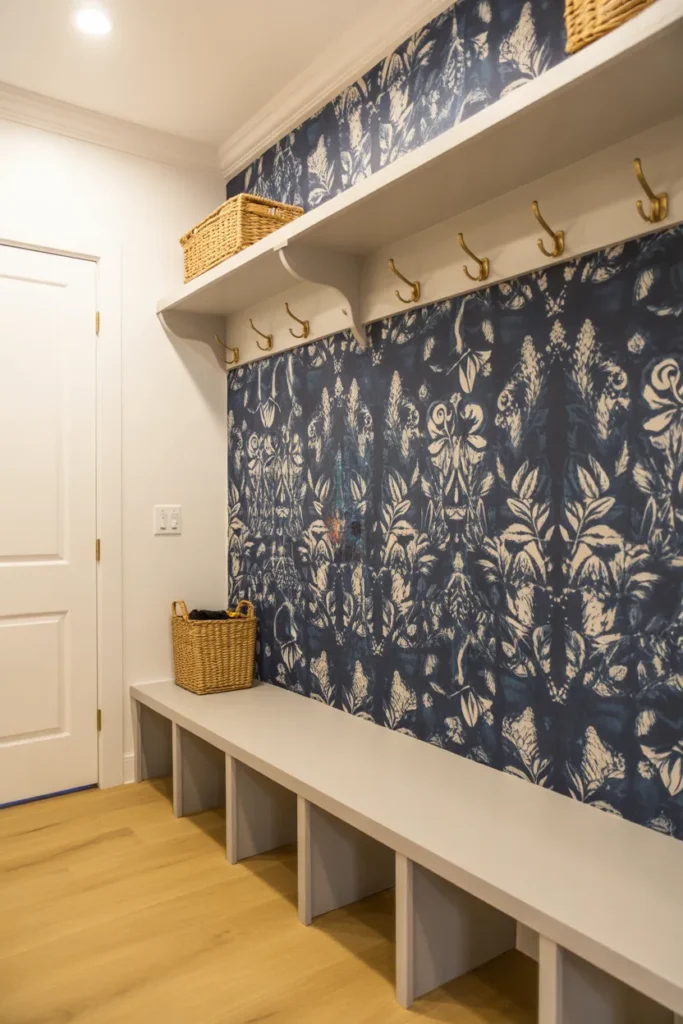
Botanical prints, geometric patterns, and textural grasscloth-look wallpapers all work well. Avoid very light backgrounds in a mudroom — marks, scuffs, and fingerprints show immediately on light wallpaper at entry level.
Keep all other finishes neutral when the wallpaper is bold. White cabinetry, natural wood bench, and simple metal hooks let the wallpaper read as a design choice rather than a mistake.
15. The Mudroom With Barn Door
A sliding barn door on a mudroom entrance solves two problems at once: it saves the swing clearance of a traditional hinged door in a tight entry, and it adds a strong visual element that elevates the whole space. In a hallway or galley-style entry where a swinging door would conflict with bench seating or foot traffic, a barn door is the correct technical choice.
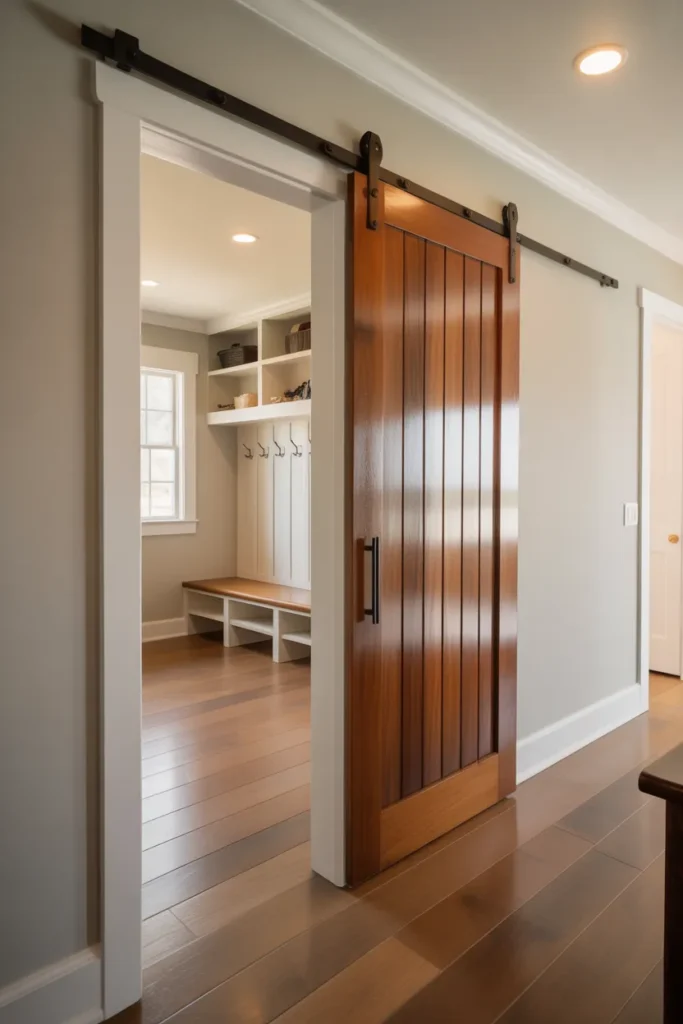
The door should be wide enough to cover the full opening plus 2 to 4 inches on each side when closed. Undersized barn doors that reveal gaps at the edges look unfinished and are a common installation mistake. The hardware track should be mounted at ceiling height or as close to it as the wall framing allows — low tracks create a proportional imbalance.
Barn door materials that work well in a mudroom include solid wood with a natural or painted finish, MDF with a shiplap-style routing pattern, and frosted glass panels for spaces where borrowing light from adjacent rooms matters. Avoid hollow-core interior doors converted to barn door use — the weight and sound dampening are noticeably inferior.
16. The Side Entry Mudroom in a Narrow Hallway
Many American homes have a side entry through a narrow hallway that is technically the most-used door in the house but receives the least design attention. A hallway that is 36 to 42 inches wide can still support a functional mudroom setup if the design accounts for the tight clearance correctly.
In a narrow hallway mudroom, wall-mounted everything is the rule. A shallow bench at 10 to 12 inches depth instead of the standard 18 inches keeps the walkway clear while still providing a seating and storage surface. Hooks above at staggered depths — some projecting 3 inches, some 5 — allow layered hanging without items colliding.
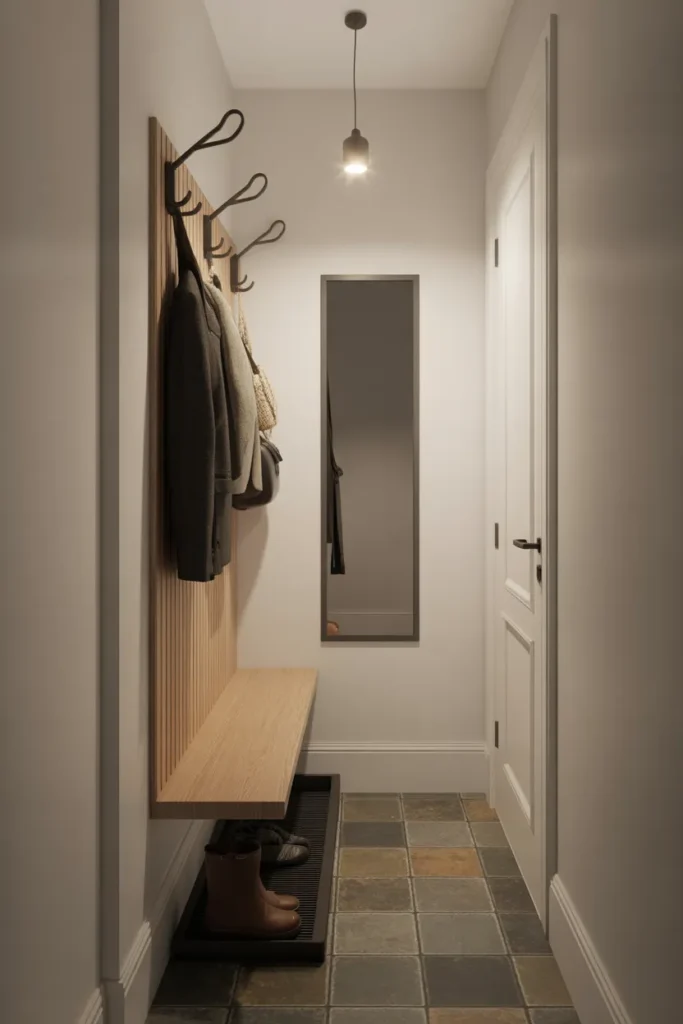
Use vertical storage only — no floor-standing units, no freestanding racks. Every storage element should be wall-mounted to keep floor space fully walkable. A tall, narrow cabinet 12 to 15 inches deep at the end of the hallway adds significant storage without reducing clearance mid-hall.
Mirrors on one wall of a narrow mudroom hallway serve a dual function: they make the space feel twice as wide and they serve the practical function of last-look before leaving the house.
17. The Mudroom With Natural Materials: Rattan, Wood, and Stone for a Grounded Entry
A mudroom built around natural materials — rattan baskets, reclaimed wood benches, stone tile, and linen curtains — creates an entry that feels warm and livable rather than purely functional. This approach is well suited to homes with an organic, Scandinavian, or California casual aesthetic where the entryway should feel like a continuation of the interior rather than a utility zone.
The material choices also have practical logic: stone tile handles moisture and dirt better than most alternatives. Solid wood benches are more durable than painted MDF over time. Rattan and woven baskets are lighter and more flexible than fixed cubbies and can be moved or replaced as storage needs change.
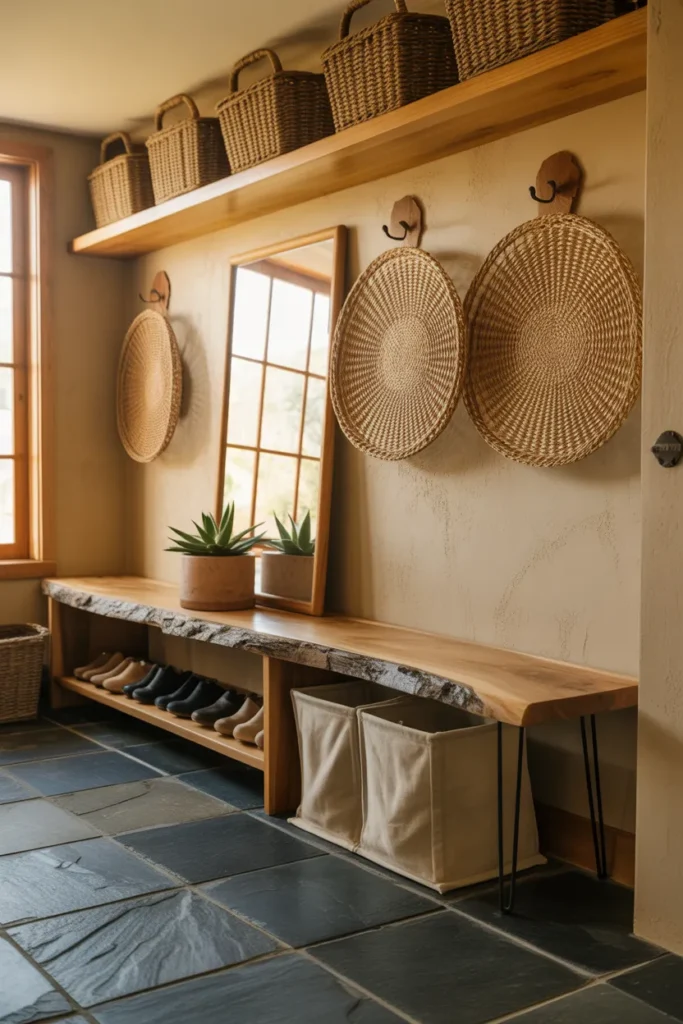
Natural material mudrooms require more maintenance than painted cabinetry systems — wood needs periodic oiling, stone needs sealing, and rattan baskets need dusting. This is the correct trade-off if the aesthetic priority is high, but it is the wrong choice for households that want zero-maintenance upkeep.
Keep the color palette earth-toned to let the materials speak: warm white walls, natural wood, and one or two muted accent tones in olive, terracotta, or sand.
18. The Mudroom With Enclosed Shoe Storage Cabinet
A dedicated, enclosed shoe storage cabinet — whether built-in or freestanding — is the single piece of mudroom furniture that has the highest immediate impact on entryway organization. Shoes are the primary source of visual disorder in most American entryways, and containing them completely behind a door changes the entire character of the space.
The most functional version is a cabinet with angled shoe shelves inside — these hold shoes at a slight backward tilt so heels clear the shelf above, allowing more pairs per shelf than flat storage. A cabinet 12 inches deep, 36 inches wide, and 72 inches tall holds approximately 20 to 24 pairs of shoes depending on style and size.
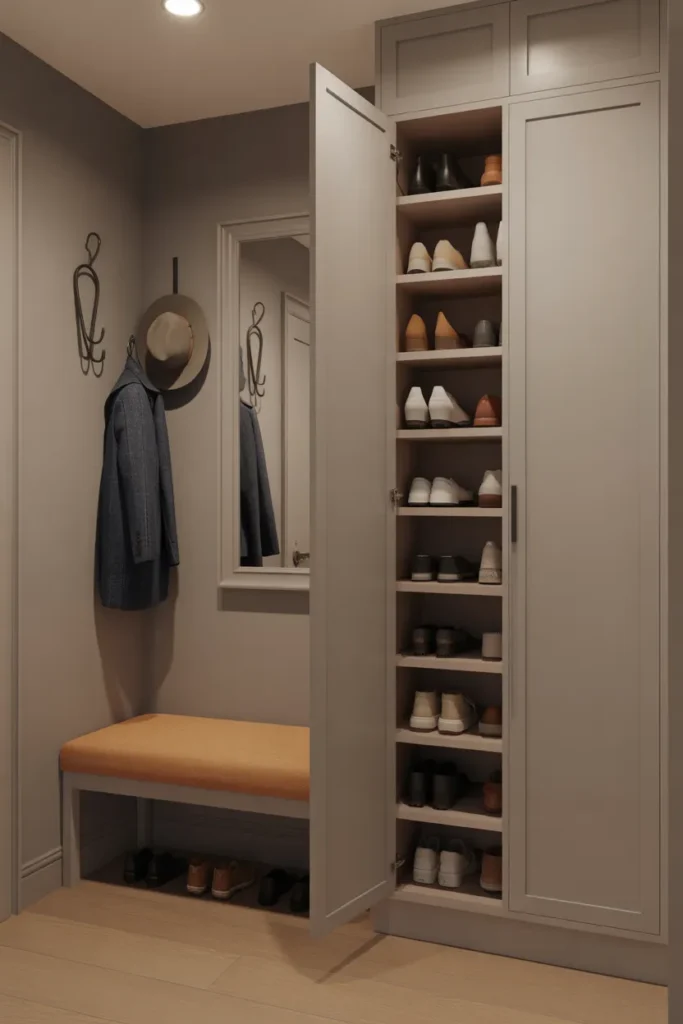
Freestanding shoe cabinets are a viable option for renters or households that are not ready to commit to built-in cabinetry. Choose one that matches the bench or hook wall finish to create a cohesive system rather than an assembled-over-time look.
The one mistake to avoid: choosing a cabinet with a top surface that is too small to function. A shoe cabinet with a 12 by 36 inch top surface can double as a display ledge, a basket surface, or a last-item drop zone. A cabinet with a rounded or angled top loses this secondary function entirely.
Final Thoughts
A well-designed mudroom is not about square footage — it is about making the right decisions for your household size, home layout, and daily routine. Whether you implement one idea from this list or combine several into a complete entryway system, the result is an entry that stays organized without requiring daily effort to maintain.
Save this post so you can reference it when you are ready to start planning. If you found these mudroom ideas for a perfectly organized entryway useful, explore more entryway storage guides, small space organization ideas, and built-in storage solutions for every room in the home.