
Choosing the right sofa shape is one of the most impactful decisions in any living room, and curved sofas are dominating interior design conversations heading into 2026 for good reason. If you have been unsure whether a curved sofa will work in your specific space, room size, or layout, this guide gives you the practical answers you need. These curved sofa ideas for living room 2026 cover everything from small apartments to large open-plan homes — with real decision guidance at every step.
1. Place a Crescent-Shaped Sofa in the Center of an Open-Plan Room to Anchor the Space
An open-plan living area without a clear focal point tends to feel undefined, even when it is well-furnished. A crescent or curved sofa placed in the center of the room — away from the wall — solves this by creating an immediate gathering zone that visually divides the living area from the dining or kitchen space behind it.
The curved back of the sofa acts as a soft architectural wall. It gives the room a sense of structure without using actual dividers, which would shrink the space. This is why curved sofas work so much better than straight sectionals in open-plan layouts — the arc creates enclosure without blocking sightlines.
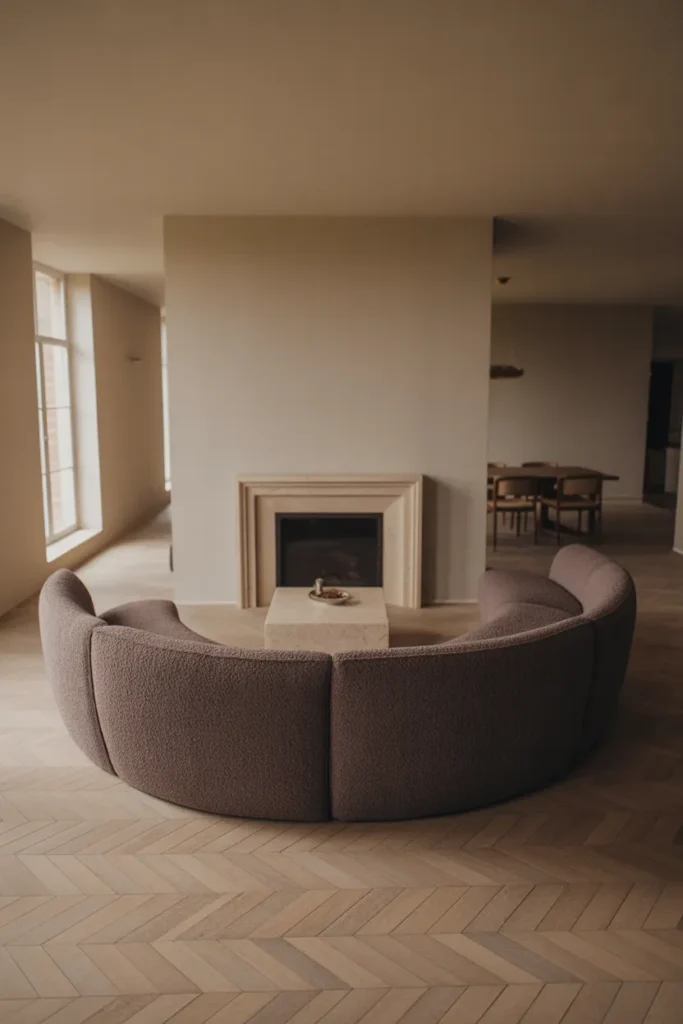

This placement works best when the sofa faces a fireplace, a TV console, or a large window. The curve should open toward the focal point so the seating naturally orients everyone in the same direction. Avoid pushing a curved sofa flush against a flat wall — you lose the defining shape of the piece and the back curve becomes invisible.
Decision guide: If your open-plan space feels like one large undifferentiated room, a center-placed curved sofa is the single most effective piece of furniture to fix that without any construction.
2. Use a Small Curved Loveseat in a Studio Apartment to Define the Living Zone
Studio apartments suffer from one core layout problem: every function competes for the same visual space. A small curved loveseat — rather than a standard two-seater — creates a subtle sense of boundary around the living zone without using room dividers, shelving units, or any other structural additions.
The arc of even a compact curved sofa draws a psychological line between the sitting area and the rest of the room. It reads as intentional design rather than furniture arrangement, which matters significantly in small spaces where everything is visible at once.
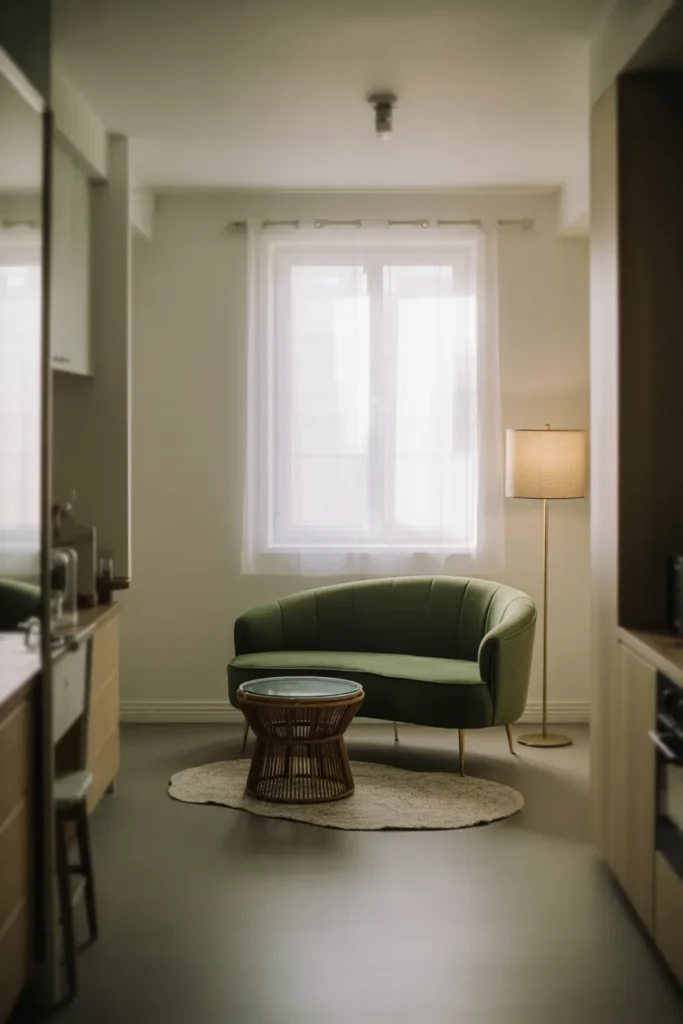
Choose a loveseat in a tight curved form — not a full semi-circle, which would be too large — and place it with the open side facing inward toward a low coffee table. This keeps the zone walkable while still feeling like a dedicated room within the room.
Avoid bulky curved sofas with high backs in studio apartments. The visual weight overwhelms a small space. Look for low-profile frames with slim legs that allow light to pass underneath, keeping the floor plane visible and the room feeling open.
Decision guide: If your studio apartment feels like one large undifferentiated space with furniture placed randomly, a small curved loveseat is the fastest layout fix available.
3. Pair a Full Curved Sectional With a Round Coffee Table to Solve the Corner Problem
Straight sectionals create a corner — and that corner almost always becomes a dead zone that is awkward to sit in and difficult to style around. A curved sectional eliminates the hard corner entirely, which means every seat on the sofa is equally comfortable and equally oriented toward the center of the room.
Pairing a curved sectional with a round coffee table reinforces the circular flow of the layout. The round table fits naturally within the arc of the sofa, fills the visual center of the arrangement, and is reachable from every seat — something that a rectangular coffee table with a curved sofa often fails to achieve.
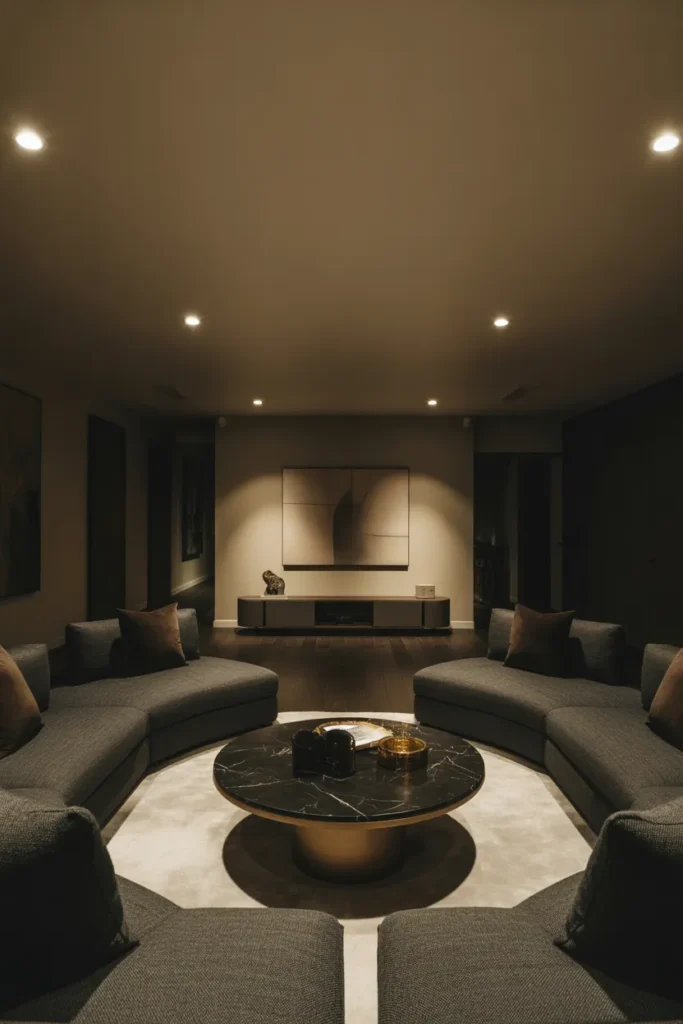
This combination is one of the most functional living room layouts for families or households that regularly have multiple people seated at once. There is no bad seat, no awkward corner position, and no table edge that cuts off the seating arc.
The one mistake to avoid is choosing a coffee table that is too small for the sectional scale. A large curved sectional needs a coffee table that is at least sixteen to eighteen inches in diameter — ideally larger. An undersized table makes the sofa look enormous and the table look like an afterthought.
4. Choose a Curved Sofa in Bouclé Fabric to Add Texture Without Pattern Overload
One of the most common decorating mistakes in a neutral living room is adding pattern to create visual interest — and then immediately regretting it when trends shift. Bouclé fabric on a curved sofa solves the texture problem without committing to a pattern. The looped, slightly nubby surface catches light differently across its curves, creating natural visual variation that reads as richness rather than decoration.
Bouclé works especially well on curved forms because the fabric wraps around the arc and the light plays differently on each section of the curve. A flat sofa in bouclé looks interesting. A curved sofa in bouclé looks designed.
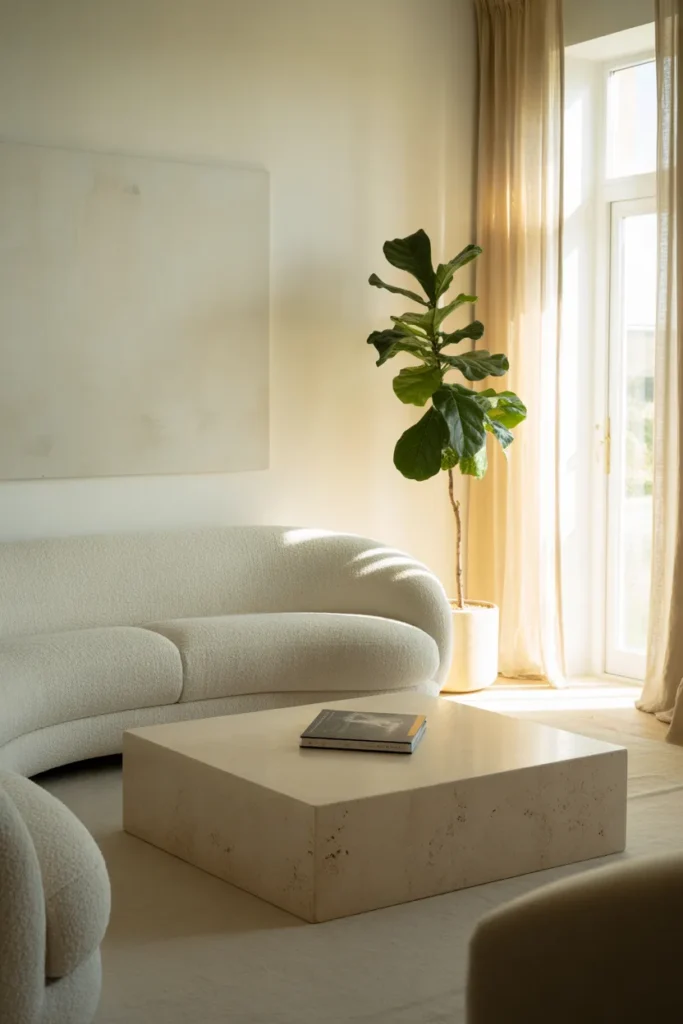
This is the right choice for living rooms with a neutral, tonal color palette — whites, creams, warm grays, soft greiges — where you want warmth and depth without introducing color or print. It also photographs exceptionally well, which is worth noting if you care about how your home looks in photos.
Maintain bouclé well by brushing lightly with a soft fabric brush every few weeks. It catches lint and pet hair more readily than smooth fabrics. Avoid it if you have multiple pets or young children who will be on the sofa daily — the loops can snag.
5. Position a Curved Sofa Facing a Floor-to-Ceiling Window to Frame the View
When a living room has a compelling view — a city skyline, a garden, a body of water, or simply a tree-lined street — the furniture layout should center that view. A curved sofa positioned to face a floor-to-ceiling window does this naturally, because the arc wraps the sitters inward and orients every seat toward the glass.
This works better than a straight sofa in a window-facing position because a straight sofa creates two end seats that look slightly sideways at the view. A curved sofa positions every occupant to face forward, toward the window, without any seat feeling like an afterthought.
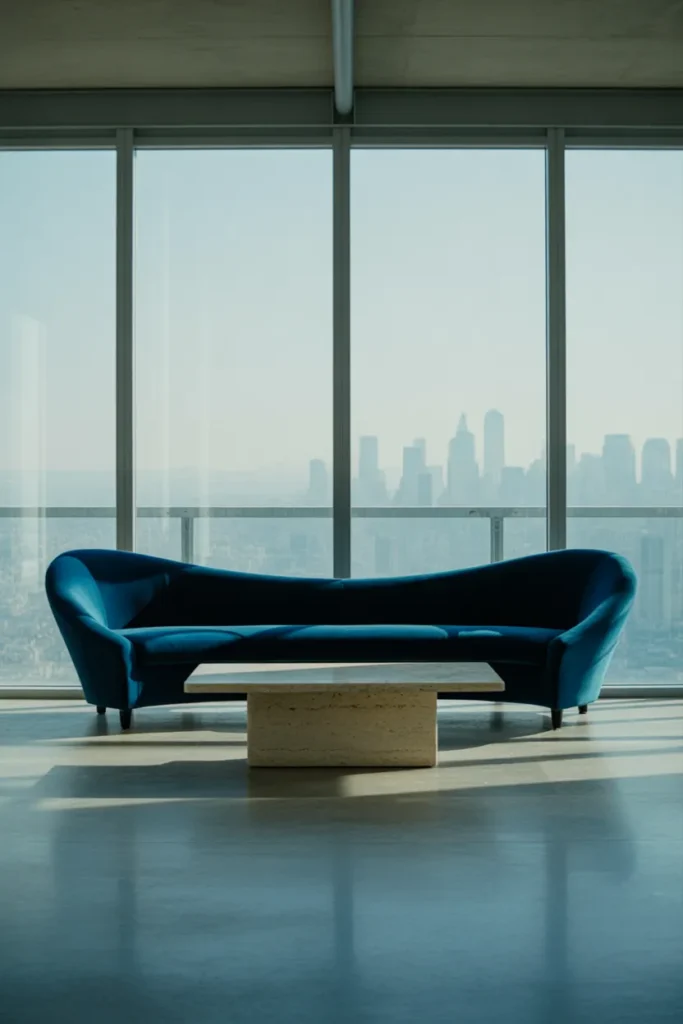
In rooms with a strong view, keep the rest of the decor deliberately minimal. The view is the art. A curved sofa in a muted, solid fabric, a simple coffee table, and nothing else competing for attention is the correct approach. Cluttering the space with side tables, floor lamps on both ends, and decorative objects defeats the purpose of the window-forward layout.
This setup is particularly effective in high-rise apartments, homes with garden-facing rear extensions, and any room where the window provides more visual interest than any artwork could.
6. Use a Curved Sofa With Exposed Legs to Keep a Small Living Room Feeling Open
In small living rooms, the floor plane is one of your most valuable visual assets. The more floor you can see, the larger the room feels. A curved sofa with exposed slim legs — rather than a skirted or platform-base sofa — keeps the floor visible underneath the piece, which preserves the sense of open space even when the room is modestly sized.
This is the same visual principle used in interior design when choosing raised furniture for small rooms: visible floor equals perceived space. A curved sofa that sits low to the ground with no leg gap eats up the visual floor and compresses the room. Exposed legs — in brass, black iron, or natural walnut — lift the piece optically.
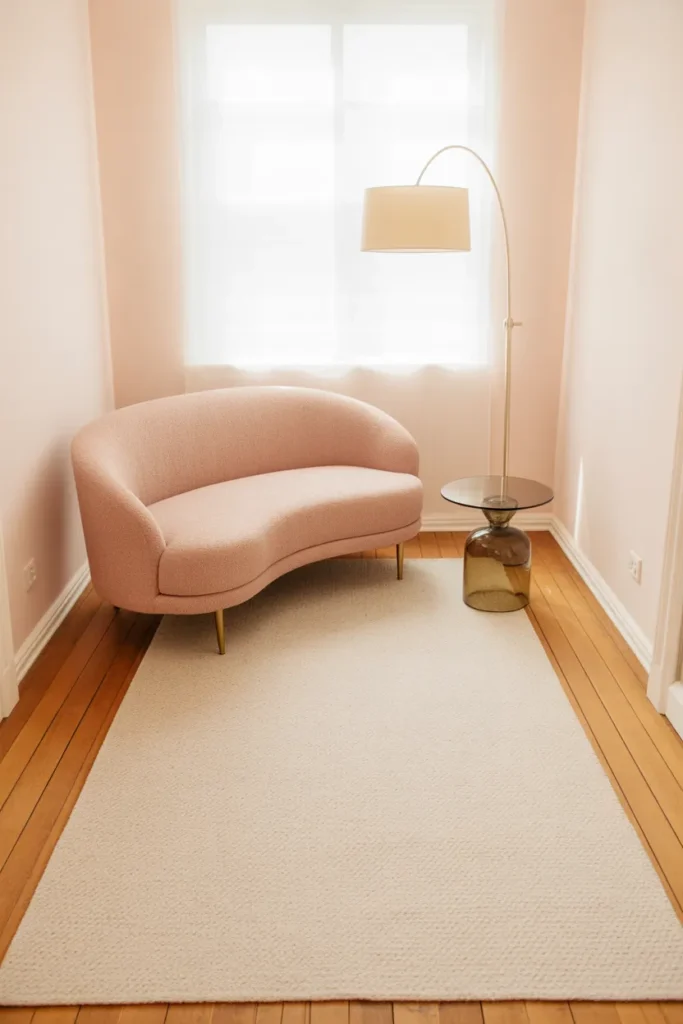
Pair the exposed-leg curved sofa with a rug that defines the seating zone. The rug should be large enough that the front legs of the sofa sit on it — never float behind it. This grounds the floating sofa visually and prevents it from looking like it was placed randomly.
Avoid this approach in rooms with very low ceilings, where floating furniture can sometimes emphasize the ceiling height awkwardly. In standard or high-ceiling rooms, it is almost universally the right choice.
7. Layer a Curved Sofa Into a Maximalist Room Without Losing Visual Order
Maximalism and curved sofas are a natural pair, but only when the curve is used as the anchor that brings order to a busy room. In a maximalist living room — layered rugs, gallery walls, mixed textiles, many objects — the curved sofa functions as the one consistent, sweeping shape that ties everything together. Its arc is soft against the hard lines of frames, shelves, and decorative objects.
The key is choosing a sofa in a single solid, grounded color that can hold its own against a visually active backdrop. Deep forest green, burgundy, cognac leather, or saturated navy work better than pale neutrals, which get swallowed in a maximalist environment.
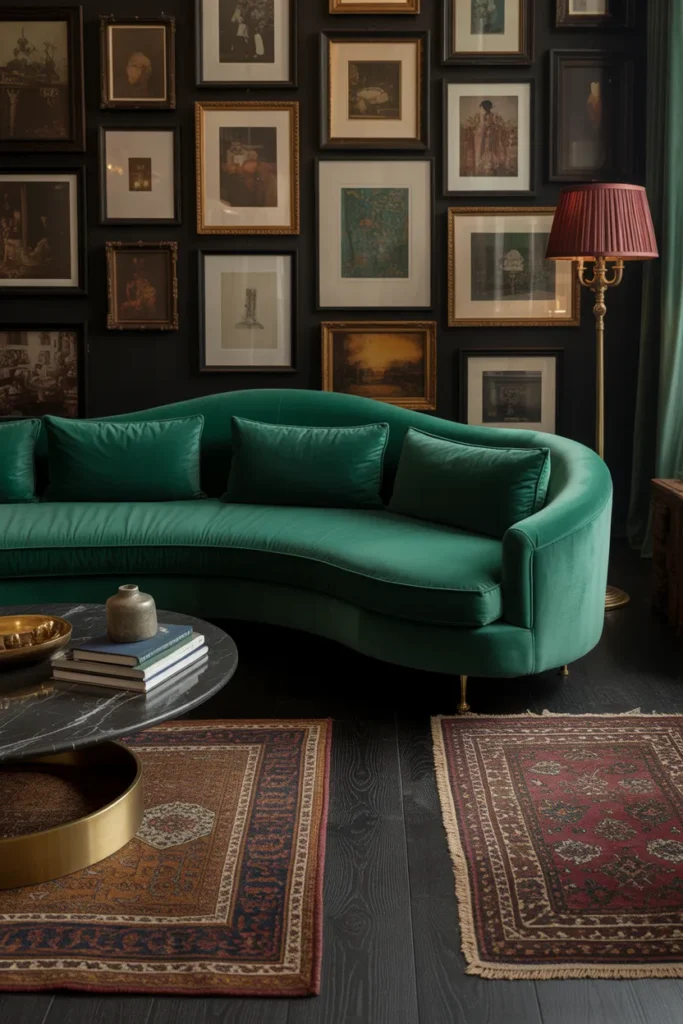
Place the curved sofa as the physical and visual center of the room, and build the maximalist layers outward from it. The gallery wall goes above and behind it. The layered rugs extend in front. The decorative objects cluster on the coffee table and side surfaces around it. The curve is the organizing anchor.
The mistake in maximalist rooms is trying to make the sofa itself busy — with pattern, fringe, or heavy decorative pillows. The room is already active. The sofa should be the one calm, confident element.
8. Combine a Curved Sofa With an Asymmetric Layout for a More Dynamic Living Room
Most living rooms are arranged symmetrically — sofa centered, identical side tables on each end, matching lamps. Symmetry is safe but often produces a room that feels static and overly formal. A curved sofa paired with an asymmetric layout brings movement and energy into the space without disorder.
The principle is simple: let the sofa anchor one side of the arrangement and use the remaining space on the other side for a single statement piece — a large plant, an arc floor lamp, a sculptural side table, or an armchair at an angle. The asymmetry creates visual interest and makes the room feel curated rather than arranged from a catalog.
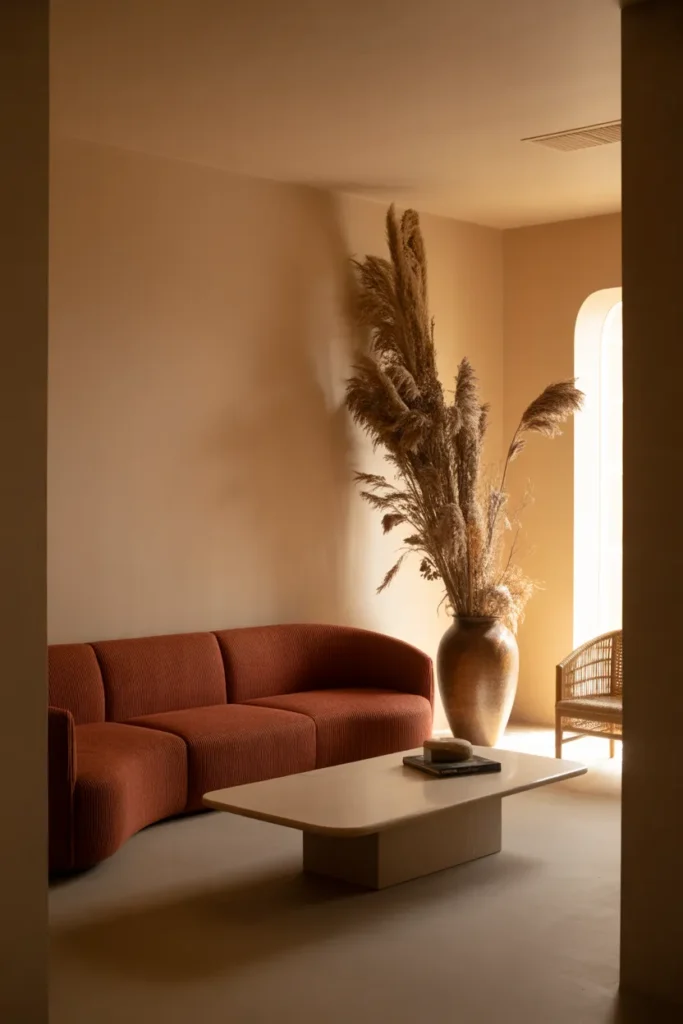
This works best in medium to large living rooms where there is enough space for the asymmetric element to breathe. In very small rooms, asymmetry can read as incomplete rather than intentional.
The curved sofa is ideal for this layout because its shape already implies movement and flow. A straight sofa in an asymmetric arrangement can look unfinished. A curved sofa in the same arrangement looks deliberate.
9. Select a Curved Sofa in a Dark Color to Ground a Bright White Room
All-white living rooms are clean and visually expansive, but they often lack the weight and grounding that makes a room feel finished. A curved sofa in a deep, saturated color — charcoal, navy, hunter green, chocolate brown — gives a white room the visual anchor it needs without introducing pattern or complexity.
The contrast between a white room and a dark curved sofa is one of the most effective and timeless combinations in interior design. The dark sofa reads as a confident design choice. The white room makes the sofa’s shape pop clearly, which means the curve itself becomes the design statement.
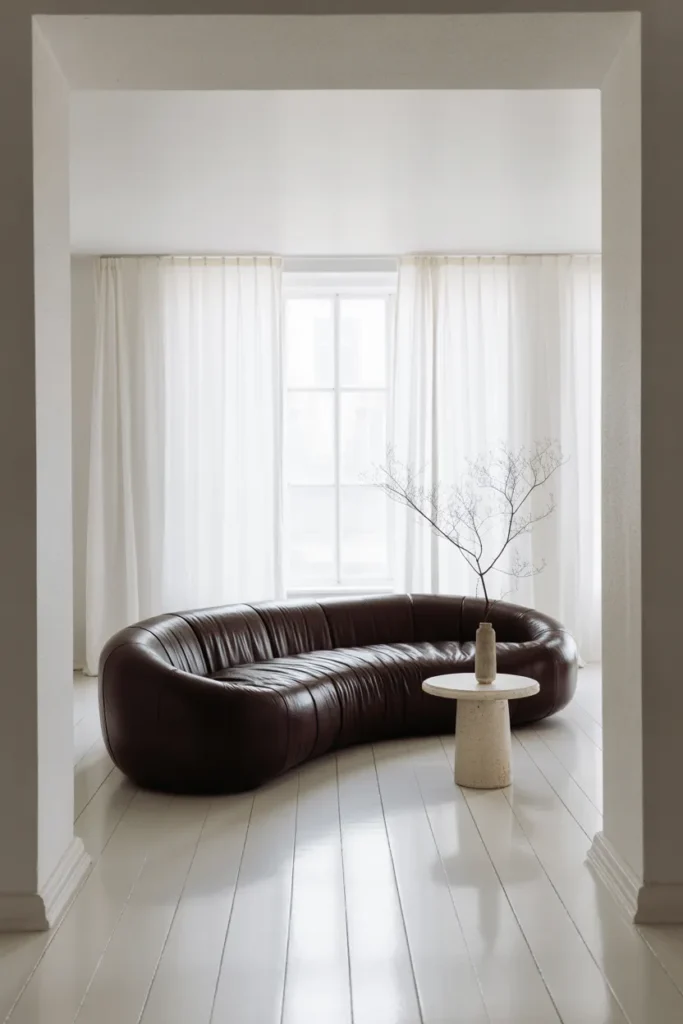
This pairing also photographs exceptionally well, which is part of why it is consistently popular in interior design media. The curve of the sofa is legible in a high-contrast setting in a way it simply is not in a room where the sofa blends into its surroundings.
Avoid adding too many other dark elements around the sofa — a dark rug, dark curtains, dark coffee table all at once. One or two dark accents are enough. The power of this layout comes from the tension between the dominant white field and the single dark anchor.
10. Build a Curved Conversation Pit Effect Using Modular Curved Sofa Sections
A full sunken conversation pit is an architectural feature most homes cannot accommodate. A modular curved sofa arranged in a near-complete circle or deep U-shape on a defined rug achieves the same psychological effect — a sense of enclosure, intimacy, and focus — without any construction. The arrangement signals clearly that this is a space for gathering and conversation, not just watching television.
Modular curved sections allow you to configure the depth of the arc depending on your room size. A tighter arc works in medium rooms. A wider, deeper U-shape works in large rooms with high ceilings. The modularity also means you can reconfigure over time as your space or needs change.
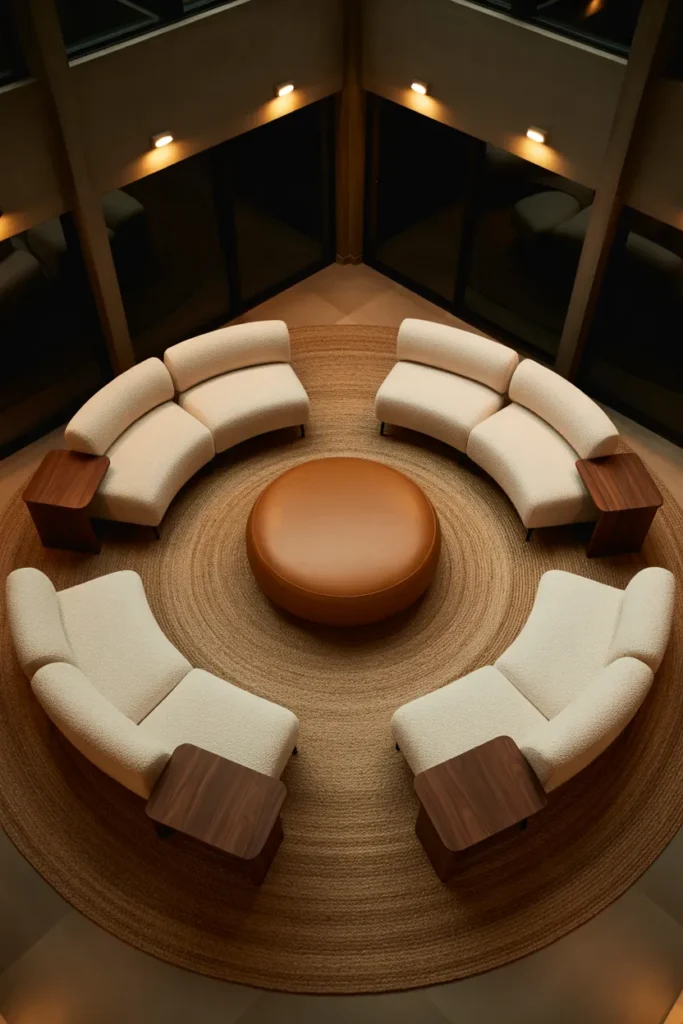
Place a round ottoman or a large round coffee table in the open center of the arrangement. The closed-off center gives the grouping a natural focal point and provides a surface for everyone seated to use comfortably.
This layout is not ideal for rooms where the primary function is television viewing. The inward-facing curve draws attention to the center of the arrangement, not toward a wall-mounted screen. If TV is the main activity, a crescent shape is more appropriate than a deep U.
11. Introduce a Curved Sofa Into a Mid-Century Modern Room for a Contemporary Update
Mid-century modern interiors rely on clean lines, tapered legs, and organic shapes — which makes them surprisingly compatible with curved sofas. A curved sofa in a mid-century room feels like the natural evolution of the style rather than a departure from it. The organic form echoes the period’s interest in sculptural, functional furniture.
The key is choosing a curved sofa with mid-century design cues: tapered wooden legs, a lower profile, and an arm style that is slim rather than oversized. Fabrics in warm mustard, burnt orange, olive green, or warm camel all reference the period palette while keeping the sofa looking current.
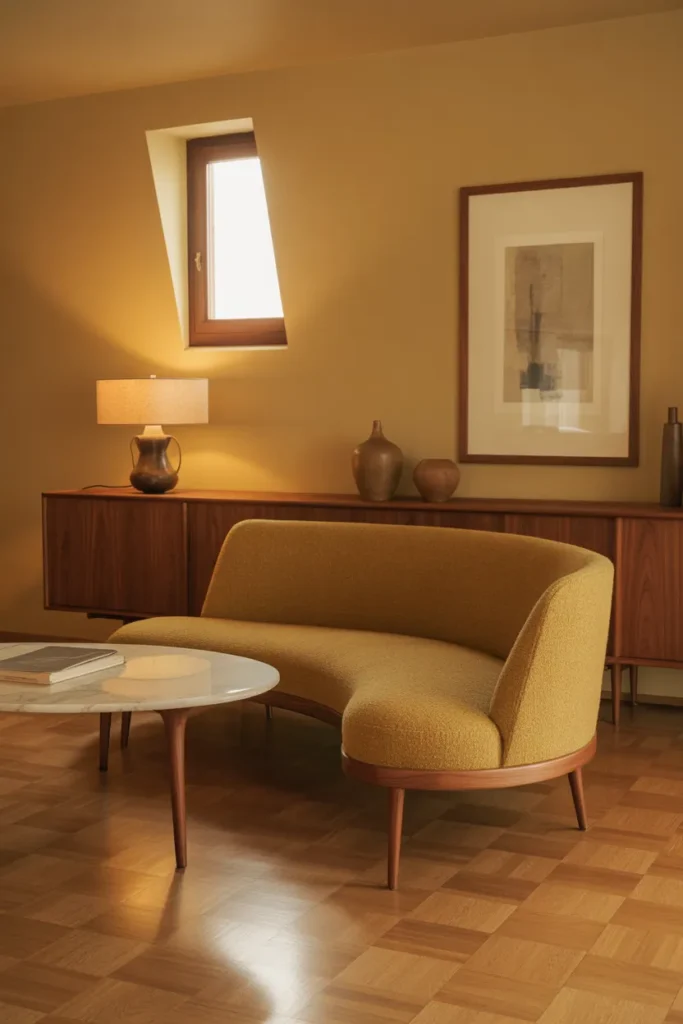
Position the curved sofa as the anchor of the seating area, and complement it with existing mid-century pieces — a tulip or sputnik coffee table, an Eames-style side chair, or a credenza along the opposite wall. The mix of curved and angular mid-century pieces creates the layered, collected look that makes the style feel authentic.
Avoid pairing a mid-century curved sofa with overly contemporary minimalist decor — all gray, all straight lines, no warmth. The clash between the warmth of mid-century and the coldness of stark minimalism reads as unresolved rather than intentional contrast.
12. Use a Curved Sofa to Solve an Awkward Diagonal Corner in an Irregular Room
Not every living room is a perfect rectangle. Bay windows, angled walls, chimney breasts, and irregular footprints create corners and angles that standard furniture never quite fills correctly. A curved sofa is one of the few furniture forms that resolves an awkward room shape rather than fighting it.
By positioning the curved sofa at an angle — or by choosing a sofa whose arc follows the room’s own geometry — you create a layout that feels responsive to the space rather than imposed upon it. The soft curve forgives irregular angles in a way that straight-edged furniture never can.
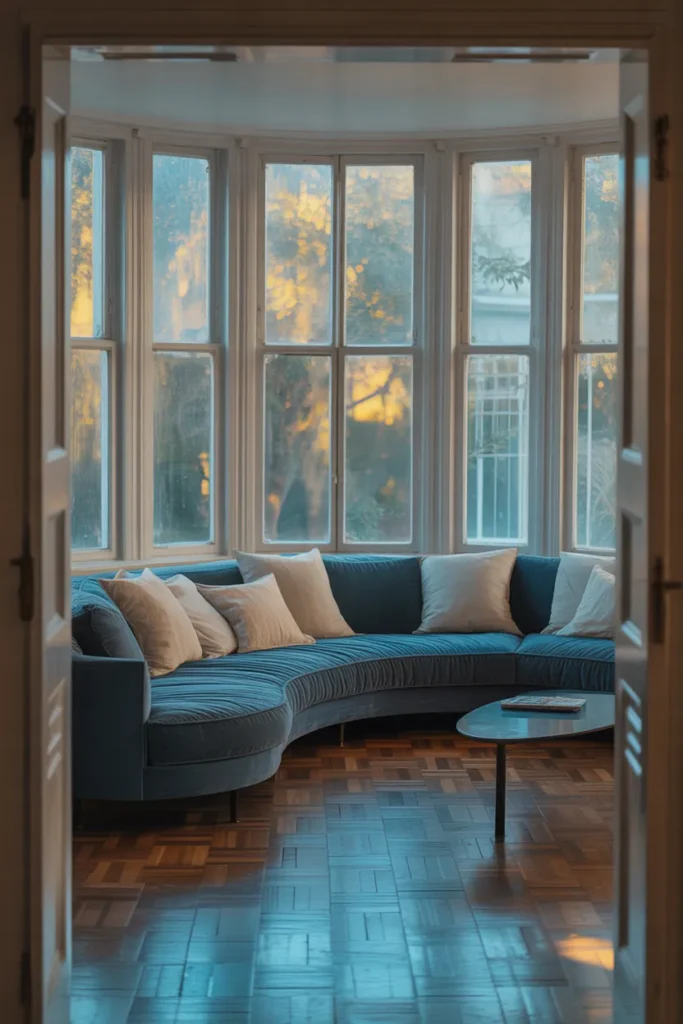
This approach works particularly well in rooms with bay windows. Placing a curved sofa in front of a bay window, with the arc mirroring the bay’s own curve, creates an immediate sense that the furniture belongs exactly where it is. It also maximizes the seating capacity near the window without blocking the glass.
The mistake in irregular rooms is always the same: choosing a large straight sectional and trying to force it into a corner that does not support it. The result is a sofa that looks jammed in, exposed dead space on one side, and a layout that will never feel resolved.
13. Choose a Curved Sofa With a High Curved Back for Maximum Drama in a Tall-Ceiling Room
Rooms with high or double-height ceilings have a specific problem: standard-height furniture looks undersized and makes the ceiling feel even more disconnected from the room’s activity. A curved sofa with a high, enveloping back addresses this by adding vertical presence to the seating zone without requiring tall bookcases or oversized art.
A high-back curved sofa also creates its own microenvironment — a sense of enclosure and intimacy within a large open room. Sitting inside the curve of a high-back sofa in a tall room feels protected and cozy, which is exactly the experience a large room needs to manufacture at the human scale.
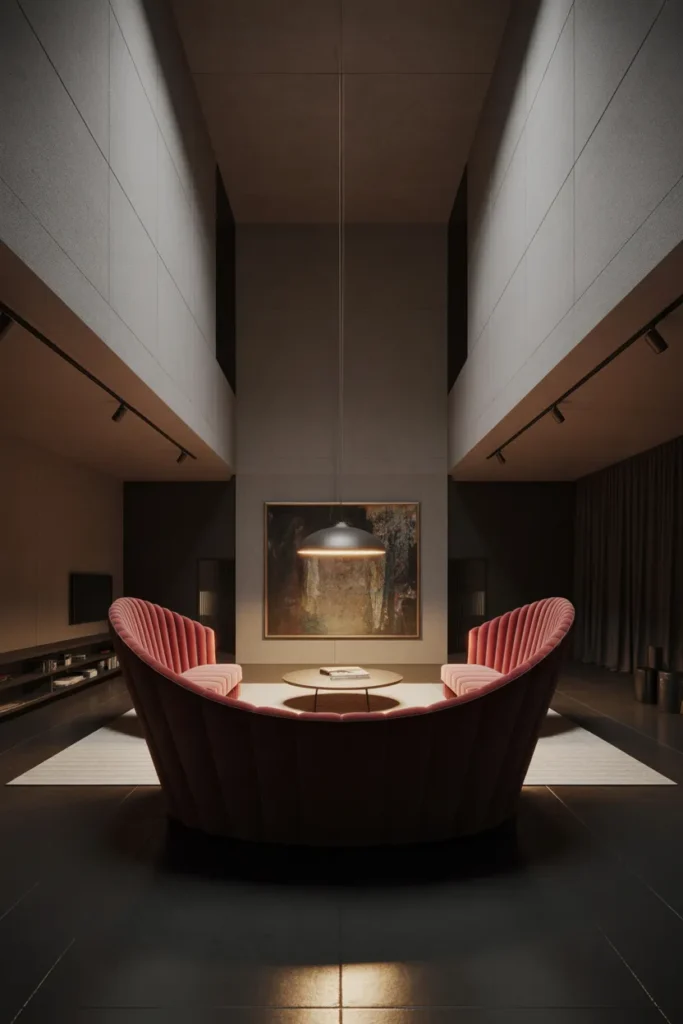
These sofas work best in rooms where the sofa is positioned away from the wall, so the full height and form of the back is visible. Pushed against a wall, a high-back curved sofa loses its most distinctive quality.
This is not the right choice for rooms with standard eight-foot ceilings. In low-ceiling rooms, a high-back curved sofa will feel overpowering and will visually compress the ceiling further. Reserve this form for rooms that genuinely have the vertical space to support it.
14. Pair a Curved Sofa With Natural Stone Surfaces for an Organic Modern Living Room
The organic modern interior trend for 2026 is centered on a specific combination: soft, rounded forms paired with raw, natural materials. A curved sofa is the defining furniture piece of this aesthetic, and pairing it with natural stone surfaces — travertine, honed marble, limestone, or raw slate — creates the tension between softness and hardness that defines the style.
The curved sofa provides the soft, enveloping form. The stone surfaces — a travertine coffee table, a slate side table, a stone-clad fireplace — provide the weight and rawness that keeps the room from feeling too precious or overly decorated. Together, they achieve the grounded, natural quality that this aesthetic is known for.
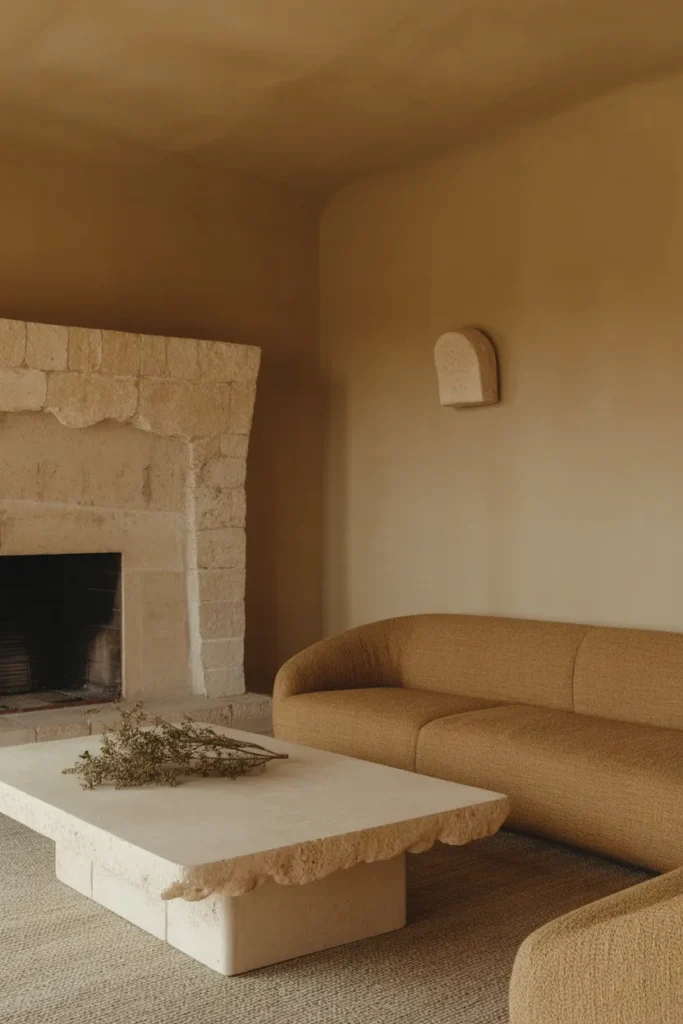
This combination works across a wide range of room sizes and layouts. In smaller rooms, use stone on one surface only — the coffee table is the most impactful choice. In larger rooms, layer stone across multiple surfaces for a more immersive effect.
Choose sofa fabric that references the organic palette: warm cream, oat, sand, warm gray, or terracotta. Avoid bright colors in this context — they break the natural, grounded quality of the combination.
15. Add a Curved Accent Chair to Complement a Straight Sofa Before Committing to a Full Curved Sofa
Not everyone is ready to invest in a full curved sofa — and that is a practical consideration worth taking seriously. Curved sofas require more room to move around, more careful placement, and a commitment to a particular aesthetic. A curved accent chair used alongside a straight sofa is a lower-commitment way to introduce the curved form into your living room and test how it feels in your specific space.
Place a curved accent chair at an angle to the main sofa, creating a conversational grouping. The curve of the chair softens the straight line of the sofa and begins to move the room in the direction of curved sofa ideas for living room 2026 without requiring a full furniture replacement.
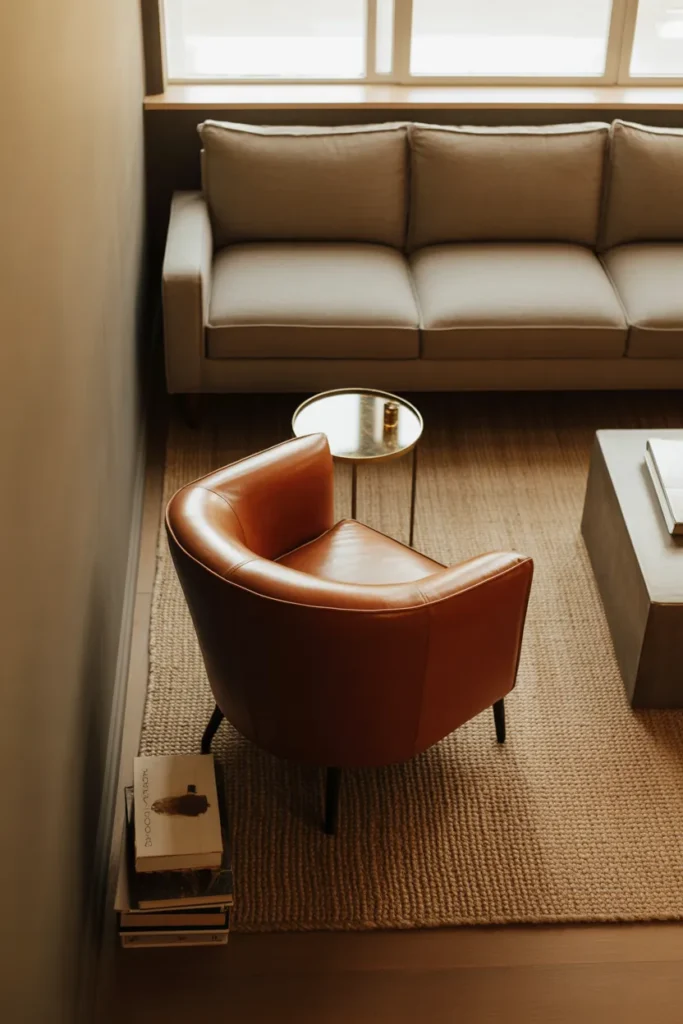
This is also a smart interim approach if you are planning a full room refresh but are not ready to execute it yet. The accent chair makes an immediate visual impact and bridges the gap between your current setup and where you want the room to go.
When the time comes to replace the main sofa, you will already know how a curved form functions in your specific space — how traffic flows around it, how it reads in the room’s light, and whether the aesthetic suits you day to day.
16. Use a Curved Sofa in a Jewel-Toned Color to Make a Neutral Room Instantly Memorable
Neutral living rooms are easy to live in but often forgettable. A curved sofa in a jewel-toned color — deep sapphire, amethyst, forest green, or rich teal — gives a neutral room an immediate identity without requiring any other significant changes. The sofa becomes the room’s design statement, and everything else can remain calm and understated.
The curved form amplifies the impact of a bold color because the arc of the sofa displays more fabric surface than a straight sofa of similar length. You see the color wrapping around the form, which is more visually engaging than a flat frontal presentation.
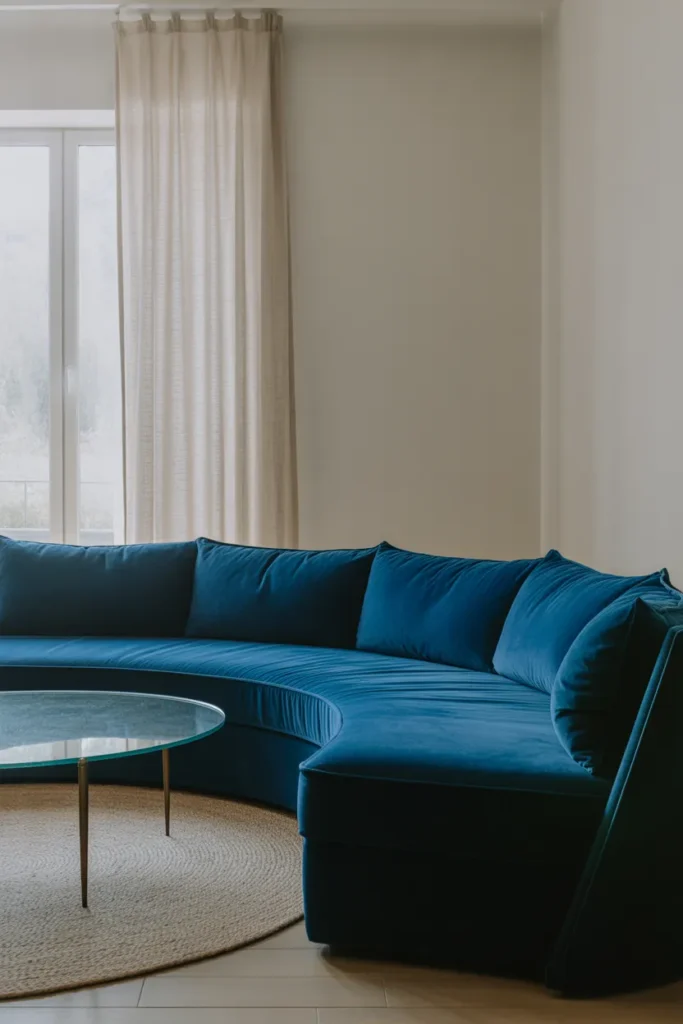
This works best when the walls, floors, and remaining furniture are genuinely neutral — not off-white with other warm tones, but truly quiet and recessive. The contrast between a neutral field and a jewel-toned curved sofa is what creates the memorability.
One important consideration: jewel-toned velvet sofas photograph beautifully but can show wear and directional pile marks over time. In high-use family rooms, consider a performance velvet rather than standard velvet — it offers the same visual impact with significantly better durability.
17. Layer Cushions Strategically on a Curved Sofa to Work With the Shape, Not Against It
Cushion placement on a curved sofa requires a different approach than on a straight sofa. On a straight sofa, a row of cushions placed along the back at even intervals works perfectly. On a curved sofa, the same approach produces an awkward line of cushions that fights the curve rather than following it.
The correct approach is to fan the cushions along the arc, angling each one slightly so it follows the sofa’s curve rather than standing perpendicular to it. This keeps the cushions looking placed rather than propped, and maintains the visual integrity of the sofa’s form.
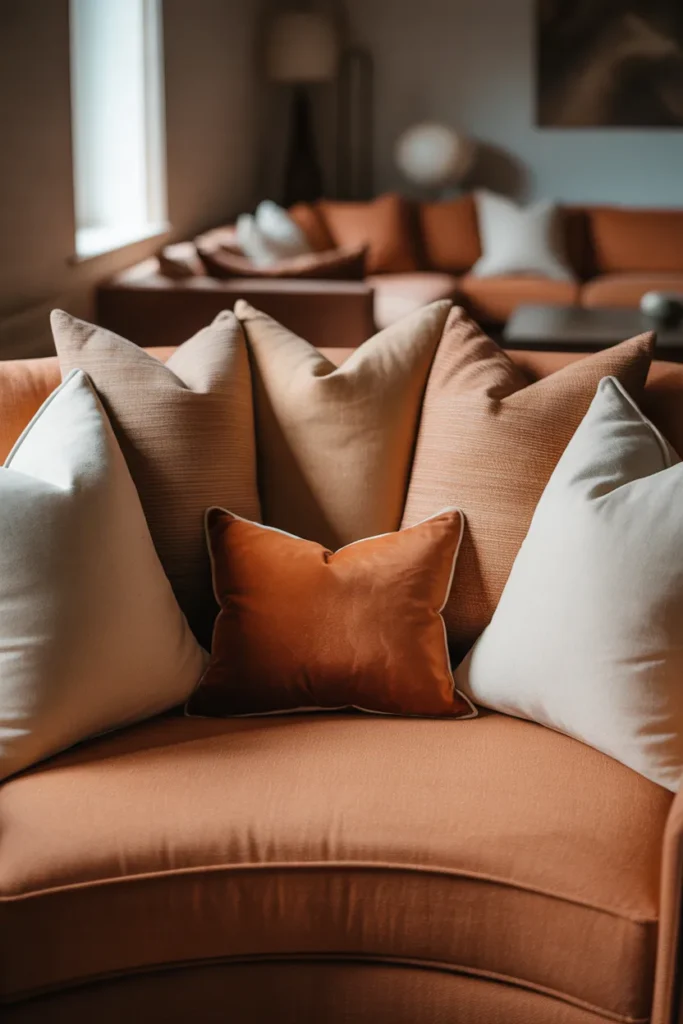
Use an odd number of cushions — three or five — rather than an even number. Odd groupings feel more natural and less rigid, which suits the organic quality of a curved sofa. Vary the size slightly: two larger cushions at the ends and one or two smaller cushions in the center, or vice versa.
Avoid mixing too many patterns. On a curved sofa, which is already a strong visual form, two patterns maximum is the limit before the arrangement becomes visually noisy. One solid, one subtle texture, and one gentle pattern is a reliable and tested combination.
Final Thoughts
The right curved sofa in the right placement will do more for your living room than almost any other single design decision. Whether you are working with a small studio, an open-plan layout, or a large room that needs anchoring, these curved sofa and chair ideas for living room 2026 give you the practical framework to make a decision that actually works in your space. Save this post before you go — it covers everything from fabric and color to layout, delivery, and cushion placement, and it is the kind of guide you will want to return to when you are ready to shop. If you want to keep exploring, look into round coffee table pairings and open-plan living room layout ideas to continue building on what you have started here.