
Choosing the wrong backsplash is one of the most common and costly kitchen mistakes — it either clashes with everything around it or blends in so completely it adds nothing. These kitchen backsplash ideas 2026 are organized by material, layout, and kitchen type so you can identify the right option for your specific space before you commit to anything.
1. Zellige Handmade Tile Backsplash That Adds Texture Without Pattern Overwhelm
Zellige tile — the hand-pressed Moroccan clay tile with a naturally irregular glaze surface — has moved firmly into mainstream American kitchen design for 2026 because it solves a problem that machine-made subway tile cannot: it adds visual depth and texture without introducing a repeating pattern that competes with cabinetry or countertops.
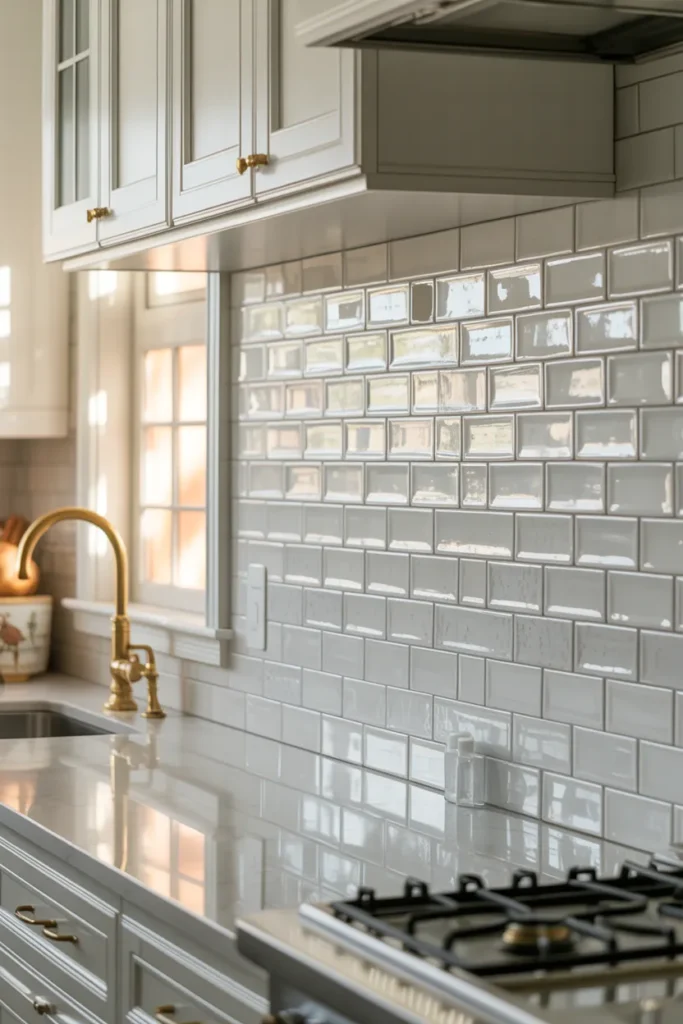
Each zellige tile varies slightly in color, thickness, and surface reflection. Installed in a standard running bond or stacked grid, the variation in the tile itself creates visual interest without any decorative pattern work. This makes it a particularly forgiving backsplash choice for kitchens with bold cabinet colors or strongly veined countertop stone — the zellige adds richness without adding noise.

The practical consideration most people overlook is grout joint width. Zellige tiles are handmade and therefore not dimensionally consistent. They require wider grout joints — typically 3/16 to 1/4 inch — than machine-made tile. Attempting to install zellige with the tight 1/16-inch joints used for ceramic subway tile will result in cracked tiles and failed installation within months. Use an unsanded grout or a narrow-joint epoxy grout matched to the tile’s dominant color.
2. Full-Slab Porcelain Backsplash That Eliminates Grout Lines Completely
A full-slab porcelain backsplash — where a single large-format panel runs from countertop to upper cabinet or ceiling without any grout joints — is one of the most practical kitchen backsplash ideas for 2026 in terms of long-term maintenance. Without grout lines, there is no surface for grease, steam, or food residue to penetrate. The entire backsplash area wipes clean with a single pass.
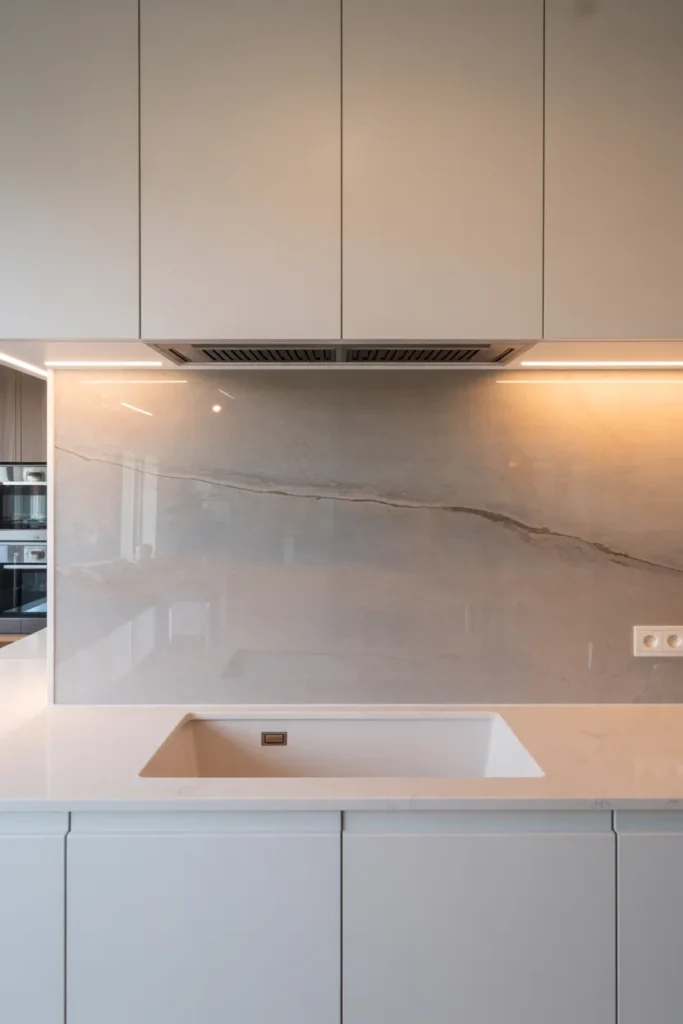
This approach works best in contemporary and minimalist kitchens where clean, uninterrupted surfaces are the defining design principle. Large-format porcelain is available in slab sizes up to 126 by 63 inches, which is sufficient to cover the typical backsplash zone of most residential kitchens in a single panel. Bookmatch two slabs side by side in a larger kitchen for a mirror-image stone effect that reads as architectural rather than decorative.
The installation challenge is weight and fragility during handling. Large-format porcelain panels can weigh 80 to 150 pounds and will crack under uneven pressure during cutting or setting. This is not a DIY installation for most homeowners — professional installers with large-format tile experience and suction-cup handling equipment are necessary to execute this correctly. Attempting to install large-format porcelain without the right equipment is the most common and expensive mistake in this category.
3. Unlacquered Brass Mirror Tile Backsplash for Moody Galley Kitchens
Mirrored or metallic tile backsplashes expand the perceived depth of a kitchen by reflecting light and the surrounding space back into the room — a functional benefit that matters significantly in narrow galley kitchens or any kitchen without a window at the sink wall. Unlacquered brass mirror tile takes this concept further by adding a warm amber tonal shift to the reflection, which reads as intentional patina rather than cold chrome.
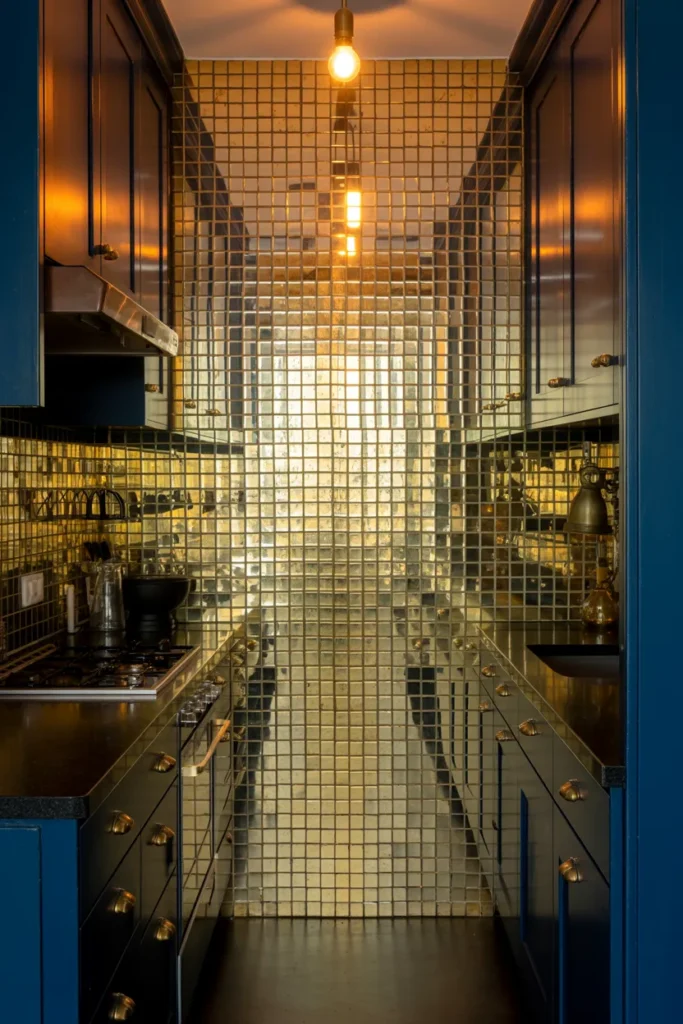
This backsplash type is specifically suited to kitchens that lack natural light or feel enclosed due to their layout. A standard 8×8 or 4×4 antique brass mirror tile installed in a stacked joint will visually double the depth of the wall it covers. In a galley kitchen with this backsplash on one wall, the space reads as significantly wider and more open than its actual dimensions.
The maintenance reality of mirrored tile is that fingerprints, water spots, and cooking residue are more visible on a reflective surface than on a matte tile. A spray of glass cleaner after cooking sessions is necessary to keep the surface looking intentional rather than neglected. This is not the right choice for households with young children or for kitchens used for high-volume cooking where cleanup is a constant effort.
4. Limewash Plaster Backsplash That Works in Rental Kitchens and Tight Budgets
Limewash plaster applied directly over existing tile or drywall is one of the most cost-effective kitchen backsplash ideas for 2026 because it requires no demolition, no tile, and no grout — only surface preparation, the limewash material itself, and a few hours of application time. The result is a soft, layered, matte surface with organic variation that reads as artisanal and considered.
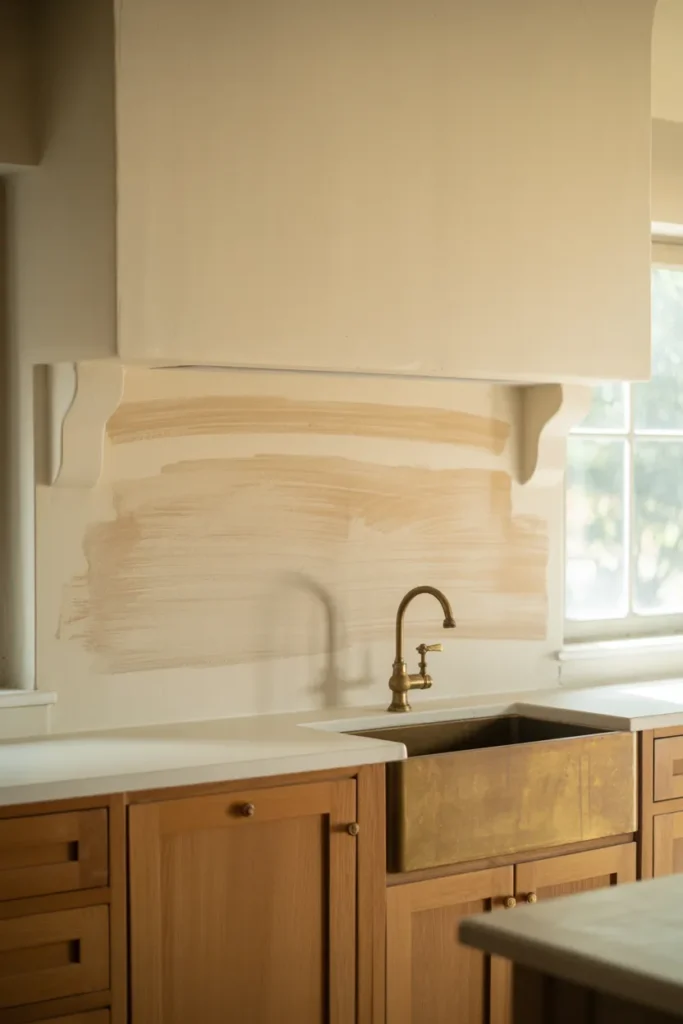
This approach works in rental kitchens where tile removal is not permitted, in older homes where the existing tile is sound but dated, and in any kitchen where the budget does not support a full backsplash replacement. Limewash is applied in two to three thin coats with a wide natural-bristle brush, and the variation in coverage is what creates the characteristic depth — brushwork that is too uniform defeats the purpose.
The durability limitation is important to understand before choosing this option. Limewash plaster is not as water-resistant as ceramic or porcelain tile. The area directly behind the sink and cooktop will require a penetrating sealer — reapplied every one to two years — to prevent moisture from penetrating and causing the finish to peel or bubble. Limewash is fully appropriate for backsplash areas away from heavy moisture exposure, but the sink surround requires the sealer without exception.
5. Fluted Ceramic Tile Backsplash That Adds Dimension to Flat White Kitchens
Fluted or ribbed ceramic tile — a standard ceramic body with a series of raised vertical channels on the face — introduces architectural dimension to a backsplash wall without color, pattern, or material drama. In an all-white or monochromatic kitchen, a fluted white ceramic backsplash creates visual interest purely through the shadow play of its surface relief, which changes throughout the day as the light angle shifts.
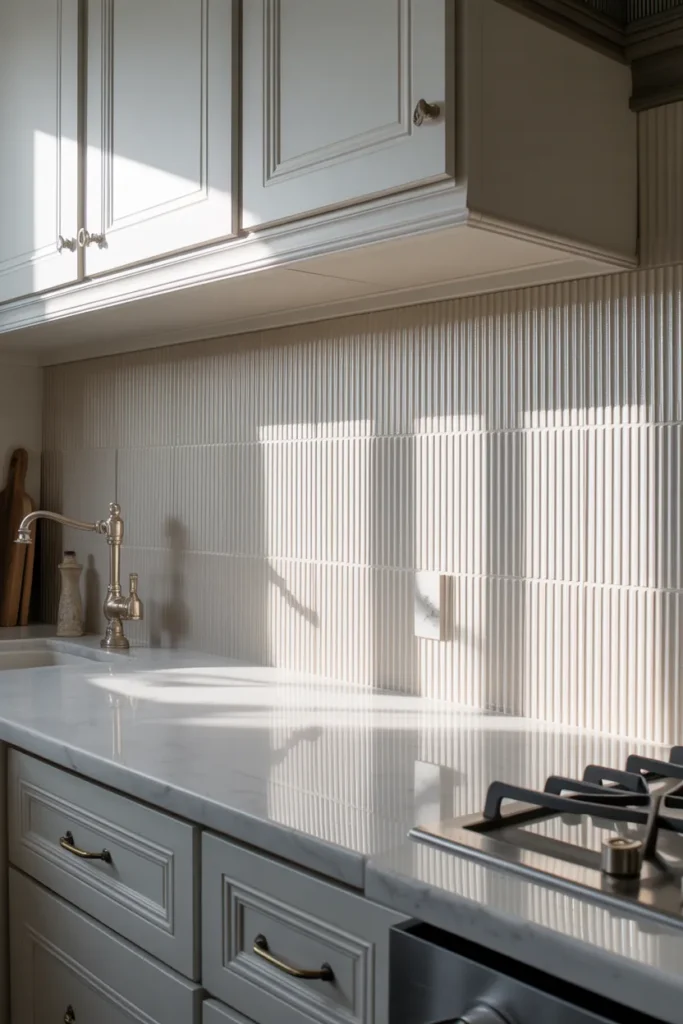
This is one of the most effective solutions for homeowners who want to upgrade a plain white kitchen without committing to color or a bold material. The fluted surface reads as a texture update rather than a design statement, which keeps the kitchen feeling calm and livable rather than trend-driven. It also photographs exceptionally well under both natural and task lighting, which matters for anyone staging a home or maintaining a design-focused social media presence.
Install fluted tile with the channels running vertically for the most effective shadow definition. Horizontal installation flattens the visual effect significantly and loses most of the dimensional quality that makes this tile worth using. Grout color should match the tile body as closely as possible — a contrasting grout color in the narrow channels between flutes creates a striped visual effect that overwhelms the subtle texture the tile is designed to provide.
6. Dark Grout With White Subway Tile for a Grid That Commands Attention
White subway tile with dark grout — charcoal, slate, or near-black — is one of the most underutilized kitchen backsplash ideas 2026 continues to validate, because it takes the most familiar tile format in American kitchens and makes it look deliberate and graphic rather than default. The dark grout lines create a visible grid across the white tile field that reads as an intentional pattern element rather than a maintenance afterthought.
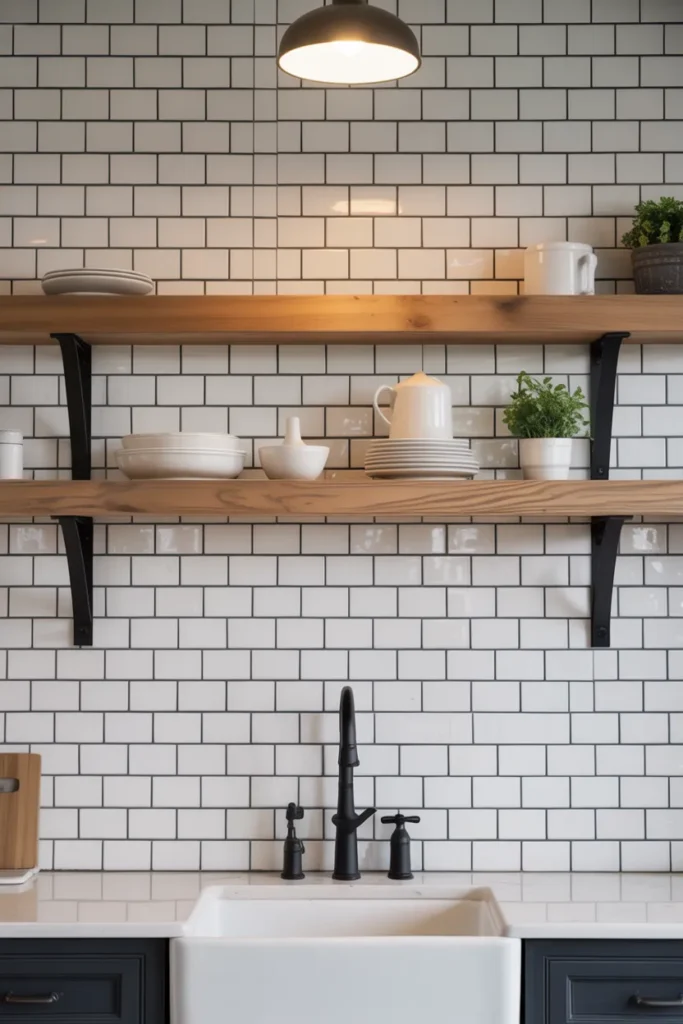
This combination works in kitchens where the cabinetry and countertop are relatively neutral — white, gray, or natural wood — and the backsplash is intended to provide visual structure. It also works particularly well in kitchens with open shelving, where the grid of the backsplash creates an organized visual backdrop for the shelving content rather than competing with it.
The practical advantage that most homeowners discover after installation is that dark grout does not show staining the way standard white or light gray grout does. In a kitchen with a gas cooktop or heavy daily cooking, a white grout subway tile backsplash will show discoloration within one to two years regardless of sealing. Dark grout eliminates that problem entirely and maintains its appearance with standard cleaning.
7. Terracotta Tile Backsplash That Brings Warmth to Cool Gray Kitchens
Terracotta tile — either traditional unglazed Mexican saltillo or a refined pressed Italian format — introduces a warm, earthy material quality to kitchen backsplash walls that no painted or glazed surface can replicate. The natural clay color ranges from pale peach to deep rust, and the variation within a single tile is part of its material authenticity rather than a defect.
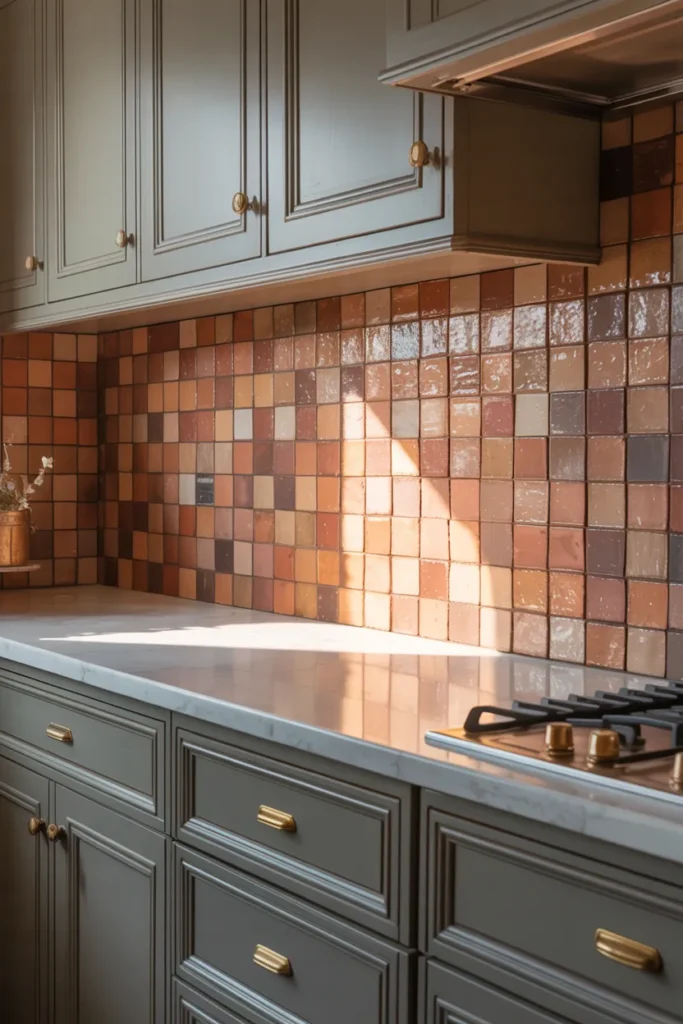
This backsplash choice is particularly effective in kitchens dominated by cool tones — gray cabinets, white quartz countertops, stainless appliances — where a warm material anchor is needed to prevent the space from reading as clinical. A terracotta backsplash in a cool gray kitchen creates a warm-cool material balance that feels resolved and considered rather than matched.
Sealing is the non-negotiable maintenance step with unglazed terracotta. Unsealed terracotta is highly porous and will absorb cooking oils, food stains, and moisture within minutes of contact. Apply a penetrating sealer before grouting and a topcoat sealer after grouting — then reseal once a year. Glazed terracotta formats eliminate this requirement but also lose much of the material warmth and authenticity that makes unglazed terracotta worth using in the first place.
8. Stacked Vertical Marble Mosaic Backsplash That Makes Ceilings Feel Taller
The orientation of a tile installation has a direct and measurable effect on how a kitchen reads spatially. A stacked vertical mosaic — where narrow rectangular tiles are installed vertically rather than horizontally — draws the eye upward along the wall, which makes ceiling height feel greater than it actually is. This is a space-planning technique used consistently in small kitchen layout design and apartment kitchens where ceiling height is fixed and cannot be altered.
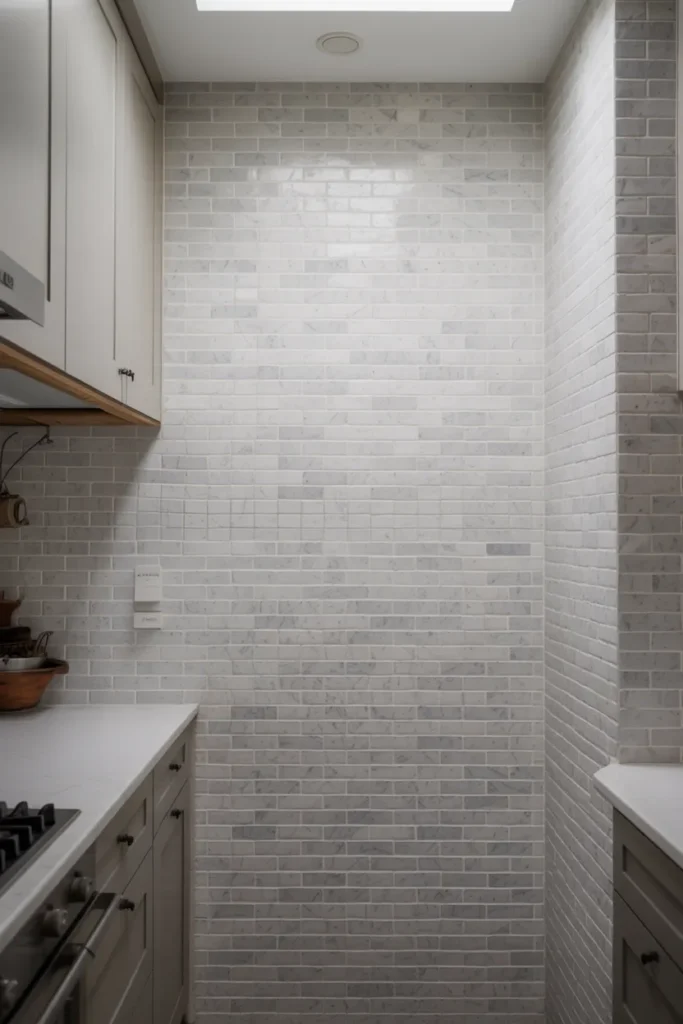
Marble mosaic in a vertical stacked format — typically 1×4 or 2×8 inch pieces — works well because the natural veining of the stone runs across multiple tiles, creating a continuous visual flow that reinforces the vertical movement. This is more effective than ceramic or porcelain in this format because synthetic materials lack the through-body veining that creates the connective visual flow between tiles.
The installation requirement for vertical stacked mosaic is precise layout from the centerline outward. Because the tiles are narrow and tall, any drift from plumb becomes visible quickly across the installation. A laser level set to plumb rather than level is the correct tool for setting the vertical reference line — standard spirit levels on narrow tile edges are not reliable enough for this application.
9. Handpainted Spanish Tile Accent Backsplash Used Strategically, Not Wall-to-Wall
A common and costly mistake with decorative handpainted tile is installing it across the entire backsplash zone. The visual result is overwhelming — the pattern competes with every other surface in the kitchen and creates a space that is difficult to live with daily. The correct application for handpainted Spanish or Talavera-style tile is as a strategic accent: a single row as a border, a panel behind the range, or a defined inset within a field of complementary neutral tile.
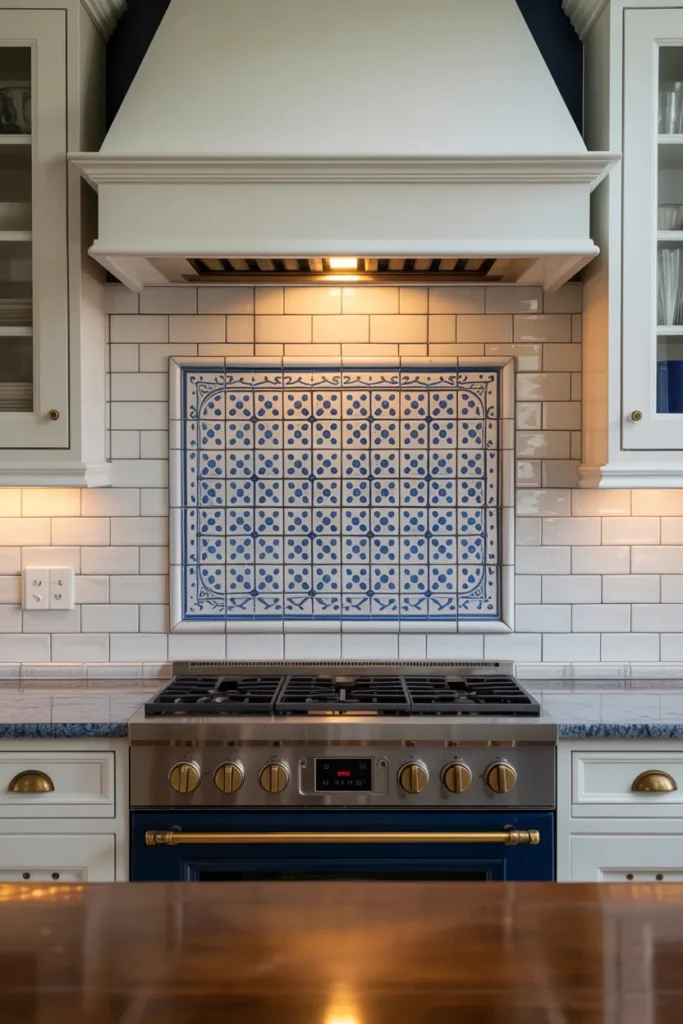
Used this way, handpainted tile becomes the focal point of the kitchen without overwhelming it. A five-tile-wide panel of blue and white Spanish tile centered behind a range, framed by a border of solid white subway tile on each side, reads as collected and intentional. The same tile installed edge to edge across the full backsplash wall reads as busy and unresolved.
This approach also has a practical advantage: decorative handpainted tile is significantly more expensive per square foot than field tile. Using it selectively in a focal accent panel rather than across the full backsplash area reduces material cost substantially while delivering more visual impact than a wall-to-wall installation would.
10. Concrete Microcement Backsplash for an Uninterrupted Industrial Look
Microcement — a thin-coat cement-based finish applied directly over existing surfaces — creates a completely seamless, joint-free backsplash wall with an industrial texture and matte surface quality that no tile can replicate. Applied in two to three thin coats with a trowel, microcement is suitable over existing tile, drywall, or backer board, and the finished surface can be tinted in a wide range of neutral and earth tones.
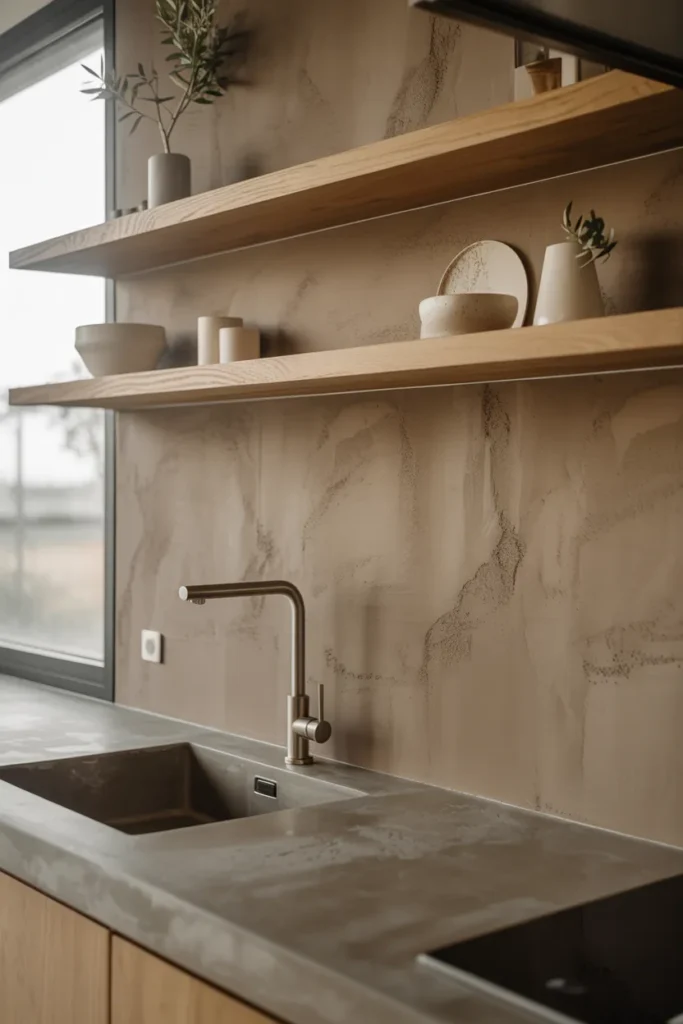
This finish reads as deliberately raw and architectural, which suits industrial, loft-style, and Japandi kitchen aesthetics where material honesty is part of the design language. It is one of the kitchen backsplash ideas 2026 that continues to gain traction specifically because it provides a seamless alternative to grout-jointed tile in kitchens where every visible grout line feels like visual noise.
Sealing is mandatory and non-negotiable with microcement in a kitchen environment. An unsealed microcement surface will absorb cooking oil, wine, and acidic liquids immediately and permanently. Apply a minimum of two coats of a food-safe penetrating sealer after the final microcement coat cures, followed by a topcoat wax or polyurethane finish. Reseal the entire surface every 12 to 18 months depending on cooking volume and cleaning frequency.
11. Recycled Glass Mosaic Backsplash That Performs Well in Bright Coastal Kitchens
Recycled glass mosaic tile — small pieces of tumbled or smooth glass set in a mesh sheet — catches and refracts natural light in a way that ceramic and stone tile cannot. In a kitchen with strong natural light, particularly in coastal or sun-facing orientations, a glass mosaic backsplash creates a shifting, luminous surface that changes character throughout the day as the sun angle moves.
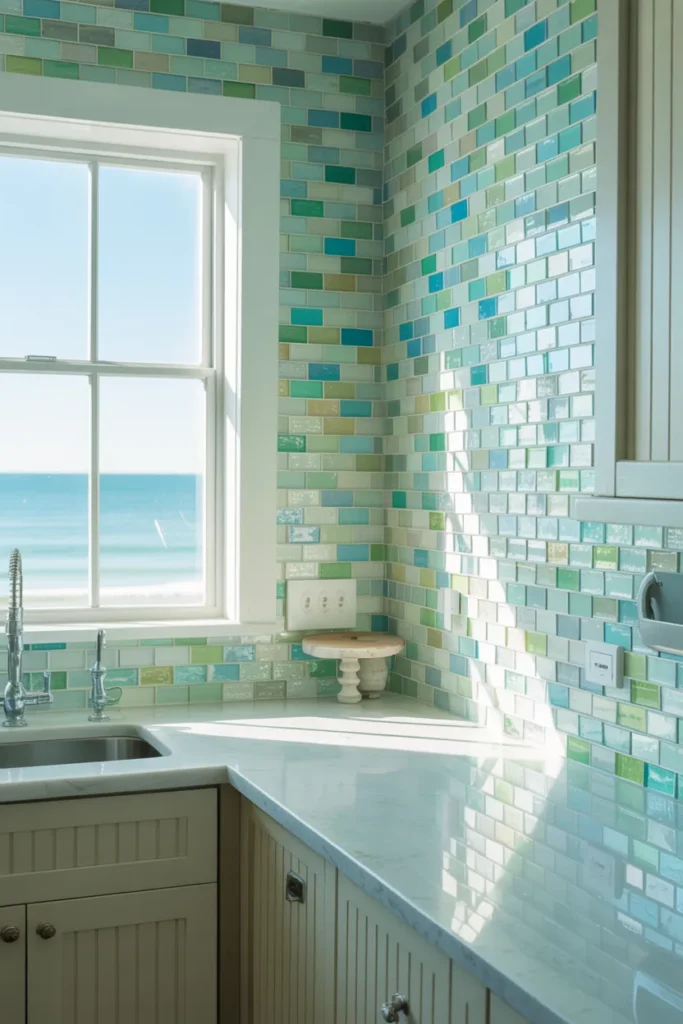
This backsplash is specifically suited to bright kitchens that receive direct sunlight for a significant portion of the day. The light-refracting quality of glass tile that makes it compelling in a sunny kitchen becomes its weakness in a north-facing or artificially lit kitchen, where the same tile reads as flat and dull without sunlight to activate it. Assess your kitchen’s light quality honestly before choosing this material.
Installation of glass mosaic requires a white or light gray polymer-modified thinset — not standard gray thinset. Standard gray thinset is visible through translucent glass tiles and gives the installation a muddy, grayish cast that defeats the luminous quality of the material. White thinset allows the glass color to read true and lets the translucency of the tile work as intended.
12. Bookmatched Quartzite Slab Backsplash With Dramatic Veining as Functional Wall Art
Bookmatched quartzite — where two slabs cut consecutively from the same block are opened like a book and installed as mirror images — creates a backsplash with a symmetrical vein pattern that functions as permanent wall art. The bilateral symmetry of the bookmatch is a naturally occurring pattern that reads as both organic and architectural, which is why it has become one of the most sought-after kitchen backsplash ideas 2026 for high-design kitchens.
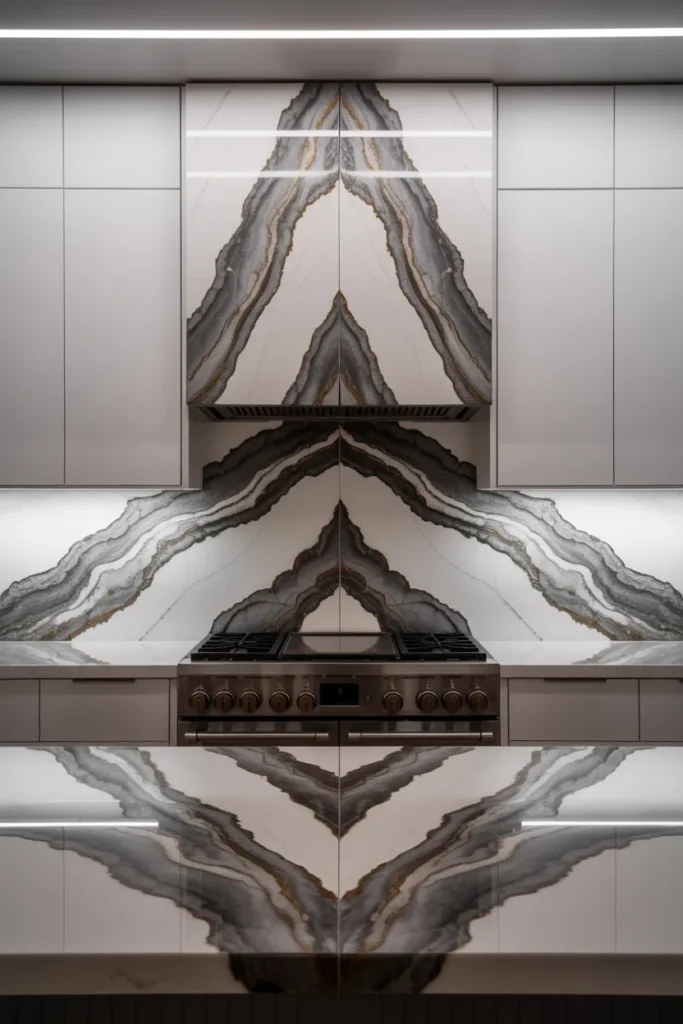
This works best when the backsplash runs the full width of the kitchen without interruption — no upper cabinets, just open wall space from countertop to ceiling. The full slab installation from counter to ceiling, combined with the bookmatched mirror image pattern, creates a backsplash that is the unambiguous focal point of the entire kitchen. It does not need — and should not have — competing design elements on the same wall.
Quartzite, unlike marble, is a metamorphic stone with a hardness rating that makes it genuinely resistant to etching from acidic foods and cleaning products. This is a practical distinction from marble that matters in a kitchen backsplash application. Confirm that your supplier is selling quartzite and not a soft quartzose marble — the two are frequently confused in the trade, and the difference in durability is significant. A hardness test or petrographic analysis from a reputable supplier resolves any ambiguity.
Final Thoughts
The best kitchen backsplash is the one that solves a specific problem in your kitchen — whether that is hiding a lack of natural light, adding warmth to a cool palette, simplifying maintenance, or making a low-ceiling space read taller. Every idea in this list was chosen because it addresses a real condition, not just because it looks good in a photograph.
Save this post to your Pinterest boards now so you have this reference when you are ready to decide. Revisiting these kitchen backsplash ideas 2026 side by side — rather than browsing dozens of unrelated images — is the fastest way to narrow your options and make a confident final choice. For more kitchen design guidance, explore our related posts on countertop material selection, cabinet hardware trends, and small kitchen layout planning ideas.