
Small apartment bathroom decor is one of the most searched and least well-answered topics in home design — most guides show beautiful spaces without addressing the real constraints of limited square footage, no natural light, and zero storage. This guide gives you 14 specific, actionable ideas with clear guidance on what works, what does not, and how to make each decision for your actual bathroom.
1. A Light-Reflective Color Palette That Makes a Tiny Bathroom Feel Twice as Large
Color is the single most impactful and lowest-cost change available in a small apartment bathroom. The right palette does not just look good — it physically changes how spacious the room feels by controlling how light moves across surfaces.
Warm whites, soft off-whites, pale greige, and light warm beige are the most reliable choices for small bathrooms. These tones reflect natural and artificial light back into the room rather than absorbing it, which creates the perception of more space without changing a single dimension. Cool whites with blue or gray undertones can work but tend to feel clinical rather than calm in small, enclosed spaces.
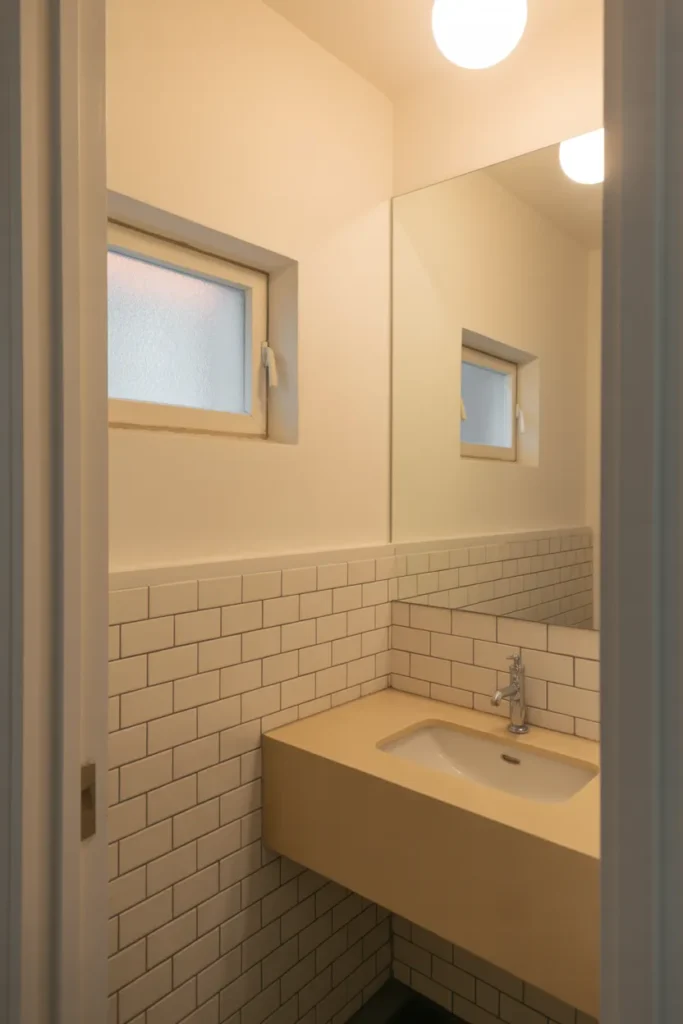

The most effective approach is a tonal palette — using two or three shades from the same color family rather than contrasting colors. A pale warm white on the walls, a slightly deeper ivory on the trim, and a soft sand on any cabinetry creates depth through tone rather than contrast, which reads as sophisticated and spacious simultaneously.
The mistake to avoid is using multiple distinct colors in a small bathroom. Dark walls, colorful tile, and bold vanity finishes each work individually in larger bathrooms but compete with each other in a space under 50 square feet, making the room feel fragmented and smaller than it is.
2. Vertical Storage That Draws the Eye Up and Keeps the Floor Clear
In a small bathroom, floor space is the most valuable resource. Every piece of furniture or storage unit that sits on the floor reduces the visible floor area and makes the room feel more confined. Vertical storage — shelving, cabinets, and organizers that extend upward rather than outward — solves the storage problem without consuming the floor.
A tall, narrow open shelving unit installed between the toilet and the wall, or a ladder shelf leaning against an unused wall section, adds significant storage capacity while keeping the floor visible beneath it. Visible floor equals perceived space — this is a consistent principle in small bathroom design that holds true across every style direction.
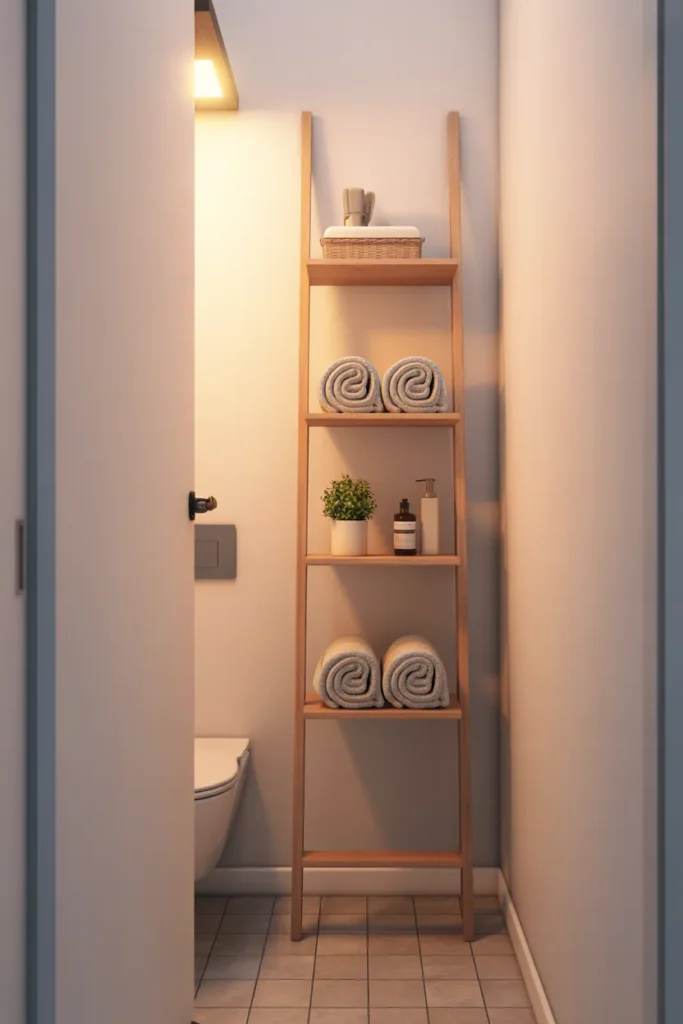
Over-the-toilet shelving is one of the most underused vertical storage solutions in apartment bathrooms. The 12 to 18 inches of wall space above a toilet is typically empty in most apartments and can accommodate a wall-mounted cabinet or two to three floating shelves that hold towels, toiletries, and decorative objects without any floor impact.
Vertical storage works best when it is organized rather than filled. Tall shelves that are crammed with mixed items add visual weight and clutter. Use uniform storage bins, rolled towels, and a limited number of decorative objects to keep the vertical display feeling intentional rather than overcrowded.
3. A Large Mirror That Doubles the Visual Depth of Any Small Bathroom
A mirror in a bathroom is not just a functional necessity — it is the most effective visual tool available for expanding a small space. A large mirror reflects the room back at itself, effectively doubling the perceived depth and bringing more light to every corner.
The guiding principle is to go larger than feels comfortable. In a bathroom that is 40 to 60 square feet, most people default to a mirror that matches the width of the vanity. The stronger design decision is to extend the mirror significantly wider — to the full width of the vanity wall, or as close to it as plumbing and electrical placement allow. A mirror that spans from near the ceiling to the top of the backsplash creates a seamless reflective surface that transforms the room’s perceived scale.
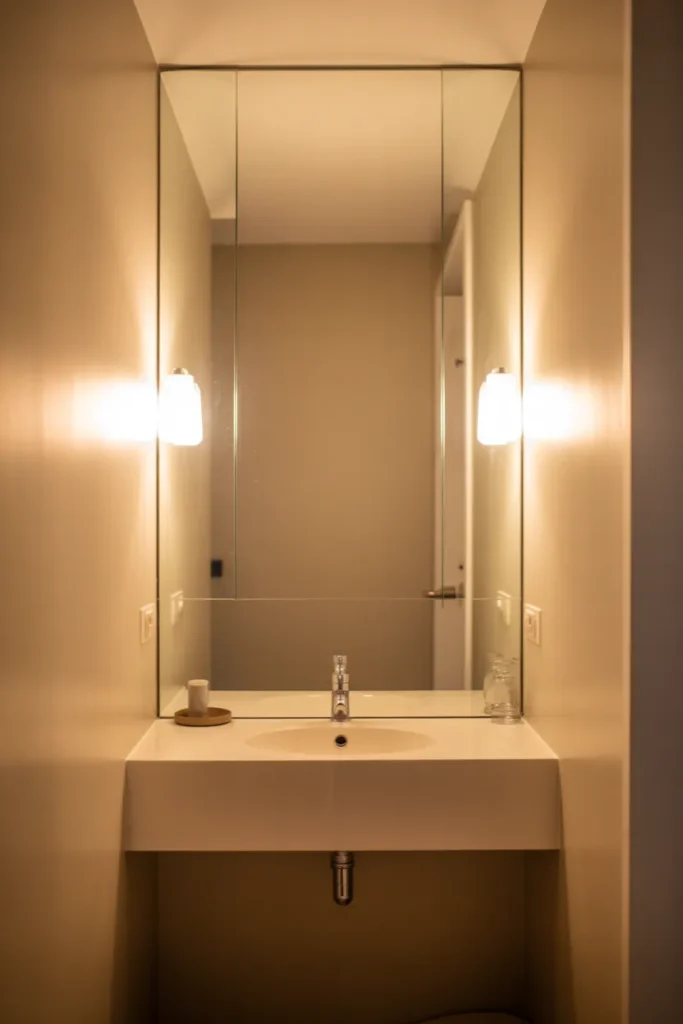
Frameless mirrors or mirrors with thin metal frames (brushed nickel, matte black, or unlacquered brass) keep the wall feeling open. Wide, heavy frames add visual mass that works against the expansive effect you are trying to create.
In bathrooms with no natural light, a large mirror positioned across from the primary light source — overhead vanity light or wall sconce — amplifies the artificial light significantly. This is one of the most effective fixes for dim, windowless apartment bathrooms and costs less than any lighting upgrade.
4. Open Floating Shelves That Replace Bulky Bathroom Cabinets
Standard bathroom vanity cabinets with solid doors are practical but visually heavy. In a bathroom under 50 square feet, a bulky cabinet base can make the room feel like it is dominated by furniture. Replacing a cabinet-style vanity with a floating open-shelf vanity — or supplementing it with wall-mounted open shelves — lightens the visual weight considerably.
Open shelves work particularly well in small bathrooms because the visible wall behind and floor below them prevents the enclosed, heavy feeling that closed cabinetry creates. Two or three wall-mounted shelves in a narrow bathroom can hold the same volume as a cabinet while taking up a fraction of the visual space.
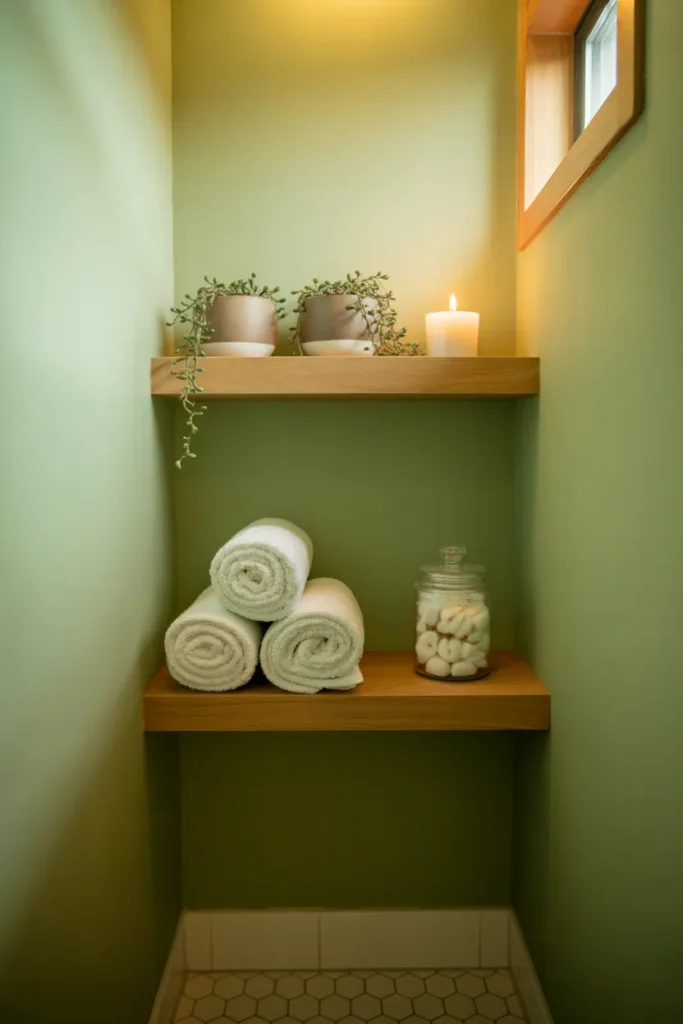
The practical requirement for open shelf storage in a bathroom is organization discipline. Everything on the shelf is visible at all times, so uniformity matters. Use matching containers — glass jars, ceramic dishes, matching baskets — to keep the display looking intentional. If your bathroom items are in their original mixed retail packaging, open shelves will look cluttered within a week.
For a small apartment bathroom decor approach that balances openness with concealment, use one open shelf for displayed items — plants, candles, folded hand towels — and one closed storage option below for items you prefer to hide. This hybrid approach gives you the visual lightness of open storage without complete exposure.
5. Peel-and-Stick Tile or Wallpaper That Transforms Walls Without Lease Violations
Renters in apartment bathrooms face a specific constraint: most leases prohibit permanent changes to walls, floors, and tile. Peel-and-stick tile and removable wallpaper have both advanced significantly in quality and realism, making them a genuinely viable option for small apartment bathroom decor that needs personality without permanence.
Peel-and-stick floor tiles in a stone, cement, or geometric pattern can completely change the visual character of a bathroom floor in an afternoon. In a small bathroom, even a minor floor pattern update draws the eye downward and creates the impression of a designed space rather than a default apartment finish.
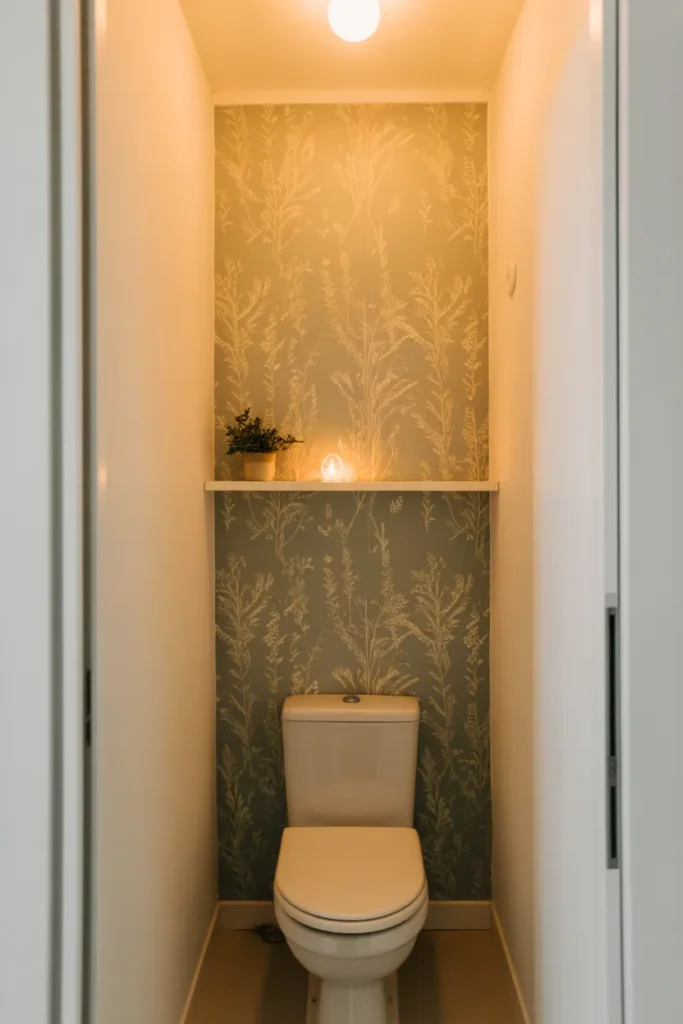
Removable wallpaper applied to a single accent wall — typically the wall behind the toilet or the wall facing the vanity mirror — adds pattern and depth without a painting commitment. In a small bathroom, one wallpapered wall is sufficient and often more effective than papering all four, which can feel overwhelming in an enclosed space.
Before applying either product, clean the surface thoroughly and test a small section first. Peel-and-stick products adhere best to smooth, non-porous surfaces. They perform poorly on textured walls or tile with deep grout lines, and forcing the application in these conditions leads to peeling edges within weeks.
6. A Vessel Sink or Wall-Hung Vanity That Opens Up Counter and Floor Space
Vanity choice is one of the most consequential decisions in a small apartment bathroom, particularly when the bathroom comes with a builder-grade vanity that is disproportionately large for the space. Replacing or working around the existing vanity with a more space-conscious option transforms the bathroom’s functionality and visual openness.
A wall-hung or floating vanity — mounted to the wall with no floor contact — is the most space-efficient vanity format for small bathrooms. The visible floor beneath the vanity makes the room feel wider and easier to clean. Even a shallow-depth floating vanity at 16 to 18 inches provides adequate sink and counter function while taking significantly less visual space than a floor-standing cabinet at 21 inches deep.
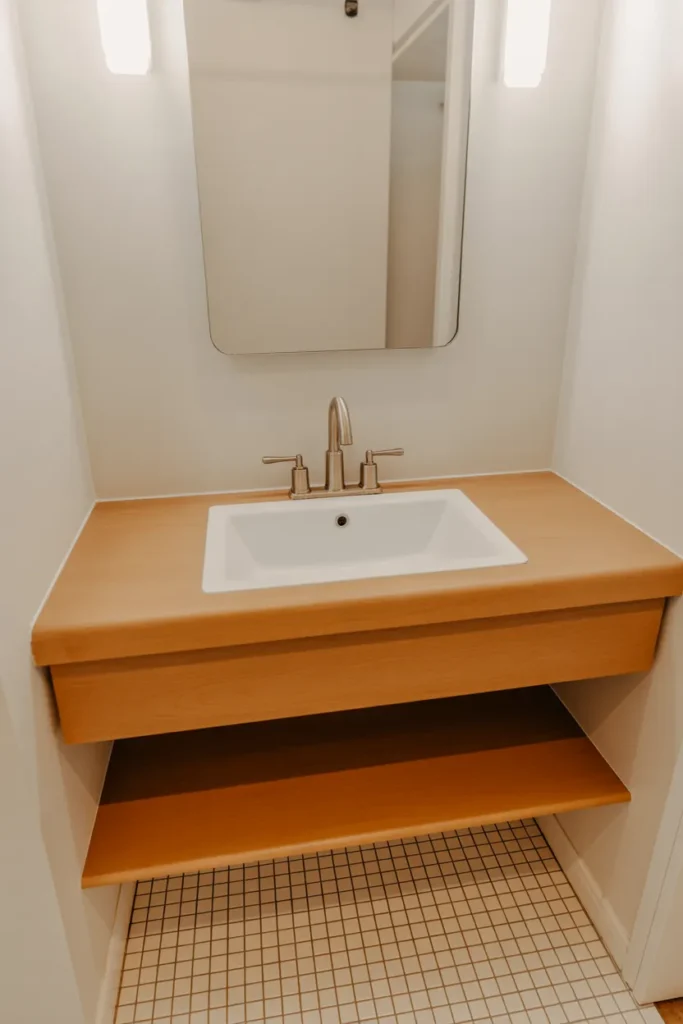
A vessel sink — a sink that sits above the counter surface rather than being inset — works well on a narrow shelf or slim console table in bathrooms where a full vanity is not possible. The vessel format allows use of a much shallower surface, sometimes as narrow as 10 to 12 inches, while still providing a functional sink. This is particularly useful in galley-style apartment bathrooms where door clearance limits vanity depth.
The mistake to avoid with vessel sinks is choosing an oversized bowl on a small surface. A vessel sink that extends close to the edges of the counter leaves no usable counter space beside it and makes the vanity feel cramped and difficult to use daily.
7. Warm Lighting Layers That Fix the Harshness of Standard Apartment Bathroom Fixtures
The single overhead light fixture installed in most apartment bathrooms is one of the least flattering and least functional lighting setups possible. It casts downward shadows on the face, creates a flat, clinical atmosphere, and does nothing to make the bathroom feel welcoming. Replacing or supplementing it is one of the highest-impact upgrades in small apartment bathroom decor.
The simplest improvement is replacing the existing overhead bulb with a warm white LED bulb in the 2700K to 3000K range. Most apartment bathrooms come equipped with cool daylight bulbs (5000K or above) that contribute to the harsh, institutional feel. This is a change that costs almost nothing and is reversible when you move out.
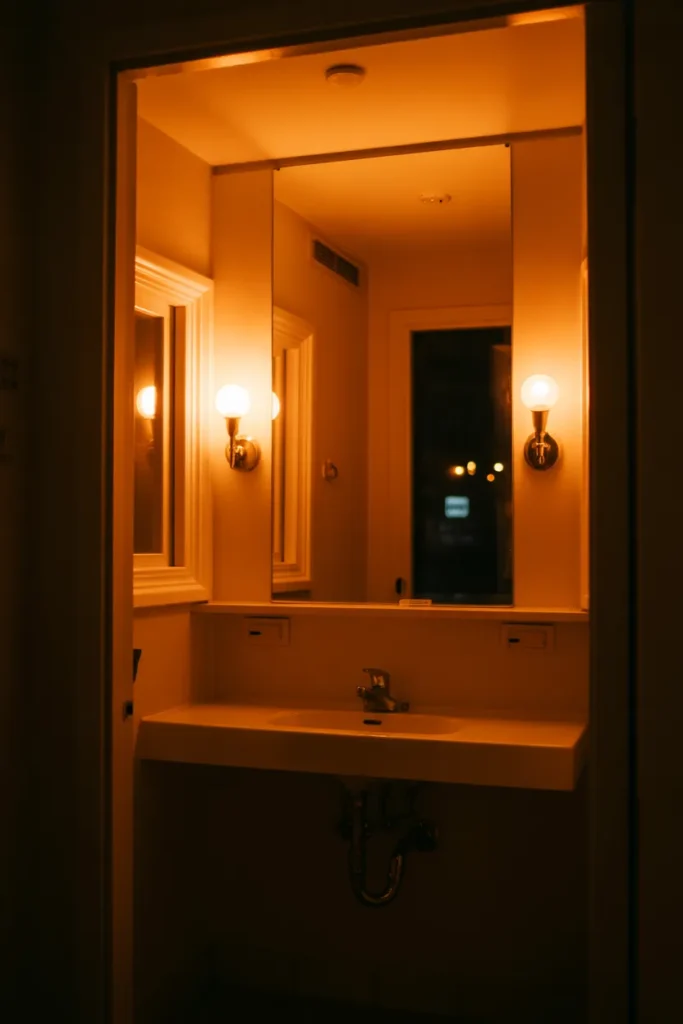
Beyond the bulb swap, adding a secondary light source at mirror level makes a significant difference in both function and atmosphere. Plug-in wall sconces on either side of the mirror are renter-friendly — they require no hardwiring, plug into any outlet, and can move with you. Positioned at face height flanking the mirror, they provide the even, shadow-free illumination that a single overhead source cannot deliver.
Avoid battery-operated puck lights directly on the mirror as a lighting solution. They are rarely bright enough, the color temperature is often inconsistent, and frequent battery changes make them impractical in daily use.
8. Matching Textiles and Towels That Unify a Visually Disjointed Bathroom
One of the fastest and most cost-effective ways to make a small apartment bathroom feel intentionally designed is to unify the textiles. Most bathrooms accumulate towels, bath mats, and shower curtains from different purchases over time, resulting in a mix of colors, patterns, and textures that reads as disordered rather than decorated.
Choosing a single cohesive palette for all bathroom textiles — towels, hand towels, bath mat, and shower curtain — creates an immediate sense of curation that elevates the entire room. This does not require matching everything exactly; a tonal approach works well, such as all-white towels with a warm sand bath mat and a slightly textured ivory shower curtain.
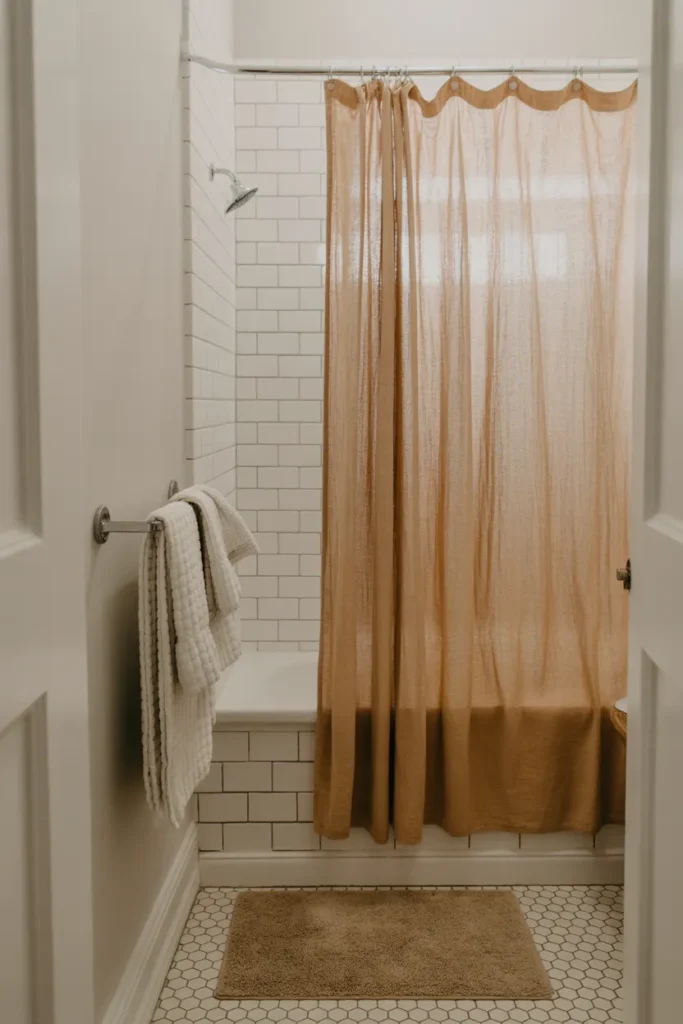
In a small bathroom, the shower curtain is the largest piece of textile in the room and has the most visual impact. A shower curtain that is too short, too narrow, or in a busy pattern can make the bathroom feel smaller and more chaotic. A floor-length curtain in a solid neutral or subtle texture — hung from a rod as close to the ceiling as possible — adds height to the room and creates a clean, unbroken vertical line.
Hanging the shower curtain rod higher than the shower opening — even by 6 to 12 inches — is one of the most consistently effective tricks in small bathroom design. It draws the eye upward and makes the ceiling feel taller without any structural change.
9. Plants and Greenery That Add Life Without Taking Up Counter Space
Live plants in a bathroom serve a practical and aesthetic function simultaneously. They add organic texture and color to a space that is often dominated by hard, reflective surfaces, and many plant varieties genuinely thrive in the humidity generated by daily showers — making the bathroom one of the lower-maintenance plant locations in an apartment.
The most important consideration for bathroom plants is light availability. In a bathroom with a window, pothos, peace lilies, ferns, and spider plants all perform well with indirect natural light and high humidity. In a windowless bathroom, air plants and certain varieties of ZZ plant tolerate artificial light, though they will grow more slowly and require attention to avoid overwatering.
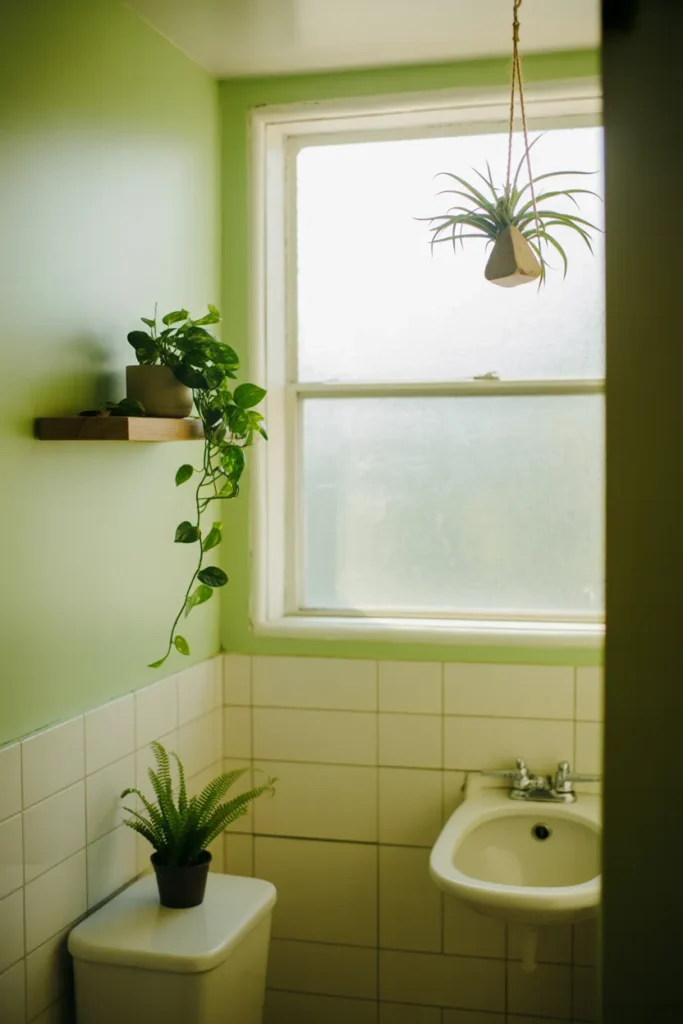
Placement matters as much as plant selection in a small bathroom. Counter space is too valuable to dedicate to a large plant pot. The most effective placements are: on top of the toilet tank, on a dedicated wall-mounted plant shelf, hanging from the ceiling in a small planter, or positioned on an over-the-door hook if the door swings into a usable wall area.
Avoid placing large floor plants in a bathroom under 50 square feet. A fiddle leaf fig or large monstera in a small bathroom occupies significant floor space, creates humidity and soil moisture challenges, and can visually overwhelm the room. One to three small, well-chosen plants deliver more design impact than a single oversized specimen.
10. Strategic Use of Dark Accent Color to Add Depth Without Closing In the Space
The conventional wisdom for small bathrooms is to stick exclusively to light colors. While a light foundation is correct, adding one carefully placed dark accent — in the right format and the right location — can give a small bathroom the visual sophistication and depth that all-light spaces sometimes lack.
The most successful approach is a single dark element used at a scale that adds drama without dominating. A matte black faucet and hardware set against a white vanity and light tile, a narrow strip of dark grout in white tile, or a single floating shelf in a deep smoked oak finish all introduce a dark tone without the room feeling smaller.
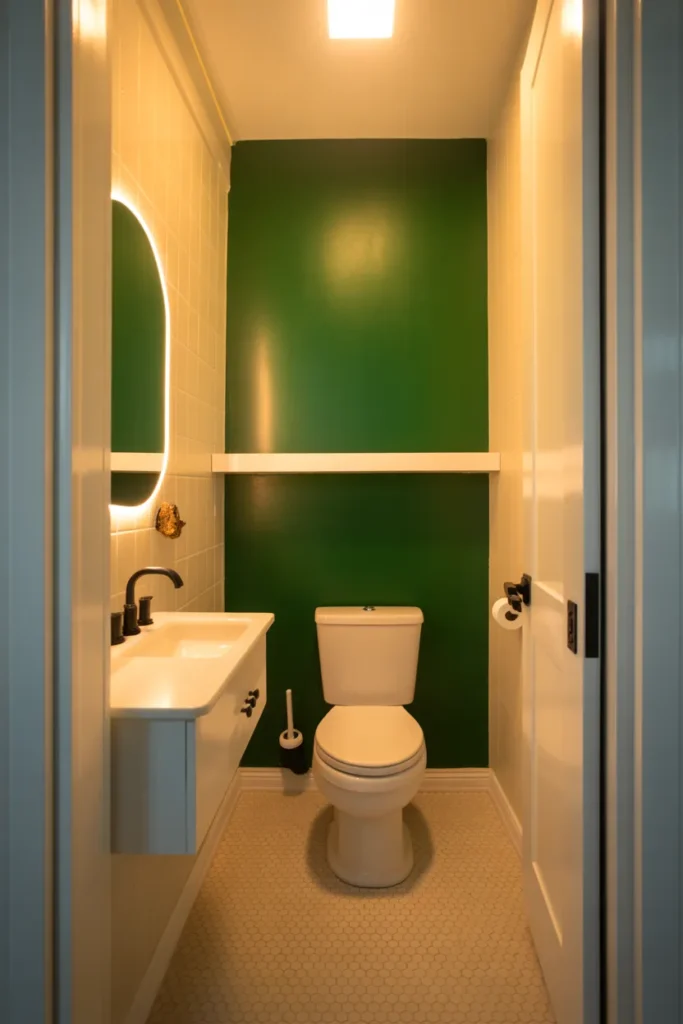
Painting one wall in a deep tone — charcoal, navy, or forest green — can work in a small bathroom when the remaining three walls stay light and the lighting is strong. This is not a safe default choice for every small bathroom, but in rooms with good lighting and at least 5 feet of width, a single dark feature wall reads as a deliberate design decision rather than a mistake.
The format to avoid is dark tile floor combined with dark walls in a bathroom under 45 square feet. Dark on multiple surfaces in a very confined space compresses the room visually in a way that light fixtures and mirrors cannot fully compensate for.
11. A Recessed Medicine Cabinet That Adds Storage Without Projecting Into the Room
Standard surface-mounted medicine cabinets project 3 to 4 inches out from the wall, which in a small bathroom can create a spatial obstruction at head and shoulder level — particularly near the vanity in a narrow room. A recessed medicine cabinet, installed into the wall between studs, sits flush with the wall surface and adds zero projection into the room.
The storage capacity of a recessed medicine cabinet is substantial for its footprint. A standard 16 to 20-inch wide recessed cabinet holds a full bathroom’s worth of daily-use products behind a mirrored door that also functions as the vanity mirror. Two functions — storage and reflection — in one zero-footprint installation.
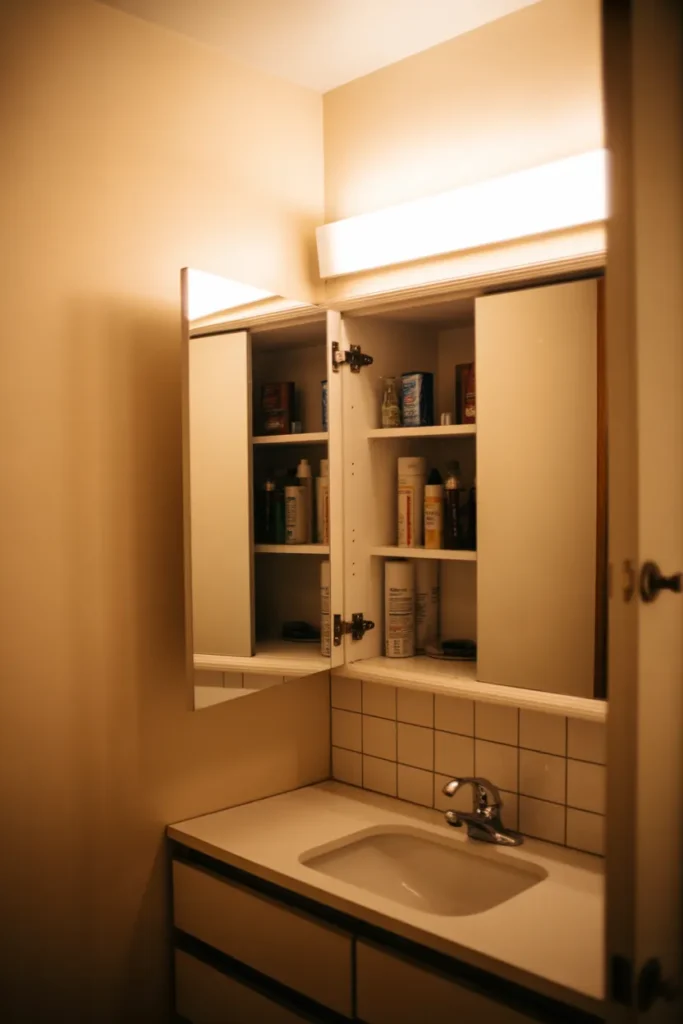
For renters, recessed cabinet installation requires wall modification that most leases do not permit without landlord approval. In owned apartments or condos, it is one of the highest-value bathroom upgrades available at modest cost. Always verify whether the target wall is an exterior wall or contains plumbing or electrical runs before cutting, or hire a professional to assess first.
In bathrooms where recessed installation is not possible, a slim surface-mount cabinet with mirrored doors in a shallow 3-inch depth is the next best alternative — it minimizes projection while still providing the combined mirror-and-storage function.
12. A Cohesive Hardware Finish That Ties the Entire Bathroom Together
Fixture and hardware finish is one of the most overlooked elements in small apartment bathroom decor, yet it is one of the strongest signals of whether a bathroom feels designed or assembled. In a small room where every surface is close together and constantly visible, mismatched metal finishes create visual noise that makes the space feel unresolved.
The most common hardware inconsistency in apartment bathrooms is the combination of chrome faucets, brushed nickel towel bars, and brass or gold toilet hardware — all from different purchases at different times. None of these finishes is wrong individually, but together they fragment the room’s visual coherence.
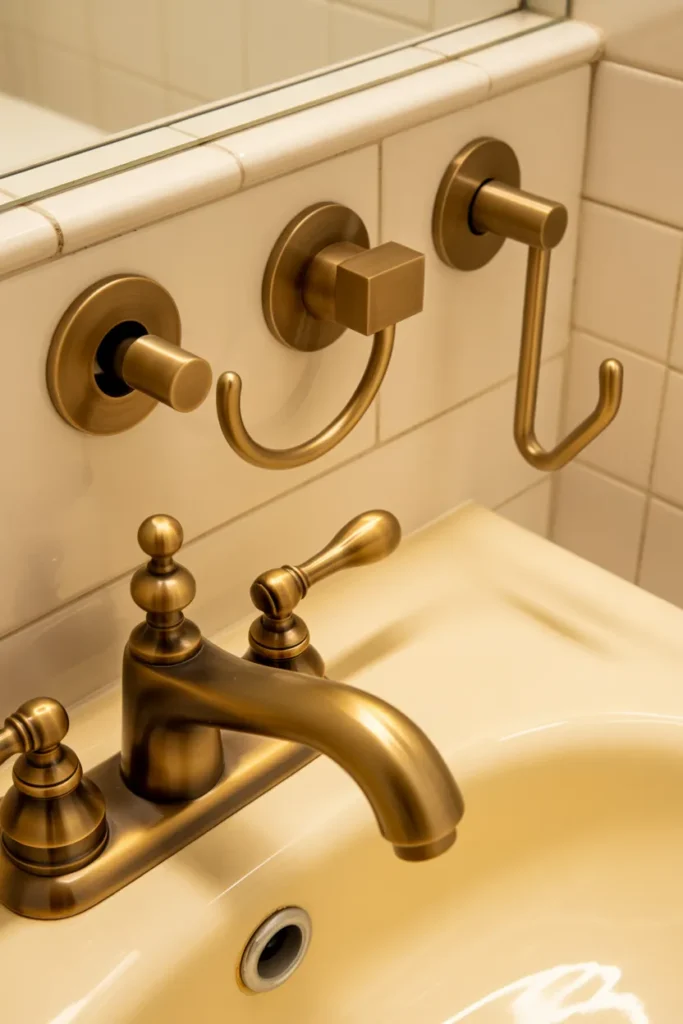
Choosing one metal finish and applying it consistently across faucet, towel bar, toilet paper holder, robe hook, and drain cover creates a unified thread that makes the bathroom feel intentionally designed even when no other changes are made. Brushed nickel remains the most versatile and forgiving choice for small apartment bathrooms because it complements both warm and cool color palettes and shows water spots less readily than polished chrome.
Matte black hardware has become a strong design choice in small bathrooms because it creates clean contrast against white and light-colored surfaces and reads as intentionally modern. The one practical consideration: matte black finishes can show toothpaste and soap residue more visibly than brushed finishes, which matters in a bathroom that is not wiped down daily.
13. A Shower Niche or Corner Caddy That Eliminates Clutter Inside the Shower
Product clutter inside a small shower enclosure makes the entire bathroom feel less organized, even when the rest of the space is tidy. Bottles lined up on the edge of a tub, hanging caddies that rust and swing, and soap bars sitting in pooled water are all functional problems that also have a direct negative effect on how clean and spacious the bathroom looks.
A built-in shower niche — a recessed shelf cut into the shower wall — is the cleanest solution. It holds shampoo, conditioner, and body wash at eye level with no hanging hardware and no surface clutter. In tiled showers, a niche can often be added during a retile or, in some cases, as a standalone installation if the wall thickness permits.
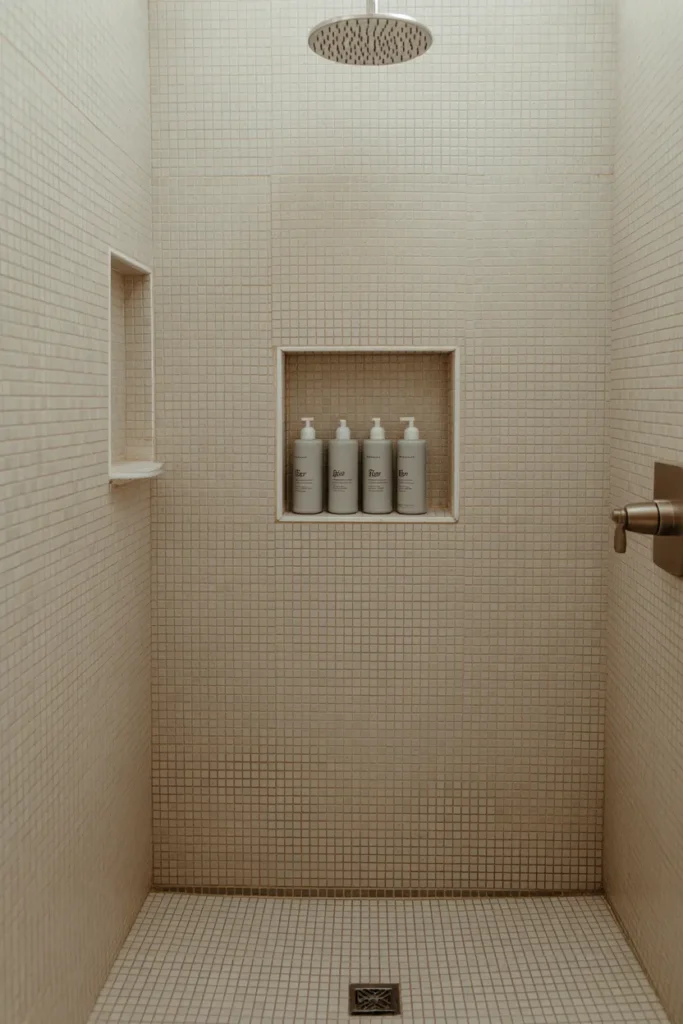
For renters or bathrooms where a niche is not possible, a corner tension caddy that locks between floor and ceiling without suction cups or drilling is the most stable and practical removable option. Tension caddies that use suction cups eventually fail, particularly in steam environments, and falling hardware in a wet shower is both a safety and damage concern.
Reducing the number of products stored in the shower itself is the simplest version of this solution. Keeping only what is used daily in the shower — and storing extras under the sink — eliminates visual clutter without any installation requirement. Three to four products in a small recessed niche reads as organized; the same niche overloaded with eight bottles reads as chaotic regardless of how the rest of the bathroom is styled.
14 . Thoughtful Decor Accents That Add Personality Without Adding Visual Weight
The final layer in small apartment bathroom decor is the accounted addition of personality — objects, art, and accents that make the room feel inhabited and considered without adding clutter or visual heaviness. This is the layer most people either skip entirely or over-apply, and getting it right is what separates a bathroom that feels styled from one that feels staged.
The correct scale for bathroom decor accents in a small space is deliberately small. One piece of framed art — a simple botanical print, an abstract in a thin frame, or a photograph — hung on the wall above the toilet or beside the mirror adds personality without taking any surface space. A single scented candle on the vanity, a small ceramic object beside the sink, or a wooden bath tray across the tub each contribute to the room’s character with minimal footprint.
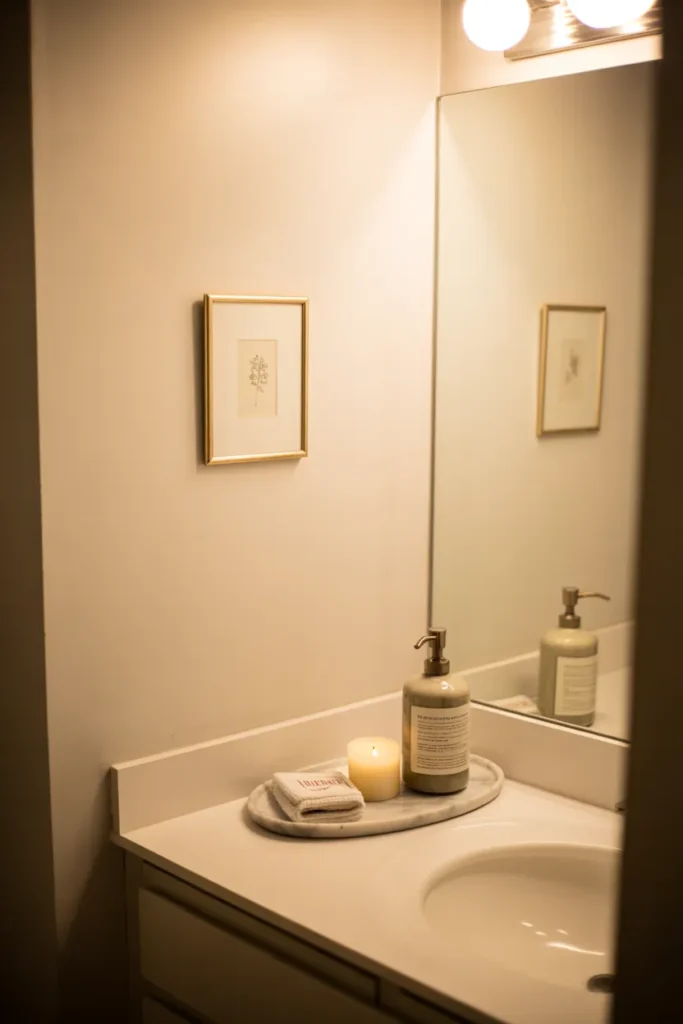
Trays are one of the most practical and aesthetically effective tools in a small bathroom. A small marble, wood, or ceramic tray on the vanity corrals loose items — soap dispenser, hand lotion, a small candle — into a defined zone that looks organized even when fully loaded. The tray creates a visual boundary that makes a grouping of objects look intentional rather than scattered.
The decision to make is restraint. Every object in a small bathroom should be there because it contributes something — functional, aesthetic, or both. Objects added because they seemed nice in a shop but serve no clear role in the bathroom accumulate into the low-level clutter that undermines every other design decision you have made in the space.
Final Thoughts
Small apartment bathroom decor does not require demolition, a large budget, or landlord permission for most of these ideas. The changes that deliver the most immediate impact — color, lighting, mirrors, and unified textiles — are available to virtually every renter and homeowner regardless of how much the bathroom can be structurally altered.
Save this post so you can return to it section by section as you work through your bathroom. Each idea here is designed to be implemented independently, so you can start with one change and build from there. If this guide was useful, explore more small space decor and apartment design content for the same level of practical, room-by-room guidance.